Sunday, 18 March 2018

LDC to UDC Upgradation - Railway Board Report


LDC to UDC Upgradation - Railway Board Report

ABOLISH AND UPGRADE ALL POSTS OF LOWER DIVISION CLERKS (LDCs) TO UPPER DIVISION CLERKS (UDCs) - MINISTRY OF RAILWAYS IS NOT IN FAVOUR OF THE STAFF SIDE DEMAND
Action taken report on the minutes of the standing Committee National Council JCM held on 03.05.2017

Minutes - Reacting to the comment made by the official side, the staff side pointed out that prima-facie, on introduction of computerized functioning in almost all departments, the functions assigned to LDCs have become redundant.

Decision - What is required is to get the report from each department and take a conscious decision, as LDC is a common category.

Report of the Ministry of Railways (OM dated 01.12.2017)

In view of functional requirement of Ministry of Railways (Railway Board) and promotional aspects of MTS, proposal to abolish and upgrade all posts of LDCs (LDC now as Junior Secretariat Assistant) to UDCs (now called as Senior Secretariat Assistant) may not be recommended and besides this, RBSCS is patterned on the lines of the CSCS and the existing system is working well, unless there is any change in CSCS, no change is desirable in RBSCS. 7th CPC has also not provided upgradation of to LDCs; therefore to abolish and upgrade all posts of LDCs to UDCs is considered not feasible.

Source: Confederation

Pasting of Reservation Charts on Train Coaches Discontinued?


Pasting of Reservation Charts on Train Coaches Discontinued?

Discontinuing Reservation Chart Preparation

Based on a similar successful experiment conducted by South Western Railway, the practice of pasting of reservation charts on train coaches was discontinued at New Delhi, Hazrat Nizamuddin, Bombay Central, Chennai Central, Howrah and Sealdah stations of Indian Railways on experimental basis for a period of three months. Keeping in view the positive feedback received from Zonal Railways, it has been decided to discontinue pasting of reservation charts on reserved coaches of trains at all erstwhile A1, A & B category of stations as a pilot project for six months starting from 01.03.2018.

The logic behind doing away with the practice of pasting of reservation charts on reserved coaches is as under:-

(i) Passengers holding confirmed ticket are aware of their coach/berth number as the same is indicated on the tickets at the time of booking itself, except in case of First Class air-conditioned class.
(ii) At present around 65% of the reserved tickets are being issued through internet for which, mobile number is invariably captured on which an SMS is sent at the time of booking.
(iii) Waitlisted and Reservation Against Cancellation (RAC) passengers get their status update on their registered mobile number through SMS at the time of preparation of first reservation chart which is at least four hours before the scheduled departure of the train.
(iv) Digital charting system has been installed at major stations and at other stations manual boards are installed for displaying the status of the waitlisted tickets to guide the passengers.
(v) Apart from the above, Interactive Voice Response System (IVRS) service through 139, online booking website is available for passengers for checking the status of the tickets on real time basis.
(vi) It will save the cost of stationery as well as savings on account of manpower involved in pasting of reservation charts.

In view of the reasons mentioned above, now there is no need for the passengers to check their reservation status through the reservation charts displayed on the coaches. Moreover, reservation charts continue to be displayed on the station platforms for passengers including senior citizens who would like to view it on charts/ digital charts in all stations including A-1, A & B category stations.

This information was given by the Minister of State for Railways and Coal Shri Rajen Gohain in a written reply to a question in Rajya Sabha on 14.3.2018.

7th CPC Minimum Pay and Fitment Factor: Confederation writes to NJCA


7th CPC Minimum Pay and Fitment Factor: Confederation writes to NJCA

NJCA 
 
CONFEDERATION WRITES TO NJCA LEADERS

Ref: Confdn/Genl/2016-19
Dated: 14.03.2018
To
1. Shri M. Raghavaiyya
Chairman,
National Joint Council of Action of JCM (NC) Staff Side organisations (NJCA) & General Secretary

National Federation of Indian Railwaymen
Leader Staff side NC (JCM)
3, Chelmsford Road, New Delhi - 110055
2. Shri Shiv Gopal Misra
Convenor, NJCA & General Secretary
All India Railwaymen’s Federation (AIRF) & Secretary, Staff side,
National Council (Staff Side) JCM
13- C, Ferozeshah Road, New Delhi - 110001

Dear Comrade,
As you may be aware the Govt. of India, Ministry of Finance, has given the following written reply in Parliament for a question asked to Minister of Finance, regarding our demand - "Increase in Minimum Pay and Fitment Formula".

Reply given by Minister of state for Finance:
"The minimum pay of Rs.18000/- p.m. and fitment factor of 2.57 are based on the specific recommendations of the 7th Central Pay Commission in the light of the relevant factors taken into account by it. Therefore, no change therein is at present under consideration".
From the above it is crystal clear that Govt. has gone back from the assurance given on 30.06.2016 by Group of Ministers including Sri Rajnath Singh, Home Minister, Shri Arun Jaitley, Finance Minister and Shri Suresh Prabhan, then Railway Minister, that Minimum Pay and Fitment formula will be increased and for that purpose a High Level Committee will be appointed to submit report within four months.

Now that Govt. has gone back from its assurance, I on behalf of Confederation of Central Govt. Employees & Workers, which is a constituent organisation of NJCA, request you revive our deferred agitational programmes immediately and for that purpose, if necessary, an urgent meeting of the NJCA may be convened.

Awaiting response,
Yours fraternally,
(M. Krishnan)
Secretary General
Mob: 0944768125
Email: mkrishnan6854@gmail.com
Source: Confederation

Grant of Tough Location Allowance to Central Govt. Employees of Darjeeling


Grant of Tough Location Allowance to Central Govt. Employees of Darjeeling
"Consider grant of any kind of Special Duty Allowance/Tough Location Allowance/High Altitude Allowance as a special case"
Ref: Confdn/Genl/2016-19
Dated : 14.03.2018
To
The Secretary
Ministry of Finance
Department of Expenditure
North Block, New Delhi - 110001

Sir,
Sub:  Grant of Tough Location Allowance to Central Govt. Employees of Darjeeling.

This is to bring to your kind notice that Hill Compensatory Allowance (HCA) was being paid till June 2017 to the employees of Darjeeling. Unfortunately HCA has been withdrawan from the month of July 2017 onwards after implementation of 7th CPC Allowance Committee report. However, the neighbouring state, Sikkim is still getting the Special Compensatory Allowance (SCA). It is worth mentioning that Darjeeling and Sikkim share same type of terrain, alongwith climatic conditions. It is further to mention here that the employees of some hill areas viz; Shimla in Himachal Pradesh, comparatively similar to Darjeeling Hills, are enjoying Tough Location Allowance (TLA). But the employees of Darjeeling are deprived of both the Tough Location Allowance (TLA) and Special Compensatory Allowance (SCA).

Darjeeling being the world famous tourist spot and the "Queen of Hills" is one of the expensive place to live in as all the basic commodities are to come from Siliguri, which is a 'Y' category city with 16% HRA. This has led the employees of Darjeeling being economically handicapped with the removal of Hill Compensatory Allowance.

In view of the above, I request you to review the orders withdrawing the Allowance already enjoyed by the employees of Darjeeling, and Consider grant of any kind of Special Duty Allowance/Tough Location Allowance/High Altitude Allowance as a special case, considering the geographical, climatical and economical hardship faced by the employees.

Awaiting response,
Yours faithfully,
(M. Krishnan)
Secretary General
& Member, Standing Committee
National Council (JCM)
Mob: 09447168125

Email: mkrishnan6854@gmail.com
Source: Confederation

Option for Pay Fixation in Revised Pay Scale: Confederation


Option for Pay Fixation in Revised Pay Scale: Confederation

PERMISSION TO OPT FOR PAY FIXATION IN THE REVISED PAY STRUCTURE ON A DATE AFTER THE DATE OF ISSUE OF CCS (REVISED PAY) RULES 2016 NOTIFICATION DATED 25.07.2016 DEMAND OF THE JCM NATIONAL COUNCIL STAFF SIDE REJECTED BY GOVERNMENT.

JCM national council, Staff Side, has demanded that under the existing orders the option to come over to revised pay structure from the date of promotion is available only for those employees who are promoted before 25.07.2016. The staff side has demanded that such an option of fixation of pay for coming over to revised pay scale may be given to employees promoted after 25.07.2016 also. The staff side has contended that not giving such an option to an employee who was due for promotion on a date after 25.07.2016 (say on 26.07.2016) will be discriminatory. Government has considered the demand and rejected. The following is the reply of the Finance Ministry, Department of Expenditure.

(M. Krishnan)
Secretary General
Confederation
Mob: 09447068125
Email: mkrishnan6854@gmail.com

DEPARTMENT OF EXPENDITURE VIDE OM DATED 30.08.2017

The position on action taken in respect of item regarding permission to opt for pay fixation in the revised pay structure on a date after the issue of CCS (RP) Rules 2016 (notification on 25.07.2016) in the case of employees whose promotion becomes due after 25.07.2016 is given below:
In the said item the staff side has demanded that under the existing orders the option to come over to revised pay scale from the date of promotion is available only for those employees who are promoted before 25.07.2016, the date of notification of CCS (RP) Rules 2016. The staff side has demanded that such an option of fixation of pay for coming over to revised pay scale may be given to employees promoted after 25.07.2016 also. The staff side has contended that not giving such an option to an employee who was due for promotion on 26.07.2016 (one day after the date of notification) and afterwards will be discriminatory.

The revised Pay rules contained in CCS (RP) Rules 2016 are effective from 01.01.2016. A person holding a particular post as on 01.01.2016 has an option to come over to revised pay scale applicable to that post either straight away on 01.01.2016 or from a date later than that such an option is clearly mentioned in provisio 1 and provisio 2 of Rule 5. A combined reading of provisio 1 and provisio 2 to Rule 5 provided that a Government Servant may elect to continue to draw pay in the existing pay structure until the date on which he earns his next or any subsequent increment in the existing pay structure or until he vacates his post or ceases to draw pay in the existing pay structure.

But, in cases where a Government servant has been placed in a higher grade pay or scale between 01.01.2016 and the date of notification of CCS (RP) Rules 2016 on account of promotion or upgradation, the Government servant may elect to switch over to the revised pay structure from the date of such promotion or upgradation.

Therefore the rules provide while in respect of post held by a Government Servant as on 01.01.2016, the concerned Government Servant may elect to come over to revised pay scale applicable to that post either from 01.01.2016 or from a date later than 01.01.2016, in case he is promoted to a post not held by him on 01.01.2016 on a date later than that, then he can opt to come over to revised pay scale from the date of promotion provided such promotion takes place between 01.01.2016 and the date of notification. Thus the date of notification of the Rules on 25.07.2016 which are effective from 01.01.2016 is the outer limit for option in cases the option is from date of promotion. The similar was the provisions in the Rules pertaining to the 6th CPC in terms of CCs (RP) Rules 2008. This is the fair and time tested rule, as it seeks to allow option in case of promotion during the retrospective effect of the Rules. There has to be outer date and that date is the date of notification of CCS (RP) Rules 2016, which is objective and of fair application. No such objective date beyond 25.07.2016 could be of fair application.

Accordingly it is not possible to agree to the demand of the staff-side.

Source: Confederation

Saturday, 17 March 2018

Grant of Deputation (Duty) Allowance - Recommendations of the 7th CPC

Grant of Deputation (Duty) Allowance - Recommendations of the 7th CPC


F No.6-23(01)/2018-PAT
Government of India
Ministry of Communications & IT
Department of Telecommunications
Sanchar Bhawan, 20, Ashoka Road,

New Delhi - 110001
Datcd: 09/03/2018
CIRCULAR No. 74

Subject : Grant of Deputation (Duty) Allowance - Recommendations of the 7th CPC -reg

The undersigned is directed to forward herewith a copy of Ministry of Personnel, PG & Pensions. Department of Personnel & Training OM No.21/11/2017-Estt. (Pay-II) dated 24th November, 2017 on the subject cited above for information / necessary action.
Encl: As above.

(R.Thamby Jeya Raj)
Section Officer (PAT)
No.2/11/2017-Estt.(Pay-II)
Government of India
Ministry of Personnel, Public Grievances & Pensions
Department of Personnel & Training
North Block, New Delhi
Dated the 24th November, 2017
OFFICE MEMORANDUM

Subject: Grant of Deputation (Duty) Allowance - Recommendations of the Seventh Central Pay Commission - Regarding

This Department's OM No. 6/8/2009-Estt.(Pay-II) dated 17.6.2010 inter-alia provides for rates of Deputation (Duty) Allowance admissible to Central Government employees.

2. As provided in para 7 of Ministry of Finance, Department of Expenditure's Resolution No.1- 2/2016-IC dated 25th July, 2016, the matter regarding allowances (except Dearness Allowance) based on the recommendations of the 7th Central Pay Commission (CPC) was referred to a Committee under the Chairmanship of Finance Secretary and until a final decision thereon, all Allowances have been paid at the existing rates in the existing pay structure.

3. The decision of the Government on various allowances based on the recommendations of the 7th CPC and in the light of the recommendations of the Committee under the Chairmanship of the Finance Secretary has since been issued as per the Resolution No.11-1/2016-IC dated 6th July 2017 of Department of Expenditure.

4. As mentioned at Sl.No.46 of the Appendix-II of the said Resolution dated 6th July 2017, the recommendation of the 7th CPC for enhancement of ceiling of Deputation (Duty) Allowance for civilians by 2.25 times has been accepted and this decision is effective from 15t July, 2017. Accordingly, the President is pleased to decide that the rates of Deputation (Duty) Allowance and certain other conditions relating to grant 'of Deputation (Duty) Allowance shall be as under:-
The Deputation (Duty) Aliowance admissibl,e shall be at the following rates:
(a) In case of deputation within the same station the Deputation (Duty) Allowance will be payable at the rate of 5% of basic pay subject to a maximum of Rs.4500 p.m.

(b) In case of deputation involving change of station, the Deputation (Duty) Allowance will be payable at the rate of 10% of the basic pay subject to a maximum of Rs.9000 p.m.

(c) The ceilings will further rise by 25 percent each time Dearness Allowance increases by 50 percent.

(d) Basic Pay, from time to time, plus Deputation (Duty) Allowance shall not exceed the basic pay in the apex level i.e. Rs. 2,25,000/- .In the case of Government servants receiving Non Practising Allowance, their basic pay plus Non-Practising Allowance plus Deputation (Duty) Allowance shall not exceed the average of basic pay of the revised scale applicable to the Apex Level and the Level of the Cabinet Secretary i.e. Rs.2,37,500/-.
Note: 1 'Basic pay' in the revised pay structure (the pay structure based on 7th Central Pay Commission recommendations) means the pay drawn by the deputationist, from time to time, in the prescribed Level, in Pay Matrix, of the post held by him substantively in the parent cadre, but does not include any other type f pay like personal pay, etc.

Note: 2 In cases where the basic pay in parent cadre has been upgraded on account f non-functional upgradation (NFU), Modified Assured Career Progression Scheme (MACP), Non Functional Selection Grade (NFSG), etc., the upgraded basic pay under such upgradations shall not be taken into account for the purposed of Deputation (Duty) Allowance.

Note: 3 In the case of a Proforma Promotion under Next Below Rule (NBR) : If such a Profoqna Promotion is in a Level of the Pay Matrix which is higher than that of the ex-cadre post, the basic pay under such Proforma Promotion shall not be taken into account for the purpose of Deputation (Duty) Allowance. However, if such a Proforma Promotion under NBR is in a Level of the pay matrix which is equal to or below that of the ex-cadre post, Deputation (Duty) Allowance shall be admissible on the basic pay of the parent cadre post allowed under the proforma promotion, if opted by the deputationist.

Note: 4 In case of Reverse Foreign Service, if the appointment is made to post whose pay structure and or Dearness Allowance (DA) pattern is dissimilar to that in the parent organisation, the option for electing to draw the basic pay in the parent cadre [alongwith the Deputation (Duty) Allowance thereon and the personal pay, if any] will not be available to such employee.

Note: 5 The term 'same station' for the purpose will be determined with reference to the station where the person was on duty before proceeding on deputation.

Note: 6 Where there is no change in the headquarters with reference to the last post held, the transfer should be treated as within the same station and when there is change in headquarters it would be treated as not in the same station. So far as places falling within the same urban agglomeration of the old headquarters are concerned, they would be treated as transfer within the same station.

5. Para 6.1 of this Department's OM No.6/8/2009-Estt (Pay-II) dated 17.6.2010 stands amended to the above effect.

6. In so far as persons serving in the Indian Audit & Accounts Department are concerned, these orders issue after consultation with the Comptroller & Auditor General of India.

7. These orders shall take effect from 1st July, 2017.

(Rajeev Bahree)
Under Secretary to the Government of India
Source: http://www.dot.gov.in

7th CPC Risk and Hardship Allowance


7th CPC Risk and Hardship Allowance

"Recommendation of 7th CPC- decision relating to grant of Risk and Hardship Allowance for Track Maintainer of Indian Railways"

GOVERNMENT OF INDIA (BHARAT SARKAR)
Ministry of Railways (Rail Mantralaya)
(Railway Board)
File No.PC-VII/2017/I/7/5/4

New Delhi, Dated: 13.03.2018
The General Manager,
East Central Railway,
Hajipur, Dist. Vaishali, Bihar- 844101

Sub: Recommendation of 7th CPC- decision relating to grant of Risk and Hardship Allowance for Track Maintainer of Indian Railways.

Ref: Your No. dated 19.02.2018 (copy encl)


Vide letter under reference, clarification has been sought by the Railway as to whether the categories of employees placed above Level-5 in the pay Matrix are eligible for grant of Risk and Hardship Allowance payable to Track Maintainers in terms of RBE No.87/2017.

2. In this context, it is pointed out that the amount payable as Risk and Hardship Allowance as per the R3H2 matrix per accepted recommendation of the 7th CPC is 2700/- for Level-8 and below and 3400/- for Level-9 and above. However, it is only the category of "Track Maintainers" (that Consists of Track Maintainers- I, II, III and IV) who are eligible for payment of Risk and Hardship Allowance, in terms of RBE No.87/2017. As per their extant pay level, this allowance payable is therefore 2700/- p.m. Apart from Track Maintainers, no other category of Railway Employees has been included for payment of the aforesaid Risk and Hardship Allowance as per the accepted recommendations of the 7th CPC.

sd/-
(Jaya Kumar G)
Deputy Director(Pay Commission)-VII
Railway Board
Source: http://www.indianrailways.gov.in/

Military Service Mandatory for State Government, Central Government Jobs?


Military Service Mandatory for State Government, Central Government Jobs?

5years-Military-Training


Compulsory Military Training

Aspirants for the state and central government jobs should henceforth serve five years in the military. A proposal to this effect was made by the Parliamentary Standing Committee.

More than 20 countries around the world, including North Korea and Russia, have compulsory military service for all its citizens. Some of these countries have compulsory military service for women too. They insist on this training because they believe that, in addition to instilling a sense of patriotism in its citizens, military training also teaches them discipline and good values.

The Parliamentary Standing Committee has pointed out that there is a shortage of about 7,000 officers and about 20,000 soldiers in the Indian Army. The Indian Air Force is short of 150 officers and 15,000 soldiers; and the Navy is running short of 150 officers and 15,000 lower ranked personnel. The Parliamentary Standing Committee has suggested ways to reduce this growing shortage.

The Parliamentary Standing Committee, under the leadership of Retired Army Major General KC Khanduri, submitted its report on defence. The committee has recommended that a five-year military service be made mandatory for those who are seeking government jobs. The committee believes that the measure would reduce the shortage of human resource in armed forces.

The central institutes that design and implement the various training programmes for government employees could look into it, the committee said. According to statistics, more than 30 lakh people are employed in various central government offices, and more than 2 crore people are employed in the various state government agencies throughout the country.

Central Minister Arun Jaitley had, in July 2014, clarified that the government was not supporting the implementation of compulsory military service in India. But, he also informed that the number of recruits in the National Cadet Crop is increasing.

TRANSFER AND POSTING OF WOMEN EMPLOYEES


TRANSFER AND POSTING OF WOMEN EMPLOYEES

Women-Employees-Central-Government-Services


GOVERNMENT OF INDIA
MINISTRY OF PERSONNEL, PUBLIC GRIEVANCES AND PENSIONS
(DEPARTMENT OF PERSONNEL & TRAINING)
LOK SABHA
UNSTARRED QUESTION NO. 2592
(TO BE ANSWERED ON 03.01.2018)

TRANSFER AND POSTING OF WOMEN EMPLOYEES

2592. SHRI C.S. PUTTA RAJU:
Will the PRIME MINISTER be pleased to state:
(a) whether women appointed in Government Service have been deputed in areas far away from their families;
(b) if so, the details thereof;
(c) whether the Government proposes to formulate rules for appointment and transfer of single women working in the Ministries; and
(d) if so, the details thereof?
ANSWER
MINISTER OF STATE IN THE MINISTRY OF PERSONNEL, PUBLIC GRIEVANCES AND PENSIONS AND MINISTER OF STATE IN THE PRIME MINISTER’S OFFICE (DR. JITENDRA SINGH)
(a)&(b): Respective Ministries / Departments have their own guidelines / policy for transfer and posting of their employees depending upon the specific requirements of that Ministry / Department.
(c) & (d): There is no such proposal under consideration for appointment and transfer of single women working in all Ministries.
Source: http://loksabha.nic.in/

Enhancement of Reservation for SCs & STs - Rajya Sabha Q&A


Enhancement of Reservation for SCs & STs - Rajya Sabha Q&A

No proposal for enhancement of reservation for Scheduled Castes in proportion to their population has been received in this Ministry. The Ministry of Tribal Affairs has informed that they received The Telangana Backward Classes, Scheduled Castes and Scheduled Tribes (Reservation of seats in Educational Institutions and of appointments or posts in the services under the State) Bill, 2017 through Ministry of Home Affairs for enhancement of reservations for Scheduled Tribes from existing 4% to 10% in the State for comments/views. The Ministry of Tribal Affairs has supported the proposal contained in the Bill.

As per the 9 judge Constitutional Bench judgement of Hon'ble Supreme Court in India Sawhney case, total reservation cannot exceed the limit of 50% . Clause (4) of Article 16 of the Constitution of India, which empowers the State to provide reservation for Scheduled Castes, Scheduled Tribes & Other Backward Classes speaks of adequate representation and not proportionate representation.
This information was given by the Minister of State for Social Justice and Empowerment Shri Vijay Sampla in a written reply to a question in Rajya Sabha on 15.3.2018.

Flash News

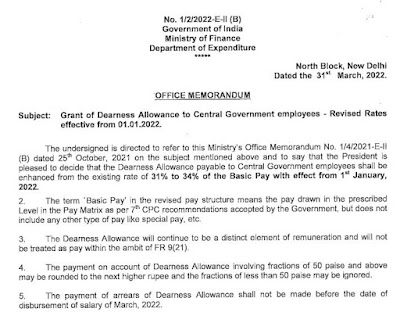
DA Jan 2022 - Grant of Dearness Allowance to Central Government employees - Revised Rates effective from 01.01.2022

 3% DA Hike - Revised Rates effective from 01.01.2022: DoE OM dated 31.03.2022 No. 1/2/2022-E-II (B) Government of India Ministry of Finance...