Monday, 12 February 2018

Grant of leave to officers belonging to All India Services on completion of their tenures of Inter-cadre deputation


Grant of leave to officers belonging to All India Services on completion of their tenures of Inter-cadre deputation

F.No. 14017/06/2017-AIS-II
Government of India
Ministry of Personnel, Public Grievance and Pensions
Department of Personnel & Training
North Block, New Delhi
dated 9th February, 2018
To
The Chief Secretaries of all the
State Governments / UTs

Subject: Grant of leave to officers belonging to All India Services on completion of their tenures of Inter-cadre deputation - reg.

Sir,

This Department has issued Consolidated Deputation Guidelines for All India Services w.r.t. Rule 6 of the IAS (Cadre) Rules, 1954 and analogous provisions in the IPS (Cadre) Rules and IFoS (Cadre) Rules, vide letter No. 14017/33/2005-AIS(II)(Pt.) dated 28th  November 2007.

2. Clause 1.3 under para 3.2 of the said instructions issued vide letter dated 28th November 2007 provides for inter-cadre deputation to another State Government, under Rule 6(2)(ii) of the IAS (Cadre) Rules, 1954 and analogous provisions in the IPS (Cadre) Rules and 1FoS (Cadre) Rules. Maximum tenure of 5 years has been provided for this category, provided that the officer has Completed 9 years in his own cadre and has not reached the Super-time scale.

3. In so far as Central Deputation as per clause 1.1 under Rule 6(1) is concerned, instructions issued vide this Department's OM No. 27(38)-EO (87 (SM) dated 20th  May 1987 (copy enclosed) provide that on reversion from Central deputation, the officers concerned might be allowed leave not exceeding two months by the concerned Ministry Department, and that the officer concerned should apply for further leave to the State Government / Cadre Authority. It is also to be stated that such leave is debitable from the leave account of the Officer.

4. The matter regarding extending these instructions to cases of inter-cadre deputation has been considered and it has now been decided with the approval of the Competent Authority that the said instructions dated 20th  May 1987 as amended from time-to-time are also applicable to cases of inter-cadre deputations mentioned above.
(Jyotnsa Gupta)
Under Secretary to the Govt. of India
Source: DoPT

Filling up the post of Chief Accounts Officer(CAO) in Delhi Development Authority (DDA), New Delhi under the M/o Housing and Urban Affairs

Filling up the post of Chief Accounts Officer(CAO) in Delhi Development Authority (DDA), New Delhi under the M/o Housing and Urban Affairs

F.No. 26/1/2018 EO(MM-II)
Government of India
Ministry of Personnel, P.G and Pensions
Department of Personnel & Training
(Office of the Establishment Officer)
North Block, New Delhi
Dated 9th February, 2018
To,
1. The Chief Secretaries,
All State Governments,
2. All Secretaries,
Ministries/Departments of Government of India

Subject: Filling up the post of Chief Accounts Officer(CAO) in Delhi Development Authority (DDA), New Delhi under the M/o Housing and Urban Affairs.

Sir/Madam,
It is proposed to fill up the post of Chief Accounts Officer in Delhi Development Authority(DDA) under the Ministry of Housing & Urban Affairs on deputation basis.
2. The officers of the rank of Deputy Secretary/Director of the Government of India or equivalent level, eligible for appointment under the Central Staffing Scheme are eligible for the post The period of deputation is 4/5 years for Deputy Secretary/Director respectively. Experience in Accounts and Finance would be desirable.
3. The post may be circulated amongst officers eligible to be appointed at Deputy Secretary/Director or equivalent level in the Government of India on priority basis. Names of willing and eligible officers who can be spared by the State Governments/Ministries/Departments may be forwarded to the Department alongwith cadre clearance, vigilance clearance, detailed bio-data in the enclosed proforma and CR Dossiers of last five years. For officers working in the cadre, it may also be ensured that the 'Cooling off' after a previous stint on deputation, if any, is completed and the officer is eligible to be appointed on Central Deputation as per instructions.

4. The post is a Non-Central Staffing Scheme post to be filled up through the Civil Services Board (CSB) procedure. It may be noted that no 'Mandatory Posting Certificate' for allotment/retention of Government accommodation would be issued by this office to the officer appointed on the above referred post. However, those officers who have served and are currently serving on Central Staffing Scheme post in Delhi for at least four years and require to retain Government accommodation, would be issued a certificate to the effect that the officer concerned has served at least four years in CSS post and he/she needs to retain Government accommodation for his/her tenure on non-CSS post.

5. It is requested that the application(s) of the eligible officer(s) may please be forwarded so as to reach this Department within one month from the date of issue of this Circular.
Yours faithfully,
(J. Srinivasan)
Source: DoPT

Migration of Home Loan to Revised HBA - Ministry of Housing & Urban Affairs


Migration of Home Loan to Revised HBA - Ministry of Housing & Urban Affairs

Interest bearing advances/ Seventh Central Pay commission on migration Of existing government employees who have already taken Home Loans from Banks' other Financial Institutions

1-17011/11(4)/2016-H.III
Government of India
Ministry of Housing & Urban Affairs
Housing-III Section
Nirman Bhawan, New Delhi,
Dated:31.01.2018
Office Memorandum

Subject: Interest bearing advances/ Seventh Central Pay commission on migration Of existing government employees who have already taken Home Loans from Banks' other Financial Institutions - reg.

Kind attention is invited to para 2(viii) of this Ministry's OM. No. l- 17011/11 (4)/2016-H.III dated 09.11-2017 on the above-mentioned subject regarding fulfilment of extant conditions, extant conditions are clarified as follows.

a) Before granting such House Building Advance. the Head of the Department
i) Should satisfy himself that the home loans were taken by the government employee entirely for purpose of construction / purchase of new house/ flat.

ii) Should ensure that the House Building Advance sanctioned is to tie amount of loan still due to be repaid by the government employee
b) House Building Advance can be availed towards repayment of bank loan taken for the purpose of construction/ purchase of new house/ flat.

C) Employee shall be eligible for grant Of House Building Advance on the date she obtained loans from banks and other financial institutions, irrespective of whether they applied for House Building Advance before raising he loan.

d) House Building Advance fry repayment of loans Shall be granted to the Eligible employees in one lump sum. However, the Government employee shall produce the HBA Utilisation Certificate within one month the date of release of HBA

e) Employee has to satisfy tie other provisions of the House Building Advance Rules -2017.
(Shailendra Vikram Singh)
Director(FD)
Authority: www.mohua.gov.in

Small Family Norms in House Building Advance Rules-2017 as per the recommendations of 7th CPC


Small Family Norms in House Building Advance Rules-2017 as per the recommendations of 7th CPC
 
Government of India
Ministry of Housing & Urban
Housing - III Section
Nirman Bhawan, New Delhi,
Dated 31.01.2018
Office Memorandum

Subject: Small Family Norms in House Building Advance Rules- 2017 as per the recommendations of 7th CPC- reg.

The undersigned is directed to invite attention to Ministry of Finance's 0M NO. 12(4)/2016-EIII.A dated 7th July 2017 on above mentioned subject and to say that interest rebate available to HBA beneficiaries for promoting small family norms shall cease to exist with effect from 01.07.2017.

(Shailendra Vikram Singh)
Director(IFD)
Authority: www.pcdapension.nic.in

Sunday, 11 February 2018

Meeting of Federations (NFIR) with Member Staff and DG (Personnel) on7th February 2018


Meeting of Federations (NFIR) with Member Staff and DG (Personnel) on7th February 2018
NFIR-federations-meeting


Important points requiring priority attention for redressal

(i) PNM and formal meetings are not being held regularly at Railway Board's level resulting several issues continued unresolved. Appropriate action may be taken for conducting
meetings regularly. Special priority be given to resolve pending PNM items.
(ii) In most of the cases, the replies to Federation's letters are not sent. Machinery needs to be tightened for ensuring prompt replies to Federation's letters.
(iii) Agreements reached through formal negotiations are not being honoured resulting serious resentment among staff. A few are cited below as example:-
(a) Replacement GP 4600/- with GP 4800/- (for SSEs, Inspectors/Supervisors etc).
(b) Stepping up of pay of Loco inspectors inducted prior to 01/01/2006.
(c) NFIR's PNM agreement for stepping up of pay of senior- most SSOs (Accounts) w.e.f.0110112006 to GP 5400/-.
(d) Implementation of ratio l0 :20 :20 : 50 for Track Maintainers in 6th CPC GP 2800/-, 2400/-,1900/- & 1800/- respectively- NFIR's PNM agreement not implemented.
(e) Manning of coaches by Ticket Checking Staff - restoration of Board's orders of 2000 (NFIR's PNM agreement) not implemented yet.
(f) Placement of Loco Pilot Mail/Express in GP 4600/-.
(g) Railway Board's norms for creation of posts of Helpers, ESMs, SSEs/JEs (Signal) not implemented. PNM agreement on item No. 14/2010 not implemented.
(iv) Running Staff Allowances issues not yet resolved. Federation's proposal for revision of Kilometrage rates need to be accepted duly retaining pay element of 55 & 30% for retirement and other purposes.


(v) Merger of Technicians Grade-II with Grade-I:- While reaching an agreement on 22nd July 2016 on revision of percentages of Technicians, the Railway Board had assured to process the merger proposal with Ministry of Finance for obtaining clearance. Though 1% years has passed, their been no finality. This may kindly be expedited.

(vi) Upgradation of Apex level Group 'C' posts to Group 'B' Gazetted(3335 posts):- Although agreed for upgrading the posts, no orders have been issued even after a lapse officious years. This needs to be expedited on top priority.

(vii) Vacancies continued to remain unfilled, leading additional burden on staff. Action be taken to fill all vacancies at the earliest.

(viii) Outsourcing of activities, closure of establishments etc., is being resorted to indiscriminately, without consultations and without realizing the adverse effects on efficiency. These are required to be reviewed.

(ix) Revision of designations:- NFIR's proposals not yet considered.

(x) Graduate Engineers are extremely agitated over "ZERO" career growth - NFIR's PNM agenda as well letters may be connected for taking action for career growth of engineers.

(xi) MACPS issues discussed in the PNM meetings are yet to be resolved. Assurance was given for holding meeting at the level of MS &FC, but unfortunately there has been no progress.

NFIR also insisted that 'Very Good' bench marking needs to be scrapped in Railways and this subject was discussed with CRB on 05/01/2018, on subsequently, CRB has assured to solve this problem.

(xii) Continuation of LARGENESS:- Expeditious action may kindly be taken for continuance of LARGENESS in the light of Supreme Court's Order giving free hand to Railway Ministry to re-visit the Scheme and take conscious decision. It needs to be appreciated that the Scheme has been introduced in public interest as well the personal safety of staff working in the safety categories, therefore it should be continued and Board's letter dated 27/10/2017 may also be withdrawn.

(xiii) Inter Railway request transfer applications:- In the case of ex-servicemen re-employed in Railways, the 5 years minimum service condition needs to be relaxed as demanded by federation vide its PNM agenda item. This subject was also discussed by the Federation with CRB on 05/01/2018, consequently, the CRB has agreed to relax, but however, instructions have not been issued.

(xiv) Induction of Act Apprentices in GP 1800/- in the Safety category posts in exigency:- GMs be empowered to take decision.

(xv) Regularization of Quasi Administrative Staff in the Railways - Discussed in the full board meeting held on 07/02/2014. However decision to restore the policy of 1973/1977 has not yet been taken NFIR's detailed note on the subject may kindly be considered and approval accorded for absorption of Quasi-staff.

NFIR urges positive action for satisfactory redressal of issues listed above.

(Dr.M.Raghavaiah)
General Secretary
Source: NFIR

Railways has 13,000 'absentee' employees, will terminate services


 Railways has 13,000 'absentee' employees, will terminate services

The railways had launched a drive to improve performance of the organisation and boost the morale of sincere and diligent employees.

The Indian Railways has identified more than 13,000 employees in its ranks who are on "unauthorised" leave for a long time and initiated disciplinary action to terminate their services, it said Friday.

The railways had launched a drive to improve performance of the organisation and boost the morale of sincere and diligent employees. The action is part of that campaign.

"A massive drive to identify long-term absentees in various establishments of Railways has been initiated. As a result of the drive, more than 13,000 employees out of about 13 lakh employees were found to be on unauthorised absence for a long time," the railways said in a statement.

The establishment has initiated disciplinary action under the rules to terminate the service of such absentees.

"Railways have instructed all officers and supervisors to weed out these employees from the employees’ rolls after following due process," the statement stated.

Hindi Version

 ऐसे रेल कर्मचारी, जो लंबे समय से बिना किसी अनुमति के अनुपस्थित चल रहे हैं, या फिर सरकारी नौकरी के नाम पर बिना उपस्थिति दर्ज कराएं, मौज काट रहे हैं, उनके ऊपर अब रेल मंत्रालय का डंडा चलने वाला है. दरअसल, भारतीय रेलवे ने ऐसे 13,000 कर्मचारियों की पहचान की है जो कि लंबे समय से 'अनाधिकृत' रूप से अनुपस्थित चल रहे हैं. इन कर्मचारियों की सेवाएं समाप्त करने की अनुशासनात्मक कार्रवाई शुरू की गई है.

रेलवे के बयान में कहा गया है कि मंत्रालय ने संगठन का प्रदर्शन बेहतर करने और निष्ठावान व मेहनती कर्मचारियों का मनोबल बढ़ाने के लिए एक अभियान शुरू किया था. यह कार्रवाई इसी अभियान का हिस्सा है.

इसके अनुसार, 'रेलवे के विभिन्न प्रतिष्ठानों में लंबे समय से अनुपस्थित कर्मचारियों की पहचान करने के लिए एक व्यापक अभियान शुरू किया गया. इस अभियान के परिणाम में रेलवे ने अपने लगभग 13 लाख कर्मचारियों में से 13 हजार से भी अधिक ऐसे कर्मचारियों की पहचान की है, जो लंबे समय से अनाधिकृत तौर पर अनुपस्थित हैं.' इसके अनुसार रेलवे ने इन अनुपस्थित कर्मचारियों की सेवाएं समाप्त करने के लिए नियमों के तहत अनुशासनात्मक कार्रवाई शुरू की है.

रेलवे ने सभी अधिकारियों और पर्यवेक्षकों को उचित प्रक्रिया पर अमल के बाद कर्मचारियों की सूची से इनका नाम हटाने का निर्देश दिया है.

Central Government Approves Maternity Leave For Employees Opting For Surrogacy


Central Government Approves Maternity Leave For Employees Opting For Surrogacy

The ministry has written to all central government departments about a 2015 Delhi High Court order on this issue.

Central government's women employees, whose children are born through surrogacy, will now be entitled to maternity leave, according to an official order of the personnel ministry.

The employees can avail of paid maternity leaves up to 26 weeks (about 180 days).

The ministry has written to all central government departments about a 2015 Delhi High Court order on this issue.

“All ministries / departments are advised to give wide publicity of its contents to the concerned officers,” the personnel ministry said in its latest directive to all the ministries and enclosed a copy of the court’s order with it.

The court verdict had come on a plea by a Kendriya Vidyalaya teacher who had twins through surrogacy but was denied maternity leave as she was not the biological mother.

"A female employee, who is the commissioning mother, would be entitled to apply for maternity leave," the court had held.

Based on material placed before it, the competent authority would decide on the timing and the period for which maternity leave ought to be granted to a commissioning mother who adopts the surrogacy route, the court said.

The scrutiny would be keener and detailed, when leave is sought by a female employee, who is the commissioning mother, at the pre-natal stage, it said.

In case maternity leave is declined at the pre-natal stage, the competent authority would pass a reasoned order having regard to the material, if any, placed before it, by the female employee, who seeks to avail maternity leave, the court order said.

In a situation where both the commissioning mother and the surrogate mother are employees, who are otherwise eligible for leave (one on the ground that she is a commissioning mother and the other on the ground that she is the pregnant women), suitable adjustment would be made by the competent authority, it said.

Saturday, 10 February 2018

India Post Payments Bank (IPPB) to enable Digital Payments in Post Offices by April 2018


Ministry of Communications
India Post Payments Bank (IPPB) to enable Digital Payments in Post Offices by April 2018
India-Post-Payments-Bank-IPPB

10 FEB 2018
India Post Payments Bank (IPPB) Expansion Programme continues to make brisk progress and a nation-wide roll-out is scheduled beginning April 2018. No decision has been taken to revise the timelines as reported in some sections of the media on Tuesday, 06th February 2018. Once the proposed expansion is completed, IPPB will be providing the largest financial inclusion network in the country, covering both urban as well as rural hinterland with ability to provide digital payment services at the doorstep with the help of Postmen and GraminDakSewaks (GDS). IPPB will also enable more than 17 crore active account-holders of Post Office Savings Bank to make interoperable digital payments including the benefit of NEFT, RTGS, UPI and bill payment services. Additionally, the IPPB will enable acceptance of digital payments across post offices in the country in line with the digital payments initiative of the government.

PIB

29 cases resolved at the Second 'Pension Adalat'


29 cases resolved at the Second 'Pension Adalat'

Ministry of Personnel, Public Grievances & Pensions
29 cases resolved at the Second 'Pension Adalat'
Use of technology improves Grievance redressal: Jitendra Singh

The Union Minister of State (Independent Charge) Development of North-Eastern Region (DoNER), MoS PMO, Personnel, Public Grievances & Pensions, Atomic Energy and Space, Dr Jitendra Singh attended the second 'Pension Adalat' here today. The Pension Adalat was organized by the Department of Pension & Pensioners’ Welfare. The objective of the Pension Adalat was to provide on-the-spot resolution of unresolved grievances and also to reduce the delays in the settlement of legitimate dues of the pensioners

Addressing the Pension Adalat, MoS, Shri Jitendra Singh congratulated the Department of Pension & Pensioners’ Welfare for successfully conducting the second 'pension Adalat' where out of 31 grievance cases 29 were resolved within few hours of hearing. He said that technology can play a vital role in facilitating the pensioners in disposing off their cases and for speedy redressal system for them.

He added that earlier Department of Pension & Pensioners Welfare is now a days in the news for all good reasons as it has done a lot good to the old pensioners. It has brought smile to the pensioners faces by resolving their cases quickly and amicably.

Appreciating the Centre Government's initiatives under the leadership of Prime Minister, Shri Narendra Modi for older generation in the field of pension and health, he said , it has brought changes in society where old people feel neglected. He also suggested for starting a helpline by the Department of Pension & Pensioners’ Welfare for the pensioners in resolving their problems.

In this Pension Adalat 34 pension grievances cases were listed and the various Stakeholders from Ministries, Departments, Banks, and CPAO have been called upon to redress the issue on spot. The issue includes revision of Family Pension, Commutation of Pension, final settlement of GPF, Fixed Medical Allowance etc.

Friday, 9 February 2018

7th Pay Commission Minimum Pay Calculation: Comparison of Methodology for calculation of minimum Pay of Central Government and a few State Governments as on 1/7/2017

7th Pay Commission Minimum Pay Calculation: Comparison of Methodology for calculation of minimum Pay of Central Government and a few State Governments as on 1/7/2017

7th-Pay-Commission-Minimum-Pay-Calculation


Comparison of Minimum Pay

Comparison of Minimum Pay of Central Government and a few State Governments as on 1/7/2017.

Pay Commission Objective: It is the endeavour of every pay commission to ensure that the pay and allowances of employees should be ‘fair and reasonable'. The pay structure should also motivate the employees to reasonable levels of performance in the tasks assigned to them, so that the general public derive the benefit of their service as intended.

7th CPC of Central Government: The Central Government has been following the practice of pay revision for employees once in ten years. Pay scales of the Central government employees have been revised with effect from 1.1.2016 based on the report of the Seventh Central Pay Commission. The revised minimum pay effective from 01.01.2016 is 2.57 times the pre-revised basic pay. The minimum pay of the central employees has been worked out at Rs.18,000/- per month and represents a real increase of 14.29% of the pre-revised wages. The multiplication factor adopted for revising all the other scales ranges between 2.57 and 2.72 resulting in maximum pay of Rs.2,05,400 corresponding to the highest pre-revised pay scale other than the apex pay scale of Rs.80,000 which is raised to Rs.2,25,000. The Cabinet Secretary's pay is fixed at Rs.2,50,000.
Employees Associations (Staff side JCM) have also sought minimum pay revision to Rs.26,000 with effect from 01.01.2016.

Pay Revision of various State Governments

Government of Kerala Pay Scales: The revised pay structure introduced by the Government of Kerala witheffect from 1.7.2014 is based on the recommendations of the 10th PayRevision Commission and relates to index level of 239.92 points ofAIACPI (IW). Basic Pay of Group "D" employee is fixed at Rs 16500/-
The rates of increment range from Rs.500 to Rs.2,400. The payment of DA formula is unaltered and continues to be as per the central government formula to neutralise the price rise over and above the 239.92 points twice in a year.

Andhra Pradesh Pay Scales: The revised pay structure formulated by Government of Andhra Pradeshon the basis of the recommendation of 10th Pay Revision Commissionrelates to index level of 220.61 points of AIACPI (IW), Basic Pay of Group "D" employee is fixed at Rs 13000/-
The HRA ranges from 30% to 12% of basic pay subject to a maximum of Rs.20,000 depending upon the classification of places and pay.

Karnataka Pay Scales: The revised pay structure formulated by Government of Karnataka on the basis of the recommendation of 6th Pay Revision Commission relates to index level of 276.9 of AIACPI (IW).

Costs of consumable items obtained from the Department of Economics & Statistics, Government of Karnataka are utilised for their calculation.

CLICK HERE FOR REPORT 
http://www.finance.kar.nic.in/6thPay/6thPayComReport .pdf

(For English version read from page number 135 on wards)

The 6th pay commission appointed by the Karnataka Government recommended a 30% increase in the salaries of around 5,20,000 government employees and 73,000 employees from "aided institutions".

The revision of pay and pension is to come into effect from 1 July 2017 with benefits paid from 1 April 2018. The Group "D" minimum basic pay is fixed at Rs 17000/-.

Methodology for calculation of minimum wage adopted by Pay commissions both Central and State Pay Commissions

Central pay commissions as well as pay commissions in some states have adopted the approach of determining the minimum pay for employees based on the cost of a minimum acceptable standard of living for a household. This is calculated on the basis of the current prices of daily necessities like food, clothing, housing, etc., for a family of three consumption units typical in the case of young employees starting their careers in government. The normative consumption requirements of the family as adopted in the 15th Indian Labour Conference in 1957 are considered for this purpose. While the minimum pay is thus worked out on the basis of a set of quantitative norms and based on Dr. Wallace Aykroyd's formula , the maximum pay for employees at the highest levels is to be determined as that required to attract and retain persons of qualifications and skills appropriate for the higher positions in government services.

Comparative picture of pay of Central Government and State Government in regards to minimum wage as on 1.7.2017

Govt. of India
Group "C" Min Basic Pay =Rs 18000/-
DA 5% = Rs 900/-
Total Basic Pay + DA =Rs 18900/-

Andhra Pradesh & Telangana
Group "D" Min Basic Pay =Rs 13000/-
Provide for Skill by adding 25% =Rs 3250-
Total Group "C" Min Basic Pay = Rs 16250/-
DA @ 24.1% = 3916/-
Total Basic Pay + DA=Rs 20166/-

Kerala
Group "D" Min Basic Pay =Rs 16500/-
Provide for Skill by adding 25% Rs 4125/-
Total Group "C" Min Basic Pay =Rs 20625/-
DA @ 14% = 2887/-
Total Basic Pay + DA= Rs 23512/-

Karnataka
Group "D" Min Basic Pay = Rs 17000/-
Provide for Skill by adding 25% = Rs 4250-
Total Group "C" Min Basic Pay = Rs 21250/-
DA = NIL
Total Basic Pay + DA = Rs 21250 /-

Ratios between minimum and maximum pay
The existing ratios between minimum and maximum pay of the central government and the States is as follows:
Government of India 1 :12.5
Andhra Pradesh 1:8.527
Kerala 1 :7
Karnataka 1:8.86

The gap is highest in Central Government should be reduced ratios between minimum and maximum pay to 1: 8

Hence there is need for revision of minimum wage for Central Government employees and also fitment formula on the lines of the State Government Pay Commissions, the State Government economic conditions are not as good as the Central Government still the State Governments are paying more for their employees comparing it to the Central Government, in case of the 7th CPC the Central Government Employees got only 14.29% , the Group "A" and above officers of Central Government got more pay hike due to higher fitment formula of 2.72 . Thus injustice is done for Group "C" and Group "B".

whereas the Karnataka State Government employees got 30% wage hike , Central Government Employees got only 14.29% wage hike , the uniform multiplication factor should be fixed for the Central Government employees and also Central Government Employees should also get 30% wage hike .

Source:www.karnatakacoc.blogspot.in

Flash News

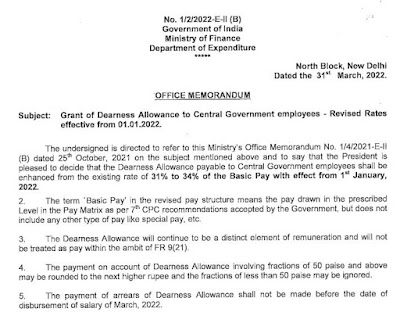
DA Jan 2022 - Grant of Dearness Allowance to Central Government employees - Revised Rates effective from 01.01.2022

 3% DA Hike - Revised Rates effective from 01.01.2022: DoE OM dated 31.03.2022 No. 1/2/2022-E-II (B) Government of India Ministry of Finance...