Sunday, 26 November 2017

Change of date of holiday on account of Milad-un-Nabi (Id-e-milad, Prophet Mohammed's Birthday) for all Central Government Administrative Offices located in Chennai


Change of date of holiday on account of Milad-un-Nabi (Id-e-milad, Prophet Mohammed's Birthday) for all Central Government Administrative Offices located in Chennai

CENTRAL GOVERNMENT EMPLOYEES WELFARE CO-ORDINATION COMMITTEE
OFFICE OF THE CHIEF COMMISSIONER OF CUSTOMS
CUSTOM HOUSE, 60 RAJAJI SALAI, CHENNAI - 600 001.

CHAIRMAN: SHRI M. AJITKUMAR
CHIEF COMMISSIONER OF CUSTOMS
CHENNAI ZONE

EXECUTIVE SECRETARY : SMT. K. KOMATHI
JOINT COMMISSIONER OF CUSTOMS,
CHENNAI - II, CUSTOM HOUSE,
CHENNAI - 600 001.

NO. CGEWCC/5/2017
DATED: 23.11.2017
To
All Executive Members &
Members of CGEWCE, Chennai
(as per mailing list)

Sir/ Madam,

Sub:  Change of date of holiday on account of Milad-un-Nabi (Id-e-milad, Prophet Mohammed's Birthday for all Central Government Administrative Offices located in Chennai - reg.

As per the list of Holidays circulated vide CGEWCE-2016 DATED 10.01.2017, the holiday on account of Milad-un-Nabi was declared on 01.12.2017 (Friday). Government of Tamil Nadu, vide G.O. Ms.No.962 dated 21.11.2017 has notified that Milad-Un-Nabi (Prophet Mohammed's Birthday) will be celebrated on 02.12.2017 (Saturday).

Accordingly, it has been decided to shift the holiday for Milad-Un-Nabi to 02.12.2017 in the place of 01.12.2017 as notified earlier, for all the Central Government Offices situated in Tamil Nadu.

Yours Sincerely
(K.KOMATHI)
EXECUTIVE SECRETARY, CGEWCE, CHENNAI
change-of-holiday-Milad-un-Nabi

Central Government Employees Group Insurance Scheme 1980 - Table of Benefits for the saving fund for the period from 01.10.2017 to 31.12.2017


Central Government Employees Group Insurance Scheme 1980 - Table of Benefits for the saving fund for the period from 01.10.2017 to 31.12.2017

7thCPC-Central-Government-Employees-Group-Insurance-Scheme


No.7(2)/EV/2016
Government of India
Ministry of Finance
Department of Expenditure
New Delhi, the 23 November, 2017
OFFICE MEMORANDUM

Sub: Central Government Employees Group Insurance Scheme-1980 - Tables of Benefits for the savings fund for the period from 01.10.2017 to 31.12.2017.

The Tables of Benefits for Savings Fund to the beneficiaries under the Central Government Employees Group Insurance Scheme-1980, which are being issued on a quarterly basis from 01.01.2017 onwards, as brought out in this Ministry’s OM of even number dated 17.03.2017, for the quarter from 01.10.2017 to 31.12.2017, as worked out by IRDA based on the interest rate of 7.8% per annum (compounded quarterly) as notified by the Department of Economic Affairs as per their Resolution No. 5(1)-B(PD)/2017 dated 23.10.2017, are enclosed.

2.The Tables enclosed are of two categories as per the existing practice. As hitherto, the first Table of Benefits for the savings fund of the scheme is based on the subscription of Rs.10 p.m. from 1.1.1982 to 31.12.1989 and Rs.15 p.m. w.e.f. 1.1.1990 onwards. The second Table of Benefits for savings fund is based on a subscription of Rs.10 p.m. for those employees who had opted out of the revised rate of subscription w.e.f. 1.1.1990.

3.While these orders are in respect of Table of Benefits for the period from 01.10.2017 to 31.12.2017, the Tables already issued for the quarters from 1.1.2017 to 31.3.2017, from 1.4.2017 to 30.6.2017 and from 01.07.2017 to 30.09.2017 are also reproduced for the sake of convenience and consolidation.

4.In their application to the employees of Indian Audit and Accounts Department, these orders are issued after consultation with the Comptroller & Auditor General of India.

5.Hindi version of these orders is attached.
sd/-
(Amar Nath Singh)
Director
Authority: http://www.doe.gov.in/

Clarification regarding calculation of quantum of Annual Increment in pay in case of Running Staff

Clarification regarding calculation of quantum of Annual Increment in pay in case of Running Staff.
GOVERNMENT OF INDIA
MINISTRY OF RAILWAYS
(RAILWAY BOARD)

No. PC-VI/2016/Z/4
Dated: 04.10.2017
OFFICE MEMORANDUM

Sub: Clarification regarding calculation of quantum of Annual Increment in pay in case of Running Staff.

Ref.: M/o Finance's OM No. 332469/2016-E IIIA dated 01.02.201

The undersigned is directed to refer to this Ministry's OM of even no. dated 30.08.2016 wherein an issue raised by one of the Staff Federations vide PNM Agenda Item No.10/2016 was referred to M/o Finance for examination. The Federation had demanded that the basic pay for the purpose of calculation of increment in the 6th CPC should include Pay element of Running Allowance for the Running staff. This meant that increment of Running Staff should be calculated @3 % of {Basic pay + pay element (presently 30% of Basic Pay)}.

2. This issue was examined in Pay Commission Dte. of Railway Board and a copy of reply sent to one of the Zonal Railways is enclosed as Annex-I.

3. As regards the queries raised by M/o Finance vide 011/1 dated 01.02.2017, it is clarified that a portion of Basic Pay of the Running Staff is treated as a “Pay element of running allowance” which itself falls outside the definition. of Basic Pay as defined in FR(9) (21)(a)(i) but falls in the broader definition of the term "pay" as in FR(9) (21)(a)(iii). The pay element at specified rates is counted for specified purposes only. As per Rule No. 25 of "The Rules for payment of Running and other Allowances to the Running Staff on Railways, 1981" read with para 3.23 of Railway Board’s letter No.E(P&A)II-80/RS- 10 dated 17.07.1981 (Annex-11), the pay element i.e. 30% of the Basic Pay of Running Staff will be reckoned as pay for specified purposes (not for all) such as Dearness Allowances, House Rent Allowance, entitlement to Passes, PTOs etc. It is pertinent to mention here that pay element is not reckoned as pay for Transport Allowance, Night Duty Allowance etc.

3.1   In accordance with para 2 of Board’s letter No. E(P&A) II-2005/RS-34 dated 26.12.2008 (RBE No.202/2008) (Annex-III}, pay element in the Running n Allowance for running staff would be 30% of the basic pay under Railway Service (Revised Pay) Rules,2008 for computation of specified benefits excluding retirement benefits. For the purpose of computation of retirement benefits of running staff, an additional quantum of 55% of the basic pay under RS(RP) Rules,2008 would be reckoned.

S/d,
(U.K. Tiwari)
Deputy Director,
Pay Commission-VI
Railway Board.
Ph. No. 011-47845224

Kind Attn:  Sh. Ashok Kumar
Under Secretary (DMA),
Department  of Expenditure,
Ministry  of Finance, North Block, New Delhi.

Source: NFIR

Government to examine Rs.5 lakh tax exemption proposal for pensioners


Government to examine Rs.5 lakh tax exemption proposal for pensioners

The finance ministry has informed Congress MP Shashi Tharoor that his suggestion to increase the tax exemption limit for pension up to Rs 5 lakh would be examined during the ongoing preparations for the Union Budget 2018, according to a communication.

Responding to a letter written by Tharoor in late September, Minister of State for Finance Shiv Pratap Shukla said the suggestion that pension up to Rs 5 lakh per annum should be exempted from income tax in all cases was examined.

"The proposal would be examined during the exercise for the ensuing Union Budget 2018 and the outcome would be reflected in the Finance Bill, 2018," said the letter, which was tweeted by Tharoor.
The letter, dated November 14, said that a pensioner who is above 80 years is not required to pay tax if the total income, including pension, does not exceed Rs 5 lakh.

"The suggestion that pension up to Rs 5 lakh per annum should be exempt in all cases would require amendment to the existing provisions of the Income Tax Act, 1961," the letter said.

A pensioner, who is a senior citizen - aged 60 to 80 years - is exempt from income tax if the income, including from pension, does not exceed Rs 3 lakh.

About the letter, Tharoor tweeted, "Govt's semi- encouraging reply to my request to exempt pensioners from tax on the first 5 lakhs of income. Hope @arunjaitley will include this in his next budget".

The work for preparation of the General Budget has already commenced and Finance Minister Arun Jaitley is likely to present it to Parliament in the first week of February.

Source: Indian Express

Revision of Pension of Pre-2016 Central Civil Pensioners - MoD Orders dt. 22.11.2017


Revision of Pension of Pre-2016 Central Civil Pensioners - MoD Orders dt. 22.11.2017

Review of the progress made by Defence Establishments revision of Pension/Family Pension of pre-2016 Central Civil Pensioners

Office of the Controller General Of Defence Accounts
Ulan Batar Road palam Delhi Cantt. - 110010

Fax: 011-25574814 Phone : 011-25665529
Regd Fax.
AT/V/DAD/15101/Circular/2017

To,
All PCsDA/PCA(Fys)/CsDA
Dated: 22.11.2017
Sub: Review of the progress made by Defence Establishments revision of Pension/Family Pension of pre-2016 Central Civil Pensioners.

A review meeting was held on November 2017 under chairmanship of Defence regarding subject mentioned wherein following decisions were taken:
i. All HoDs have to ensure completion of 80% Of pension cases by 31.12.2017 and 100% cases by 31.0320 18.

ii. HoDs shall prescribc weekly targets for the HOOs for preparation and submission or pension revision cases to PCsDA/PCA(Fys)/CsDA. Similar targets are to be prescribed by CGDA to the PCsDA/CsDA for disposal of cases received from the HOOs. The progress made thereof to be reviewed by HoDs/CGDA every fortnight.

iii. FADS will assess the functioning of the office of the PCDA (Pension), Allahabad in so far as it relates to dealing of pension revision cases and take steps for improving its capacity to handle higher volumes of cases.

iv. CGDA to issue clarification to PCsDA/PCA(Fys)/CsDA about their role in vetting/scrutiny/audit of the LPC-Cum-Data Sheet, prescribe checklist of documents/action required with proposals received from HOOs, and specify the stepwise action( with timelines).
3. In this context, please rcfer to PCDA Circular NO.175 Vide which action regarding vetting & submission of LPC Cum Data Sheet has already been clarified by PCDA (P) Allahabad.

4. Action may kindly be taken to complete the task within stipulated period of time as per direction received from MoD.

Jt.CGDA (Pen.) has seen.
sd/-
Krishna Kumar
SAO (AT/P)
Authority: http://cgda.nic.in/

7th CPC Bunching Benefit - Explain with Matrix Table


7th CPC Bunching Benefit - Explain with Matrix Table 

Bunching benefit in 7th CPC
Are you eligible for getting Bunching benefit in 7th CPC ? Please see in enclosed table.

Please check this bunching stages in 7th CPC.

7th-cpc-bunching-table

Friday, 24 November 2017

Deputation (Duty) Allowance to Central Government Employees - Recommendations of the 7th Pay Commission - DOPT Orders

Deputation (Duty) Allowance to Central Government Employees - Recommendations of the 7th Pay Commission - DOPT Orders
7th-CPC-Deputation-Duty-Allowance-DoPT


No.2/11/2017-Estt.(Pay-II)
Government of India
Ministry of Personnel, Public Grievances & Pensions
Department of Personnel & Training

North Block, New Delhi
Dated the 24th November, 2017

OFFICE MEMORANDUM

Subject:- Grant of Deputation (Duty) Allowance - Recommendations of the Seventh Central Pay Commission - Regarding.

This Department’s OM No. 6/8/2009-Estt.(Pay-II) dated 17.6.2010 inter-alia provides for rates of Deputation (Duty) Allowance admissible to Central Government employees.

2. As provided in para 7 of Ministry of Finance, Department of Expenditure’s Resolution No.1-2/2016-IC dated 25th July, 2016, the matter regarding allowances (except Dearness Allowance) based on the recommendations of the 7th Central Pay Commission (CPC) was referred to a Committee under the Chairmanship of Finance Secretary and until a final decision thereon, all Allowances have been paid at the existing rates in the existing pay structure.

3. The decision of the Government on various allowances based on the recommendations of the 7th CPC and in the light of the recommendations of the Committee under the Chairmanship of the Finance Secretary has since been issued as per the Resolution No.11-1/2016-IC dated 6th July 2017 of Department of Expenditure.

4. As mentioned at Sl.No.46 of the Appendix-II of the said Resolution dated 6th July 2017, the recommendation of the 7th CPC for enhancement of ceiling of Deputation (Duty) Allowance for civilians by 2.25 times has been accepted and this decision is effective from 1st July, 2017. Accordingly, the President is pleased to decide that the rates of Deputation (Duty) Allowance and certain other conditions relating to grant of Deputation (Duty) Allowance shall be as under:-

The Deputation (Duty) Allowance admissible shall be at the following rates:

(a) In case of deputation within the same station the Deputation (Duty) Allowance will be payable at the rate of 5% of basic pay subject to a maximum of Rs.4500 p.m.

(b) In case of deputation involving change of station, the Deputation (Duty) Allowance will be payable at the rate of 10% of the basic pay subject to a maximum of Rs.9000 p.m.

(c) The ceilings will further rise by 25 percent each time Dearness Allowance increases by 50 percent.

(d) Basic Pay, from time to time, plus Deputation (Duty) Allowance shall not exceed the basic pay in the apex level i.e. Rs. 2,25,000/-. In the case of Government servants receiving Non Practising Allowance, their basic pay plus Non-Practising Allowance plus Deputation (Duty) Allowance shall not exceed the average of basic pay of the revised scale applicable to the Apex Level and the Level of the Cabinet Secretary i.e. Rs.2,37,500/-.

Note: 1 ‘Basic pay’ in the revised pay structure (the pay structure based on 7th Central Pay Commission recommendations) means the pay drawn by the deputationist, from time to time, in the prescribed Level, in Pay Matrix, of the post held by him substantively in the parent cadre, but does not include any other type of pay like personal pay, etc.

Note: 2 In cases where the basic pay in parent cadre has been upgraded on account of non-functional upgradation (NFU), Modified Assured Career Progression Scheme (MACP), Non Functional Selection Grade (NFSG), etc., the upgraded basic pay under such upgradations shall not be taken into account for the purpose of Deputation (Duty) Allowance.

Note 3 In the case of a Proforma Promotion under Next Below Rule (NBR): If such a Proforma Promotion is in a Level of the Pay Matrix which is higher than that of the ex-cadre post, the basic pay under such Proforma Promotion shall not be taken into account for the purpose of Deputation (Duty) Allowance. However, if such a Proforma Promotion under NBR is in a Level of the pay matrix which is equal to or below that of the ex-cadre post, Deputation (Duty) Allowance shall be admissible on the basic pay of the parent cadre post allowed under the proforma promotion, if opted by the deputationist.

Note 4 In case of Reverse Foreign Service, if the appointment is made to post whose pay structure and/ or Dearness Allowance (DA) pattern is dissimilar to that in the parent organisation, the option for electing to draw the basic pay in the parent cadre [alongwith the Deputation (Duty) Allowance thereon and the personal pay, if any] will not be available to such employee.

Note: 5 The term ‘same station’ for the purpose will be determined with reference to the station where the person was on duty before proceeding on deputation.

Note: 6 Where there is no change in the headquarters with reference to the last post held, the transfer should be treated as within the same station and when there is change in headquarters it would be treated as not in the same station. So far as places falling within the same urban agglomeration of the old headquarters are concerned, they would be treated as transfer within the same station.

5. Para 6.1 of this Department’s OM No.6/8/2009-Estt(Pay-II) dated 17.6.2010 stands amended to the above effect.

6. In so far as persons serving in the Indian Audit & Accounts Department are concerned, these orders issue after consultation with the Comptroller & Auditor General of India.

7. These orders shall take effect from 1st July, 2017

(Rajeev Bahree)
Under Secretary to the Government of India

Source: DOPT

219th Meeting of Central Board of EPFO Held

219th Meeting of Central Board of EPFO Held

The 219th meeting of the Central Board of Employees' Provident Fund Organisation (EPFO) held in New Delhi yesterday under the chairmanship of Union Minister of labour & Employment Shri Santosh Kumar Gangwar.

Following where are the key decisions of the Board:

a) The Board took note of the 10 requests from ineligible establishments for waiver of damages during the period May 20, 2017 to September 30, 2017 which were earlier rejected by EPFO.

b) The Central Board started investing in Equity Exchange-Traded Funds (ETFs) from August 2015. The Accounting Policy for valuation and accounting of equity investments were prepared in consultancy with IIM Bangalore. The observations of the CAG were also incorporated in the accounting policy. The same was approved by the Central Board.

c) Present decentralized system of EPFO for making payment to its beneficiaries involves higher cost of transactions, delays in recredits in case of failed transaction and does not provide for AADHAAR enabled payments. Hence, EPFO proposed to move towards the Centralised Payment System using National Payments Corporation of India (NPCI) platform. The benefits of the proposed system are:
  • Funds will be transferred on the same day to the beneficiaries through NPCI platform.
  • Office may reconcile the transaction status on T+0 basis. This will result in early recredit in the accounts of beneficiaries in the case of failed transactions.
  • Availability of the facility of AADHAAR enabled transfer of funds.
  • Transaction cost by way of bank charges will also come down.
The Board gave in-principle approval for the same.

The Central Board also took note of the recent IT based initiatives of EPFO for better services to its stakeholders:-

(1) Online Adhaar Verified UAN allotment to any citizen at Unifed Portal: Universal Account Number (UAN) is mandatory for filing the returns and depositing the contributions. However, the establishments face difficulties in seeding Aadhaar details of the employees. To obviate this difficulty, an open functionality has been introduced through which any citizen / present prospective employee can generate his/her UAN on the basis of Aadhaar and link his KYC details. The registration facility is available at Member Interface in the Unified Portal (https://unifiedportal-mem.epfindia.gov.in/memberinterface/). It being an online facility, there is no need to submit any physical documents.

(2) Introduction of Online request functionality to EPF Subscribers for correction in Name, DoB and Gender:
 
In line with the decision of Government for digital India, a functionality has been developed where member can give online request to his/her employer at Member Interface in the Unified Portal (https://unifiedportal-mem.epfindia.gov.in/memberinterface/) for correction in Name, DoB and Gender.

EPFO is committed to strengthen the e-governance system to bring more transparency and to provide better services to its stakeholders. EPFO has already launched a number of e-governance initiatives such as Electronic Challan-cum-Return, Member e-passbook, payment through National Electronic Fund Transfer, Online Registration of Establishments, Mobile governance, Online receipt of claims, Auto transfer of Accounts etc.

PIB

Thursday, 23 November 2017

7th CPC - Classification of Civil Posts under CCS(CCA) Rules - Gazette Notification

7th CPC - Classification of Civil Posts under CCS(CCA) Rules - Gazette Notification

 THE GAZETTE OF INDIA : EXTRAORDINARY [PART II-SEC. 3(ii)]
MINISTRY OF PERSONNEL, PUBLIC GRIEVANCES AND PENSIONS
(Department of Personnel and Training) 

 ORDER 

New Delhi, the 9th November, 2017 

S.O. 3578 (E). In exercise of the powers conferred by the proviso to article 309 of the Constitution read with rule 6 of the Central Civil Services (Classification, Control and Appeal) Rules, 1965 and in supersession of the notification of the Government of India in the Ministry of Personnel, Public Grievances and Pensions (Department of  Personnel and Training) number S.O. 2079(E), dated the 20th August, 2014, except as respects things done or omitted to be done before such supersession, the President hereby directs that with effect from the date of publication of this Order in the Official Gazette, all civil posts except persons serving in the Indian Audit and Accounts Department under the Union, shall be classified as follows :

S.No.
Description of Posts
Classification of posts
(1) (1) (3)
1 A Central Civil Post carrying the pay in the Pay Matrix at the Level from 10 to 18. Group A
2 A Central Civil Post carrying the pay in the Pay Matrix at the Level from 6 to 9. Group B
3 A Central Civil Post carrying the pay in the Pay Matrix at the Level from 1 to 5. Group C


Explanation - For the purpose of this Order, 'Level' in relation to a post means, the Level specified in third row of Part A of the Schedule to the Central Civil Services (Revised Pay) Rules, 2016.

[F. No. 11012/10/2016 -Estt.A-III]
GYANENDRA DEV TRIPATHI, Jt. Secy.

Source: DoPT
PDF in English & PDF in Hindi

Cadre Restructuring of Group 'C' employees in Department of Posts


Cadre Restructuring of Group 'C' employees in Department of Posts

No.25-04/2012-PE-I (Vol.II)
Government of lndia
Ministry of Communications
Department of Posts
(PE-I Section)
Dak Bhawan, Sansad Marg,
New Delhi - 110001
Dated: 10th November, 2017
To,
All Heads of Circles,

Subject: Cadre Restructuring of Group 'C' employees in Department of Posts.

Sir/Madam,
The Cadre Restructuring Order of Group 'C' employees was issued vide this office letter of even number dated 27.05.2016. Later on, some Circles requested for further clarification, which were issued vide this office letter of even number dated 11.11.2016. However, Circles still faced with problems while implementing the orders.

2. Issues like norms for allotment of number of LSG posts, instructions for identification of surplus LSG posts other than C and B class POs, identification of HSG-I (NFG) posts, divisionalisation of LSG Cadre, relaxation of minimum qualifying service for promotion to HSG-II and HSG-I and date of effect of the orders etc. needed further clarification.

3. Therefore, on representation of various Staff Unions to the Secretary (Posts) regarding the issues arising out of implementation of Cadre Restructuring, a Committee was constituted vide Office Order of even number dated 09.06.2017, under the Chairmanship of Sh. Charles Lobo, CPMG Karnataka Circle and DDG (Estt), PMG (M&BD), Chennai and PMG, Pune Region as its members to examine all such issues. The Committee after thorough consultation, including one with the staff representatives, submitted its report on 22.09.2017.

4. The recommendations of the Committee, as accepted by the Competent Authority, are as under:

4.1 Uniform Guidelines for identifying the surplus LSG posts other than Single Handed and Double Handed (C and B Class) Post Offices:
(i) Treasurer posts should not be identified for upgradation as Treasurer posts are PA posts with special cash handling allowance.

(ii) The posts of System Administrator, Marketing Executive, DO (PLI) etc. are not cadre specific posts. Therefore, any suitable official can be deployed against these posts.

(iii) As per the Recruitment Rules, the PAs of Foreign Posts are recruited separately and trained for Foreign Post. But on promotion to LSG they are transferable to other LSG posts on postal side and vice versa. Hence extending the benefit of cadre restructuring to officials of Foreign Post in LSG and above cadres is in order as far as foreign post is concerned. Only Mumbai Foreign Post is treated as separate Foreign Post unit.

(iv) The present cadre restructuring order is not applicable to RLO. Hence RLO staff should not be included in cadre restructuring.

(v) After upgrading C and 8 class SPM posts to LSG remaining LSG posts allotted to the Circle can be utilized as per functional requirement. The officials occupying these restructured LSG posts will have either or both supervisory and operative responsibilities as per allocation ofwork by competent authority.

(vi) The SPMs posts of C and B class post offices are upgraded to LSG without following the LSG norm of 5:1. Therefore, it is not practicable to prescribe the norm for other restructured LSG posts. Number of posts to be created in each office will be as per functional requirement.

(vii) Accountants are Postal Assistants only who have passed the PO & RMS Accountants examination. They are eligible for promotion as per Recruitment Rules. Norm based LSG accountants posts can be upgraded to HSG II within the number of posts allotted to the circle.

(viii) The post of Accountant in Divisional Office can be upgraded to LSG. If there is more than one post of Accountant in HPOs, some may be upgraded to LSG while leaving some others for time scale Accountants.

(ix) More Posts may be identified in bigger offices like HPOs and MDGs. It is not possible to specify the number of posts as the staff strength and functional requirements vary from office to office. Thereafter PM Grade-III/HSG I pre restructured HPOs may be given preference for creation of posts. PM Grade II/HSG II HPOs, PM Grade III/HSG I MDG, PM Grade II/ HSG II SO/MDG, (all pre restructured) may be preferred for creation of posts in that order based on functional requirement. Circles should ensure that the posts are not disproportionately concentrated in a few offices/cities.

(x) In charge CPC, Foreign post (except Mumbai Foreign Post), PSD and CSD or other offices can be considered for upgradation of posts to LSG.

(xi) If Circles are left with surplus LSG posts, then limited number of posts in Divisional Office and important delivery offices may be identified for upgradation.

(xii) All the posts of SPMs in B and C class offices should be upgraded to LSG and all LSG norm based and A class offices should be upgraded to HSG II as a result of the implementation of the orders.
4.2 Identification of NFG posts in HSG I: Only 10 percent of HSG I posts i.e. 235 posts have been approved for NFG scale. Therefore it is not possible to promote all HSG I officials who are completing 2 years of service in HSG I. Although there is need to identify these posts for promotion from HSG l, in order to avoid inconvenience to staff in the initial stage and purely as a temporary measure, the officials can be given NFG on the basis of seniority wherever they are posted in HSG l by upgrading the HSG I post to NFG and simultaneously downgrading the NFC position to HSG-I elsewhere. In due course of time the posts need to be identified.

4.3 LSG Cadre: The Committee examined the issue of Divisionalization of LSG Cadre. The Committee observed that there are some mofussil Divisions which have more B and C class offices now upgraded to LSG but are having very less HSG II and HSG I offices. On the other hand there will be city Divisions where the number of B and C class post offices now upgraded to LSG are very less. Divisionalization will provide less opportunity for staff of these divisions to get LSG promotion and in turn affect their HSG promotions. The Divisionalization will create promotional disparity between employees in different Divisions. Therefore, the Committee's recommendation not to Divisionalize LSG cadre has been accepted. It will remain a circle cadre. However, for better management of transfer and postings and to minimize inconvenience to the staff, Circle would allot officials to Regions for further allotment to Divisions, which in turn shall issue the posting orders in case. of the LSG officials and rotational transfer orders thereafter till such time that they remain allotted to that Division by the Region. At any time the Circle or Region may allot these LSG officials to any other Region or Division respectively.

4.4 Revision of Leave Reserve (LR) strength consequent upon upgradation to LSG. It has been observed that consequent on cadre restructuring the LR strength would be considerably reduced. The Committee observed that the postmaster in restructured LSG grade working in B and C class offices have to do operative work. Similarly restructured LSG PAs in other post offices have to do operative/supervisory work. Therefore, the Committee's recommendation that considering the PA strength and the restructured LSG strength for calculation of LR strength will be in order, has been accepted.

4.5 Date of Effect of the Orders and completion of restructuring: For the sake of uniformity, the promotion will be effective from the date of issue of the original order dated 27.05.2016 as per existing instructions on the subject. It will be applicable to all eligible officials including those who were in service but now retired.

5. The rationalization of posts, as recommended by the Committee and accepted by the Competent Authority, is attached as Annexure-I.

6. In view of the above, all the Circles are requested to take immediate necessary action to implement the Cadre Restructuring of Group 'C' employees, keeping in view the above instructions without any further delay. All attempts should be made to complete the exercise of conducting DPCs by 31.12.2017 and the whole exercise, including transfer/posting Orders, must be completed by 31.01.2018.
Yours faithfully
sd/-
(Tarun Mittal)
Asstt. Director General (PE-I)
cadre-post-groupC


Source: cept.gov.in

Flash News

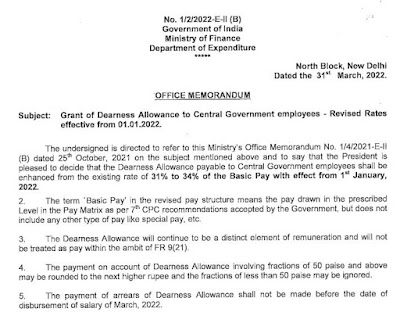
DA Jan 2022 - Grant of Dearness Allowance to Central Government employees - Revised Rates effective from 01.01.2022

 3% DA Hike - Revised Rates effective from 01.01.2022: DoE OM dated 31.03.2022 No. 1/2/2022-E-II (B) Government of India Ministry of Finance...