Saturday, 4 February 2017

Clarification regarding pay fixation under 7th CPC for the post of 'Trainee' appointed on compassionate grounds

Clarification regarding pay fixation under 7th CPC for the post of 'Trainee' appointed on compassionate grounds
CGDA, Ulan Batar Road, Palam, Delhi Cant-110010

No.AN/XlV/14164/7th CPC/corrsp/Vol-I
Dated 01/02/2017
To
All PCsDA/CsDA/PCof A(Fys)Kolkata

Subject: Clarification regarding pay fixation under 7th CPC for the post of 'Trainee' appointed on compassionate grounds.

This office is receiving several references frorn various controller offices seeking clarification regarding pay fixation under Seventh CPC in respect of 'Trainee-appointed on ground without acquiring minimum educational qualification in the pay scale of Rs 4440/-7440/- (pre-revised ) without any Grade Pay. Such trainees are to be placed in the pay band-I (5200-20200) With Grade pay of Rs 1800/- only on acquiring the minimum qualification prescribed under the recruitment rules. However, under the CPC, neither any specific pay matrix level nor the manner for fixation of pay in respect of MTS Trainee has been prescribed.

2. In this regard, it is intimated that matter already stands referred to the Ministry for furnishing necessary clarification/guidelines to regulate the pay fixation of trainees under Seventh CPC. Reply of the same is still awaited. As and when , reply is received from the Ministry, the same will be widely publicized. Hence, it is requested to await for orders/ clarification from the Ministry in this regard.

3. This is for your information and necessary action please.

sd/-
(Kavitha Garg)
Sr.Dy.CGDA(AN)
Authority: http://cgda.nic.in/

Budget 2017 and Central Government employees demands


Budget 2017 and Central Government employees demands

Comrades ,
The budget for the year 2017-18 was presented by the Shri Arun Jaitleyji Hon’ble Minister of Finance on 1st Feb 2017 , the Central Government employees had lot of hopes of this budget especially on increasing the tax slabs and tax rates reduction , also on allowances and increasing our wages i.e. revision of the fitment formula . One more important issue of filling up of vacant post in the Central Government.

Shri Arun Jaitleyji Hon’ble Minister of Finance had not uttered a single word about Central Government employees in his budget speech of nearly two hours, even though the Central Government employees work with dedication and implement the programmes and policy of the Central Government either way of revenue collection, transportation, public service , working for the welfare of the people of the country etc . This has caused dissatisfaction amongst Central Government employees as many of the demands of the Central Government employees are not considered. The tax proposals provided only a small relief to the Central Government Employees, actually a big relief should have been provided. The Central Government employees are disappointed of the outcome of the budget.

Now let us focus main issues of the CG employees and the budget 2017-17 especially this budget is being presented after the demonetization. As stated earlier the financial position of the Central Government is very good even after demonetization. The budget 2017-18 has once again proved that the Central Government resources are very good the revenue expenditure has been at 21.47 lakh crores. The fiscal deficit will be 3.2 % of GDP.
Now coming to the revenue growth of the Central Government in last four years we can observe from the financial year 2013-14 the Revenue Expenditure which was at is Rs 14.88 lakh crores the Revenue Expenditure the financial year 2017-18 which stands at 21.47 lakh crores . The fiscal deficit has also reduced from 4.8 % to 3.2 % of GDP in last four years . This shows that the financial status of the Central Government is very good. The growth rate of the revenue collection is about 15% annually. In fact the Shri Arun Jaitleyji Hon'ble Minister of Finance had stated the revenue collection is increasing to about 17 % annually. We should be proud that your country economy is in good shape. Indian economy is a stable economy can accommodate any additional financial expenditure to be made for the welfare of Central Government employees.

The revenue of the Central Government is increasing at about 15% annually, from last three years the revenue of the Central Government has increased by 45% the expenditure towards salary of Central Government employees including the defence employees has risen only by 14.5 % on wage hike due to 7th CPC and also Dearness Allowances expenditure. So total rise in pay hike is about 22% , even if allowances are released in next financial year additional expenditure is likely at just 3% as 70% of the employees don’t avail HRA which is the major allowances, . which is very much less than the 45% of the revenue collection of the Central Government. So the Central Government can afford to increase our wages considerably i.e revision of fitment formula and minimum wage . The allowances should be made effectively from 1st Jan 2016.

Next on the tax slabs the Shri Arun Jaitleyji: Hon'ble Minister of Finance had made announcement of the tax proposals provided only a small relief to the Central Government Employees by reducing the taxes for the slab 2.5 lakhs to 5 lakhs from 10% to 5% . This is only a very small gestures on the part of Shri Arun Jaitleyji Hon’ble Minister of Finance , actually a big relief should have been provided by way of abolishing the taxes up to Rs 5 lakhs . The expenditure loss for reduction of taxes for the slab 2.5 lakhs to 5 lakhs(1.95 crore show income between Rs 2.5 to Rs 5 lakh) from 10% to 5% is just at Rs 15,500/- crores only , if the Hon'ble Minister of Finance had announced the abolishing the taxes up to Rs 5 lakhs it could have been additional expenditure of Rs 15,000 crores only which at just half percent of the total budget revenue collections , next Rs 5 to Rs10 lakhs slab (only 52 lakh show income between Rs 5 to Rs 10 lakhs ) here also there should have been reduction in taxes from 20% to 10% , the limit of Rs 1.5 lakh under Section 80C for investment should have been increased upto 2.5 lakh which would have encouraged savings , all these measures could have gone a long way benefiting the Central Government employees and the salaried class employees a lot.

Today hardly 3 % of the country population are paying the income tax, the rest 97% do not pay income tax .The Central Government Employees are honestly paying the taxes. A big tax relief is genuinely due for them.
One more important problem faced by the Central Government Employees is that the no filling up of the vacant post in the Central Government, nearly 4 lakhs post are vacant, even in Railway safety post of 1.41 lakh post are vacant and Income tax department post are vacant, more manpower is required for effectively collection of the taxes and implementation of the programmes and policy of the Central Government. This will also provide jobs for the youth of the country.

We sincerely hope the Hon'ble Minister of Finance would reconsider his decision and improve the taxation policy and consider the demands of the CG employees effectively in true spirit.

Comradely yours
(P.S.Prasad)
General Secretary
Source: http://karnatakacoc.blogspot.in/

AIRF: Meeting with Honorable Minister for Railways on 03.02.2017

AIRF: Meeting with Honorable Minister for Railways on 03.02.2017 - Feedback
Though the CRB has assured that, shortly needful will be done in the matter, but it is advised to all of you that we should continue our agitations till this letter of the Railway Board is withdrawn.
A.I.R.F
All India Railwaymen's Federation
(Estd, 1924)

4, State Entry Road,
New Delhi - 110055
No.AIRF/24(C)
Dated: February 3, 2017
The General Secretaries,
All Affiliated Unions,
Dear Comrades!
Sub: Meeting with Hon'ble Minister for Railways
Today I met Hon'ble Minister for Railways, Shri Suresh Prabhakar Prabhu and handed him over a copy of our Protest Letter, No.AIRF/24(C) dated February 2, 2017, against Railway Board's letter No.2017/E(LR)III/Ref./RB/1 dated 30.01.2017, wherein Supervisors(Grade Pay of Rs.4200 and above) working in Safety Categories have been debarred from become office-bearers of the unions/federation after 31.03.2017.
I explained him that, on the one hand railway administrations wants all sorts of cooperation from the federation, on the other they are issuing such a letter wherein they are directly interfering in the unions/federation affairs.
Hon'ble MR immediately called the CRB and advised him that this issue should be resolved without any further loss of time.
In our letter as well as during the course of discussions I demanded immediate withdrawal of Railway Board's letter supra dated 30.01.2017, which is illegal and against 87th ILO Convention and having no ground for debarring the supervisors from the trade union in the name of safety.
Though the CRB has assured that, shortly needful will be done in the matter, but it is advised to all of you that we should continue our agitations till this letter of the Railway Board is withdrawn.
With Fraternal Greetings!
Yours faithfully,
sd/-
(Shiv Gopal Mishra)
General Secretary
Source: AIRF

Dr Jitendra Singh gives away awards to various Ministries/Departments for meritorious performance in handling Public Grievances on PG portal


Dr Jitendra Singh gives away awards to various Ministries/Departments for meritorious performance in handling Public Grievances on PG portal

Minister reviews the functioning of DARPGSEVA

The Union Minister of State for Development of North Eastern Region (I/C), Prime Minister’s Office, Personnel, Public Grievances & Pensions, Atomic Energy and Space, Dr Jitendra Singh gave away the award of certificates for meritorious performance by the Ministries/Departments for effective redress of public grievances received on CPGRAMS, here today. Under the scheme, the certificate of recognition is given to three Ministries/Departments who are found to have done outstanding work during a quarter as per the prescribed criteria.

On the occasion, Dr Jitendra Singh awarded the following Ministries/departments for the quarter July, 2016 to September, 2016 and October, 2016 to December, 2016:

Group(July-Sep, 2016) (Oct-Dec, 2016)
A
(Ministries/Deptts receiving upto 300 grievances during the quarter)
Ministry of Development of North Eastern RegionDepartment of Scientific and Industrial Research
B
(Ministries/Deptts receiving upto 301-2000 grievances during the quarter)
Ministry of Women and Child DevelopmentMinistry of Housing and Poverty Alleviation
C
(Ministries/Deptts receiving upto above 2000 grievances during the quarter)
Central Board of Direct Taxes (Income Tax)Central Board of Direct Taxes (Income Tax)

Speaking on the occasion, Dr Jitendra Singh said that the awards will act as a motivator for the departments. He said that the number of grievances lodged has increased considerably in the recent years, which shows the increased faith of public in the government. He also said that the emphasis of the government has been on transparency and accountability. The Minister also said that the government has given importance to citizen-centric government with maximum governance and minimum government.

The Minister also reviewed the functioning of Twitter Seva started by the DARPG on February 1, 2017. The Twitter Seva will enable the DARPG to reach out to the common public and various stakeholders for facilitating redress of grievances and other issues of importance related to department.

The senior officers of the department were also present on the occasion.

PIB

NJCA: 7th Pay Commission Centre may hike Allowances of Central Gov employees from April 1


NJCA: 7th Pay Commission Centre may hike Allowances of Central Gov employees from April 1

A day after Budget 2017 was tabled in the Parliament by Finance Minister Arun Jaitley, the CG employees were upset as Jaitely nowhere mentioned any increase in the hike of allowances in the 7th Pay Commission.

But the members of National Joint Action Committee (NJCA) are an optimist about the implementation of 7CPC and believe that the government will come up with some positive news on April 1. The NJCA also believe that the Union Government will be implementing the 7CPC latest by April 1, after the end of financial year.

On Wednesday, the central government employees were gripped with pessimism after Arun Jaitley made no reference to the anomalies related to 7CPC in his Budget speech. "All of us were eagerly waiting for Finance Minister to make some announcement on minimum wages. But after Mr Jaitley's speech ended without mentioning a single word about the increase in the minimum wage, most of us were upset," Shiv Gopal Mishra, NJCA chief said.


He further added, "The government may implement the 7th pay commission recommendations by April 1 and their demand to increase the minimum wage will also be implemented. If the government fails to increase minimum wages from Rs 18,000 to Rs 25,000 then we will launch a massive protest against the government".

The NJCA has been actively involved with the Centre where they are seeking a revision of minimum salary from Rs 18,000 to Rs 26,000. The NJCA members and its conveyor had also met Home Minister Rajnath Singh, Finance Minister Arun Jaitley, Railway Minister Suresh Prabhu, a day after the implementation of 7th pay commission and had kept their demands in front of senior leaders.

Shiv Gopal Mishra is quite optimist about the hike in allowances of government employees but he is not sure that their demands of raising the minimum wage would be fulfilled by the government.

On Wednesday, most of the senior central government employees were eagerly waiting for the Budget speech as most of them expected the Finance Minister to speak on the 7th pay commission.

On July 1, 2016, the 7th Pay Commission was approved by the Union Cabinet. The date of implementation was fixed by the high-powered committee as for January 1, 2016. From the month of July, the central government employees were provided with the hiked salaries, along with the arrears of six months. But the hike was only related to the basic component of their pay. The increase in allowances was upheld, due to the anomalies raised by employees unions.

Source: India.com

Allotment of 12 Digit PPO Number to Pre-90 pensioners


Allotment of 12 Digit PPO Number to Pre-90 pensioners

GOVERNMENT OF INDIA
MINISTRY OF FINANCE
DEPARTMENT OF EXPENDITURE
CENTRAL PENSION ACCOUNTING OFFICE
TRIKOOT-II, BHIKAJI CAMA PLACE,
NEW DELHI-110066
No.CPAO/DBK/Pre-90/2017/1

Dated: 12-01.2017
Office Memorandum

Subject: Allotment of 12 Digit PPO Number to Pre-90 pensioners - regarding

Reference is invited to this office circular No. CPAO/TECH/PRE-90/DBK/2011-12/115 dated 02.01.2012 (copy enclosed), regarding allotment of 12 Digit PPO Numbers to the Pre-90 pensioners/family pensioners. Since CPAO database recognizes only 12 digit PPO Number, it is required to lodge & track grievances and make queries on CPAO website. The 12 Digit PPO number is also required for the e-revision of pension. Therefore, all the Pay and Accounts officers are advised to follow the instructions contained in previous circular dated 02.1.2012 for the conversion of Old PPOs. A list of all pending Pre-90 cases where PPO numbers are not yet converted into unique 12 digits PPO number is displayed at Sl.No 19 under the login of PAO in CPAO website www.cpao.nic.in.

All the Pr. CCAs/CCAs/CAs(IC) are requested to instruct concerned PAOs to download old cases and send the photocopies of PPOs along with duly filled proforma for allotment of 12 digits PPO Number.

(ABHE SINGH)
Dy. Controller of Accounts
Authority: www.cpao.gov.in

Dearness Allowance for Workmen and Officer Employees in banks for the months of February, March & April 2017 under X BPS/ Joint Note dated 25.5.2015


Indian Banks' Association has issued Circular regarding Increase in DA for Bank Employees and officers from February 2017

Indian  Banks' Association
HR & Industrial Relations
No.CIR/HR&IR/76/D/2016-1711996
February 1, 2017
All Members  of the Association
(Designated  Officers)

Dear Sirs,
Dearness  Allowance  for Workmen and Officer Employees  in banks  for the months of February, March  & April  2017 under X BPS/ Joint Note dated 25.5.2015

The confirmed All India Average Consumer Price Index Numbers for Industrial Workers (Base1960= 100) for the quarter ended December 2016 are as follows:-

October 20166345.60
November 20166322.77
December 20166277.12

The average CPI of the above is 6315 and accordingly the number of DA slabs are 469(6315-4440= 1875/4= 469  Slabs) The last quarterly Payment of DA was at 478 Slabs.  Hence there is a decrease in DA slabs of 9, i.e 469 Slabs for payment of DA for the quarter February, March & April 2017.

In terms of clause 7 of the 101h  Bipartite Settlement dated 25.05.2015 and clause 3 of the Joint Note dated 25.05.2015, the rate of Dearness Allowance payable to workmen and officer employees for the months of February, March & April  2017 shall be 46.90  % of  'pay'. While arriving at dearness  allowance payable, decimals from third  place  may please  be ignored.

We advise banks to pay the difference between the old and revised salary and allowance to officers on an ad hoc basis, pending amendments to Officers' Service Regulations.
Yours faithfully,
K S Chauhan
Senior Vice President
Source : IBA

Income tax reduced by 5% for Income upto Rs. 5 lakh: Budget 2017


Income tax reduced by 5% for Income upto Rs. 5 lakh: Budget 2017

Finance Minister announced in the budget speech for 2017-18 today in Lok Sabha, there were legitimate expectations of the salary class after demonetization to reduce the tax burden. He proposed reducing the present rate of income tax from 10 to 5 percent for the first slab of income from 2.5 lakhs to 5 lakh rupees

NEW INCOME TAX RATES 2017-18 (ASSESSMENT YEAR 2018-19)

Total IncomeNormal Rates of Income Tax
Up to Rs.2,50,000 to Rs.5,00,0005%
  • All taxpayers above 5 lakh rupees to get benefit of 12,500 rupees across the board
  • 10% Surcharge on individuals with income between 50 lakh to 1 Crore
  • Surcharge of 10% for individuals earning between Rs 50 lakh- 1 crore; Surcharge for incomes > Rs 1 crore at 15% to continue
  • A single one-page form for filing IT returns for taxable income up to 5 lakh rupees
  • Tax on income from 2.5 lakh to 5 lakh reduced from 10 per cent to 5 per cent
  • Time period of revising tax return to be reduced to 12 months

Wednesday, 1 February 2017

Income Tax Return form for the category of individuals having taxable income upto Rs 5 lakhs other than business income


A simple one- page Income Tax Return form for the category of individuals having taxable income upto Rs 5 lakhs other than business income.

"Finance Minister Shri Jaitley said that the present burden of taxation is mainly on honest tax payers and salaried employees who are showing their income correctly. Therefore, post-demonetisation, there is a legitimate expectation of this class of people to reduce their burden of taxation."

Press Information Bureau
Government of India
Ministry of Finance

01-February-2017 14:11 IST

Finance Minister reduces the tax rate from 10 to 5 per cent for individual income between Rs 2.5 to Rs 5 lakh.

Finance Minister appeals to all citizens to contribute to Nation Building by making a small payment of 5 per cent tax if their income is falling in this slab.

A simple one- page Income Tax Return form for the category of individuals having taxable income upto Rs 5 lakhs other than business income


The Union Finance Minister Shri Arun Jaitley reduced the rate of taxation from existing 10 per cent to 5 per cent for individual assesses between income of Rs 2.5 lakhs to Rs 5 lakhs. This would reduce the tax liability of all persons below Rs 5 lakh income either to zero (with rebate) or 50 per cent of their existing liability.

While presenting the General Budget 2017-18 in the Parliament today, the Union Finance Minister Shri Jaitley said that the present burden of taxation is mainly on honest tax payers and salaried employees who are showing their income correctly. Therefore, post-demonetisation, there is a legitimate expectation of this class of people to reduce their burden of taxation. The Finance Minister further said that if a nominal rate of taxation is kept for lower slab, many more people will prefer to come within the tax net. The Finance Minister made an appeal to all the citizens of India to contribute to Nation Building by making a small payment of 5 per cent tax if their income is falling in the lowest slab of Rs 2.5 lakhs to Rs 5 lakhs.

The Union Finance Minister Shri Jaitley said that the Government is trying to bring within tax-net more people who are evading taxes. So, in order to expand tax net, it is decided to have a simple one-page form to be filed as Income Tax Return for the category of individuals having taxable income upto Rs 5 lakhs other than business income. Also, a person of this category who files income tax return for the first time would not be subjected to any scrutiny in the first year unless there is specific information available with the Department regarding his high value transaction.

In his Budget Speech, the Finance Minister further said that in order not to have duplication of benefit, the existing benefit of rebate available to the same group of beneficiaries is being reduced to Rs 2500, available only to assessees upto income of Rs 3.5 lakhs. The combined effect of both these measures will mean that there would be zero tax liability for people getting income upto Rs 3 lakhs per annum. and the tax liability will only be Rs 2,500 for people with income between Rs 3 and Rs 3.5 lakhs. While the taxation liability of people with income upto Rs 5 lakhs is being reduced to half, all the other categories of tax payers in the subsequent slabs will also get a uniform benefit of Rs 12,500 per person. The total amount of tax foregone on account of this measure is Rs 15,500 crore.

In order to make good some of this revenue loss on account of this relief, a surcharge of 10 per cent of tax payable on categories of individuals whose annual taxable income is between Rs 50 lakhs and Rs 1 crore has been proposed. This is likely to give additional revenue of Rs 2,700 crore.

The Finance Minister said that the direct tax proposals for exemptions, etc. would result in revenue loss of Rs 22,700 crore but after counting for revenue gain of Rs 2,700 crore for additional resource mobilisation proposal, the net revenue loss in direct tax would come to Rs 20,000 crore.

PIB

Salient Features of Direct Tax Proposals in Union Budget 2017


Salient Features of Direct Tax Proposals in Union Budget 2017

The Union Budget 2017 was laid before the Parliament today by the Hon'ble Finance Minister of India. The salient features of Direct Tax proposals are summarised below:

I. Affordable Housing:
1. Three concessions in the scheme of Income Tax exemption for affordable housing:
(a) Area of 30 and 60 Sq.mtr. to be counted as carpet area and not built-up area;
(b) 30 Sq.mtr. only in 4 metropolitan city limits and 60 Sq.mtr. for the rest of the country;
(c) Completion period extended from 3 years to 5 years.

2. Tax on Notional rental income for builders to be calculated only after 1 year from the end of the year in which completion certificate is received.

3. Changes in Capital Gain taxation for immovable properties:
(a) Holding period reduce for computation of long term capital gain from three years to two years
(b) Base year for counting the cost of property shifted from 1.4.1981 to 1.4.2001 for all classes of assets including immovable property.
4. Basket of financial instrument in which capital gain can be invested without payment of tax to be expanded.

5. For joint development agreement, the liability to pay capital gain tax will arise in the year in which project is completed.

6. For Andhra Pradesh capital, land belonging to owners as on 2.6.2014 to be exempted from capital gain if the same is offered under land-pooling mechanism.

II. Measures for stimulating growth:
1. Concessional withholding rate of 5 per cent. for interest received by foreign entities on loans given in India to be continued for another 3 years beyond 30.6.2017.
2. Start-ups to get two relaxations under the scheme of Income Tax holiday given last year.
(a) The condition of continuous holding of 51 per cent. voting rights to be relaxed as long as the original investment of promoter is not diluted.
(b) Exemption available for three years out of any 7 years from the date of establishment instead of 3 out of 5 years
3. The period of carry forward of MAT/AMT credit increased from 10 years to 15 years.
4. The corporate income tax to be reduced from 30% to 25% for companies with turnover upto Rs.50 crore in 2015-16. This will benefit 96% of existing 6.67 lakh companies. This will result into tax saving of 16.67% for these companies.
5. Deduction for provision for NPA of Banks to be increased from to 8.5% instead of 7.5% of profit.
6. In case of NPA of non-scheduled cooperative banks, interest to be recognised as income only when received.

III Promoting Digital Economy:
1. In the presumptive income tax for small traders, income to be taken as 6% of turnover which is received by digital or banking means.
2. Cash expenditure allowable to be reduced to Rs.10,000 from the existing Rs.20,000.
3. Cash transaction of above Rs.3 lakh not to be permitted. The penalty of equal amount to be levied in case of breach.

IV Transparency in Electoral Funding:
1. The cash donation to political parties from one person limited to Rs.2,000/-.
2. Electoral Bond to be introduced for facilitating donation to political parties from explained sources.
3. Political parties to file their return in time limit prescribed in the Income Tax Act.

V. Ease of Doing Business:
1. Domestic transfer pricing to be applied only if one of the two companies enjoys specified profit-linked deduction.
2. The audit limit for business entities opting for presumptive scheme to be increased from Rs.1 crore to Rs.2 crore.
3. Individuals and HUFs not required to keep books of accounts if their turnover is up to Rs.25 lakhs or income is upto Rs.2.5 lakhs.
4. Investment in Category 1 and 2 foreign portfolio investors registered with SEBI to be exempted from provisions of indirect transfer.
5. TDS of 5% not to be deducted for individual insurance agents if they certify their income to be below taxable limit.
6. Professionals in presumptive scheme to pay advance tax only in one instalment in March instead of four.
7. The time limit for revising a tax return reduced to 12 months. Also time limit for completion of scrutiny will be brought down to 12 months from Assessment Year 2019-20 onwards.

VI Personal Income Tax:
1. Personal income tax for people with income in the slab of 2.5 lakh to 5 lakh to be reduced to 5% instead of 10%. This will reduce their tax liability to half while all other tax payers above this slab will also be benefited in terms of lesser tax of Rs.12,500 per individual (revenue loss ofRs.15,500 crores).
2. Surcharge of 10% to be levied on individuals with income between Rs.50 lakhs to Rs.1 crore (revenue gain of Rs.2,700 crore).

VII. Miscellaneous:
1. TCS exemption for state transport corporation in respect of purchase of vehicles.
2. Income of Chief Minister’s relief fund exempt from tax.
3. Penalty on accountant, registered valuer and merchant banker for furnishing incorrect information.
4. In order to ensure timely filing of return and expeditious issue of refund, a fee shall be levied for delay in filing of return.

PIB

Flash News

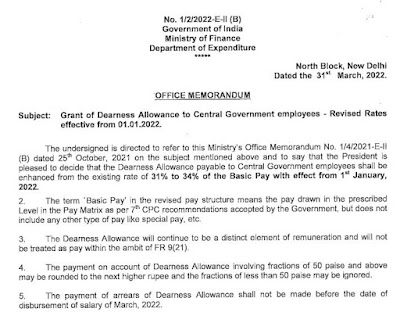
DA Jan 2022 - Grant of Dearness Allowance to Central Government employees - Revised Rates effective from 01.01.2022

 3% DA Hike - Revised Rates effective from 01.01.2022: DoE OM dated 31.03.2022 No. 1/2/2022-E-II (B) Government of India Ministry of Finance...