Thursday, 3 November 2016

Centre Approves 100% Hike in the Salaries of Member of Parliaments, Bill Likely in Winter Session

Centre Approves 100% Hike in the Salaries of Member of Parliaments, Bill Likely in Winter Session

Parliamentarians can soon expect a steep hike in salary as the Centre has decided to provide them with a basic salary of Rs 1 lakh per month, a 100% hike from the current Rs 50,000.

The salary hike for the MP’s has been in demands from a while when the Delhi government approved the huge hikes in Delhi MLA’s salaries. But Government was looking to avoid the hike in the salaries of the Member of Parliaments.

But Now it Looks like that the government had bowed to the increasing demand by the MP’s.
The Prime Minister’s Office (PMO) is learnt to have agreed to consider a recommendation made by the Joint Committee on Salaries and Allowances of Members of Parliament, which is headed by BJP MP Yogi Adityanath.

The panel had also demanded a slew of benefits like more air tickets and soft loans for cars.
A bill is expected to be passed in the upcoming winter session of Parliament to hike the MPs’ salary and allowances .

Not Just the MP’s but also the Governors and President will be benefitted with the salary hike. The government is also mulling over increasing the President’s salary from current Rs 1.5 lakh per month to Rs five lakh and the Governor's salary from current Rs. 1.10 lakh to Rs.2.5 lakh.

Source: northbridgetimes.com

Status of Cadre Review proposals processed in DoPT from 1st January, 2011 to 31st October, 2016


Status of Cadre Review proposals processed in DoPT from 1st January, 2011 to 31st October, 2016
A. Approved by Cabinet - 20

B. Pending Proposals - 17

1. With Concerned Ministry - CRC meeting held and Cabinet approval pending (5)
2. With Department of Personnel & Training (10)
3. With Department of Expenditure (1)
4. With Ministry concerned for clarification: (2)

A. Approved by Cabinet

S. No. Name of the Service CRC* Meeting Cabinet Approval
1. CPWD Central Engineering Service. Central Electrical & Mechanical Engineering Service and Central Architecture Service 27/06/2011 03/01/2012
2. Military Engineering Services (Indian Defence Services of Engineers. Architect Cadre and Surveyor Cadre) 22/09/2011 and 23/01/2012 18/04/2013
3. Indian Revenue Service 19/02/2013 and GoM** 29/04/2013 23/05/2013
4. Indian Radio Regulatory Service 19/02/2013 03/07/2013
5. Central Labour Service 19/02/2013 17/07/2013
6. Indian Customs & Central Excise 27/08/2013 05/12/2013
7. Indian Cost Accounts Service 29/10/2013 02/01/2014
8. Central Power Engineering Service 11/12/2013 13/05/2014
9. Indian Ordnance Factory Service 19/03/2014 29/10/2014
10. Indian Civil Accounts Service 17/07/2013 16/01/2015
11. Border Road Engineering Service 26/02/2015 07/04/2015
12. Defence Aeronautical Quality Assurance Service 08/01/2015 06/05/2015
13. Indian Trade Service 06/05/2014 01/07/2015
14. Indian Statistical Service 24/06/2014 29/07/2015
15. Indian Skill Development Service 10/04/2015 07/10/2015
16. Indian Postal Service 28/12/2015 25/05/2016
17. Central Reserve Police Force 15/12/2015 29/06/2016
18. Indian Information Service 05/05/2016 24/08/2016
19. Border Security Force 29/06/2016 12/09/2016
20. Indian P & T Accounts and Finance Service 17/09/2015 27/10/2016
 *CRC - Cadre Review Committee ** GoM - Group of Ministers

 B. Pending Proposals

S.No. Name of the Service
Status
1. With Concerned Ministry - CRC meeting held and Cabinet approval pending (5)
1. Railway Protection Force CRC meeting held on 29/07/2013. Decision with the approval of MoS (PP) and FM has been communicated to the Ministry of Railways on 09/10/2013 for taking Cabinet apporoval.
2. Indian Naval Material Management Service The CRC meeting held on 24/10/2013. Comments of DoPT on Cabinet Note have been provided to Ministry of Defence on 21/1/2015.
3. Ministry of Micro, Small and Medium Enterprises (MSME) CRC Meeting held on 28/12/2015. Approval of MoS (PP) and FM has been obtained. MSME has to take the approval of Cabinet.
4. Indian Telecom Service Recommendation of Group of Officers considered by CRC on 03/10/2016. Approval of MoS (PP) and FM has been obtained. DoT has to take the approval of Cabinet.
2. With Department of Personnel & Training (10)
5. Central Engineering Service (Roads) CRC Meeting held on 25/04/2016. Approval of Mos (PP) & FM has been obtained and proposal sent to MoRTH for approval of Cabinet. Comments of DoPT on revised Cabinet Note are under
examination.
6. Indian Petroleum and Explosive Safety Service (IPESS) Approval of Secretary (P) and Secretary (Exp) has been obtained on the proposal and CRC Note is under examination.
7. Indian Railways Personnel Service Approval of Secretary (P) has been obtained and proposal sent to DOE for approval of Secretary (Expenditure). DoE has returned the proposal. Revised proposal awaited from Ministry of Railways

8. Indian Railways Traffic Service
-do-
9. Indian Railways Stores Services
-do-
10. Indian Railways Service of Mechanical Engineers
-do-
11. Indian Railways Accounts Service
-do-
12. Indian Railways Service of Electrical Engineers
-do-
13. Indian Railways Service of Engineers
-do-
14. Indian Railways Service of Signal Engineers
-do-
3. With Department of Expenditure (1)
15. Indian Defence Accounts CRC meeting held on 09/09/2016. Approval of MoS(PP) has Service been taken and file has been sent to DoE for approval of FM on the recommendation of CRC on 07/10/2016
4. With Ministry concerned for clarification: (2)
16. Indian P&T Building Works Clarifications are awaited from DoT on the cadre strength
17. SSB Clarifications are awaited from MHA/SSB on the point emerged during the meeting held on 31/08/2016.

Source: DOPT Orders 2016

One Rank One Pension demand by Armed Forces personnel

One Rank One Pension demand by Armed Forces personnel

One Rank One Pension (OROP) has been a constant demand by hard working Armed Forces personnel over the past 40 years, yet governments have come and gone but OROP is still to see the light of day. But what exactly is OROP?

According to OROP, Armed Forces personnel retiring at the same rank with the same length of service should be eligible for the same pension regardless of their date of retirement. OROP would ensure that any changes in rates of pension afforded to Armed Forces personnel retiring in recent times will be relevant to all other retired Armed Forces personnel having same rank and length of experience. Hence, One Rank One Pension irrespective of date of retirement.

Importance of OROP
Since Armed Forces personnel retire at younger ages, with some retiring between 35-37 years of age and others between 54-56 years of age, they do not have the opportunity for further pay hikes afforded to civilians and therefore are reliant on their pension only. The Armed Forces of the country needs a young work force, but less youths will be inclined to join if they are not sure of their future financial security.

Hurdles In Adopting OROP
The OROP concept was applicable till 1973 when the pensions for Armed Forces and civilian employees was equalised, due to bureaucracy issues. Since then, one of the key issues has been the initial investment cost to launch OROP since typically pension is cut from the salary of a working person, however, for the base line year used by OROP the difference in pension would come directly from the pocket of the government. In addition, every time the pay commission announces a salary increase the governments direct expense will also increase.

Current Status
However, the concept of OROP was accepted but then the point of contention rose of which year pay scales should be taken as base year. While government wanted to use the 2011 pay scales as base year, the veterans wanted 2014. The difference of 3 years would make a difference in not only salary and pensions levels but also regarding the number of personnel eligible for OROP resulting in an additional cost of nearly Rs 4,000-Rs 6,000 crore. Finally the government consented to the 2014 base year date.
The Narendra Modi government agreed to adopt OROP with an estimated expense of Rs 1,000 crore which they have stated will be given in instalments due to the large value.

Source : http://newsworldindia.in

7th CPC Transport Allowance & Calculation


7th CPC Transport Allowance

Transport Allowance (TPTA) is granted to cover the expenditure involved in commuting between place of residence and place of duty. The existing rates are as under:


Moreover, officers drawing GP 10000 and higher, who are entitled to the use of official car, have the option to avail themselves of the existing facility or to draw the TPTA at the rate of Rs.7,000+DA pm. Differently abled employees are granted this allowance at double the rate, subject to a minimum amount of Rs.1,000 plus DA.

Many representations have been received regarding Transport Allowance. Most of them advocate granting the allowance at the same rate to all employees, irrespective of their place of posting, on the grounds that fuel prices affect everybody equally.

Analysis and Recommendations : The Commission notes that TPTA is fully DA-indexed. The first issue to be considered is whether the rate of Transport Allowance should be the same for all places. There are arguments both for and against this view.

Proponents of the idea argue that petrol prices are almost same everywhere. Moreover, public transport system is better developed in many of the A1/A Class cities, thereby reducing the cost of commuting significantly. The argument, therefore, is that A1/A category places do not need to have a higher rate.
Opponents point out that the categorization of A1/A has been abolished for other purposes (like HRA, CCA) but retained for Transport Allowance. Incidentally, only 13 cities fall under this categorization: six in A1, viz., Hyderabad, Delhi, Bengaluru, Greater Mumbai, Chennai, Kolkata and seven in A, viz., Ahmedabad, Surat, Nagpur, Pune, Jaipur, Lucknow and Kanpur. Recently, six more cities, viz., Patna, Kochi, Kozhikode, Indore, Coimbatore and Ghaziabad have been added to A1/A categories, making it nineteen in all. (Incidentally, vide a recent notification No. 21(2)/2015-E.II(B) dated 06.08.2015, the use of term 'A1/A' has been dropped for these nineteen cities. Hence, the Commission will refer to these nineteen cities as Higher TPTA cities.). In all these places the commuting distances are far more than in other cities. Moreover, the public transport system is not as developed as it should be in all these places. Therefore, it is argued, the distinction should remain.

After considering both the viewpoints, the Commission is of the view that by and large the commuting distances and associated difficulties involved in Higher TPTA cities are much more compared to other places. Hence, the argument that the distinction should stay is a valid one.

The second issue is whether Transport Allowance should be the same for all personnel posted at the same place. Here the Commission feels that a question of status of employee is involved and hence, complete parity is not possible.

Regarding the optimal rate of Transport Allowance, the Commission notes that the allowance is already fully DA indexed. Therefore, since DA has already reached 119 percent and is likely to rise further before the implementation of our report, the following rates of Transport Allowance are recommended:

Transport-allowance-7cpc


Officers in Pay Level 14 and higher, who are entitled to the use of official car, will ave the option to avail themselves of the existing facility or to draw the TPTA at the rate of Rs.15,750+DA pm. Differently abled employees will continue to be paid at double rate, subject to a minimum of Rs.2,250 plus DA.

JCM Staff Side suggestion on Transport Allowance : The 5th CPC had introduced transport allowance for employees working in classified towns on account of various factors like unprecedented growth of city limits, increase in volume of traffic and non availability of residential accommodation at reasonable rents near offices, which are usually located in the heart of cities. If these were the factors it appears that the 5th CPC did not take into account that it is usually a low paid employee who finds residence at a very long distance from his office whereas officers are offered residences very near to their offices. If, therefore, transport allowance was meant to defray the transportation charges from residence to office and back the higher rates should have been recommended for the low paid employees who were residing at a distant places. Since the 6th CPC?s recommendation in this regard was implemented, there had been several rounds of increase in the fuel charges making a cascading impact on the public transport fares.

Taking these factors into account, we suggest that the following rates of transport allowance may please be recommended.

At first glance, both transport allowance and travelling allowance might look the same. But, the two are very different for Central Government employees. Recent spate of orders issued by the DOPT and Finance Ministry on TRAVELLING ALLOWANCE was the inspiration behind this write-up.

Pay RangeX classified cityY classified towns.
Pay upto Rs. 75,000Rs. 7500 + DARs. 3750 +DA
Above Rs. 75,000Rs. 6500 +DARs. 3500+ DA

Transport Allowance and Travelling Allowance Rules at a glance

In its order last week, the DOPT said that senior officers who have to travel by air for official purposes may not have to submit the boarding passes while settlement of TA claims. They will have to henceforth submit the passes only when required. The very next day, the Finance Ministry issued an order that made it mandatory for senior officials to submit boarding passes alongwith TA bills for air journey performed on Government account.

The concept of Transport Allowance was introduced by the 5th CPC to defray the cost of commuting between residence and office. The 6th CPC while recommending CCA to be subsumed in Transport Allowance. Transport Allowance is given to the Central Government employees for their everyday commute to and from the workplace. Based on their Grade Pay or Band Pay, this could be anything between Rs. 400 to Rs. 3200 per month. It also depends on the population of the city or town where the office is located. Transport allowance is twice the normal amount for physically challenged employees.
Travelling allowance is given to employees who have to travel out of station for official work. There are a number of rules, guidelines and restrictions that control travelling allowance. DOPT and the Ministry of Finance issues amendment orders related to travelling allowances from time to time.

Travelling allowance differs based on the employee's grade pay. The ‘Grade Pay’ for determining the TA/DA entitlement is as indicated in Central Civil Service(RP)Rules 2008. Depending on the grade pay, the employee has to opt for the appropriate class of accommodation while travelling via bus, train, ship or by aeroplane. The employee can refund only that amount that he is entitlement for. The Finance Ministry order published on 23.9.2008, OM explained the details of the Travelling allowance and entitlements for Government officials as per title given below:

Government officials on Tour : Travelling Allowance and Entitlements, Entitlement for journeys on tour and travel entitlements within the country, International Travel Entitlement, Mileage allowance for journeys by road, Daily Allowance, Travelling allowance on Transfer, Transfer Grant and Packing Allowance, Transportation of Personal Effects, Transportation of Conveyance, Travelling allowance Entitlement of Retiring employees, Lumpsum Transfer Grant and Packing Allowance

Daily Allowance : If the official tour on is of longer duration, then the employee is paid Daily Allowance to meet his boarding and lodging expenses. This too depends on the Grade pay of the employee. This is what is known as TA/DA. While seeking the TA/DA claims, the employee has to present receipts and bills.
In this regard, the notification, that senior officials are not required to submit the boarding passes while seeking settlement of TA claims of their air travel expenses, was confusing.

The order is not applicable to Group C employees. But some have misunderstood the order and have assumed that it was for the air travel facility that is available as part of the Leave Travel Concession.

GST Council likely to finalise tax rates shortly

GST Council likely to finalise tax rates shortly

New Delhi: The GST Council, which began 2-day deliberations here today, is likely to shortly finalise a 4-tier tax structure with some tinkering of the Centre's proposal.


The Centre has proposed 4-tier tax structure of 6, 12, 18 and 26 per cent, the peak rate being for FMCG and consumer durables.

According to sources, the Council comprising state finance ministers and headed by Union Finance Minister Arun Jaitley may opt for a lower rate of 5 per cent instead of the proposed 6 per cent.

The members may agree to raise the higher slab to 28 per cent rate from the proposed 26 per cent.

They may retain the 12 per cent and 18 per cent rate for certain categories under the Goods and Services Tax regime.

Sources also said that certain states are in favour of 40 per cent tax rate on tobacco.

The meeting will have to sort out the issues concerning tax rate to enable Parliament to approve the Central GST (CGST) and Integrated GST (IGST) legislations in the Winter Session beginning November 16 and pave the way for rollout of the new indirect tax regime from April 1 next year.

A state finance minister said "mood in the meeting is very good" and the Council is expected to seal the rate structure by evening.

On the issue of dual control or cross empowerment, another state minister said that there would be a generic line in the CGST Bill regarding jurisdiction of centre and states on taxes. The final touches would be given by GST Council.

As per the slab proposed the Centre, the items which are currently taxed between 3-9 per cent would fall in the 6 per cent bracket; those in 9-15 per cent range would come under 12 per cent rate.

Those products which are currently taxed between 15-21 per cent would attract 18 per cent levy while those above 21 per cent would be taxed at the peak rate of 26 per cent.

Wednesday, 2 November 2016

7th CPC : 5th Meeting of Committee on Allowances for Postal Department

7th CPC : 5th Meeting of Committee on Allowances for Postal Department

7cpc-allowance

No. 7-3/2016-PCC
Government of India
Ministry of Communications
Department of Posts
Dak Bhawan, Sansad Marg,
New Delhi - 110001
Date: 01.11.2016
To
1. Shri R.N. Prashar,
Secretary General,
National Federation of Postal Employees (NFPE),
7th Floor, North Avenue, PO Building,
New Delhi - 110001.

2. Shri.D.Theagarajan,
Secretary General,
Federation of National Postal Organization (FNPO),
T-24, P&T Atul Grove Road,
New Delhi -110001.

3. Shri Shivkant Mishra,
Secretary General,
Bhartiya Postal Employees Federation (BPEF)
T-21 Atul Grove Road,
New Delhi -110001

Sub : 5th Meeting of Committee on Allowances constituted to examine the recommendations of 7th Central Pay Commission regarding Allowances.

Sirs,
The 5th Meeting of the Committee on Allowances is scheduled to be held on 3rd November 2016 at 5.00 PM in Room No. 72, North Block, New Delhi under the chairmanship of Finance Secretary & Secretary (Expenditure). During the meeting the allowances relating to Department of Posts will be discussed.

2. In this context, the Implementation Cell, Department of Expenditure has requested to send the names of members of such recoged Associations who will present their views on the allowances recommended by the 7th CPC relating to Department of Posts in the meeting to be held on 03.11.2016. Accordingly, it has been decided to invite General Secretaries of. all three federations to attend the said meeting.

3. It is therefore requested to kindly attend the 5th Meeting as scheduled on 03.11.2016 on allowances relating to Department of Posts.
Yours faithfully,
(S.V. Rao)
Director (Establishment)
Source : confederationhq.blogspot.in

7th Pay Commission: Fatter allowances awaits cabinet approval

7th Pay Commission: Fatter allowances awaits cabinet approval

New Delhi: Fatter allowances under the 7th Pay Commission recommendations, which has been finalized by the Committee on Allowances headed by Finance Secretary Ashok Lavasa, awaits the approval of the Union Cabinet.

It may come up in the Cabinet meetings in this month, say sources in Finance Ministry.

The Cabinet meetings in this month is understood to approve the proposal of Committee on Allowances, which has been constituted to examine the recommendations of 7th Pay Commission on allowances other than dearness allowance for cabinet nod as the pay commission had recommended abolition of 51 allowances and subsuming 37 others out of 196 allowances. So, there was resentment among employees over suggestions to scrap some allowances.

The Committee on Allowances is to recommend to stick with the 7th Pay Commission's recommendations on allowances, said the Finance Ministry sources on Wednesday.

The ‘Committee on Allowances has already given final touch to its report. The committee met up with the deadline of four months given to it by the cabinet to submit the report, the Finance Ministry sources added.
The Prime Minister’s Office (PMO) also directed the Finance Ministry to obtain report from the Committee on Allowances and to prepare cabinet note in this regard.

Allowances contribute 63 percent in the pay hike recommendation. When the allowance is not taken into consideration it will mean fewer amounts because the allowance which the commission proposed is very substantial. Accordingly, the central government employees get a little hike in pay now, so employees are pressing hard to issue it very shortly, said sources in PMO.

The Finance Ministry sources told that the Finance Minister Arun Jaitley will soon place higher allowances note before the Cabinet for approval after receiving the Committee on Allowances report.

Until cabinet approval on the Committee on Allowances report, allowances are to be paid according to the existing rates under the existing pay structure, says an earlier official statement issued by the finance ministry.

TST

Ministry Of Railways Decides To Post Station Directors at A1 Category Stations

Ministry Of Railways Decides To Post Station Directors at A1 Category Stations

In a significant measure to further improve functioning at railway stations Ministry of Railways, has decided to post Station Directors at all A-1 Category railway stations numbering 75. The deployment of Station Director will be done in phases to begin with Station Directors have been posted at 12 such stations namely (1) Chhatrapati Shivaji Terminus (CST) Mumbai (2) Lokmanya Tilak Terminus (LTT) Mumbai (3) Mumbai Central (4) Delhi (5) New Delhi (6) Secunderabad (7) Chennai Central (8) Bengaluru City (9) Howrah (10) Sealdah (11) Ahmedabad and (12) Jaipur. The remaining 63 AI Category railway station will be manned with Station Directors by the end of this year.

Station Directors will ensure that the stations function as excellence centers for the customers with the additional objective to ensure vigilant and sensitive customer service and also superior commercial sense. The functions of the Station Directors and their teams will be as follows :
  • Prompt, courteous and hassle-free service to customers.
  • Proper cleanliness and hygiene at the station and stationary trains
  • Efficient working of booking and reservation office
  • Punctuality of trains t the station, timely placement and withdrawal of rakes at platforms of the station
  • Proper functioning, upkeep/repairs of all passenger amenities at the station.
  • Upkeep of passenger enquiry system, display board etc.
  • Ensuring efficient, transparent and customer oriented working of Parcel Office
  • Monitoring the service of catering/vending stall at the station
  • Prompt grievance redressal
  • Security of passengers
  • Any other items identified for making station an excellent center for customer
The Station Directors shall be supported by cross functional team in suitable manner to undertake these functions effectively. Station Directors shall also be associated in the decision making process related to proposals and execution of ‘traffic facility’ and passenger amenities’ works at that particular stations. They will also be actively involved in the process of raising revenue from ‘non fare box’ like commercial advertisement, etc. at that station. For all this, the Station Directors will seek the assistance of officers/superiors of the respective Departments, as the case may be.

The post of Station Directors will be manned by officers belonging to the Traffic (both Commercial & Operations) Department.

List of A-1 Category Stations is enclosed
PIB

Transfer of posts of CSS and CSSS to Ministry of Urban Development

Transfer of posts of CSS and CSSS to Ministry of Urban Development

F.No.24/ 3 / 20 14-CS.I(P)
Government of India
Ministry of Personnel, Public Grievances & Pensions
(Department of Personnel & Training)

Lok Nayan Bhawan, New Delhi
Dated the 02nd November, 2016
Order

The Competent authority in Ministry of Personnel, Public Grievances and Pensions (Department of Personnel & Training) hereby allocates the under mentioned posts, of CSS/CSSS to Ministry of Urban Development for implementation of Swachh Bharat Mission for urban Areas in that Ministry.

S.NoDesignation / PostService to
which belong
No. of PostRevised strength of respective grade in
MoUD
1.Assistant Section
Officer
CSS01448
2.Private SecretaryCSSS0299

(Raju Saraswat)
Under Secretary to the Government of India
Tel:24649412
Copy to:
1. Ministry of Urban Development (Shri S.K. Gupta, Under Secretary),
Admin Division, Nirman Bhawan, New Delhi W.r.t their O.M. No. A-
11013j 2 j2015-Admn.I dated 17.12.2015
2. Department of Expenditure (Shri Ravi Katyal, Deputy Secretary), North
Block, New Delhi W.r.t their ID No. 198716jE.C.I.j2016 dated
28.06.2016
3. Deputy Secretary(CS.II)jUnder Secretary(CSSS)
4. Internal Distribution: US(A)jSO(A)jWebsite of this Department

Source: Dopt order

7th Pay Commission Latest News: No 'Achhe Din' for govt employees, no hike in basic pay, fatter allowances likely

7th Pay Commission Latest News: No 'Achhe Din' for govt employees, no hike in basic pay, fatter allowances likely

It simply means, the National Anomaly Committee or Committee on Allowances won't suggest or approve any changes in the basic pay or allowance against the recommendations of the 7th Pay Commission.

The ‘Committee on Allowances’, headed by Finance Secretary Ashok Lavasa, is yet to submit its report on fatter allowances recommended by the 7th Pay Commission, however the Finance Ministry sources said the government won’t consider any change in 7th Pay Commission recommendations. Sources confirmed that there will be no changes in basic pay and allowances recommended by the 7th Pay Commission. It simply means, the National Anomaly Committee or Committee on Allowances won’t suggest or approve any changes in the basic pay or allowance against the recommendations of the 7th Pay Commission.

Sources in the Finance Ministry have made it clear that the National Anomaly Committee on behalf of the government won’t consider any hike in basic pay and fatter allowances recommended by the 7th Pay Commission. The latest development contradicts with what Union Finance Minister Arun Jaitley had promised. Those who will hope over these issues will gain nothing but no change on 7th Pay Commission recommendations of pay scales and allowances are very much possible, said sources.

Finance Minister Arun Jaitley had promised the government would consider the demand of an increase in basic pay and allowances of the central government employees. The government had said it will form a High Level Committee to review the new pa scales. However no such committee has been formed till date. Instead, the government formed a 22-member National Anomaly Committee headed by Secretary, Department of Personnel and Training (DoPT) to look into various pay related anomalies arising out of the implementation of the 7th Pay Commission’s recommendations.

Sources said the government has decided to stick to the recommendations of the 7th Pay Commission on basic pay and allowances. They also confirmed that the ‘Committee on Allowances’ won’t suggest any hike and is likely to stick with the recommendations of the 7th Pay Commission. The 7th Pay Commission notification confirmed that central government employees will get 14.27 per cent hike in basic pay at junior levels, which is the lowest in 70 years. The Cabinet also approved the increase in minimum pay Rs 18,000 from existing Rs 7,000. The 7th pay commission had recommended abolition of 51 allowances and subsuming 37 others out of 196 allowances.

Source: india.com

Flash News

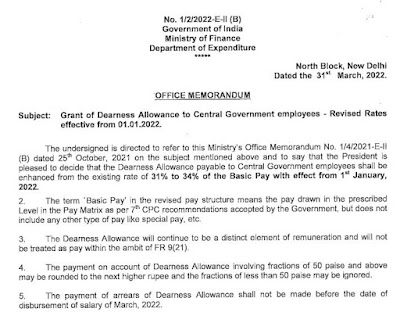
DA Jan 2022 - Grant of Dearness Allowance to Central Government employees - Revised Rates effective from 01.01.2022

 3% DA Hike - Revised Rates effective from 01.01.2022: DoE OM dated 31.03.2022 No. 1/2/2022-E-II (B) Government of India Ministry of Finance...