Saturday, 18 June 2016

Finmin reject claims of inflation due to 7th Pay Commission award

Finmin reject claims of inflation due to 7th Pay Commission award

A salary hike is likely proposed by the Empowered Committee of Secretaries, which has been constituted to look into the recommendations of the 7th Pay Commission for cabinet nod, will not fuel inflation, says Finance Ministry top officials.

“The implementation of these recommendations will not affect inflation. The recommended pay scale has been hiked in line with the increasing size of the budget of government of India,” they told our reporter.
The 13-member body of Empowered Committee of Secretaries, headed by the Cabinet Secretary P K Sinha, who is processing the recommendations of the 7th Pay Commission decided to hand over soon its possible proposal to the the Finance Minister Arun Jaitley for cabinet nod. It is likely to propose a substantial pay hike which could be up to 30 per cent or even more, said officials.

the 7th Pay Commission had recommended a minimum monthly basic salary of Rs. 18,000 and maximum Rs. 2,50,000. A 30 percent increase would translate into minimum basic salary of Rs. 23,400 and maximum at Rs. 3,25,000, respectively.

However, The Empowered Committee is likely to purpose Rs 2,70,000 as highest basic pay and Rs 24,000 as the lowest, they also likely to recommend for doubling of existing rates of allowances and advances, the officials added.

The government in its annual budget has provisioned Rs 70,000 crore to meet the demand for implementation of 7th Pay Commission for central government employees which will take effect from January 1, 2016, while the allowances would be paid from the date of implementation.

“Central government employees could get the revised pay and allowances from their August salaries and arrears are to be paid ahead of festive season of Dussehra in one installment,” the officials confirmed.
The Economists fear that the 30 percent salary hike would fuel inflation as the pay commission recommendations will also have a bearing on the salaries of the state government staff.

So quite understandably, the government employees are happy as pay increase will enable them to increase their consumption and meet some of their unmet demand.

At the same time, there is a widespread fear that the pay commission recommendations are likely to increase inflation which will reduce the purchasing power of money.

RBI Governor Raghuram Rajan earlier said the 7th Pay Commission recommendations will not upset fiscal maths as additional expenditures will be offset by either surplus revenues or expenditure cuts.

Finance Minister Arun Jaitley earlier also said hat he was not worried about fiscal deficit on implementation of the pay commission’s recommendations. He said that the Pay commission award increase government expenses by Rs 1.02 lakh crore but that would not be a problem.

“The government has sufficient resources. Implementing the 7th Pay commission award will not affect inflation.” the official told our reporter.

The officials said that apart from hiking pay, the government is also likely to propose some administrative reforms, to be implemented in phases.

TST

7th CPC: Secretaries group submits final report to Fin Min; Cabinet approval in 15 days

7th CPC: Secretaries group submits final report to Fin Min; Cabinet approval in 15 days

New Delhi: It’s good news for central government employees eagerly waiting for the implementation of 7th Pay Commission.

The implementation of 7th Pay Commission appears to be a matter of a few days now. As per Dainik Jagran report, the Cabinet Secretary met the PMO officials on Wednesday and apprised them about the secretaries panel’s recommendations on the salary and allowances hike recommended for central government employees.

The secretaries panel reviewing the 7th pay commission’s recommendations have submitted its report to the Finance Ministry. The Finance Ministry will prepare a note and present it before the Cabinet in the next 15 days.

With the threat of strike by central government employees looming large, the Cabinet is expected to take a prompt decision on the recommendations resulting in notification.

The salary hikes recommended are expected to apply from July.

Read at: Zee News

7th Pay Commission – Non-settlement of demands – 11th July Indefinite Strike – NJCA writes to PM for intervention

7th Pay Commission – Non-settlement of demands – 11th July Indefinite Strike – NJCA writes to PM for intervention

Ph.: 23382286
National Council (Staff Side)
Joint Consultative Machinery
for Central Government Employees
13-C, Ferozshah Road, New Delhi – 110001
EMail: nc.jcm.np@gmail.com

NO.NC/JCM/2016/CS/PM
Dated: 14.06.2016
Hon’ble Prime Minister of India,
152, South Block,
Raisina Hill,
New Delhi-110011
Respected Sir,

Sub: Non-settlement of our demands – Decision to go on “Indefinite Strike” commencing from 11.07.2016 – Request for your intervention and support.

I write this on behalf of the apex level body of all the Central Government Employees Organizations who are participating in the Negotiating Forum; called the Joint Consultative Machinery. The JCM as a Negotiating Forum was conceived and implemented in 1966 after the prolonged discussions with the Staff Associations and the Federations in the Central Services in the wake of first industrial action in 1960. The idea of setting up the JCM was in realization of the absence of a platform to discuss, deliberate and settle the demands/issues/grievances/problems of the Civil Servants. Up to 1995-96 the JCM, which has a three level negotiating platform was functioning well, meetings were regular. However, after the promulgation of the new recognition Rules in 1993, the meetings at the Ministry level became few and far between and at the national level, the deterioration stepped in a little latter. The National Council, which was to meet thrice in a year did not meet even once in a year. The last meeting of the National Council was held on 15.05.2010 The organizations participating in the JCM were demanding the meeting to be held, but the pleas were ignored by the successive Cabinet Secretaries. The Charter of Demands (copy enclosed), in pursuance of which the strike is decided to be organized, has arisen due to long neglect of the grievances of the employees/workers.

When the 7th CPC was set up in February, 2014, no announcement for Interim Relief or DA Merger was made by the then government, which had all along been the practice whenever the government had set-up the Pay Commissions earlier. We fully co-operated with the Commission, submitted a memorandum detailing the issues and explained the reasoning behind each demand. The 7th CPC submitted report on 19.11.2015 to the government. In our communication dated 10.12.2015 (copy enclosed), we sought
improvement/amendment over the recommendations of the 7th CPC and explained our demands both in writing and orally before the Empowering Committee. Most of the meetings were monologues except perhaps the last one. What we have understood, is that, the Empowering Committee might not come forward to make any major changes. A fruitful meeting is supposed to be a dialogue where both parties at the negotiating table exchange their understanding, views and difficulties and reach a mutually acceptable position. In 1998, when the then Cabinet Secretary decided not to have such a dialogue with the Staff Side and unalterably issued the Government Notification on the 5th CPC recommendations, the then government did set up a committee of Group of Ministers. The GoM held discussions on all issues and averted the strike action. The 1998 situation establishes, without an iota of doubt, that, the Staff Side has always taken reasonable stand on all the issues and paved way for settlement.

The one and only recommendation made by the 7th CPC was to provide some relief to the past old pensioners. The Department of Pension & Pensioners’ Welfare has unfortunately recommended to the Cabinet Secretary that, even that recommendation must be rejected on the specious plea that the requisite relevant records might not be available.

These developments have caused anguish, anxiety and anger amongst the workers. It is now more than six months that the Commission submitted its report. If the government comes forward to hold a meaningful discussion with the leaders of the NJCA, a mutually acceptable settlement can be brought about and the impending strike, slated to commence from 11.07.2016, can ultimately be avoided.

We seek your co-operation, supports and intervention in the matter
Yours faithfully,
sd/-
(Shiva Gopal Mishra)
Secretary(Staff Side),
NC/JCM
Source : National Council (Staff Side)

Improve VII CPC recommendations. Revise Central Govt. employees wages immediately

Improve VII CPC recommendations. Revise Central Govt. employees wages immediately.

In the face of the unprecedented rise in the inflation of the Indian Economy during 2006-16, the Central Govt. employees demanded the Government to affect wage rise, for the emoluments fixed on the basis of the 6th CPC was incapable of meeting the both ends of an employee. Though under threat the then Government conceded the demand for setting up of the 7th CPC, they refused to grant any interim relief or DA merger, which alone would have mitigated the difficulties of the low paid employees.

When the NDA Government came to power, the NJCA & CCGGOO approached them also with a request that the difficulties of the low paid employees in Central Government must be appreciated and the demand for Interim Relief or DA merger be conceded. The NDA Government too did not respond to the plea made by the NJCA & CCGGOO.

The 7th CPC was to submit its report in August, 2016. However, at the intervention of the Government, the report was further delayed and it ultimately reached the Government only in November, 2015.
The report of the 7th Central pay commission was totally disappointing as it did not address any of the issues projected before them in a proper manner and most of the demands were rejected sans reasoning and logic. The increase they recommended was a paltry 14%, the lowest any Pay Commission had ever suggested.
Except setting up an Empowered Committee of Secretaries, the Government did not do anything so far on the report. It is now more than six months the report is with the Government. Normally the revised allowances which form part and parcel of the salary of the employees are granted with prospective effect i.e. from the date of the issue of the orders. The delay in taking decision on the 7th pay commission report will rob the employees of the increased allowances for ever.

The Staff side had been pursuing to have a meaningful negotiation and settlement of the issues. Except hearing the leaders of NJCA & CCGGOO, the empowered Committee did not go further. It acted as if it was powerless and the final decision will have to be taken by the Government. At the request of the Cabinet Secretary on 1st March, 2016 the strike action which was to commence in April, 2016 was deferred.
The determination of the Minimum wage on the basis of Dr. Aykhroyd formula enunciated in 1957 to which the Government of India was a party is the most significant issue. A right settlement thereon will have far reaching impact in the wage determination of the entire working class in the country. The confrontation is between the forces who wanted India to be the destination for cheap labour and others who fight against the exploitation.

The new Contributory Pension scheme introduced by the Government in 2004 has made one third of the Civil servants unsure of their entitlement at the evening of their life even though they were to contribute huge sums from their wages every month compulsorily. The PFRDA bill became an Act in the country as the members of Parliament both belonging to NDA and UPA voted in favour of the loot of the employees. Even the recommendation made by the Standing Committee of the Parliament to provide for a minimum guaranteed annuity pension was rejected when the Bill was passed. The other issue which must have a satisfactory settlement is about the contributory pension scheme.

The new pension scheme is a curse on the employees. As far as employees are concerned, they are worried that in future they may be deprived of their pension in total. They are also worried that there is no guarantee of either family pension or gratuity as per 7th pay commission recommendations. Scrap the PFRDA Act and NPS and grant Pension/family Pension to all CG employees under CCS (Pension) Rules, 1972 & Railways Pension Rules, 1993.

The one and only positive recommendation made by the 7th CPC was to provide some relief to the in the pension entitlement of the past pensioners. The Department of Pension & Pensioners’ Welfare has unfortunately recommended to the Cabinet Secretary that, even that recommendation must be rejected on the specious plea that the requisite relevant records might not be available.

The central government employees are very much annoyed and anxious with the 7th pay commission recommendations. As there had been no fruitful negotiations or discussions and having realized that the Government has no intention to settle the Charter of demands, the NJCA & CCGGOO have served strike notices. The indefinite strike will commence on 11th July, 2016, if no satisfactory settlement is brought about on the charter of demands. Prime Minister should intervene immediately for improvement of VII CPC recommendations and revision of Central Govt. employees wages.

Source-http://aidrdotoa.blogspot.in/

AIBOA Strike on 12th and 13th July 2016

AIBOA  Strike on 12th and 13th July 2016

ALL INDIA BANK EMPLOYEES’ ASSOCIATION
Singapor Plaza, 164, Linghi Chetty Street, Chennai-600 001
ALL INDIA BANK OFFICERS’ ASSOCIATION
A.K.Nayak Bhavan, 14, 2nd Line Beach, Chennai-600 001


CIRCULAR TO ALL UNITS
16th June, 2016
Dear Comrades,
AIBEA-AIBOA decide to plunge into immediate action to oppose attempts to denigrate Public Sector Banks and to protest against proposed merger and consolidation of Banks with a view to divert the people’s attention from the Himalayan bad loans in Banks .

12th July, 2016 – All India Strike in 5 Associate Banks
13th July, 2016 – All India Strike in ALL BANKS

All our units and members are aware of the increasing attacks being heaped on the public sector banks and the challenges faced by the PSBs.

In the name of banking sector reforms, the attempt is to privatise the Banks and hand them over to the private corporates to enable them to further loot the precious savings of the people.

The attempt is to consolidate the Banks to make them bigger with a view to globalize them instead of expanding the Banks and reach the common people within our country.

Already our Banks are bleeding due to alarming increase in bad loans, thanks to the deliberate default by the corporates and big business enterprises. Instead of taking tough measures to book the culprits and recover the loans, efforts are taken to hand over the banks to very same defaulters.

It is very clear that all their talks of banking reforms and proposals of merger and consolidation are only a ploy and game plan to divert the attention of the people from the massive bad loans in the Banks.

Our country needs strong public sector banks and not necessarily big banks or global-sized banks. Our country needs banking expansion and not consolidation of banks and shrinkage of banking services to people.

The focus should be the alarming increase in bad loans to the tune of about R. 13 lac crores. The efforts should be to recover the money by taking stringent measures and not hush it up through provisions, write-offs, CDRs and SDRs.

If the loans have been sanctioned wrongly, action should be taken on the concerned Executives. If the borrower has cheated the Banks, criminal action should be taken against the defaulter.

Providing for the bad loans, clean-up of Balance Sheet and making the Banks to incur the losses is not the solution to the problem. It is obvious, all these are only diversionary tactics to escape from the accountability for the huge bad loans.

Kingfisher Mallya is only the tip of the iceberg. There are many more sharks in the ocean of bad loans in the Banks. Why the list of defaulters is not being published by them? Why criminal action is not taken on the willful corporate defaulters? Why all velvet treatment to them? Why the attempt to convert the bad loans as equity investment in these defaulter companies? Is it the corporate governance and good governance policy of the Government ?

In IDBI Bank, 10 years ago, about Rs.9000 crores of bad loans were taken out of their books. Now another Rs. 19,000 crores is the bad loan. Instead taking action to recover these bad loans, the Government wants to privatise and sell the Bank to the very same private sector which is responsible for these huge loan default in IDBI Bank.

Hence AIBEA and AIBOA have decided to plunge into immediate action to oppose attempts to denigrate Public Sector Banks and protest against proposed merger and consolidation of Banks with a view to divert the people’s attention from the Himalayan bad loans in Banks.

Programmes

20th June Demonstrations in all centres all over the country
30th June Dharna in all State Capitals
12th July All India Strike in the 5 Associate Banks
13th July All India Strike in all the Banks

Comrades, while we are proud that we fought and achieved nationalisation of Banks, it is equally our duty to fight against the attacks on public sector banks. People’s money cannot be allowed to be looted like this. Public Sector Banks should be saved. They are nation building institutions. They must remain so.

It is time to move, time to fight. We exhort all our units and members to carry out the programme successfully and make the strikes a total success.

With greetings,
Yours comradely,
S. NAGARAJAN
GENERAL SECRETARY
AIBOA
C.H. VENKATACHALAM
GENERAL SECRETARY
AIBEA

7CPC: Good news for government employees! Secretary Panel submits report; recommendations implementation soon

7CPC: Good news for government employees! Secretary Panel submits report; recommendations implementation soon

New Delhi,  There is a good news for central government employees who have been ardently waiting for the implementation of 7th Pay Commission. According to a Dainik Jagran report, “The Cabinet Secretary met the PMO officials on Wednesday and apprised them about the secretaries panel’s recommendations on the salary and allowances hike recommended for central government employees.

The secretaries panel reviewing the 7th pay commission’s recommendations have submitted its report to the Finance Ministry. The Finance Ministry will prepare a note and present it before the Cabinet in the next 15 days.” Whereas according to a India.com report, “The 13-member Committee of Secretaries headed by the Cabinet Secretary Pradeep Kumar Sinha is likely to submit its final report on the recommendations proposed by the 7th Pay Commission on June 18. After panel submits its report, Cabinet is expected to give the green signal for implementation of the revised recommendations. However the government is planning to implement the recommendation made by the 7th Pay Commission regarding the salary hike of government employees from August 1.” According to latest reports, Government staff will get their six months arrears in one installment in the month of October. It is being said that Government will implement Seventh Pay Commission most likely from July. Employees will get increased payout in their July salary and it will be credited in their account on August 1. The recommendations when implemented would have bearing on remuneration of 47 lakh central government employees and 52 lakh pensioners. Subject to acceptance by the government, the recommendations will take effect from January 1, 2016.

OneIndia News

Friday, 17 June 2016

7th Pay Commission: Double bonus for Government employees – salary hike from August, six month arrears in October – Social Media

7th Pay Commission: Double bonus for Government employees – salary hike from August, six month arrears in October – Social Media

Around 47 lakh Central Government employees are eagerly awaiting the salary hike, along with the 52 lakh pensioners who are expecting a significant increase in the monthly pension provided to them.

New Delhi, June 16: As per the latest updates related to 7th Pay Commission, the government is likely to give a double bonus for those working under the central government. According to reports, the Commission has decided that salaries would be hiked from August 1 and six months arrears will be paid to the employees in one installment in October.

As per the recent developments, the government has already started working to credit the hiked salaries in the accounts of employees from August 1, 2016. Around 47 lakh Central Government employees are eagerly awaiting the salary hike, along with the 52 lakh pensioners who are expecting a significant increase in the monthly pension provided to them which was also promised by Narendra Modi government.

The Seventh Pay Commission will be implemented from July and the increased payout will be credited in employee’s’ account on August 1.

On Thursday a news report suggested that the six months arrears from January to July will be handed before Dussehra festival which is in October.

An unidentified official working with the commission was quoted by The Financial Express saying, “Central government employees could get the revised pay-scales with their July salaries that would be credited on August 1?.

There was a meeting held on Tuesday where Cabinet Secretary P K Sinha along with other Empowered Committee of Secretaries sat for few hours and submitted its final report. Report suggest that, Secretaries Panel in its final report has recommended 30 per cent hike which is more than what was proposed by the pay panel i its November report.

The commission had earlier recommended a minimum monthly basic salary of Rs 18,000 and maximum of Rs 2,50,000. With the 30 per cent hike the minimum basic monthly pay will be Rs 23,500 and the maximum will be Rs 3,25,000. The new reforms will directly impact the Central Budget by Rs 73,650 crore and the Railway Budget by Rs 28,450 crore.

Source : India.com

Grant of House Rent Allowance to Railway Employees posted to new zones/new divisions

Grant of House Rent Allowance to Railway Employees posted to new zones/new divisions

GOVERNMENT OF INDIA
MINISTRY OF RAILWAYS
(RAILWAY BOARD)
RBE.NO.63/2016
NO.E(P&A)II-98/HRA-6
New Delhi, dated 13.06.2016.
The General Manager/CAO’s
All Indian Railways & Production units.

Sub: Grant of House Rent Allowance to Railway Employees posted to new zones/new divisions – regarding.

Attention is invited to the instructions contained in Board’s letter of even number dated 9.3.2004 and 17.02.2016 on the above subject.

2. The matter has been considered by the Board subsequent to issue of letter No.E(G)2009 QR-1-2 dated 05.04.2016 and it has been decided that railway employees posted to ECR and NWR may be allowed house rent allowance upto 31.12.2016 on the same terms and conditions laid down in the letter of even number dated 09.03.2004 ibid and as emended/clarified from time to time.

3. This issues with the concurrence of the Finance Directorate of the Ministry of Railways.
sd/-
(Salim Md.Ahmed)
Dy.Director/E(P&A)-II
Railway Board.

Minutes of the Pre Retirement counseling workshop held on 31st May, 2016 at Vigyam Bhawan under the chairmanship of Secretary (Pension)

Minutes of the Pre Retirement counseling workshop held on 31st May, 2016 at Vigyam Bhawan under the chairmanship of Secretary (Pension)

A Pre Retirement counseling workshop was conducted on 31st May, 2016 at vigyan bhawan, New Delhi for retiring employees of various Ministries/Departments of the Central Government.

At the outset, Joint Secretary (Pension) welcomed the participants and gave a brief overview of the workshop. During the technical sessions she informed the participants about the road map for sanction of pension and other retirement benefits and the role and responsibility of the retiring employees as well as that of Head of Office for timely payment of retirement dues. participants were asked to complete all formalities in time and submit Form 5 to Head of Office. Heads of Departments were requested to monitor the delay at various stages through Bhavishya.

In the next session, participants were informed about Sankalp, the scheme of Department of Pension & PW for engaging pensioners for voluntary work. Retiring employees were asked to share their experience through Anubhav portal so that the institutions could benefit from their experience and the institutional memories could be strengthened. The Anubhav forms submitted by Pensioners were collected.

Dr.Tiwani, Director, CGHS informad the participants about the CGHS scheme for pensioners and family pensioners and the procedure to get temporary card after retirement.

In the next sessions basic advice on investment, preparation of will and benefits available to senior citizens including Income Tax benefits were also covered.

During the question and answer session, following issues were raised by the participants:

Issue 1: Service verification has not been completed in time and there was an round delay in processing of pension cases.
It was agreed that the matter would be taken up with the concerned Ministry. a general set of instructions would also be sent.

Issue 2: A participant raised a point that for the CGEGIS, payment is delayed due to missing entry in the service book.
Js(P) stated that the matter has been taken up with Department of Expenditure and would be followed up.

Issue 3: One of the participant asked whether vigilance clearance is required at the time of retirement.

It was informed that there is no provision in pension rules.

Issue 4: One participant enquired whether any pension process will be delayed on account of non availability of record of government accommodation and not informed by Directorate of Estates.
JS (P) stated that Directorate of Estates is responsible for giving timely information on dues to be deducted on account of license fee etc. Gratuity may be paid by office if Directorate of Estates does not inform in time.
The workshop ended with vote of Thanks to the participants.

7th Pay Commission Latest News – Increase in Basic Pay meagre but expected gains out of other compensation, a solace

7th Pay Commission Latest News – Increase in Basic Pay meagre but expected gains out of other compensation, a solace

Here are some areas of 7th Pay Commission report which are much beneficial to Central Government Employees. If Govt accepts these recommendations as such overall compensation package of Central Government Employees will be more attractive.

7th Pay Commission Latest News – Increase in Basic pay of 14.22% which is lowest increase out of any Pay Commission – However, certain Positive Aspects of Recommendations made in the 7th CPC Report mainly in the areas of Central Government Employees Welfare measures and Retirement Schemes may be solace to Central Government Employees

After a long wait of 10 years, Basic Pay of Central Government Employees has been proposed for an increase of 14.22%. In any standards, this quantum of increase can not be justified to be adequate. In fact this is the lowest increase out of any pay commission constituted in India so far. Let’s wait and see whether Empowered Committee formed by the Govt to process the present pay commission report make any positive changes to it.

Though 7th Pay Commission report failed to convince Central Government Employees in pay and allowances front, there are certain positive aspects in the recommendations which mainly relate to welfare measures, compensation and Retirement benefits. In the following paragraphs we would be discussing those which might surely improve overall Compensation package of central government employees in the long run.

7th Pay Commission’s decision to retain CPI-IW with base Year 2001=100 for determining Dear Allowance rate:
As demanded by various Central Government Employees Federations 7th CPC has proposed for retaining All India Consumer Price Index (Industrial Workers) with base year 2001=100. This means the allowance offered by govt to compensate inflation would continue to be calculated in the same as it is done presently, after deducting the quantum of DA (@ 125% for 126%) that is to be merged with pre-revised pay.
Dearness Allowance with effect from 1st January 2016 =[ (Avg of AICPI for the period from January 2015 to December 2015 – 115.76)*100/115.76] – 125 (or) 126

Interestingly, the earlier Pay Commission (6CPC) had proposed for adopting to new series of index (CPI-IW with base year 2001=100) which was later accepted by Govt. This measure needed adjustment in the calculation formula in respect of dearness allowance with effect from 1st January 2006 in the form of linking factor of 4.63 between base year 1982=100 and 2001=100
7th Pay Commission as well as Govt could justify in retaining CPI-IW with base year 2001=100 as new series of the index with base year 2015=100 is yet to be unveiled.

A new series of CPI-IW for DA Calculation means adjustments from old base year to new base year using linking factor and rounding-off which would surely put breaks on higher DA to Central Government Employees. So, 7th Pay Commission’s recommendations on retaining the present series of CPI-IW for DA purpose is welcome one.

Enhanced Central Government Employees General Insurance Scheme Coverage up to Rs. 50 lakh:

7th Pay Commission Recommended Rates of CGEGIS
Level of Employee                 
Monthly Deduction
(Rs.)
Insurance Amount
(Rs.)
10 and above
5000
50,00,000
6 to 9
2500
25,00,000
1 to 5
1500
15,00,000

Increase in Gratuity ceiling to Rs. 20 lakh with DA indexed Gratuity for the first time:

7th Pay Commission proposed that ceiling in respect of Gratuity will have to be increased from the existing Rs.10 lakh to Rs.20 lakh.

Moreover, for the first time DA indexed Gratuity viz., increase by 25 percent whenever DA rises by 50 percent has been introduced by the Commission. This measure would surely compensate the inflation factor as gratuity of Rs. 20 lakh received by a retiring employee in 2016 will never be equal to the same amount received by another in 2025.

Further, 7th Pay Commission has proposed that 20 times of monthly emoluments is to be paid as gratuity for employees who intend to retire after serving 10 year of service but before 20 years of service. Presently, 10 times of monthly emoluments is being paid for length of service between 10 years to 20 years.

Child Care Leave extended Single Male Central Government Employees also:

Child Care Leave (CCL) is granted to women employees presently for a maximum period of two years (i.e., 730 days) during their entire service for taking care of their minor children (up to eighteen years of age).
In addtion to women employees, 7th CPC has propsed that a male employee who is single, will also be entited to Child Care Leave.

House Building Advance (HBA) – Loan Ceiling increased to Rs. 25 lakh:

As far Housing loan extended by Govt to its employees is concerned the Commission proposes 34 times of Basic Pay or Rs.25 lakh OR anticipated price of house, whichever is least. This is more than three times higher than the present level.

Children Education Allowance and Hostel Subsidy increased by 1.5 times – whenever DA increases by 50%, these two reimbursements will be increased by 25%

CEA (Rs. pm) 1500×1.5 = 2250 Whenever DA increases by 50%, CEA shall increase by 25%
Hostel Subsidy (Rs. pm) 4500 x 1.5 = 6750 (ceiling) Whenever DA increases by 50%, Hostel
Subsidy shall increase by 25%

7th Pay Commission recommends Higher Grade Pay for certain Posts in Central Government Service considering the service conditions:

On the basis of nature of work and anomalies, 7th Pay Commission has recommended higher grade pay for certain cadres.
Post wise higher grade pay recommended list is given below:

Sl.No Ministry / Dept Name of the Post Present 6cpc Grade Pay (Rs.) New Grade Pay recommended by 7th Pay Commission (Rs)
1. Railways Dietitians 4200 4600
2. Railways Senior Dietitians 4600 4800
3. Railways Assistant Dietetic Officer 4800 5400 (in PB-2)
4. Andaman and Nicobar Administration Junior Radiographer 2000 2800
5. Railways Perfusionists 2400 4200
6. CGHS Dental Hygienists 2400 4200
7. Defence Russian Officers Translators 4600 5400
8. Defence Russian Senior Officers Translators 5400 6600
9. Defence Russian Editors 6600 7600
10. Central Sheep Breeding Farm Sheep Shearer cum Supervisor 1800 2400
11 Indian Postal Service Inspector 4200 4600
12. Indian Postal Service ASPOs 4800 5400
13.
National Archives of India
Assistant Archivists 4200 4600
14. National Archives of India Archivists 4600 4800
15. National Archives of India Scientific Officer 4600 4800, 5400(12 yrs)
16. All Ministries Officers in organised accounts cadres 4800 5400
17. Dr. RML Hospital Junior ECG Technician/Junior Cardiac Technician 2400 2800
18. Andaman and Nicobar Administration Junior Agriculture Assistant/Junior Soil    Conservation    Assistant 2400 2800
19. Andaman and Nicobar Administration Bus Conductors 1800 1900
20. Mines Senior Technical Assistants (STAs) 4200 4600
21.
JTA, Store Keeper, 2800 4200
22.
Assistant Store Keeper 1900 2400
23.
Electrical Supervisor 2800 4200
24
Laboratory Assistant 2400 2800
25
Machine Man, Junior Press Assistant 1800 1900
26 CBI Sub Inspector 4200 4600
27
Inspector 4600 4800
28 Railways Assistant Station Master (ASM) 2800 4200
29 Railways Commercial Clerks + Enquiry Cum Reservation Clerks (ECRCs)+Ticket Checking staff (TTEs and TCs)= Commercial and Ticketing Staff 19002400 20002800
30 Railways Accounts 4800 5400
31 Railways Chemical  and  Metallurgical  Assistants 4600 5400
32 Shipping Head Light Keeper 4200 4600
33 Shipping Navigational Assistant Gr.II 2800 4200
34 Shipping Navigational Assistant Gr.III 2400 2800
35 Shipping Light House Attendant 1800 1900
36 Statistics Director General, Central Statistics Office HAG+ L17
37 Textiles Technical Officers 4200 4600
38 Textiles Assistant Director Gr. II (Technical) 4600 4800
39 Town and CountryPlanning Organisation Planning Assistants 4200 4600
40 Central Water Commission (CWC) Senior Research Assistant 4200 4600
41 Central Water Commission (CWC) Assistant Research Officer 4600 4800
42 Central Ground Water Board (CGWB) Technical Operator (Drilling) 1800 1900
43 National Academies heads of National Academies
Apex Scale Rs.80000
44
Intelligence Bureau (IB)
ACIO-II 4600 4800
45 Intelligence Bureau (IB) ACIO-I 4200 4600

Flash News

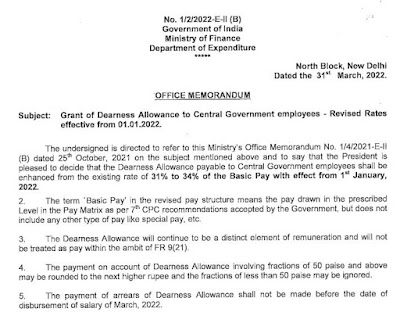
DA Jan 2022 - Grant of Dearness Allowance to Central Government employees - Revised Rates effective from 01.01.2022

 3% DA Hike - Revised Rates effective from 01.01.2022: DoE OM dated 31.03.2022 No. 1/2/2022-E-II (B) Government of India Ministry of Finance...