Sunday, 21 February 2016

Good news for Central Government Employees! DA likely to be hiked to 125% from existing 119%

Good news for Central Government Employees! DA likely to be hiked to 125% from existing 119%
da-hike-12-percent-cg-employees


New Delhi: Narendra Modi government is likely to hike dearness allowance (DA) by 6 percent to 125 percent.

The likely increase in dearness allowance by six percent to 125 percent from existing 119 percent would benefit over 10 million central government employees and pensioners.

The new rate of DA will be implemented from January 1, 2016, which will be applicable for 4.8 million central government employees and 5.5 million pensioners. DA is paid as a proportion of basic pay of employees.

The proposal to hike DA is moved by the Finance Ministry on the basis of accepted formula for calculation. The Union Cabinet approves the DA hike for its employees.

The Centre revised DA twice in a year on the basis of one year average of retail inflation for industrial workers as per the accepted formula.

Earlier in September last year, DA was increased to 119 percent from 113 percent which was effective from July 1, 2015. In April last year, the government had hiked DA by 6 percentage points to 113 percent of their basic pay with effect from January 1, 2015.

Source: Zee news

Budget 2016: After its 7th Pay Commission Rs 40,000 crore ‘request’ denied, Indian Railways wants FinMin to bear PSO bill

Budget 2016: After 7th Pay Commission Rs 40,000 crore request of Indian Railways was denied, Rail Ministry Rail Ministry wants cost of its Public Service Obligations in 2016-17 to be shared by the finance ministry – Indian Railways has demanded that Budget 2016 bear the PSO cost. The PSO, sources said, includes a part of passenger subsidies but not all of it, as the Indian Railways is still to figure out what PSO is.

Even as experts call for an overhaul of the operations of the Indian Railways and its corporatisation, the transporter’s losses from the passenger segment and public service obligations are rising relentlessly and it is now looking for some relief from Budget 2016 (Union Budget 2016 presentation date is February 29).

Indian Railways gives as many as 53 types of concessions in passenger fares. Because of the various subsidises and concessions the transporter provides, Indian Railways had to bear an overall loss of Rs 32,000 core in FY14 for running passenger operations. All of passenger categories except AC three-tier are making losses for the Indian Railways.

Sources in the ministry of railways told FE that Indian Railways social obligation cost would be around Rs 34,000 crore this financial year, steeply higher than about Rs 25,000 crore in FY14. The figure is believed to have stood at over Rs 30,000 crore last financial year, although no official estimate is still out.

The Indian Railways carries out numerous transport activities which are uneconomical in nature but are considered to be in the larger interest of the society. The items which fall under PSOs and are making losses, include transport of essential commodities carried below cost, subsidies and concessions on passenger fares and other coaching services, operation of uneconomic branch lines and new lines opened for traffic during the last 15 years.

“There is no clarity on whether the Indian Railways is a commercial entity or a tool to meet social service obligations. As the transporter needs to invest a lot of money for the expansion and up keep of its infrastructure, there needs to be a proper framework to compensate the Indian Railways on the losses it makes on running passenger operations and the cost it incurs for meeting its public service obligations,” said Abhay Krishna Agarwal, Partner Infrastructure & PPP at EY LLP.

Sources said even the Standing Committee on Indian Railways has recommended the government to work out a procedure on the basis of which the public service obligation costs are reimbursed to the railways. Documents accessed by FE reveal that the finance ministry wants an independent body to evaluate and define what qualifies under ‘public service obligation’ for railways and also decide on the extent of relief which can be claimed from the government under it.

“Utilising your track for providing compensations and subsidises and running below cost operations is not a prudent way of running operations, who is stopping you from increasing passenger fares, political compulsions should not be factored into while deciding fares,” Raghvan Sivadasan, former railway board member said.

While the finance ministry wants an independent body to evaluate and decide on the quantum of burden to be shared, the ministry of railways has proposed an Inter-Ministerial Committee to be set-up for evaluating the impact and the framework of sharing the public service obligation cost borne by the railways. As an interim measure the transporter wants the general revenue to bear a certain percentage losses incurred by the Indian Railways in FY16.

Sources: Financialexpress.com

Budget 2016 expectations: From OROP, 7th Pay Commission overhang to sectoral impact, here are 10 points to note

Budget 2016 expectations: From OROP, 7th Pay Commission overhang to sectoral impact, here are 10 points to note

1. The FM’s priority in the 2016-17 budget will be higher growth, with fiscal rectitude, we believe. With the private sector capex yet to pick up, he will budget for higher plan capital expenditure (investments), in addition to the higher spends on OROP and 7th Pay Commission, which need to be factored in. These will be proposed to be financed by higher revenues from divestment/privatisation, higher indirect tax rates, telecom auctions and better tax compliance, apart from a cut in non-plan expenditure (subsidies) via DBT.

2. A lower fiscal deficit will leave more money available for the private sector, help in easing inflation, and moderate interest rates further. We expect targets under the FRBM Act to be largely maintained. We expect the FM to target a fiscal deficit of 3.7% for FY17 and budget for a gradual reduction in fiscal deficit per annum to 2.5% by FY19.

3. Expect FM Arun Jaitley to target real GDP growth of 7.7% in FY17 and bring it to over 8% next year. Larger and targeted plan expenditure capital outlays, with strict implementation timelines, would likely be announced, to ensure economic recovery and sustainable growth. We expect plan expenditure target to increase by 30% over FY16RE.

4. The budget will aim to provide an investment – led supply aid to growth (with private sector participation via Make in India campaign) as well as a consumption – led demand pull growth via 7th Pay Commission, OROP and DBT of subsidies.

5. On taxation front, we expect the Government to initiate reform process in direct taxes, in line with the announcements of the previous budget. The tax rate is expected to gradually come down from 30% to 25%, with a corresponding removal of exemptions / deductions available currently. On indirect taxes, we expect increase in service tax rate to bring it in line with the proposed GST rate of about 17-18%. Similarly, excise duties will likely be levied on various exempt items and increased for various items which are currently taxed at concessional rates. We are not expecting change in base rate of excise duty.

6. FM Arun Jaitley will have to restrict non plan expenditure to meet his FD targets. While the food subsidy burden will be taken up, we believe the FM will budget for lower fuel subsidy bill on the back of lower crude prices. He will also better target subsidies through the JAM trinity. The government has already announced on January 1, the launch of DBT for kerosene subsidy in a bid to cut down the diversion and black marketing of the fuel. The kerosene subsidy in FY15 was pegged at about Rs.248bn. As per reports, Direct Benefit Transfer (DBT) for LPG had resulted in savings of about Rs.140bn in FY15. We expect DBT to be gradually used for more subsidies. Implementation of DBT for fertilizer and crop subsidy could result in substantial savings.

7. To provide higher employment opportunities and to make the workforce employable, we expect measures to promote the ‘Make in India’ and ‘Skill India’ initiative. We also expect higher allocations towards agriculture and rural sector to support rural growth, after two continuous drought years in the country.

8. We expect the divestment target to be increased to Rs 500bn in FY17 v/s the FY16RE of Rs.200bn. Tax revenue targets (net) may be set at Rs.10.2trn, an 8% growth over FY16RE. Customs duty may be tweaked on several items to further the ‘Make in India’ cause. We expect implementation of GAAR to be postponed to FY18. We also expect tax benefits for the export-oriented sectors, in view of the consistently falling exports and some measures to restrict dumping.

9. SENSEX AND NIFTY TODAY: The 30-share index on Thursday opened 154.60 points up at 23,536.47 on account of firm global markets.

10. We believe that, the budget may have the following implications for the sectors: BUDGET IMPACT POSITIVE: Sectors – Auto, Banking/NBFCs, Capital Goods, Cement, Construction, Metals & Mining, Oil & Gas, Paints, Power, Shipping & Logistics. BUDGET IMPACT NEUTRAL: Sectors – Agro Chemicals, Aviation, FMCG, Information Technology, Media, Pharmaceuticals, Real Estate.

PTI Via financialexpress

Friday, 19 February 2016

Summary report of NJCA Meeting with 7th Pay Commission implementation Cell will be forwarded to the Empowered Committee soon

Summary report of NJCA  Meeting with 7th Pay Commission implementation Cell will be forwarded to the Empowered Committee soon

summary-report-NJCA-meeting-7thCPC

Latest 7th CPC News: Outcome of NJCA Meeting with 7th Pay Commission implementation Cell

Sources Close to the NJCA told that Meeting with 7th Pay Commission Implementation Cell took place as scheduled today.

Joint Secretary, Department of Expenditure, 7th Pay Commission Implementation Cell, represented the Government. It is told that the meeting of NJCA with 7th Pay Commission Implementation Cell continued for three Hours

Justification for 26 demands submitted by NJCA to Cabinet secretary has been summarized before the Joint Secretary, Implementation Cell. Various Issues including revising Fitment Formula, Increasing Minimum Pay, Revising Allowances, restoring Advances with increased rates and granting two increment on Promotion, increasing the rate of increment to 5% have been discussed in detail. Suitable justification was given by NJCA to establish their claims on these demands are reasonable.

It seems that the Points put by NJCA is well taken by the 7th CPC Implementation Cell and the same will be forwarded to Empowered Committee. It is told that the Empowered Committee headed by Cabinet Secretary will invite NCJCM Staff Side to discuss and finalize the issues discussed in this Meeting. After that It will be sent to Cabinet for its nod.

The summary report of this Meeting will be forwarded to the Empowered Committee soon. It is considered as a positive development towards the implementation of 7th Pay Commission recommendations with taking into consideration of NCJCM Staff Side Views.

Loans and Advances by the Central Government – Interest rates and other terms and conditions

Loans and Advances by the Central Government – Interest rates and other terms and conditions

MOST IMMEDIATE
F.No.5(3)-B(PD)/2015
Government of India
Ministry of Finance
Department of Economic Affairs
New Delhi, the 3rd February, 2016
OFFICE MEMORANDUM
Subject:- Loans and Advances by the Central Government – Interest rates and other terms and conditions.

Reference this Ministry’s Office Memorandum F.No.5(3)-B(PD)2014 dated 29th December, 2014 on the captioned subject.

2. The lending rates, categories and conditions prescribed in the
aforesaid Office Memorandum have been reviewed. The revised rates of interest, categories and conditions as given in the Table below, would be applicable from 1st April, 2015 and till the time these are reviewed:

S.No Category of borrower & type of loan Interest rate per cent per annum
1. State Governments:* 8.50
2. Union Territory Governments (with Legislature):

(i) Loans upto 1 year and EAP loan 8.50

(ii) Other Loans 9.00
3. Industrial and Commercial Undertakings in the Public Sector and Cooperatives.

(i) Investment loans # -

(ii) Working Capital loans and loans to meet Cash losses # -

(iii) Loans for implemantation of VRS in sick PSUs 10.00
4. Financial institutions in the Public Sector, Port Trusts, KVIC, NHAI, Municipal Corporation of Delhi,Commodity Boards, Social Service Institutions, Individuals, etc. @
5. National Bank for Agriculture and Rural Development (NABARD) 9.50
* Loans to State Government would be under EAP loans only. For Ways & Means loans, State Govts. have access to RBI window. In case any State has any specific contingent requirement, the proposal would be considered on case specific basis by Budget Division.

# The window of investment and working capital loan to CPSUs from Government of India in general, is hereby closed. CPSUs, in general, are hardly having debt and hence should raise debt from market or from banks. Only if CPSU is justified as significant from ‘Strategic’/ ‘Security’ angle, banks refuse loan to it and it has no real assets including land, to monetise, would loan be extended to it at 11% with the prior approval of Budget Division. However, wherever Investment and Working Capital loan has already been extended to CPSUs in 2015-16, the rate of interest would be at 11.50% and 13.50% respectively.

@The window pertaining to loans to Financial Institutions in the Public Sector, Port Trusts, KVIC, NHAI, Municipal Corporation of Delhi, National Co-operative Development Corporation (NCDC), Commodity Boards, Social Service Institutions, Individuals etc. in general, is hereby closed seeing the offtake under this in last 3 financial years. However, if a specific case still comes in future, it
would be examined by the Budget Division, DEA on merits of that case.

3. The terms, including interest rate of loans to Foreign Governments may be settled in consultation with Budget Division. Terms for on-lending of funds under externally aided projects should be in accordance with the prescribed pattern. In case, deviation is considered necessary, Budget Division should be consulted.
4. The interest rates prescribed above assume timely repayments and interest payments and hence no further rebate in rates is to be allowed for timely payments.

5. OTHER TERMS AND CONDITIONS
(a) The loan sanctioning authority should meticulously follow the instructions contained in General Financial Rules, 2005 (GFR 2005), particularly, rules framed under Chapter 9 (II-LOANS) of GFR, 2005, while sanctioning loans to various entities as stipulated therein.

(b) The instructions issued from time to time have been reviewed and are set out in the following paragraphs for facility of reference.
Click to read more: Finmin.nic.in

Advances to Government servants – Rate of interest for purchase of conveyances during 2015-2016

Advances to Government servants – Rate of interest for purchase of conveyances during 2015-2016
advances-rate-of-interest-government-servants

F.No. 5(2)-B(PD)/2015
Government of India
Ministry of Finance
Department of Economic Affairs


New Delhi, the 3rd February, 2016


OFFICE MEMORANDUM


Subject : Advances to Government servants — Rate of interest for purchase of conveyances during 2015-2016.

The undersigned is directed to state that the rates of interest for advances sanctioned to the Government servants for purchase of conveyances during 2015-2016 i.e. from 1st April, 2015 to 31st March, 2016 are as under:
    Rate of interest
per annum
(i)     Advance for purchase of conveyance other than motor car (viz. motor cycle, scooter etc.)     9%
(ii)     Advance for purchase of motor car     11.5%

The rates remain unchanged from those applicable for the financial year 2014-15.

(A.K. Bhatnagar)
Under Secretary (Budget)

To
1. All Ministries/Departments of the Government of India with spare copies for Integrated Finance Division (IFD), Controller of Accounts and Pay and Accounts Offices.

2. Finance Secretaries of UTs without legislature.

Copy forwarded to:—
1. C&AG of India, New Delhi.
2. C.G.A., New Delhi.
3. C.G.D.A., New Delhi.
4. All AGs and Director of Accounts.
5. Supreme Court of India.
6. UPSC, New Delhi.

Official Order

Government announced the Leave Travel Concession (LTC) rules for easy settlement of the LTC claims

Government announced the Leave Travel Concession (LTC) rules for easy settlement of the LTC claims

The amended Office Memorandum No.31011/3/2015-Estt(A.IV) seek to ease the procedural difficulties faced by government employees while applying for and settling LTC claims.

Setting outer time-limits for various LTC procedures, the DoPT today said leave or sanction of LTC leave advance would take no more than five days each. This would be extendable by three days where the government employee is away for the headquarters.

Besides, the administration will take no more than 10 days (13 where the employee is away from headquarters) to verify LTC claims after the LTC bill is submitted by the government employee.

The government also proposes to allow its employees to self-certify their proposed LTC journey. Under existing CCS (LTC) Rules, government employees are required to inform their controlling officer before the journey on LTC is to be undertaken.

Also, whenever a government employee applies for LTC, he /she may be provided with a copy of the guidelines to be followed while availing of the concession.

A government servant is allowed to avail of LTC once in a block of two years to visit his/her hometown, while LTC to any place in India can be availed once in a four-year block. If not availed during these blocks, the LTC may also be availed in the first year of the following block.

Latest developments in 7th pay commission implementation will be known after NJCA meeting

Latest developments in 7th pay commission implementation will be known after NJCA meeting

Internal Meeting of NJCA is postponed to tomorrow

One of the NJCA Leader told that the internal Meeting of NJCA scheduled to be held today at 05.00 PM has been postponed tomorrow 19-2-2015 at 9.00 AM.

Further he added that until they meet Implementation Cell tomorrow, they have nothing to tell about the developments in Implementation of 7th Pay Commission. “We must first know the views of Central Government before come to any conclusion “ he said.

When we asked him about the Rumors that ‘PMO has told the Empowered Committee to speed up the process of implementation of 7th Pay commission recommendation’ and ‘30 Percent increase is recommended by Empowered Committee in Basic Pay’, annoyed at hearing this rumors, he told, “Many stories like this is being circulated in News Media for unknown reasons.”

“But we are the Stake holders, we are not informed anything about this development. We are invited for the meeting tomorrow by 7th CPC implementation Cell. Only after attending the meeting, we will be able to tell about the recent developments in settling our Charter of Demands submitted to Cabinet Secretary. 26 demands pertaining to Modification of 7th CPC recommendation also has been included in the Charter of Demands” He added.

Source: govtstaffnews.in

Thursday, 18 February 2016

Central Civil Services (Leave Travel Concession) Rules, 1988 – Fulfillment of procedural requirements: Dopt Orders on LTC

Dopt Orders on LTC: Central Civil Services (Leave Travel Concession) Rules, 1988 — Fulfillment of procedural requirements.

No. 31011/3/2015-Estt (A.IV)
Government of India
Ministry of Personnel, Public Grievances and Pensions
Department of Personnel and Training
Establishment A-IV Desk
North Block, New Delhi-110 001
Dated: February 18, 2016
 OFFICE MEMORANDUM 

Subject:- Central Civil Services (Leave Travel Concession) Rules, 1988 — Fulfillment of procedural requirements.

This Department is in receipt of a number of references regarding the procedural difficulties faced by the Government employees in application and settlement of the LTC claims. Sometimes, the Government servants claim that failure to follow the correct procedure was on account of a lack of knowledge of the rules/instructions. It is alleged that in some cases, processing of LTC claims takes unduly long time, particularly when the employee and the sanctioning authorities are located at different stations.

2. To remove these bottlenecks, it has been decided to simplify the procedure of application and make the procedure of processing of LTC claims time bound. The following time-limits shall be followed while processing the LTC applications/claims of  the Government servants.

leave-travel-claim-LTC
*(a) Additional 3 days transit-time may be allowed in cases where the place of posting of the Government employees is away from their Headquarters, The Government employee may proceed on LTC after action on S.No. 1 .

(b) Efforts should be made to reduce the duration of processing of LTC applications/claims at the earliest. The maximum time limit should be strictly adhered to and non —compliance of time limit should be adequately explained.

3. Under CCS (LTC) Rules, the Government servants are required to inform their Controlling Officer  before the journey(s) on LTC to be undertaken. It has now been decided that the Leave Sanctioning Authority shall obtain a self-certification from the employee regarding the proposed LTC journey. The proforma for self-certification has been annexed with this O.M.

4. In addition to the above, it has been decided that whenever a Government servant applies for LTC, he/she should be provided with a copy of the guidelines (enclosed) which ne ds to be followed while availing LTC.

5. Employees ay be encouraged to share interesting insights and pictures, if any, of the destination he/she visited while availing LTC in an appropriate forum.

Enclosures:
1) Proforma fo self-certification
2) Guidelines
(Surya Narayan Jha)
Under Secretary to the Government of India
To
The Secretaries
All Ministries / Departments of Government of India
(As per the standard list)

Proforma for self-certification by the Government employee 

I Sh./Smt./Kr. ----------------------------------------- (Name of the Govt. servant) wish to confirm that I am availing  ----------------------------------- (Home Town/ Any Place in India) LTC in respect of self/ family member(s) for the block year  --------------- to visit ---------------------  (Place of visit) during  (dates of journey). It is stated that I or the family member for whom I wish to avail LTC has/have not availed of the same before in the present block.

2. The Particulars of members of family in respect of whom the Leave Travel Concession is being claimed are as under:

3. It is certified that the above facts are true and any false statement shall make me liable for appropriate action under Rule 16 of CCS(LTC) Rules, 1988 and the relevant disciplinary rules.

* N.B.: The Government employee may share interesting insights and pictures, if any, of  the destination visited while availing LTC on an appropriate forum.

Guidelines 

1. Please ensure that you have applied for leave and submitted the self-certification form to your Administration before the LTC journey is undertaken.

2. Please check your eligibility before applying for LTC. LTC to Home Town can be availed once in a block of two years and LTC to Any Place in India may be availed once in a four year block. If not availed during these blocks, the LTC may also be availed in the first year of the following block.

3. Please note that the current two year block is 2016-17 and the current four year block is 2014-17.

4. In case of fresh recruits, LTC to Home Town is allowed on three occasions in a block of four years and to any place in India on the fourth occasion. This facility is available to the fresh recruits only for the first two blocks of four years applicable after joining the Government service for the first time. (For details, please refer to DoPT's O.M. No. 31011/7/2013 -E stt. (A-IV) dated 26.09.2014 available on www.persmin.nic. in' << `OMs & Orders'<< ' Frequently Asked Questions (FAQs) on LTC entitlements of a Fresh Recruit')

5. A Fresh recruit may at his option choose to avail LTC under the normal LTC rules as applicable to other Government employees. In this case he/she will not be allowed to avail other LTCs as admissible to the fresh recruits in that block of four years.

6. The retiring Government employees are eligible to avail LTC as per their entitlement provided that the return journey is performed before their date of retirement. LTC is not allowed after retirement.

7. The Journeys on LTC are to be undertaken in the entitled class of the Government servant in public/Government mode of transport.

8. Travel by private modes of transport is not allowed on LTC, however, wherever a public transport is not available, assistance shall be allowed for the private transport subject to the certification from an Appropriate Authority that no other public/Government mode of transport is available for that particular stretch of journey and these modes operate on a regular basis from point to point with the specific approval of the State Governments/Transport authorities concerned and are authorised to ply as public carriers.

9. If a Government servant travels on LTC upto the nearest airport/ railway station by authorized mode of transport and chooses to complete rest of the journey to the declared place of visit by 'own arrangement' (such as personal vehicle or private taxi etc.), while the public transport system is already available in that part, then he may be allowed the fare reimbursement till the last point where he has travelled by the authorised mode of transport. This will be subject to the undertaking from the Government employee that he has actually travelled to the declared place of visit and is not claiming the fare reimbursement for the part of journey performed by the private  owned/operated vehicle

10. Government servant may apply for advance for himself and/or his family members sixty five days before the proposed date of the outward journey and he/she is required to produce the tickets within ten days of the drawal of advance, irrespective of the date of commencement of the journey.

11. Reimbursement under LTC scheme does not cover incidental expenses and expenditure incurred on local journeys. Reimbursement for expenses of journey is allowed only the basis of a point to point journey on a through ticket over the shortest direct route.

12. The time limit or submission of LTC claim is :
  • Within three months of completion of return journey, if no advance is drawn;
  • Within one month of completion of return journey, if advance is drawn.
13. Government employees entitled to travel by air are required to travel by Air India only in Economy Class at LTC-80 fare or less unless permitted to do so by any general or specific provision.

14. Government employees not entitled to travel by air may travel by any airline, however, reimbursement in such cases shall be restricted to the fare of their entitled class of train/transport or actual expense, whichever is less.

15. In all cases whenever a Govt. servant claims LTC by air, he/she is required to book the air tickets either directly through the airlines or through the approved travel agencies viz: M/s Balmer Lawrie & Co. Ltd/ M/s Ashok Tours & Travels Ltd/ IRCTC. Booking of tickets through any other agency is not permissible.

16. Travel on tour packages is not allowed, except in the case of tours conducted by Indian Tourism Development Corporation (ITDC), State Tourism Development Corporation (STDC) and Indian Railway Catering and Tourism Corporation (IRCTC). In such cases, only the fare component shall be reimbursable provided ITDC/STDC/IRCTC separately indicate the fare component and certify that the journey was actually performed by the Government servant and his family members for which he/she claiming the Leave Travel Concession.

17. Please ensure that your LTC claim is as per the instructions to avoid rejection of your claim.

"Have a pleasant journey and a happy holiday"

Authority: www.persmin.gov.in

Filling up of the post of JS NCW New Delhi under Ministry of Women and Child Development

Filling up of the post of JS NCW New Delhi under Ministry of Women and Child Development

No.04/04/2016-EO(SM-I)
Government of India
Ministry of Personnel, Public Grievances & Pensions
Department of Personnel & Training
[Office of the Establishment Officer]
New Delhi, 17th February, 2016
To
1. The Chief Secretaries, All State Governments.
2. The Secretaries of all the Ministries/Departments of the Government of India

Subject:- Filling up of the post of Joint Secretary, National Commission of Women, New Delhi under the Ministry of Women & Child Development – reg.

Sir/Madam,
It is proposed to fill up the post Joint Secretary, National Commission of Women, New Delhi a non-CSS post, under the Ministry of Women & Child Development in the pay band of Rs,37,400 – 67,000 (PB-4) and grade pay of Rs10,000/- on deputation basis,

2. Names of willing and eligible officers, who have been em panelled to hold Joint Secretary or equivalent posts at the Centre under the Central Staffing Scheme, may be recommended to this office
along with cadre clearance, vigilance clearance, detailed bio-data, viz, name, date of birth, service, batch, contact telephone number, email address, educational qualifications, complete experience/posting details etc, CR dossiers/certified ACRs for the last five years and details of debarment & cooling off in respect of past central deputation, In case the officers are currently on Central deputation, the nomination may be forwarded with the approval of the Minister-in-charge concerned,

3, The post is a Non-Central Staffing Scheme post to be filled up through the Civil Services Board (CSB) procedure. It may be noted that no ‘Mandatory Posting Certificate’ for allotment Retention of Government accommodation would be issued by this office to the officer appointed on the above referred post. However, those officers who have served and are currently serving on Central Staffing Scheme post in Delhi for at least four years and require to retain Government accommodation, would be issued a certificate to the effect that the officer concerned has served for at least four years in CSS post and she/he needs to retain Government accommodation for her/his tenure on non-CSS post.

4, It is requested that the applications of the eligible candidates may be forwarded so as to reach this Department within one month from the date of issue of this circular,
Yours faithfully,
(Nandini palieal)
Deputy Secretary to the Government of India
Tel. No. 011-2309 2187
Source: ccis.nic.in

Flash News

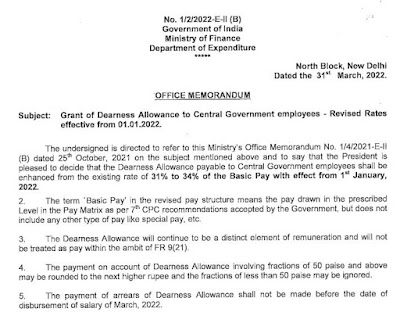
DA Jan 2022 - Grant of Dearness Allowance to Central Government employees - Revised Rates effective from 01.01.2022

 3% DA Hike - Revised Rates effective from 01.01.2022: DoE OM dated 31.03.2022 No. 1/2/2022-E-II (B) Government of India Ministry of Finance...