Tuesday, 17 November 2015

Impact of 7th pay commission very different from last one

Impact of 7th pay commission very different from last one

With investments sluggish and unlikely to pick up for another year or two, many are now betting on a recovery in consumption demand to bump up GDP. The feeling is falling interest rates will prompt purchases of homes and cars, and that central government employees could turn out to be big buyers once their bank accounts have been credited with funds following the recommendations of the 7th Pay Commission. Savings to households from lower prices of oil are expected to free up cash for discretionary spends while a higher MSP (minimum support price) for wheat, if that happens, will boost farm incomes.

However, for a variety of reasons, the rise in consumption-demand this time around may not quite match the spurt seen when the 6th Pay Commission’s recommendations were implemented. As Kotak Institutional Equities points out, the economic environment at the time—the report was implemented in 2008 but effective from January 2006—was far less challenging than currently and there were many other factors that contributed to the surge in consumer demand, none of which is present today. Halving of excise duties—from 16% to 8% between February 2008 and 2009—allowed auto firms to drop prices, and a 425 bps cut in the policy rate in a span of just seven months made money significantly cheaper. Both moves were part of a stimulus package meant to revive demand after the global financial meltdown and resulted in a fall in product prices; the cost of a Maruti Swift, for instance, fell from R6.4 lakh to R5.6 lakh or by around 12%. That apart, the rural economy at the time was in far more robust shape than it is today with farm incomes rising sharply over FY05-13 driven by the MNREGA and big hikes in MSPs; the hike in MSPs for both seasons of FY09 was particularly steep given the elections were round the corner. As such, rural India was a lot more prosperous than now with real rural wages barely growing.

Moreover, consumer confidence was reasonably high as private sector investment, which rose steadily after 2004 and peaked in 2008 at 14% of GDP, had created a lot of jobs. Today, private sector investments are at 15-year lows and corporate cash flows are crimped with most companies highly leveraged. Given the far more difficult environment today, it would be unwise to expect an impact of similar magnitude on consumption demand from pay hikes following the 7th Pay Commission’s recommendations. To be sure, the impact would also depend on the quantum of the hike — the last time around, there was a total increase of 120% between FY06 and FY11, translating into a compounded annual increase of 17%, including R44,000 crore of arrears. Even if the pay hikes are as generous, since there will be no great delay in implementation, there will be no major piling up of arrears. Given that the overall environment will not be as conducive as it was at the time of the 6th Pay Commission, it is unlikely the 7th Pay Commission will pull consumer sentiment up enough to give the economy the boost it needs.

Source: PAlegacy

Allotment of berths under physically handicapped quota – Railway Board Order

Allotment of berths under physically handicapped quota – Railway Board Order

GOVERNMENT OF INDIA (Bharat Sarkar)
MINISTRY OF RAILWAYS (Rail Mantralya)
(RAILWAY BOARD)
No.2012/TG-I/20/P/Handicap
New Delhi, dated 16.11.2015
Chief Commercial Managers,
All Zonal Railways
General Manager,
PRS/CRIS, Chanakyapuri,
New Delhi.

(Commercial Circular No. 67 of 2015)

Sub: Allotment of berths under physically handicapped quota.

As per extant instructions, handicapped quota of 2 berths in sleeper class (one lower and one. middle) is earmarked for physically handicapped persons travelling on concession.

1. There are two types of handicapped persons who can book berth under this quota; one for whom it is compulsory to travel along With escort and the second for whom it is optional. Recently instances were brought to the notice of this office where the handicapped persons for whom it is optional to. take an escort were not allowed to book single berth against this quota by some Railways since the second berth will go vacant as middle berth cannot be allotted to physically handicapped persons. This issue was also raised in Court of Chief Commissioner for Persons with Disabilities.

2. The matter has been accordingly examined and it has been decided. as under:-
(i) There will be two types of handicapped quota of two berths each (one lower and one middle) in the same cabin; one for physically handicapped persons who can utilize concession only when accompanied by an escort and the second for those handicapped persons for whom it is optional to take an escort with them.

(ii) As for the former category it is compulsory to be accompanied by an escort, these berths can be booked by such category of handicapped persons booking tickets on concession on first come first serve basis.

(iii) For the later, where. it is optional to be accompanied by an escort, if the first handicapped person intends to book berth along with escort, both the berths will be booked. However if the first handicapped person books without escort, the second berth will not be booked under handicapped quota and will be released to RAC/waitlisted passengers at the time of preparation of reservation charts.

(iv) Further, at the time of preparation of reservation charts, the unutilized lower berths under this quota can be released to physically handicapped passenger(of either category who were kept in general waiting list due to-exhaustion of their quota), single senior citizen travelling alone on priority and thereafter to waitlisted passengers as per priority. In case a single berth. i.e. middle berth is left vacant in this quota of second category it will be released to RAC/waitlisted passengers.

(v) It has also been decided that whenever a physically handicapped person books ticket on concession and if no berth is available in handicapped quota, the system will automatically try to allot he lower berth to him/her and middle berth to escort subject to availability of same at the time of booking

(vi) CRIS will make necessary modifications in the software at the earliest but not later than 22.12.2015 under intimation to all Zonal Railways as well as to this office.
3. Necessary instructions may be issued to all concerned. After provision of this facility by CRIS, wide publicity to above changes may be made for information of general public.
sd/-
(Sanjay Manocha)
Dy. Director Traffic Commercial (G)-II
Railway Board
Authority : http://www.indianrailways.gov.in/

7th Central Pay Commission likely to submit its final report on November 20

7th Central Pay Commission likely to submit its final report on November 20

NEW DELHI: The 7th Central Pay Commission is likely to submit its final report to finance ministry on November 20 which is due for implementation from January 1, 2016.

More than 48 lakh serving central government employees and 54 lakh pensioners will be impacted by the 7th CPC which is likely to recommend an average hike of 15%, said a source.

The 900-page report is believed to have made suggestions on parity of 36 organized Group A services with the IAS which has so far largely dominated in superior positions in the central government.

The pay panel was constituted in February 2014 and was asked to submit its report within 18 months. However, in August the government gave the panel four months extension to submit its report by December.

Its recommendation will guide how the salary and various allowances of central staff will be revised besides improving their service condition. The report would also impact all the public sector employees and central autonomous bodies which generally make corrections as per the hikes given to the central staff.

Even before the report was finalized there was intense lobbying seen where all the 36 organised Group A services petitioned the commission seeking parity with the IAS and determination of central postings based on merit.

The IAS officers too had sent their individual dissention notes to department of personnel and training and the cabinet secretariat besides the pay panel demanding that their edge and superiority be maintained.

One of the demands of the Group A services is to change the composition of the Civil Services Board which is responsible for central staffing. As of now this is dominated by IAS officers and has no representation from any other service. The pay panel may recommend changes that would ensure level playing field for all officers of Group A services.

Source: TOI

Monday, 16 November 2015

7th Central Pay Commission Issues and Expectations

7th Central Pay Commission (CPC): Issues and Expectations

Every ten years, the Central Government of India sets up a Central Pay Commission (CPC) to revise the pay scales of its employees. Since these pay scales are largely adopted by state governments as well, they influence the income of millions of households.

During 2013, time seemed to be running out for the constitution of the next Commission before the beginning of the election cycle. But on September 25, 2013, a week before the election-related Code of Conduct became effective, the government set up the Seventh Central Pay Commission. This commission will review and revise the salary and pensions of 50 lakh (5 million) or more Central Government employees. Now that it is constituted, the Commission will most likely be able to implement its recommendations by the scheduled date of January 1, 2016.

Duties of the Seventh Central Pay Commission

On Feb 28, 2014, the Cabinet approved the terms of reference of the 7th CPC. The CPC is expected to suggest a merger of 50% of DA (daily allowance) with basic pay, which would increase the gross salary of Central Government employees by around 30%. The Cabinet has approved an additional 10% DA over the existing 90% admissible DA, effective January 1, 2014. This increase would be paid in cash after the disbursement of March salary. The 7th CPC is required to submit its recommendation within a year and a half of its date of constitution.

Major issues to be resolved

1. Pay Parity between IAS & other government services: Hundreds of letters are sent by IAS officers to the concerned government officials apprehending that the seventh central pay commission may try to restore parity between different government services in terms of compensation and career progression. It is to be seen how 7th CPC and government deals with this crucial issue.

2. Pay parity with private sector: Central services have demanded to every pay commission to create parity with the officers of private sectors and make their salary structure comparable to later.

3. Retirement age: There is no denial of the fact that working efficiency of an employee is influenced by the increasing age but experience often weighs heavily over the age factor. Even then looking at attitude of present government impression is clear that pay commission is signaled to reduce the retirement age of government employees. Whatever circumstantial indications are available it shows that either 33 years of service of 60 years of age (whichever is minimum) is likely to be recommended. If media reports have ant substance of truth, under performers may be asked to opt for voluntary retirement after reaching the age of 55 years.

4. Pay gaps between least & highest paid employees: In 1947, gaps in salary between lowest and highest paid government employee was in the 1:41 ratio that got reduced to 1:12 by subsequent pay commissions. It has to be observed whether this gap is widened or reduced by the 7th CPC.

5. Continuing with grade pay system? It would be interesting to note whether 7th CPC continue grade pay system or adopts old pay scale system. As per reliable sources, grade pay system will not longer exists in 7th CPC structure. A table is circulating in the media predicting projected pay scales believed to be suggested by 7th CPC.

What are the hottest rumors?
1. Central Government is willing to merge 50% DA with basic pay with effect from 1.1.2015 – All Government employees would be happy if it has happened,
2. Age of Retirement will be determined based on completion of 33 Years of service or at the age of 58/60/62/65 Years (depending on existing retirement age in various departments) whichever is earlier.

Members of the Seventh Central Pay Commission
Chairman – Ashok Kumar Mathur (Former Supreme Court Justice and Former Chairman, Armed Forces Tribunal)
Full time member – Vivek Rae (oil secretary)
Part time member – Rathin Roy (Director, NIPFP)
Secretary – Meena Agarwal (OSD, Department of Expenditure)
Latest update
  • Union Cabinet chaired by PM on August 26, 2015 gave its approval for extension to 7th CPC to submit its report by the end of December 2015.
  • As per reports in media, 7th CPC is likely to maintain status quo on the retirement age. However, some unconfirmed sources didn’t rule out the possibility of a suggestion from Pay Commission to the government that the earliest of either 33 years of service length or 60 years of age may be considered as a criteria for superannuation of central government employees.
  • Recommendation for pay hike is likely to be low after merging the existing basic pay and dearness allowances. Merging the both component mean 155% rise and adding 25-35% extra makes it 1.8 to 1.9 times in terms of basic to basic.
  • Grade Pay is likely to be abolished by 7th CPC and gaps between pay scales may widen and hence 7th CPC scale may some what follow the earlier pay formats (as in 3rd, 4th or 5th CPC)
  • Government may not risk any adverse effect of disclosures related to pay recommendations on election prospects in upcoming Bihar elections.
Implementation Dates of Previous Pay Commission Recommendations
January 1, 1986 – 4th Pay Commission
January 1, 1996 – 5th Pay Commission
January 1, 2006 – 6th Pay Commission

The Pay Commission Process
Implementation of a Pay Commission’s recommendations always leaves behind a few anomalies for the next commission to resolve. Making recommendations for pay revision is a long process, involving discussion with various organizations, submission of demands by representatives of unions and associations, and evaluating the potential financial impact of these demands on the national exchequer. Representatives of various organizations are asked to make presentations. The Pay Commission examines service conditions, pay, and perks given to employees.

All the earlier Commissions set up to revise the pay of Indian Central Government employees—except the 6th CPC—took more than three years to submit their report. The Sixth Pay Commission submitted its report within just eight months. Nevertheless, such a quick turnaround cannot be taken for granted for future Pay Commissions, since the timing of report submission and the nature of the recommendations are influenced by political and economic considerations.

Rationale for the Seventh Pay Commission
The constitution of the Seventh Pay Commission is justified for the reasons listed below.
  • Daily Allowance (DA) has already exceeded 100% of basic pay, and it cannot be merged with basic pay due to the recommendations of the 6th CPC.
  • Since the wages of some categories of non-government employees are revised at intervals of less than ten years, wages should be revised every five years for central government employees also.
  • Prompt pay revision of Central Government employees will help reduce the increasing disparities between Central Government employees, public sector employees, bankers, and private sector employees.
    How much increase in salary is expected after 7th CPC implementation
Other expected tasks for the 7th Pay Commission include resolving anomalies created by the 6th CPC and addressing bonuses and problems related to the new pension program. All sections of employees will get an opportunity to present pay-related problems to the new Pay Commission and request redress of their grievances.

A new demand gaining support is constitution of a National Pay Panel that will make recommendations for all employees of the country. Since most of the states have adopted for their own employees the pay structure suggested by the 6th CPC for Central Government employees, uniform recommendations would remove discrimination between state and central employees. Recommending a uniform wage structure for each and every employee of India would also reduce pay disparities between private, public and autonomous organizations.

My poll indicates that 39% believe that Central Government employees are likely to get a threefold raise in salary. This is consistent with what was done in the past by earlier pay commissions. Given the existing trend in DA increase, salary may increase 2.3 times by the implementation date of the 7th CPC. Projected pay scales under this assumption are shown below.

Projected Pay Scales (After Implementation of the 7th CPC)

Projected 7th CPC Pay Structure

A projection based on media report is reproduced below. However, a fake report in the name of 7th CPC is also being circulated in the media by some miscreants. 7th CPC has been granted extension by the Government of India to submit it report by the end of December 2015. It would be clear after the submission of report by 7th CPC what content it has submitted to the ministry for acceptance. Further, each and every point in the report will be examined by the cabinet and approved after considering all the implications. Till then enjoy and go through the speculations made by experts.

7th_pay_commission_pay_scale

7th CPC as per some media reports has eliminated grade pay system and recommended pay scales similar to earlier pay commissions.

A better way to get rid of corruption in public life than across-the-board increases would be to legalize a commission on services by each and every employee. This would also help improve the productivity of private sector employees. In some private or autonomous banking institutions, for example, employees are paid a reasonable percentage for accomplishments such as encouraging customers to open more accounts.
Wage revision is expected for Central Government employees effective January 1, 2016. The newly constituted Pay Commission will get two years to review the existing wage structure and suggest a new one, to meet the expectation of employees, and also to increase efficiency at work at a pace with the growth in the economy.

The Seventh Pay Commission needs to introduce more parity into the pay structure of various sectors. Employees in all departments have been vested with more responsibilities, but their pay structure still belongs to the British period. People serving in the police and armed forces have very low salaries although their duties have become enormously more challenging. Government should increase the compensation to its officers for any service-related casualty. Police forces working under adverse conditions and in remote areas must be paid high wages and good benefits so that more people join these organizations.

The new pension system implemented based on the recommendations of the 6th CPC needs to be revisited and reviewed by the 7th CPC, since the adequacy of fund management depends on market forces and the capabilities of fund managers. The 7th Pay Commission needs to take some vigorous action, based on discussions with trade unions, to come out with a more amicable solution for the new pension scheme.
These are some of the things people genuinely expect from the government, but time will tell how much people get from the CPC.

Source: Hubpages.com

7th Pay Commission Minimum Pay 21000 and Fitment Formula from 2.86 to 3.15

7th Pay Commission Minimum Pay 21000 and Fitment Formula from 2.86 to 3.15

“There is a possibility of 7th CPC to submit its report on 20th November 2015 or 23rd November 2015 , but the report will not be to your expectations, The minimum wage taking into prices published by the Government of India shall come to Rs 26,000/-, considering the existing retail prices the minimum wages works out to Rs 28,000/- and fitment formula shall works out to 4.00 , but the minimum wage may be around Rs 21,000/ against the justified demand of Rs 28,000/- the fitment formula may be from 2.86 to 3.15 , also many other important demands of five promotion policy, Increment rate increase, retirement issues, pension issues etc.

We have to wait and watch the 7th CPC report will the 7th CPC accept the staff side demands or not.”

Observance of All India protest day on 19th November 2015 & 7th CPC to submit its report shortly

Comrades
The Confederation and NJCA had given call for holding protest meetings from 2ndNovember 2015 to 6th November 2015 and also Observance of All India protest day on 19th November 2015 in respect of following demands.

Charter of Demands
1. Effect wage revision of Central Government employees from 1.12014 accepting the memorandum of the staff side JCM; ensure 5-year wage revision in future; grant interim relief and merger of 100% of DA. Ensure submission of the 7th CPC report with the stipulated time frame of 18 months; include Grameen Dak Sewaks within the ambit of the 7th CPC. Settle all anomalies of the 6th CPC.

2. No privatisation, PPP or FDI in Railways and Defence Establishments and no corporatisation of postal services;

3. No Ban on recruitment/creation of post.

4. Scrap PFRDA Act and re-introduce the defined benefit statutory pension scheme.

5. No outsourcing; contractorisation, privatization of governmental functions; withdraw the proposed move to close down the Printing Presses; the publication, form store and stationery departments and Medical Stores Depots; regularise the existing daily rated/casual and contract workers and absorption of trained apprentices;

6. Revive the JCM functioning at all levels as an effective negotiating forum for settlement of the demands of the CGEs.

7. Remove the arbitrary ceiling on compassionate appointments.

8. No labour reforms which are inimical to the interest of the workers.

9. Remove the Bonus ceiling;

10. Ensure five promotions in the service career.
We should not let down our struggle path I once again request one and all to participate in the All India protest day on 19th November 2015 at all places including the districts and send me the photos of protest meeting to publish on COC Karnataka website and this will send information to the Central Government on our demands.
Comradely yours
(P.S.Prasad)
General Secretary
Source: www.karnatakacoc.blogspot.in

Sunday, 15 November 2015

Sanction of 6% dearness Relief on the pension of the pensioners of the state of Madhya pradesh

Madhya pradesh Dearness Relief 6% July 2015

GOVERNMENT OF MADHYA PRADESH
FINANCE DEPARTMENT
MANTRALAYA – BHOPAL
No.F 9-2/2015/Rule/IV
Bhopal, dated 6th November, 2015
To,
All Department of Government
The president of Board of Revenue, Gwalior
All Commissioners of Divisions
All Heads of Department
All collectors
Madhya Pradesh

Sub: Sanction of 6% dearness Relief on the pension of the pensioners of the state of Madhya pradesh.

The state Government had sanctioned 113% dearness relief w.e.f 01.01.2015 on pension/family pension to their pensioners/family pensioners vide Finance Department Memo No.F 9-1/2015/Rule/IV dated, 28 May, 2015. The state Government has now decided that the dearness relief admissible to pensioners should be sanctioned as given below. The additional pension payable to the pensioner’s aged 80 years or above shall also qualify for dearness Relief.

PeriodRate of Dearness Relief per Month
w.e.f. 01-07-2015 (Pension/family pension for the month of July, 2015 paid in August, 2015119% of Pension/Family Pension
  1. The above dearness Relief shall be payable on the Superannuation, Retiring, Invalid and Compensation Pension. This dearness relief shall also be payable on the Compassionate Allowance sanctioned to the employees discharged or removed from service and the said dearness relief shall also be payable to persons receiving family pension and extra ordinary pension under the restrictions contained in the Finance Department’s Memo No.F.B.6/43/76/R-II/IV dated 5.10.76. The dearness Relief on the pension/family pension shall not be payable in the cases where the pensioners/family pensioners are appointed/re-appointed under the State Government or autonomous institutions. This relief on family pension shall be payable in cases where a person at the time of the death of the spouse was in service and was not appointed on compassionate grounds. This relief on family pension shall not be payable in cases where a person on account of the death of the spouse has been appointed on compassionate grounds. In this connection attention is invited to the provisions contained in Finance Department’s Memo No.F.B.6/10/76/R-II/IV, dated 27.7.76 read with Memo No.F.B.6/10/77/R-II/IV, dated 2.5.77 and Memo No.F-12-5/2007/Rule/IV dated 19.4.2007.
  2. Pensioners, who have commuted a part of their pension, shall be paid the dearness relief on their original pension (Pension before commutation.)
  3. This Order shall be applicable in respect of State Government employees who had drawn lump sum amount on absorption in PSU/Autonomous body/Board/Corporation etc and have become eligible to restoration of 1/3rd commuted portion of pension in terms of this Department’s memo No.F.9/9/2006/Rule/IV dated 5.1.2007.
  4. Fraction of rupee of the amount to be paid as dearness relief shall be rounded off to the next rupee.
  5. All Treasury Officers/Sub Treasury Officers/Pension Disbursing Officers are directed to make payment of the above sanctioned dearness relief to state Government pensioners early, keepin in view the amended provisions of S.R.347 of the M.P.T.C. Volume-1, issued vide Finance Department’s endorsement No.E.-4/1/83/R-V/IV, dated 29th January, 1983. After payment of dearness relief the same may be got checked from the usual payment authority received from the Accountant General, Madhya pradesh. If some inaccuracy/discrepancy comes to the notice. the same may be adjusted in the payment on next month.
By order and in the name of the
Governor of Madhya Pradesh
Sd/-
(Milind Waikar)
Additional Secretary,
Government of Madhya Pradesh
Finance Department
Signed Copy Madhya-Pradesh-Pensioner-DA-July-2015

Pay Band for Postal Assistant

Pay Band for Postal Assistant

A notification is published by the Department of Posts, Government of India in connection with candidates called for the post of POSTAL ASSISTANTS. Based on this, for the post of POSTAL ASSISTANTS they will be applicable for the scale of pay in Pay Band 5200-20200 with Grade Pay 2400.

Let us know approximately, how much Gross pay will be drawn by the newly appointed Postal Assistant.

If appointed in the rural areas,
Basic pay – Rs.7510
Grade Pay – Rs.2400
Dearness Allowance @ 100% – Rs.9910.00
House Rent Allowance @ 10% (BP+GP) – Rs.991.00
Transport Allowance (Rs.800+100%) – Rs.1600.00
Gross – Rs. 22411.00
If appointed in the A1 cities like CHENNAI, CALCUTTA,MUMBAI & DELHI
Basic Pay – Rs. 7510.00
Grade Pay – Rs. 2400.00
Dearness Allowance @ 100% – Rs. 9910.00
House Rent Allowance @ 30% (BP+GP) – Rs.2973.00
Transport Allowance (Rs.1600+100%) Rs. 3200.00
Gross – Rs. 25993.00

If appointed in the B1 cities (list of B1 cities issued by the Central Government)
Basic Pay – Rs. 7510.00
Grade Pay – Rs. 2400.00
Dearness Allowance @ 100% – Rs. 9910.00
House Rent Allowance @ 30% (BP+GP) – Rs .1982.00
Transport Allowance (Rs.800+100%) – Rs.1600.00
Gross – Rs. 23402.00

Apart from this you can draw hill station allowance if you are posted in the hill stations.

Kejriwal demands OROP to be implemented in its true essence

Kejriwal demands OROP to be implemented in its true essence

“Despite the fact that OROP has crossed two stages, protests by army veterans continue in New Delhi. The centre has made official announcements regarding OROP, but protests are continuing demanding the annual revision of pension.”

Equal pension for all ex-servicemen is the most important goal of the OROP scheme. This can be achieved only if pension is revised based solely on the rank and years of service, once every year. Pension revision once every five years is unacceptable. This is the bone of contention for the continuing protests.

Delhi Chief Minister Arvind Kejriwal met the protesters and expressed his support. He also harshly criticized the centre. “OROP must be implemented in its true essence. The centre’s announcements are not complete because they do not reflect the essence of OROP. The centre should refrain from fooling the army veterans. They are not begging for alms. They are only fighting for what rightfully belongs to them. It is unfortunate that these veterans who fought for the country are now being forced to protest on the streets for their rights. The centre should immediately accept and implement their demands,” he said.

Meanwhile, the army veterans had threatened to return their gallantry service medals if the government did not accept their demands. Some of the frustrated veterans tried to burn down their medals. But others restrained them.

Manohar Parrikar, the Minister of Defence, while addressing a gathering in Madurai, said that returning the medals was akin to insulting the country and the armed forces. He had also clarified that OROP was the promise of a political party, not of the central government. He added that protesting was their right and that they should approach the judicial panel committee. He made it very clear that not all the demands will be fulfilled.

Indian Ex-Servicemen Movement general secretary Group Capt V.K. Gandhi (retd) also said that until the judicial committee submits it report, the veterans could not go to court. This, he said, was a “delaying tactic”.

In an article published by the Indian Express yesterday, it was said that the veterans risk losing public support due to their immoderate position and political leadership also needs to reachout to the veterans.

The army veterans are hoping for an amicable resolution of the protests through fair negotiations with the government.

Source: http://www.cgstaffportal.in/

Cashless Health Insurance Mandatory for Punjab Government Employees, Pensioners

Chandigarh: The Punjab government today said the newly notified cashless health insurance scheme has been made mandatory for all government employees and pensioners.

The government has also issued directions to the effect that member enrolment forms regarding this should be submitted till November 30 to the concerned DDOs so that the employees could avail benefits under the scheme.

Disclosing this here today, an official spokesperson said that as per the Punjab Government employees and Pensioner Health Insurance Scheme (PGIPHIS), all the employees and pensioners would get the annual cashless insurance facility up to Rs 3 lakh from January 1, 2016.

The spokesperson further said this scheme will be mandatory for employees presently in service, pensioners, new employees after the expiry of enrolment period and Pensioners (In special circumstances) whereas it would be optional for all India service officers (presently serving).

Under this scheme, Punjab government has made arrangements for the Indoor medical treatment and care for pre-decided diseases and hazardous diseases.

This scheme would be applied equally to the persons availing old pension scheme and new pension scheme.
According to the spokesperson, PGIPHIS provides the facility of cashless treatment concerning those diseases under State service rule-1940 which include day care (those cases which require a patient to be admitted in the hospital for at least 24 hours) and those on which the OPD medical expenditure accrued is less then Rs 3 lakh per family per year.

Besides this, the medicines for the chronic diseases would also be provided at the designated hospitals and medical stores in each district and block under the cashless scheme.

The spokesperson said under the scheme all the registered beneficiaries can avail the treatment facilities from the hospitals designated by the state government in Punjab, Chandigarh and NCR regions.

PTI

Saturday, 14 November 2015

Fixation of range of seniority for promotion from PA to PS Grade of CSSS-Select List Year 2014

Fixation of range of seniority for promotion from PA to PS Grade of CSSS-Select List Year 2014-reg
REMINDER-V
No.4/15/2015-CS-II (A)
Government of India
Ministry of Personnel, Public Grievances and Pensions
Department of Personnel & Training

3rd Floor, Lok Nayak Bhawan, Khan Market,
New Delhi -110003.
Dated the 13th November, 2015
OFFICE MEMORANDUM

Subject: – Fixation of range of seniority for promotion from PA to PS grade of CSSS- Select List Year 2014 – regarding.

The undersigned is directed to refer to this Departments’ O.M. of even number dated 07.08.2015 and subsequent reminders dated 03.09.2015, 06.10.2015, 19.10.2015 and 27.10.2015 on the above mentioned subject. The requisite information regarding  recommendation of DPC for promotion of eligible PAs to PS Grade of CSSS for the Select List Year-2014 was required to be furnished in the prescribed proforma by 31.08.2015 by the Cadre Units of CSSS.

2. The requisite information from the Cadre Units as per Annexure, has not so far been received despite several reminders. The non-receipt of the said information is delaying the process of finalization of the panel of eligible officers for appointment to PS Grade of CSSS for the Select List Year-2014. The defaulting Cadre Units are once again requested to furnish the requisite information immediately without any further delay.
(AK Saha)
Deputy Secretary to the Government of India
Tel.No.24622365
Source: ccis.nic.in

Flash News

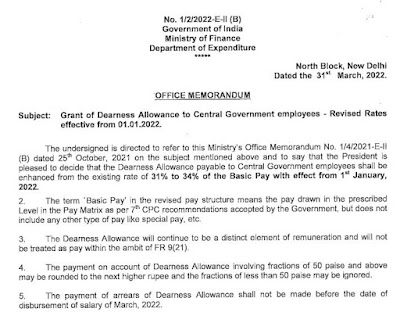
DA Jan 2022 - Grant of Dearness Allowance to Central Government employees - Revised Rates effective from 01.01.2022

 3% DA Hike - Revised Rates effective from 01.01.2022: DoE OM dated 31.03.2022 No. 1/2/2022-E-II (B) Government of India Ministry of Finance...