Saturday, 7 March 2020

Latest clarification on MACP scheme – Financial upgradation, to Junior Cashier promoted from the post of Senior Shroff / JAA / Senior clerk

Latest clarification on MACP scheme – Financial upgradation, to Junior Cashier promoted from the post of Senior Shroff / JAA / Senior clerk


Latest clarification on MACP scheme – Financial upgradation, to Junior Cashier promoted from the post of Senior Shroff / JAA / Senior clerk

Latest clarification on MACP scheme


GOVERNMENT OF INDIA
MINISTRY of Railways
(Railway Board)

S.No.PC.VII/150
No. PC-V/2009/ACP/2

RBE No. 18/2020
New Delhi, dated 04-02-2020

The General Managers
All Indian Railways & PUs
(As per mailing list)

CORRIGENDUM

Sub: Grant of financial upgradation, under MACPs to Jr. Cashier promoted from the post of Sr. Shroff / JAA / Sr. Clerk – clarificationReg.

Ref: Railway Board’s letter of even number dated 30-9-2019 (RBE No. 163/2019)

Para 1 of the letter referred above may be reacd as under:

Also check: MACP ON PROMOTIONAL HIERARCHY – MACP Supreme Court Order – Heard & Reserved – Order dated 23 Jan 2020

“The issue regarding grant of financial ungradation under MACPS to Jr. cashier by not reckoning their appointment / promotion from Sr.Shroff/ JAA/ Sr. Clerk to Jr. Cashier’s post has been under consideration. Since appointment / promotion from Sr. Shroff / JAA / Sr. Clerk to Jr. Cashier post involves promotion from one cadre to another cadre carrying same payscale / Grade Pay wihout benefit of pay fixation, it has now been decided in consultation with Finance Directorate and Establishment Directorate of Railway Board that regulating MACP benefits to such staff, the appointment from the post of Sr. Shroff / JAA / Sr. Clerk to the post of Jr. Cashier should not be constructed as promotion and, therfore, may not be reckoned for the purpose of grant of financial upgradation under MACPS”

This issues with the concurrence of the Finance Directorate of the Ministry of Railways.

Whether MACP scheme entitles financial upgradation of pay to the next grade pay or to the grade pay of the next promotional post as envisaged under the ACP scheme

Hindi version is enclosed.

(Sudha A Kujur)
Dy. Director, pay Commission
Railway Board

New Public & Private Companies Registration for EPFO & ESIC now on MCA portal

Ministry of Labour & Employment
Registration of New Public & Private Limited Companies for EPFO & ESIC now on MCA Portal

06 MAR 2020

As part of the ongoing efforts to improve India’s ranking in the Doing Business Report 2021, The Ministry of Labour & Employment has completed the reform to “Integrate process of registration for GST, EPFO, ESIC and Profession Tax for Maharashtra with company incorporation” in tandem with the MCA.

The reform has been completed by making the registration of new Public, Private Limited Companies and One Person Company for ESIC and EPFO mandatory through the Spice+ and AGILE-PRO eforms of MCA w.e.f., 15-02-2020. Registration for ESIC and EPFO for new companies as above has been stopped on Shram Suvidha Portal from 15.02.2020. A message to this effect is displayed on the Shram Suvidha Portal and the website of Ministry of Labour and Employment www.labour.gov.in as follows:

Also check: EPFO – Revised Transfer Claim Form 13

Registration for EPFO & ESIC for new Public& Private Limited Companies and One Person Company has been stopped on Shram Suvidha Portal from 15.02.2020.

With effect from 15.02.2020, new Public& Private Limited Companies and One Person Company shall get registration number for EPFO & ESIC on MCA portal (www.mca.gov.in) through Spice + and AGILE-PRO eforms) only at the time of incorporation.

However, the above new companies will have to comply with the provisions of EPF & MP Act, 1952, and ESI Act, 1948 when they cross the threshold limit of employment under the respective Acts.

PIB

Whether MACP scheme entitles financial upgradation of pay to the next grade pay or to the grade pay of the next promotional post as envisaged under the ACP scheme

Whether MACP scheme entitles financial upgradation of pay to the next grade pay or to the grade pay of the next promotional post as envisaged under the ACP scheme


Whether MACP scheme entitles financial upgradation of pay to the next grade pay or to the grade pay of the next promotional post as envisaged under the ACP scheme

 
REPORTABLE

IN THE SUPREME COURT OF INDIA
CIVIL APPELLATE JURISDICTION
CIVIL APPEAL NO. 2016 OF 2020
(Arising out of SLP (C) No.21803 of 2014)

UNION OF INDIA AND OTHERS

…Appellants

VERSUS

M.V. MOHANAN NAIR

…Respondent

WITH

CIVIL APPEAL NO. 2017 OF 2020
(Arising out of SLP(C) No.22181 of 2014)
CIVIL APPEAL NO. 2018 OF 2020
(Arising out of SLP(C) No.23335 of 2014)
CIVIL APPEAL NO. 2019 OF 2020
(Arising out of SLP(C) No.23333 of 2014)
CIVIL APPEAL NO. 2020 OF 2020
(Arising out of SLP(C) No.18227 of 2015)
CIVIL APPEAL NO. 2021 OF 2020
(Arising out of SLP(C) No.31125 of 2016)
CIVIL APPEAL NO. 2022 OF 2020
(Arising out of SLP(C) No.33706 of 2016)
CIVIL APPEAL NO(s). 2044-2045 OF 2020
(Arising out of SLP(C)No(s). 5917-5918 of 2017
@ SLP(C)Diary No.6042 of 2017)

JUDGMENT

BANUMATHI, J.

Leave granted.

2. The instant batch of appeals have been filed assailing the orders of various High Courts dismissing petitions filed by the appellants, thereby upholding decisions rendered by different Benches of Central Administrative Tribunal granting financial upgradation of grade pay in the next promotional hierarchy by placing reliance upon Union of India and others v. Raj Pal and another CWP No.19387 of 2011 dated 19.10.2011. In these batch matters, we are concerned with the question whether MACP Scheme entitles financial upgradation to the next grade pay or to the grade pay of the next promotional hierarchy.

3. In all these appeals, almost all the High Courts have followed the Raj Pal and Ved Prakash’s case and granted relief as prayed for by the Being aggrieved, the appellant- UOI has filed these appeals.

Also check: MACP ON PROMOTIONAL HIERARCHY – MACP Supreme Court Order – Heard & Reserved – Order dated 23 Jan 2020


4. The main questions falling for consideration in these appeals are:-
  •     Whether MACP scheme entitles financial upgradation of pay to the next grade pay or to the grade pay of the next promotional post as envisaged under the ACP scheme? Whether MACP Scheme envisages grant of financial upgradation in Grade Pay Hierarchy and not in promotional hierarchy?
  •     As contended by the respondents, whether MACP scheme is disadvantageous to the employees in comparison to ACP scheme as long as the financial upgradation is granted in hierarchy of grade pay under MACP scheme?
  •     Whether respondents are entitled to stepping up of their grade pay to be at par with grade pay of their juniors who were getting the higher grade pay on account of implementation of MACP Scheme?

Appeals relating to Issue No.III were ordered to be de-tagged and listed separately.

5. At the outset, it is to be pointed out that almost all the Tribunals/High Courts have only relied upon Raj Pal’s case for grant of financial upgradation on promotional hierarchy and rejected the stand of the appellant-UOI that under MACP scheme, the employees are entitled to financial upgradation of the next grade pay only. Since the matter was considered on merits and since the issue involves impact on the public ex- chequer and also interest of the staff of various establishments, we requested learned Senior counsel, Mr. Jaideep Gupta to assist the Court as amicus curiae which the learned Senior counsel has readily Mr. Kunal Chatterji, learned counsel has agreed to assist the learned Senior counsel-amicus.

 Also check: IMPLEMENTATION OF HONARABLE SUPREME COURT ORDER ON MACP SCHEME

Assured Career Progression (ACP) Scheme :-

6. The Government of India with a view to “deal with the problem of genuine stagnation and hardship faced by the employees due to lack of adequate promotional avenues”, introduced the Assured Career Progression (ACP) Scheme with effect from 09.08.1999 vide its Office Memorandum dated 09.08.1999. To mitigate the hardship in cases of acute stagnation in a cadre or in an isolated post, it has been decided to grant two financial upgradations under the ACP Scheme to Group ‘B’, ‘C’ and ‘D’ employees on completion of 12 and 24 years of regular service. As per ACP Scheme, isolated post in Group ‘A’, ‘B’, ‘C’ and ‘D’ cadres which have no promotional avenues also qualify for similar benefits. The financial upgradations under the ACP Scheme is placement in the higher Pay Scale and financial benefits in the higher Pay Scale without regular promotion. Under the financial upgradation, grant of financial benefits under the ACP Scheme to the government servants concerned is on personal basis. Such financial upgradation neither amounts to regular promotion nor require creation of new post. Some of the salient features of the ACP Scheme are as follows:-
  •     The ACP Scheme envisages merely placement in the higher pay- scale/grant of financial benefits (through financial upgradation) only to the Government servant concerned on personal basis and shall, therefore, neither amount to functional/regular promotion nor would require creation of new posts for the purpose;
  •     Under the ACP Scheme, two financial upgradations shall be allowed to Group ‘B’, ‘C’ and ‘D’ employees on completion of 12 years and 24 years of his/her regular service. As per para 1 of Annexure-1 – conditions for grant of benefits under the ACP Scheme, it is stipulated that two financial upgradations would be available only if no regular promotion during the prescribed period (12 and 24 years) was granted to an employee. If an employee has already received one regular promotion, he/she would qualify for second ACP only on completion of 24 years of regular service. However, in case if two regular promotions have been received by an employee, no further benefit under the ACP Scheme would accrue in favour of the employee.
  •     As per para 1 of the Office Memorandum dated 09.08.1999, the grant of financial upgradations under the ACP Scheme shall be subject to the conditions mentioned in the Annexure-I annexed thereon to the Office Memorandum dated 09.08.1999.
7. Para 8 of the Annexure provides that the financial upgradations shall be purely personal to the employee and would have no relevance to his/her seniority position. In other words, there would be no additional financial upgradations for the senior employee on the ground that the junior employee has got the higher pay scale under the ACP Scheme. Para No.12 of Annexure-I provides that the ACP Scheme contemplates merely placement on personal basis in the higher pay scale/grant of financial benefits only and shall not amount to actual functional promotion of the employees concerned. We may usefully refer to the relevant features of the ACP Scheme as stipulated in Annexure-I to the Office Memorandum dated 09.08.1999-Conditions for Grant of Benefits under the ACP Scheme, which reads as under:-

Conditions for grant of benefits under the ACP Scheme :-

1. The ACP Scheme envisages merely placement in the higher pay-scale/grant of financial benefits (through financial upgradation) only to the Government servant concerned on personal basis and shall, therefore, neither amount to functional/regular promotion nor would require creation of new posts for the purpose;

………

4. The first financial upgradation under the ACP Scheme shall be allowed after 12 years of regular service and the second upgradation after 12 years of regular service from the date of the first financial upgradation subject to fulfilment of prescribed conditions. In other words, if the first upgradation gets postponed on account of the employee not found fit or due to departmental proceedings, etc. this would have consequential effect on the second upgradation which would also get deferred accordingly;

………

8. The financial upgradation under the ACP Scheme shall be purely personal to the employee and shall have no relevance to his seniority position. As such, there shall be no additional financial upgradation for the senior employee on the ground that the junior employee in the grade has got higher pay-scale under the ACP Scheme;

……….

12. The proposed ACP Scheme contemplates merely placement on personal basis in the higher pay-scale/grant of financial benefits only and shall not amount to actual/functional promotion of the employees concerned. Since orders regarding reservation in promotion are applicable only in the case of regular promotion, reservation orders/roster shall not apply to the ACP Scheme which shall extend its benefits uniformly to all eligible SC/ST employees also. However, at the time of regular/functional (actual) promotion, the Cadre Controlling Authorities shall ensure that all reservation orders are applied strictly;

………”

8. ACP Scheme was replaced by Modified Assured Career Progression (MACP) Scheme which became operational with effect from 09.2008. The Sixth Central Pay Commission has recommended the adoption of MACP Scheme primarily to rectify the problems arising from inter-departmental disparities:-

  •     ACP Scheme led to creation of certain disparities within the employees in different organisations/departments who were directly recruited in the same pay scale who received different financial upgradations under the ACP Scheme because of existence of different promotional hierarchical structure and different promotional pay scales in different organisations/ departments;
  •     Another adverse consequence in the implementation of the ACP Scheme was that the benefit of a higher pay scale was not available if the next post in the hierarchy also existed in the identical pay scale. 
9. In order to bring systematic changes in the existing scheme of ACP so that all employees irrespective of existing hierarchical structure in their organisations/cadre get the same benefit, MACP was recommended by the Sixth Central Pay Commission which was accepted by the Government with certain modifications vide its Office Memorandum dated 05.2009. Under the Sixth Central Pay Commission, revised pay structure has been implemented with effect from 01.01.2006; whereas benefits of ACP Scheme have been allowed till 31.08.2008. Vide Office Memorandum dated 19.05.2009, the Government of India introduced the MACP Scheme, in supersession of the ACP Scheme w.e.f. 01.09.2008. There shall be no change in distinction, classification or higher status on grant of financial upgradation under MACP as the upgradation is purely personal and merely placement in the next higher Grade Pay.

Modified Assured Career Progression (MACP) Scheme:-

10. Under the MACP Scheme, three financial upgradations are made available in the next grade pay to an employee who has completed 10, 20 and 30 years of regular service in the same post without getting any The benefit would be available at the next higher grade pay. Some of the salient features of the MACP Scheme are as follows:-

  •     Para 2 of the MACP Scheme provides that the “MACP Scheme envisages merely placement in the immediate next higher grade pay in the hierarchy of the recommended revised pay bands and grade pay”.
  •     As per para 10 of the MACP Scheme – Office Memorandum dated 19.05.2009, no stepping up of pay in the pay band or grade pay would be admissible with regard to junior getting more pay than the senior on account of pay fixation under the MACP Scheme.
  •     As per para No.11 of the said memorandum dated 19.05.2009, the differences in pay scales on account of financial upgradations under the ACP Scheme and MACP Scheme would not be construed as anomaly.

11. Para (19) of MACP Scheme contemplates merely placement on personal basis in the immediate higher grade pay / grant of financial benefits only and shall not amount to actual/functional promotion of the employees concerned. As per para (20) of the MACP Scheme, financial upgradations shall be purely personal to the employee and shall have no relevance to the seniority position. As such, there shall be no additional financial upgradation for the senior employees on the ground that the junior employees in the grade have received higher grade pay under MACP Scheme. We may usefully extract the relevant portion of Annexure-I of the Office Memorandum dated 19.05.2009, which reads as under:-

ANNEXURE-I

MODIFIED ASSURED CAREER PROGRESSION SCHEME (MACPS)

    There shall be three financial upgradation s under the MACPS, counted from the direct entry grade on completion of 10, 20 and 30 years service Financial upgradation under the Scheme will be admissible whenever a person has spent 10 years continuously in the same grade-pay.
    The MACPS envisages merely placement in the immediate next higher grade pay in the hierarchy of the recommended revised pay bands and grade pay as given in Section 1, Part-A of the first schedule of the CCS (Revised Pay) Rules, Thus, the grade pay at the time of financial upgradation under the MACPS can, in certain cases where regular promotion is not between two successive grades, be different than what is available at the time of regular promotion. ln such cases, the higher grade pay attached to the next promotion post in the hierarchy of the concerned cadre/organisation will be given only at the time of regular promotion.

…………

17. The financial upgradation would be on non-functional basis subject to fitness, in the hierarchy of grade pay within the PB-1.Thereafter for upgradation under the MACPS the benchmark of ‘good’ would be applicable till the grade pay of Rs. 6600/- in PB-3. The benchmark will be ‘Very Good’ for financial upgradation to the grade pay of Rs. 7600 and above.

19. The MACPS contemplates merely placement on personal basis in the immediate higher Grade pay /grant of financial benefits only and shall not amount to actual functional promotion of the employees Therefore, no reservation orders/roster shall apply to the MACPS, which shall extend its benefits uniformly to all eligible SC/ST employees also. However, the rules of reservation in promotion shall be ensured at the time of regular promotion. For this reason, it shall not be mandatory to associate members of SC/ST in the Screening Committee meant to consider cases for grant of financial upgradation under the Scheme.

………….

25. If a regular promotion has been offered but was refused by the employee before becoming entitled to a financial upgradation, no financial upgradation shall be allowed as such an employee has not been stagnated due to lack of opportunities. If, however, financial upgradation has been allowed due to stagnation and the employees subsequently refuse the promotion, it shall not be a ground to withdraw the financial upgradation. He shall, however, not be eligible to be considered for further financial upgradation till he agrees to be considered for promotion again and the second the next financial upgradation shall also be deferred to the extent of period of debarment due to the refusal.

……………”

12. Clause 28 contains illustrations as to grant of financial upgradation under MACP. The illustrations in Clause 28 of the Scheme can easily be understood by referring to the First Schedule, Part-A of Section 1 of Central Civil Services (Revised Pay) Rules, 2008 which gives a comparison of the scale of pay under the 5th Pay Commission and the 6th Pay Commission as under:-

Download order:

MACP-ACP-Scheme-Supreme-Court-Judgement_05-Mar-2020

Thursday, 5 March 2020

Benefit of gratuity in respect of Railway employees covered under NPS

Benefit of gratuity in respect of Railway employees covered under NPS

NPS

GOVERNMENT OF INDIA (BHARAT SARKAR)
MINISTRY OF RAILWAYS (RAIL MANTRALAYA)
(RAILWAY BOARD)

RBE No.29/2020

No. F(E)HI/2005/PN1/35

New Delhi, Dated : 04.o3.2020

The GMs/ Principal Financial Advisors,
All Zonal Railways/ Production Units,
(As per mailing list)

Subject: Counting of service on joining new service in State Government / Central Government / Autonomous Body for the benefit of gratuity in respect of Railway employees covered under National Pension System (NPS).

A copy of Department of Pension & Pensioners’ Welfare (DOP&PW’s) O.M. No. 7/5/2012-P&PW(F)/B dated 12th February, 2020 is enclosed herewith for compliance and guidance. These instructions shall apply mutatis mutandis on the Railways also. Central Civil Services (Pension) Rules, 1972 correspond to the Railway Services (Pension) Rules, 1993.

The Railway Board’s instructions corresponding to the DOP&PW’s instructions referred to in their aforesaid O.M. dated 12th February, 2020 are given under :-


S. No.DOP & PW’s instructions Railway Board’s corresponding instructions.
1.O.M. No. 38/41/06 -P&PW(A) dated 05.05.2009Letter No. 2008/ AC-II/21/19 dated 29.05.2009.
2.O.M. No.7/5/2012 -P&PW(F)/B dated 26.08.2016Letter No. 2012/ F(E)III/1(1)/4 dated 05.09.2016.

(G. Priya Sudarsani)
Director, Finance (Estt.)
Railway Board.

D.A.: as above

No. F(E)III/2005/PN1/35

New Delhi, dated: 04 . 03.2020.

Copy to Deputy Comptroller and Auditor General of India (Railways), Room No. 224, Rail Bhawan, New Delhi.

For Financial Commissioner / Railways


Premature Retirement Fundamental Rules FR 56(j) - PIB


Ministry of Personnel, Public Grievances & Pensions
Premature Retirement

04 MAR 2020

As on 27.02.2020, based on the updated/ reconciled information/ data provided by various Ministries/ Departments/ Cadre Controlling Authorities (CCAs) on the Probity Portal operated by Department of Personnel and Training, provisions of the Fundamental Rules FR 56(j) similar rules have been invoked against 163 Group ‘A’ officers, (including All India Services officers) and 157 Group ‘B’ officers during the period July, 2014 to January, 2020.

As per the provisions under FR 56(j), Rule 48 of Central Civil Services (CCS) (Pensions) Rules, 1972, and Rule 16(3) (Amended) of All India Services (Death-cum-Retirement Benefits) Rules, 1958, Government has the absolute right to retire Government officials prematurely on the ground of lack of integrity or ineffectiveness, in public interest.

Also check: Periodic review of Central Government Employees under Rule 48 of CCS (Pension) Rules,1972

This information was provided by the Union Minister of State (Independent Charge) Development of North- Eastern Region (DoNER), MoS PMO, Personnel, Public Grievances & Pensions, Atomic Energy and Space, DrJitendra Singh in written reply to a question in Lok Sabha today.

PIB

Kendriya Vidyalayas School Admission Schedule for 2020-2021 - changes/modifications are effected in KVS Admission Guidelines - KVS


Kendriya Vidyalayas School Admission Schedule for 2020-2021 - changes/modifications are effected in KVS Admission Guidelines - KVS

Kendriya Vidyalayas School Admission Schedule for 2020-2021


KENDRIYA VIDYALAYA SANGATHAN
(Min. of HRD, Deptt. of Education, Govt. of India)
F.No.110331/01/2020/KVS(HQ)-Acad/9916-9948

03.03.2020

The Deputy Commissioner
Kendriya Vidyalaya Sangathan
All Regional Offices

Subject : Intimation regarding admission schedule for the academic session 2020 - 2021 - reg.

Madam/Sir,

With regard to the subject cited above, this is to say that KVS (HQ) is receiving number of queries regarding. announcement of admission schedule for the academic session 2020-21 for admission in all Kendriya Vidyalayas. In this connection, it is informed that some essential changes / modifications in KVS Admission Guidelines are under way. Therefore, admission process shall be started after such changes/modifications are effected in KVS Admission Guidelines. KVS will issue detailed instructions / guidelines very soon in this regard.

Also check: 7th Pay Commission Pay Scale revision - Assistant Editor in PB-2 GP 4600 w.e.f. 1.1.2006 and Pay Matrix Level-7 w.e.f. 1.1.2016: KVS Order

You are, therefore, directed to instruct all Principals under your jurisdiction to wait till further orders.

Yours faithfully,
(Dr. E. Prabhakar)
Joint Commissioner (Trg.)

Source: kvsangathan.nic.in

Implementation of RTI Act


Ministry of Personnel, Public Grievances & Pensions
Implementation of RTI Act

04 MAR 2020

The Central Government is fully committed to implement the Right to Information (RTI) Act in respect of public authorities under it. Each State Government is responsible for implementation of the Right to Information Act in respect of the public authorities in the State concerned.

In respect of the Central Information Commissions, the appointment process has been conducted duly as and when vacancies were required to be filled up and has not been at preliminary stage.

Also check: DoPT - Notification regarding RTI Rules 2019

The Hon’ble Supreme Court vide its Order dated 16.12.2019 in M.A. No. 1979 of 2019 in WP (C) No. 436 of 2018: Ms Anjali Bhardwaj & Others Vs. Union of India and Others pertaining to fill up the vacancies in Central Information Commissions, has inter-alia directed that the Government complete the process of appointment in 3 months.

The process has reached an advanced stage for appointment of the Chief Information Commissioner and one Information Commission in Central Information Commission.

This information was provided by the Union Minister of State (Independent Charge) Development of North- Eastern Region (DoNER), MoS PMO, Personnel, Public Grievances & Pensions, Atomic Energy and Space, Dr Jitendra Singh in written reply to a question in Lok Sabha today.

MACP ON PROMOTIONAL HIERARCHY - MACP Supreme Court Order – Heard & Reserved - Order dated 23 Jan 2020

PIB

Lokpal Complaint Rules, 2020 - section 59 of the Lokpal and Lokayuktas Act, 2013 (1 of 2014), the Central Government hereby makes the following rules - DoPT


Lokpal Complaint Rules, 2020 - section 59 of the Lokpal and Lokayuktas Act, 2013 (1 of 2014), the Central Government hereby makes the following rules - DoPT
Lokpal-Complaint-Rules-2020


Lokpal (Complaint ) Rules, 2020

Latest DoPT Orders 2020

MINISTRY OF PERSONNEL, PUBLIC GRIEVANCES AND PENSIONS
Department of Personnel and Training

NOTIFICATION

New Delhi, the 2nd March, 2020

G.S.R.148(E).- In exercise of the powers conferred by section 59 of the Lokpal and Lokayuktas Act, 2013 (1 of 2014), the Central Government hereby makes the following rules, namely:-

1. Short title and commencement. - (1) These rules may be called the Lokpal (Complaint) Rules, 2020.
(2) They shall come into force on the date of their publication in the Official Gazette.

2. Definition. - In these Rules, unless the context otherwise requires -

(a) “Act” means the Lokpal and Lokayuktas Act, 2013 (1 of 2014);
(b) “offence” means an offence punishable under the Prevention of Corruption Act, 1988 (49 of 1988);
(c) words and expressions used and not defined in these rules, but defined under the Act shall have the same meaning as respectively assigned to them under the Act.

3. Form and manner of complaint. - (1) For the purposes of clause (e) of sub-section (1) of section 2 of the Act, a complaint shall be filed in the form appended to these rules as Annexure.
(2) A complaint shall be filed in any of the following manner, namely: -
  • electronically, in the manner, as laid down by the Lokpal; or
  • by post; or
  • in person:
Provided that where the complaint is filed electronically, the hard copy thereof shall be required to be submitted to the Lokpal within a period of fifteen days from the date of filing:
Provided further that the Lokpal shall not keep the said complaint, received electronically, as pending, if the same is complete in all respects.
(3) A complaint shall contain the details of allegations about commission of an offence committed by the public servant:
Provided that no complaint shall be filed against the public servant under the Army Act, 1950(45 of 1950) or the the Navy Act, 1957 (62 of 1957) or the Air Force Act, 1950 (46 of 1950) or the Coast Guard Act, 1978 (30 of 1978), as the case may be.
(4) A complaint may ordinarily be made in English:
Provided that the Lokpal may also entertain a complaint in any of the languages referred to in the Eighth Schedule to the Constitution.
(5) The following shall be required to be annexed with the complaint, namely: –
  • copy of the identity proof as specified in the form of complaint;
  • registration or incorporation certificate of the organisation, on whose behalf the complaint is being made, if it is a board, body, corporation, company, limited liability partnership, authority, society, association of persons or trust; (c) copy of authorization certificate in favour of the signatory if the complaint is being made on behalf of the board, body, corporation, company, limited liability partnership, authority, society, association of persons or trusts;
  • an Affidavit in the form as specified in the Part D of the Annexure; and
  • duly signed detailed statement making out the allegation.
(6) The complaint filed against a public servant referred to in clause (a) of sub-section (1) of section 14 of the Act, shall be decided by the full bench referred to in sub-clause (ii) of clause (a) of sub-section (1) of section 14, in the first instance, at the admission stage
(7) The complaint filed against a public servant referred to in clauses (b) and (c) of sub-section (1) of section 14 of the Act shall be decided by the bench as referred to in sub-section (3) of section 20 of the Act, in the first instance, at the admission stage.
(8) The Lokpal may seek such other information or affidavit relating to a complaint, as it deems fit.

Also check: Revised Rotational Transfer Policy applicable to CSS officers - Latest DoPT Orders 2020 January 27, 2020

4. Handling form(s) of complaint. - The Lokpal may process a complaint in the following manner, namely:-
(a) protect the identity of the complainant or the public servant complained against till the conclusion of the inquiry or investigation:
Provided that the protection, shall not be applicable, in cases where the complainant himself has revealed his identity to any other office or authority while making a complaint to the Lokpal;
(b) protect the integrity of the process of inquiry or investigation;
(c) dispose of the complaints, in limine, under the following conditions, namely:-
  • where the contents of the complaint are illegible;
  • where the contents of the complaint are vague or ambiguous;
  • where the contents of the complaint are trivial or frivolous;
  • where the complaint does not contain allegation against a public servant;
  • where the complaint is not filed within the period of limitation under section 53 of the Act; and
  • where the cause of the complaint is pending before any other Court or Tribunal or Authority.
(d) the Lokpal shall dispose of the complaints satisfying the conditions as contained in clause (c) above within a period of thirty days.

Source: DoPT

Wednesday, 4 March 2020

Coverage under Railway Services (Pension) Rules, 1993, in place of National Pension System, of those Railway employees

NPS

RBE No. 28/2020
GOVERNMENT OF INDIA (BHARAT SARKAR)
MINISTRY OF RAILWAYS (RAIL MANTRALAYA)
(RAILWAY BOARD)

No. D-43/12/2018-F(E)III

New Delhi, Dated : 03.03.2020

The GMs/ Principal Financial Advisors,
All Zonal Railways/ Production Units,
(As per mailing list)

Subject: Coverage under Railway Services (Pension) Rules, 1993, in place of National Pension System, of those Railway employees whose selection for appointment was finalized before 01.01.2004 but who joined Railway service on or after 01.01.2004.

Also check: Good news for NPS employees

A copy of Department of Pension & Pensioners’ Welfare (DOP&PW’s) O.M. No. 57/04/2019-P&PW(B) dated 171 h February, 2020 is enclosed herewith for compliance and guidance. These instructions shall apply mutatis mutandis on the Railways also. Central Civil Services (Pension) Rules, 1972 correspond to the Railway Services (Pension) Rules, 1993. The Department of Economic Affairs, Ministry of Finance’s Notification No. 5n/2003-ECB &PR dated 22.12.2003, mentioned in the DOP&PW’s O.M. dated 17.02.2020, has been circulated on Railways vide this office’s letter No. F(E)III/2003/PN 1/24 dated 31.12.2003.

Also check: Progress of National Pension System by Railway Board Minutes of meetings

Similar to the amendments made in the Central Civil Services (Pension) Rules, 1972 and other connected rules, as mentioned in para 1 of the DOP&PW’s O.M. dated 17.02.2020, the Railway Services (Pension) Rules, 1993 and other connected rules were also amended vide Notification No. F(E)III/ 2003/PN1/38 dated 30.12.2003.

NPS: Additional benefit on death/disability of Government servant covered by NPS

Further, separate instructions with respect to para 9 of the DOP&PW’s O.M. dated 17.02.2020 will be issued by the Accounts Directorate for accountal of the corpus available in the NPS account of the railway servant.
NPS to Railway Services Pension Rules 1993 who joined after Jan 1, 2004


D.A.: as above

(G. Priya Sudarsani)
Director, Finance (Estt.)
Railway Board

Strengthening of administration - Periodic review of Central Government Employees under Fundamental Rule (FR) 56(j)/(l) and Rule 48 of CCS(Pension)Rules, 1972

CGDA

Controller General of Defence Accounts
Ulan Batar Road, Palam, Delhi Cantt- 110010
AN/XI/11206/SA/PR/FR-56(J)/2019

Dated: 02.03.2020

To
All PCsDA/PCA (Fys)/CsDA
(Through CGDA Website)

Subject: Strengthening of administration-Periodic review of Central Government Employees under Fundamental Rule (FR) 56(j)/(1) and Rule 48 of CCS (Pension) Rules,1972.

Please refer to this HQrs office circular bearing No. AN/XI/11206/e-Suchna/2019 dated 21.01.2020 under which periodicity and due date for receipt of the subject report along with other directions was circulated for strict compliance.

Also check: Steps to complete the pension case as prescribed in in CCS Pension Rules, 1972

Instructions exist on the need for periodical review of performance of Government servants with a view to ascertain whether the Government servant should be retained in service or retired service in the public interest. Provisions in this regard are contained in FR 56(j), FR 56(l) and Rule 48(1) (b) of CCS (Pension) Rules, 1972. Besides, the detailed guidelines on the above subject are already in public domain at http://dopt.gov.in under 'Notification' -'OM & Orders'- Establishment- Premature Retirement. However, copies of DOP&T O.M. No 25013/1/2013-Estt (A) dated 21.03.2014, No.25013/01/2013-Estt.A-IV dated 11.09.2015 and MOD, D (lab) Branch ID No 26(1)/2015-D (Lab) dated 30.05.2016 are enclosed herewith for guidance and taking an appropriate action with reference to orders on the subject.

Also read: Government amends Rule 54 of CCS (Pension) Rules, 1972 for Central Government Employees who dies early in his career

It is also re-iterated that project e-Suchna has been launched with an objective to introduce paperless reporting system. In order to achieve this objective, it is once again requested that the reports, (i) Strengthening of administration - Periodic review of Central Government Employees under Fundamental Rule (FR) 56(j)/(l) and Rule 48 of CCS(Pension)Rules, 1972. (ii) Review of mechanism to ensure probity among Government servants (iii) Periodical review of Performance of Government servant as per the provision of FR 56(j), FR 56(l) and Rule 48(1) of CCS (Pension) Rules, 1972 and (iv) Representation of Women Members on the various Committees/ Boards concerned with selection of Posts in Central Government, may strictly be rendered through e Suchna portal only. Rendition of hard copy/ Fax copy may be discontinued.


Enclosures:
Amendment in CCS (Pension) Rules 1972 - Central Government employees

(Rajeev Ranjan Kumar)
Dy. CGDA (AN)

Flash News

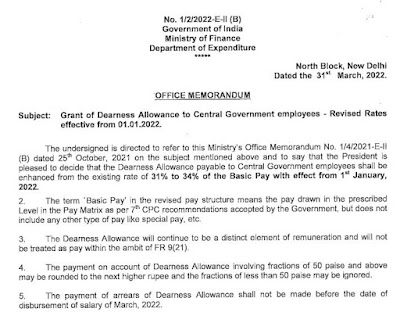
DA Jan 2022 - Grant of Dearness Allowance to Central Government employees - Revised Rates effective from 01.01.2022

 3% DA Hike - Revised Rates effective from 01.01.2022: DoE OM dated 31.03.2022 No. 1/2/2022-E-II (B) Government of India Ministry of Finance...