Thursday, 21 March 2019

Revised Subscription Rates of Railway Employees Liberalized Health Scheme as per 7th CPC Pay Matrix

Revised Subscription Rates of Railway Employees Liberalized Health Scheme as per 7th CPC Pay Matrix

The Railway Board has decided to revise the subscription rates of Railway Employees Liberalized Health Scheme (RELHS) as per the Pay Matrix Level recommended by the 7th Pay Commission.
Following the subscription calculation method of CGHS for Central Government Employees and Pensioners, the Railway Board has now decided and published the revised subscription rates for all the group of Railway employees through its official portal.

On 9th January, 2017 the Health Ministry published the new rates of monthly subscription for availing the CGHS facility. The Central Government Pensioners have an option to get their CGHS Pensioners Card by either making CGHS contribution on an annual basis (12 Months) or by making contribution for 10 years for life time validity.

The rate of contribution to join RELHS shall be last month’s basic pay drawn or the subscription rate indicated in the above table at different levels as per the 7th Pay Commission whichever is lower.

Pay Matrix LevelSubscription Rate to Join RELHS (in Rs.)
Level 1 (Grade Pay 1800)30,000
Level 2 (Grade Pay 1900)30,000
Level 3 (Grade Pay 2000)30,000
Level 4 (Grade Pay 2400)30,000
Level 5 (Grade Pay 2800)30,000
Level 6 (Grade Pay 4200)54,000
Level 7 (Grade Pay 4600)78,000
Level 8 (Grade Pay 4800)78,000
Level 9 (Grade Pay 5400)78,000
Level 10 (Grade Pay 5400)78,000
Level 11 (Grade Pay 6600)78,000
Level 12 and Above1,20,000

The revised rate of subscription as above shall be applicable to those railway employees who shall be retiring and joining RELHS on or after the date of issue of this letter (23.2.2017). Those who have already retired and are not member of RELHS shall be governed by the rules which were prevalent at the time of their retirement.

RAILWAYS: Change of Nomenclature of the posts of Senior Translator & Junior Translator

RAILWAYS: Change of Nomenclature of the posts of Senior Translator & Junior Translator

GOVERNMENT OF INDIA
MINISTRY OF RAILWAYS
(RAIL WAY BOARD)
No.2019/ERB-II/12/9
New Delhi, dt 19.03.2019
ORDER

Consequent upon change of nomenclature of the posts of Senior Translator and Junior Translator of Central Secretariat Official Language Service (CSOLS) vide Dept. of Official Language, MHA’s Order No. 16/24/2018//O.L. (Service) dated 11.02.2019, The Competent Authority has decided to adopt the same nomenclature in the Ministry of Railways (Railway Board) also as under:

S.NO.Existing Nomenclature of the PostNew Nomenclature
1.Senior TranslatorSenior Translation Officer (STO)
2.Junior TranslatorJunior Translation Officer (JTO)

The change in nomenclature will have immediate effect it will not lead to upgradation pf pay/level in future.

The necessary amendment in respective recruitment rules will follow.
sd/-
(Anil Kumar C.V)
Under Secretary (Admin.)
Railway Board
The Pay & Accounts Officer,
Ministry of Railways (Railway Board)
New Delhi
No.2019/ERB-II/12/9
New Delhi, dt.19.03.2019
Copy to:
  1. The Principal Director of Audit, Northern Railway, New Delhi.
  2. Deputy Comptroller & Auditor General of India (Rlys), R.No.222, Rail Bhawan, New
  3. US (A)-IV, US(E)-III, Railway Board for further necessary action regarding amendment in Recruitment Rules.
  4. All Officers and Branches of Railway Board.
  5. Secretary RBMSA, Railway Board.
Source: AIRF

Wednesday, 20 March 2019

Excessive delay in the completion of railway pensioner's grievances – Dissatisfaction of Hon'ble MoSR/G and instructions

Excessive delay in the completion of railway pensioner's grievances – Dissatisfaction of Hon'ble MoSR/G and instructions

  (भारत सरकार) GOVERNMENT OF INDIA
(रेल मंत्रालय) MINISTRY OF RAILWAYS
(रेलवे बोर्ड) RAILWAY BOARD


RBA No. 14/2019

No. 2018/AC-II/21/11/Pn rep to MoS(G)

New Delhi, dated 18th March, 2019

Gencral Managers,
All Zonal Railways and Production Units

    Sub :- Inordinate delay in finalization of pension related grievances of Railway Pensioners.


Ref:- Board’s letter No. 2018 /AC-I1/21 11/Pn rep to MoS (G) dated 28.09.2018.

 Hon'ble MoSR(G) has expressed deep dissatisfaction at the inordinate delay, on one Zonal Railway, in inclusion of the name of unmarried disabled daughter in PPO. He has directed that efforts should be made to dispose off such grievances within a month’s time.

Attention is also drawn to Board’s letter under reference, wherein a detailed Action ‘Taken Report (ATR) was required to be submitted to Board’s office by 8.10.2018 by all Railways on status of disposal of pension related grievances. Many Zonal Railways took a prolonged period to report their respective status. This resulted in delay in submission of the ATR to MoSR/G. While reviewing the ATR, MoSR/G has expressed his displeasure and has directed that responsibility may be fixed for the delay in submission of the ATR, in the subject case. Further, MoSR/G has directed all the Zonal Railways and Production units to urgently initiate the following course of action:-

a) GMs, PCPOs and PE As needs to put a system in place for adapting a coherent approach in resolving the pension related grievances immediately;

b) Immediate action must be taken to digitize the records so that Railways move away from paper documentation;

c) Electronic communication means should be adopted, including periodic reporting, rules/records updation, seeking documents and disseminating information, to ensure regulatory disclosure; .

d) Updatation of pension related records and validation of revision by various stakeholders should be close to real time.

e) System improvement and technological upgradation should be adopted in strict time lines so that the system may come into force from 1st April, 2019.

 Action taken in this regard may kindly be reported to Board’s Office urgently latest by 25th March, 2019 .

(Anjali Goyal)
Principal Executive Director {Accounts)
Railway Board

PCDA circular: FMA for Ex-Servicemen Pensioners/Family Pensioners who are members of ECHS and reside in a non - ECHS district.

PCDA circular: FMA for Ex-Servicemen Pensioners/Family Pensioners who are members of ECHS and reside in a non - ECHS district.


OFFICE OF THE PR. CONTROLLER.OF DEFENCE ACCOUNTS (PENSIONS)
DRAUPRADI GHAT, ALLAHABAD-211014

Circular No. 616
Dated: 31.01.2019
To,
The OI/C
Records/PAO(ORs)
--------------------
--------------------

    Subject:- Grant of Fixed Medical Allowance (FMA) to Ex-Servicemen Pensioners, and Ex-Servicemen Family Pensioners who are ECHS members and residing in Districts not covered by ECHS Polyclinic / Armed Forces Hospitals / MI Room upgraded to accommodate ESMs.

Reference:- This office Circular No. 451 dated 21.02.2011;Circular.No..544 dated 04.06.2015 & Circular No. 586 dated 25.09.2017.

 A copy of GoI, MoD letter No. 22(01)/2011.WE/D(Res-I):dated:01.11.2018 on the above subject, which is self-explanatory, is forwarded: herewith for information and necessary action.

2.. As per ibid Govt letter Fixed: Medical-Allowance (FMA) to Ex-Servicemen Pensioners and Ex-Servicemen Family Pensioners is also admissible to ECHS members who are residing in Districts not covered by ECHS Polyclinic/Armed Forces Hospitals / MI Room upgraded to accommodate ESMs.

3... Those pensioners who are covered under this. Govt order are-required to submit the necessary application in the prescribed format. to the nearest Stn HQ in triplicate. The Stn HQ will scrutinize the. residential address of the ECHS member and verify the applicability of District in the. address ‘for FMA. .and confirm the authorization of FMA on the application in the prescribed format.

4. A separate communication will follow for submission of LPC-cum-datasheet along with instructions in due course.

5. This circular. has been uploaded on this office website www.pcdapension.nic.in for dissemination to all concerned.

Gts/Tech/05/LXXI
Dated 31.01.2019
(S.K. Singh)
Addl.CDA(P)

Source: PDCA

Registration closed for KV Admission 2019 - 20 Class-1

Registration closed for KV Admission 2019 - 20 Class-1

Regarding online Admission for class 1

Parents are requested to cancel the multiple applications for the same child otherwise application will be considered rejected KV Admission 2019-20 Class-1 Registration Process came to an end yesterday itself.

The ongoing online registration process for admissions in Class I came to an end yesterday. KVS has received 7,95,121 applications for more than 1L seats of Class I available in 1202 KendriyaVidyalaya across the country.

Description Dates Scheduled
Online Registration for Class-I 01-03-2019 From 8.00 A.M
Last date of Online Registration for Class-I 19-03-2019 Till 4.00 P.M.
Declaration of provisionally selected list for Class I & admissions for Class-I. 1st List 26-03-2019,
2nd List 09-04-2019,
(if seats remain vacant),
3rd List 23-04-2019,
(if seats remain vacant)
Extended date for Second Notification for admissions to be made under RTE Provisions (Class-I), if sufficient applications not received under RTE Provisions. Notification:30-03-2019 Registration:30-03-2019 to 06-04-2019
Admissions: 08-04-2019 to 15-04-2019
In case sufficient number of registrations for SC/ST not received in 1st Phase, second notification may be issued. Notification:30-03-2019
Registration:30-03-2019 to 06-04-2019
Admissions: 08-04-2019 to 15-04-2019
Registration for Class-II onwards (except Class XI)-Subject to availability of vacancies in a particular class. 02-04-2019 From 8:00 A.M. to 09.04.2019 Till 4.00 P.M Note: During school hrs.
Declaration of list of class II onwards. 12-04-2019
Admission for class II onwards. 12-04-2019 to 20-04-2019
Last date for admission except Class XI. 30-04-2019
For KV students: Registration for admission in class XI. Within 10 days after declaration of Board results.
KV students: Display of admission list & admissions for Class-XI. Within 20 days after declaration of Board results.
Non-KV students: Registration, display of admission list & admissions in class XI (Subject to availability of vacancies) After the admissions of KV students in class XI.
Last date of Admission for class XI. 01/07/19

The inclusion in the Model Code of Conduct (MCC) of manifesto release period – ECI notification

The inclusion in the Model Code of Conduct (MCC) of manifesto release period – ECI notification

ELECTION COMMISSION OF INDIA
NirvachanSadan, Ashoka Road, New Delhi – 110001

No.437/6/1/ECI/INST/FUNCT/MCC/2019

Dated: 16th March, 2019

To
President/Chairperson/General Secretary of all Recognized National/State political parties.

Subject:- Inclusion of period of release of manifesto in the Model Code of Conduct (MCC) – regarding.

Sir/Madam,

I am directed to refer to the Commission’s letters of even number dated 22.01.2019 and 09,02.20L9, whereby a proposal to fix a timeline, by way of an outer time limit for the release of manifesto by the Political Parties in an election was forwarded to all recognized National and State Political Parties with a request to offer their comments on the same. Having considered the suggestions/comments received from the political parties, the Commission has fixed a timeline for the release of manifesto by the political parties which has now been included as para-no. 4 under Part-VIII [Guidelines on Election ManifestosJ in the Model Code of Conduct, as under:-

“4. Prohibitory period of Release of Manifesto during elections(s)

i. In case of single phase election, manifesto shall not be released during the
prohibitory period, as prescribed under Section 126 of the Representation of the People Act, 1951.

ii. In case of multi-phase elections, manifesto shall not be released during the prohibitory periods, as prescribed under Section 126 of the Representation of the People Act, 1951, of all the phases of those elections. “

2. This provision will, henceforth, be applicable and implemented as a part of the Model Code of Conduct for all future elections.

3. A copy of the full text of the “Model Code of Conduct for the Guidance of Political Parties and Candidates” including para 4 in Part- VIII is enclosed for your information.

4. You are requested to bring this to the notice of all concerned for their
information and compliance.

Yours faithfully,
sd/-
(NARENDRA M BUTOLTA)
PRINCIPAL SECRETARY

Copy to CEOs of all States/UTs for information and necessary action.

ELECTION COMMISSION OF INDIA
MODEL CODE OF CONDUCT FOR THE GUIDANCE OF POLITICAL PARTIES AND CANDIDATES

I. General Conduct

(1) No party or candidate shall include in any activity which may aggravate
existing differences or create mutual hatred or cause tension between different castes and communities, religious or linguistic.

(2) Criticism of other political parties, when made, shall be confined to their
policies and programme, past record and work. Parties and Candidates shall refrain from criticism of all aspects of private life, not connected with the public activities of the leaders or workers of other parties. Criticism of other parties or their workers based on unverified allegations or distortion shall be avoided.

(3) There shall be no appeal to caste or communal feelings for securing votes. Mosques, Churches, Temples or other places of worship shall not be used as forum for election propaganda.

(4) All parties and candidates shall avoid scrupulously all activities which are “corrupt practices” and offences under the election law, such as bribing of voters, intimidation of voters, impersonation of voters, canvassing within 100 meters of polling stations, holding public meetings during the period of 48 hours ending r,vitli the holrr fixed for the close of tlre poll, and the transport and convevance of .”‘oters to and from poliing station.

(5) The right of every individual for peaceful and undisturbeci home-lil’e shall be respected, however much the political parties or candidates may resent his political opinions or activities. Organizing demonstrations or picketing before the houses of individuals by way of protesting against their opinions or activities sirail not lle resorted lo under any circunistances.

(6) No political pafty or candidate shall pennit its or his followers to make use of any individual’s land, building, compound wall etc., withor”rt his permission for erecting flag-staffs, suspending banners, pasting notices, writing slogans etc.

(7) Political parties and candidates shall ensure that their supporters do not
create obstructions in or break up meetings and processions organized by other parties. Workers or sympathisers of one political party shall not create disturbances at public meetings organized by another political party by putting questions orally or in writing or by distributing leaflets of their own party. Processions shall not be taken out by one party along places at which meetings are held by another party. posters issued by one party shall not be removed by workers of another parry.
II. Meetings

(1) The party or candidate shall inform the local police authorities of the venue and time any proposed meeting Well in time so as to enable the police to make necessary arrangements for controlling traffic and maintaining peace and order,

(2) A Party or candidate shal] ascertain in advance if there is any restrictive or prohibitory order in force in the place proposed for the meeting if such orders exist, they shall be followed strictly. If any exemption is required from such orders, it shall be applied for and obtained well in time.

(3) If permission or license is to be obtained for the use of loudspeakers or any other facility in connection with any proposed meeting, the party or candidate shall apply to the authority concerned well in advance and obtain such permission or license.

(4) 0rganizers of a meeting shal] invariably seek the assistance of the police on duty for dealing with persons disturbing a meeting or otherwise attempting to create disorder. organizers themselves shall not take action against such persons.
III. Procession

(1) A Party or candidate organizing a procession shall decide before hand the time and place of the starting of the procession, the route to be followed and the time and place at which the procession will terminate. There shall ordinary be no deviation from the programme.

(2) The organizers shall give advance intimation to the local police authorities of the programme so as to enable the letter to make necessary arrangement.

(3) The organizers shall ascertain if any restrictive orders are in force in the
localities through which the procession has to pass, anci shall cornply wjtir the restrictions unless exempted specially by the competent authority, Any traffic regulations or restrictions shall also tre carefully adhered to.

(4) The organizers shall take steps in advance to arrange for passage of tile
procession so that there is no clock or hindrance to traffic. If the procession is very long, it shall ‘be organized in segments of suitable lengths, so that at convenient intervals, especially at poillts where the procession has to pass road junctions, the passage of held up traffic could be allowed by stages lhus avoiding heavy traffic congestion.

(5) processionals shall be so regulated as to keep as much to the right of the road as possible ancl the direction and advice of the poiice on ct-rty shall be strir:tl,v complieci i,vith.

(6) If two or lrore politicai parties or canclidates propose to take processions over the same route or parts thereof at about the same time, the organizers shall establish contact i’vell in advance and decide r”rpon the measures to he taken lo see that lhe processions do not clash ol’ cause hindrance to traffic. The assistance of the local polics shall be availed of for arriving at a satisfactory arrangement. For this purpose the parties shail contact the police at the earliest opportunity.

(7) The political parties or candidates shall exercise control to the maximum
extent possible in the matter of processionists carrying articles which may be put to misuse by undesirable elernents especially in moments of excitement.

(8) The carrying of effigies purporting to represent member of other political parties or their leaders, burning such effigies in public and such other forms demonstration shall not be countenanced by any political party or candidate.

IV. Polling Day

All Political parties and candidates shall –

(i) co-operate with the officers on election duty to ensure peaceful and orderly polling and complete freedom to the voters to exercise their franchise without being subjected to any annoyance or obstruction.

(ii) supply to their authorized workers suitable badges or identity cards.

(iii) agree that the identity slip supplied by them to voters hall be on plain [whiteJ paper and shall not contain any symbol, name of the candidate or the name of the party;

(iv) refrain from serving or distributing liquor on polling day and during the forty eight hours preceding it.

(v) not allow unnecessary crowd to be collected near the camps set up by the political parties and candidates near the polling booths so as to avoid Confrontation and tension among workers and sympathizers of the parties and the candidate.

(vi) ensure that the candidate’s camps shall be simple .They shall not display any posters, flags, symbols or any other propaganda material. No eatable shall be served or crowd allowed at the camps and

(vii)  co-operate with the authorities in complying with the restrictions to be iniposed on the plying of vehicles on the polling clay and obtain permits for them i,vhich should be displayed prominently on those vehicles.

V. Polling Booth

Excepting the voters, no one without a valid pass from the Hlection Commission shall enter the polling booths.

VI. Observers


The Election Commission is appointing Observers. If the candiclates or their
agents have any specific compl;rint or problem regarding the concluct of elections they may bring the same to the notice of,the Observer.
VII. Party in Power

The party in power whether at the Centre or in the State or States concerned, shall ensure that no cause is given for any conrplaint that it has used its official position for the purposes of its election carnpaign and in particr_rlar *

[i] [a] The Ministers shall not conrbine their oflicial visit with elecrioneering work and shall not also make use of official machinery or personnel cluring the electioneering work.

(b) Government transport including official air-crafts, vehicles, machinery ancl personnel shall not be used for furtherance ofthe interest ofthe party in po\ryer;

(iiJ Public places such as maidens etc., for holding election meetings, and use of helipads for air-flights in connection with elections shall not be monopolized by itself. Other parties and candidates shall be allowed the use of such places and facilities on the same terms and conditions on which they are used by the party in power;

(iii) Rest houses, dark bungalows or other Government accommodation shall not be monopolized by the party in power or its candidates and such accommodation shall be allowed to be used by other parties and candidates in a fair manner but no party or candidate shall use or be allowed to use such accommodation (including premises appertaining thereto) as a campaign office or for holding any public meeting for the purposes of election propaganda;

(iv) Issue of advertisement at the cost of public exchequer in the newspapers and other media and the misuse of official mass media during the election period for partisan coverage of political news and publicity regarding achievements with a view to furthering the prospects of the party in power shall be scrupulously avoided.

(v) Ministers and other authorities shall not sanction grants/payments out of discretionary funds from the time elections are announced by the Commission; and

(vi) From the time elections are announced by Commission, Ministers and other authorities shall not –

(a) announce any financial grants in any form or promises thereof; or

(b) [except civil servants) lay foundation stones etc. of’projects or schemes of any kind; or

[cJ make any promise of construction of roads, provision of drinking water
facilities etc,; or

(d) make any ad-hoc appointments in Government, Public Undertakings etc. which may have the effect of influencing the voters in favor of the party in power.

Note : The Commission shall annor.rnce the date of any election r,vhich shall be a clate ordinarily not more than three weeks prior to the date on whicir the notification is likely to be stirred in respect of such elections.

[vii) Ministers of Central or State Government shall not enter any polling station or place of counting except in their capacity as a candidate or voter or authorized agent.
VIII Guidelines on Election Manifestos

1. The Supreme Court in its judgment dated 5th July 2013 in SLP(CJ No. 21455 of 2008 [ S. Subramaniam Balaji Vs Govt, of Tamil Nadu and OthersJ has directed the Election Commission to frame guidelines with regard to the contents of election manifestos in consultation with all the recognized political parties. The guiding principles which will lead to framing of such guidelines are quoted below from the judgment:-

(i) “Although, the law is obvious that the promises in the election manifesto cannot be construed as ‘corrupt practice’ under Section 123 of RP Act, the reality cannot be ruled out that distribution of freebies of any kind, undoubtedly, influences all people. It shakes the root of free and fair elections to a large degree”.

[ii] “The Election Commission, in order to ensure level playing field between
the contesting parties and candidates in elections and also in order to see that the purity of the election process does not get vitiated, as in past been issuing instructions under the Model Code of Conduct. The fountainhead of the powers under which the Commission issues these orders is Article 324 of the Constitution which mandates the Commission to hold free and fair elections.”

[iii) “We are mindful of the fact that generally political parties re]ease their election manifesto before the announcement of election date, in that scenario, strictly speaking, the Election Commission will not have the authority to regulate any act which is done before the announcement of the
date. Nevertheless, an exception can be made in this regard as the purpose of election manifesto is directly associated with the election process,,.

2. Upon receiving the above directions of the Hon’ble Supreme Court, the Election Commission held a meeting with the recognized National and State
Political Parties for consultation with them in the matter and took note of their conflicting views in the matter. During consultations, while some political parties supported the issuance of such guidelines, others were of the view that it is their right and duty towards voters to make such offers and promises in manifestos in .a healthy democratic polity. While the Commission agrees in principle with the point of view that framing of manifestos is the right of the political parties, it cannot overlook the undesirable impact of some of the promises and offers on the conduct of free and fair elections and maintaining level playing field for all political parties and candidates.

3. The Constitution under Article 324 mandates the Election Commission, to
conduct elections inter alia to the Parliament and the State Legislatures. Having due regard to the above directions of the Supreme Court and after consultation with the Political Parties, the Commission, in the interest of free and fair elections , hereby directs that Political Parties and Candidates while releasing election manifestos for any election to the Parliament or State Legislatures, shall adhere to the following guidelines :-

(i) The election manifesto shall not contain anything repugnant to the ideals and principles enshrined in the Constitution and further that it shall be consistent with the letter and spirit of other provisions of Model code of conduct.

[ii) The Directive Principles of State Policy enshrined in the Constitution enjoin upon the State to frame various welfare measures for the citizens and therefore there can be no objection to the promise of such welfare measures in election manifestos. However, political parties should avoid making those promises which are likely to vitiate the purity of the election process or exert undue influence on the voters in exercising their franchise.

[iii] In the interest of transparency, level playing field and credibility of promises, it is expected that manifestos also reflect the rationale for the promises and broadly indicate the ways and means to meet the financial requirements for it. Trust of voters should be sought only on those promises which are possible to be fulfilled.

i. Prohibitory period of Release of Manifesto during elections(s)

In case of single phase election, manifesto shall not be released during the
prohibitory period, as prescribed under Section !26 of the Representation of the People Act 1951.

In case of multi-phase elections, manifesto shall not be released during the prohibitory periods, as prescribed under Section 126 of the Representation of the People Act 1951, of all the phases of those elections.

DoPT Order: Recording of the Annual Performance Appraisal Report (APAR) for the 2017 - 18 financial year for CSS officers

DoPT Order: Recording of the Annual Performance Appraisal Report (APAR) for the 2017 - 18 financial year for CSS officers

No.22/10/2018-CS-I (APAR)
Government of India
Ministry of Personnel, Public Grievances & Pensions
Department of Personnel & Training
2nd Floor, Lok Nayak Bhawan,
Khan Market, New Delhi-110003,
dated the 19th March, 2019
S.No.ACTIVITYEXTENDED TIMELINES FOR THE YEAR 2017- 18
1.Submission of self-appraisal by Officer to be Reported Upon (ORU) to Reporting Officer31st July, 2018
2.Forwarding of Report by the Reporting Officer to Reviewing Officer16th August, 2018
3.Forwarding of Report by the Reviewing Authority to the Administrator / APAR Cell31st August, 2018

The progress of writing of APARs of CSS officers was monitored closely and it was observed that a large number of ORUs, Reporting & Reviewing Officers, had not recorded their remarks in the APARs even after the expiry of extended date-lines. All the Ministries/Departments were, therefore, requested vide O.M. dated 29.11.2018 to send ‘alert’ to all the officers for completing action on their part at the earliest and force forward APARs of ORUs, who failed to submit their self- appraisal by 14.12.2018, to next level i.e. Reporting Officer. The ‘SPARROW’ window has been closed on 31.12.2018.

The details of activities completed for writing of APARs on SPARROW for the year 2017-18 are as under:
S.NO.STAGE AT WHICH THE APAR WAS CLOSEDNO. OF PARS (2017 -18 -AS ON 01.01.2019)
1.Officer to be Reported Upon (ORU)51
2.Reporting Authority180
3.Reviewing Authority200
4.NRCs461
5.Pending for Disclosure286
6.Representations7
7.Closed by the system after all activities2010
8.Total3195

Attention is invited to the O.M. dated 29.11.2018 followed by Secretary (P)’s D.O. dated 11.12.2018, in terms of which the APARs for 2017-18 pending at ORU level were required to be force forward to next level i.e. Reporting Officer. However, 51 APARs for 2017-18 were closed at ORU level. The concerned Ministries/Departments are requested to elaborate reasons for not force-forwarding these APARs to the next level i.e. Reporting Officer. A list of 51 ORUs whose APARs were not force forwarded is enclosed at Annexure.

Secondly, inspite of clear cut instructions from this Department vide O.M. No.21011/02/2009-Estt(A) dated 16.02.2009, a large number of APARs have been closed at the level of Reporting Officers and Reviewing Authorities. Further, around 286 APARs are pending for Disclosure. It is brought to the notice of all the Ministries/ Departments that the APAR for 2017-18 are now available for viewing to the officer concerned by visiting sparrow-css.eoffice.gov.in-> Dossier-Ny Completed PAR. The officers may be advised to view their APARs for 2017-18 through above link and send representation, if any, to their Ministry/Department, within 15 days from the issue of this O.M. Their representations may be examined as per the extant instructions and outcome of such representations may be intimated to the officer concerned under intimation to this Department.

All the Ministries/ Departments are, therefore, requested to take necessary action as per extant instructions and send a completion report alongwith a printout of APARs for 2017-18 closed on SPARROW web portal for records in this Division.

Encl: As above.

(Rajul Bhatt)
Director
Tel: 011-24629411
Source: DoPT

Tuesday, 19 March 2019

Extension of CGHS facilities to Kendriya Vidyalaya Sangathan retired employees


KVS: Extension of CGHS facilities to Kendriya Vidyalaya Sangathan retired employees

CGHS Facilities to Retired Employees of KVS
CGHS-facilities-Kendriya-Vidyalaya-Sangathan-retired-employees

Kendriya Vidyalaya Sangathan
18, Institutional Area, Shaheed Jeet Singh Marg
New Delhi 110 016

F.11086/01/2012-KVS(HQ)/Admn.II/291-338
Dated: 13-03-2019
OFFICE MEMORANDUM

Subject: Extension of CGHS facilities to the retired employees of Kendriya Vidyalaya Sangathan (KVS) - matter regarding.

Ministry of HRD, vide letter No.F3-5/2011-UT-2 dated:13-03-2019 has conveyed the approval of the Ministry of Health & Family Welfare O.M.No.S.11016/8/2015-CGHS (P) dated 06.03.2019 vide which Ministry of Health & Family Welfare has extended the implementation of CGHS facilities to all the retired employees of KVS, who were having CGHS cards while in service, in all CGHS covered Cities, on the same terms and conditions on which retired employees of KVS were extended CGHS facilities in Delhi/NCR vide Ministry of Health & Family Welfare OM dated 29.05.2015.

Other terms and conditions of MoH&FW OM dated 29.05.2015 circulated vide KVS (HQ) OM No.11086/01/2012-KVS HQ (Admn.II) 793/805 dated 21.08.2015 will remain unchanged.
sd/-
(Dr. Shashi Kant)
Joint Commissioner (Pers.)

DoPT: Posting of Dr. Ambedkar International Center, New Delhi and Government e Marketplace (GeM)

DoPT: Posting of Dr. Ambedkar International Center, New Delhi and Government e Marketplace (GeM)

F.No-21/12/2018-CS.I (P)
Government of India,
Ministry of Personnel, Public Grievances & Pensions
(Department of Personnel & Training)
2nd Floor, A Wing, Lok Nayak Bhawan,
Khan Market, New Delhi
Dated 18th March, 2019
OFFICE MEMORANDUM

Subject: Filling up of posts in Dr. Ambedkar International Centre, New Delhi and Government e Marketplace (GeM) on deputation basis.

The undersigned is directed to circulate herewith under mentioned two vacancy circulars received from Dr. Ambedkar International Centre, New Delhi and Government e Marketplace along with its enclosures for the information of all eligible CSS officers.

S.No.Department / MinistryName of Post
1.Dr. Ambedkar International Centre, Ministry of Social Justise And Empowerment, New DelhiDirector
2.Government e Marketplace (GeM), Ministry of commerce & IndustryFinancial Control Head

It may be noted that cadre clearance from CS-I Division will be required in case of Under Secretary and above level officers of CSS applying for deputation.

In case of any further clarifications, applicants are advised to contact concerned Ministry/ Department.
(George D. Toppo)
Under Secretary to the Government of India

F.No.17020/09/2015-SCD-VI
Government of India
Ministry of Social Justice and Empowerment
(Department of Social Justice and Empowerment)
Shastri Bhawan, New Delhi-l10001
Dated the 12th March, 2019
OFFICE MEMORANDUM
Subject: Filling up the post of Director in Dr. Ambedkar International Centre, Ministry of Social Justice and Empowerment, New Delhi on deputation basis in the Pay Scale of Rs.37400-67000/- (PB-4) with Grade Pay of Rs.8700/-, - reg.

The undersigned is directed to enclose herewith a copy of circular iNo.l7020/09/2015- SCD-VI dated 08.03.2019 on the above cited subject with a request to upload it on DOPT's website for wider circulation so that suitable candidates are able to sen~ their applications through proper channel within the stipulated time.
(M.Jena)
Under Secretary to the Government of India

Job Profile for: Financial Control Head

Key Responsibilities Areas
  • Responsible for day to day financial related matters in the organization and the development and implementation of financial policies and procedures for the organization
  • Budgeting, bill processing, operational cash flow and forecasting, tax planning and compliance, payroll and financial reporting of revenue/expense and balance sheet preparation
  • Finance modelling, Revenue modelling and forecasting. Management accounting, Assignment of
  • Cost/Profit Centres, Strategic Business Units (SBU) wise GMV/ revenue assessment
  • Responsible for the financial health of the organization and monitoring the day to day financial operations in the organization :
  • Coordination with individual department heads on budgeting and implementation of the budget
  • Development of risk mitigation plans and minimizing financial risk of the organization
  • Develop and document business processes and accounting policies to maintain and strengthen internal controls
  • Ensure record keeping to meets the requirements of auditors and government agencies
  • Track the organization's financial status and performance to identify areas for potential improvement
  • Any other responsibility as assigned by the competent authority from time to time
Key Shared Accountabilities
  • Coordinate the issuance of financial information and reporting of financial results to the board of directors
  • Support HR in the design of wage incentives, commissions, and salaries for the staff
  • Development and monitoring of control systems to report accurate financial reports and results
  • Coordinate the preparation of regulatory reporting
  • Support decision making regarding prioritization of new projects basis financial analysis and planning
Eligibility criteria & Pay level:
Officers of the Central Government, State Government, Central Public Sector Undertakings and Statutory and Autonomous Bodies:-
Holding equivalent Level 13 post on regular basis, OR Officers holding Level 12 post for at least 3 years.

Pay Level-13 in the Pay Matrix under 7th CPC [Pre-revised PB-3, Rs. 15600-39100 + GP Rs. 6600] with allowances such as DA, HRA etc. as per Govt. Rules.

Qualification:
A Master / Bachelors Degree in Business Administration/ Economics / CA/ CS from a recognized University / institution or, Membership of the Institute of Chartered Accountants of India/ Institute of Cost and Works Accountants of India and possessing requisite experience in the relevant field.

Source: DoPT

Compliance with Model Code/related instructions issued by Election Commission of India - DoPT


Compliance with Model Code/related instructions issued by Election Commission of India - DoPT

Election Matter
A-43014/2/2018-Ad.IV
Government of India
Election Matter
Ministry of Personnel, PG & Pensions
Department of Personnel & Training
North Block, New Delhi,
The 18th March, 2019
OFFICE MEMORANDUM

Subject: General Elections to Lok Sabha, 2019 and State Legislative Assemblies in the State of Andhra Pradesh, Arunachal Pradesh, Odisha and Sikkim and certain bye-elections - Enforcement of Model Code of Conduct- reg.

The undersigned is directed to enclose a copy each of D.O. letter No. 1/41/2/2019-Cab dated 11 .03.2019 and O.M. No. 1/41/2/2019-Cab dated 12.03.2019 received from Cabinet Secretariat, for information and compliance.

Encl: As above
(Brij mohan)
Under Secretary to the Government of India
To
All concerned through website of DOP&T and e-Office.

ELECTION COMMISSION OF INDIA

NIRVACHAN SADAN, ASHOKA ROAD. NEW DELHI-110001

No.437/6/1/ECI/INST/FUNCT/MCC/2019
Dated: 10th March, 2019
TO
1. The Cabinet Secretary, Government of India, Rashtrapati Bhawan, New Delhi.
2. The Chief Secretaries to the Governments of all States and
Chief Secretaries/ Administrators of Union Territories.
3. The Chief Electoral Officers of all States and Union Territories.

Sub: Application of Model Code of Conduct - General Elections to House of the People (Lok Sabha), 2019 and State Legislative Assemblies in the States of Andhra Pradesh, Arunachal Pradesh, Odisha and Sikkim and certain bye-elections - reg.

Sir,
I am directed to state that the Election Commission has announced the schedule for holding General Elections to Lok Sabha and to the Legislative Assemblies of the States of Andhra Pradesh, Arunachal Pradesh, Orissa and Sikkim and certain bye-elections (Press Note No. ECI/PN/23/2019, dated 10th March, 2019, available at the Commission’s web-site - www.eci.gov.in).

2. With this announcement, the provisions of the Model Code of Conduct for the guidance of the Political Parties and Candidates have come into force with immediate effect and will be in force till the completion of the General Elections and bye-elections, mentioned above. This may be brought to the notice of the Central and all State Governments/ Union Territory Administrations, all Ministries/ Departments/ Offices of the Union Government and the State Governments/Union Territory Administrations. A copy of instructions issued by you to this effect, may be sent to the Commission for its information and record.

3. Your particular attention is drawn to the provisions of Model Code of Conduct for the guidance of Political Parties and Candidates and various instructions issued by the Commission, which, inter- alia, state that the party in power whether at the Centre or in the State or States concerned, shall ensure that no cause is given for any complaint that it has used its official position for the purposes of its election campaign and in particular:-

(i) (a) The Ministers shall not combine their official visit with electioneering work and shall not also make use of official machinery or personnel during the electioneering work;
(b) Government transport including official air-crafts, vehicles, machinery and personnel shall not be used for furtherance of the interest of the party in power;

(ii) Public places such as maidans etc., for holding election meetings, and use of helipads for air-flights in connection with elections shall not be monopolised by the party in power. Other parties and candidates shall be allowed the use of such places and facilities, on the same terms and conditions, on which they are used by the party in power;

(iii) Rest houses, dak bungalows or other Government accommodations in the States/Union Territories where elections have been announced or are taking place can be given to the political functionaries who are provided security by the State in ‘Z’ scale or above or equivalent by various State Governments or the Central Government under provisions of their laws, on
equitable basis. This shall be subject to condition that such accommodation is not already allotted or occupied by election related officials or the Commission’s Observers. Such political functionaries shall not carry out any political activity while staying in the Government Guest Houses/Rest Houses or other Government accommodation etc.;

(iv) Issue of advertisement at the cost of public exchequer in the newspapers and other media and the misuse of official mass media during the election period for partisan coverage of political news and publicity regarding achievements with a view to furthering the prospects of the party in power shall be scrupulously avoided;

(v) Ministers and other authorities shall not sanction grants/payments out of discretionary funds from the time, elections are announced by the Commission; and

(vi) From the time, elections are announced by Commission, Ministers and other authorities shall not -
(a) announce any financial grants, in any form or promises thereof; or
(b) (except civil servants) lay foundation stones etc. of projects or schemes of any kind; or
(c) make any promise of construction of roads, provision of drinking water facilities etc; or
(d) make any ad-hoc appointments in Government, Public Undertakings etc. which may have the effect of influencing the voters in favour of the party in power.
4. As will be observed from Para 3{Clause IV) above, no advertisement shall be issued in electronic and print media highlighting the achievements of the Govt. at the cost of public exchequer. If any advertisement has already been released for telecast/broadcast or publication in the print media, it must be ensured that the telecast/broadcast of such ads on electronic media is stopped forthwith and that no such ad is published in any newspapers, magazines, etc„ i.e. in print media, from today itself and it should be immediately withdrawn.

5. The instruction of the Commission contained in its letter No.437/6/2009-CCBE dated 5th March, 2009 is available on the Commission’s web-site at path “https://eci.gov.in/important-instructions/” for your information and necessary action. The Commission’s all other relevant instructions, ‘Manual on Model Code of Conduct’ and ‘Compendium of Instructions on Model Code of Conduct’ are also available On the Commission’s website for your guidance.

6. The Commission further directs that there shall be a total ban on the transfer of all officers/officials connected with the conduct of the election. These include but are not restricted to:

(i) The Chief Electoral Officer and Additional/Joint/Deputy Chief Electoral Officers;

(ii)Divisional Commissioners;

(iii)The District Election Officers, Returning Officers, Assistant Returning Officers and other Revenue Officers connected with the conduct of election;

(iv) Officers of the Police Department connected with the management of election, like range IGs and DIGS, Senior Superintendents of Police and Superintendents of Police, Sub-Divisional Police Officers like Deputy Superintendents of Police and other Police officers who are deputed to the Commission under section 28A of the Representation of the People Act, 1951;

(v)The transfer orders issued in respect of the above categories of officers prior to the date of announcement but not implemented till date should not be given effect to without obtaining specific permission from the Commission in this regard;

(vi) This ban shall be effective till the completion of the election. The Commission further directs that the State Governments should refrain from making transfers of senior officers who have a role in the management of election in the State;

(vii) In those cases where transfer of an officer is necessary on account of administrative exigencies, the concerned State Government may with full justification approach the Commission for prior clearance.

The receipt of the letter may kindly be acknowledged.
Yours faithfully,
(NARENDRA N.BUTOLIA)
PRINCIPAL SECRETARY
Source: DoPT

Flash News

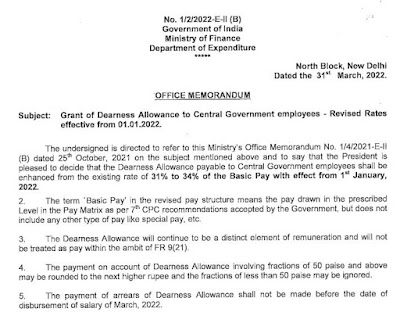
DA Jan 2022 - Grant of Dearness Allowance to Central Government employees - Revised Rates effective from 01.01.2022

 3% DA Hike - Revised Rates effective from 01.01.2022: DoE OM dated 31.03.2022 No. 1/2/2022-E-II (B) Government of India Ministry of Finance...