Thursday, 8 March 2018

7th CPC DA Arrears Ready Reckoner Tables for Level-2


7th CPC DA Arrears Ready Reckoner Tables for Level-2

DA Arrears Ready Reckoner Tables

Yesterday (7.3.2018) the Cabinet Committee has given its approval to hike 2% additional DA and DR to Central Government employees and pensioners with effect from January 2018.

DA Arrears Ready Reckoner Tables

Pay Matrix level 2 (GP1900) - Effective from 1.1.2018

Index
5%7% Difference Arrears
1199009951393398796
22050010251435410820
32110010551477422844
42170010851519434868
52240011201568448896
62310011551617462924
72380011901666476952
82450012251715490980
925200126017645041008
1026000130018205201040
1126800134018765361072
1227600138019325521104
1328400142019885681136
1429300146520515861172
1530200151021146041208
1631100155521776221244
1732000160022406401280
1833000165023106601320
1934000170023806801360
2035000175024507001400
2136100180525277221444
2237200186026047441488
2338300191526817661532
2439400197017587881576
2540600203028428121624
2641800209029268361672
2743100215530178621724
284440022:2031088881776
2945700228531999141828
3047100235532979421884
3148500242533959701940
32500002500350010002000
33515002575360510302060
34530002650371010602120
35546002730382210922184
36562002810393411242248
37579002895405311582316
38596002980417211922384
39614003070429812282456
40632003160442412642528
Source: Expected DA

7th CPC DA Arrears Ready Reckoner Tables for Level-1


7th CPC DA Arrears Ready Reckoner Tables for Level-1

DA Arrears Ready Reckoner Tables

Yesterday (7.3.2018) the Cabinet Committee has given its approval to hike 2% additional DA and DR to Central Government employees and pensioners with effect from January 2018.

DA Arrears Ready Reckoner Tables

Pay Matrix level 1 (GP1800) - Effective from 1.1.2018

Index5%7% Difference Arrears
1180009001260360720
2185009251295370740
3191009551337382764
4197009851379394788
52030010151421406812
62090010451463418836
72150010751505430860
82210011051547442884
92280011401596456912
102350011751645470940
112420012101694484968
122490012451743498996
1325600128017925121024
1426400132018485281056
1527200136019045441088
1628000140019605601120
1728800144020165761152
1829700148520795941188
1930600153021426121224
2031500157522056301260
2132400162022686481296
2233400167023386681336
2334400172024086881376
2435400177024787081416
2536500182525557301460
2637600188026327521504
2738700193527097741548
2839900199527937981596
294110020S528778221644
3042300211529618461692
3143600218030528721744
3244900224531438981796
3346200231032349241848
3447600238033329521904
3549000245034309801960
36505002525353510102020
37520002600364010402080
38536002680375210722144
39552002760386411042208
40569002845398311382276

Source: Expected DA

2% Dearness Allowance to Central Government employees & Pensioners


2% Dearness Allowance

2% Dearness Allowance to Central Government employees & Pensioners

Cabinet approves two percent Dearness Allowance to Central Government employees
The Union Cabinet chaired by Prime Minister Shri Narendra Modi has given its approval to release an additional installment of Dearness Allowance (DA) to Central Government employees and Dearness Relief (DR) to pensioners w.e.f. 01.01.2018 representing an increase of 2% over the existing rate of 5% of the Basic Pay/Pension, to compensate for price rise.

This will benefit about 48.41 lakh Central Government employees and 61.17 lakh pensioners.

The combined impact on the exchequer on account of both Dearness Allowance and Dearness Relief would be Rs.6077.72 crore per annum and Rs.7090.68 crore in the financial year 2018-19 (for a period of 14 months from January, 2018 to February, 2019).

This increase is in accordance with the accepted formula, which is based on the recommendations of the 7th Central Pay Commission.

Women Personnel in Army


Ministry of Defence

Women Personnel in Army

07 MAR 2018
Held strength of women officers (excluding Medical, Dental and Nursing) in the Indian Army for the last three years are as under:

YearNumber of officers
2015 (as on 1st July)1466
2016 (as on 1st July)1512
2017 (as on 1st July)1548

The borne strength of women officers (excluding Medical and Dental) in the Indian Navy as on 1st January from 2015 onwards is as follows

YearBorne strength of women officers
2015382
2016409
2017469

The strength of women officers (except Medical and Dental branch) in Indian Air Force in the last three years is as follows:

YearStrength of women officers
20151428
20161584
20171598

Details of women officers (excluding Medical, Dental and Nursing) in different Arms and Service of Indian Army as on 1st January, 2018 are as under:

Arm / ServiceWomen officers
AAD63
Engrs195
Sigs220
ASC265
AOC292
EME263
Int73
Army Avn20
AEC85
RVC0
JAG85
Total1561

Current held strength of women officers in Armed Forces Medical Services as on 1st January, 2018 is as under:

ServicesNumber of Officers
AMC (Medical Officers)975
AD Corps (Dental Officers)127
MNS (Military Nursing Service)3730

There are no non-commissioned women officers in the Army. As on 27 February 2018, the total strength of women officers in the Indian Navy (including Medical and Dental) is 639.

The branch wise breakdown is as follows:

Branch /Cadre / SpecialisationStrength
Education132
Logistics144
Law04
ATC67
Naval Constructor64
Observer70
Pilot02
Naval Armament10
Medical144
Dental02
Total:639

Branch wise details of women officers (except Medical and Dental branch) in the Indian Air Force (IAF) as on 1st February, 2018 is as follows:

BranchNo. of women officers
F(P)104
F(N)16
AE(M)48
AE(L)569
ADM430
LGS162
ACCTS116
EDN83
MET70
Total:1598
There are no non-commissioned women officers in the IAF.

The complaints of discrimination received from women officers at work place in the armed forces are investigated and necessary action taken against defaulting officers, in accordance with the prevailing Acts and rules in force.

This information was given by Raksha Rajya Mantri Dr. Subhash Bhamre in a written reply to Smt Kamla Devi Paatle in Lok Sabha today.

PIB

Recruitment of Soldiers


Ministry of Defence

Recruitment of Soldiers

07 MAR 2018
The details of youths who were recruited as soldiers in the Indian Army at various levels such as Commissioned Officers, Junior Commissioned Officers / Other Ranks (JCOs / ORs) are given below:

Officers *:
YearCandidates Selected
20151961
20161858
20171773

JCOs / ORs *:
YearCandidates Selected
2014-1566,992
2015-1671,434
2016-1752,086
2017-1817,257(Till 31st December 2017)
*Recruitment for Commissioned Officers is done calendar year wise, whereas the recruitment for JCO / ORs is done financial year wise.

This information was given by Raksha Rajya Mantri Dr. Subhash Bhamre in a written reply to Shri Vinod Lakhamashi Chavda in Lok Sabha today.

PIB

Facilities By Indian Railways For Disabled Persons


Indian Railways

Ministry of Railways
Facilities By Indian Railways For Disabled Persons
07 MAR 2018
Provision/augmentation of amenities at stations, including those for Persons with Disabilities (Divyangjan) and elderly passengers is a continuous process. In order to provide better accessibility to Persons with Disabilities (Divyangjan) and elderly passengers, short term facilities as detailed below have been planned at all the stations:
  • Standard ramp for barrier free entry.
  • Earmarking at least two parking lots.
  • Non-slippery walk-way from parking lot to building.
  • Signages of appropriate visibility.
  • At least one toilet (on the ground floor).
  • At least one drinking water tap suitable for use by Persons with Disabilities (Divyangjan).
  • 'May I help you' Booth.
    In addition, long term facilities as detailed below have been planned at 'A-1', 'A' & 'B' category stations:
  • Provision of facility for inter-platform transfer.
  • Engraving on edges of platform.
Details of railway stations provided with facilities for Persons with Disabilities (Divyangjan) are as under:

 S.
No.
Facilities for Persons with Disabilities (Divyangjan)Approx. Number of stations.
1Standard ramp for barrier free entry2350
2Earmarking at least two parking lots1350
3Non-slippery walk-way from parking lot to building1410
4Signages of appropriate visibility.1430
5At least one toilet (on the ground floor).1850
6At least one drinking water tap suitable for use by differently-abled persons1790
7‘May I help you’ Booth1080
8Provision of facility for inter-platform transfer1240
9Engraving on edges of platform1780

Railways has decided to provide escalators at all the A1, A & C category stations (footfall 25000 or above). Additionally railways has also planned to provide elevators at 500 more stations. About 3800 disabled friendly Integral Coach Factory (ICF) design coaches are available in the fleet of Indian Railways (IR). These coaches have a suitably designed compartment & toilet adapted to the needs of the disabled/Divyangs. More disabled friendly coaches shall be added to the fleet of IR in the coming years. It is endeavoured to have at least one such ICR design coach in each Mail/Express train running with ICF coaches. Further, the fully air conditioned (WRRMDAC) Garib Rath trains have been provided with an Air conditioned disabled friendly compartment in the power cars.

For the assistance of visually impaired travellers, Integrated Braille signages, i.e. signages superimposed with Braille scripts are being provided in the newly manufactured coaches of Indian Railways (IR). In addition, retro-fitment of the same in existing coaches has also been taken up in a phased manner.

Railways has provided 467 escalators at 171 railway stations and 318 elevators at 134 railway stations for senior citizens/disabled/ Divyangs.

This information was made available in reply to a question in Lok Sabha today.

PIB

International Women’s Day - 8th March 2018

International Women’s Day - 8th March 2018
WE WILL MAKE IT HAPPEN
Usha Bonepalli.
Chairperson,
Women’s Committee,
Confederation of Central Government Employees and Workers

International Women’s Day - 8th March 2018


Dear comrades,
Hearty wishes to every one of you on International Women’s Day 2018. We celebrate this day in honour of the great struggles that are waged by women, throughout the history of working class. We also mark this occasion to acknowledge and appreciate the wonderful roles that women play in making this world habitable, livable and lovable place of living. We utilize this occasion to reflect on the problems that prevent women from achieving gender parity, oppressions faced by them, and work out measures that lead to progress of women in all spheres of life.

One of the first organized struggles for women in modern times was held at Lowell Cotton Mills in Massachussets in 1834. Women worked for 14 hrs per day in mills in confinement, noise, lint filled air, for 1/3rd wages as compared to men. When these wages were also cut, they organized and went on strike. Women in several other mills joined them and an organised movement started for the first time in history. A second strike followed in 1836. Both the strikes were crushed by management, but that is how pioneering struggles start. Defeat gives spirit for better and more organized action. Women began Labour Reform Associations and started huge petition campaigns and political action, asking the Massachussets state legislature to cap working hours in mills at 10 hours. In 1847, New Hampshire became the 1st state to pass a 10 hour working day. This was the first success for organized working women in any part of the world. This success fuelled organized women movements throughout the world’s working class. Today, we remember that struggle with a sense of pride and honour.

The first National Womens Day was held in NewYork in 1909 to commemorate the 1908 garments workers strike. On 8th March 1908, 15000 women garment workers marched through Union Square to demand economic and political rights. The three month strike against Triangle Shirtwaist and other mills became hugely successful. This success was celebrated throughout Europe and Soviet. Clara Zeitkin, a German socialist proposed designating a day as ‘International Women’s Day’ at International Socialist Congress in Copenhagen in 1910. From 1911, we are observing International Womens Day. From 1975, UNO began celebrating International Womens Day on March 8th.
Comrades, the working conditions and safeguards that are available to women today, are a result of many such glorious struggles across the world. We have an 8 hour working day, equal pay for equal work, at least in the government sector, and statutory framework for women like Maternity Benefit Act 1961, Factories Act 1948, Equal Remuneration Act 1976, Sexual Harrassment of Women at Workplace (Prevention, Prohibition and Redressal) Act 2013 etc. None of these acts were made by way of compassion, but were a result of prolonged struggle of the working women. The latest Act in 2013 against sexual harassment at workplace was a result of Supreme Court guidelines in the Visakha case. Everyone knows that women are subject to sexual harassment in all spheres of life, but it took till 2013, and only after a long and concerted legal struggle before the Supreme Court, that guidelines were issued and Government found it fit to pass an Act on this issue. We should keep this in mind that nothing could be achieved unless we organize and wage struggles. We should realize that, though the working women’s movement has achieved significant results, there is a lot lot more to be achieved.

Nagaland, which went to polls recently, did not have a single woman MLA in its 54 years of statehood and 12 assembly elections. The situation is not much rosy in other states and even in the Parliament. Women representation in Lok Sabha is barely 11.3 % - 62 women out of 543 MPs. Take any elected body, including the trade unions, the presence of women in leadership positions is barely minimum. There are two reasons, resistance to give opportunities to women as men are entrenched in leadership positions, and lack of enough strength from women to push themselves ahead. Let us address the second issue, which is the only way to repulse the first issue.

Women are bogged down by multiple commitments, they have the inescapable responsibility of household duties. A working woman needs to get up early, cook food, pack lunches for everyone, layout breakfast and clothes for the boys, then commute to work, spend the day in office, and commute back to home, to cook again, help in homework, and then retire to bed, trying to look beautiful. This is the story of every working woman, either in Postal department, or in Dept of Atomic Energy, either as a clerk or in a higher cadre. There is no CL or EL to this duty. Good health or bad health, there is no escape from this routine. Added to this, women face stigma, violence and harassment at workplace, in society, on the streets, during commute, and some times, even at home. Women face deficit in respect in all walks of life. Media and commerce address women as a commodity. They stereotype women, erect standards of medieval morality and even resort to body-shaming. The invisible chains that tie up women are too heavy and too arresting, to unshackle. It’s a herculean task for any woman to unshackle herself, free herself and make her voice count, in public discourse and organized struggles. But we have to realize, and there is no better day that today, that struggle is the only way. It is only because of our organized struggles that we have achieved so far.
One way to derive inspiration and strength to unshackle ourselves is to celebrate the success stories of women, big or small, in all walks of life. Look around for icons and celebrate them. When our daughters submit a project in school and get two stars, lets celebrate that at home, with all the vigour. When Harmanpreet Kaur hits 171 in 115 balls in Cricket World Cup, lets put her posters (over Sachin’s posters) in our rooms and celebrate that with joy. When we come to know that global Chairman/MD/CEOs of General Motors, Pepsico, IBM, Lockheed Martin are all women, lets celebrate that. When we realize that the superstar of male-centric Bollywood during 1980s was not a man but a woman, lets celebrate that. Every woman who achieved something in life, would have achieved against all odds, facing many difficulties. Lets be proud of all of them, lets gain inspiration from them. And lets help our colleagues, our relatives, our neighbours, our fellow women, in whatever they are aspiring to achieve. And stand by her in all her difficulties. Unless a woman supports a woman, no one supports her.

Another way to unshackle ourselves is to resist media stereotypes. Media is obsessed with stereotyping women as loud viragoes. Social media is obsessed with posting comments on women in the form of jokes, which insult and denigrate the attitude of women. And the commercial industry insults women by portraying women as beautiful only if they are slim or if they have certain body statistics. Why is a man’s figure or his tummy not an object of shame but a woman’s figure or tummy is shamed. A woman becomes a mother, has a rebirth herself when she gives birth to children, undergoes many body changes and fights to come back to normal. Whatever shape she eventually has, the society should make her feel proud of it, not ashamed of it. But because of the intense media standards on what is beautiful and what is not, women are psychologically forced to follow some fad diets, starve themselves and spoil their health. Even school going girls are doing dieting. This is a very dangerous trend. Yes, we need to have fitness. We should do exercise or yoga if it fits in our daily routine, or at least some walking, but beauty doesn’t mean looking like a pencil. We need a movement, first in our minds, and then in the society, to stop this trend. Because of our workload at home and at workplace, women need to eat well, be healthy, and feel confident about whatever shape they are in. One report says that 80 % of present day women above 40 are cases for bone related ailments like osteoporosis. So I request all women to take your health seriously, get some sunlight for Vit D, have iron and calcium supplements and above all, eat well. Don’t starve. We are ourselves. We will not allow the media to judge us.

Friends, the sure way to unshackle ourselves is to develop the confidence in our abilities. Seek responsibilities, take active part in leadership positions in your workplace, in administration, and in unions. If you develop the will and confidence, there is nothing that a woman cannot do, as good as, if not better than, her male counterpart. We have an immense task cut out before us. Once women gain employment, they should be endowed with right to equality, right against discrimination in workplace. Women should be assured dignity of labour, equal wages, beneficial facilities and additional safeguards which compensate for their lack of level playing field. These safeguards and benefits should be made statutory, institutionalised, and implemented thoroughly. We should make relentless fight for safegaurds that we are yet to achieve. We should be very vigilant. Because there will always be attempts to mock, sneer, and trample on the safeguards and the genuine benefits that we rightfully deserve.

Achieving gender equality and empowering women and girls is the unfinished business of our time, and the greatest human rights challenge in our world.” These are the words of our present UN Secretary General Antonio Guterres. In recognition of this ‘unfinished business’ and ‘greatest human rights challenge’, the campaign theme for International Women’s Day for 2018 is selected as ‘Press for Progress’. The campaign requires that the following activities are taken up:
a. Maintain a gender parity mindset (question any lack of womens’ participation, identify alternatives that are more inclusive, nominate women for opportunities, always include and support women, think 50/50 as goal),
b. Challenge stereotypes and bias (question assumptions about women, challenge statements that limit women, always use inclusive language, work to remove barriers to women’s progress, bur from retailers who position women in positive ways),
c. Forge positive visibility of women (identify ways to make women more visible, extend opportunities to women first, assume women want opportunities until declined, select women as spokepersons and leaders, support visible women),
d. Influence others’ beliefs/actions (supportively call-out inappropriate behavior, campaign for equality in meaningful ways, lead by example via inclusive actions, be a role model for equality, actively contribute to change the status quo) and
e. Celebrate women’s achievements (believe achievement comes in many forms, value women’s individual and collective success, ensure credit is given for women’s contributions, celebrate women role models and their journeys, support awards showcasing women’s success).
Lets do that comrades. As Chairperson of the Womens Committee of Confederation of Central Government Employees and Workers, I call upon everyone to join hands and rededicate ourselves to this call – Press for Progress. We will make it happen.
Source: Confederation

Wednesday, 7 March 2018

Partial Withdrawal under NPS

Ministry of Finance

Partial Withdrawal under NPS

06 MAR 2018

The Pension Fund Regulatory Development Authority (PFRDA) has relaxed the norms for partial withdrawal under the National Pension Scheme (NPS). In accordance with the PFRDA (Exits and Withdrawals under the National Pension System) (First Amendment) Regulations 2017, the subscriber ought to be subscribed to the National Pension System, at least for a period of three years from the date of his or her joining to such system, to be eligible to make partial withdrawals, under specific circumstances as specified in such regulations.

The NPS subscribers can withdraw after three years from the date of joining the system and a maximum of three times during the entire tenure of subscription under NPS, but the partial withdrawal is linked with contributions made by the subscriber. The subscriber shall be permitted to withdraw accumulations not exceeding twenty-five per cent of the contributions made by him or her and standing to his or her credit in his or her individual pension account, as on the date of application for withdrawal.

Earlier the subscriber under NPS was permitted to withdraw accumulations not exceeding twenty-five per cent of the contributions made by him or her after 10 years from the date of his or her joining the system, and a maximum of three times during the entire tenure of subscription under NPS.

This was stated by Shri Shiv Pratap Shukla, Minister of State for Finance in written reply to a question in Rajya Sabha today.

PIB

Facilities to CAPF Personnel


Ministry of Home Affairs

Facilities to CAPF Personnel
06 MAR 2018
The total number of CAPFs & AR personnel posted in the country, force- wise as on 31.01.2018 is as under :-
ForceNumber of personnel posted
CRPF3,01,041
BSF2,46,554
CISF1,42,836
SSB   80,285
ITBP   83,641
Assam Rifle   63,485
Total9,17,842

As per information received from CAPFs & AR, 4202 personnel died during service and on duty due to non-combat causes during the last three years and current year upto 31.01.2018.

CAPFs & AR personnel and officers (upto the rank of Commandant, who are deployed in field formation only) are entitled to Ration Money Allowance @ Rs. 97.85 per head per day.

The details of facilities provided to CAPF personnel is as per details given below:
  1. Continuous endeavours are made to improve the living conditions of the CAPF personnel, including enhancing the level of their housing satisfaction and appropriate budgetary allocations are also made for this purpose.
  2. Forces have taken adequate steps to provide potable drinking water to its troops and families even in remotest areas. Borewells in permanent locations, water supplies from State Water bodies, installing commercial Reverse Osmosis (RO) system and water-harvesting are some of the measures undertaken by the forces for providing water.
  3. CAPF personnel deployed at borders are provided with barrack accommodation with cook house, dining hall and toilet blocks. In harsh areas, integrated composite building with central heating and freeze proof toilets are provided. Medical facilities, Air Courier Services, dedicated rail coaches in some major trains, Central Police Canteen, recreation and transit camp facilities are also available to the personnel deployed at borders.
  4. Ex-gratia lump-sum compensation @ Rs.35 lakhs for death on active duty and Rs.25 Lakhs for death on duty, as the case may be, is entitled to the Next of Kin of the deceased personnel.
  5. Under the Prime Minister Scholarship Scheme, amount @ Rs.2250/- pm for girls and Rs.2000/- pm for boys is being released to the wards of serving/retired CAPFs, AR and NSG personnel. Prime Minister Scholarship is admissible to 1000 girls and 1000 boys.
  6. 5% vacancies are reserved in Group 'C&' for compassionate appointments for NoK of the deceased personnel.
  7. There is a reservation in MBBS and BDS seats for the wards of CAPFs & AR personnel in Medical Colleges.
  8. Central Police Canteens are functioning at various locations in the country.
  9. A Welfare & Rehabilitation Board has been established for the welfare and rehabilitation of CAPF & AR personnel and their families including disabled personnel.
  10. The NOKs of deceased CAPFs & AR personnel who sacrificed their lives for the cause of nation are eligible for 'Operational Casualty Certificate'.
  11. The Government has accepted the recommendations of 7th Central Pay Commission (CPC) on various allowances, inter alia, Risk & Hardship Allowance, Dress Allowance, Additional Free Railway Warrant/LTC, etc.
This was stated by the Minister of State for Home Affairs, Shri Kiren Rijiju in a written reply to question in the Lok Sabha today.

PIB

Tuesday, 6 March 2018

Ministry of Railways instructs Zonal Railways to link the arrival & departure of trains with Data Loggers

Ministry of Railways

Ministry of Railways instructs Zonal Railways to link the arrival & departure of trains with Data Loggers
A data logger (also data recorder) is an electronic device that records data over time or in relation to location either with a built-in instrument or sensor or via external instruments and sensors
41 stations across India records Punctuality of trains through Data Loggers
Punctuality of almost 80% of mail/express trains is being monitored through this system
This system will improve punctuality of trains & provide real time train movement information to passengers.
06 MAR 2018

Ministry of Railways have eliminated the practice of manually recording punctuality performance at 41 major railway junctions across zones to ensure correct reporting of such data. The Railway Board has instructed zonal railways to link the arrival and departure of trains with data loggers from January 1 2018 without the fear of drop in punctuality and report authentic punctuality status.

A data logger (also data recorder) is an electronic device that records data over time by sensing status of relays. Railway zones have provided such data loggers this across 41 stations which include Howrah, Mumbai CST, Mughalsarai, Lucknow, Kanpur, Chennai Central, Ahmedabad and Bangalore.

It has been an endeavour of Indian Railways to run trains punctually and provide information to their customers more current, reliable and accurate, with minimal human intervention. Data Loggers were provided at Stations to monitor the status of functioning of signaling gears. For train control, Optical Fibre network has also been laid and linked to control centres of the Divisions.

It was decided to utilize these data loggers for capturing trains running information & update Control Office Application (COA) automatically at the central server. For this purpose, to start with, the data loggers of one terminal station and one more station at each zonal railway is linked with COA through optical fibre backbone for automatically picking up the train running status. The work at 17 terminal stations and 17 other stations has been implemented as a pilot project. The system has been working since 1st Jan.2018 and extended to total 41 stations. (List attached)

As on date, punctuality of almost 80% of mail/express trains is being monitored through this system. It has been planned to further expand the network covering all the terminal stations. With the implementation of this system, the information available to the passenger is reliable and more current.

List of Railway stations zones where data loggers have been provided :
S.No. Statio Division Railway
1. Khandwa Bhusawal CR
2. Balahrshah Nagpur CR
3. Roha Mumbai CR
4. Mumbai CST Mumbai CR
5. Asansol Asansol ER
6. Howrah Howrah ER
7. East Outer Cabin Mughalsarai ECR
8. Manpur Mughalsarai ECR
9. Mughalsarai (NEWC) Mughalsarai ECR
10. Goldenganj Sonpur ECR
11. Seemapur Sonpur ECR
12. KIUL Danapur ECR
13. Pradankhunta Dhanbad ECR
14. Bhubaneshwar Khurda Road ECoR
15. Bhadrakh Khurda Road ECoR
16. Duvvada Waltair ECoR
17. Chipyana Delhi NR
18. Palwal Delhi NR
19. Kanpur Allahabad NCR
20. Lucknow Jn Lucknow NER
21. Gorakhpur RRI Lucknow NER
22. Varanasi City Varanasi NER
23. Guwahati Lumding NFR
24. New Bongaigaon-3 cabins Rangiya NFR
25. Rani nagar Jalpaiguri Katihar NFR
26. Old Malda Jn Katihar NFR
27. Katihar RRI-3 cabins Katihar NFR
28. Jaipur Jaipur NWR
29. Rewari Jaipur NWR
30. Chennai Central Chennai SR
31. Jolarpetttai Chennai SR
32. Gudur Vijayawada SCR
33. Secuderabad Secuderabad SCR
34. Jharsuguda Chakradharpur SER
35. Bilaspur Bilaspur SECR
36. Banglore Banglore SWR
37. Ahmedabad Ahmedabad WR
38. Nagda Ratlam WR
39. Bina Bhopal WCR
40. Jabalpur Jabalpur WCR
41. New Katni Jn Jabalpur WCR

PIB

Flash News

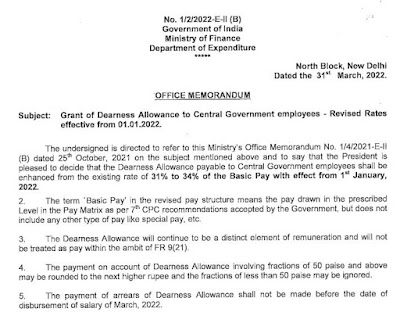
DA Jan 2022 - Grant of Dearness Allowance to Central Government employees - Revised Rates effective from 01.01.2022

 3% DA Hike - Revised Rates effective from 01.01.2022: DoE OM dated 31.03.2022 No. 1/2/2022-E-II (B) Government of India Ministry of Finance...