Showing posts with label Disabled Persons. Show all posts

Wednesday, 27 March 2019

FAQ on reservations for disabled persons in Central Government posts / services

FAQ on reservations for disabled persons in Central Government posts / services

No.36035/02/2017-Estt (Res)
Government of India
Ministry of Personnel, Public Grievances & Pensions
Department of Personnel & Training
North Block, New Delhi
dated the 25 March, 2019
Subject: Frequently Asked Questions (FAQs) on reservation to Persons with Benchmark Disabilities in posts/services under Central Government - reg.

This Department receives references from various Ministries/Departments seeking clarification on instructions with regard to reservation for Persons with Benchmark Disabilities issued vide OM of even number dated 15.1.2018; therefore, a set of Frequently Asked Questions (FAQs) have been answered as under for their use:

Q.1 Whether the reservation for Persons with Benchmark Disabilities are vacancy based or post based?
Answer: Reservation for. Persons with Benchmark Disabilities is vacancy based as per Section 34 of the Rights of Persons with Disabilities Act, 2016.

Q.2 What categories of specified disabilities are covered for reservation and what is the percentage allocation of reservation for each category of persons with benchmark disabilities?
Answer: As provided in Para .2 of the OM of even number dated 15.1.2018, categories of specified disabilities covered under reservation in posts and services of the Central Government vis-a-vis category wise percentage of reservation is as under:
a)blindness and low vision;1%
b)deaf and hard of hearing;1%
c)locomotor disability including cerebral palsy, leprosy cured, dwarfism, acid attack victims and muscular dystrophy;1%
d)autism, intellectual disability, specific learning disability and mental illness;1%
e)multiple disabilities from amongst persons under clauses (a) to (d) including deaf-blindness,1%

Q.3 Whether the Persons with Benchmark Disabilities can apply against the posts, which are not identified suitable for Persons with Benchmark Disabilities?
Answer: Persons with Benchmark Disabilities can apply only against the posts identified suitable for the relevant category.

Q.4 Whether any priority has been given in selection to any category of
disability?

Answer: Priority has not been given in selection to any category of Persons with Benchmark disability.

Q.5 Whether a Benchmark Disability candidate can compete for appointment against an unreserved vacancies?
Answer: Yes, Benchmark Disability candidates can compete for appointment by direct recruitment against an unreserved vacancy if selected without relaxed standards along with other candidates for those posts/services which are identified suitable for them.

Q.6 Whether the vacancies which are to be earmarked reserved for Persons with Benchmark Disabilities is to be computed on the total number of vacancies in the cadre strength in identified categories of posts as well as unidentified categories of posts.
Answer: Yes, vacancies which are to be earmarked reserved for Persons with Benchmark Disabilities is to be computed on the total number of vacancies in the cadre strength in identified categories of posts as well as unidentified categories of posts. However, recruitment of persons with benchmark disabilities would only be against the category of posts identified suitable for them.

Q.7 Whether a separate roster is to be maintained for Persons with Benchmark Disabilities irrespective of the post based roster applicable for SC/ST/OBC?
Answer: Yes, every Central Government establishment shall maintain group-wise separate 100 point vacancy based reservation roster register in the prescribed format for determining/effecting reservation for the Persons with Benchmark Disabilities – one each for Group ‘A’ posts filled by direct recruitment, Group ‘B’ posts filled by direct recruitment and Group ‘C’ posts filled by direct recruitment.

Q.8 What to do with vacancies reserved for any particular category(s) of Persons with Benchmark Disabilities cannot be filled due to non-availability of a suitable candidate, or for any other sufficient reasons?
Answer: As per Section 34(2) of the Rights of Persons with Disabilities Act, 2016, if in any recruitment year any vacancy cannot be filled up due to non-availability of a suitable person with benchmark disability or for any other sufficient reasons, such vacancy shall be carried forward in the succeeding recruitment year and if in the succeeding recruitment year also suitable person with benchmark disability is not available, it may first be filled by interchange among the five categories and only when there is no person with disability available for the post in that year, the employer shall fill up the vacancy by appointment of a person, other than a person with disability.
(G. Srinivasan)
Director (Res)
reservations for disabled persons in Central Government posts

Thursday, 8 March 2018

Facilities By Indian Railways For Disabled Persons


Indian Railways

Ministry of Railways
Facilities By Indian Railways For Disabled Persons
07 MAR 2018
Provision/augmentation of amenities at stations, including those for Persons with Disabilities (Divyangjan) and elderly passengers is a continuous process. In order to provide better accessibility to Persons with Disabilities (Divyangjan) and elderly passengers, short term facilities as detailed below have been planned at all the stations:
  • Standard ramp for barrier free entry.
  • Earmarking at least two parking lots.
  • Non-slippery walk-way from parking lot to building.
  • Signages of appropriate visibility.
  • At least one toilet (on the ground floor).
  • At least one drinking water tap suitable for use by Persons with Disabilities (Divyangjan).
  • 'May I help you' Booth.
    In addition, long term facilities as detailed below have been planned at 'A-1', 'A' & 'B' category stations:
  • Provision of facility for inter-platform transfer.
  • Engraving on edges of platform.
Details of railway stations provided with facilities for Persons with Disabilities (Divyangjan) are as under:

 S.
No.
Facilities for Persons with Disabilities (Divyangjan)Approx. Number of stations.
1Standard ramp for barrier free entry2350
2Earmarking at least two parking lots1350
3Non-slippery walk-way from parking lot to building1410
4Signages of appropriate visibility.1430
5At least one toilet (on the ground floor).1850
6At least one drinking water tap suitable for use by differently-abled persons1790
7‘May I help you’ Booth1080
8Provision of facility for inter-platform transfer1240
9Engraving on edges of platform1780

Railways has decided to provide escalators at all the A1, A & C category stations (footfall 25000 or above). Additionally railways has also planned to provide elevators at 500 more stations. About 3800 disabled friendly Integral Coach Factory (ICF) design coaches are available in the fleet of Indian Railways (IR). These coaches have a suitably designed compartment & toilet adapted to the needs of the disabled/Divyangs. More disabled friendly coaches shall be added to the fleet of IR in the coming years. It is endeavoured to have at least one such ICR design coach in each Mail/Express train running with ICF coaches. Further, the fully air conditioned (WRRMDAC) Garib Rath trains have been provided with an Air conditioned disabled friendly compartment in the power cars.

For the assistance of visually impaired travellers, Integrated Braille signages, i.e. signages superimposed with Braille scripts are being provided in the newly manufactured coaches of Indian Railways (IR). In addition, retro-fitment of the same in existing coaches has also been taken up in a phased manner.

Railways has provided 467 escalators at 171 railway stations and 318 elevators at 134 railway stations for senior citizens/disabled/ Divyangs.

This information was made available in reply to a question in Lok Sabha today.

PIB

Friday, 29 April 2016

Facility for Disabled and Senior Citizens on Trains and at Railway Stations

Facility for Disabled and Senior Citizens on Trains and at Railway Stations

Instructions exist for provision of Wheel Chair at stations. This facility is provided, duly escorted by coolies (on payment) as per present practice.

Almost all the Mail/Express trains (except special type of trains like Rajdhani, Shatabdi, Janshatabdi, AC Special, Duronto) including Garib Rath trains have been provided with at least one disabled friendly coach. SLRD (Second Class Cum Luggage Cum Guard Van & Disabled friendly compartment) coaches and Power Cars for Garib Rath trains having provisions for PWD (Persons with Disability) Compartment with air-conditioning are already in service. These coaches have wider entrance doors for wheelchair access. Besides, following features are also provided:
i) Wider entrance doors of 920 mm width against 782 mm in conventional body side doors.
ii) Handrails on side walls for providing assistance to the disabled.
iii) Wider aisle of 1050 mm instead of usual 570 mm (the seats alongside the sidewall have been removed).
iv) Wider cushioned Berths – 707 mm instead of 607 mm in conventional coaches.
v) To accommodate wheel chairs, space between berths increased to 1201 mm against usual 542 mm.
vi) Larger Lavatory: 1947 mm square instead of 1540 mm x1189 mm.
vii) Wider lavatory door provided: 840 mm instead of usual 520 mm.
viii) Additional grab rails provided in the lavatory.
ix) Lower height of wash basin and mirror in the toilet.
Zonal Railways have been authorised to introduce ‘Battery Operated Vehicles’ at major Railway Stations for Disabled, Old Aged and sick Passengers on first come first served basis through sponsorship from individuals, NGOs, trusts, Charitable institutions, Corporates and PSUs/Corporate Houses under their Corporate Social Responsibility with no charge to passenger or to the Railway.

Provision/augmentation of amenities at stations, including those for differently abled passengers is a continuous process. In order to provide better accessibility to differently abled passengers, short term facilities as detailed below have been planned at all stations:
· Standard ramp for barrier free entry.
· Earmarking at least two parking lots.
· Non-slippery walk-way from parking lot to building.
· Signages of appropriate visibility.
· At least one toilet (on the ground floor).
· At least one drinking water tap suitable for use by differently-abled persons.
· ‘May I help you’ Booth.
In addition, long term facilities as detailed below have been planned at ‘A-1’, ‘A’ & ‘B’ category stations:
· Provision of facility for inter-platform transfer.
· Engraving on edges of platform.
Instructions have been issued to zonal railways for providing above facilities at all ‘A-1’ category stations by July 2016 and to provide all identified short term facilities at 50% of stations by March 2018.

This Press Release based on information given by the Minister of State for Railways Shri Manoj Sinha in a written reply to a question in Rajya Sabha on 29.04.2016 (Friday).

PIB

Thursday, 19 June 2014

Dopt Orders on Posting of Government employees who have differently abled dependents

Dopt Orders on Posting of Government employees who have differently abled dependents 
No.42011/3/2014-Estt.(Res.) 
Government of India 
Ministry of Personnel, Public Grievances and Pensions 
Department of Personnel and Training 
North Block, New Delhi 
Dated the 6th June, 2014 
OFFICE MEMORANDUM 
Sub: Posting of Government employees who have differently abled dependents - reg. 
There has been demand that a Government employee who is a care giver of the disabled child may not have to suffer due to displacement by means of routine transfer/rotational transfers. This demand has been made on the ground that a Government employee raises a kind of support system for his/her disabled child over a 
period of time in the locality where he/she resides which helps them in the rehabilitation. 

2. The matter has been examined. Rehabilitation is a process aimed at enabling persons with disabilities to reach and maintain their optimal physical, sensory, intellectual, and psychiatric or a social functional level. The support system comprises of preferred linguistic zone, school/academic level, administration, neighbours, tutors/special educators, friends, medical care including hospitals, therapists and doctors, etc. Thus, rehabilitation is a continuous process and creation of such support system takes years together.
3. Considering that the Government employee.who has disabled child serve as the main care giver of such child, any displacement of such Government employee will have a bearing on the systemic rehabilitation of the disabled child since the new environment/set up could prove to be a hindrance for the rehabilitation process of the child. Therefore, a Government servant who is also a care giver of disabled child may be exempted from the routine exercise of transfer/rotational transfer subject to the administrative constraints.
The word 'disabled' includes
(i) blindness or low vision 
(ii) hearing impairment 
(iii) locomotor disability or Cerebral Palsy 
(iv) leprosy cured 
(v) mental retardation 
(vi) mental illness and
(vii) multiple disabilities. 
4. Upbringing and rehabilitation of disabled child requires financial support. Making the Government employee to choose voluntary retirement on the pretext of routine transfer/rotation transfer would have adverse impact on the rehabilitation process of the disabled child.
5. This issues with the approval of MoS(PP).
6. All the Ministries/Departments, etc. are requested to bring these instructions to the notice of all concerned under their control. 
sd/-
(Debabrata Das) 
Under Secretary to the Govt. of India
Source: www.persmin.gov.in
[http://ccis.nic.in/WriteReadData/CircularPortal/D2/D02adm/42011_3_2014-Estt.Res.-06062014.pdf]

Flash News

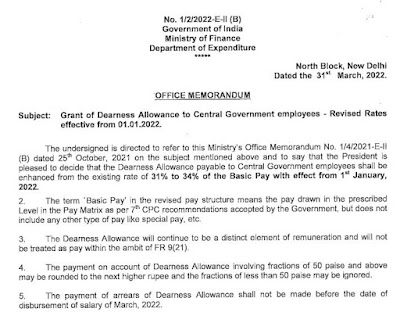
DA Jan 2022 - Grant of Dearness Allowance to Central Government employees - Revised Rates effective from 01.01.2022

 3% DA Hike - Revised Rates effective from 01.01.2022: DoE OM dated 31.03.2022 No. 1/2/2022-E-II (B) Government of India Ministry of Finance...