Thursday, 23 March 2017

Air India LTC 80 Fare as on March 2017 for Central Government Employees


Air India LTC 80 Fare as on March 2017 for Central Government Employees

Travel by Air while availing LTC - Air India LTC 80 Fare as on March 2017 - Central Government Employees travelling on LTC will have to purchase only Air India Tickets under LTC 80 Fare

Air-Travel-LTC

Instructions issued by Govt from time to time envisages that Central Government Employees will have to travel only by Air India by purchasing LTC 80 tickets, when they avail Air under Leave Travel concession.
Govt has also issued instructions regarding eligibility for reimbursement of Private Air tickets fare other than Air India LTC 80 Tickets, in certain circumstances such as non-availablity of Air India flights, tickets etc.

The Latest Air India LTC 80 Fare with effect from March 2017 along with Air India’s conditions for booking air tickets under LTC concession.

LTC Concession
Eligibility:Air India offers LTC in Economy and Business class Indians and their family members traveling on leave.For the purpose of concession, the family includes Spouse, dependent children 12Yrs and above and dependent Parents. They must be employed in the following institutions where leave facility is available:- Central & State Government.
- Public Sector Organizations.
- Educational Institute recognized / aided by Central / State Governments and / or officiated to any of the Universities / Education Boards.
Required Documents:Official ID card. Family members to carry the copy of the same.
Discount:Specific HLTC fare in Economy and DLTC in Business class.
Travel:Any sector within India.
Ticket Validity:1 Year from date of issue
Advance Purchase:Not required. Ticket can be purchased any time
Children:Normal discount on the class of travel. No additional discount applies.
Infant:(Under 2 years) 1st accompanying Infant - Rs.1000 per coupon, Plus applicable taxes. 2nd and more Infants, no discount permissible.
Date/Flight change, Cancellation & Refund:Permitted - Fee applies

TABLE - IV : LTC Fares

SECTOR & V.VHLTC (Economy Class)DLTC (Executive Class)
Base FareBase Fare
AgartalaKolkata574112601
AgattiBengaluru10141
AgattiKochi10421
AgraDelhi753118476
AgraKhajuraho574111001
AgraVaranasi679615872
AhmedabadChennai1037633856
AhmedabadDelhi815022628
AhmedabadHyderabad922625124
AhmedabadMumbai620118792
AizawlImphal631611800
AizawlKolkata647613853
AllahabadDelhi8391
AllahabadKanpur7531
AllahabadMumbai12351
AmritsarDelhi621618680
AmritsarMumbai1346135400
AmritsarNanded1346135400
AurangabadDelhi1095127552
AurangabadMumbai630117880
BagdograDelhi1266627400
BagdograKolkata728617840
BhatindaDelhi6901
BengaluruChennai655113396
BengaluruDelhi1355139956
BengaluruGoa700120056
BengaluruHubli6671
BengaluruHyderabad730121556
BengaluruKochi635114032
BengaluruKolkata1335137072
BengaluruMangalore6786
BengaluruMumbai900121644
BengaluruMysore6351
BengaluruPune803421368
BengaluruTirupati7071
BengaluruTrivandrum730116948
BengaluruVijayawada7101
BhavnagarMumbai6786
BhopalDelhi665122200
BhopalHyderabad7900
BhopalIndore613112732
BhopalJabalpur6901
BhopalMumbai720623880
BhopalPune7101
BhopalRaipur7180
BhubaneshwarDelhi1195132813
BhubaneshwarMumbai1235135108
BhubaneshwarPort Blair14166
BhubaneshwarVaranasi855023880
BhujMumbai8391
ChandigarhDelhi615118508
ChandigarhJammu6901
ChandigarhLeh655114032
ChandigarhMumbai1178635400
ChandigarhPune1178635400
ChennaiCoimbatore717117120
ChennaiDelhi1210639724
ChennaiGoa816121052
ChennaiHyderabad630118328
ChennaiKochi710119312
ChennaiKolkata1151636144
ChennaiMadurai610117012
ChennaiMumbai1152127680
ChennaiPortblair1236133312
ChennaiPune1000126752
ChennaiTrivandrum745119320
CoimbatoreDelhi1340141624
CoimbatoreMumbai1095127480
DehradunDelhi707117400
DehliDharamsala6671
DehliDurgapur1201133672
DelhiGaya900123524
DelhiGoa1247133260
DelhiGorakhpur7206
DelhiGuwahati1346133904
DelhiGwalior690112614
DelhiHyderabad1135133960
DelhiImphal1273138000
DelhiIndore670120668
DelhiJabalpur8251
DelhiJaipur540117880
DelhiJammu625118836
DelhiJodhpur755618940
DelhiKanpur7171
DelhiKhajuraho750119836
DelhiKochi1600144668
DelhiKolkata1201134600
DelhiKozhikode1370140024
DelhiKullu8151
DelhiLeh735119872
DelhiLucknow667118680
DelhiMangalore1355139956
DelhiMumbai1190131360
DelhiNagpur932122718
DelhiPantnagar6151
DelhiPatna930123120
DelhiPort Blair2516644668
DelhiPune1235136872
DelhiRaipur1000127952
DelhiRajkot11251
DelhiRanchi1176127480
DelhiSrinagar805122364
DelhiSurat1125126536
DelhiTirupati1266638000
DelhiTrivandrum1580644668
DelhiUdaipur763622680
DelhiVadodra920125476
DelhiVaranasi753122600
DelhiVijayawada1151633874
DelhiVishakhapatnam1335135876
DibrugarhDimapur510111276
DibrugarhKolkata955118312
DimapurKolkata795116827
DiuMumbai6901
DurgapurKolkata625317880
GayaKolkata635114550
GayaVaranasi670112110
GoaHyderabad710119880
GoaKochi685119123
GoaMumbai717117120
GoaPune638617880
GuwahatiImphal675117880
GuwahatiKolkata692618280
GuwahatiLilabari7001
GuwahatiSilchar7101
GuwahatiTezpur5951
GwaliorMumbai1055123946
HubliMumbai6671
HyderabadJabalpur7900
HyderabadKolkata1264633340
HyderabadMumbai710119696
HyderabadPune708118912
HyderabadTirupati650617880
HyderabadVaranasi1176127456
HyderabadVijayawada690117880
HyderabadVishakhapatnam679617880
ImphalKolkata613114480
IndoreMumbai633117128
JaipurMumbai1000124316
JaipurJodhpur703116280
JammuLeh673617880
JammuSrinagar625317880
JamnagarMumbai703116280
JodhpurMumbai983624180
KhajurahoVaranasi678619480
KochiMumbai1135128068
KochiTrivandrum615110804
KolkataLilabari9950
KolkataMumbai1213638000
KolkataPort Blair1402133708
KolkataRanchi6386
KolkataShillong7331
KolkataSilchar685114228
KolkataTezpur7001
KozhikodeMumbai1125029536
LehSrinagar645317880
LucknowMumbai1100133340
MaduraiMumbai1080130284
MangaloreMumbai793620552
MumbaiNagpur685119892
MumbaiRaipur1165026396
MumbaiRajkot713117880
MumbaiRanchi1270134160
MumbaiSurat6151
MumbaiTrivandrum1315130552
MumbaiUdaipur663622280
MumbaiVaranasi1264631221
MumbaiVishakhapatnam1205130016
Port BlairVishakhapatnam1264629621
PuneRaipur9301
RaipurNagpur703116280
RaipurVishakhapatnam610115999
SilcharTezpur5951
VijayawadaVishakhapatnam6901

Source: Download Latest Air India LTC 80 Ticket Fare with effect from March 2017 released by Air India

Kendriya Vidyalayas PGT, TGT Exam 2017 answer key released


Kendriya Vidyalayas PGT, TGT Exam 2017 answer key released

Kendriya Vidyalayas PGT, TGT Exam 2017: Answer keys, OMR sheet released at mecbsekvs.in

Kendriya Vidyalayas PGT, TGT Exam 2017: Answer keys, OMR sheet : The Kendriya Vidyalaya Sangathan recruitment examination 2017 answer keys have been released at kvsangathan.nic.in
The Central Board of Secondary Education (CBSE) conducted the written exam for the post of Post Graduate Teacher (PGT) and PRT on January 7 and Trained Graduate Teacher (TGT) and TGT (Misc.) on January 8. Answer key/ Paper solution for this examination is now available online. All appeared candidates can check official answer key from the following links.

The following KV PGT, TGT 2017 answer keys are available in the following link :
  • Answer key for Principal (paper 1)
  • Final answer key for Principal (paper 1)
  • Answer key for PGT (paper 1)
  • Answer key for PRT (paper 2)
  • Answer key for TGT (paper 1)
  • Answer key for TGT (Misc) (paper-2)
The Central Board of Secondary Education has displayed the images of OMR Sheets of the candidates who had appeared for written examination for Kendriya Vidyalaya Sangathan Recruitment Examination for the post of PGT and PRT conducted on 07/01/2017 and TGT and TGT (Misc.) conducted on 08/01/2017 along with the answer key to ensure transparency in examination process from 21/03/2017 to 25/03/2017 (midnight).

The candidates can check and download the scanned images of their OMR sheets and answer key prepared by the Board from www.mecbsekvs.in and www.kvsangathan.nic.in

The candidates willing to challenge any answer given in the Answer key displayed by CBSE may do so by submitting their challenges online on the prescribed format by clicking the link available on www.mecbsekvs.in and www.kvsangathan.nic.in upto 25/03/2017 (midnight).

The challenges submitted by any other mode like fax, email, post or in person etc. will not be entertained. A fee of Rs. 500/- per challenge will be required to be submitted by e-challan through HDFC Bank. The fee once paid is non-refundable.

If the challenge is accepted by the Board i.e. if any mistake is noticed by the subject experts in the answer key, the fee shall be refunded. CBSE's decision on the challenges shall be final and binding and no further communication will be entertained.

To avoid any confusion, CBSE has also released the images of OMR sheets of the candidates who appeared for recruitment exam on its website, mecbsekvs.in

Steps to check the answer keys:

  • Log on to the official website
  • Click on Paper 1 and Paper 2 of PGT and TGT exam link
  • Click on the ‘Download OMR sheet and submission key challenge’ link
  • Enter your roll number and date of birth
  • Click to login
  • Check and download the same

Vacancy details:

Total posts: 6,205

Name of the posts:

  • Principal: 90
  • PGTs: 690
  • TGTs: 926
  • Primary Teacher: 4499

Selection procedure:

The candidates will be selected on the basis of their performance in an interview.

Pay scale:

  • Principal: Rs 15,600 to Rs 39,100 per month
  • PGTs: Rs 9,300 to Rs 34,800 per month
  • TGTs: Rs 9,300 to Rs 34,800 per month
  • Primary Teacher: Rs 9,300 to Rs 34,800 with a grade pay of Rs 4,200 per month.

About KVS :

KVS is affiliated to the Central Board of Secondary Education (CBSE) to provide education to children of transferable Central Government employees including Defence and Para-Military personnel.

Indian Railways may allow Private Passenger Trains to use its Tracks once DFCs become operational


Indian Railways may allow Private Passenger Trains to use its Tracks once DFCs become operational

To accelerate its eroding fare revenue, the Indian Railways (IR) plans to allow private passenger trains, luxury trains and container operators to use its existing tracks once the dedicated freight corridors (DFCs) become operational, as it will move 70% of the freight traffic to the new routes.

While one Indian railway official said there is a definite thinking in this direction and a study is already going on for utilisation of the released capacity on the IR network, another railway official confirmed that the carrier is open to all such possibilities. Both officials spoke on the condition of anonymity.

Though private container operators, albeit a few, already use the IR network by paying haulage charges, "private passenger train operators are yet to come in India", said the first official quoted above.

The Dedicated Freight Corridor Corporation of India (DFCCIL), a special purpose vehicle of the Indian Railways, has been mandated to develop six DFCs across the country, of which the Eastern DFC and the Western DFC are under construction at present, with funding assistance from the World Bank and Japan International Cooperation Agency, respectively.

The total track length of the two DFCs is around 3,300 km. The surveys of the other four DFCs are done, but the work is yet to start.

These DFCs, 80% of which will be built aligned to the existing IR tracks, will carry 70% of the existing freight traffic of the railways which will result in huge released capacity.
"If you do not want to invest in rolling stock, you can lease these spaces to private parties," said the first official. By December 2020, both the Easter DFC and Western DFC will be operational, though sections of each corridor will be commissioned as and when they are ready.

Once the slow-moving freight traffic moves to DFCs, the speed differential will come down drastically. Right now there is a Gatimaan Express running at 160 km per hour and also others running at 75 km per hour, and goods train at 25 km per hour.

Now, if these goods trains are taken off the IR track, there will be only express trains running at high speed. So, speed difference will be minimum. As a result, the throughput will increase as there could be more number of trains. If there are trains running at same speed, the sectional capacity goes up, said the first official.

A consultant, which is a consortium, is being hired to recommend the possible ways to monetise the released capacity and the revenue potential is expected to be substantial.

Sectional capacity is referred to in terms of paths, which means the number of trains that can be pushed into a section. It is different for each section as some may predominantly have only passenger trains, and capacity released will be lower.

The Indian Railways freight-loading target for 2017-18 is 1,165 mt, a meagre increase of 71.5 mt from the revised estimate for 2016-17. The earnings from goods, contributing around 60% of the transporter's total traffic receipts, have been estimated to be R1.18 lakh crore for 2017-18 compared with an estimated R1.17 lakh crore in 2016-17. The passenger revenue, meanwhile, at R50,125 crore is a little below last year's target.

Source: FE

Wednesday, 22 March 2017

GST rollout from July 1 to make goods cheaper: Jaitley


GST rollout from July 1 to make goods cheaper: Jaitley

New Delhi: Hopeful of the GST rollout from July 1, Finance Minister Arun Jaitley today said it will create one of the world's biggest single markets and make commodities cheaper and tax evasion difficult.

Speaking at the 23rd Conference of the Commonwealth Auditor General, Jaitley said India has hugely a non-tax compliant society and the government banned higher denomination notes to curb the tendency of people to deal in cash that lead to tax evasion as well as terror financing.

He said the reform measures undertaken by the government will help India clock 7-8 % growth and retain the tag of fastest growing major economy in the world, but challenges remain in volatile global oil prices, reviving private sector investment and health of state-owned banks.

With regard to GST, he said the new indirect tax regime will ensure seamless transfer of goods and services, while stronger information technology backbone will make evasion difficult.

Despite being one political entity, India currently is not a single economic entity as there are multiple layers of taxation that make goods costlier. GST -  first proposed in 2006 - will replace at last 17 state and central levies.

The biggest taxation reform what we are trying to implement from July 1 is Goods and Services Tax … It will increase the volume of taxation, there is no tax on tax and therefore makes goods, commodities and services little cheaper and far more convenient, Jaitley said.

The Union Cabinet this week cleared four supplementary GST legislations which will be introduced in Parliament in the ongoing budget session.

The laws which enable this (GST) are now before Parliament which hopefully should get cleared and once they do get cleared then by the middle of this year we hope to see the implementation as far as this law is concerned, Jaitley said.

In terms of tax compliances, he said India ranks fairly high as a non-compliant state.

Therefore, one of the efforts of the state has been how to bring non- compliance to an end. Once the GST is introduced it will be a great check as far as evasion is concerned, he said, adding that the government has amended direct taxation law by bringing in curbs on cash currency.

Jaitley, yesterday, in Parliament introduced an amendment to Finance Bill 2017 proposing to ban cash dealings above Rs 2 lakh.

Cash component of Indian economy was exorbitantly high about 12.2 per cent of GDP and of this, 86 per cent was high denominational currency and therefore the tendency to deal excessively in cash did exist and this created its own challenges for economy, he said.

Cash facilitated crime, corruption, incentivised tax non-compliance and was facilitator for funding terrorism and insurgency, he said, as he defended November 8 decision of the government to demonetise 500 and 1,000 rupee notes.

(With demonetisation) Anonymity which was attached to this high level of cash operating in market that anonymity disappeared as it had to be deposited in bank.

This has also increased the trend towards digitisation of economy, (will) act as disincentive to continuing to deal in a shadow or parallel economy and lead to a further integration of informal with formal economy, Jaitley said.

He said the size of India's GDP in the near future will be bigger, size of formal economy will increase and will be cleaner.

As regards growth, Jaitley said India would continue to remain amongst the fastest growing economies of the world.

For the last three years we have been the fastest growing major economy, we will continue to be in that phase. I think for India to achieve the growth rate of 7-8 % is reasonably logically plausible. If big growth returns to the world we probably can push upwards, he said.

Outlining the challenges for Indian economy, Jaitley said the government is now trying to address the problems plaguing the public sector banks and also increasing private investment.

We are hopeful that in the next few quarters, will probably see a better result as far as those areas are concerned, he said, adding oil prices remain an uncertainty for India.

The gross NPAs of public sector banks have risen from Rs 5.02 lakh crore at the end of March 2016 to Rs 6.06 lakh crore in December 2016.

PTI

EPFO Invest more than Rs.18 crore in ETFs


EPFO Invest more than Rs.18 crore in ETFs

Employees Provident Fund Organisation (EPFO) is investing in Exchange Traded Funds (ETFs) based on Nifty 50, Sensex and Central Public Sector Enterprises (CPSE) Indices. EPFO does not invest in shares and equities of individual companies.

The total amount invested by EPFO in ETFs as on 28th February, 2017 is as under:

(i) Nifty 50 and Sensex Index based ETFs: Rs. 17,105 crore

(ii) CPSE Index based ETF: Rs. 1,504 crore.

The Employees Provident Funds & Miscellaneous Provisions (EPF & MP) Act, 1952 is applicable to every establishment employing 20 or more persons which is either a factory engaged in any industry specified in Schedule-I of the Act or an establishment to which the Act has been made applicable by the Central Government by notification in the Official Gazette.

An Employees Enrolment Campaign, 2017 has been launched for the period 01.01.2017 to 31.03.2017 to bring in more workers under the ambit of EPFO. Under the campaign, an employer, whether already covered or yet to be covered, can enroll employees who remained un- enrolled for any reason between 01.04.2009 and 31.12.2016 by making a declaration of such employees during the campaign period. Such declaration shall be valid only in respect of employees who are alive as on 1st January, 2017 and no proceedings under Section 7A of the EPF & MP Act, 1952 or under paragraph 26B of the Employees Provident Funds (EPF) Scheme, 1952 or under paragraph 8 of the Employees Pension Scheme (EPS), 1995 have been initiated against their establishment or employer, as the case may be, to determine the eligibility for membership of such employees.

This information was given by Shri Bandaru Dattatreya, the Minister of State (IC) for Labour and Employment,in written reply to a question in Rajya Sabha today.

PIB

Information under RTI Act


Information under RTI Act

No data is centrally maintained either by Government or Central Information Commission (CIC) in respect of cases wherein the information under RTI Act has not been provided to the applicants.

CIC adjudicates the second appeals and complaints received in the Commission. The Right to Information Act, 2005 provides for imposition of penalty by CIC against the Central Public Information Officer (CPIO), in pursuance of section 20 of the RTI Act. As per the information furnished by CIC, the amount of penalty imposed on such CPIOs for the last three years is as under:

YearPenalty Imposed
2013-1419,25,000
2014-157,39,000
2015-1610,52,500

Right to Information (RTI) Act 2005 mandates timely response to citizen's request for information in order to promote transparency and accountability in the working of every public authority.

Review of the implementation of the provisions of RTI Act is an ongoing process. There have been constant efforts on part of the Government to streamline and strengthen the existing mechanisms for successful and effective implementation of the RTI Act.

Government has taken several steps to strengthen the regime of RTI Act, which inter-alia include the following:
i. RTI Online Portal (https://rtionline.gov.in) was launched in August, 2013 by D/o Personnel and Training. As on 17.03.2017, 1840 Central Public Authorities have been aligned to it making it convenient for citizens to file RTI requests and First Appeals through on- line.
ii. The Government has conducted training and capacity building programs for Public Information Officers and First Appellate Authorities through State Government Training Institutes for effective implementation of the RTI Act.
iii. Ministries/Departments and other Public Authorities are proactively working towards suo-motu disclosure and more information is put on their websites so as to reduce the need for filing RTI applications.
This was stated by the Minister of State in the Ministry of Personnel, Public Grievances and Pensions and Minister of State in the Prime Minister's Office Dr. Jitendra Singh in a written reply to a question by Shri Raju Shetty in the Lok Sabha today.

PIB

Meeting of the Committee constituted to suggest measures for streamlining the implementation of the National Pension System (NPS) for Central Government Employees

Meeting of the Committee constituted to suggest measures for streamlining the implementation of the National Pension System (NPS) for Central Government Employees

NFIR
National Federation of Indian Railwaymen
No.IV/NPS/PFRDA BILL/Part-I
Dated :18-03-2017
The General Secretaries
Of Affiliated Unions of NFIR

Brother,

Sub: Meeting of the Committee constituted to suggest measures for streamlining the implementation of the National Pension System (NPS) for Central Government Employees - reg.

A Meeting of the Committee with JCM (Staff Side) under the chairmanship of Secretary (Pension), Department of Pension & Pensioners Welfare was held at sardar patel Bhavan, New Delhi on 17th March 2017 at 15.00hrs. Brief on the discussions is given below:
(i) At the outset, Secretary (Pension) stated that the Committee will try to consider and propose for safeguarding the interests of pensioners appointed on or after 01-01-2004. He said that the purpose of meeting was to elicit views from JCM (Staff Side) and make out report with an attempt to accommodate the views by and large.

(ii) Thereafter, the Additional Secretary (Pension) made a brief presentation highlighting the attempts of the Committee for formulating Rules. Regulations and procedures to be considered by the Government.

(iii) Initiating discussion, the JCM (Staff Side) leaders have reiterated their consistent stand that the Liberalized Pension Scheme needs to be made applicable to those who joined the Government service from 01 -01-2004.
2.The JCM (Staff Side) leader Dr.M.Raghavaiah and Standing Committee Member, Shri Guman Singh have participated in the meeting and pointed out as follows:
(a) The Committee should consider for recommending 50% of Last Pay drawn as minimum pension to the retiring NPS subscribers irrespective of their total service.

(b) The Pension Rules of 1972 be incorporated in the proposed draft Rules in an appropriate manner, thereby pension is guaranteed to the families of retired/deceased employees and their dependents.

(c) While 60% of Pension wealth will be paid to the retiring NPS subscriber, the remaining 40% is invested by PFRDA on which retiring employee has no control. What is needed to be ensured is Guarantee for payment of 50% of Last Pat drawn as Pension. Remaining 40% pension wealth may be invested or used by PFRDA on which retiring employee may have no claim.

(d) In the Railways, the employer deducts 10% of wages from employee's salary towards subscription and contributes equal amount. No Railway employee knows what their actual amount is, as no written statement is furnished by the employer. The JCM (Staff Side) is not concerned about the role of PFRDA -NSDL etc., as every Railway employee wants to know what is his/her amount (subscription plus contribution). It should be ensured that Railways should give at least annually, the statement of accumulated amount to the employee so that on the date of his retirement, he/she will know whether entire money was credited to PFRDA and equally he/she will know what would be 60% of the total pension wealth. The present defective system needs to be streamlined.
The above is for information of affiliates.
Yours fraternally,
(Dr.M.Raghavaiah)
General Secretary.

Source: www.nfir.org.in

Maternity Leave in Private Sector


Maternity Leave in Private Sector

Maternity benefits to workers in the private sector are regulated under Employees’ State Insurance (ESI) Act, 1948 and Maternity Benefit (MB) Act, 1961. The Government has already enhanced paid maternity leave from 12 weeks to 26 weeks for up to two surviving children under the ESI Act,1948 vide notification dated 20.01.2017. So far as enhanced benefits under MB Act, 1961 are concerned, the Government introduced Maternity Benefit (Amendment) Bill, 2016 before Rajya Sabha. The said Bill was passed by the Rajya Sabha on 11.08.2016 and Lok Sabha has also passed the Bill with some amendments on 09.03.2017.

Both the Acts provide for protection of rights of working women through robust and proper mechanism including inspections by the field officers. The Acts provide for stringent penalties, including imprisonment, for violations of its provisions to ensure proper implementation.

This information was given by Shri Bandaru Dattatreya, the Minister of State (IC) for Labour and Employment,in written reply to a question in Rajya Sabha today.

PIB

Grant of Child Adoption Leave of 180 days to female BSNL employees and extension of the facility of paternity Leave to adoptive fathers


Grant of Child Adoption Leave of 180 days to female BSNL employees and extension of the facility of paternity Leave to adoptive fathers


No.1-13/2016-PAT(BSNL)
Dated, the 20-03-2017
OFFICE ORDER

Sub: Grant of Child Adoption Leave of 180 days to female BSNL employees and extension of the facility of paternity Leave to adoptive fathers.

Leave on adoption of a child is admissible to female BSNL employee as per the provisions of Rule 43-B of CCS (Leave) Rule, 1972. As per DOPT OM No.13018/1/2009-Estt.(L) dated 22.07.2009, Child Adoption Leave to women government employees has been enhanced from 135 days to 180 days and extended the facility of Paternity Leave to adoptive fathers. Prior to DOP&T OM No.13018/1/2009-Estt.(L) dated 22.07.2009, the Child adoption leave for 135 days was admissible to the female government servants on adoption of a Child upto one year of age vide DOP&T OM No.13010/1/2004-Estt(L) 31.03.2006.

2. The case for grant of child adoption Leave of 180 days to female BSNL employees and paternity leave to BSNL male employees as per DOP&T OM dated 22.07.2009 has been examined by this office and it has been decided to make the provision of this OM dated 22.07.2009 applicable in BSNL. Accordingly, approval of the Competent Authority is, hereby, conveyed for following:-

(i) Leave of 180 days to the female BSNL employees who are adoptive mothers with fewer than two surviving Children may be granted as Child Adoption Leave on valid adoption of a child upto one year of age, on the lines of maternity leave admissible to natural mothers on the terms and conditions as laid down in DOP&T OM NO.13018/4/2004-Estt. (L) dated 31.03.2006 (Copy enclosed) and

(ii) A male employee with less than two surviving children, on valid adoption of a child below the age of one year, may be granted Paternity Leave for a period of 15 days within a period of six months from the date of valid adoption.

3. These orders shall take effect from the date of issue.

Encl: as above.

(S.P. Bhatta)
Assistant General Manager (Estt.I)
Tel.No.23037477
Signed Copy

Railways to provide fresh food cooked after every two hours

Railways to provide fresh food cooked after every two hours

New Delhi: Plagued with complaints, Railways plan to provide fresh food cooked at base kitchens in trains after every two hours to the passengers.

Railways, which provides about 11 lakh meals to passengers every day, has separated cooking and distribution of food under the recently launched new catering policy.

"We have decided to provide good quality food to our passengers and for that we have decided to have base kitchens at several places so that fresh food can be picked up at every two-hours of travel," Railway Minister Suresh Prabhu said at the round table conference on catering here.

Participated by representatives from the food and beverage industry, self-help groups, senior IRCTC and railway officials, the round table conference aims to formulate a roadmap under the new catering policy to provide best catering service at rail premises.

Admitting complaints against food served in trains, Prabhu said, Whenever complaints come we always take prompt action. We had detailed discussion before formulating the policy and today we are having discussion for its smooth implementation.

 Taking note of overcharging of food in trains, he said the issue will be taken up at the conference today. We have announced a new catering policy. There were many complaints against catering service. There were complaints against those who have got the catering responsibility under our earlier catering policy, he said.

Seeking participation of private players in food business for setting up base kitchens near stations, Prabhu said, We have decided how to provide good quality food to our passengers. So we decided to have base kitchens at many places across the country. The base kitchens will be mechanised kitchens with less human intervention. It can be done through PPP mode.

He said base kitchens will benefit passengers as fresh food can be picked up in trains in every two hours which even airlines cannot do. On the distribution front, Prabhu also sought participation of reputed caterers.

Delivery of food is important for an effective catering service. Delivery of fresh food in trains can also be done by reputed caterers with proper quality control mechanism, he added.

PTI

Flash News

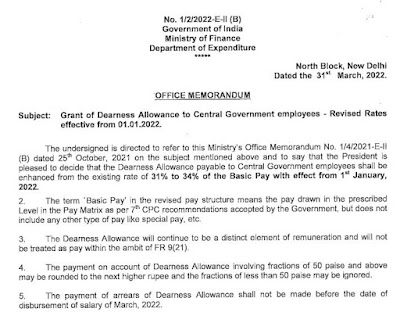
DA Jan 2022 - Grant of Dearness Allowance to Central Government employees - Revised Rates effective from 01.01.2022

 3% DA Hike - Revised Rates effective from 01.01.2022: DoE OM dated 31.03.2022 No. 1/2/2022-E-II (B) Government of India Ministry of Finance...