Wednesday, 18 January 2017

Expected DA from January 2017


Expected DA from January 2017

Expected DA from January 2017


Comrades,
The whole sale price index for the month of December has risen by 3.39%, which declined in past three months, this increase is due to manufacturing price increase (oil prices has increased), the food prices had in fact has come down in December 2016 .

The Consumer Price Index (CPI) was showing marginal decline from 278 points to 277 points in November 2016 , the DA stood at 4.76% as on November 2016, most likely the CPI may show increase of 1 point and may rise to 278 points in December 2016 or stay stable at 277 points.

Scenario I: If the CPI for the month of December 2016 is at 276 points(decrease on one point), the expected DA from January 2017 is likely at 2% (Total 4.97 %).

Scenario II: Even if the CPI for the month of December 2016 is at 277 points, the expected DA from January 2017 is likely at 3% (Total 5%).

Scenario III: If the CPI for the month of December 2016 is at 278 points, the expected DA from January 2017 is likely at 3% (Total 5.04 % ).
Comradely yours
(P.S.Prasad)
General Secretary

GDS COMMITTEE REPORT - INDEFINITE HUNGER FAST DEFERRED


GDS COMMITTEE REPORT - INDEFINITE HUNGER FAST DEFERRED

GDS


NATIONAL FEDERATION OF POSTAL EMPLOYEES
ALL INDIA POSTAL EMPLOYEES UNION-GDS
1st FLOOR NORTH AVENUE PO BUILDING
NEW DELHI - 110001
Ref: NFPE/AIPEU-GDS/AGTN/2017
Dated - 17.01.2017
GDS COMMITTEE REPORT
DEPARTMENT OF POST SOUGHT PERMISSION FROM ELECTION COMMISSION FOR PUBLISHING THE REPORT - DISCUSSION HELD WITH NFPE & FNPO - ASSURED TO PUBLISH THE REPORT IMMEDIATELY AFTER GETTING APPROVAL

INDEFINITE HUNGER FAST DEFERRED

Dear Comrades,
As you are aware, the GDS Committee headed by Shri Kamlesh Chandra, Retired Postal Board Member, has submitted its report to Government on 24th November 2016. Secretary, Posts, informed us that the report will be published only after getting approval of the Minister, Communications. Earlier, GDS Committee Report was published on the very same date of submission. 7th Pay Commission Report was also published immediately on submission to Government.

Protesting against the unjustified stand of the Department, NFPE & AIPEU-GDS conducted nationwide agitational programmes like protest demonstration, dharna etc. Finally we have given notice for indefinite hunger fast in front of the Directorate from 18.01.2017, by Secretary General, NFPE and all General Secretaries of affiliated Unions including AIPEU-GDS. After our hunger fast notice things started moving. Secretary, Department of Posts deputed a Senior Officer to the Minister's office to get the approval of the Minister. Minister granted permission to publish the Report with a condition that Election Commission’s approval should be obtained before publishing the Report, as Election Commission has already declared election to five State Assemblies.

On 16.01.2017, the Department called us for discussion with Member (Technology). In the discussion Member (T) informed that "a reference has been made to the Election Commission of India (ECI) and a response is expected shortly". We recorded our strong protest against the unjustified delay in publishing the report. The Member (T) expressed "the difficulty in hosting the report in the Department’s website on account of the enforcement of the Model Code of Conduct in view of assembly elections having been announce in five states". The appeal given by the Department to call off the indefinite hunger fast is published below.

In view of the above, the Federal Secretariat of NFPE and AIPEU-GDS has reviewed the situation based on the written assurance given by the Department and has decided to postpone the indefinite hunger fast to be commenced from 18th January 2017. Even if we go on indefinite fast or strike, Department cannot publish it without the permission of Election Commission, as the Department has already submitted it to Election Commission for permission.

We hope that the Election Commission will grant permission shortly to publish the Report.
NFPE & AIPEU-GDS has made sincere effort for compelling the Department to publish the GDS Committee Report and conducted nationwide agitational programmes. It is only because of our agitational programmes and indefinite hunger faster notice, the Department was compelled to get permission and also submitted it for Election Commission’s approval.

NFPE & AIPEU-GDS always stand with the three lakhs Gramin Dak Sevaks and we assure our GDS employees that if GDS Committee Report is against the interest of the GDS NFPE & AIPEU-GDS will declare serious agitational programmes including strike.
Fraternally yours,
R. N. Parashar Secretary General, NFPE / P. Panduranga Rao General Secretary, AIPEU-GDS

NJCA MEETING - 17th January 2017, NO CONSENSUS ON REVIVAL OF DEFERRED INDEFINITE STRIKE


NJCA MEETING - 17th January 2017, NO CONSENSUS ON REVIVAL OF DEFERRED INDEFINITE STRIKE

"No doubt, our strike will have a great impact in settling the demands and also in exposing the powers-that-be who betrayed the cause of 33 lakhs Central Govt Employees and 34 lakhs Pensioners.

Somebody should come forward to protest and also, if necessary, to suffer and Confederation is ready for it. Let Confederation lead and others follow."

NJCA MEETING - 17th January 2017
NJCA MEETING
NO CONSENSUS ON REVIVAL OF DEFERRED INDEFINITE STRIKE

Much awaited meeting of the National Joint Council of Action (NJCA) was held on 17th January 2017 at National Council (JCM) Staff-side office at New Delhi. Leaders of Railways, Defence, Postal and Confederation attended. Detailed discussions were held on the developments that took place after the deferment of the indefinite strike of 11th July 2016 and also on the totally negative attitude of the Government towards the 7th Pay Commission related issues of the Central Government Employees & Pensioners, including increase in Minimum Pay, Fitment formula, Allowances, Pensioner's Option-I etc.

Unfortunately, there was no consensus regarding revival of the deferred indefinite strike. Hence no decision could be taken. Meeting ended with a decision to meet again after some days. In the meantime NJCA Chairman and Convener may try to meet the Cabinet Ministers who have given the assurances on 30th June 2016 to NJCA leaders.

As there is no immediate possibility for revival of the indefinite strike by NJCA, Confederation National Secretariat has decided to intensify the mobilization campaign and preparation for making the 16th March 2017 one day strike a grand success. All Affiliated Organizations and C-O-Cs are once again requested to make all –out efforts to ensure cent percent participation of employees in the strike. In addition to the campaign programme of National Secretariat members, each affiliated organization and C-O-Cs should chalk out their own separate campaign programme. Please give wide publicity through local print / electronic media and social media like whatsapp, facebook etc.

No doubt, our strike will have a great impact in settling the demands and also in exposing the powers-that-be who betrayed the cause of 33 lakhs Central Govt Employees and 34 lakhs Pensioners.

Somebody should come forward to protest and also, if necessary, to suffer and Confederation is ready for it.

Let Confederation lead and others follow.
M.KRISHNAN
Secretary General
Confederation
Mobile & Whatsapp -  09447068125
E-mail: mkrishnan6854@gmail.com

Tuesday, 17 January 2017

Extension of scope of Additional Relief on death/disability of Government Servants covered by the New Defined Contribution Pension System (NPS)

Extension of scope of Additional Relief on death/disability of Government Servants covered by the New Defined Contribution Pension System(NPS).

No.25014/05/2016.AIS-II
Government of India
Ministry of Personnel, Public Grievances and Pensions
Department of Personnel & Training

North Block, New Delhi - 110001
Dated the 17th January, 2017
To
The Chief Secretaries of all the
State Governments and UTs.

Subject: Extension of scope of Additional Relief on death/disability of Government Servants covered by the New Defined Contribution Pension System (NPS).
Sir,

1 am directed to refer to the Department of Pension and Pensioner Welfare's OM No. 38/41/06.P&PW(A) dated 05th May, 2009 (copy enclosed) regarding "Additional Relief on death/disability of Government Servants covered by the New Defined Contribution Pension System(NPS)".

2. The applicability of the provisions of the aforesaid OM regarding grant of Additional Relief on death/disability of members of All India Service who have joined Service on or after 01.01.2004 has been considered by this Department and it has been decided to make the provisions of the aforesaid Office Memorandum of Department of Pension and Pensioner Welfare regarding "Additional Relief on death/disability of Government Servants covered by the New Defined Contribution Pension System(NPS)" applicable, mutatis-mutandis, to the All India Service Pensioners/family of All India Service officers who have joined Service on or after 01.01.2004.

Yours faithfully,
(Rajesh umar Yadav)
Under Secretary to Government of India
Authority: http://dopt.gov.in/

Revision of Provisional pension sanctioned under Rule 69 of the CCS (Pension) Rules, 1972


Revision of Provisional pension sanctioned under Rule 69 of the CCS (Pension) Rules, 1972

CCS Pension Rules

No.25014/05/2016.AIS-II
Government of India
Ministry of Personnel, Public Grievances and Pensions
Department of Personnel & Training

North Block, New Delhi - 110001
Dated the 17 January, 2017
To
The Chief Secretaries of all the
State Governments and UTs.

Subject: Revision of Provisional pension sanctioned under Rule 69 of the CCS (Pension) Rules, 1972.

Sir,
I am directed to refer to the Department of Pension and Pensioner Welfare's OM No.38/6/2010-P&PW(A)(Pt.) dated 18th March, 2013 (copy enclosed) regarding "Revision of Provisional pension.".

2. The applicability of the provisions of the aforesaid OM regarding grant of Provisional Pension sanctioned under Rule 69 of the CCS (Pension) Rules, 1972 has been considered by this Department and it has been decided to make the provisions of the aforesaid Office Memorandum of Department of Pension and Pensioner Welfare regarding "Revision of Provisional Pension" applicable, mutatis-mutandis, to the All India Service Pensioners to whom provisional pension was sanctioned under Rule 6 of All India Service (Death-Cum-Retirement-Benefits) Rules, 1958.

Yours faithfully,
(Rajesh Kumar Yadav)
Under Secretary of Government of India
Authority: http://dopt.gov.in/

Grant of Dearness Relief to Central Government pensioners who are in 5th CPC

Grant of Dearness Relief to Central Government pensioners who are in 5th CPC

dearness-relief-pension-5th-CPC


"Grant of Dearness Relief to Central Government pensioners who are in receipt of provisional pension or pension in the pre-revised scale of 5th CPC w.e.f. 01/07/2012."

No.25014/05/2016.A1S-II
Government of India
Ministry of Personnel, Public Grievances and Pensions
Department of Personnel & Training

North Block, New Delhi - 110001
Dated the 17 January, 2017
To
The Chief Secretaries of all the
State Governments and UTs.

Subject: Extension of scope of grant of Dearness Relief to Central Government pensioners who are in receipt of provisional pension or pension in the pre-revised scale of 5 th CPC w.e.f. 01/07/2012.

Sir,
I am directed to refer to the Department of Pension and Pensioner Welfare’s OM No.42/13/2012-P&PW(G) dated 25th October, 2012(copy enclosed) regarding “Grant of Dearness Relief to Central Government pensioners who are in receipt of provisional pension or pension in the pre-revised scale of 5th CPC w.e.f. 01/07/2012.”.

2. The applicability of the provisions of the aforesaid OM to All India Service Pensioners who are in receipt of provisional pension or pension in the pre-revised scale of 5th CPC has been considered by this Department and it has been decided to make the provisions of the aforesaid Office Memorandum of Department of Pension and Pensioner Welfare regarding “Grant of Dearness Relief to Central Government pensioners who are in receipt of provisional pension or pension in the pre-revised scale of 5 th CPC w.e.f. 01/07/2012” applicable, mutatis-mutandis, to the All India Service Pensioners who are in receipt of provisional pension or pension in the prerevised scales of 5th CPC.

Enclo: as above.
Yours aithfully,
(Rajesh Kumar Yadav)
Under Secretary to Government of India
Authority: http://dopt.gov.in/

Measures for streamlining the implementation of the National Pension System for Central Government employees

Measures for streamlining the implementation of the National Pension System for Central Government employees
No. 57/112016-P&PW(B)
Government of India
Ministry of Personnel, PG and Pensions
Department of Pension and Pensioners Welfare

3rd Floor, Lok Nayak Bhawan,
Khan Market, New Delhi
Dated the 16th January, 2017
Notice

Subject: Measures for streamlining the implementation of the National Pension System for Central Government employees- reg.

A Committee has been constituted to suggest measures for streamlining the implementation of the National Pension System for Central Government employees. Accordingly, suggestions / views are invited for streamlining the implementation of the National Pension System for Central Government employees for may be sent through s.chakrabarti75@gov.in
(Harjit Singh)
Director (Pension Policy)
Source: http://www.pensionersportal.gov.in/

Centre, states reach consensus on GST rollout from July 1


Centre, states reach consensus on GST rollout from July 1

New Delhi: In a significant breakthrough in implementation of India's biggest tax reform, the deadlock over administration of GST ended on Monday after the Centre agreed to allow states control over most of small taxpayers, but the rollout date was pushed back by 3 months to July 1.

The split of GST taxpayers between the two will be done horizontally with states getting to administer and control 90 per cent of the asseesses below INR 1.5 crore annual turnover, and the remaining 10 per cent coming under the Centre.

The Centre and states will share control of assessees with annual turnover of over INR 1.5 crore in 50:50 ratio even as Finance Minister Arun Jaitley insisted that each tax payer will be assessed only once and by only one authority.

Besides ceding control, the Centre also agreed to the demand of coastal states, allowing them to tax economic activity in 12 nautical miles even though constitutionally the Centre has jurisdiction over territorial waters.

"This is a significant headway," Jaitley said after the meeting.

While a four-rate tax slab of 5, 12, 18 and 28 per cent had already been reached, a consensus on the administration of the Goods and Services Tax - which will subsume central and state levies like excise duty, service tax and VAT - paved the way for finalisation of the draft supporting laws.

Jaitley said the draft of Integrated GST or IGST, the tax which will be levied by the Centre on inter-state movement of goods and services, as well as SGST and CGST will be finalised in the next meeting of the GST Council on February 18.

Once approved, the Council will then decide on taxing various goods and services in different tax slabs, he said.

The stalemate over administration of GST had been holding up consensus in the GST Council since early November with four successive meetings failing to break the deadlock as the Centre was not in favour of a horizontal split. It said states did not have the expertise to administer levies like service tax.
The Centre also did not favour dual agencies auditing and scrutinising each taxpayer as multiple authorities could end up acting at cross-purposes.

With the legislative calendar drawn up, Jaitley said "realistic" date for implementation of GST will be July 1 instead of previously planned April 1.

Since GST is a transactional tax, which is to be levied when a sale takes place, it does not necessarily have to be implemented from the beginning of the fiscal, he said.

PTI

Budget 2017 - Expectations of the Salaried Class

Budget 2017 - Expectations of the Salaried Class

budget-2017

With the Union Budget 2017 just a couple of weeks away, there are expectations that the government will take some measures to help the common man, especially the salaried class, who has rallied behind the government's decision on demonetization despite suffering a lot post the note ban.

Experts are also of the view that the upcoming Budget 2017 should provide some tax gain for the common people to soothe at least the cash ban pain.

Otherwise also, "there are only a few tax concessions available to individual tax payers. Most of the current set of tax benefits like medical reimbursement, conveyance allowance etc., at the present level, do not offer any real economic benefit to the individual tax payers.

Instead they only add to the administrative burden for the employers as claims made by the employees have to be reviewed and processed by them," says Vikas Vasal, National Leader-Tax, Grant Thornton India LLP.

Thus, either these tax benefits should be substantially increased or they should be done away with and instead a special tax benefit like the erstwhile standard deduction be introduced. "This would simplify the tax law, reduce administrative burden and curtail unnecessary litigation associated with these tax concessions," suggests Vasal.

In view of the above, here's what to expect from the Budget 2017 for the salaried class:

1. Tax slab rates should be revised upwards

It is widely expected that there may be some upward revision in the income tax slabs to provide some relief to the common tax payers. What is making people more optimistic is the recent hint from Finance Minister Arun Jaitley himself that income tax slabs could further be increased, lowering the tax burden on taxpayers due to higher revenue being collected on account of cashless systems.

Some people are even expecting that the government should increase the current income tax exemption limit from Rs 2.5 lakh to Rs 4 lakh. However, the common expectation is that the exemption limit be raised from the current Rs 2.50 lakh per annum to Rs 3 lakh, while the subsequent slabs of 10 per cent, 20 per cent and 30 per cent should be applicable to annual income range of above Rs 3 lakh and up to Rs 10 lakh, above Rs 10 lakh and up to Rs 20 lakh and above Rs 20 lakh, respectively. If implemented, this will help alleviate the common man’s sufferings to some extent.

2. Reduction in tax rates

Salaried individuals are always at a loss when it comes to tax rates since they end up paying high amount of taxes when they fall into high salary brackets. Currently anyone who earns more than Rs. 10 lakh per annum pays 30% tax on the amount exceeding Rs. 10 lakh. Thus, he has to forgo a large portion of his income in taxes. Hence, apart from revision in tax slabs, change in tax rates would always be a welcome move.

"The IDS scheme of the government launched last year is expected to add a lot of tax revenues to the government coffers with almost Rs. 75,000 crore declared as black money. Considering a tax rate of 45%, almost Rs. 35,000 will be collected as taxes. These revenues are expected to help the government reduce the tax rates in the coming FY," informs Vaibhav Sankla, Director, H&R Block India.

3. Higher deduction for interest paid on housing loan

Housing and the real estate sector are facing a lot of hardship. The recent media reports indicate that sales have declined substantially and the sentiment is quite low. It is a fact that the real estate sector is one of the key growth engines for a developing economy like India.

It provides large-scale employment to unskilled and semi-skilled workers in the country, which is a need of the hour, to boost employment opportunities for a large scale population. This sector also impacts a few of the critical sectors like cement, steel, logistics etc., which in turn are important for the overall growth of the GDP.

Also, "keeping in view the government's agenda of providing housing for all, it is imperative that some tax concessions are provided in the Budget. One such option could be to increase the tax deduction for interest paid on housing loan from Rs 2 lakh to Rs 3 lakh. This will also provide an immediate boost to the banking services sector, which is flush with funds post demonetization and looking at avenues to lend money to the masses," says Vasal.

Some tax experts also believe that people having a single home need to be allowed to deduct the entire amount paid as interest on home loan. Vaibhav Sankla, for instance, says that currently the home loan interest deduction is capped at Rs. 2 lakh per annum for self-occupied house property and deduction of actual interest paid is allowed for a second home that is given on rent or is deemed rented.

However, "nowadays buying a second home is not very common owing to high property prices. In such cases, home owners possessing a single home need to be allowed to deduct the entire amount paid as interest on home loan. This would be a welcome relief for salaried individuals since they do not have much scope for tax saving and moreover this is an expense-based deduction," says Sankla.

4. Increase in deduction for insurance premium

The deduction under 80D is currently capped at Rs. 25,000 for self, spouse and dependent children. An additional deduction of Rs. 25,000 is available for parents and Rs. 30,000 if they are senior citizen parents. Hence the total deduction available under this section can go up to Rs. 55,000. A deduction for preventive medical expenses is also available up to Rs. 5,000 spent as a part of the overall deduction.

A deduction for the actual expenses made in this regard on medical insurance premiums will be a welcome move since insurance premiums are very high, especially when it comes to parents. The cap of Rs. 5,000 on preventive health check-up expenses should also be removed in budget 2017. It will help salaried individuals to save huge amounts in taxes.

5. Increase in deduction for education and childcare expenses

Childcare nowadays has become very expensive for parents, especially for those staying in metro cities. The maximum deduction for tuition fees permitted under Section 80C is Rs 1.5 lakh per financial year, with deductions eligible only for two children per assessee. Tuition fees generally constitute a very small portion of the entire education fees for the year. This deduction should be extended to other portions of the fees as well.

"Childcare in big cities also calls for daycare expenses, especially for working parents. The expenses many a time run into more than Rs 1-2 lakh per annum. These expenses should also form a part of deductions under Section 80C. This will provide another expense-based deduction to individuals and be a great move towards providing a deduction aimed at working parents," says Sankla.

6. Deduction for rent paid where no HRA is paid by the organization

Generally, organisations pay HRA to employees in order to ease the burden of rent and there is an exemption available under the tax laws on HRA. However, there are instances when organisations do not include HRA in the salary components.

When HRA is not paid by the organization, salaried individuals are being allowed a deduction of Rs. 5,000 per month under Section 80GG from FY2016-17. This deduction should be increased to at least Rs. 10,000 for metro cities. This is because rent for a decent accommodation in metro cities has risen to this level and there is a need to increase the deduction so that salaried individuals get the benefit of this deduction.

7. Standard Deduction

There are many deductions/ exemptions like medical reimbursement, conveyable allowance, meal allowances etc. Employees actually incur much more cost and obtain very little tax benefit. To highlight, a family of four members will incur on an average, say, Rs 50,000 plus on general medical ailments. And if the family has senior/ailing households, then this expenditure for general hospital/doctor visits and medicines may be much higher.

Therefore, there is need to take a re-look at all such benefits and increase them substantially in line with the current economic reality. Same is the case with other tax benefits like travel allowance etc. Keeping this in view, there is need for a special tax benefit like the erstwhile standard deduction to be introduced the budget 2017.

Source: FE

ATM Withdrawal increased to Rs.10000 per day per card - RBI Notification issued on 16.1.2017


ATM Withdrawal increased to Rs.10000 per day per card - RBI Notification issued on 16.1.2017

Enhancement of withdrawal limits from ATMs and Current Accounts
RBI/2016-17/213
DCM (Plg) No.2559/10.27.00/2016-17
January 16, 2017

The Chairman / Managing Director / Chief Executive Officer,
Public Sector Banks / Private Sector Banks / Foreign Banks /
Regional Rural Banks / Urban Co-operative Banks /
State Co-operative Banks/District Central Co-operative Banks

Dear Sir,

Enhancement of withdrawal limits from ATMs and Current Accounts


Please refer to our circulars DCM (Plg) No. 1274, 1317, 1437 and 2142/10.27.00/2016-17 dated November 14, 21 and 28 and December 30, 2016, respectively, on the above subject.

2. On a review of limits placed on withdrawals from ATMs and current accounts, it has been decided to enhance the same, with immediate effect as under:

(i) The limit on withdrawals from ATMs has been enhanced from the current limit of Rs. 4,500/- to Rs. 10,000/- per day per card (It will be operative within the existing overall weekly limit).

(ii) The limit on withdrawal from current accounts has been enhanced from the current limit of Rs. 50,000/- per week to Rs. 1,00,000/- per week and it extends to overdraft and cash credit accounts also.

3. There are no changes in the other conditions. The relaxations as provided in our circular dated November 28, 2016 will continue.

4. Please acknowledge receipt.

Yours faithfully,

sd/-
(P Vijaya Kumar)
Chief General Manager
Authority: www.rbi.org.in

Flash News

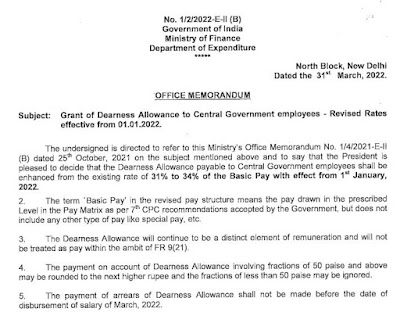
DA Jan 2022 - Grant of Dearness Allowance to Central Government employees - Revised Rates effective from 01.01.2022

 3% DA Hike - Revised Rates effective from 01.01.2022: DoE OM dated 31.03.2022 No. 1/2/2022-E-II (B) Government of India Ministry of Finance...