Saturday, 28 May 2016

Retention of names on offer for Central Deputation under the Central Staffing Scheme for the year 2016

Retention of names on offer for Central Deputation under the Central Staffing Scheme for the year 2016- reg.
IMMEDIATE
No. 32/2016-E0 (MM.II)
Government of India
Ministry of Personnel, Public Grievances & Pensions
Department of Personnel & Training
North Block, New Delhi
Dated the 25th May, 2016
To
1. The Chief Secretaries of the State Governments
(As per list enclosed)
2. All Cadre Controlling Authorities of Group ‘A’ Services
(As per list enclosed)

Sub: Retention of names on offer for Central Deputation under the Central Staffing Scheme for the year 2016- reg.

Sir/Madam,
Please refer to this Department’s D.O. letters of even number and No. 33/2016-EO (MM.II) both dated 17th December, 2015 regarding sponsoring of the names of eligible officers for appointment in the Government of India under the Central Staffing Scheme for the year 2016.

2. As per directions of the ACC, the names of officers, for being placed on offer are to be obtained from the State Governments/Cadre Controlling Authorities in two Branches.

3. It is, therefore, requested to kindly sponsor the names of officers to this office, for retention under the Central Staffing Scheme for the 2 nd tranche. Kindly give this circular wide publicity amongst the eligible officers under your administrative control. As far as possible the application may be forwarded by 31st July, 2016.

4. The applications of willing officers (including those pending from 1st tranche of 2016) may be forwarded to this Department after due scrutiny at the earliest. A copy of the D.O. letter dated 17th December, 2015 is enclosed with this letter.
Yours faithfully,
(Jagannath Srinivasan)
Deputy Secretary(MM)
DoPT Circular

Clarification on facility of concessional retention of General Pool Residential Accommodation at the last place of posting to Central Government employees transferred to NER, Sikkim, Andaman & Nicobar Islands, Lakshadweep and to the State of J&K

Clarification on facility of concessional retention of General Pool Residential Accommodation at the last place of posting to Central Government employees transferred to NER, Sikkim, Andaman & Nicobar Islands, Lakshadweep and to the State of J&K.

No.12035/4/2015-Pol.II
Government of India
Ministry of Urban Development
Directorate of Estates
Nirman Bhavan,
New Delhi-110108.
Dated the 24th May, 2016
OFFICE MEMORANDUM

Sub: Clarification on facility of concessional retention of General Pool Residential Accommodation at the last place of posting to Central Government employees transferred to NER, Sikkim, Andaman & Nicobar Islands, Lakshadweep and to the State of J&K.

The concessional retention of General Pool Residential Accommodation (GPRA) to Central Government Civilian employees has been permitted at their last place of posting vide the Directorate of Estates OM No: 12035/31l96-Pol.III dated 79.1998 and OM No: 12035/2/90-Pol.II(Pt.II) dated 15.9.1998 on their transfer to NER, Sikkim, Andaman & Nicobar Islands, Lakshadweep and to the State of J&K. It has been brought to notice that some Central Government employees who have come on deputation to Delhi and other places and whose parent Offices are located in NER, Sikkim, Andaman & Nicobar Islands, Lakshadweep and to the State of J&K, on repatriation to their parent Office/Unit request for the facility of concessional retention of GPRA at the last place of deputation.

2. It is clarified that the facility of concessional retention of GPRA at the last place of posting for Central Government employees is permitted only when the allottee of GPRA is transferred to NER, Sikkim, Andaman a Nicobar Islands, Lakshadweep and to the State of J&K from other places and is not permitted to the Central government employees who are repatriated back to his/her parent office in NER, Sikkim, Andaman & Nicobar Islands, Lakshadweep and to the State of J&K on completion of their deputation from other places.
sd/-
(Swarnali Banerjee)
Deputy Director of Estates(Policy)
Click here to Download the Original Order

Central Board of Direct Taxes – Use of email based communication for Paperless Assessment Proceedings

Central Board of Direct Taxes – Use of email based communication for Paperless Assessment Proceedings

F.No.225/267/2015/ITA.II
Government of India
Ministry of Finance
Department of Revenue
Central Board of Direct Taxes
New Delhi, the 23rd May, 2016
To,
The Pr. Chief Commissioner of Income Tax,
Ahmedabad, Bangalore, Chennai, Delhi, Mumbai, Hyderabad, Kolkata

Sir,
Subject: Use of email based communication for Paperless Assessment Proceedings-reg.

Paperless assessment/ e-assessment has been conceived to usher in a paperless environment while carrying out regular assessments of cases selected by the Department. In this regard, to start with, the Board had, during the last Financial Year, decided to implement the e-mail based assessments on a pilot basis in non-corporate charges of 5 cities ie. Ahmedabad, Bangalore, Chennai, Delhi and Mumbai where the e-mail based assessment proceedings were initiated and disposal of several cases has been reported.

2. It has now been decided to cover two more cities, namely Hyderabad and Kolkata, for implementing e-mail based communication scheme for paperless assessment proceedings. It shall now be open for all the taxpayers assessed in those seven cities, whose cases have been selected under scrutiny, to opt for being scrutinized under the e-mail based paperless assessment proceedings by giving their consent. However, the cases, which require submission of voluminous documents and it is not practicable to submit the scanned copies thereof through e-mail, the documents could be received by the assessing officer in physical form provided reasons are recorded for the same. It is also necessary that proper Note-sheet is maintained for recording the entire proceedings.

3. The Directorate of Systems is in the process of developing a dedicated module. for comprehensive e-scrUtiny. Till the same gets functional, the Assessing Officers may be advised to follow Notification No.2/2016 dated 3rd Feb 2016 issued by Pr. DGIT(Systems) prescribing the procedure, formats and standards for ensuring secured transmission, of electronic communication. Further, the instructions issued by the Member (IT) vide his D.,O dated 9th May 2016 may also be strictly complied with.

4. In order to make the Scheme a success, you are requested to give due publicity in media and create awareness and a sense of confidence so that the taxpayers of the above seven cities, whose cases have been selected under scrutiny, give their consent for being covered under the e-mail based paperless assessment proceedings.

5.This issues with the approval of Chairman, CBDT.
Yours faithfully,
sd/-
(Neeraj Gupta)
DClT-OSD(ITA.II)
Source : irsofficersonline.gov.in

Thursday, 26 May 2016

Impact of 7th Pay Commission only 25K crore and not 100K crore – Confederation

Impact of 7th Pay Commission only 25K crore and not 100K crore – Confederation

Central Government Employees of Karnataka State has expressed its views that Government of India has to spend an additional Rs.25,000/- crores and not Rs.1,00,000/- crores as a result of implementation of 7th Pay Commission contrary to media reports. This will amount to 0.4 per cent of GDP.

Expenditure towards Salary of Central Government Employees on implementation of 7th Pay Commission will be around 25000 Cr and not Rs.1 lakh Crore as projected by media reports says Confederation
Confederation of Central Government Employees and Workers, Karnataka State has come up with a detailed report on actual expenditure involved out of 7th Pay Commission recommendations.
Comrades,
There are various reports in the media about the impact of the 7th Pay Commission recommendations on the common man and the government resources at large, the reports suggest that amount of Rs.one lakh crores of public money has been spent for implementation of the 7th Pay Commission recommendations for 35 lakhs central Government employees, Perhaps the strongest criticism of Pay Commission awards is that they play havoc with government finances and also state government demand support to implement the 7th Pay Commission recommendations. At the aggregate level, these concerns are somewhat exaggerated and which is totally wrong.

Let us examine the 7th Pay Commission report vide para no 3.65 and 3.66 and the website of Government of India Ministry of Finance Department of Expenditure Pay Research Unit for Brochure on Pay and Allowances of Central Government Civilian Employees visit website PayAllowance2013-14


The 7th Pay Commission report para number 3.65 and 3.66
3.65 The total expenditure on pay and allowances for civil personnel of Central Government in the recent years is brought out in Table 9.

Table 9: Expenditure on Pay and Allowances

Year 2007-08 2008-09 2009-10 2010-11 2011-12 2012-13
Amount (Rs.crore) 51,664 80,110 1,07,402 1,07,550 1,17,565 1,29,599
As a percent of GDP 1.04 1.42 1.66 1.38 1.33 1.30

The 7th Pay Commission report para number 3.65 and 3.66

3.65 The total expenditure on pay and allowances for civil personnel of Central Government in the recent years is brought out in Table 9.

Table 9: Expenditure on Pay and Allowances

3.66 The expenditure per capita on pay and allowances for Civil Central Government personnel for FY 2012-13 was Rs..3.92 lakh per annum i.e Rs..32666/- per month.

Add 35% DA for the period 1/4/2013 to 1/1/2016 average salary of Civil Central Government personnel as on 1/1/2016 at 125% DA which works around Rs.37500/- per month (Rs.4.50 lakhs per annum ) without 7th CPC recommendations . i.e., Rs..1.57,000 crores.

Add average 16% wage increase due to 7th Pay Commission which works out to Rs 43500/- per month (Rs.5.22 lakhs per annum) with 7th Pay Commission implementation .

Total Expenditure for 35 lakhs for Civil Central Government personnel for FY 2016-17 is around Rs..1,83,000 crores In respect of pensions expenditure for 55 lakhs pensioners amount is around Rs..81,000/ crores as on 1/1/2016. which is against the revenue receipts of Rs..19 lakh crores. The percentage of revenue receipt and wages is just around 13% of the total revenue is spent on the wages and pension for the Central Government personnel. In fact it is just at 1.3% of the GDP.

This clearly shows that that the increase in impact for the government of India finances is just additional Rs..25,000/- crores not additional Rs..1,00,000/- crores as per the media reports.

The 7th Pay Commission recommendations’ impact need not give jitters to the government because the rise in government wages will amount to only 0.4 per cent of GDP.

One more aspect is that technically, the recommendations of a Central Pay Commission are only for Central Government employees and States are not bound to follow suit. Indeed, up to the 1980s, States constituted their own Pay Commissions and prescribed their own pay scales, based upon their fiscal capacity.

Let us not be carried over by the media or press reports, hence we should educate each and every employee for struggle and so that a decent wage hike is achieved.
Comradely yours
(P.S.Prasad)
General Secretary
Click to view the report by Confederation of Central Government Employees and Workers, Karnataka

Central Government Staff stir over pay anomalies from June 9

Central Government Staff stir over pay anomalies from June 9

KKN Kutty, national president of the Confederation of Central Government Employees and Workers, today said the employees of the Central government would stage a demonstration from June 9 onwards in case the “shortcomings in the seventh pay commission recommendations” were not rectified.

Kutty, while talking to media persons on the sidelines of the All India Trade Union Education Camp 2016 in Dehradun, said the seventh pay commission had recommended Rs 18,000 per month as minimum wage whereas it should be Rs 26,000 per month. “Thirty five to 40 per cent positions are vacant in the Central government departments which must be filled at the earliest,” he said while criticizing the government for its outsourcing policy.

“Several issues are there which should be resolved. We have asked the Centre to hold talks with us before June 9, otherwise we will be forced to launch an agitation,” he said. He said it was wrong to link government employees with corruption. “It is in society and there should be a mechanism to check it,” he asserted.
Earlier, while addressing the All India Trade Union Education Camp 2016, Kutty called upon the Central government employees to work unitedly towards ensuring justice for them.

Another speaker, Venkatesh Ramakrishnan, said the liberalization policies followed by the rise of communalism in the country had adversely affected the working class. He said the Central government employees were facing challenging times as they were being neglected.

Source: Tribune India

Instructions for applicants applying for General Pool residential accommodation (GPRA) under Lady Officers Pool

Instructions for applicants applying for General Pool residential accommodation (GPRA) under Lady Officers’ Pool

`Married lady officer’ means a lady officer whose marriage is subsisting and who is not judicially separated from her husband. All other women employees fall in single lady officer category

As per the provisions of SR 317-B-8 of the Allotment of Government Residences (General Pool in Delhi) Rules, 1963, ‘Lady Officers Pool’ is maintained separately for allotment of GPRA to married lady officers and single lady officers in the ratio of 2:1

No.12035/10/84-Pol.II (Vol. II)
Government of India
Ministry of Urban Development
Directorate of Estates
Nirman Bhawan,
New Delhi-110 108.
Dated the 5th May, 2016
OFFICE MEMORANDUM

Subject: Instructions for applicants applying for General Pool residential accommodation (GPRA) under Lady Officers’ Pool.

As per the provisions of SR 317-B-8 of the Allotment of Government Residences (General Pool in Delhi) Rules, 1963, ‘Lady Officers Pool’ is maintained separately for allotment of GPRA to married lady officers and single lady officers in the ratio of 2:1.`Married lady officer’ means a lady officer whose marriage is subsisting and who is not judicially separated from her husband. All other women employees fall in single lady officer category.

2. But, it has been observed in many cases that at the time of applying in DE-II Form, a single lady officer apply under single lady category but after marriage of her, do not update her status in DE-II Form and gets accommodation in single lady officer category despite being married. This allotment violates the existing provisions of the Allotment of Government Residences (General Pool in Delhi) Rules, 1963.

3. Therefore, it is to inform that the following instructions should be followed strictly by the applicants applying under Lady Officers Pool and also by the Nodal Officer of the office of the applicant:-
a) The personal information furnished in DE-II Form by a woman employee has to be verified by the office of the applicant as to whether the employee is married or single at the time of submission of the Form as well as at the time of acceptance of allotment of GPRA.
b) A single lady officer should update her records in DE-II Form as soon as she gets married and she will be included in the waiting list of married Lady Officers for the eligible type of accommodation and will get allotment of GPRA from married Lady Officer quota only. In case, a Lady Officer is found to have suppressed information of her marriage and gets an allotment of GPRA from single Lady Officer quota, the allotment shall be cancelled and appropriate action shall be taken as per rules.
(Swarnali Banerjee)
Deputy Director of Estates (Policy)
Download Directorate of Estates OM No.12035/10/84-Pol.II (Vol. II) dated 05.05.2016

7th Pay Commission Recommendations may be revised upwards by Committee of Secretaries appointed by Government

It is expected that decision of Committee of Secretaries on 7th Pay Commission recommendations would be submitted in the month of June 2016

Indian-Military-Veterans-7cpc


7th Pay Commission Recommendations may be revised upwards by Committee of Secretaries appointed by Government.

Cabinet Secretary P K Sinha who is heading the Empowered Committee or Secretaries group is likely to hand over a report on the revised pay structures of 7th pay commission recommendations to Finance Minister Arun Jaitley by the end of next month.

Finance Minister Arun Jaitley said government had requisite fund to implement 7th pay commission award. Cabinet Secretary Sinha will finally make his appearance before the the Empowered Committee or Secretaries group on June 11 to make a proposal on the recommendations of 7th Pay Commission before cabinet nod.

Committee’s decisions on 7th Pay Commission Recommendations is expected to be submitted by June .  The same will be placed before the Cabinet after the finance ministry’s review. We don’t think it will take more time for Finance Minister Arun Jaitley’s consideration and the new pay structures will be implemented from July after cabinet nod,” said a top official from the Finance Ministry who did not wish to be named.

The 7th Pay Commission headed by Justice A K Mathur submitted the report on November 19. It had proposed the highest salary at Rs 250,000 and the lowest at Rs 18,000. The commission also recommended 14.27 per cent increase in basic pay, 23.55% overall increase in salary, allowances and pensions.

The increase in allowances has been recommended to the extent of 63% while pension has  been proposed to be raised by 24%. Finance Minister Jaitley is likely to agree with the Secretaries group. “I think it should not be touched again,” the official said. Once the new structure is implemented, salaries of around 48 lakh central government employees and 52 lakh pensioners will rise by 30 percent. The Finance Minister already said the 7th pay commission award would not make the commodity prices to go up.

The central government employees and pensioners will also spend more money on a variety of goods after receiving the 7th Commission award with arrears from January 2016. “This means higher consumption similar to what happened in the past. But the previous two Pay Commission awards came with a lag of two years. So the arrears were large.

This time, it will not be so,” says Pronab Sen, former Chief Statistician, government of India and now Country Director, International Growth Centre, a think tank based at LSE, run in partnership with University of Oxford.

The official also agrees with Sen and said there was no possibility of any impact of the report on the market at this stage of implementation as there were no impacts when the Pay Commission had first submitted the report. The government formed a 13 member secretary-level Empowered Committee or Secretaries group headed by Sinha in January to review the report of the 7th Pay Commission before cabinet nod. The 7th pay commission was set up by the UPA government in February 2014. It submitted the report after around 22 months. After getting the 7th pay commission report, the finance minister Jaitley while introducing the Seventh Pay Commission report on November 19, already said that the final decisions on the Seventh Pay Commission report took five and a half months including the process of Secretaries group. Finance Minister also said, government had requisite fund to implement it.


The secretary group is likely to propose pay structure of minimum at Rs 21,000 and the maximum at Rs 2,70,000 Accordingly, the Secretaries group is likely to reach the conclusion to propose 30 percent basic pay raise instead of 14.27 per cent, which was recommended by 7th Pay Commission.

They are also mulling for doubling of existing rates of such allowances and advances, which has been recommended for abolition by the 7th Pay Commission, sources said.

Source: Indian Military Veterans

Wednesday, 25 May 2016

Penalty for urinating in open, spitting in Central Government Offices

Penalty for urinating in open, spitting in Central Government Offices

Penalty for urinating in open, spitting in Central Government Offices

Urinating in open and spitting on the central government office premises will now attract a penalty as the Centre has issued a new Standard Operating Procedures (SOP) for ‘Swachh Bharat Mission’ to ensure a clean, hygienic and healthy work environment.

Also, littering and non-collection of construction and demolition waste by the contractor will also attract the penalty.

These SOPs have been shared with all central government ministries recently asking them to follow the new procedures to ensure complete sanitation in office premises, senior government officials said.

It mandates every department to form a sanitation committee under the chairmanship of relevant Joint Secretary looking after the charge of administration to monitor compliance to the SOP.

The SOP casts an obligation on authority concerned to “impose penalty on defaulters for littering, spitting and open urinating” besides conducting surprise inspections of the office premises to ensure a clean, hygienic and healthy work environment.

“If contractors have the obligation to collect the construction and demolition waste, it should be done immediately after all work is finished. Failure to do so will attract penalty,” says the SOPs, sent to secretaries of all central government ministries.

The central government departments have been asked to carry out self-assessment and ratings for the buildings on overall sanitation infrastructure by measuring their effort in removing paan and gutkha stains, providing dustbins and required number of urinals to meet the cleanliness needs.

Prime Minister Narendra Modi had in October 2014 launched the Swachh Bharat Mission with an aim to make the country absolutely clean by October 2, 2019.

All government departments have been asked to ensure collection of waste, rubbish and debris inside and outside the building and garden or open spaces and dispose as per set frequency, the SOP said.

An intensive cleaning of the entire office premises should be carried out at least once in two months which should also involve participation of all officials and staff (through Shramdaan) for disposal of redundant or unused hardware, furniture which can be added to inventory and re-allocated as per demand, it said.

“Weeding and recording of files should be resorted to at least once in six months. The records in the record room should be reviewed once a year and destroyed as per guidelines. This would ensure that constant space is created for keeping more recorded files. If necessary extra manpower for this purpose should be resorted to,” the SOP said.

The purpose of this SOP is to improve current cleanliness levels in the government of India offices. The primary way to achieve cleanliness is through inculcating good sanitation and hygiene practices in employees and visitors, it said.

PTI

Cabinet gives ex-post facto approval to the cadre review of Indian Postal Service (IPoS)

Cabinet gives ex-post facto approval to the cadre review of Indian Postal Service (IPoS)

The Union Cabinet chaired by the Prime Minister Shri Narendra Modi today granted ex-post facto approval to the proposal for undertaking cadre review of the Indian Postal Service.

The cadre review will enable the Department of Posts to meet the functional requirements and strengthening the cadre structure both in the headquarters and in the field on the basis of functional requirement, which will provide more avenues to earn review and respond effectively to the customer needs, reduce the existing stagnation and improve the career prospects of Indian Postal Service officers.

The proposal will be implemented through measures that include creation of a post of DG(Postal Operations) in the Apex scale, creation of post of Additional DG(Coordination) in the HAG+ scale, one post in HAG level, 5 posts in SAG level and 4 posts at the JAG level, and also increase of 84 posts at JTS level by down-grading from STS and overall decreasing STS posts by 96 for adjustment of new posts proposed to be created, without any overall change in the total number of posts in the cadre.

For undertaking the above exercise, necessary consultations on the CRC recommendations with Ministry of Finance and the Ministry of Personnel, Public Grievances & Pensions have been duly completed. The Department of Expenditure have conveyed their ‘no objection’ to the proposal.

PIB

Many unconfirmed sensational news about 7th Pay Commission – Exclusive Report

Many unconfirmed sensational news about 7th Pay Commission – Exclusive Report by GServants

The Empowered Committee is Expected to Meet on 11th June 2016

Some news on 7th pay commission are being posted in couple of websites -on a nearly daily basis.

7thCPC-exclusive-news


All Central Government Employees are eagerly searching for latest news about 7th pay commission regularly.
But to attract these visitors, some websites keep posting some unconfirmed news on a regular basis.

When reading this, the CG Employees wanted to check the authenticity of the news with their Association Leaders. While asking them, they expect that the Leaders should tell, “Yes, it’s true”.

But the worst part of this story is the Federation Leaders couldn’t tell anything against their wish.

The top level Union leaders are flooded with queries about pay commission from Cg Staffs when they come to headquarters. Unfortunately they have no answers to this queries.

In addition to that, by posting this unconfirmed sensational news, these particular websites are adding fuel to fire.

In spite of this, News about Implementation dates and Minimum wages are keep changing and coming every day.

The latest news is, the Empowered Committee on 7th CPC is Expected to Meet on 11th June 2016. And the Minimum wage will be 24000/-
Let’s all Hope this is true and wait for the outcome of the Meeting
Source: gservants.com

Flash News

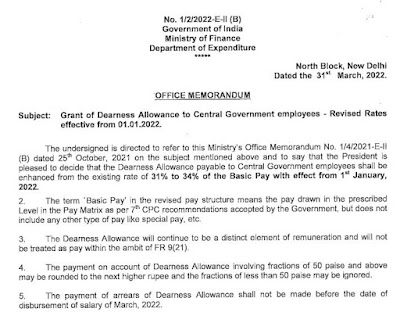
DA Jan 2022 - Grant of Dearness Allowance to Central Government employees - Revised Rates effective from 01.01.2022

 3% DA Hike - Revised Rates effective from 01.01.2022: DoE OM dated 31.03.2022 No. 1/2/2022-E-II (B) Government of India Ministry of Finance...