Monday, 12 October 2015

Bonus Orders 2015 : Adhoc Bonus Orders for Central Government employees

Bonus Orders 2015 : Adhoc Bonus Orders for Central Government employees

As pe the information available in the official blog of Karnataka COC, bonus order for this year likely to be issued after 12.10.2015 only. The message is reproduced and given below for your information…

Adhoc Bonus Orders

The Union Finance Minister, Shri Arun Jaitley is on tour to USA and Peru in connection with recent developments in the global economy and lack of progress in the implementation of the 2010 IMF quota reforms during his official tour to Peru from October 7-11 .  

Hence Adhoc Bonus orders is likely to be issued after 12th October 2015.

7th Pay Commission likely to propose highest pay hike since 1947

7th Pay Commission likely to propose highest pay hike since 1947

7th pay commission
New Delhi: The Seventh Pay Commission is likely to propose pay hike for central government employees, which will be highest since first pay commission’s proposal in 1947.
The first pay commission was constituted in 1946, while its submitted its report on May, 1947 to the interim government of India. ‘Living wage’ — the guiding principle for the first Pay Commission — is long past.
‘Now is Seventh Pay Commission time’, which is also to take in to account living cost of central government employees cost of their appraisal.
The cost of living measures the annual cost of necessities for one adult to live a secure, yet modest, lifestyle by estimating the costs of housing, food, transportation, health care, other necessities, and taxes.

Every government employee likely has a six-member family including his parents. So, Seventh Pay Commission is likely to increase salaries and allowances to minimise the impact on the cost of living for 50 lakh central government employees and 56 lakh pensioners including dependents.
Inflation pushes living cost, inflation, is an economic concept. The effect of inflation is the prices of everything going up year by year. A central government employee got salary Rs 3000 in 1987 under Sixth pay commission, now he gets Rs 80,000 with two promotion, this is called inflation, the price of everything goes up. When the price goes up, the salaries go up.
Every successive Pay Commission has roughly tripled pay. This means that simply by hiking up living cost for 10 years, a government employee would have tripled his pay.
The first pay commission was recommended Rs 55 salary to the lowest earning employee, second Rs 80, third Rs 185, fourth Rs 750, fifth Rs 2550 and sixth Rs 6660.
Accordingly, the Seventh Pay Commission is likely to propose minimum basic salary Rs 20,000 of central government employees, sources in the pay panel said.
The main reason behind the proposal of Seventh Pay Commission is to hike highest pay since 1947 on the account of Dearness Allowance (DA). The central government employees will get Dearness Allowance likely 125 percent at the time implementation of Seventh pay Commission. They never got such type of Dearness Allowance hike before implementation of any Pay Commission.
Dearness Allowance always merges with salaries and allowances under every pay commission’s proposal.
“The Seventh Pay Commission is ready with recommendations and the report will be submitted soon,” according to sources.
Headed by Justice Ashok Kumar Mathur, the Seventh Pay Commission was appointed in February 2014 and its recommendations are scheduled to take effect from January 1, 2016.
The government constitutes the Pay Commission almost every 10 years to revise the pay scale of its employees and often states also implement the panel’s recommendations after some modifications. The first pay commission was constituted in 1946, second in 1957, third in 1970, fourth in 1983, fifth in 1994, sixth in 2006 and seventh in 2014.
As part of the exercise, the Seventh Pay Commission holds discussions with various stakeholders, including organisations, federations, groups representing civil employees as well as defence services.
Meena Agarwal is the secretary of the Commission. Other members are Vivek Rae, a retired IAS officer of 1978 batch and Rathin Roy, an economist.
The Sixth Pay Commission was implemented with effect from January 1, 2006, the fifth from January 1, 1996 and the fourth from January 1, 1986.

TST

Leave applicable to railway school staff, Child Care Leave and Commuted Leave – FAQ

Leave applicable to railway staff, Child Care Leave and Commuted Leave – Frequently Asked Questions RBE 100/2015
Text of the Railway Board’s letter No. No. E(P&A)I-2008/CPC/LE-8 dated 10.09.2015 (RBE No. 100/2015) addressed to The General Managers/FA&CAOs. All Indian Railways and Production Units etc.
Sub; Leave applicable to railway school staff, Child Care Leave and Commuted Leave – Frequently Asked Questions.
Please refer to the provisions contained in Rule Nos. 525, 551E, 521 of IREC Vol-I in respect of Leave applicable to school staff, Child Care Leave and Commuted leave/Leave on Production of Medical Certificate by the Railway servants.
2. Now, DOP&T has inter-alia issued clarification on Leave to school staff, Child Care Leave and Commuted Leave in the form of frequently asked questions (FAQ) in terms of their Office Memorandum No. 21011/08/2013-Estt(AL). The text of OM is tabulated below for guidance of all concerned.
Sl. No. Questions Answer
1.
What are the leave entitlements of Railway servants serving in Railway schools?
The Rule No. 525 of IREC VOL-I, which came into effect from 1.9.2008 regulates the grant of Leave an Average Pay for persons serving in the Railway Schools. The said rule provides for as follows:-
(1) (a) A Railway servant serving in a Railway School such as a teacher, principal, headmaster, librarian, laboratory assistant or a waterman shall not be entitled to any Leave an Average Pay in respect of duty performed in any year in which he avails himself of the full vacation.
(b) In respect of any year in which a Railway servant avails a portion of the vacation, he shall be entitled to Leave an Average Pay in such proportion of 30 days, as the number of days of vacation not taken bears to the full vacation.
Provided that no such leave shall be admissible to a Railway servant not in permanent employment or quasi-permanent employment in respect of the first year of his service.
(c) If, in any year, the Railway servant does not avail any vacation, Leave on Average Pay shall be admissible to him in respect of that year under Rule 523.
  • For the purpose of this rule, the term “year” shall be construed not as meaning a calendar year in which duty is performed but as meaning twelve months of actual duty in a Railway School.
  • A Railway servant entitled to vacation shall be considered to have avoi led a vacation or a portion of a vacation unless he has been required by general or special order of a higher authority to forgo such vacation or portion of a vacation.
  • Provided that if he has been prevented by such order from enjoying more than fifteen days of the vacation, he shall be considered to have availed himself of no portion of the vacation.
  • When a Railway servant serving in a Railway School proceeds on leave before completing a full year of duty, the Leave on Average Pay admissible to him/her shall be calculated not with reference to the vacations which fall during the period of actual duty rendered before proceeding on leave but with reference to the vacation that falls during the year commencing from the date on which he completed the previous year of duty.
  • As per Rule 526 of IREC Vol-I the half pay leave account of every Railway servant, permanent or temporary including the one who is serving in a Railway school, shall be credited with Leave on Half Average Pay in advance, in two installments of ten days each on the first day of January and July of every calendar’ year. This is subject to conditions laid down in Board’s letter- No.E(P&A)I-2008/CPC/LE-10 dated 06.03.2009.
2. Whether Govt. servant can be permitted to station/go abroad while on CCL? Child care leave is granted to a woman employee to take care of the needs of the minor children. If the child is studying abroad or the Railway servant has to go abroad for taking care of the child she may do so subject to other conditions laid down for this.
3. What is the intention behind the instruction that CCL is to be treated like LAP and sanctioned as such? The intention is that CCL should be availed with prior approval of leave sanctioning authority and that the combination of CCL with other leave, if any, should be as per the restriction on LAP. The restriction of the limit of 180 days at a stretch as applicable in the case of LAP will not a l in case of CCL.
4. Whether commuted leave is admissible based on medical certificates of Hospitals/Medical Practitioner approved by the employer of the spouse in cases where the concerned employee has been allowed to avail such facilities from the employer of the spouse? Leave on medical grounds may be allowed on the basis of certificates issued by Hospitals/Medical Practitioners approved by the employer of the spouse in such cases.

3. This issues with the concurrence of the Finance Directorate of the Ministry of Railways.

http://www.er.indianrailways.gov.in/cris/uploads/files/1443006561881-132%202015.pdf

Fixation of pay of ex-servicemen re-employed on the Railways – clarification reg.

Fixation of pay of ex-servicemen re-employed on the Railways – clarification reg.

RBE No.122/2015
GOVERNMENT OF INDIA
MINISTRY OF RAILWAYS
RAILWAY BOARD
New Delhi, dated 08.10.2015
No.E(G)2013/EM 1-5
The General Manager(s),
All Indian Railways &
Production Units.

Sub: Fixation of pay of ex-servicemen re-employed on the Railways – clarification reg.

The issue regarding fixation of pay of ex-servicemen re-employed on the Railways was taken up by NFIR in the PNM. It was pointed out that the policy instructions on the issue were not been implemented on the Zonal Railways in their proper perspective and there was a lot of confusion in the matter. They had requested for issue of suitable guidelines/clarification in the matter.

2. As the Railway administration are aware, fixation of pay of ex-servicemen re-employed on the Railways is done on the basis of instructions contained in Railway Board’s letter No. PC-VI/2009/1/RSRP/2 dated 30/4/2009 read with instructions contained in letter No.E(G)86/EM 1/8 dated 21/1/87 and the clarificatory instructions issued vide letter No.E(G)2013/EM 1-4 dated 24/7/2013 and E(G)2010/EM1/2 pt. dated 12/12/2011.

3. It may be stated that Para 3 (iv) of the DOP&T’s OM dated 05.04.2010 as circulated vide Board’s letter No. E(G)2010/EM 1/2 pt. Dated 12.12.2011 is applicable in respect of persons re- employed prior to 01.01.2006 and were in re-employment as on 01.01.2006. Thus, for this category of persons, pay would have been already fixed as per V CPC provisions as on 01.01.2006. Para 3(iv) prescribes manner of pay fixation/migration to VI CPC scales, in case of PBOR persons, Commissioned Officers etc.

4. Para 3(v) of the OM dated 05.04.2010 prescribes manner of pay fixation/migration to VI CPC scales, in case of PBOR persons, Commissioned Officers etc., who retired prior to 01.01.2006 and have been re-employed after 01.01.2006 and before issue of the OM dated 05.04.2010.

5. Thus, the Paras 3(iv) and 3(v) have detailed provisions for pay fixation/fitment as per VI CPC rates, for allranks of re-employed pensioners who retired prior to 01.01.2006 and re-employed as on and after 01.01.2006 and before issue of the OM dated 05.04.2010 respectively.

6. It may also be stated that the Orders make a clear distinction between fixation of pay of those who were Commissioned Officers and those who were non-commissioned. In the case of Commissioned Officer, non-ignorable pension is deducted, but last pay drawn (with Grade Pay in the re-employment post) is allowed, in terms of para 2 of OM dated O5.04.2010.

7. In the case of non-commissioned officers, pension is not deducted and pay is allowed only at the Entry pay in the revised pay structure of the re-employed post applicable in the case of Direct Recruits appointed on or after 01.01.2006 as notified vide section II of First Schedule to RS(RP) Rules, 2008, in terms of para 2 of the OM dated 05.04.2010.

8. As regards the Federation’s demand that MSP will have to be reckoned for fixation of pay, the provision is already there vide DOP&T’s OM No. 3/19/2009-Estt. Pay-II dated 8/11/2010 which was circulated to the Railways vide Board’s letter No.E(C)2013/EM 1-4 dated 24/7/2013 which stipulates that all defence officers/personnel whose pension contains an element of MSP, that need not be deducted from the pay fixed on re-employment.

9. Please acknowledge receipt.

10. Hindi version will follow.
(D. Joseph)
Dy. Director Estt(Genl)
Source:- NFIR

Sunday, 11 October 2015

Central Government Employees Likely To Get 30-Day Bonus in Festive Season

Central Government Employees Likely To Get 30-Day Bonus in Festive Season

New Delhi: Ahead of the festival season, the government is likely to give an ad-hoc bonus of up to Rs 3,500 to Group C central government employees and personnel of the armed and para military forces.


The government may sanction grant of non-productivity linked bonus (ad-hoc bonus) equivalent to 30 days emoluments for the accounting year 2015-16 to the central government employees (Group C) and the notification in this regad will be issued next week, a senior official of Finance Ministry said.


“Since the election code of conduct for Bihar Assembly polls is in force, but announcement of bonus a routine administrative matter for which permission of the Election Commission not required to go ahead with,” he added.


“The limit for bonus is Rs 3,500,and the bonus will also be given to all non-gazetted employees in Group B, who are not covered by any productivity- linked bonus scheme,” he also told us.


The payment will also be admissible to the central Police and para-military personnel and personnel of armed forces.

Employees of the Union Territory Administration, which follows the central government pattern of emoluments and not covered by any other bonus or ex-gratia scheme would also be eligible for this ad-hoc bonus.

The expenditure incurred on this account will be debitable to the respective heads to which the pay and allowances of these employees are debited, the Finance Ministry official said.

TST

Train Enquiry Mobile Application on iOS platform – IT Enabled Passenger Services Launched by Indian Railways

Train Enquiry Mobile Application on iOS platform – IT Enabled Passenger Services Launched by Indian Railways


Paperless Unreserved Tickets, Season tickets, Platforms tickets, CoTVM, Train Enquiry Mobile App
 
IT Enabled Passenger Services Launched by Indian Railways

Shri Suresh Prabhakar Prabhu Launched these Services Through Video Conferencing from New Delhi. The Railway Minister Shri Suresh Prabhakar Prabhu launched following IT enabled passenger services through video conferencing from New Delhi:

1. Paperless Unreserved Ticketing through Mobile Phones on suburban stations over Central Railway

2. Paperless Platforms tickets at Chhatrapati Shivaji Terminus, Dadar Central, Panvel, Thane and Lokmanya Tilak Terminus, Andheri, Mumbai Central, Borivali, Dadar Western, Dadar Central, Vasai Road, Bandra, New Delhi and Nizamudding stations on Northern Railway, Western Railway and Central Railway

3. Paperless Season tickets on suburban sections of Western Railway, Central Railway and New Delhi-Palwal Section of Northern Railway.

4. Currency, Coin – cum – Card operated Automatic Ticket Vending Machines at various suburban stations on Central Railway and Western Railway.

5. Train Enquiry Mobile Application on iOS platform.

On this occasion ,Chairman Railway Board, Shri AK Mital and other Board Members, Additional Member(C&IS) Shri Mohd. Jamshed, MD CRIS Ms Vandana Nanda were among those present at the programme.

Speaking on the occasion , Minister Of Railways Shri Suresh Prabhu said ­“Moving ahead in the direction of making Digital India, today, I am happy to inaugurate the System for Paperless Unreserved Tickets, Paperless Season Tickets and Paperless Platform Tickets through Mobile Phones, in the Mumbai Suburban system of WR and CR and Delhi – Palwal section of Northern Railway from today.

About 50 Currency-cum-coin-cum-card Ticket Vending Machines (CoTVMs) are now functional over various stations.

I am also happy to inaugurate the Currency and Coin Operated Ticket Vending Machines (CoTVMs), being installed at various stations of Central and Western Railway. All these initiatives were promised in my Budget Speech this year.

Another initiative that is being launched today is the Train Enquiry Mobile App on the iOS that is Apple platform. This app has been working very well on the Android and Windows based mobile phones and now will give good facilities for Apple phone users also.

The paperless Unreserved Ticketing System is a boon for passengers traveling in suburban areas, since it will drastically reduce the time a passenger takes at the station, waiting in queue to buy a ticket. It will enable “Mission 5 minutes” (not more than 5 minutes to buy a ticket) to become a reality. Railways will also benefit from this innovation because they will be able to cope with higher ticket sales with lower investments.

The Paperless Ticketing service is already running in some sections of Mumbai Western Railway and Delhi. With the latest launch, this service will be available across all of Mumbai’s suburban sections on both Central and Western Railways. This system is based on the “UTS on Mobile” app, which has a “Railway Wallet” feature. While this system has been introduced to increase passenger convenience, a few safeguards have been built-in to prevent misuse of the tickets. Firstly, the tickets cannot be forwarded from one phone to another. Second, one cannot buy the ticket after starting one’s journey. A system of distinct daily colour codes, embedded QR codes, and sync feature has been devised to ease the work of the ticket examiners, while providing unparalleled convenience to the users.

A very useful feature added today is that of buying Paperless Season Tickets and Paperless Platform Tickets through the Mobile App. The Paperless Season Ticket feature will be particularly useful for the suburban passengers, large numbers of whom travel on Season Tickets.

Another innovative system being introduced for Mumbai suburban section of Western Railway and Central Railway is the Cash/Smart Card operated Ticket Vending Machine (CoTVM), which is a self-service kiosk for passengers to buy their own unreserved tickets. It has a user-friendly graphical interface that can be used by all passengers. The machine takes currency notes and coins in addition to smart cards for payment. This will save the passengers’ precious time, and will ease the pressure on the Railway administration as well, enabling them to give better service to the passengers. Again, security features”

Procedure for booking of Paperless Unreserved Journey tickets, Season tickets and Platform tickets

Download the Mobile application from Google Play Store or Windows Store.
  • Register by providing Mobile Number, Name, City, Train Type, Class, Ticket Type, Number of Passengers and Frequently travel routes.
  • Payment has to be made using R-Wallet. Upon successful registration, R-Wallet will be opened with Zero Balance.
  • Value can be topped up in R-Wallet by tendering cash across the nominated counter and also online on website “utsonmobile.indianrail.gov.in”.
  • Passenger can book single Journey ticket, Platform ticket as well as season tickets by choosing appropriate option in the App.
  • The Smart Phone should be GPS enabled to book single journey ticket and Platform ticket.
Functioning Of CoTVM

Cash/Smart card operated ticket vending machine (CoTVM) is a self-operated kiosk, which can be used by passengers to buy unreserved tickets through currency/coins/smart cards and to recharge smart cards. These kiosks have easy graphical interface for ticket transaction so that the user can operate these machines themselves. The kiosk accepts currency/coin of all glued/taped/coloured notes and accepts currency notes of Gandhi series. CoTVMs will reduce queue lengths at existing ticket counters by providing an alternate unmanned ticketing solution and mode of payment.

CoTVMs have the following functions
  1. Issue of non-concessional second class journey tickets for non-suburban section and second/first class journey/return tickets for suburban section.
  2. Issue of platform tickets.
  3. Renewal of non-concessional season tickets.
  4. Recharge of smart cards in denominations of Rs. 20/-, Rs. 50/-, Rs. 100/- and Rs. 500/-.
CoTVM consists of:

1. Thin Client
2. Thermal Printer
3. Touch screen
4. RFID reader
5. Cash Validator with 15 notes escrow
6. Coin Validator with 10 coins escrow
7. The cash box has the capacity to hold 25,000 notes and 3,000 coins.

The basic difference between automatic ticket vending machine (ATVM) installed upto now and CoTVM is that ATVM can issue tickets through smart cards only whereas CoTVM can issue tickets using cash (notes & coins) and smart cards. It can also be used for recharging these smart cards.

Security of CoTVM

The machine has two access doors, both at the front side of the machine and is equipped with mechanical & electronic locks. One door is used for maintenance activity by the service engineer. The second door is for accessing the cash box and is integrated with an alarm system. The alarm will go off whenever the door is opened by any unauthorized person. The machine has a cash box with electro mechanical lock at the bottom. Whenever the authorized supervisor wants to open the cash box to takeout shift cash, he/she will gain access to the machine by using a supervisory smart card and his password. After entering the password, machine will print the Daily Trains Cash-cum-Summary Book (DTC) for accountal of the collected cash.

Commissioning of CoTVM

On 01.09.2015, 6 CoTVMs were inaugurated at New Delhi of Northern Railway and 08 CoTVMs at Sealdah & Howrah stations of Eastern Railway. So far, total 48 CoTVMs have been commissioned over Northern Railway and Eastern Railway.

Train Enquiry Mobile Application on iOS platform

Centre for Railway Information System (CRIS), the IT arm of Indian Railways, has enhanced the train enquiry system by developing mobile apps. Mobile app for Windows 8 and Android were launched earlier and are widely used by rail passengers. Now one more step ahead, mobile app for iOS platform has also been developed and ready for launch. It has now become easier for the rail passengers to track information on expected arrival and departure timings of a particular train and other information.

National Train Enquiry System (NTES) is the base system which provides information to public about train running on near real time through various interfaces like nationwide unique rail enquiry number 139, website (www.trainenquiry.com), mobile interfaces, Touch Screens, Face to Face enquiry and Display Boards at stations.

One of the best features of the app is ‘spot your train’ which provides information such as its current position, expected time of arrival and departure at a particular station. Other features are ‘train schedule’, ‘train between station’, ‘live station’, ‘information on cancelled, rescheduled & diverted trains’. ‘Live Station’ query provides list of trains expected to arrive at/depart from any station in next 2 or 4 hours.
Thus, CRIS has made available train enquiry app for three most commonly used mobile platforms viz. Windows, Android and iOS.

The NTES app is available as a free download from App store.

Source: PIB News

Saturday, 10 October 2015

Grand Success of Income Tax Employees Strike held on 8.10.2015 – JCA Circular

Grand Success of Income Tax Employees Strike held on 8.10.2015 – JCA Circular

JOINT COUNCIL OF ACTION
INCOME TAX EMPLOYEES FEDERATION & INCOME TAX GAZETTED OFFICERS’ ASSOCIATION
A-2/95, Manishinath Bhawan, Rajouri Garden, New Delhi-110 027

Joint Convenors :
Rupak Sarkar
08902198000
itefcentral@gmail.com
Bhaskar Bhattacharya
089-021-98888
secgenitgoachq@gmail.com

No. N-1/2015-16
Dated: 09th October, 2015
To,
The Presidents/General Secretaries,
Of all the Units of ITGOA and ITEF.

Dear Comrades,

Sub: The call for Agitation

A Red Salute to all the members of JCA for making the Strike on 08-10-2015 a grand success in the entire Tax-India. The reports of the whole-hearted participation of members of ITGOA and ITEF from all regions across the country are very encouraging. The agony and frustration of our members were expressed against the indifferent and partisan attitude of the CBDT towards the just demands of 97% of officers/officials of the Department in a very disciplined and organised manner making virtual closures of the Income Tax Offices in the entire country. The Joint Council of Action felt that the agitation programmes and strike action are in the national interest in as much as early resolution to the problems by the intervention of the political authority will bring about a conducive climate to concentrate on tax collection and other statutory duties of the Department and this fact was properly been taken into the notice of the print & electronic media all over the country.

We, on behalf of the Central JCA, once again congratulate the leaders of all the Units/Circles of ITGOA/ITEF for their herculean efforts that has ensured such a grand success to the said strike.
With fraternal greetings,
Yours comradely,
(Bhaskar Bhattacharya) (Rupak Sarkar)
Joint Convenors
Source: www.itgoa.org

Bonus Ceiling : Revision of eligibility and calculation ceilings are expected after Bihar Elections

Bonus Ceiling : Revision of eligibility and calculation ceilings are expected after Bihar Elections

Enhancement of the ceiling of bonus

NC JCM Staff Side Secretary said in the letter regarding the issue of bonus ceilings, the letter reproduced and given below…
Shiva Gopal Mishra
Secretary
Ph.: 23382286
National Council (Staff Side) Joint Consultative Machinery
Central Government Employees
13-C, Ferozshah Road, New Delhi – 110001
E Mail : nc.jcm.np@gmail.com
No.NC/JCM/2015
Dated: October 9, 2015
All Constituent Organizations of National Council(JCM)(Staff Side)

Dear Comrades,

Sub: Enhancement of the ceiling of bonus

Ministry of Labour(Government of India) has sent a proposal to the Cabinet for enhancement of ceiling of bonus from Rs.3500 to Rs.7000 with a cap of maximum payment of Rs.20,000.

Though the Election Commissioner has cleared it, but it has not been included in the Cabinet Agenda for the reasons best known to government, but we are hopeful that, it may be finalized after Bihar elections.

Yours faithfully,
sd/-
(Shiva Gopal Mishra)
General Secretary
Source: NC JCM Staff Side

Chhattisgarh government employees to furnish 5 year assets details for promotion

Chhattisgarh government employees to furnish 5 year assets details for promotion

Raipur: Chhattisgarh government employees will now have to furnish their Annual Information Report (AIR) carrying five year’s description of their immovable assets for seeking departmental promotion.

Chhattisgarh Chief Minister Raman Singh
A decision in this regard was taken in a Cabinet meeting chaired by Chief Minister Raman Singh last evening at his official residence, an official spokesperson said here today.

As per directives issued by General Administration Department (GAD) in 2012, employees had to submit their annual report of immovable property during their departmental promotion but now the cabinet has decided that officials now have to furnish their five year’s description of immovable property to Departmental Promotion Committee (DPC), he said.

The cabinet also took the decision to relax the ceiling of 10 per cent on compassionate appointment in Grade-3 posts for a year, the spokesperson said.

The officials in the meeting informed that a similar decision to exempt ceiling of 10 per on compassionate appointment in Grade-3 posts was taken on June 16, 2013 whose limit expired on June 13, 2014, resulting in pending cases piling up pertaining to compassionate appointment.

Therefore, the same decision has been taken again, he added.

The Cabinet on the occasion also expressed pleasure over the state’s performance in implementing the Pradhan Mantri Mudra Yojana.

Under the scheme, a special drive was conducted from September 25-October 2, during which about 54,109 beneficiaries were sanctioned loan to the tune of Rs 251 crore against the target of 54,000 beneficiaries, he said.

Around 38,000 beneficiaries have been disbursed loan of Rs 168 crore.

Measures taken for the relief of farmers in drought-hit areas of the state were also discussed in the meeting.

PTI

Ministry of Home Affairs wants check on content on Portal for Retiring Employees

Ministry of Home Affairs wants check on content on Portal for Retiring Employees

Home Secretary Rajiv Mehrishi
New Delhi: Home Ministry has sought a mechanism to check sharing of any objectionable content by retiring employees, who might be privy to sensitive internal security matters, on an online public platform launched for them by government in March to share their experience.

A suggestion in this regard was made by MHA officials during a recent meeting called by Personnel Ministry with representatives of some of other departments to encourage submission of write-ups on Anubhav–a portal for the retiring central government employees to showcase commendable work done by them during their service.

“Ministry of Home Affairs suggested that facility to edit the write-ups at the level of Head of Office and Head of Department may be given so that the objectionable paragraph in the write-up could be deleted and the entire write-up is not rejected,” according to the minutes of the meeting held late last month.

It was explained that this facility has not been allowed with the intention that the employees submission should not be modified, it said.

Earlier, Central Reserve Police Force has objected to sharing of operational experience by retiring personnel of armed forces on a Anubhav saying it will be a “risk” to national security.

MHA also suggested that there should be a facility to upload the write-ups in Hindi. It was assured that this facility would be provided shortly, it said.

Representatives of Ministry of Information and Broadcasting were requested to provide material which would motivate the retiring employees to contribute in Anubhav.

The problems being faced by the ministries or departments in increasing the number of write-ups were also discussed during the meeting.

“Representative of Ministry of Earth Science wanted guidelines on the format and content of write-ups that could be of help to motivate the retiring employees.

He was informed that there are guidelines on what not to write. There can be no guidelines for write-up which mainly is a experience sharing instrument,” according to the minutes of the deliberation.
Senior officials who are part of the programme emphasised upon the need to increase the number of published write-ups in Anubhav and that rejections be avoided as far as possible.

It was said that paramilitary forces, posts, railways, Central Board of Direct Taxes (CBDT) and Central Board of Excise and Customs (CBEC) are being expected to add maximum number as they have huge number of employees.

About 793 write-ups have already been published on the Anubhav website. 227 others are yet to be released and 31 write-ups have been rejected, according to a latest data.

As part of the Anubhav initiative, central government employees retiring within next six months are expected to share experiences and good work done by them during their tenure.
PTI

Flash News

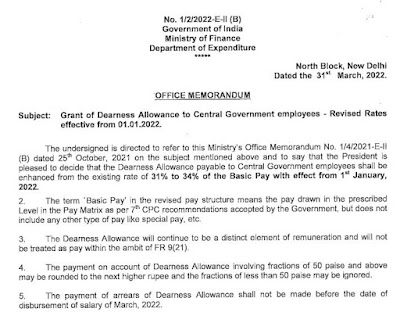
DA Jan 2022 - Grant of Dearness Allowance to Central Government employees - Revised Rates effective from 01.01.2022

 3% DA Hike - Revised Rates effective from 01.01.2022: DoE OM dated 31.03.2022 No. 1/2/2022-E-II (B) Government of India Ministry of Finance...