Sunday, 25 May 2014

Early Closure of Offices in connection with the Swearing in Ceremony of the newly elected Prime Minister of India on 26.05.2014

Early Closure of Offices in connection with the Swearing in Ceremony of the newly elected Prime Minister of India on 26.05.2014
 No.12/15/2014-JCA 2
Government of India
Ministry of Personnel Public Grievances and Pensions
(Department of Personnel and Training)
North Block, New Delhi
Dated the 23rd May, 2014
OFFICE MEMORANDUM

Sub: Early Closure of Offices in connection with the Swearing in Ceremony of the newly elected Prime Minister of India on 26.05.2014

In connection with arrangements for the Swearing in Ceremony of the newly elected Prime Minister of India on 26.05.2014, it has been decided that the Government offices located in the North Block, South Block and Hutments would be closed early at 13:00 hrs. on 26th May, 2014 (Monday).
2. Hindi version will follow.
sd/-
(Ashok Kumar)
Deputy Secretary (JCA)

Source: www.persmin.gov.in
[http://ccis.nic.in/WriteReadData/CircularPortal/D2/D02est/12_15_2014_JCA-2.pdf]

Friday, 23 May 2014

When will the 7th CPC submit its recommendations? When will the recommendations of 7th CPC be implemented?

When will the 7th CPC submit its recommendations? When will the recommendations of 7th CPC be implemented?

These questions are now constantly on the minds of Central Government employees!

Although highly placed sources say that the commission will compile its reports and recommendations in 18 months and that these recommendations will be implemented on 01.01.2016, there are also many who wonder aloud because there are no official confirmations yet.

This is not an exaggeration. The proof lies in the fact that two months ago, the question was raised in the Parliament. While the Terms of Reference make it clear that the Panel Committee has given 18 months time for the 7th CPC to submit its recommendations, a question was raised on when the report would be submitted. The concerned minister’s reply was vague. In other words, there was no concrete announcement.
Let us hope that the Commission submits its reports and recommendations on time.

7th Pay Commission is seeking the considered views of all stakeholders

7th Pay Commission is seeking for suggestions on various issues

The 7th Pay Commission compiled a list of questions and sent it along with a circular to all the Ministries/Departments of Indian Government, inviting their suggestions. It has come to our knowledge that the circular was also sent to all the Central Government employee federations. This could be treated as a irrefutable proof of the fact that the 7th Pay Commission has already started its work! 

Although this is part of the usual procedure, it is a well known fact that Central Government employees treat certain questions as an indication of the mindset of the 7th Pay Commission. 

Let’s see the questions…

What kind of impact did the 6th Pay Commission’s reforms on the Pay Scale structure have, when they were implemented? Do you think such changes were required? The Pay Commission has included questions about the results and procedures of reducing Pay Scale and Pay Bands. 

Has Grade Pay Concept been effective? If no, the Commission wants to know what could be done to get the desired results. 

The questions regarding increments have triggered curiosity and interest. Has the purpose behind making July 1 the date of implementing the annual increment, served its purpose? Or, are there any changes required in it?
With annual increment fixed at 3%, what, according to you, would be a reasonable and acceptable level?

What are the pros and cons of the MACP Scheme?
House Rent Allowance is currently being given according to three categories, based on the population of the city. What criteria should be taken into account for the calculation of House Rent Allowance? This particular question assumes great significance.

Questions have been raised about the ratio of the salary of the lowest level employee and the top management. While debates on this issue have been on for a while now, it is worth pointing out that the question has also appeared on the 7th Pay Commission’s list. 

The list also has questions and a number of sub-questions about raising Government salaries to match the payments given in private sectors. 

Questions have been asked about the possibility of incorporating attributes like talent and performance in job evaluation.  

The sub-list also has questions regarding bonus, variable increments, performance-based schemes, State Government employees’ pay scales, and pensions. 

One thing is for sure – the circular and its questions have become the hottest topic of discussion and countless debates among government employees right now. 

Source: www.90paisa.blogspot.in
[http://90paisa.blogspot.in/2014/04/7th-pay-commission-is-seeking-for.html]

7th CPC Report – When is it going to be submitted?

7th CPC Report – When is it going to be submitted

7th Pay Commission Report and the Need for Timeliness 

Background of the 7th Pay Commission

The 7th pay commission report – when is it going to be submitted?
 
The announcement about the 7th pay commission report came out on September the 25th of 2013. This pay commission unlike the 6th pay commission was set up well in advance. This became possible due to significant efforts of various organisations, union lists and the finance commission report. Announcements say that the 7th pay commission will be implemented from 1.1.2016 and it will take approximately 18 months time for the report to be submitted. 

Recently, the 7th pay commission Chairman and the members gave out a public statement on 4.2.2014 and after that on 22.2.2014 the important 7th cpc terms and references were released. Now, the thought that floats on everyone’s mind is whether the 7th pay commission report will be submitted within the 18 months time period and will the employees be able to get the benefits along with their salary from 1.1.2016.
Recently, in the Lok Shaba during the question and answer session, it was pointed out that no specific time limit can be specified as of now for the implementation of the 7th pay commission. However, the finance ministry is now recruiting people for the 7th pay commission pay cell on deputation basis. This is a good attempt which boosts our confidence in the fact that the 7th pay commission will be put into effect on time. 


Reports of the Earlier Pay Commissions

If the employees get the benefits of the 7th pay commission along with our salary on 1.1.2016, then, this will be the first time we are given the pay commission benefits without arrears. I am providing a link containing reports about when the previous pay commissions were set and when they were implemented.

Pay Commission Date of Appointment Date of submission of report Financial impact (Rs. In crores) Time
First Pay Commission May, 1946 May, 1947 N.A 1 YEAR
Second Pay Commission August, 1957 August, 1959 39.62 2 YEARS
Third Pay Commission April, 1970 March, 1973 144.60 3 YEARS (aprx)
Fourth Pay Commission June, 1983 3 reports submitted in June, 1986; Dec. 1986 and May, 1987 1282 4 YEARS(aprx)
Fifth Pay Commission April, 1994 January, 1997 17,000 3YEARS (aprx)
Sixth pay commission July 2006 March 2008 18 months

Arrears of the 6th Pay Commission :- When you see the timetable above, you can understand that none of the previous pay commissions were implemented on time and without the payment of arrears. When the 6th pay commission was implemented, the government paid a huge amount as arrears in two instalments. This impacted the economy considerably and caused changes in inflation rate and GDP. This shocking fact was revealed by the 13th finance committee report. 

The Benefits of the Timely Implementation of the 7th Pay Commission :- What benefits will the employees get if the 7th pay commission is implemented on 1.1.2016? Let us have a look. 

Firstly, all the allowances and benefits can be got on 1.1.2016. When the benefits are paid as arrears the employees will not get some of the allowances due to exclusion. 

Secondly, the government will not have to pay a huge amount as arrears and thereby can avoid economic burden. 

Thirdly, if a National Anomaly Committee is set up and the shortcomings of the 7th pay commission are corrected immediately, employees can receive the benefits easily. We have to note that several points mentioned the anomaly committee report of the 6th pay commission still remain problematic and uncorrected. 

Fourthly, let us have a look at the elements of ACP and MACP. Like the ACP and MACP, the financial up gradation is going to be introduced in the 7th Pay Commission; the issues that may arise due to this have to be resolved in a timely manner so that everyone may be benefitted by it.   In the 5th pay commission, the time limit for promotion through ACP remained at 12 years, and in the 6th pay commission the time limit for promotions through MACP remained at 10 years. In the 5th pay commission, a new method of promotion through hierarchy was introduced. In the 6th pay commission promotions happened through grade pay structure. 

The main aim of introducing ACP and MACP is to make sure that an employee gets minimal promotion at least thrice in his life time of service. If this is the case, the minimal service period of an employee should be at least 30 years. But presently, employees are appointed even at the age of 37 and so their service period is just 23 years. Such problems have to be carefully considered well in advance and solved before the 7th pay commission is implemented. 

Let us believe that the 7th pay commission will be the first arrears-free pay commission and implemented on time as per the guidelines of the 13th finance commission.
 

Will the 7th CPC fulfil the demands of LDCs and UDCs?

Will the 7th CPC fulfil the demands of LDCs and UDCs?
 
For a number of years now, especially after the 6th CPC, the problems faced by LDCs and UDCs have started gaining prominence. The unity and sense of purpose among them makes them look all set for the kind of victory that Pharmacists had. Common sense of purpose, unity and dedication sure make success possible!
 
In order to decrease the number of grades, the 6th Pay Commission combined all the different grades between Grade Pay 1300 to Grade Pay 1800 into a single grade – Grade Pay 1800, thereby wiping out the entire Group ‘D’. As a result, everybody became Group ‘C’ employees. Even those who lacked the minimum education levels, illiterates and everybody else were lumped into Group ‘C’. Their Grade Pay was also raised to Rs. 1800. But, at the same time, employees working as LDCs, who have a minimum educational qualification of Class XII and also possess some technical education, were not given any upgrading. Instead, they now had to share their grade with lesser-qualified former Grade ‘D’ employees.

The next huge trouble originated from the MACP. Those who didn’t get any promotion for years are given career upgradations through MACP. LDCs who didn’t get any promotions for more than 10 years were given their next grade pay, from Rs. 1900, their pay rose to Rs. 2000. The increase of mere Rs. 100 turned out to be a huge disappointment to many. Similarly, those with Grade Pay 2400 were hoping for a jump to Grade Pay 4200, but were instead forced to upgrade with only Grade Pay 2800 as per MACP rules. That anger kept seething too, because the different is 1400.
 
The most important demand of the LDCs and UDCs is to upgrade the current Pay Scale-Grade Pay.
 
Grades are decided based on the educational qualification of the employees. An LDC possesses a minimum educational qualification of Class XII and also has some technical qualifications. The basic salary of an LDC is just Rs. 1900 + 5830 = Rs. 7730.00. They want it revised to Rs. 2400 + 7510 = Rs. 9910.
 
The big question is – will the 7th CPC grant this demand?
 
[http://90paisa.blogspot.in/2014/05/will-7th-cpc-fulfil-demands-of-ldcs-and.html]

Why is Annual Increment denied to employees retiring in June?

Why is Annual Increment denied to employees retiring in June?

Until 01.01.2006, the date of implementing employee’s annual increment was fixed on the basis of his/her date of appointment or promotion option. After the 6th CPC, it was decided that 1st July of each year would be the uniform date of implementation of annual increment for all Central Government employees.

Employees who are appointed after January 1st are not eligible for that year’s annual increment on July 1. They qualify for annual increment only the next year.

The revised pay rules said that “If an employee is on leave or is availing joining time on the 1st of July, the benefit of annual increment in pay will be drawn only from the date on which he resumes duty and not from the first of July. Each year, employees who retire in the month of June are not given the annual increment of the year since they do not report to work on 1st July. Only those employees who resume duty on July 1st are eligible to receive the annual increment. Or, the day they report back to work is taken as the date for implementing the annual increment. Since there are no possibilities for the retired employees to return to work, they are not considered as qualified to receive the annual increment.

The revised pay rules states that only those who have been receiving the same basic pay continuously for 6 months are considered as qualified for annual increment. According to the another rule of qualification for increment, the person should have complete one year in service after receiving the annual increment. Therefore, despite being qualified, these employees are denied their annual increment.

There is an order that states that those who retire on July 1st should complete the retirement formalities in the month of June.

Instead of strictly looking into such technicalities, it would be a nice gesture on the part of the Government to extend the benefits of annual increment to those senior employees too who retire from service in the month of June.

Source: 90paisa.blogspot.in
[http://90paisa.blogspot.in/2014/05/why-is-annual-increment-denied-to.html]

Thursday, 22 May 2014

Expected DA-Status, as of March 2014

Expected Dearness Allowance from July 2014 for Central Govt Employees and Pensioners...


Expected DA- Status, as of March 2014
Expected Dearness Allowance from July 2014 : This time there is a considerable slackening in the pace of the expected DA. It looks as if there are plenty of reasons for it.

As of March, the AICPIN has increased by one point and is at 239. The rapid increase in Consumer Price Index (IW) has been brought under control now. Election is believed to be one of the reasons for it. Since price rise and inflation are under control, there is not much of an increase in All India Consumer Price Index for Industrial Workers. With a fall in the prices of essential commodities, the AICPIN points have actually reduced.

Another reason is the reduction of AICPIN by 4 points in December 2013. The Consumer Price Index, which was steadily rising till then, slumped by 4 points. It wasn’t much of a shock then because the Additional DA for the month of January 2014 increased by 10% and had touched 100%.
The All India Consumer Price Index for Industrial Workers Base Year 2001=100, which was at 243, fell by 4 points to end up at 239. It again fell by 2 points to touch 237, thus dampening the expectations surrounding the next additional Dearness Allowance announcements. It looks highly unlikely that the AICPIN would rise by 4 points to return to its previous levels.


We are of the opinion that there will not be much of a change in what we had said last time(Expected da from Jul 14 - Feb).

The table given below will easily explain you why…
Month/
Year
AICPIN
(IW) Base Year 2001=100
Increased/
Decreased Points
in AICPIN
Total Points Increased Total of 12 Months 12 Months Average % Increase over 115.763 Approximate DA Total DA % DA%
Increase Month wise
Jan-1322122535211.2595.4982.49822
Feb-1322322559213.2597.4984.22844
Mar-1322412582215.1799.4185.87855
Apr-1322622603216.92101.1687.38877
May-1322822625218.75102.9988.97888
Jun-132313122648220.67104.9190.629010
Jul-1323542671222.58106.8292.28922
Aug-1323722694224.5108.7493.93933
Sep-1323812717226.42110.6695.59955
Oct-1324132741228.42112.6697.32977
Nov-1324322766230.5114.7499.12999
Dec-13239-482786232.17116.41100.5610010
Jan-14237-22802233.5117.74101.711011
Feb-1423812817234.75118.99102.791022
Mar-14239102832236120.24103.861033
Apr-14
May-14
Jun-14

‘Expected DA from July 2014’ completed its third step..!

[http://90paisa.blogspot.in/2014/05/expected-da-status-as-of-march-2014.html]

Sunday, 18 May 2014

Letter from 7th Central Pay Commission to GOI Secretaries for data contribution on OGD Platform

Letter from 7th Central Pay Commission to GOI Secretaries for data contribution on OGD Platform
GOVERNMENT OF INDIA
SEVENTH CENTRAL PAY COMMISSION
NEW DELHI – 110001
MEENA AGARWAL
SECRETARY
No. 7CPC/21/Secy.’s
Dated: May 2, 2014
Dear
This is further to my DO letter No. 7CPC/15/Questionnaire dated 9th April 2014, enclosing a Questionnaire through which the views of your Ministry were sought on the various aspects of the broad issues that the Seventh Pay Commission is mandated to address.

2. While examining the various issues that it is required to look at, apart from the views already sought, the Commission would also need specific data / information on some of the focus areas viz., personnel position, expenditure on salaries and allowances, deployment of contractual staff, training and skill development of personnel, etc. Accordingly, templates for seeking the necessary data have been prepared and are enclosed herewith. Each of the focus areas is covered in a separate Annexure. Data provided by the Ministries / Departments will be crucial in analyzing the key parameters to be studied by the Commission.

3. This composite data template is being shared through the Open Government Data(OGD) platform (data.gov.in). The nodal officers of your Ministries / Department for data collation activity the pre-designed spreadsheets in XLS format and fill them in offline. Once this data collation activity is completed those sheets can be uploaded through the data.gov.in. The Data Controllers of data.gov.in are already familiar with process and methodology of uploading data on to this site. In case your Ministry has not yet nominated the Data Controller, this may kindly be done in accordance with the instructions as contained in the letter of the Cabinet Secretary dated July 18, 2012 in this regard. The weblink of the letter is http://data.gov.in/sites/default/files/CabSect_Letter.pdf.

4. Instructions may please be issued to the concerned Nodal Officer designated to deal with Pay Commission to furnish replies to the template, complete in all respects. All expenditure related data may kindly be got vetted/ obtained from the Principal CCA/CA of the Ministry / Department in ease of Civil Ministries and by the counterpart officers in the case of Defence, Railways and Posts.

5. I shall be grateful if the data as sought for is furnished to the Commission by 10 June 2014.
With regards,

Yours Sincerely,
Sd/-
(Meena Agarwal)

To
All Secretaries in Government of India
Copy to :
DG, National Information Centre, New Delhi
Source: www.data.gov.in
http://data.gov.in/sites/default/files/Seventh_CPC.pdf

Appointment and Submission of Report Dates of all Pay Commissions

Appointment and Submission of Report Dates of all Pay Commissions…
 
The official website of Seventh Central Pay Commission has published the details of all Central Pay Commission’s appointment date and report submission date recently.
 
Seventh Central Pay Commission
 
In a resolution dated 28th February, 2014, Government of India has appointed the Seventh Central Pay Commission comprising Justice Shri Ashok Kumar Mathur as Chairman, Shri Vivek Rae as full time Member, Dr. Ratin Roy as part time Member and Smt. Meena Agarwal as Secretary. The Commission is headquartered in Delhi and has been given 18 months from date of its constitution to make its recommendations. To this end the Commission will set up its team of Officers, Advisers, Institutional Consultants and Experts and call for required information and documents from Ministries and Departments of Government of India and various Service associations.
 
The dates of appointment and submission of recommendations of the previous six central pay commissions are as under :-
 
Central Pay Commissions Date of Appointment Date of Submission of Report
First Pay Commission May, 1946 May, 1947
Second Pay Commission August, 1957 August, 1959
Third Pay Commission April, 1970 March, 1973
Fourth Pay Commission June, 1983 Three Reports submitted in June, 1986;
December, 1986 and
May, 1987 respectively
Fifth Pay Commission April, 1994 January, 1997
Sixth Pay Commission October, 2006 March, 2008

Source: www.7cpc.india.gov.in
[http://7cpc.india.gov.in/about_us.html]

TYPES OF LEAVE ADMISSIBLE: Leave Rules – CCS (Leave) Rules, 1972

TYPES OF LEAVE ADMISSIBLE: Leave Rules – CCS (Leave) Rules, 1972 


TYPES OF LEAVE ADMISSIBLE
• Casual Leave
• Earned Leave
• Half Pay Leave
• Commuted Leave
• Leave Not Due
• Extra-ordinary Leave
• Study Leave
• Hospital Leave
• Special Disability Leave
• Maternity Leave
• Paternity Leave
• Child care Leave

General Conditions:- Leave

• Leave – no claim as a right;
• Can be refused/ revoked;
• Kind of leave applied can not be altered by sanctioning authority;
• Commutation of leave within 30 days;
• Can not be granted for more than 5 years at a stretch;
• Prefix / Suffix – Sundays/holidays;
• MC : Govt servants – from AMA/CGHS Dispensary;
• MC: NGOs – from RMP;
• Period of over-stayal debited as HPL with no pay/allowances;
• Disc. Action on willful absence from duty after expiry of leave.

Casual Leave

• Not a recognised form ;
• Can be combined with special CL / vacation only;
• Sundays/holidays falling during a period of CL not counted;
• Sundays / holidays / restricted holidays can be prefixed/suffixed;
• Can be availed for half a day;
• Total 08 days admissible in a calendar year;
• Normally more than 5 days at a time not allowed;
• Joining in middle of year-proportionately or full – at the discretion.

Earn Leave

• 15 days on 1st January/July in advance;
• Credit reduced @ 1/10th of EOL& Dies non in previous half year;
• Rounding – fraction;
• Accumulation up to 300+15 days;
• Fresh appointment , Retirement /removal / dismissal / death in middle of half year – @ 2½ days per completed month;
• 180 days maximum can be availed at a time, exception
• Unavailed joining time credited in EL account.
• Encashment of E.L. during LTC (10 Days ) / On retirement ( Max 300 days)

Half Pay Leave

• 10 days on 1st January/July in advance;
• Credit reduced @ 1/18th of Dies non;
• Rounding – fraction;
• Accumulation – No limit;
• Fresh appointment – @ 5/3 days p.m.;
• Retirement /removal / dismissal / death in middle of half year
• Temp. Employee – grant subject to his return to duty;
• Can be on MC/without MC;
• On MC- Comm. Leave on full pay if applied for.

Commuted Leave

• Not exceeding half of HPL balance on medical certificate;
• up to 90 days during entire service –w/o MC for an approved course of study certified to be in public interest;
• up to 60 days to a female G.S. with less than 02 living children, on adoption of a child less than one year old;
• up to 60 days to a female G.S. w/o MC in continuation of maternity leave;
• Granted only if reasonable prospects of the G.S. returning to duty on its expiry.
• If quits service- period treated as HPL;
• If quits on ill health/death – No recovery.

Leave not due

• To permanent GS with no HPL at credit;
• Only on MC;
• Limited to HPL – G.S. likely to earn in remaining service period;
• Debited in HPL a/c;
• Temp. GS with min. 01 year of service – suffering from TB, Cancer or Mental illness can be granted .
• Not granted as LPR.

Leave not due-Exception

• To female GS w/o MC – in continuation of maternity leave;
• To female GS w/o MC – on adoption of a child less than one year old.
• Max. 360 days during entire service .

Leave Not Due [LND]

• Cancelled if GS does not return to duty – L.S. recovered;
L.S. not to be recovered :
- if resigns due to ill- health incapacitating him for further service,
- if retired prematurely,
- in the event of death.

Extra Ordinary Leave (EOL)

• When no Other leave is admissible; or
• When Other leave admissible, but Govt. servant applies for EOL;
Subject to maximum leave period of 05 years, EOL can be granted to a permanent Govt. servant up to any limit

For temporary officials: -
- Up to 03 months with or w/o MC;
• with a minimum of 01 year’s service- – up to 06 months with MC for common ailments;
- Up to 18 months with MC for cancer, mental illness, pulmonary TB or Pleurisy of Tubercular origine;
• With three or more year’s service
- up to 24 months where the leave is required for studies certified to be in public interest.

Maternity Leave- Female Employees

• Admissible to married/unmarried female G.S.; – Pregnancy: 135 days;
- Miscarriage / abortion: total 45 days in the entire service.
• Leave is not debited to leave account.
• It is granted on full pay.
• It may be combined with leave of any other kind.
• Any kind of leave (i/c 60 days of Comm. Leave/LND w/o MC) up to one year can be sanctioned in continuation of Maternity Leave;
• Not admissible for ‘threatened abortion’

Paternity Leave-Male Govt. Servant

• To male Govt. servant with less than two surviving children.
• It is not debited in leave account.
Leave salary equal to last pay drawn is admissible

 
Study Leave

• Five year’s service (I/c period on probation)
• For higher studies/specialized training in a professional/technical subject capable of widening his mind in a manner likely to improve his ability as a civil servant;
• Study leave can be :
- Granted for maximum 24 months in the entire service and may be granted at a stretch or in different spells;
- not debited to the leave account;
- Requisite Bonds in the prescribed forms are required to be executed
• Finance Ministry’s agreement for release of foreign exchange is necessary for study leave outside India;

• Leave Salary:
- Pay plus DA, HRA, CCA & study allowance admissible outside India;
- No study allowance admissible for course in India.

Special Disability Leave

• When disabled by injury intentionally inflicted or caused in due performance of official duties;
• When disabled by illness incurred in performance of any duty, which has the effect of increasing liability to illness or injury beyond the ordinary risk attached to civil post;
• Period of leave to be certified by AMA;
• Maximum 24 months;
• Not be debited to the leave account;
• First 120 days on full pay , after that on HPL;
• Period counts for pension.

Hospital Leave

• Gr ‘C’ whose duties involve handling of dangerous machinery, explosive material, poisonous drugs or performance of hazardous tasks; and
• Gr ‘D’ while under treatment in a hospital or otherwise for illness or injury directly due to risks incurred in the course of official duties.
• Certificate of AMA necessary;
• Period of leave considered necessary by authority;
• Total period combined with any other kind not exceeding 28 months;
• Not be debited to the leave account;
• First 120 days on full pay , after that on HPL.
• Period counts for pension.

Child Care Leave

Who are entitled for Child Care Leave?
• Child Care Leave can be granted to women employees having minor children below the age of 18 years, for a maximum period of 2 years (i.e. 730 days) during their entire service, for taking care of up to two children whether for rearing or to look after any of their needs like examination, sickness etc. Child Care Leave shall not be admissible if the child is eighteen years of age or older.
• Child Care Leave shall not be debited against the leave account. Child Care Leave may also be allowed for the third year as leave not due (without production of medical certificate)
• No. CCL is not applicable to third Child.
• The Conditions regarding spell of CCL, imposed upon by the Government are that it may not be granted in more than 3 spells in a calendar year and that CCL may not be granted for less than 15 days.
• No. As per the OM of even number dated 7.9.2010, Child Care Leave may not be granted in more than 3 spells. Hence CCL may not be allowed more than 3 times irrespective of the number of days or times Child Care Leave has been availed earlier.

Source: Central Government News
[http://www.centralgovernmentnews.com/types-of-leave-admissible-leave-rules-ccs-leave-rules-1972/]

Flash News

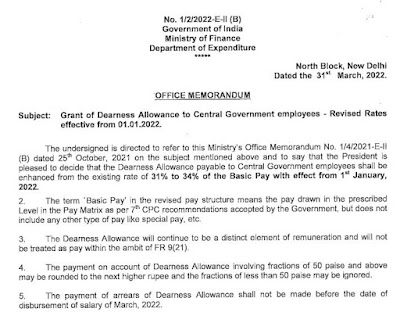
DA Jan 2022 - Grant of Dearness Allowance to Central Government employees - Revised Rates effective from 01.01.2022

 3% DA Hike - Revised Rates effective from 01.01.2022: DoE OM dated 31.03.2022 No. 1/2/2022-E-II (B) Government of India Ministry of Finance...