Saturday, 17 March 2018

Grant of Deputation (Duty) Allowance - Recommendations of the 7th CPC

Grant of Deputation (Duty) Allowance - Recommendations of the 7th CPC


F No.6-23(01)/2018-PAT
Government of India
Ministry of Communications & IT
Department of Telecommunications
Sanchar Bhawan, 20, Ashoka Road,

New Delhi - 110001
Datcd: 09/03/2018
CIRCULAR No. 74

Subject : Grant of Deputation (Duty) Allowance - Recommendations of the 7th CPC -reg

The undersigned is directed to forward herewith a copy of Ministry of Personnel, PG & Pensions. Department of Personnel & Training OM No.21/11/2017-Estt. (Pay-II) dated 24th November, 2017 on the subject cited above for information / necessary action.
Encl: As above.

(R.Thamby Jeya Raj)
Section Officer (PAT)
No.2/11/2017-Estt.(Pay-II)
Government of India
Ministry of Personnel, Public Grievances & Pensions
Department of Personnel & Training
North Block, New Delhi
Dated the 24th November, 2017
OFFICE MEMORANDUM

Subject: Grant of Deputation (Duty) Allowance - Recommendations of the Seventh Central Pay Commission - Regarding

This Department's OM No. 6/8/2009-Estt.(Pay-II) dated 17.6.2010 inter-alia provides for rates of Deputation (Duty) Allowance admissible to Central Government employees.

2. As provided in para 7 of Ministry of Finance, Department of Expenditure's Resolution No.1- 2/2016-IC dated 25th July, 2016, the matter regarding allowances (except Dearness Allowance) based on the recommendations of the 7th Central Pay Commission (CPC) was referred to a Committee under the Chairmanship of Finance Secretary and until a final decision thereon, all Allowances have been paid at the existing rates in the existing pay structure.

3. The decision of the Government on various allowances based on the recommendations of the 7th CPC and in the light of the recommendations of the Committee under the Chairmanship of the Finance Secretary has since been issued as per the Resolution No.11-1/2016-IC dated 6th July 2017 of Department of Expenditure.

4. As mentioned at Sl.No.46 of the Appendix-II of the said Resolution dated 6th July 2017, the recommendation of the 7th CPC for enhancement of ceiling of Deputation (Duty) Allowance for civilians by 2.25 times has been accepted and this decision is effective from 15t July, 2017. Accordingly, the President is pleased to decide that the rates of Deputation (Duty) Allowance and certain other conditions relating to grant 'of Deputation (Duty) Allowance shall be as under:-
The Deputation (Duty) Aliowance admissibl,e shall be at the following rates:
(a) In case of deputation within the same station the Deputation (Duty) Allowance will be payable at the rate of 5% of basic pay subject to a maximum of Rs.4500 p.m.

(b) In case of deputation involving change of station, the Deputation (Duty) Allowance will be payable at the rate of 10% of the basic pay subject to a maximum of Rs.9000 p.m.

(c) The ceilings will further rise by 25 percent each time Dearness Allowance increases by 50 percent.

(d) Basic Pay, from time to time, plus Deputation (Duty) Allowance shall not exceed the basic pay in the apex level i.e. Rs. 2,25,000/- .In the case of Government servants receiving Non Practising Allowance, their basic pay plus Non-Practising Allowance plus Deputation (Duty) Allowance shall not exceed the average of basic pay of the revised scale applicable to the Apex Level and the Level of the Cabinet Secretary i.e. Rs.2,37,500/-.
Note: 1 'Basic pay' in the revised pay structure (the pay structure based on 7th Central Pay Commission recommendations) means the pay drawn by the deputationist, from time to time, in the prescribed Level, in Pay Matrix, of the post held by him substantively in the parent cadre, but does not include any other type f pay like personal pay, etc.

Note: 2 In cases where the basic pay in parent cadre has been upgraded on account f non-functional upgradation (NFU), Modified Assured Career Progression Scheme (MACP), Non Functional Selection Grade (NFSG), etc., the upgraded basic pay under such upgradations shall not be taken into account for the purposed of Deputation (Duty) Allowance.

Note: 3 In the case of a Proforma Promotion under Next Below Rule (NBR) : If such a Profoqna Promotion is in a Level of the Pay Matrix which is higher than that of the ex-cadre post, the basic pay under such Proforma Promotion shall not be taken into account for the purpose of Deputation (Duty) Allowance. However, if such a Proforma Promotion under NBR is in a Level of the pay matrix which is equal to or below that of the ex-cadre post, Deputation (Duty) Allowance shall be admissible on the basic pay of the parent cadre post allowed under the proforma promotion, if opted by the deputationist.

Note: 4 In case of Reverse Foreign Service, if the appointment is made to post whose pay structure and or Dearness Allowance (DA) pattern is dissimilar to that in the parent organisation, the option for electing to draw the basic pay in the parent cadre [alongwith the Deputation (Duty) Allowance thereon and the personal pay, if any] will not be available to such employee.

Note: 5 The term 'same station' for the purpose will be determined with reference to the station where the person was on duty before proceeding on deputation.

Note: 6 Where there is no change in the headquarters with reference to the last post held, the transfer should be treated as within the same station and when there is change in headquarters it would be treated as not in the same station. So far as places falling within the same urban agglomeration of the old headquarters are concerned, they would be treated as transfer within the same station.

5. Para 6.1 of this Department's OM No.6/8/2009-Estt (Pay-II) dated 17.6.2010 stands amended to the above effect.

6. In so far as persons serving in the Indian Audit & Accounts Department are concerned, these orders issue after consultation with the Comptroller & Auditor General of India.

7. These orders shall take effect from 1st July, 2017.

(Rajeev Bahree)
Under Secretary to the Government of India
Source: http://www.dot.gov.in

7th CPC Risk and Hardship Allowance


7th CPC Risk and Hardship Allowance

"Recommendation of 7th CPC- decision relating to grant of Risk and Hardship Allowance for Track Maintainer of Indian Railways"

GOVERNMENT OF INDIA (BHARAT SARKAR)
Ministry of Railways (Rail Mantralaya)
(Railway Board)
File No.PC-VII/2017/I/7/5/4

New Delhi, Dated: 13.03.2018
The General Manager,
East Central Railway,
Hajipur, Dist. Vaishali, Bihar- 844101

Sub: Recommendation of 7th CPC- decision relating to grant of Risk and Hardship Allowance for Track Maintainer of Indian Railways.

Ref: Your No. dated 19.02.2018 (copy encl)


Vide letter under reference, clarification has been sought by the Railway as to whether the categories of employees placed above Level-5 in the pay Matrix are eligible for grant of Risk and Hardship Allowance payable to Track Maintainers in terms of RBE No.87/2017.

2. In this context, it is pointed out that the amount payable as Risk and Hardship Allowance as per the R3H2 matrix per accepted recommendation of the 7th CPC is 2700/- for Level-8 and below and 3400/- for Level-9 and above. However, it is only the category of "Track Maintainers" (that Consists of Track Maintainers- I, II, III and IV) who are eligible for payment of Risk and Hardship Allowance, in terms of RBE No.87/2017. As per their extant pay level, this allowance payable is therefore 2700/- p.m. Apart from Track Maintainers, no other category of Railway Employees has been included for payment of the aforesaid Risk and Hardship Allowance as per the accepted recommendations of the 7th CPC.

sd/-
(Jaya Kumar G)
Deputy Director(Pay Commission)-VII
Railway Board
Source: http://www.indianrailways.gov.in/

Military Service Mandatory for State Government, Central Government Jobs?


Military Service Mandatory for State Government, Central Government Jobs?

5years-Military-Training


Compulsory Military Training

Aspirants for the state and central government jobs should henceforth serve five years in the military. A proposal to this effect was made by the Parliamentary Standing Committee.

More than 20 countries around the world, including North Korea and Russia, have compulsory military service for all its citizens. Some of these countries have compulsory military service for women too. They insist on this training because they believe that, in addition to instilling a sense of patriotism in its citizens, military training also teaches them discipline and good values.

The Parliamentary Standing Committee has pointed out that there is a shortage of about 7,000 officers and about 20,000 soldiers in the Indian Army. The Indian Air Force is short of 150 officers and 15,000 soldiers; and the Navy is running short of 150 officers and 15,000 lower ranked personnel. The Parliamentary Standing Committee has suggested ways to reduce this growing shortage.

The Parliamentary Standing Committee, under the leadership of Retired Army Major General KC Khanduri, submitted its report on defence. The committee has recommended that a five-year military service be made mandatory for those who are seeking government jobs. The committee believes that the measure would reduce the shortage of human resource in armed forces.

The central institutes that design and implement the various training programmes for government employees could look into it, the committee said. According to statistics, more than 30 lakh people are employed in various central government offices, and more than 2 crore people are employed in the various state government agencies throughout the country.

Central Minister Arun Jaitley had, in July 2014, clarified that the government was not supporting the implementation of compulsory military service in India. But, he also informed that the number of recruits in the National Cadet Crop is increasing.

TRANSFER AND POSTING OF WOMEN EMPLOYEES


TRANSFER AND POSTING OF WOMEN EMPLOYEES

Women-Employees-Central-Government-Services


GOVERNMENT OF INDIA
MINISTRY OF PERSONNEL, PUBLIC GRIEVANCES AND PENSIONS
(DEPARTMENT OF PERSONNEL & TRAINING)
LOK SABHA
UNSTARRED QUESTION NO. 2592
(TO BE ANSWERED ON 03.01.2018)

TRANSFER AND POSTING OF WOMEN EMPLOYEES

2592. SHRI C.S. PUTTA RAJU:
Will the PRIME MINISTER be pleased to state:
(a) whether women appointed in Government Service have been deputed in areas far away from their families;
(b) if so, the details thereof;
(c) whether the Government proposes to formulate rules for appointment and transfer of single women working in the Ministries; and
(d) if so, the details thereof?
ANSWER
MINISTER OF STATE IN THE MINISTRY OF PERSONNEL, PUBLIC GRIEVANCES AND PENSIONS AND MINISTER OF STATE IN THE PRIME MINISTER’S OFFICE (DR. JITENDRA SINGH)
(a)&(b): Respective Ministries / Departments have their own guidelines / policy for transfer and posting of their employees depending upon the specific requirements of that Ministry / Department.
(c) & (d): There is no such proposal under consideration for appointment and transfer of single women working in all Ministries.
Source: http://loksabha.nic.in/

Enhancement of Reservation for SCs & STs - Rajya Sabha Q&A


Enhancement of Reservation for SCs & STs - Rajya Sabha Q&A

No proposal for enhancement of reservation for Scheduled Castes in proportion to their population has been received in this Ministry. The Ministry of Tribal Affairs has informed that they received The Telangana Backward Classes, Scheduled Castes and Scheduled Tribes (Reservation of seats in Educational Institutions and of appointments or posts in the services under the State) Bill, 2017 through Ministry of Home Affairs for enhancement of reservations for Scheduled Tribes from existing 4% to 10% in the State for comments/views. The Ministry of Tribal Affairs has supported the proposal contained in the Bill.

As per the 9 judge Constitutional Bench judgement of Hon'ble Supreme Court in India Sawhney case, total reservation cannot exceed the limit of 50% . Clause (4) of Article 16 of the Constitution of India, which empowers the State to provide reservation for Scheduled Castes, Scheduled Tribes & Other Backward Classes speaks of adequate representation and not proportionate representation.
This information was given by the Minister of State for Social Justice and Empowerment Shri Vijay Sampla in a written reply to a question in Rajya Sabha on 15.3.2018.

Friday, 16 March 2018

Canteen functioning in Central Government Offices


Canteen functioning in Central Government Offices

Staff strength in Non- Statutory departmental canteens/tiffin rooms functioning from Central Government Offices in Delhi/ Outside Delhi.

No.3/1/2018-Dir(C)
Government of India
Ministry of Personnel & Public Grievances & Pensions
Department of Personnel & Training
3rd Floor, Lok Nyak Bhavan
Khan Market, New Delhi, the 13th March, 2018

OFFICE MEMORANDUM

Subject:- Staff strength in Non- Statutory departmental canteen/ tiffin rooms functioning from Central Government Offices in Delhi/ Outside Delhi.

This undersigned is directed to refer to the subject citied above and to say that the Office Of Director [Canteens], Department Of Personnel and Training is the nodal authority for laying down important instructions/ guidelines/ policies on various aspects Of Non- Statutory Departmental canteens/ tiffin rooms functioning from Central Government Offices.

2. It has been observed that the data pertaining to Non- Statutory departmental canteens/tiffin rooms was collated in this Department a few years ago and needs to be updated.

3. All the Ministries/ Departments and their attached/subordinate Offices are, therefore, requested to furnish information in the annexed proforma, in respect Of all the departmental canteens/ tiffin rooms under their administrative charge to this Department latest by 15.04.2018.

sd/-
(Kulbhusluan Malhotra)
Under Secretary to the Government of India
Source: www.dopt.gov.in

Minutes of JCM Meeting with Chairmanship of JS (Army) on 9.3.2018 - INDWF


Minutes of JCM Meeting with Chairmanship of JS (Army) on 9.3.2018 - INDWF

Most Immediate
JCM Matter

Government of India
Ministry of Defence
Department of Defence
D(JCM)

 Subject:- 'Minutes' of the JCM Meeting held under the Chairmanship of JS (Army) on 09.03.2018 at 4.00 PM on the Notice of the 3 Recognized Federations of Ministry of Defence for holding meeting to discuss issues/demands of Defence Civilian Employees

A copy of the Minutes of the Meeting held under the Chairmanship of JS (Army) on 09.03.2018 on the above subject, is enclosed.

2.All the addressees are requested that the same may be gone through and an immediate action may be initiated in the matter and the Action Taken Report (ATR)/views/comments on all point(s) mentioned against each Section/HQ/Orgns, may be forwarded to D(JCM) Section in the form of a 'self-contained note' , with the approval of the JS/HOD/HOO concerned.

3.In those cases where action on certain point(s) is/are going on and not yet finalized, the progress arrived at so far may be furnished from time to time to D(JCM) Section till finalization of the case.

sd/-
(Pawan Kumar)
Under Secretary to the Govt. of India
Telefax: 2301 1260

Minutes of the Meeting held on 09.03.2018 under the Chairmanship of JS (Army) discuss the issues/demands of the three recognized Federations of Ministry of Defence

A meeting was convened under the Chairmanship of JS (Army) to discuss the issues raised by the Forum consisting of recognized Federations of Trade Unions of Defence Civilian Employees/Workers vide their notice dated 19th February, 2018 for holding ‘Call Attention Strike’ on 15th March, 2018. JS(LS) was also present in the meeting. The list of participants is attached.
At the outset, the representatives of Federations, and members of the Official Side were introduced to the Chairperson. Thereafter, the Agenda Points were taken up for discussion.

Demands:

1. To withdraw the decision to declare 250 items being manufactured by Ordnance Factories as "Non-Core".

2. To not declare 39 items of DEF Group of Factories as Non-Core items.

3. To withdraw the Govt. order to grant uniform Allowance to the soldiers in place of stitched uniforms.

Discussion: The 3 Federation Representatives submitted the following views:

In the interest of the Army and their qualitative requirement of troop comfort items like Army Logo Uniforms, various types of battle dress, parachutes, blankets, boots, tents, jerseys, etc. the 5 OEF Group of Factories should continue to remain with the same product profile and the infrastructure and facilities available should not be dismantled, since these factories are war reserve and huge money is invested in these factories and that should not go as waste/scrap. In the past several times Army has gone to private sector for procurement of these items in the name of cost. However, the experience is that since the private sector has failed in quality and timely supply the Army has again come back to the OEF Group of Factories. Therefore, these factories should not be distributed resulting in its closure in the name of non-core and outsourcing. According to the Federations, all these items are core items only. The Federations are of the view that the past experience of the Army will be repeated and if these established facilities are not readily available when the Army fail in procurement of these items from private sector at that point of time then again re-building those facilities of producing troop comfort items will be very difficult. In spite of all these facts even then if the Government is keen in outsourcing these items, the employees of these factories should not be displaced/transferred. The Government may come with a road map to decide about the future products to be manufactured in these factories then employees may be trained and placed in the same factory without disturbing them in their seniority, future promotion and protection of wages etc. and also for retaining the skill by recruitment of trained apprentices. The Federations also expressed their deep concern about the workload and the future of Small Arms Group of Factories, Vehicle Factory and GIF, Jabalpur and HAPP Trichy. They requested that a positive decision in this regard may be taken by the Government to provide sufficient workload to these factories. They also requested that the indent for the workload of 2018-19 of the OEF Group of Factories may be immediately issued since due to non-receipt of indent, the factories are not able to place supply orders for raw materials. They also requested that the reduced expenditure budget of Rupees more than 3,000 crores may be restored to the Ordnance Factories in the interest of completion of target. The Federations also insisted that the battle field dress like Army Logo Uniforms, Jerseys, etc. should not be included in the Uniform Allowance.
Official Side: Responding to the Federations, JS(LS) mentioned that all of us are proud of achievements of OFB and the aim of the policy is to make the organization lean and effective. The capabilities of the private sector has improved with the progress made in the country. There are issues regarding indents of forces not being fulfilled. The intention of the Government is to concentrate on the core sector. A road map/time frame has been given by the Government for developing vendor base. The road map for redeployment of employees will be given for implementation by the Ordnance Factory Board. The steps initiated are towards improving the future of the Ordnance Factories. He assured that the reduction made in the expenditure budget of approximate Rs. 3000 crores is likely to be restored. Further, he assured that no factory will be closed and no employee will be retrenched. As far as possible, efforts will be made not to dislodge the employees from their existing factories/ place of posting. In case after the stipulated period the Army do not place indent for the existing items, then appropriate training of staff for redeployment would be considered. JS(LS) concluded that new opportunities are opening and needs to be utilized by the Ordnance Factories so that the organization grows and scales new heights. JS(Army) stated that the items which are included in the Uniform Allowance is being examined and will be clarified, and the case is under process for releasing the indents for the next financial year for the allotted workload. JS(LS) also stated that VFJ is loaded with manufacturing of Mine-Protected Vehicle and often the factory is not able to deliver the same (the Federations representatives stated that the same is due to non-availability of raw materials etc). JS (LS) also assured about the future workload of Small Arms Factories.

Demands:-

4. To withdraw the decision to convert Army Base Workshops into GOCO Model.

5. To withdraw the decision to close 4 Depots under the DGOS.

6. To withdraw the decision to close 39 Military Farms.

7. To withdraw the decision to declare 31012 employees surplus.

Discussion: The representatives of the Federations reiterated that the implementation of GOCO Model in the Army Base Workshop, closure of Station Workshops, Depots under DG:OS and Military Farms may be reconsidered by the Government and the decision declaring more than 31,000 employees surplus and the proposed action to displace/transfer them may be reconsidered/withdrawn and those employees should not be disturbed from their place of works. In MES, the E-in-C has taken action for filling up of 17,000 posts through Direct Recruitment and hence there is no surplus in MES and the above posts may be filled up immediately without any delay.

Official Side: JS (Army) assured that no employee will be retrenched and the effect of GOCO Model on employees of Army Base Workshops and the manpower requirement of MES would be considered. As far as possible, all efforts will be made to not dislodge the employees from their existing workshops, depots and MES. In case of redeployment becomes necessary, appropirate training will be given to the employees to retain them in the same unit. As regards the concern of the Federations with regard to the surplus of employees, it will be our endeavour that employees are not subjected to hardships.

Demand: 8 Undue delay in holding the DPC for effecting promotions based on the Cadre Restructuring of various categories of DGQA approved by the Government.

Official Side: JS(LS) assured that the matter will be examined and necessary instructions issued for holding of DPCs and effecting promotions in DGQA.

The other demands of the Federations were not taken up in the meeting and it was assured that regular meeting will be held with the Federations to discuss these issues and the process of implementation of the assurance given would be monitored.

Conclusion: JS (Army) concluded the meeting stating that the views of the Federations will be placed before the higher authorities in the Ministry. He also reiterated the assurance given by JS (LS) that no factory will be closed and no employee will be retrenched. As far as possible, efforts will be made not to dislodge the employees from their existing factories/place of posting. In case after the stipulated period the Army do not place target/indent for those items declared as non-core to the Ordnance Factories then appropriate training for redeployment would be considered. Therefore, he requested the Federations that considering the goodwill of the Government and its commitment towards the welfare of the employees to withdraw the Notice for Call Attention Strike on 15.03.2018. The leaders of the Federations stated that in view of the assurance given, they will deliberate and consider the decision to withdraw the proposed Call Attention Strike on 15.03.2018 after receipt of the Minutes of the Meeting.

The Federations once again reiterated that in the interest of National Security as the country maintains the Armed Forces, the Defence Establishments also should be maintained, strengthened and the interest of civilian employees should also be protected.
The meeting ended with the vote of thanks to the Chair.

Source: INDWF

POSTPONEMENT OF STRIKE ON 15.03.2018 - INDWF

POSTPONEMENT OF STRIKE ON 15.03.2018 - INDWF
"It was assured that no employees will be retrenched and no factory will be closed."
INDWF/Circular/Strike/2018

Date: 13.03.2018
To
All Affiliated Unions of INDWF
All Office Bearers, Working Committee Members,
Special Invitees & Permanent Invitees of INDWF

Dear Affiliates
Joint memorandum submitted by Three recognised Federations and INDWF Circular No. INDWF/Circular/002/2018 dated 19.02.2018 for holding oal attention Strike on 15.03.2018 alongwith demands were discussed in a meeting by MoD convened under the Chairmanship of JS (Army) on 09.03.2018 at New Delhi. All the issues were discussed and it was agreed by MoD.

1. Reduction made in the expenditure budget of approximate Rs.3000 Crores is likely to be restored.

2. It was assured that no factory will be closed and no employees will be retrenched.

3. Efforts will be made not to dislocate the employees from their existing factories/place of postings.

4. In case, after the stipulated period the Army do not place indent for existing items, then appropriate training of staff for re-deployment would be considered.

5. Items which are included in the Uniform allowance are being examined and will be clarified, and the case is under process for releasing the indents for the next financial year for the allotted workload.

6. JS (LS) also stated that VFJ is loaded with manufacturing of Mine Protected Vehicle (MPV) and Federation was assured about the future work load of Small Arms Factories.

7. No employee will be retrenched in Army and the effect of GOCO model on employees of Army Base Workshops (ABWs) and the manpower requirement of MES would be considered. All efforts will be made do not dislocate the employees from their existing Workshops, Depots and MES.

8. Necessary instructions will be issued for holding DPCs and effecting promotions in DGQA.

9. It was assured that no employees will be retrenched and no factory will be closed.
Based on the assurances given in the meeting with the Federation leaders and the issue of minutes of the meeting with the above assurances, three Federations have deliberated and considered the above decision and decided to POSTPONE the proposed "Call Attention Strike" and the "ONE Hour Work Boycott on 15.03.2018.

At the affiliated unions are directed to conduct the Gale meeting on 15.03.2018 during the mustering in time and declare the decisions to all the employees not to proceed with the agitation already declared till further instructions are issued for communication. The Federation will monitor these decisions with MoD for adopting/implementing the decisions. Unions may communicate to all the employees accordingly, further discussion will take place in the Working committee Meeting to be held at Medak on 6th and 7th April, 2018.

Yours Sincerely,
(R. SRINIVASAN)
General Secretary

Minutes of JCM Meeting with Chairmanship of JS(Army) on 9.3.2018 - INDWF
Source: INDWF

Gramin Dak Sevaks : LokSabha Q&A

Gramin Dak Sevaks : LokSabha Q&A

GOVERNMENT OF INDIA
MINISTRY OF COMMUNICATIONS
DEPARTMENT OF POSTS

LOK SABHA
UNSTARRED QUESTION NO. 3216
TO BE ANSWERED ON 14th MARCH, 2018
GRAMIN DAK SEVAKS
  1. SHRI BIDYUT BARAN MAHATO:
    SHRI A. ANWHAR RAAJHAA:
    SHRI GAJANAN KIRTIKAR:
    SHRI SUDHEER GUPTA:
    SHRI T. RADHAKRISHNAN:
    SHRI ASHOK SHANKARRAO CHAVAN:
    SHRI NARANBHAI KACHHADIYA:
    KUNWAR HARIBANSH SINGH:
    SHRI S.R. VIJAYAKUMAR:
Will the Minister of COMMUNICATIONS be pleased to state:
(a) the number of Grameen Dak Sevaks working in the country at present, State/UT-wise;
(b) whether pay/remuneration of Grameen Dak Sevaks has not been increased as per 7th Pay Commission recommendation and if so, the details thereof and the reasons therefor;
(c) whether the Government has received any representation’s from people representatives to increase their pay/ remuneration as per 7th Pay Commission recommendations;
(d) if so, the details thereof and the response of the Government thereto; and
(e) the time by which their pay/ remuneration is likely to be increased?

ANSWER
THE MINISTER OF STATE (IC) OF THE MINISTRY OF COMMUNICATIONS &
MINISTER OF STATE IN THE MINISTRY OF RAILWAYS
(SHRI MANOJ SINHA)

(a) The number of Grameen Dak Sevaks working in the country at present, State/UT-wise is given in Annexure - I.
(b) Grameen Dak Sevaks are not covered under the purview of the 7th Pay Commission. Therefore a separate one man Committee was constituted to examine the wage structure and service conditions of the Grameen Dak Sevaks. The Committee has submitted its report and the recommendations are presently under consideration of the Government. The details of the recommendations are given in Annexure - II.

(c) Yes, Madam. Government has received several representations from people’s representatives to implement the recommendations of the GDS Committee Report.

(d) & (e) 34 such representations were received between January 2017 to February 2018.
The recommendations of the one man Committee are presently under active considerations of the Government, and action will be taken after following due procedure.
ANNEXURE - I
STATE WISE LIST OF NUMBER OF GRAMEEN DAK SEVAKS WORKING IN THE COUNTRY

SINAME OF THE STATENUMBER OF GRAMIN DAK SEVAKS WORKING IN THE COUNTRY
1Andhra Pradesh15627
2Arunachal Pradesh462
3Assam7794
4Bihar15325
5Chhattisgarh4645
6Delhi139
7Goa330
8Gujarat13294
9Haryana3764
10Himachal Pradesh5916
11Jammu & Kashmir2495
12Jharkhand6041
13Karnataka14128
14Kerala9532
15Madhya Pradesh11513
16Maharashtra17807
17Manipur1797
18Meghalaya857
19Mizoram926
20Nagaland785
21Odisha14193
22Punjab5535
23Rajasthan12844
24Sikkim473
25Tamil Nadu19236
26Telangana8356
27Tripura1248
28Uttar Pradesh26691
29Uttarakhand5485
30West Bengal16035

UNION TERRITORY WISE LIST OF NUMBER OF GRAMIN DAK SEVAKS WORKING IN THE COUNTRY

SL.NONAME OF THE UNION TERRITORYNUMBER OF GRAMIN DAK SEVAKS WORKING IN THE COUNTRY
1Andaman and Nicobar162
2Chandigarh50
3Daman and Diu17
4Dadar and Nagar Haveli48
5Lakshdweep6
6Puducherry161
Annexure- II
Salient features of the One Man Committee Report headed by Shri Kamlesh Chandra
  1. The old system of payment of Time Related Continuity Allowance (TRCA) is dispensed with and replaced with a new wage payment system. Under the new wage payment system, 11 TRCA slabs are subsumed into 3 Wage Scales with two Levels each for BPMs and for other than BPMs. One wage scale would be common for both the categories of GDSs.
  2. The minimum working hours of GDS Post Offices and GDSs are increased to 4 hours from 3 hours.
  3.  T he new working hours for GDS Post Offices will be 4 hours and 5 hours only.
  1. The Level 1 GDS Post Offices / GDSs will have 4 hours as working hours and Level - 2 will have 5 hours as working hours.
  2. The Point System for assessment of workload of BPMs has been abolished.
  3.  The new wage payment system is linked to revenue generation of GDS Post Offices. Under the new system, there will be no increase in wages of BPMs from Level -1 to Level -2 on the basis of workload but the same will be increased based on achievement of prescribed revenue norms which is fixed at 100% for normal areas and 50% for special areas.
  4.  The GDS Post Offices not achieving the prescribed revenue norm within the given working hours will have to open GDS Post Offices for minimum of additional 30 minutes beyond the prescribed working hours.
  1. The GDS BPMs will be paid Revenue Linked Allowance @10% beyond level-2 wage scale if they will be successful in achieving revenue beyond prescribed norms
  2. The GDS Post Offices has been categorized into A, B; C and D categories based on the revenue generation norms. The GDS Post Office in A category will achieve 100% revenue norm. The Committee has recommended a set of actions for each category of GDS Post Offices.
  3. The six approved categories of GDSs are subsumed into two categories only. One category will be Branch Post Master and all other 5 categories of GDSs are subsumed into one Multi Tasking Category.
  4. The GDSs working in the GDS Post Offices will be known as Assistant Branch Post Master (ABPMs) and those working in the Departmental Post Offices will be known as Dak Sevak (DS).
    The minimum wage has been increased to Rs. 10000/- per month and maximum pay to Rs. 35480/- per month.
  5. The rate of annual increase is recommended as 3%.
  6. A Composite Allowance comprising of support for hiring accommodation for GDS Post Offices as well as mandatory residence, office maintenance, mobile and electricity usage charges etc. has been introduced for the first time.
  7. 14.Children Education Allowance @Rs. 6000/- per child per annum has been introduced for GDSs
  1. Risk & Hardship Allowance @Rs. 500/- per month for GDS working in the special areas has also been introduced.
  2. A Financial up-gradation has been introduced at 12 years, 24 years and 36 years of services in form of two advance additional annual increases.
  3. The Ceiling of ex-gratia gratuity has been increased from Rs. 60,000 to Rs. 5,00,000
  4. The GDS Contribution for Service Discharge Benefit Scheme (SDBS) should be enhanced maximum up to 10% and minimum up to 3% of the basic wage per month, whereas the Department should contribute a fixed contribution of 3% of the basic wage of the GDSs.
  5. The coverage of GDS Group Insurance Scheme has been enhanced from Rs. 50000/- to Rs. 5,00,000/
  6. The contribution of Department in Circle Welfare Fund (CWF) has been increased from Rs. 100/ per annum to Rs. 300/ per annum.
  7. The scope of CWF is extended to cover immediate family members such as spouse; daughters, sons and dependent daughters in law in the scheme.
  8.  The Committee also recommended 10% hike in the prescribed limits of financial grants and assistances in the Circle Welfare Funds.
  9. 23.The Committee has recommended addition of Rs. 10,000/ for purchase of Tablet / Mobile from the Circle Welfare in the head “Financial Assistance of Fund by way of loans with lower rate of interest (5%)”.
  1. Provision of 26 weeks of Maternity Leave for women GDS has been recommended.
  2. The wages for the entire period of Maternity Leave is recommended to be paid from salary head from where wages of GDSs are paid.
  3. The Committee has also recommended one week of paternity leave.
  4.  Leave accumulation and encashment facility up to 180 days has been introduced.
  5.  Online system of engagement has been recommended.
  6.  Alternate livelihood condition for engagement of GDSs has been relaxed.
  7.  Voluntary Discharge scheme has been recommended.
  8.  The Discharge age has been retained at 65 years.
  9. The Limited Transfer Facility has been relaxed from 1 time to 3 times for male GDSs. There will be no restriction on number of chances for transfer of women GDSs. The powers for transfer has been delegated to the concerned Divisional head.
  10. The ex-gratia payment during put off period should be revised to 35% from 25% of the wage and DA drawn immediately before put off.
  11. The Committee has recommended preferring transfer before put off duty.
Lok Sabha

Thursday, 15 March 2018

Grant Of Dearness Allowance to Central Government - Revised Rates effective from 1.1.2018: Finmin DA Order


Grant Of Dearness Allowance to Central Government - Revised Rates effective from 1.1.2018: Finmin DA Order
Dearness-Allowance-Central-Government-Employees

No.1/1/2018-E-II(B)
Government of India
Ministry of Finance
Department of Expenditure
North Block, New Delhi
Dated the 15th March, 2018
Office Memorandum

Subject: Grant Of Dearness Allowance to Central Government - Revised Rates effective from 1.1.2018.

The undersigned is directed to refer to this Ministry's Office Memorandum No.1/9/2017- E-II (B) dated 20th September, 2017 on the subject mentioned above and to say that the President pleased to decide that the Dearness Allowance payable to Central Government employees shall be enhanced from the existing rate of 5% to 7% of the basic pay with effect from 2018.

2. The term 'basic pay' in the revised pay structure means the pay drawn in the prescribed Level in the Pay Matrix as per CPC recommendations accepted by the Government, but does not include any other type of pay like special pay, etc.

3. The Dearness Allowance will continue to be a distinct element of remuneration and will not be
treated as pay within the ambit of FR 9(21).

4. The payment on account of Dearness Allowance involving fractions of 50 paise and above may be rounded to the next higher rupee and fractions of less than 50 paise may be ignored.

5. The payment of arrears of Dearness Allowance shall not be made before the date of disbursement of salary of March, 2018.

6. These orders shall also apply to the civilian employees paid from the Defence Services Estimates and the expenditure be chargeable to the relevant head of the Defence Services Estimates. In respect of Armed Forces personnel and Railway employees, separate orders will be issued by the Ministry of Defence and Ministry of Railways, respectively.

7. In so far as the employees working in the Indian Audit and Accounts Department are Auditor concerned, these orders are issued with the concurrence of the Comptroller General of India.
sd/-
(Nirmala Dev)
Deputy Secretary to the Government of India
Source: www.doe.gov.in

Flash News

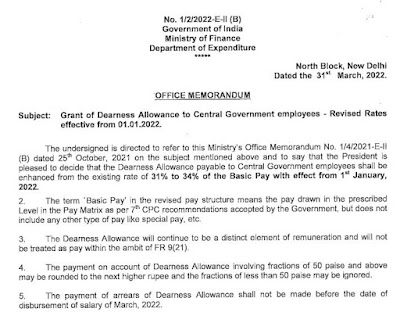
DA Jan 2022 - Grant of Dearness Allowance to Central Government employees - Revised Rates effective from 01.01.2022

 3% DA Hike - Revised Rates effective from 01.01.2022: DoE OM dated 31.03.2022 No. 1/2/2022-E-II (B) Government of India Ministry of Finance...