Wednesday, 22 March 2017

GST rollout from July 1 to make goods cheaper: Jaitley


GST rollout from July 1 to make goods cheaper: Jaitley

New Delhi: Hopeful of the GST rollout from July 1, Finance Minister Arun Jaitley today said it will create one of the world's biggest single markets and make commodities cheaper and tax evasion difficult.

Speaking at the 23rd Conference of the Commonwealth Auditor General, Jaitley said India has hugely a non-tax compliant society and the government banned higher denomination notes to curb the tendency of people to deal in cash that lead to tax evasion as well as terror financing.

He said the reform measures undertaken by the government will help India clock 7-8 % growth and retain the tag of fastest growing major economy in the world, but challenges remain in volatile global oil prices, reviving private sector investment and health of state-owned banks.

With regard to GST, he said the new indirect tax regime will ensure seamless transfer of goods and services, while stronger information technology backbone will make evasion difficult.

Despite being one political entity, India currently is not a single economic entity as there are multiple layers of taxation that make goods costlier. GST -  first proposed in 2006 - will replace at last 17 state and central levies.

The biggest taxation reform what we are trying to implement from July 1 is Goods and Services Tax … It will increase the volume of taxation, there is no tax on tax and therefore makes goods, commodities and services little cheaper and far more convenient, Jaitley said.

The Union Cabinet this week cleared four supplementary GST legislations which will be introduced in Parliament in the ongoing budget session.

The laws which enable this (GST) are now before Parliament which hopefully should get cleared and once they do get cleared then by the middle of this year we hope to see the implementation as far as this law is concerned, Jaitley said.

In terms of tax compliances, he said India ranks fairly high as a non-compliant state.

Therefore, one of the efforts of the state has been how to bring non- compliance to an end. Once the GST is introduced it will be a great check as far as evasion is concerned, he said, adding that the government has amended direct taxation law by bringing in curbs on cash currency.

Jaitley, yesterday, in Parliament introduced an amendment to Finance Bill 2017 proposing to ban cash dealings above Rs 2 lakh.

Cash component of Indian economy was exorbitantly high about 12.2 per cent of GDP and of this, 86 per cent was high denominational currency and therefore the tendency to deal excessively in cash did exist and this created its own challenges for economy, he said.

Cash facilitated crime, corruption, incentivised tax non-compliance and was facilitator for funding terrorism and insurgency, he said, as he defended November 8 decision of the government to demonetise 500 and 1,000 rupee notes.

(With demonetisation) Anonymity which was attached to this high level of cash operating in market that anonymity disappeared as it had to be deposited in bank.

This has also increased the trend towards digitisation of economy, (will) act as disincentive to continuing to deal in a shadow or parallel economy and lead to a further integration of informal with formal economy, Jaitley said.

He said the size of India's GDP in the near future will be bigger, size of formal economy will increase and will be cleaner.

As regards growth, Jaitley said India would continue to remain amongst the fastest growing economies of the world.

For the last three years we have been the fastest growing major economy, we will continue to be in that phase. I think for India to achieve the growth rate of 7-8 % is reasonably logically plausible. If big growth returns to the world we probably can push upwards, he said.

Outlining the challenges for Indian economy, Jaitley said the government is now trying to address the problems plaguing the public sector banks and also increasing private investment.

We are hopeful that in the next few quarters, will probably see a better result as far as those areas are concerned, he said, adding oil prices remain an uncertainty for India.

The gross NPAs of public sector banks have risen from Rs 5.02 lakh crore at the end of March 2016 to Rs 6.06 lakh crore in December 2016.

PTI

EPFO Invest more than Rs.18 crore in ETFs


EPFO Invest more than Rs.18 crore in ETFs

Employees Provident Fund Organisation (EPFO) is investing in Exchange Traded Funds (ETFs) based on Nifty 50, Sensex and Central Public Sector Enterprises (CPSE) Indices. EPFO does not invest in shares and equities of individual companies.

The total amount invested by EPFO in ETFs as on 28th February, 2017 is as under:

(i) Nifty 50 and Sensex Index based ETFs: Rs. 17,105 crore

(ii) CPSE Index based ETF: Rs. 1,504 crore.

The Employees Provident Funds & Miscellaneous Provisions (EPF & MP) Act, 1952 is applicable to every establishment employing 20 or more persons which is either a factory engaged in any industry specified in Schedule-I of the Act or an establishment to which the Act has been made applicable by the Central Government by notification in the Official Gazette.

An Employees Enrolment Campaign, 2017 has been launched for the period 01.01.2017 to 31.03.2017 to bring in more workers under the ambit of EPFO. Under the campaign, an employer, whether already covered or yet to be covered, can enroll employees who remained un- enrolled for any reason between 01.04.2009 and 31.12.2016 by making a declaration of such employees during the campaign period. Such declaration shall be valid only in respect of employees who are alive as on 1st January, 2017 and no proceedings under Section 7A of the EPF & MP Act, 1952 or under paragraph 26B of the Employees Provident Funds (EPF) Scheme, 1952 or under paragraph 8 of the Employees Pension Scheme (EPS), 1995 have been initiated against their establishment or employer, as the case may be, to determine the eligibility for membership of such employees.

This information was given by Shri Bandaru Dattatreya, the Minister of State (IC) for Labour and Employment,in written reply to a question in Rajya Sabha today.

PIB

Information under RTI Act


Information under RTI Act

No data is centrally maintained either by Government or Central Information Commission (CIC) in respect of cases wherein the information under RTI Act has not been provided to the applicants.

CIC adjudicates the second appeals and complaints received in the Commission. The Right to Information Act, 2005 provides for imposition of penalty by CIC against the Central Public Information Officer (CPIO), in pursuance of section 20 of the RTI Act. As per the information furnished by CIC, the amount of penalty imposed on such CPIOs for the last three years is as under:

YearPenalty Imposed
2013-1419,25,000
2014-157,39,000
2015-1610,52,500

Right to Information (RTI) Act 2005 mandates timely response to citizen's request for information in order to promote transparency and accountability in the working of every public authority.

Review of the implementation of the provisions of RTI Act is an ongoing process. There have been constant efforts on part of the Government to streamline and strengthen the existing mechanisms for successful and effective implementation of the RTI Act.

Government has taken several steps to strengthen the regime of RTI Act, which inter-alia include the following:
i. RTI Online Portal (https://rtionline.gov.in) was launched in August, 2013 by D/o Personnel and Training. As on 17.03.2017, 1840 Central Public Authorities have been aligned to it making it convenient for citizens to file RTI requests and First Appeals through on- line.
ii. The Government has conducted training and capacity building programs for Public Information Officers and First Appellate Authorities through State Government Training Institutes for effective implementation of the RTI Act.
iii. Ministries/Departments and other Public Authorities are proactively working towards suo-motu disclosure and more information is put on their websites so as to reduce the need for filing RTI applications.
This was stated by the Minister of State in the Ministry of Personnel, Public Grievances and Pensions and Minister of State in the Prime Minister's Office Dr. Jitendra Singh in a written reply to a question by Shri Raju Shetty in the Lok Sabha today.

PIB

Meeting of the Committee constituted to suggest measures for streamlining the implementation of the National Pension System (NPS) for Central Government Employees

Meeting of the Committee constituted to suggest measures for streamlining the implementation of the National Pension System (NPS) for Central Government Employees

NFIR
National Federation of Indian Railwaymen
No.IV/NPS/PFRDA BILL/Part-I
Dated :18-03-2017
The General Secretaries
Of Affiliated Unions of NFIR

Brother,

Sub: Meeting of the Committee constituted to suggest measures for streamlining the implementation of the National Pension System (NPS) for Central Government Employees - reg.

A Meeting of the Committee with JCM (Staff Side) under the chairmanship of Secretary (Pension), Department of Pension & Pensioners Welfare was held at sardar patel Bhavan, New Delhi on 17th March 2017 at 15.00hrs. Brief on the discussions is given below:
(i) At the outset, Secretary (Pension) stated that the Committee will try to consider and propose for safeguarding the interests of pensioners appointed on or after 01-01-2004. He said that the purpose of meeting was to elicit views from JCM (Staff Side) and make out report with an attempt to accommodate the views by and large.

(ii) Thereafter, the Additional Secretary (Pension) made a brief presentation highlighting the attempts of the Committee for formulating Rules. Regulations and procedures to be considered by the Government.

(iii) Initiating discussion, the JCM (Staff Side) leaders have reiterated their consistent stand that the Liberalized Pension Scheme needs to be made applicable to those who joined the Government service from 01 -01-2004.
2.The JCM (Staff Side) leader Dr.M.Raghavaiah and Standing Committee Member, Shri Guman Singh have participated in the meeting and pointed out as follows:
(a) The Committee should consider for recommending 50% of Last Pay drawn as minimum pension to the retiring NPS subscribers irrespective of their total service.

(b) The Pension Rules of 1972 be incorporated in the proposed draft Rules in an appropriate manner, thereby pension is guaranteed to the families of retired/deceased employees and their dependents.

(c) While 60% of Pension wealth will be paid to the retiring NPS subscriber, the remaining 40% is invested by PFRDA on which retiring employee has no control. What is needed to be ensured is Guarantee for payment of 50% of Last Pat drawn as Pension. Remaining 40% pension wealth may be invested or used by PFRDA on which retiring employee may have no claim.

(d) In the Railways, the employer deducts 10% of wages from employee's salary towards subscription and contributes equal amount. No Railway employee knows what their actual amount is, as no written statement is furnished by the employer. The JCM (Staff Side) is not concerned about the role of PFRDA -NSDL etc., as every Railway employee wants to know what is his/her amount (subscription plus contribution). It should be ensured that Railways should give at least annually, the statement of accumulated amount to the employee so that on the date of his retirement, he/she will know whether entire money was credited to PFRDA and equally he/she will know what would be 60% of the total pension wealth. The present defective system needs to be streamlined.
The above is for information of affiliates.
Yours fraternally,
(Dr.M.Raghavaiah)
General Secretary.

Source: www.nfir.org.in

Maternity Leave in Private Sector


Maternity Leave in Private Sector

Maternity benefits to workers in the private sector are regulated under Employees’ State Insurance (ESI) Act, 1948 and Maternity Benefit (MB) Act, 1961. The Government has already enhanced paid maternity leave from 12 weeks to 26 weeks for up to two surviving children under the ESI Act,1948 vide notification dated 20.01.2017. So far as enhanced benefits under MB Act, 1961 are concerned, the Government introduced Maternity Benefit (Amendment) Bill, 2016 before Rajya Sabha. The said Bill was passed by the Rajya Sabha on 11.08.2016 and Lok Sabha has also passed the Bill with some amendments on 09.03.2017.

Both the Acts provide for protection of rights of working women through robust and proper mechanism including inspections by the field officers. The Acts provide for stringent penalties, including imprisonment, for violations of its provisions to ensure proper implementation.

This information was given by Shri Bandaru Dattatreya, the Minister of State (IC) for Labour and Employment,in written reply to a question in Rajya Sabha today.

PIB

Grant of Child Adoption Leave of 180 days to female BSNL employees and extension of the facility of paternity Leave to adoptive fathers


Grant of Child Adoption Leave of 180 days to female BSNL employees and extension of the facility of paternity Leave to adoptive fathers


No.1-13/2016-PAT(BSNL)
Dated, the 20-03-2017
OFFICE ORDER

Sub: Grant of Child Adoption Leave of 180 days to female BSNL employees and extension of the facility of paternity Leave to adoptive fathers.

Leave on adoption of a child is admissible to female BSNL employee as per the provisions of Rule 43-B of CCS (Leave) Rule, 1972. As per DOPT OM No.13018/1/2009-Estt.(L) dated 22.07.2009, Child Adoption Leave to women government employees has been enhanced from 135 days to 180 days and extended the facility of Paternity Leave to adoptive fathers. Prior to DOP&T OM No.13018/1/2009-Estt.(L) dated 22.07.2009, the Child adoption leave for 135 days was admissible to the female government servants on adoption of a Child upto one year of age vide DOP&T OM No.13010/1/2004-Estt(L) 31.03.2006.

2. The case for grant of child adoption Leave of 180 days to female BSNL employees and paternity leave to BSNL male employees as per DOP&T OM dated 22.07.2009 has been examined by this office and it has been decided to make the provision of this OM dated 22.07.2009 applicable in BSNL. Accordingly, approval of the Competent Authority is, hereby, conveyed for following:-

(i) Leave of 180 days to the female BSNL employees who are adoptive mothers with fewer than two surviving Children may be granted as Child Adoption Leave on valid adoption of a child upto one year of age, on the lines of maternity leave admissible to natural mothers on the terms and conditions as laid down in DOP&T OM NO.13018/4/2004-Estt. (L) dated 31.03.2006 (Copy enclosed) and

(ii) A male employee with less than two surviving children, on valid adoption of a child below the age of one year, may be granted Paternity Leave for a period of 15 days within a period of six months from the date of valid adoption.

3. These orders shall take effect from the date of issue.

Encl: as above.

(S.P. Bhatta)
Assistant General Manager (Estt.I)
Tel.No.23037477
Signed Copy

Railways to provide fresh food cooked after every two hours

Railways to provide fresh food cooked after every two hours

New Delhi: Plagued with complaints, Railways plan to provide fresh food cooked at base kitchens in trains after every two hours to the passengers.

Railways, which provides about 11 lakh meals to passengers every day, has separated cooking and distribution of food under the recently launched new catering policy.

"We have decided to provide good quality food to our passengers and for that we have decided to have base kitchens at several places so that fresh food can be picked up at every two-hours of travel," Railway Minister Suresh Prabhu said at the round table conference on catering here.

Participated by representatives from the food and beverage industry, self-help groups, senior IRCTC and railway officials, the round table conference aims to formulate a roadmap under the new catering policy to provide best catering service at rail premises.

Admitting complaints against food served in trains, Prabhu said, Whenever complaints come we always take prompt action. We had detailed discussion before formulating the policy and today we are having discussion for its smooth implementation.

 Taking note of overcharging of food in trains, he said the issue will be taken up at the conference today. We have announced a new catering policy. There were many complaints against catering service. There were complaints against those who have got the catering responsibility under our earlier catering policy, he said.

Seeking participation of private players in food business for setting up base kitchens near stations, Prabhu said, We have decided how to provide good quality food to our passengers. So we decided to have base kitchens at many places across the country. The base kitchens will be mechanised kitchens with less human intervention. It can be done through PPP mode.

He said base kitchens will benefit passengers as fresh food can be picked up in trains in every two hours which even airlines cannot do. On the distribution front, Prabhu also sought participation of reputed caterers.

Delivery of food is important for an effective catering service. Delivery of fresh food in trains can also be done by reputed caterers with proper quality control mechanism, he added.

PTI

Tuesday, 21 March 2017

Resolution of Anomalies in the 6th CPC Report


Resolution of Anomalies in the 6th CPC Report
RESOLUTION-ANOMALIES-6TH-CPC-7TH-CPC


Recommendations of the Sixth Central Pay Commission (CPC) and several improvements made thereon by the Government have been largely well received by the armed forces personnel including ex-servicemen. Some issues regarding service conditions, pay, pension and allowances, including demand for non-functional upgradation, were subsequently received, which were examined by the Government on case to case basis.
Some of the pay concerns of armed forces personnel were also examined by a committee constituted under the chairmanship of Shri Pranab Mukherjee, the then Minister of External Affairs. The committee's recommendation on placement of Lt Cols / equiv in Pay Band IV was accepted and implemented by the Government.

Thereafter, a committee was constituted under the chairmanship of the Cabinet Secretary in 2012, to examine certain pay and pension issues of armed forces personnel. All the recommendations of Cabinet Secretary Committee related to ex- servicemen were implemented. The Committee's recommendations on pay related issues were referred to the 7th CPC.

The improvement of service conditions, pay, allowances and retirement benefits of armed forces personnel is a continuous process, which is examined in consultation with various stakeholders, and on case to case basis.
This information was given by Minister of State for Defence Dr. Subhash Bhamre in a written reply to Shri Rajeev Chandra Sekhar in Rajya Sabha today.

PIB

Pension to retired personnel


Pension to retired personnel

There are demands from the in service and retired Central Armed Police Forces (CAPFs) and Assam Rifles (AR) personnel for extending One Rank One Pension (OROP). CAPF & AR personnel retire only on attaining the age of 57/60 years and they are entitled for pension and other pensionary benefits as per Central Civil Services (Pension) Rules, 1972. These rules are different from the pension rules applicable to Ex-Servicemen. Further CAPF & AR personnel, who are appointed on or after 01/01/2004 are covered under New Pension System (NPS).

The Government has taken several steps for the Central Armed Police Forces (CAPFs) personnel including Next of Kin (NoK) of CAPFs personnel who lay down their lives for the country. Following benefits, inter alia, are given to Central Armed Police Forces (CAPFs) personnel including the Next of Kin (NoK) of those who lay down their lives for the country:-
(i) Ex-gratia lump-sum compensation @ Rs.35 lacs for death on active duty and @Rs. 25 lakhs for death on duty, as the case may be, is entitled to the Next of Kin of the deceased personnel.

(ii) The NoK of the deceased is entitled to get Liberalized Family Pension (i.e. last pay drawn) under Central Civil Service (Extra Ordinary Pension) Rules, 1939 and other pensionary benefits as admissible.

(iii) 5% vacancies are reserved in Group "C" & "D" for compassionate appointments for NoK of the deceased personnel.

(iv) Under the Prime Minister Scholarship Scheme, amount @ Rs.2250/- pm for girls and Rs.2000/- pm for boys is being released to the wards of serving/retired CAPFs personnel. Prime Minister Scholarship is admissible to 1000 girls and 1000 boys.

(v) There is a reservation of 15 MBBS and 02 BDS seats for the wards of CAPFs personnel in the seats of Central Government for these courses.

(vi) Central Police Canteens at various locations in the country have been functioning.

(vii) A Welfare and Rehabilitation Board has been established for the welfare and rehabilitation of CAPFs personnel and their families including differently abled personnel.
This was stated by the Minister of State for Home Affairs, Shri Kiren Rijiju in a written reply to question by Shri Kamal Nath and Shri Jyotiraditya M. Scindia in the Lok Sabha today.

PIB

Performance of Central Public Sector Enterprises (CPSEs) during 2015-16


Performance of Central Public Sector Enterprises (CPSEs) during 2015-16

The Public Enterprises Survey (2015-16), brought out by the Department of Public Enterprises, Ministry of Heavy Industries & Public Enterprises, Government of India on the performance of Central Public Sector Enterprises was placed in both the Houses of Parliament on 21st. March, 2017. There were 320 CPSEs in 2015-16, out of which 244 were in operation. Rest (76) of the CPSEs were under construction. The major Highlights of the performance of Central Public Sector Enterprises (CPSE), during 2015-16 are mentioned below:

Performance of Central Public Sector Enterprises (CPSEs) during 2015-16.

2015-162014-15
Overall net profit of 244 CPSEs is Rs.1,15,767 crore in 2015-16Overall net profit of 236 CPSEs is Rs.1,02,866 crore in 2014-15
165 CPSEs posted net profit of Rs.1;44,523 crore in 2015-16159 CPSEs posted net profit of Rs.1,30,364 crore in 2014-15
78 CPSEs incurred net loss of Rs.28,756 crore in 2015 -1676 CPSEs incurred net loss of Rs.27,498 crore in 2014-15
Total investment in 320 CPSEs stood at Rs. 11,77,844 crore in 2015-16Total investment in 298 CPSEs stood at Rs. 10,95,554 crore in 2014-15
Dividend paid by CPSEs during 2015-16 is Rs. 70,954 croreDividend paid by CPSEs during 2014 -15 is Rs. 56,527 crore

Highlights
  • Total paid up capital in 320 CPSEs as on 31.3.2016 stood at Rs. 2,28,334 crore as compared to Rs. 2,13,020 crore as on 31.3. 2015 (298 CPSEs), showing a growth of 7.19%.
  • Total investment (equity plus long term loans) in all CPSEs stood at Rs.11,71,844 crore as on 31.3.2016 compared to Rs.10,95,554 crore as on 31.3.2015, recording a growth of 6.96%.
  • Capital Employed (Paid up capital plus reserve & surplus and long term loans) in all CPSEs stood at Rs. 19,68,311 crore on 31.3.2016 compared to Rs. 18, 66,944 crore as on 31.3.2015 showing a growth of 5.43 %.
  • Total turnover/gross revenue from operation of all CPSEs during 2015-16 stood at Rs 18,54,667 crore compared to Rs. 19, 95,176 crore in the previous year showing a reduction in turnover of 7.04 %.
  • Total income of all CPSEs during 2015-16 stood at Rs. 17,64,754 crore compared to Rs. 19, 65,657 crore in 2014-15, showing a reduction in income of 10.22%.
  • Profit of profit making CPSEs stood at Rs. 1,44,523 crore during 2015-16 compared to Rs 1,30,364 crore in 2014-15 showing a growth in profit by 10.86%.
  • Loss of loss incurring CPSEs stood at Rs.28, 756 crore in 2015-16 compared to Rs 27, 498 crore in 2014-15showing an increase in loss by 4.57 %.
  • Overall net profit of all 244 CPSEs during 2015-16 stood at Rs 1,15,767 crore compared to Rs 1,02,866 crore during 2014-15 showing a growth in overall profit of 12.54%.
  • Reserves & Surplus of all CPSEs went up from Rs. 7,71,389 crore in 2014-15 to Rs 7,96,467 cores in 2015-16, showing an increase by 3.25 %.
  • Net worth of all CPSEs went up from Rs 9,84,409 crore in 2014-15 to Rs. 10,20,737 crore in 2015-16 registering a growth of 3.69 %.
  • Contribution of CPSEs to Central Exchequer by way of excise duty, customs duty, corporate tax, interest on Central Government loans, dividend and other duties and taxes increased from Rs 2,00,593 crore in 2014-15 to Rs 2,78,075 crore in 2015-16, showing a growth of 38.63%.
  • Foreign exchange earnings through exports of goods and services decreased from Rs 1,03,071 crore in 2014-15 to Rs 77,216 crore in 2015-16, showing a reduction of 25.08%.
  • Foreign exchange outgo on imports and royalty, know-how, consultancy, interest and other expenditure decreased from Rs.5,44,561 crore in 2014-15 to Rs.3,88,045 crore in 2015-16 showing a reduction of 28.74%.
  • CPSEs employed 12.34 lakh people (excluding contractual workers) in 2015-16 compared to 12.91 lakh in 2014-15, showing a reduction in employees by 4.42%.
  • Salary and wages went up in all CPSEs from Rs.1,26,777 crore in 2014-15 to Rs 1,28,263 crore in 2015-16 showing a growth of 1.17 %.
  • Total Market Capitalization Market Capitalization (M-Cap) of 46 CPSEs traded on stock exchanges of India is Rs. 11,06,766 crore as on 31.03.2016 as compared to Rs. 13,27,393 crore as on 31.03.2015 showing a reduction of 16.62% .
  • M-Cap of CPSEs as per cent of BSE M-Cap decreased from 13.08% as on 31.3.2015 to 11.68% as on 31.3.2016.
PIB

Flash News

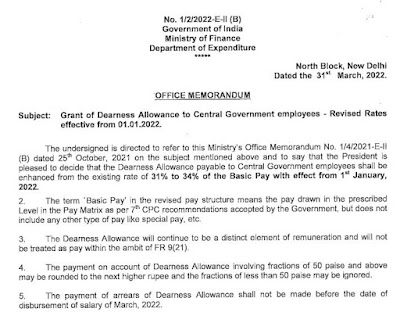
DA Jan 2022 - Grant of Dearness Allowance to Central Government employees - Revised Rates effective from 01.01.2022

 3% DA Hike - Revised Rates effective from 01.01.2022: DoE OM dated 31.03.2022 No. 1/2/2022-E-II (B) Government of India Ministry of Finance...