Thursday, 23 June 2016

One Rank One Pension – More delay in OROP – Government Gives Six Month Extension to Panel

One Rank One Pension – More delay in OROP – Government Gives Six Month Extension to Panel

With the extension, the implementation of One Rank One Pension (OROP) may take more time as the panel can submit its report by December 14, official sources said.

benefits-one-rank-one-pension


One Rank One Pension – More delay in OROP – The tenure of the committee formed on implementation of One Rank One Pension (OROP) scheme has been extended.

The tenure of the committee formed on implementation of One Rank One Pension (OROP) scheme has been extended by six months upto the middle of December this year.

The government recently amended the gazette notification issued last year under which the committee headed by former Chief Justice of Patna High Court Justice (Retd) L Narasimha Reddy was scheduled to submit its report by June 14. With the extension, the implementation of OROP may take more time as the panel can submit its report by December 14, official sources said.

The government had announced implementation of OROP on November 7, 2015 to benefit over 25 lakh ex-servicemen and war widows. The OROP mandates payment of uniform pension to the armed forces personnel retiring in the same rank with the same length of service, regardless of their date of retirement, which implies that bridging the gap between the rate of pension of current and past pensioners at periodic intervals.

The other Terms of Reference of the Committee will continue which include measures for the removal of anomalies that may arise in the implementation of the OROP as notified by the government.

The panel is also looking into the measures for the removal of anomalies that may arise out of inter-services issues of the three forces due to implementation of OROP besides implications on service matters. The Committee is examining all other matter referred to it by the central government on implementation of the OROP or related issues.

In making its recommendations, the Committee shall take into account the financial impact of its recommendations, as per its Terms of Reference. The panel, if necessary, may give interim reports to the government on any of the matters related to its terms of reference.

Source: NIE

Incentives announced for textiles will help create jobs

Incentives announced for textiles will help create jobs

The “extra push” given to the textiles industry through an incentive package will help create more jobs and push exports, Commerce and Industry Minister Nirmala Sitharaman said today.

“It is a sector where India has gained a lot of advantage … It has a great potential for job creation,” the minister told reporters here.

This “extra push” was given to the sector due to various global developments, she said.

The Union Cabinet yesterday approved a Rs 6,000 crore package for textiles and apparel sector with an aim to create one crore new jobs in three years and attract investments of USD 11 billion while eyeing USD 30 billion in exports.

Textiles exports contribute significantly to the country’s total exports at about USD 17 billion in 2014-15. The sector is witnessing huge competition from small countries like Bangladesh and Vietnam, which have access to developed markets at lower tariffs.

When asked about the impact of Brexit (possible exit of Britain from European Union) on India, Sitharaman said that the government is “watching the situation”.

“We will be observing the developments. It is too early for me to comment (on its impact),” she added.
Talking about the stalled India-EU free trade agreement, the minister said India is waiting for the dates to resume the talks.

“We are waiting for the dates. It is my doubt that if because they are waiting for the outcome of Brexit, they have not yet given the dates as yet. The moment they give the dates, we will be keenly wanting to continue the talks to reach the conclusion at the earliest,” she added.

Launched in June 2007, the negotiations for the proposed agreement have witnessed many hurdles with both sides having major differences on crucial issues like intellectual property rights, duty cut in automobile and spirits, and liberal visa regime.

The pact is aimed at reducing or significantly eliminating tariffs on goods, facilitating trade in services and boosting investments between the two sides.

When asked about Apple Inc’s proposal to open single brand retail stores in the country after announcement of the tweaked FDI policy in the sector, Sitharaman said: “We have announced the policy. We will wait to hear from them”.

The ministry has stated that it will give exemption to foreign firms such as Apple Inc coming with state-of-the-art technology from the mandatory local sourcing norms in the single-brand retail sector for up to three years.

PTI

Fixation of range of seniority for promotion from PA to PS grade of CSSS- Select List Year 2015 – regarding

Fixation of range of seniority for promotion from PA to PS grade of CSSS- Select List Year 2015 – regarding

 REMINDER-III
No.4/1/2016-CS-II(A)
Government of India
Ministry of Personnel, Public Grievances and Pensions
Department of Personnel & Training

3rd Floor, Lok Nayak Bhawan, Khan Market,
New Delhi – 110003.
Dated the 23rd June, 2016
OFFICE MEMORANDUM

Subject: – Fixation of range of seniority for promotion from PA to PS grade of CSSS- Select List Year 2015 – regarding.

Reference is invited to this Departments O.M. of even number dated 29.03.2016 and subsequent reminders dated 13.05.2016 & 08.06.2016 on the above mentioned subject. The requisite information regarding recommendation of DPC for promotion of eligible PAs to PS Grade of CSSS for the Select List Year-2015 was required to be furnished by the Cadre Units of CSSS in the prescribed proforma by 29.04.2016.

2. The requisite information received from the Cadre Units, as per Annexure, is either incomplete or has not at all been received till date. The non-receipt of this information is delaying the process of finalizing the panel of eligible officers for appointment to PS Grade of CSSS for the Select List Year-2015.The concerned Cadre Units are once again requested to furnish the requisite information without any further delay.

(AK Saha)
Deputy Secretary to the Government of India
Tel .No.24622365
Encl:- as above
To
Joint Secretary in charge of(Admn.) of the concerned cadre units.

DoPT Circular

7th Pay Commission – Recommendation for more Leave and Holidays

The following paragraphs bring out, the different kinds of holidays and leave admissible, demands received (if any) and views of the 7th Pay Commission on each one of them. 

7th-Pay-Commission-leave-holidays

7th Pay Commission – Recommendation for more Leave and Holidays – Presently Central Government offices observe a five-day week which results in 104 holidays every year on account of weekends.

Presently Central Government offices observe a five-day week which results in 104 holidays every year on account of weekends. In addition, there are three National Holidays, fourteen Gazetted Holidays and two Restricted Holidays. Further, civilian government employees are entitled to 8 days’ Casual Leave, 20 days’ Half Pay Leave (commutable to Medical Leave) and 30 days’ Earned Leave. Besides the above, quite a few other types of leave are admissible.

The following paragraphs bring out, the different kinds of holidays and leave admissible, demands received (if any) and views of the 7th Pay Commission on each one of them. Unless otherwise stated, the existing terms and conditions regulating these holidays and leave shall remain unchanged.

Casual Leave (CL) – Casual Leave is granted to enable a government servant to attend to sudden/ unforeseen needs / tasks. Presently 8 days CL is normally granted to a Central Government employee per calendar year. The number goes up to 10 days for Industrial Workers, 20 days for Defence Officers and 30 days for Defence PBORs. Certain other categories of staff, particularly in the Railways, are granted CL ranging from 11 to 13 days in a year. Demands have been made to increase the number of CL to 15 days for Industrial Workers and 12 days for other employees. CAPFs have also sought parity with defence forces in matters of Casual Leave.

Child Adoption Leave
– This leave is granted to female employees, with fewer than two surviving children on valid adoption of a child below the age of one year, for a period of 135 days immediately after the date of valid adoption.

Commuted Leave – Presently, Commuted Leave not exceeding half the amount of half-pay leave due can be taken on medical certificate. A demands have been made to do away with the need for medical certificate.

Child Care Leave (CCL) – Child Care Leave (CCL) is granted to women employees for a maximum period of two years (i.e., 730 days) during their entire service for taking care of their minor children (up to eighteen years of age). There are several demands relating to CCL which include converting the same into “family care” leave, extending the facility to male parents and many representations stressing that it should be extended at least to single male parents. Suggestions have also been received that in cases where the child is differently abled, the clause stipulating that the child should be minor, should be done away with. Single mothers have highlighted their unique problems and requested the Commission for liberalising the grant of CCL. Interestingly, representations have also been made for discontinuance of the CCL, primarily on the grounds that it disrupts office working and also because it promotes gender discrimination.

Earned Leave (EL) or Leave on Average Pay (LAP) – Presently 30 days EL per annum is granted to Civilian employees and 60 days to Defence personnel. EL can be accumulated up to 300 days in addition to the number of days for which encashment has been allowed along with LTC. Suggestions have been made to increase the accumulation to 450 days, allow encashment of 50 percent of the accumulated EL after 20 years of service and delink encashment of leave from LTC.

Paternity Leave – Presently, a male employee with less than two surviving children may be granted Paternity Leave for a period of 15 days during the confinement of his wife, up to 15 days before or six months from the date of delivery of child. Paternity leave may also be granted to a government servant with less than two surviving children on valid adoption of a child below the age of one year, within a period of 6 months from the date of valid adoption. There are demands to increase the period to 30 days.

Maternity Leave – Maternity leave is granted to women government employees–up to 180 days for pregnancy and 45 days in the entire service for miscarriage/abortion. Maternity leave can be combined with any other leave upto two years without medical certificate. The 7th pay Commission has received representations for enhancement of Maternity leave to 240 days with full pay and further 120 days with half pay.

It is noted that Maternity Leave was raised from 135 days to 180 days and ‘period in continuation’ raised from 1 year to 2 years by the VI CPC. No further increase is warranted. Status quo is recommended.

Special Disability Leave – It is admissible to civilian employees when disabled by injury intentionally or accidentally inflicted or caused by or in consequence of the due performance of official duties or in consequence of official position held. Full pay is admissible for the first 120 days and half pay thereafter. The leave may be combined with any other kind of leave due and admissible, provided the total period of leave does not exceed 24 months.

There are demands to remove the ceiling limit of 24 months–the duration of leave may be left to the discretion of doctor and full pay paid for the entire period.

Source: Patrika.com

Most important demand of CG employees is minimum wage and fitment formula – P.S.Prasad

Most important demand is that of the CG employees is the minimum wage and fitment formula – P.S.Prasad
7cpc-minimum-wage-demands-cg-employees

“The formal announcement by the of the 7th CPC acceptance is likely to be made by the Government just before the 11th July strike by the CG employees indicating the actual minimum wage and fitment formula.”

7th CPC latest
Comrades,
The empowered committee of Secretaries headed by the Cabinet Secretary had discussion from past five months on the charter of demands raised by the staff side, The finance ministry is working out the financial implications arising out of the improved recommendations of the 7th CPC especially on the minimum wage and fitment formula being improved, granting two increment on promotion and having annual increment on 1st Jan and 1st July instead of just on 1st July. This will benefit a lot of persons on promotion. The other aspect is considering grant of advances, which the 7th CPC has recommended for abolition.

The formal announcement by the of the 7th CPC acceptance is likely to be made by the Government just before the 11th July strike by the CG employees indicating the actual minimum wage and fitment formula.
The cabinet Secretary will present the view of the empowered committee of Secretaries before the Union Cabinet meeting based upon the principle adopted in actual calculation of the minimum wage and fitment formula. The 7th CPC had adopted the Dr Aykroyd formula minimum wage is calculated on the basis of the 15th ILC norms. But erred in many aspects for example the average of prices of last 12 months was taken, The housing weight age , education weight age etc . The prices of essential items are rising from past many years, even in last six months the retail inflation is rising above 5.4%.

Secondly the prices quoted by the GOVERNMENT OF INDIA MINISTRY OF LABOUR & EMPLOYMENT LABOUR BUREAU CLEREMONV, SHIMLA http://labourbureaunew.gov.in/ , the Director of Economic & statics , Ministry of Agriculture and Farmers Welfare, Government of India, New Delhi & the retail market prices are varying .

If we calculate the minimum wage based upon the LABOUR & EMPLOYMENT LABOUR BUREAU taking prices as on 1st July 2015 the minimum wage works out to Rs 21,000 / and fitment formula works to 3.00. This will result in 34% wage hike without allowances.

If we calculate the minimum wage based upon the Director of Economic & statics , Ministry of Agriculture and Farmers Welfare, Government of India, New Delhi taking prices as on 1st July 2015 the minimum wage works out to Rs 23,000 / and fitment formula works to 3.30. This will result in 50% wage hike without allowances.

If we calculate the minimum wage based upon the retail market taking prices as on 1st July 2015 the minimum wage works out to Rs 28,000 / and fitment formula works to 4.00. This will result in 70% wage hike without allowances.

The most important demand is that of the CG employees is the minimum wage and fitment formula.

The Staff side had demand of minimum wage of Rs 26000/- & fitment formula of 3.71. Against this the 7th CPC had recommended minimum wage of Rs 18000/- & fitment formula of 2.57. The 7th CPC recommendations has provided only at 14% wage hike at Group “C” level it is only ranging from Rs 2240/- to Rs 3500/- increase per month, and at Group “B” level ranging from Rs 4000/- to Rs 6500/- increase per month. After deductions & income tax the net increase will be just from Rs 500/- to Rs 3000/- only.

This increase is lowest by any pay commission, hence vast changes are required as the prices of essential commodities have gone up and also the inflation rate has gone up.

Comrades it is the time to struggle, we should educate the members and prepare for struggle, so that we should get at least 50 % wage hike without allowances, as allowances are not taken into pension benefit.
Only struggle will get us benefit. Please don’t believe on rumours. Now it is now or never.

Comradely yours
(P.S.Prasad)
General Secretary

Indefinite Strike Called by NJCA from July 11th will play a vital role to determine the fate of the 7th Pay Commission

Indefinite Strike Called by NJCA from July 11th will play a vital role to determine the fate of the 7th Pay Commission

Govt has to decide on 7th Pay Commission before Indefinite Strike

The Indefinite Strike Called by National Joint Council of Action from July 11th will play a vital role to determine the fate of the 7th Pay Commission. The amount of pressure exerted on the Government through this agitation may change the Govt Views over Pay Commission.

It is evident that the present NDA Government is not in favour of Bapus. And the Public opinion about Government Employee’s attitude and work Culture is too not in favour of CG Employees. So it is now the unity among Central Staffs and their undisputed faith over Unions, Staff Associations and Federations only will get them expected results.

At this juncture, somehow, the call for Indefinite Strike is a timely decision taken by NJCA and it is the only weapon, through which the powerless Central Staffs can intimidate the Government to do Justice for them in respect of Pay Revision and Improving Service Conditions.

That is why Federations are keep on telling the CG Staffs to be prepared for Indefinite Strike. They are, however, alarming the affiliated unions to be vigilant about the rumors about 7th Pay Commission. They informed that Social Media and Some News Agencies are publishing the false news which may deteriorate the Spirit of Govt Servants.

The Success rate of agitation Programs to be conducted by NJCA in order to prepare the Central Government Employees for Indefinite Strike will be the Pressure indicator to the Central Government to take decisions on 7th CPC issues and Pending demands prior to the Strike.

The Indefinite Strike is a well-defined and calculated move by NJCA to give the pressure to the Central Government as the Govt is reluctant to address the issues of CG Staffs and implement the 7th CPC recommendations.

It is inevitable to the Government to take decision on 7th Pay Commission before the commencement of Indefinite Strike.

Wednesday, 22 June 2016

Here’s how the 7th Pay Commission can affect your pay, most likely from August 2016!

Here’s how the 7th Pay Commission can affect your pay, most likely from August 2016!


The 7th pay commission has everything to make a central government employee happy and satisfied! The Commission is most likely to decide on a 30% hike on the basic pay. The minimum basic monthly salary recommended by the Commission was Rs 18000 and a 30% hike will make it to Rs 23500!

The 7th Pay Commission headed by Justice AK Mathur (Vivek Rae, retired IAS Officer; Rathin Roy, economist and Meena Agarwal, Secretary of the Commission are some of the other members of the Commission) had submitted its report to the Finance Minister earlier this year in the month of January. The Commission had suggested several recommendations like 23.55% increase in the pay and allowance, 24% hike for pensioners and OROP (One Rank One Pension) for central government employees and paramilitary personnel.

The exact decision of the Commission is impending. The Empowered Committee of Secretaries (13 member secretary level Committee to review the recommendation of the Pay Commission) is likely to make comparisons between the recommendations of the 7th pay commission and the comments from various stakeholders on the 7th Pay Commission. An Implementation Cell has been created in the Finance Ministry to work as the Secretariat of the Empowered Committee of Secretaries.

A Layman’s Guide to Pay Commission

Pay Commission has been set up by the Government of India, since Independence. The Commission is involved in giving recommendations regarding the salary structure of the Central government employees working in the civil and military divisions. Till date seven pay commissions have been set up for the same purpose.

The announcement for the 7th pay Commission was made on 04 February 2014. While Justice AK Mathur was the head of the Commission, other notable members included Vivek Rae, Dr. Rathin Roy and Meena Agarwal.

What will be the lowest and highest basic salary under 7th Pay Commission?

Under 7th Pay Commission the lowest and highest basic salary are Rs 18000 and Rs 250000, respectively. However the 30% hike will round the figures to Rs 23500 and Rs 325000 respectively. The figures reveal the drastic difference between the salary structure of the 7th Pay Commission with that of the 6th Pay Commission.

When is it likely to be implemented?

As mentioned above, the decision regarding implementation of the 30% hike is impending. However as per the latest reports it is likely to be implemented in August 2016.

What are the other salient features of the 7th Pay Commission?

* Annual increment has been hiked to 3%.
* HRA has been increased to 27%, 18% and 9%, if the DA crosses 50%; and further revision to 30%, 20% and 10%, when DA crosses 100%.
* Introduction of Health Insurance Scheme replacing the Central Government Health Scheme (CGHS).
* Introduction of OROP pension scheme for defence personnel
* Child Care Leave to be granted at 100% of salary for first 365 days and at 80% for next 365 days. CCL to be granted for single male parents.

The 7th Pay Commission is going to benefit near about 45 lakh Central government employees and almost 52 lakh pensioners.

Source : jagranjosh

Grants-in-aid for the year 2016-2017 to the Central Government Employees Resident Welfare Associations – Submission of Accounts for the year 2015- 2016

Grants-in-aid for the year 2016-2017 to the Central Government Employees Resident Welfare Associations – Submission of Accounts for the year 2015- 2016

No. 7/01/2016 – Welfare
Government of India
Ministry of Personnel, Public Grievances & Pensions
Department of Personnel & Training
*******
Lok Nayak Bhawan, New Delhi,
Dated 22nd June, 2016
To
The Secretaries of the Grantee,
Central Government Employee,
Resident Welfare Association,
(As per list)

Subject: Grants-in-aid for the year 2016-2017 to the Central Government Employees Resident Welfare Associations – Submission of Accounts for the year 2015- 2016 regarding.

Sir/Madam,
I am directed to say that the Department of Personnel & Training has been sanctioning Grants-in-aid to the eligible recognized Residents Welfare Associations formed by the Central Government Employees in residential colonies to enable them to meet a part of their expenditure on the welfare activities, programmes during the financial year. The recognized Central Government Employees Residents Welfare Associations II eligible to receive grants-in-aid may please send a request to this effect to this Department in the prescribed proformae.

2. The recognized Central Government Employees Residents Welfare Associations are requested to send their request keeping in view the following guidelines:-
a. Central Government employees and employees of Lok Sabha, Rajya Sabha, Supreme Court, High Court, UPSC, Statutory and Autonomous bodies and Delhi Administration shall qualify for regular membership of an Association in respect of the grants-in-aid from the Department of Personnel & Training subject to fulfillment of conditions as lajd in para (b) to (h) of clause II (2) of the O.M. No. 5/8/20 13-Welfare dated 3′ June, 2014.

b. Grants-in-aid admissible will be subject to an upper ceiling of Rs. 10,000/during a financial year.

c. Consolidated accounts for the previous financial year may be provided in Annexure ‘A’ signed by the President, Secretary, Treasurer and Internal Auditor.

d. A complete list of all the members showing their names, residential address, official  designation and address as on 31.03.2016 may be submitted as in Annexure ‘B’.

e. All the vouchers relating to each head of expenditure as appearing in Annexure ‘A’ should be maintained by the Association, so as to verify the expenditure as and when needed.

f. The Stock Register maintained by the Association as audited and certified by the Internal Auditor after physical verification should be maintained by the Association. The Department of Personnel & Training may verify the Stock Register as and when required. Similarly, the inventory of articles should also be maintained.

g. A copy of the minutes of the General Body meeting wherein the accounts of the Association and other activities thereof for the previous year have been approved may be submitted (Annexure ‘L’).

h. Utilization Certificate in respect of the grants-in-aid provided by this Department and information regarding assets acquired wholly or substantially funded from the grant may also be furnished as per proforma in Annexure ‘G’ and ‘H’ respectively. The Association who have not received grants-in-aid for the year 2014-15 and 2015-16 may submit Utilization Certificate for the previous year. However, the newly formed Associations need to submit Utilization Certificate indicating ‘Nil’ along with the Accounts for the year 2015-16.

i. A report on the activities of the Association with reference to the Annual Action Plan as provided in Clause 7 of the Rules and Regulations framed under the Model Constitution may also be provided (Annexure ‘K’).

j. A certificate regarding expenditure on Swach Bharat Mission may also be provided (Annexure ‘M’).
3. It may be noted that even if the Association is not keen to obtain further grants-in-aid from the Government, it shall have to render full and satisfactory accounts of the grants taken in the past. In case any Association fails to get grants-in-aid for any reason for two consecutive years, such Association will stand derecognized.

4. CGER WAs are requested to send their request complete in all respect, in the prescribed proformae, to DoPT preferably by 31.08.2016 for further necessary action in the matter.

Note: Incomplete Accounts for the year 2015-16, for receiving the grants-in-aid for the year 2016-17, will not be entertained by this Department.
Yours faithfully
(G. S. Arora)
Chief Welfare Officer (RWA)
DOPT Circular

7th Pay Commission implementation: Government says amount allocated to manage impact

7th Pay Commission implementation: Government says amount allocated to manage impact

Speculations are rife as Centre to take decision on 7th Pay Commission report implementation as around 47 lakh Central Government employees working in various sectors await their salary hike, which will have implications for government finances and inflation.

At a time when there are no conclusive increase in the private sector spending yet and the government also losing the benefits of low oil prices, it is facing a tough challenge in keeping up with the spending in public sector.

Reacting to a query, Finance secretary Ashok Lavasa said that a certain amount has been allocated to manage the impact of the pay commission award. But to speculate whether the amount is adequate enough, would be too early and premature.

Sources say, for this fiscal year the provision for hounouring the pay panel’s award is about Rs 54,000 crore whereas the outgo is estimated to be Rs 74,000 crore. Lavasa refused to comment on that saying no one knows as to what extent the government will accept the 7th Pay Commissions report.

Source : Financial Express

Cabinet approves special package for employment generation and promotion of exports in Textile and Apparel sector

Cabinet approves special package for employment generation and promotion of exports in Textile and Apparel sector

The Union Cabinet under the Chairmanship of Prime Minister Shri Narendra Modi has given approval for a special package for employment generation and promotion of exports in Textile and Apparel sector.
The move comes in the backdrop of the package of reforms announced by the Government for generation of one crore jobs in the textile and apparel industry over next 3 years. The package includes a slew of measures which are labour friendly and would promote employment generation, economies of scale and boost exports. The steps will lead to a cumulative increase of US$ 30 bn. in exports and investment of Rs. 74,000 crores over next 3 years.

The majority of new jobs are likely to go to women since the garment industry employs nearly 70% women workforce. Thus, the package would help in social transformation through women empowerment.

Salient features of the package announced are:

A. Employee Provident Fund Scheme Reforms
  • Govt. of India shall bear the entire 12% of the employers’ contribution of the Employers Provident Fund Scheme for new employees of garment industry for first 3 years who are earning less than Rs. 15,000 per month.
  • At present, 8.33% of employer’s contribution is already being provided by Government under Pradhan Mantri Rozgar Protsahan Yojana (PMRPY). Ministry of Textiles shall provide additional 3.67% of the employer’s contribution amounting to Rs. 1,170 crores over next 3 years.
  • EPF shall be made optional for employees earning less than Rs. 15,000 per month
  • This shall leave more money in the hands of the workers and also promote employment in the formal sector.
B. Increasing overtime caps
  • Overtime hours for workers not to exceed 8 hours per week in line with ILO norms.
  • This shall lead to increased earnings for the workers
C. Introduction of fixed term employment
  • Looking to the seasonal nature of the industry, fixed term employment shall be introduced for the garment sector
  • A fixed term workman will be considered at par with permanent workman in terms of working hours, wages, allowance and other statutory dues.
D. Additional incentives under ATUFS
  • The package breaks new ground in moving from input to outcome based incentives by increasing subsidy under Amended-TUFS from 15% to 25% for the garment sector as a boost to employment generation.
  • A unique feature of the scheme will be to disburse the subsidy only after the expected jobs are created.
E. Enhanced duty drawback coverage
  • In a first of its kind move, a new scheme will be introduced to refund the state levies which were not refunded so far.
  • This move is expected to cost the exchequer Rs 5500 crores but will greatly boost the competitiveness of Indian exports in foreign markets.
  • Drawback at All Industries Rate to be given for domestic duty paid inputs even when fabrics are imported under Advance Authorization Scheme
F. Enhancing scope of Section 80JJAA of Income Tax Act
  • Looking at the seasonal nature of garment industry, the provision of 240 days under Section 80JJAA of Income Tax Act would be relaxed to 150 days for garment industry
PPT on Textile and Apparel Sector Reform Package 

Flash News

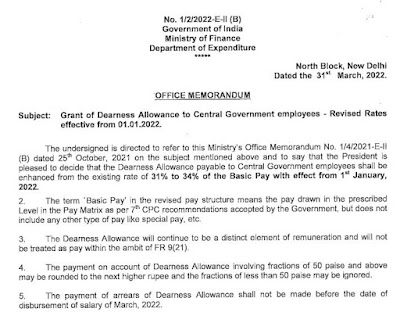
DA Jan 2022 - Grant of Dearness Allowance to Central Government employees - Revised Rates effective from 01.01.2022

 3% DA Hike - Revised Rates effective from 01.01.2022: DoE OM dated 31.03.2022 No. 1/2/2022-E-II (B) Government of India Ministry of Finance...