Wednesday, 27 January 2016

7th CPC Report : Indian Army is one of the largest professional volunteer land forces in the world

7th CPC Report : Indian Army is one of the largest professional volunteer land forces in the world

Cadres of Defence Forces Personnel : Junior Commissioned Officers (JCO)/ Other Ranks (OR)

7th-CPC-report-Indian-Army

Junior Commissioned Officers (JCO) and Other Ranks (OR) number 13.2 lakh across the three Services. JCOs/ORs can be broadly categorised in terms of their roles and skills. Roles

Army : With a strength of approximately 11 lakh, the Indian Army is one of the largest professional volunteer land forces in the world.

The cadre of the Army consists of:
i. Combat Arms (Armoured Corps, Artillery, Infantry and Mechanised Infantry)
ii. Combat Support Arms (Engineers and Signals)
iii. Specialised Cadres (AMC, ADC, RVC, AEC, CMP and APS)
iv. Logistic and Maintenance Services (ASC, AOC, EME and Pioneers).

Air Force : ‘Airmen’ comprise all ranks of combatants other than commissioned officers in the IAF. They perform a variety of functions ranging from aircrew duties on board helicopters and transport aircraft, maintenance of the most sophisticated and complex aircraft, radar, weapons and other equipment, secretariat and administrative duties involving maintenance of accounts of cash and stores, personnel documents, catering, discipline and medical care.

Navy : Every sailor is basically a seaman, irrespective of the branch to which he belongs or his trade specialisation. Seamanship duties comprise ship husbandry, hull maintenance, handling of small arms and ammunition, elementary store keeping, boat handling, firefighting, nuclear, biological and damage control as also first-aid, besides being proficient in a host of other seamanship activities such as anchor-work, rope-work, replenishment of fuel etc.

Skills

Every soldier is allotted a trade which becomes intrinsically linked to his subsequent career progression. There are numerous trades in the Army, Navy and Air Force. These have been grouped in two pay groups X and Y, as detailed in the table below:

Services Total Number of Trades and % age of Total Strength
X Y
Army 28 (2.58%) 96 (97.42%)
Navy 11 (12.00%) 42 (88.00%)
Air Force 23 (47.72%) 28 (52.28%)

The trades grouped under X require higher entry level qualification (Class XII). Entrants in group X also receive more intensive training. As against this entry level qualification for group Y is Class X only and the training.

7th CPC Recommendations : Upgradation of GP 4200, 4600 and 4800 for the Employees of the Supreme Court

7th CPC Recommendations : Upgradation of GP 4200, 4600 and 4800 for the Employees of the Supreme Court

Officers and Employees of the Supreme Court : Upgradation of Pay in Selected Posts in Existing GP 2800

Upgradation of pay has been sought for the group of posts in the present pay scale with GP 2800 to GP 4200. These include Junior Court Assistant, Chauffer, Special Process Server, Restorer Gr. I /Library Attendant Gr. I/Gestetner Operator Gr. I.

Analysis and Recommendations : The Commission has noted the recommendations made by the Committee of Judges in this regard. The Committee of Judges after examination of demands made has pointed out that in view of basic qualification, nature of duties and degree of efficiency, integrity and confidentiality the post of Junior Court Assistant can be considered for an upgradation in pay.
The Commission further notes that the educational qualifications for direct recruitment to the post of Junior Court Assistant is a degree from a recognised University and knowledge of computer operations with a stipulated typing speed in computers. The information furnished to the Commission with respect to the Recruitment Rules of various posts also indicates that in all other posts carrying a GP 2800 the educational qualifications is lower than graduation and therefore equating Junior Court Assistants with these posts would not be correct. In view of the foregoing the Commission is in agreement with the views of the Committee of Judges. Accordingly, the Commission recommends upgradation in the pay for the post of Junior Court Assistant to GP 4200 from the existing GP 2800.

Upgradation of Pay in Selected Posts in Existing GP 4200

For the group of posts covering Court Assistant, Personal Assistant, Accountant, Cashier, the Association requested pay parity with the holders of analogous/equivalent posts in the High Court of Delhi, who are drawing pay with GP 4600.

Analysis and Recommendations : The Commission has noted the recommendations made by the Committee of Judges in this regard. The Committee of Judges, after examination of demands made, agrees with the recommendation of upgradation in pay to conform to the pay of the holders of analogous posts in the High Court of Delhi.

The Commission recognises that the Supreme Court is at the apex of the hierarchy of Courts in India and hence its personnel should not be disadvantageously placed vis-à-vis the High Court of Delhi.
Accordingly, the Commission recommends upgradation for the post of Court Assistant, Personal Assistant, Accountant and Cashier to GP 4600 from the existing GP 4200.

Upgradation of Pay in Selected Posts in Existing GP 4600

Upgradation of pay has been sought for pay of the group of posts in the present GP 4600 to GP 4800. These include posts of Private Secretary to Additional Registrar, Sr. Personal Assistant, Senior Court Assistant, Court Associate, Editor of Paper books, Assistant Librarian,

Proof Reader, Assistant Accounts Officer (Concurrent Audit) and Building Supervisor. The justification for upgradation is that the holders of analogous posts in the High Court of Delhi are in GP 4800.

Analysis and Recommendations : The Commission has been informed that the Committee of Judges, after examination of demands made, have endorsed the upgradation in pay to conform with the pay of the holders of analogous posts in the High Court of Delhi.

The Commission recognises that the Supreme Court is at the apex of the hierarchy of Courts in India and hence its personnel should not be disadvantageously placed vis-à-vis the High Court of Delhi. Accordingly, the Commission recommends upgradation in the pay for the post of Private Secretary to Additional Registrar, Sr. Personal Assistant, Senior Court Assistant, Court Associate, Editor of Paper Books, Assistant Librarian, Proof Reader, Assistant Accounts Officer (Concurrent Audit) and Building Supervisor to GP 4800 from the existing GP 4600. However on completion of four years approved service further non-functional upgrade to GP 5400 (PB-2) is also recommended for these posts.

Notifying of Recruitment Rules within ten weeks time period after the same are approved by the Union Public Service Commission

Notifying of Recruitment Rules within ten weeks time period after the same are approved by the UPSC – Dopt Orders
No. AB.14017/61/2008-Estt. (RR)
Government of India
Ministry of Personnel, Public Grievances and Pensions
Department of Personnel and Training
New Delhi
Dated: the 27th January, 2016
OFFICE MEMORANDUM

Subject:- Notifying of Recruitment Rules within ten weeks time period after the same are approved by the Union Public Service Commission – regarding.

Attention is invited to Para No. 5.2 of this Department’s O.M. No.AB.14017/48/2010-Estt.(RR) dated 31 stDecember, 2010 on framing/amendment/relaxation of Recruitment Rules wherein it has been stipulated that the Recruitment Rules or amendment(s) thereto as finally approved by the Union Public Service Commission are required to be notified within a period of 10 weeks from the date of receipt of their advice letter. This time limit should be strictly adhered to.

2. The Commission has, however, brought to the notice of this Department that even after the lapse of 10 weeks time, the Recruitment Rules pertaining to a number of posts which were advised upon by the Commission are yet to be notified.

3. Ministries/Departments are, therefore, requested to initiate action for notifying the Recruitment Rules as soon as the same are approved by the Commission so that the prescribed time limit of 10 weeks is adhered to.
sd/-
(Gayatri Mishra)
Director (E-1)
Authority : www.persmin.gov.in

Immovable Property Return the year 2015 (as on 31.12.2015) – Dopt Instructions

Immovable Property Return the year 2015 (as on 31.12.2015) – Dopt Instructions

No. 26/2/2015-CS.I (PR)
Government of India
Ministry of Personnel, Public Grievances and Pensions,
Department of Personnel & Training
2nd Floor, Lok Navak Bhawan,
Khan Market, New Delhi,
Dated 27th January. 2016

OFFICE MEMORANDUM

Subject: Immovable Property Return the year 2015 (as on 31.12.2015)

The undersigned is directed to refer to this Departments Office Memorandums of even number dated 21.12.2015 and 18.01.2016 on the subject cited above (available at persmin.nic.in -> DOPT -> Central Secretairat -> CSS -> Property Return).

2. A large number of CSS Officers have not yet submitted the Immovable  Properly Return for the year 2015 on 31.12.2015). As already informed,  IPR should be submitted by all CSS officers through the Web Based Cadre Management System which is hosted at cscms.nic.in. However, as large number of officers are accessing the system, it has become slow making it difficult to submit the return online. As the system is web based, officers may try filing IPR beyond office hours when the system is less congested. If it is still not possible to file the return online for any reason, they should file the return in paper format to their offices by the stipulated date i.e. 31.01.2016. They may subsequently file the same through cscms.nic.in.
sd/-
(V.Srinivasaragavan)
Under Secretary to the Government of India

Authority: www.persmin.gov.in
Click to view the order

Demand for appropriate pay scales to officers of accounts and audit

The convention considers the measures such as reduction in the wages of women employee who avail CCL, forcing the employees to go on voluntary retirement on completion of 20 years of service in the name of ‘inefficiency’, earmarking ‘very good’ for MACP, withdrawal of all types of short term advances, refusal to recommend for scrapping of new Pension scheme, etc are the most retrograde recommendations of the 7CPC.

7th-CPC-audit-accounts


Demand for appropriate pay scales to officers of accounts and audit

Confederation of Central Government Employees has published the Declaration made in the National Convention on the demands of Grant of appropriate pay scales to employees and officers of Accounts and Audit.

JOINT ACTION COMMITTEE OF
ACCOUNTS & AUDIT EMPLOYEES & OFFICERS ORGANISATIONS
 17/2 – C, P & T Quarters, Kali Bari Marg, New Delhi: – 110001
Email: v.aicaea@mail.com

NATIONAL CONVENTION ON THE DEMANDS OF GRANT OF APPROPRIATE PAY SCALES TO EMPLOYEES AND OFFICERS OF ACCOUNTS AND AUDIT
Dated 10th January 2016


DECLARATION

The representatives of All India Audit & Accounts Association, All India Civil Accounts Employees Association, All India Postal Accounts Employees Association, All India Audit and Accounts Officers Association, All India Association of Pay & Accounts Officers (Civil), All India Civil Accounts Employees Association, Category-II, All India Federation of Divisional Accounts Officers and Divisional Accountants Associations and All India P&T Accounts & Finance Officers Association met in the National Convention on 10th January 2016, Conference Hall, 4th Floor, Nirman Bhawan, CPWD, Koti, Hyderabad.

The Convention, in conformity with the observations given by the National Joint Council of Action of the Central Government Employees, totally rejects the anti-employee recommendations of the 7th CPC. The mutilation of Dr. Aykroyd formula in computation of minimum wages based on the 12-monthly average (ending on 1.7.2015) prices of essential commodities supplied by Labour Bureau at Shimla was a total jugglery on the part of 7thCPC.

The convention considers that, reduction in the wages of women employee who avail CCL, forcing the employees to go on voluntary retirement on completion of 20 years of service in the name of ‘inefficiency’, earmarking ‘very good’ for MACP, withdrawal of all types of short term advances like festival/cycle/ LTC etc, refusal to recommend for scrapping of new Pension scheme, refusal to propose for dispensing with the outsourcing/casualisation/ contractorisation by regularizing the employees engaged through such methods for regular government functions are the most retrograde and the anti-employee recommendations of the 7CPC.

The Convention noted that on the issue of formation of Apex Level Grievance redressal mechanism to the Group B Gazetted Officers and Promotee Group A Officers, even after 67 years of independence, settlement has not taken place mainly because of intransigent and adamant stand of the Ministry of Finance, Government of India. The meeting noted that on all other demands also there is a dilly dallying attitude on the part of authorities resulting in non-settlement.

The Convention congratulates the Central Government employees for observing 27th November 2015 as BLACK DAY by wearing black badges and holding (lunch hour) demonstration at the work place and organizing lunch hour demonstration on 30th December 2015 responding to the call of NJCA, which was duly endorsed by the Confederation.

The Convention endorses the 26 Point Charter of Demands on issues related to the recommendations of the 7th CPC submitted to the Cabinet Secretary on 10th December 2015 by the Staff Side, National Council, JCM and on behalf of the NJCA and also by the CCGGOO to the Government to discuss and settle the demands immediately.

The Convention also endorses the decisions taken by NJCA on organizational actions including the decision of massive Dharna on 19th, 20th and 21st January 2016 and Indefinite Strike in the 1st Week of March 2016 with an appeal to the entirety of the Accounts and Audit Employees and Officers of the country to prepare and participate in all preparatory programmes and the Strike action under the guidance of the local Co-ordination Committees and JCAs.

The Convention takes the opportunity to congratulate all those employees and officers of Indian Audit and Accounts Department and other organised Accounts Cadre who responded the call of Apex JAC i.e. observance of demands day on 15th December 2015 and submission of the demands of the Accounts and Audit Employees and Officers in the form of Resolution to local Head of Offices for onward transmission to higher authorities.

The Convention totally agrees with the following proposals for pay structure for Audit & Accounts Cadres submitted by the apex level JAC to secretary, Department of Expenditure ON 11TH December 2015 seeking mitigation of the injustice done to the accounts and audit cadres by the 7th CPC.

1. Accounts/Audit Assistant:
Re-designation of LDC as Accounts/Audit Assistants and grant of replacement scale of PB-1 Grade Pay Rs.2400 — i.e. level 4 pay scale of Table 5.Pay Matrix.

2. Accountant/ Auditor:
Correction of error done in implementing 6CPC recommendations by the Government and Grant of replacement pay scale of PB 2 GP 4200 — i.e. level 6 pay scale of Table 5 in Pay Matrix.

3. Senior Accountant /Auditor (SA)/DA:
Streamlining the contradictory views and recommendations of 7th CPC and grant of replacement pay scale of PB 2 GP 4600 — i.e. level 7 pay scale of Table 5.Pay Matrix to the Senior Accountant/ Auditor/Accounts Assistants (in Railways).

4. Assistant Accounts Officer/ Assistant Audit Officer/DAO II:
Acceptance of Para No. 11.12.140 of the recommendations of 7th CPC and grant of replacement pay of GP 5400(PB-2) to AAOs on completion of four years’ service — i.e. Pay level 9, in the pay matrix.

5. Accounts/Audit/Senior Accounts/Audit Officer/DAO I/Sr. DAO:
Grant of following pay scales to the Cadres indicated:
Audit/Accounts Officer/DAO Gr. I GP 6600 PB-3 — i.e.level-11 pay scale of Table 5.Pay Matrix
Sr. Audit/Accounts Officer/Sr. DAO (15%) GP 7600 PB 3 — i.e. level-12 pay scale of Table 5.Pay Matrix.

6. Qualification Pay
Granting qualification Pay to all Organized Accounts and IA&AD uniformly in terms of the recommendations of 7 CPC in Para’s 8.9.43, 44 and 45 respectively.

7. Secretarial Staff
Pay scale of secretarial staff working in Account and Audit Organizations may be granted at par with Secretarial staff working in the Ministry.

8. Cadre review
Since no cadre review of Accounts and Audit departments had been done after 1987, the cadre review should immediately be initiated as per the recommendations of 7thCPC.

The Convention further resolves to:

Reorganize and reactivate the local committees of the Joint Action Committee at every station within 10th February 2016.
Organize following sustained agitational programmes.

Daylong Dharna at all stations by the local JACs on 11th February 2016
Signature campaign – all units/circles/ branches shall deposit the Signatures to their respective Central Headquarters with in 28th February 2016
Massive Dharna at Delhi

Source : Confederation of Central Government Employees

7th Pay Commission – Certain Positive Aspects of Recommendations made

7th Pay Commission – Certain Positive Aspects of Recommendations made

Here are some aspects of 7th Pay Commission report which are much beneficial to Central Government Employees. If Govt accepts these recommendations as such overall compensation package of Central Government Employees will be more attractive.

7th Pay Commission – Certain Positive Aspects of Recommendations made in the 7th CPC Report mainly in the areas of Central Government Employees Welfare measures and Retirement Schemes.

Though 7th Pay Commission report failed to convince Central Government Employees in pay and allowances front, there are certain positive aspects in the recommendations which mainly relate to welfare measures, compensation and Retirement benefits. In the following paragraphs we would be discussing those which might surely improve overall Compensation package of central government employees in the long run.
7th Pay Commission’s decision to retain CPI-IW with base Year 2001=100 for determining Dear Allowance rate:

As demanded by various Central Government Employees Federations 7th CPC has proposed for retaining All India Consumer Price Index (Industrial Workers) with base year 2001=100. This means the allowance offered by govt to compensate inflation would continue to be calculated in the same as it is done presently, after deducting the quantum of DA (@ 125% for 126%) that is to be merged with pre-revised pay.

Dearness Allowance with effect from 1st January 2016 =[ (Avg of AICPI for the period from January 2015 to December 2015 – 115.76)*100/115.76] – 125 (or) 126

Interestingly, the earlier Pay Commission (6CPC) had proposed for adopting to new series of index (CPI-IW with base year 2001=100) which was later accepted by Govt. This measure needed adjustment in the calculation formula in respect of dearness allowance with effect from 1st January 2006 in the form of linking factor of 4.63 between base year 1982=100 and 2001=100


7th Pay Commission as well as Government could justify in retaining CPI-IW with base year 2001=100 as new series of the index with base year 2015=100 is yet to be unveiled.

A new series of CPI-IW for DA Calculation means adjustments from old base year to new base year using linking factor and rounding-off which would surely put breaks on higher DA to Central Government Employees. So, 7th Pay Commission’s recommendations on retaining the present series of CPI-IW for DA purpose is welcome one.

Enhanced Central Government Employees General Insurance Scheme Coverage up to Rs. 50 lakh:

7th Pay Commission Recommended Rates of CGEGIS


Level of Employee
Monthly Deduction
(Rs.)
Insurance Amount
(Rs.)
10 and above
5000
50,00,000
6 to 9
2500
25,00,000
1 to 5
1500
15,00,000


Increase in Gratuity ceiling to Rs. 20 lakh with DA indexed Gratuity for the first time:

7th Pay Commission proposed that ceiling in respect of Gratuity will have to be increased from the existing Rs.10 lakh to Rs.20 lakh.

Moreover, for the first time DA indexed Gratuity viz., increase by 25 percent whenever DA rises by 50 percent has been introduced by the Commission. This measure would surely compensate the inflation factor as gratuity of Rs. 20 lakh received by a retiring employee in 2016 will never be equal to the same amount received by another in 2025.

Further, 7th Pay Commission has proposed that 20 times of monthly emoluments is to be paid as gratuity for employees who intend to retire after serving 10 year of service but before 20 years of service. Presently, 10 times of monthly emoluments is being paid for length of service between 10 years to 20 years.

Child Care Leave extended Single Male Central Government Employees also:

Child Care Leave (CCL) is granted to women employees presently for a maximum period of two years (i.e., 730 days) during their entire service for taking care of their minor children (up to eighteen years of age).

In addtion to women employees, 7th CPC has propsed that a male employee who is single, will also be entited to Child Care Leave.

House Building Advance (HBA) – Loan Ceiling increased to Rs. 25 lakh:

As far Housing loan extended by Govt to its employees is concerned the Commission proposes 34 times of Basic Pay or Rs.25 lakh OR anticipated price of house, whichever is least. This is more than three times higher than the present level.

Chidren Education Allowance and Hostel Subsidy increased by 1.5 times – whenever DA increases by 50%, these two reimbursements will be increased by 25%

CEA (Rs pm) 1500×1.5 = 2250 Whenever DA increases by 50%, CEA shall increase by 25%
Hostel Subsidy (Rs pm) 4500 x 1.5 = 6750 (ceiling) Whenever DA increases by 50%, Hostel
Subsidy shall increase by 25%

7th Pay Commission recommends Higher Grade Pay for certain Posts in Central Government Service considering the service conditions:

On the basis of nature of work and anomalies, 7th Pay Commission has recommended higher grade pay for certain cadres.

Post wise higher grade pay recommended list is given below.

Sl.No Ministry / Dept Name of the Post Present 6cpc Grade Pay (Rs.) New Grade Pay recommended by 7th Pay Commission (Rs)
1. Railways Dietitians 4200 4600
2. Railways Senior Dietitians 4600 4800
3. Railways Assistant Dietetic Officer 4800 5400 (in PB-2)
4. Andaman and Nicobar Administration Junior Radiographer 2000 2800
5. Railways Perfusionists 2400 4200
6. CGHS Dental Hygienists 2400 4200
7. Defence Russian Officers Translators 4600 5400
8. Defence Russian Senior Officers Translators 5400 6600
9. Defence Russian Editors 6600 7600
10. Central Sheep Breeding Farm Sheep Shearer cum Supervisor 1800 2400
11 Indian Postal Service Inspector 4200 4600
12. Indian Postal Service ASPOs 4800 5400
13.
National Archives of India
Assistant Archivists 4200 4600
14. National Archives of India Archivists 4600 4800
15. National Archives of India Scientific Officer 4600 4800, 5400(12 yrs)
16. All Ministries Officers in organised accounts cadres 4800 5400
17. Dr. RML Hospital Junior ECG Technician/Junior Cardiac Technician 2400 2800
18. Andaman and Nicobar Administration Junior Agriculture Assistant/Junior Soil    Conservation    Assistant 2400 2800
19. Andaman and Nicobar Administration Bus Conductors 1800 1900
20. Mines Senior Technical Assistants (STAs) 4200 4600
21.
JTA, Store Keeper, 2800 4200
22.
Assistant Store Keeper 1900 2400
23.
Electrical Supervisor 2800 4200
24
Laboratory Assistant 2400 2800
25
Machine Man, Junior Press Assistant 1800 1900
26 CBI Sub Inspector 4200 4600
27
Inspector 4600 4800
28 Railways Assistant Station Master (ASM) 2800 4200
29 Railways Commercial Clerks + Enquiry Cum Reservation Clerks (ECRCs)+Ticket Checking staff (TTEs and TCs)= Commercial and Ticketing Staff 1900 2400 2000 2800
30 Railways Accounts 4800 5400
31 Railways Chemical  and  Metallurgical  Assistants 4600 5400
32 Shipping Head Light Keeper 4200 4600
33 Shipping Navigational Assistant Gr.II 2800 4200
34 Shipping Navigational Assistant Gr.III 2400 2800
35 Shipping Light House Attendant 1800 1900
36 Statistics Director General, Central Statistics Office HAG+ L17
37 Textiles Technical Officers 4200 4600
38 Textiles Assistant Director Gr. II (Technical) 4600 4800
39 Town and Country Planning Organisation Planning Assistants 4200 4600
40 Central Water Commission (CWC) Senior Research Assistant 4200 4600
41 Central Water Commission (CWC) Assistant Research Officer 4600 4800
42 Central Ground Water Board (CGWB) Technical Operator (Drilling) 1800 1900
43 National Academies heads of National Academies
Apex Scale Rs.80000
44
Intelligence Bureau (IB)
ACIO-II 4600 4800
45 Intelligence Bureau (IB) ACI

Source: gconnect.in

Change of Definition of OROP in Various Correspondence of DESW Noticed

Change of Definition of OROP in Various Correspondence of DESW Noticed


Shri Manohar Parrikar
Hon’ble Raksha Mantri
104, South Block, New Delhi
Change of Definition of OROP in Various Correspondence of DESW Noticed
Dear Sh Manohar Parrikar Ji

Pl refer to:

1. MOD letter no 12(01/2014-D (Pen/Pol) dated 26 Feb 14
2. MOM of the meeting chaired by RM on 26 Feb 14 to discuss OROP
3. Reply of MOS Defense Sh Rao Inderjit Singh Dated 2 Dec 14 in a written reply to Sh Rajeev Chandrashekhar in Rajya Sabha
4. GOI press release dated 5 Sep 15
5. GOI letter no 12(1)/2014 dated 7 Nov 15 and
6. GOI letter no 12(01)/2014-D(pen/pol)- Part–II dated 14 Dec 15
GOI has accepted following definition of OROP in the letters dated 26 Feb 14 and MOS statement in Rajya Sabha dated 2 Dec 14.
One Rank One Pension (OROP) implies that uniform pension be paid to the Armed Forces Personnel retiring in the same rank with the same length of service irrespective of their date of retirement and any future enhancement in the rates of pension to be automatically passed on to the past pensioners. This implies bridging the gap between the rate of pension of the current pensioners and the past pensioners, and also future enhancements in the rate of pension to be automatically passed on to the past pensioners.
However in the Press Release dated 5 Sep 14, a phrase has been added at the end of the OROP definition “at periodic intervals”.
Definition of OROP given in 5 Sep Press Release is given below:
One Rank One Pension (OROP) implies that uniform pension be paid to the Armed Forces Personnel retiring in the same rank with the same length of service, irrespective of their date of retirement. Future enhancement in the rates of pension to be automatically passed on to the past pensioners. This implies bridging the gap between the rate of pension of the current pensioners and the past pensioners at periodic intervals.
This phrase has probably been added to justify pension equalisation every five years as is being propagated by the MOD.
Again, another attempt has been made to change/ distort the definition of OROP in GOI notification dated 7 Nov 15. OROP definition given in 7 Nov letter is reproduced below.
One Rank One Pension (OROP) implies that uniform pension be paid to the Defence Forces Personnel retiring in the same rank with the same length of service, regardless of their date of retirement, which implies bridging the gap between the rate of pension of the current pensioners and the past pensioners at periodic intervals.
I am sure you would notice subtle progressive change in the language of definition of OROP, wherein the line “This implies bridging the gap between the rate of pension of the current pensioners and the past pensioners, and also future enhancements in the rate of pension to be automatically passed on to the past pensioner” has been changed with the line “This implies bridging the gap between the rate of pension of the current pensioners and the past pensioners at periodic intervals”.
It further states as one of the salient features that it has been decided that the gap between rate of pension of current pensioners and past pensioners would be refixed every five years.
This completely changes the definition of OROP and if implemented in its changed form, it will deprive past pensioners of monetary benefits and will completely destroy the definition of OROP and in turn, destroy the very soul of OROP.
UFESM (JM) believes that this change in the definition in OROP has been inserted only to justify pension equalisation every five years. Pension equalisation every five years is against the definition of OROP and is a matter of serious concern for all Ex-servicemen. The correct and acceptable situation is that pension equalisation must be done as soon as pension of two soldiers with same rank and same length of service is noticed to be different and it must be equalised immediately. Ex-servicemen are ready to accept pension equalisation every year only to make administration of this concept easily implementable. Incidentally, any computation can be easily achieved on press of a button in today’s computer era – and this needs no emphasis.
However the matter did not end at one instance of change of definition of OROP, it has been once again repeated in GOI letter dated 14 Dec 15 “OROP implies that uniform pension be paid to the Defence Forces Personnel retiring in the same rank with the same length of service, regardless of their date of retirement, which implies that bridging the gap between the rate of pension of current and past pensioners at periodic intervals”.
The GOI letter dated 14 Dec 15 is the notification for the formation of one-man judicial committee. It is a matter of great importance that if incorrect definition is given to the Chairman of anomalies committee, he is bound to work within the constraints given by MOD and will thus give his recommendations as per incorrect definition given to him. This will be gross injustice to ex-servicemen. Ex-servicemen might be justified to think that these changes are a planned move for the vexed problem of OROP in view of the past experiences in which meanings of Honorable Supreme Court orders were changed by making subtle changes in the decision of HSC.
We sincerely hope that these changes are probably only clerical errors and not a planned direction change. We therefore sincerely request you to correct these mistakes in definition of OROP and give following definition approved by Parliament to all committees.
One Rank One Pension (OROP) implies that uniform pension be paid to the Armed Forces Personnel retiring in the same rank with the same length of service irrespective of their date of retirement and any future enhancement in the rates of pension to be automatically passed on to the past pensioners. This implies bridging the gap between the rate of pension of the current pensioners and the past pensioners, and also future enhancements in the rate of pension to be automatically passed on to the past pensioners.
We will be thankful to get a suitable reply from you at the earliest.


With regards,
Yours Sincerely,
Maj Gen Satbir Singh, SM (Retd) Advisor United Front of Ex Servicemen & Chairman IESM
Mobile: 9312404269, 01244110570 Email:satbirsm@gmail.com

Monday, 25 January 2016

AIRF to conduct secret ballot proposing Indefinite Strike against 7th CPC report

AIRF to conduct secret ballot proposing Indefinite Strike against 7th CPC report

AIRF will conduct a secret ballot on February 11 and 12 to decide the date and future course of action (on strike) – Shiv Gopal Mishra, AIRF General Secretary

All-India Railwaymen’s Federation (AIRF) threatened to go ‘Indefinite Strike’ against the Seventh Pay Commission report.

“We will conduct a secret ballot on February 11 and 12 to decide the date and future course of action (on strike),” AIRF General Secretary Shiv Gopal Mishra said here today.

He said if railway employees will cast their votes in favour of launching indefinite strike then we will go for it and accordingly a date would be announced.

Mishra said their demands also include review of new pension scheme and filling up of large number of vacant posts in the railways.

Mishra differed with the Seventh Pay Commission reports and said “the minimum wage should be increased from Rs 18,000 per month to Rs 26,000.”

According to the Seventh Pay Commission recommendations, there would be an additional burden of Rs 32,000 crore on railways and Railway Minister Suresh Prabhu has described it as “unbearable”.

Mishra also said, there were about 2.5 lakh posts including those of loco pilots, assistant station masters and track men lying vacant in railways.

On new pension scheme, he said, “it should be reviewed as there are many anomalies in it. We want the guaranteed pension scheme should be implemented.”

In order to make the proposed agitation a success, Mishra said a sustained awareness campaign will be launched from January 25 to February 10.

Source : AIRF

Reserve Bank of India has issued a circular on Payment of Agency Commission on pension accounts

Reserve Bank of India has issued a circular on Payment of Agency Commission on pension accounts

RBI has clarified that agency banks are being compensated at Rs. 65 per transaction for handling pension computation, payment and related services on behalf of Central and State Governments up to 14 transactions per year. So, splitting up transaction for earning more commission by banks is not permitted.

Reserve Bank circular on Payment of Agency Commission on pension accounts – Transaction in pension more than allowed numbers would not fetch agency commission

RESERVE BANK OF INDIA
RBI/2015-16/294
DGBA.GAD.No. 2278/31.12.010/2015-16
January 21, 2016
The Chairman & Managing Director/
The Chief Executive Officer
All Agency Banks

Dear Sir/Madam
Payment of Agency Commission on pension accounts

As you may be aware, agency banks are being compensated at Rs. 65 per transaction for handling pension computation, payment and related services on behalf of Central and State Governments. As per the norms followed by the Government, a pensioner’s account should not have more than 14 credit transactions in a calendar year attributable to pension and related arrear payments, if any.

2. It has however come to our notice that certain banks are apportioning payment of arrears on account of Dearness Relief (DR) and/or delay in start of pension monthwise, thus, resulting in inflated agency commission claims. It is reiterated that number of commisionable transactions for payment of agency commission on account of pension in a year should not exceed 14. This includes one monthly credit for payment of net pension and a maximum of two per year for payment of arrears on account of increase in DR, if applicable.

3. It is also reiterated that cases involving payment of arrears on account of late start/restart of pension qualifies as a single transaction for claiming of agency commission. In other words, any payment of arrears on account of late start/restart of pension should be effected in a single credit transaction instead of separate monthly credits.

4. Some of the Central Government Departments and State Governments prefer to compute the pension figures on their own and pass them on to banks for payment. Such transactions may be included under non-pension payments, on which agency commission is payable on a turnover basis as per the existing norms (currently at 5.5 paise per Rs. 100/-).
Yours faithfully
(Manish Parashar)
Deputy General Manager

Download RBI Circular RBI/2015-16/294 DGBA.GAD.No. 2278/31.12.010/2015-16 dated 21.01.2016

BSNL Clarification regarding Employees Pension Scheme

BSNL Clarification regarding Employees Pension Scheme

BHARAT SANCHAR NIGAM LIMITED
(A Govt. of India Enterprise)
NO.500-85/CA-II/BSNL/EPF/2011/Vol.VI
Dated 19.01.2016
To,
The IFAs,
All Circles
BSNL

Sub.: Various Gazette Notifications issued by EPFO from Time to Time

This office has been receiving queries regarding Employees Pension Scheme.

In this regard, it is informed that EPFO vide its letter no. Actuarial / 18(2)2008/ Vol.III/7738 dated 29.08.2014 (copy enclosed) has already clarified that henceforth, EPS will apply only to EPF members whose pay at the time of becoming PF member is not more than Rs.15000/- per month on or after 01.09.2014. The entire employer and employee contribution shall remain in the Provident Fund and no diversion to EPS shall be made for all new PF members on or after 01.09.2014 having salary more than Rs. 15000/- at the time of joining.

In this connection, it is mentioned that this office has already issued instructions to act in accordance with the Gazette Notifications issued by EPFO, from time to time, without waiting for endorsement from the Corporate Office as the non compliance of the EPF guidelines attract penal provisions.

It is further mentioned that suitable action may be taken by the circles for rectification of any erroneous deduction made and deposited with EPFO under the EPS head for the employees covered under the above mentioned letter of EPFO dated 29.08.2014.

All BSNL units are hereby requested to kindly take necessary action in accordance with the instructions issued by EPFO.

Encl: As above
(V.M.Gupta)
Dy. General Manager (CA-III)

EMPLOYEES PROVIDENT FUND ORGANISATION
(Ministry of Labour & Employment, Govt. of India)
Head Office

Bhavishya Nidhi Bhawan, 14, Bhikaiji Came Place, New Delhi – 110 066.

No. Actuarial/18(2)2008/Vol.III/7738
Dated: 29.08.2014
To
All Addl. Central P.F. Commissioners (Zones)
All Regional P.F.Commissioners (In-Charge of Region)

Sub: Gazette Notification providing for increase in wage ceiling under EPS 1995 from Rs. 6500 to Rs.10000/- which shall come into force on and from the 1st day of Sept 2014.

Sir.
This is in continuation of this office circular No Actuary/l 8(2)2008/ Vol.111/5905 dated 23.07.2014 wherein it was informed that the Employees’ Pension Scheme 1995 is being amended to increase the wage ceiling from Rs.6500/- per month to Rs. 15,000/- per month in the Employees’ Pension Scheme, 1995.

2. The proposed amendments have since been noti red vide Gazette Notification No. GSR 609 (E) which shall come into force on and from the 1st day of September, 2014 (Copy of notification enclosed).

3. Accordingly, with effect from the 1st day of September, 2014, the pensionable salary for all cases of exit/death on or after 01.09.2014, for calculating pension shall be the average monthly pay drawn during the contributory period of service in the span of 60 months preceding the date of death/exit from the membership of the Employees” Pension Fund. The pensionable salary shall be calculated on pro-rata basis separately for the period up to 31.08.2014 up to wage ceiling of R.6,500/- per month and for the subsequent period upto the wage ceiling of Rs.15,000 per month. Similarly. the Withdrawal Benefit shall be based on the weighted wages at different wage ceilings. As already informed necessary amendments in the applicable on software are being carried out and the necessary software shall be released by I.S. Division at the earliest.

4. Accordingly, requisite steps may be taken so hat full details of wages for 60 months are available to settle the pension claims in accordance with the proposed modification. In this regard, Form 10-C & Form 10 D are also being redesigned to incorporate the above changes and shall be circulated soon. However in the meantime wage details be obtained by attaching additional sheet or giving details of 60 months of wages along with Form 10-D in respect of all members having date of exit from EPS 1995.

5. The members having date of exit from EPS, 1995 on account of superannuation/option date for commencement of early pension etc. prior to 01.09.2014 shall get Pensionary benefits on the basis of the existing pensionable salary calculations ie by taking 12 months average.

6. Further, with effect from 01.09.2014, wherever employer & employees have opted to contribute on salary exceeding Rs.6,500/- per month such employer & employees will have to exercise a fresh option to contribute on salary exceeding Rs.15,000/- per month subject to the condition that such member would have to contribute the Government’s share of contribution @ 1.16% on the salary exceeding Rs.15,000/- per month from his/her share of contribution. The fresh Option is to be exercised within a period of 6 months. It is essential to know with certainty the employee who are currently permitted to contribute to EPS on higher wages, so that fresh options can be called for. Accordingly, you may immediately flag all such cases of contribution on salary exceeding Rs.6,500/- per month and obtain fresh options in a time bound manner. It may be made known to the existing optees that if the fresh option is not exercised it shall be deemed that the employee has not Opted in allowing contribution over age ceiling and the contributions to Employees Pension Fund made above the wage ceiling in respect of the member shall be diverted to the Provident Fund account of the memer along with interest as declared under the Employees’ Provident Fund Scheme from time to time.

7. Furthermore, with effect from 01.09.2014 the provisions for contribution on higher salary has been deleted and as such no new options can be allowed to any member of EPS, 1995 on and after 01.09.2014.
8. As EPS will henceforth apply only to EPF members whose pay at the time of becoming PF member is not more than Rs. l5,000/- per month on or after 01.09.2014 the entire employer and employee contribution shall remain in the Provident Fund and no diversion to EPS shall be made for all new PF members on or after 01.09.2014 having salary more than 15,000/- at the time of joining. This must be ensured as any negligence on this issue may lead to unwarranted litigations.

9. The above actions may be taken without any deviation and officer in charge shall be responsible for compliance of above directions under his jurisdiction.

(This issues with the approval of CPFC)
Yours faithfully,
sd/-
(CHANDRAMAULI CHAKRABORTY)
REGIONAL E.F.COMMISSIONER-I (Pensions)
Click to view the Copy of the BSNL Clarification

Flash News

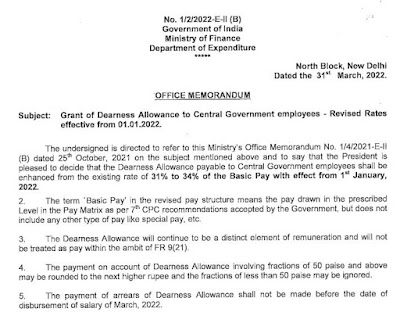
DA Jan 2022 - Grant of Dearness Allowance to Central Government employees - Revised Rates effective from 01.01.2022

 3% DA Hike - Revised Rates effective from 01.01.2022: DoE OM dated 31.03.2022 No. 1/2/2022-E-II (B) Government of India Ministry of Finance...