Sunday, 13 December 2015

Indefinite Strike by Central Government Employees – Charter of demands

Indefinite Strike by Central Government Employees – Charter of demands

Confederation of Central Government Employees JCM (NC) Staff Side has represented to Cabinet Secretary that the 7th CPC proposed 14% increase in Basic Pay is meagre compared to any other CPCs and wants to convene a meeting to discuss the charter of demands given below during Feb 2016 otherwise JCM (NC) Staff Side may have to go for indefinite Strike from 1st March 2016.

JCM (NC) Staff Side letter to Cabinet Secretary on the meagre increase of 14% of the 7th CPC recommendation – Calls for negotiation and if fails Indefinite Strike from March 2016

Confederation of Central Government Employees has represented that 7th CPC has recommended very less increase in pay compared to other CPCs in the past.  Confederation Looks for further negotiation during February 2016 and if it fails it has planned for indefinite Strike from March 2016.

NJCA
National Joint Council of Action
4, State Entry Road, New Delhi – 110055
No.NJC/2015/7th CPC

December 10, 2015

    To
    Shri. Pradip Kumar Sinha
    Cabinet Secretary
    Government of India
    Rashtrapati Bhawan Annexe
    New Delhi-110001.

    Sir,

    Subject:- 7th CPC recommendations and Charter of Demands – Reg.

We send herewith our suggestions and demands on the recommendation made by the 7th CPC. As indicated when the undersigned met you on 20th November 2015 the central government employees are extremely agitated over the totally retrograde recommendations of the Commission.

The meagre increase of 14% recommended by the 7th CPC is the lowest ever any pay Commission has made. It was the similar recommendation, we would request you to recall, made by the 2nd CPC that triggered a confrontation of an unprecedented nature, leading to a strike action which lasted for five days in the year 1960. In the background of the fact that the 5th and 6th CPC recommendations had resulted in the wage rise of 31% and 54% respectively, the anger, anguish and frustration of the employees are the natural outcome. Unless the minimum wage is re-determined with all consequential benefits, the discontent will not be capable of being addressed effectively.

It is, therefore, necessary that a meeting of the members of the Standing Committee of JCM NC is convened under your chairmanship immediately to discuss the issues we have incorporated in the enclosed charter. Settlement through bilateral negotiation has become the urgent need and requirement.

I have been directed by the meeting of the NJCA held on 8th December 2015 to convey to you the disappointment and resentment of the employees over the recommendations of the 7th CPC. We expect a bilateral negotiated settlement of the issues without delay from the Government. We request you that a mutually agreeable settlement on the issues are brought about latest by the first week of February 2016. I have been asked by the meeting to inform you that the entire Central Govt Employees under the auspices of National JCA will be constrained to go indefinite strike in the first week of March 2016 if the desired settlement through bilateral discussions is not brought about by the first week of February 2016. To facilitate an early resolution of the issues, we expect the government to set up a Committee of Group of Ministers to negotiate with the NJCA immediately.

We earnestly hope that the Government will effectively intervene and bring about a satisfactory settlement much before the first week of February 2016 and avoid an otherwise inevitable confrontation.

Thanking you,
Yours faithfully,
(Shiva Gopal Mishra)

Convener

Click to view the NCJ Staff Side letter No.NJC/2015/7th CPC dated 10.12.2015

Filling up vacancies in Central Government – BPMS

Filling up vacancies in Central Government – BPMS

BPMS – Bharatiya pratiraksha mazdoor Sangh requested Shri Dr. Jitendra Singh, Minister of State, Government of India, to fill up vacancies in the Government machinery to serve the public better. BPMS projects around 7 lakhs vacancies in Central Government installations.

BPMS requests for Filling up the vacant posts in Central Government Installations by regularising the Contract Employees.

Bharatiya Pratiraksha Mazdoor Sangh has made a request to the Minister of State Shri Jitendra Singh, for filling up of the vacant posts in the Central Government installations.

BHARATIYA PRATIRAKSHA MAZDOOR SANGH

REF: GENC / MOS / Recruitment 03
Dated: 10.12.2015
To,
Dr. Jitendra Singh,
Minister of State, Government of India,
Ministry of Personnel, PG & Pension,
New Delhi – 110001.

Subject: Filling up the vacant posts in Central Government Installations.

Hon’ble Sir,

With due regards, it is submitted that Government Employees National Confederation (GENC), affiliated to Bharatiya Mazdoor Sangh has been adopting the resolutions for filling up the vacant posts in Central Government Offices /  Establishments and has been always reflecting its concern on the functioning of Government Mechanism due to deficiency in the work force.

You are already aware of the Group-Wise & Status-Wise estimated number of Central Govt. Civilian Regular employees in major Ministries/Departments (excluding UTs) are as under in various Ministries which are mentioned below:-
(As on 01.01.2012)
Ministry
A
Number of Sanctioned Posts
Total
A
B(G)
Number in Position   
Total


B(G) 
B(NG) 
C(NG)


B(NG)  
 C(NG)

Railways
8748
7652
0
1560388
1576788
9228
8072
0
1288400
1305700
Home
18953
2390
42776
864815
928934
14817
1763
32921
780755
830276
AffairsDefence
13773
12213
14518
443233
483737
13185
11847
11174
332388
368594
(Civilians) Posts
610
1155
5639
203703
211107
610
1155
5639
203703
211107
Revenue
8255
24144
31355
74569
138323
5881
20885
23353
48668
98787
Others
50530
39286
50166
205672
345654
44239
33002
40390
152435
270066
Total
100869
86840
144454
3352380
3684543
87960
76724
113477
2806369
3084530

 (As on 01.01.2014)        (in lakh)
Ministry
Railways
Number of Sanctioned Posts
15.51
Number in Position
13.16
MHA
10.56
9.8
Defence
5.85
3.98
Civilians
Posts
 
2.50
 
1.90
Revenue
1.76
0.96
Total
40.49
33.02

From above it may be deduced that more than 7 lakh sanctioned posts are lying vacant for a long period which is not only adversely affecting the efficiency of good governance but give ample opportunity for exploitation of contract worker employed in the Government sector. Bharatiya Mazdoor Sangh has been demanding for abolition of contract work system and regularization of the contract workers.

Now, our  Hon’ble Prime Minister, Shri  Narendra  Modi  has also  assured  the unemployed youth to give them proper employment.

Hence,  it  is  requested  to  your  good  self  to  intervene  into the  matter  and  issue necessary directives to all the Ministries of Govt of India to fill up the vacant posts without further delay.
Thanking you.
Sincerely yours
SADHU SINGH
Organizing Secretary

Competent Medical Officer for issuing certificate of disability for family pension

Competent Medical Officer for issuing certificate of disability for family pension

Government of India, Ministry of Personnel, P.G. & Pensions OM describes “medical authority” competent to issue disability certificate as per M/o Health & Family Welfare Notification No.S.13020/1/2010, dated 18.6.2010

Government of India Notification on Competent Medical Officer/Board for issuing certificate of disability for the purpose of family pension under rule 54 of CCS (Pension) Rules, 1972

Ministry of Personnel, P.G. & Pensions has described that “medical authority” means any hospital or institution specified for the purposes of this Act by notification by the Central Government or appropriate State Government/UT.

No.1/18/01-P&PW(E)(Vol.II)
Government of India
Ministry of Personnel, P.G. & Pensions
Department of Pension & Pensioners’ Welfare

3rd Floor, Lok Nayak Bhavan,
Khan Market, New Delhi
the 5th November, 2015

OFFICE MEMORANDUM

Sub: Competent Medical Officer/Board for issuing certificate of disability for the purpose of family pension under rule 54 of CCS (Pension) Rules, 1972 – reg.
Reference is invited to this department’s Office Memorandum of even number dated 30th September, 2014 on the above subject.

2. It had been conveyed that for grant of family pension under the CCS (Pension) Rules, 1972, the authority competent to issue disability certificate would be as specified in the guidelines issued by the M/o Health & Family Welfare Notification No.S.13020/1/2010, dated 18.6.2010, in pursuance of the Persons with Disabilities (Equal Opportunities, Protection of Right and Full Participation) Rules, 1996. It had also been conveyed that for the past cases, the disability certificate issued either in pursuance of the guidelines, dated 18.06.2010 or in pursuance of rule 54 (6) of the CCS (Pension) Rules, 1972 shall be acceptable.

3. As per Section 2(p) of the Persons with Disabilities (Equal Opportunities, Protection of Rights and Full Participation) Act, “medical authority” means any hospital or institution specified for the purposes of this Act by notification by the appropriate Government. In pursuance of this, State Governments/UT administrations are required to notify the medical authorities to issue disability certificate.

4. In addition to the authorities indicated in para 2 above, for grant of family pension under the CCS (Pension) Rules, 1972, including past cases, the authority competent to issue disability certificate would be any hospital or institution specified as a Medical Authority for the purposes of the Persons with Disabilities (Equal Opportunities, Protection of Rights and Full Participation) Act by notification by the Central Government or a State Government or a Union Territory Administration.

(D.K. Solanki)
Under Secretary to the Government of India
Phone: 24644632
Download Govt of India OM No.1/18/01-P&PW(E)(Vol.II) dated 05.11.2015

7th Pay Commission Report on Leave Encashment of EL

7th Pay Commission Report on Leave Encashment of EL

Enhancement of ceiling of Earned Leave for purposes of Leave Encashment

The Commission has received representations seeking raising the ceiling limit of 300 days to 450 days for purposes of Leave encashment.

7th Pay Commission Report on Leave Encashment of EL


Analysis and Recommendations : The Commission notes that based on the recommendations of the VI CPC, serving employees are entitled for encashment of Earned Leave up to 60 days while in service. This is not to be deducted from the maximum number of Earned Leave of 300 days encashable at the time of retirement. The VI CPC, therefore, has further liberalised the regime of leave encashment.

The recommendations in relation to pay of both the civilian and defence forces personnel will also lead to a significant increase in the pay drawn and therefore in the total amount of leave encashment available for an employee.

Therefore raising the present ceiling of 300 days is not recommended by the Commission.

Authority: 7th CPC Report

Saturday, 12 December 2015

7th Pay Commission Report on Death Gratuity

7th Pay Commission Report on Death Gratuity

The Commission has received representations pointing to a need for rationalization of current slabs for death gratuity, especially for the slab of 5 to 20 years of qualifying service in which family pensioners are stated to be placed at a disadvantageous position.

Analysis and Recommendations : As per Rule 50 of Pension Rules, the death gratuity admissible will be as follows, subject to the maximum limit prescribed for the gratuity:


7th CPC Death Gratuity


Authority: 7th CPC Report

Central Pensioners : 37% are in the 60-70 age group


Central Pensioners : 37% are in the 60-70 age group

Age Analysis of Pensioners as on 01.01.2014 : Payment of additional pension/family pension with advancing age came into force based on recommendations of the VI CPC. This Commission, with a view to ascertain the strength in various age groups, called for information on age profile of pensioners and family pensioners. The data with regard to pensioners in terms of various age groups, as reported to the Commission, for the five categories of pensioners’ viz., Central Civil, Railways, Post, Defence (Civil) and Defence (Services) is as under:

Age Analysis of Pensioners as on 01.01.2014


# Others includes those below 60 years of age and those above 100 years.

@ Others under Central Civil additionally includes cases whose revision had not been effected, certain categories of pensioners like Judges of Supreme Court and High Courts, Ex-MPs, freedom fighters.
^ Railways have included those less than 60 years of age in the 60-70 age group.

From the table above it can be observed that of the total 51.96 lakh pensioners, 37 percent are in the 60-70 age group, about 26 percent each are in the 70-80 and ‘Others’ age group. The balance 11 percent are in the 80 plus category and thus entitled to enhanced pension based on advancing age.

The stacked bar graph brings out for each category of pensioners the break up in percentage terms of each age group viz., 60-70 years, 70-80 years, 80-90 years, 90-100 years and Others.


Railways have included those less than 60 years of age in the 60-70 age group
The graph above brings out the following:
i. Railways, in comparison to other categories have largest percentage of pensioners above the age of 80 years. While in all other categories this percentage is in the range of 7-9 percent, in the Railways it is 21 percent.
ii. Defence Services have a large percentage of personnel retiring at an early age, as is confirmed by the data. 57 percent of defence service pensioners fall in the ‘Others’ age group. Central Civil which also includes CAPFs has 25 percent in ‘Others’ age group.
Authority: 7th CPC Report

Enhanced Family Pension : No Change is being recommended by 7th CPC

Enhanced Family Pension : No Change is being recommended by 7th CPC

Increasing the existing time period of seven years for enhanced family pension

The Commission has received representations seeking enhancement in the period of enhanced family pension from the existing seven years or 67 years, whichever is less, to ten years in case of death of retirees.
Analysis and Recommendations : The current rates of enhanced family pension are–
i. In the case of death in service: Payable to the family of a government servant for a period of ten years from the date of death of a government servant, without any upper age limit.
ii. In the case of death after retirement: Payable for a period of seven years or up to the date on which he would have attained 67 years had he survived, whichever is less.
The Commission notes that the revision with regard to period of eligibility for the enhanced family pension of ten years was made based on recommendations of the VI CPC Report. No further change is being recommended by this Commission.

Strength of Central Government Pensioners as on 01.01.2014

Strength of Central Government Pensioners as on 01.01.2014

Strength of Pensioners as on 01.01.2014 : Pensioners can be broadly categorised into Civil and Defence. Within civil pensioners there exist three broad categories: Central Civil, Railways and Post.

As on 01.01.2014, as per data reported to the Commission, the total number of pensioners were 51.96 lakh. The category wise break up is shown in the pie chart below


Central Government Pensioners

Pensioners and Family Pensioners

The break-up of the total 51.96 lakh pensioners as on 01.01.2014 between pensioners and family pensioners, category wise, is as under:
Pensioners and Family Pensioners

The table above brings out the following:

i. Of the total 51.96 lakh pensioners as on 01.01.2014, 11.83 lakh viz., 23 percent were family pensioners.
ii. Civilian pensioners consisting of Central Government Civil, Railways and Posts, as on 01.01.2014 number 27.81 lakh while defence pensioners (including defence civilians were 24.15 lakh. Defence pensioners (including defence family pensioners and defence civilians) constitute 47 percent of all pensioners.

Friday, 11 December 2015

7TH PAY COMMISSION REPORT: Pay Panel bonanza: Boon or bane?

7TH PAY COMMISSION REPORT PAY PANEL
7TH PAY COMMISSION REPORT: Pay Panel bonanza: Boon or bane?

On November 19 when Justice AK Mathur submitted the 900-page Seventh Pay Commission report to Finance Minister Arun Jaitley there were smiles on the face of 48 lakh Central Government employees and 55 lakh pensioners. However, amid all the ecstasy and celebrations, economists are divided in their opinion over the impact of an additional Rs 1.02 lakh crore burden on India’s economy at a time when the Government is struggling to cut its fiscal deficit. So will the 7th Pay Panel report be a boon for the BJP-led NDA-II Government or the move will boomerang on it like the “India Shining” campaign of the NDA-I regime? Bureaucracy Today analyses the issue.

The proposed 23.55 percent hike in the salaries and pensions of Central Government employees has alarmed a section of economists, ratings agencies and brokerages which warn of a dent in India’s finances though the other section and the Government express confidence that the fiscal deficit targets will not be breached.

The Commission has proposed a new pay matrix, replacing the existing pay bands and grade pay, for the Central Government employees and pensioners, with a monthly starting pay, inclusive of dearness allowance (DA), of Rs 18,000 and an apex level pay of Rs 2.5 lakhs. The starting pay now is Rs 7,000 per month and the highest salary is Rs 90,000 (fixed) excluding the DA which is 119% at present.


IMPACT ON FISCAL DEFICIT
Ratings agency Fitch says the recommendations, “if implemented in toto, could challenge the Government’s goal of achieving a fiscal deficit of 3.5 percent in 2016-17 unless its expenditure is cut or revenue raised”. Similarly, another international ratings agency, Standard & Poor’s, opines that the implementation of the Pay Panel proposals will “put pressure on the fiscal position of the Government and will act as a constraint to sticking to the roadmap for fiscal consolidation”.

However, former Reserve Bank of India Governor Bimal Jalan feels otherwise. “I don’t think the implementation of the Seventh Pay Commission recommendations will negatively impact the Government’s fiscal deficit. With the increase in employees’ income, consumption will also increase. If the consumption increases, the Government will earn more from Excise Tax, GST, etc. An increase in consumption will lead to an increase in Government revenue,” he tells Bureaucracy Today.

Echoing Jalan’s views, former Revenue Secretary Sunil Mitra says, “Our fiscal deficit is very much in control. Whether the implementation of the Pay Panel recommendations will impact the fiscal negatively, I cannot say. It may not really impact the fiscal deficit because the macro-economic fundamentals in the country are very good at the moment. Other than inflation in some food items, generally the prices are down.”

Earlier in February this year, Finance Minister Arun Jaitley had set the fiscal deficit target for the FY 2015-16 at 3.9 percent of the gross domestic product and said the Government would reduce the target gradually to 3 percent by FY 2017-18.

Brokerage firm Citigroup warns that in the backdrop of the Pay Panel recommendations, the Government might have to “make a cut in public investments” to achieve its fiscal deficit target, offsetting “the gains on economic activity somewhat”.

“The fiscal impact of the Seventh Pay Commission report, as with the previous ones, is likely to be felt over the next two years: 2016-17 and 2017-18,” says Sonal Varma of Nomura, a broking firm, in a research paper.

Seeking to allay the fears, Economic Affairs Secretary Shaktikanta Das says, “The Commission’s report was expected and the Government knew that it would take effect from January 1, 2016. Obviously the Government was not aware of its thinking. But the Government always has a broad estimation of what is going to be the impact of Pay Commission recommendations and accordingly internally a kind of risk matrix is prepared. The Government will deal with the situation. We will work out our numbers. So far as the fiscal consolidation roadmap is concerned, that will be maintained.”

Finance Secretary Rattan Wattal tells Bureaucracy Today, “While there is fear of some revenue shortfall, especially on the direct taxes front, the Government does not want to go in for any expenditure cuts to meet the deficit target. The FY16 plan spending target is realistic and reasonable.”


MORE BURDEN ON PUBLIC?
Though the Government is assuring the nation that the Pay Panel report will not affect the Indian economy, some experts argue that the State exchequer might have to shell out more with the Government likely to impose new taxes to meet its expenditure.

G Chokkalingam, Founder and Managing Director of the Mumbai-based Equinomics Research and Advisory, opines, “The additional income in the hands of Central Government employees will constitute about 0.5 per cent of a projected GDP in FY17 and may not give any boost to consumer goods manufacturers as a major part of this would be chucked away from them by revival in inflation rates and further higher duties (on fuels as long as the oil price remains subdued) and taxes (especially on services) likely to be imposed by the Government to meet its growing expenditure needs.”

However, Bimal Jalan seeks to disagree. “I don’t think that the public has to pay more taxes to meet the expenditure requirement. The impact of the Seventh Pay Panel report on the budget will not be substantial. I would not worry about that part. It is reasonable and can be handled,” the former RBI Governor told Bureaucracy Today.

Madan Sabnavis, Chief Economist of ratings agency CARE, says though the quantum of the recommended increase in the salaries and pensions of the Government employees is justified, the amount is quite large and “absorbing Rs 1 lakh crore is a big task”.


PRESSURE ON STATES
The impact of the SCPC recommendations in all its likelihood will trigger a similar demand in the States, a fact acknowledged even by Jaitley. The Union Finance Minister admitted at a business summit in Jaipur recently that the implementation of the 7th Pay Commission recommendations will put “slight” burden on the States’ expenditure.

Former Revenue Secretary Mitra also opines that though there will be pressure on the State Governments, it won’t be huge. “The State finances are much better than those of the Central Government. I don’t anticipate that SCPC recommendations will have a huge pressure on public finance or for that matter State finances. Most State Governments have improved their finances and are better placed than the Centre on the fiscal front,” Mitra tells Bureaucracy Today.

Echoing his views, Jalan articulates that the SCPC would significantly boost the Centre’s income tax collections which will also benefit the States as the Centre’s gross tax revenue needs to be shared with them.
However, Niti Aayog Member Bibek Debroy vehemently disagrees. “The repercussions of implementing the Seventh Pay Panel report will be serious on the States’ fragile finances. When starved of funds, the State Governments slash capital expenditure and the Pay Panel report will force the States to scale back their development spend,” Debroy tells Bureaucracy Today.

He also says the Railways, which is already reeling under financial constraints, will also suffer as the wages of its staff go up. Of the total Rs 1.02 lakh crore revised salary, the Union Budget will bear Rs 74,000 crore while Rs 28,000 crore will be borne by the Rail Budget.

Debroy’s apprehensions are not unfounded. “Most of the States are working around the 3% fiscal deficit number. Accommodating the additional pay increase would be a touch and go. A few weeks ago the Central Government put forward the Ujwal Discom Assurance Yojana (UDAY) under which the States are to restructure their debt-ridden Electricity Boards (SEBs). This means bearing some additional debt in the next two years. Depending on the timing of their Pay Committee recommendations, if any, the State Governments will have a sticker path to cross as they would have to address the necessity of higher salaries and the option of reforming the SEBs along with other pressures like spending partly on setting up Smart Cities and launching other programmes,” Madan Sabnavis says.


FUTURE UNCERTAIN
Though the Central Government has set up a “cell” to examine the Pay Panel recommendations, ambiguity remains as to how the Government will bring the Rs one lakh crore money to fund the increased salaries. The challenges are at multiple levels and very little has been said in the report about addressing them. The additional expenditure has to be compensated from somewhere. To fulfil the Fiscal Responsibility and Budget Management objective, the Government either has to increase its revenue or cut down its expenditure and this is where the problem lies. It will be a major challenge for the Finance Minister when he presents the FY2016-17 budget in Parliament. It is just a matter of few months before we know how well the Government has worked on its fiscal arithmetic. For the time being, let us hope that the Government does not further bend the back of the common man who is already facing the heat of spiralling prices.

Source: bureaucracytoday.com

7th Pay Commission: Private sector employees want similar hikes

7th Pay Commission: Private sector employees want similar hikes

New Delhi: Following the 7th Pay Commission report, there is a significant discontent among private sector employees, and employers are dealing with lowered motivation and performance levels, says a survey.
According to a TimesJobs.Com survey, over 70 per cent private sector employees regret working in the private sector after central government employees bag 23.55 per cent salary hike.

“The discontent caused in the private sector by this performance-indiscriminate hike to central government employees is palpable. And India Inc employers are having to face the brunt of this dissatisfaction with lowered motivation and performance levels,” TimesJobs.Com COO Vivek Madhukar said.

A large majority of respondents (68 per cent) felt that this hike was “unfair”. Another 47 per cent respondents believe the raise has no linkage to employee performance while 30 per cent feel the massive hike will eventually widen the public and private sector income disparity.

While the disappointment with private sector pay scales was high across experience levels, entry-level employees were the most disappointed.

About 80 per cent junior/entry-level employees said they regretted having taken up jobs in the private sector, reveals the survey. Nearly 75 per cent middle and senior-level employees also shared similar sentiments.
“All (100 per cent) the professionals surveyed said private sector companies should increase minimum wages like the central government,” the survey noted.

However, most private sector employees agreed that their jobs offered them more room for career growth. Close to 80 per cent employees think private sector jobs score better over government jobs given the opportunities for growth and job change.

The survey covered over 700 professionals working in the private sector from across the country, who earn their increments based on their individual performance and contributions to the business. It had representation from employees from across sectors and experience levels.

PTI

Flash News

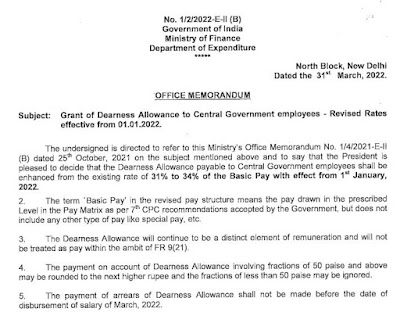
DA Jan 2022 - Grant of Dearness Allowance to Central Government employees - Revised Rates effective from 01.01.2022

 3% DA Hike - Revised Rates effective from 01.01.2022: DoE OM dated 31.03.2022 No. 1/2/2022-E-II (B) Government of India Ministry of Finance...