Thursday, 13 August 2015

7th Pay Commission likely to abolish gazetted holidays

7th Pay Commission likely to abolish gazetted holidays

New Delhi: The Seventh Pay Commission is expected to reward the central government by its recommendation on abolishing 18 days gazetted holidays and to provide three days national holidays to central government employees to reform the work culture in central government offices.

Pay commission sources said the number of holidays should come down to improve work culture.
The sources also added, “A survey has revealed that India has the highest number of gazetted holidays per year and close on her heels are her Asian neighbours like Philippines, China, Hong Kong, Malaysia. We need to cut down on holidays to facilitate more work culture.”

The sources argued that the government offices worked only for 196 days in India in a year. Besides, whenever there was election, the government servants were pressed into election work. This affected the routine government business, sources contended.

Earlier, the sixth central pay commission recommended that central government offices should remain closed only on three national holidays (Republic Day, Independence Day and Mahatma Gandhi Jayanti) and all other gazetted holidays should be abolished and the number of restricted holidays (optional) depending on one’s religious persuasion should be increased from two to eight days.

The Seventh Central Pay Commission is also likely to make suggestion for flexible work hours for women and employees with disabilities.

Flexible working gives them greater choice over when and where they work, allowing them to better manage their work-life balance

“As flexi working hours will allow women central government employees to strike a balance between her professional and family responsibility, maintain healthy lifestyles and contribute to parenting well, it is recommended for the same and urge upon the government to work out the modalities in this direction,” the pay panel source said.

“Flexible working can also provide central government employees with disabilities with a ‘bridge’ into retirement. Many of surveys show that often the complete loss of professional work account of disability can leave employees with disabilities feeling depressed and unmotivated, even to the point of affecting mental health. Flexible working time can help employees with disabilities delay retirement without giving up too much of their hard-earned freedom.” said an official.
TST

3.37 lakh women employees in central government

3.37 lakh women employees in central government

New Delhi: Over three lakh women employees are working in various central government departments across the country, Lok Sabha was informed today.

Replying to a question, Minister of State for Personnel Jitendra Singh said there are various historical and social reasons for women employees being lesser in number.

“Estimated women employment in major central government offices as on March 31, 2011 is 3.37 lakh,” he said in a written reply.

There are about 48 lakh central government employees.

“There are various historical and social reasons for the women employees being lesser in number,” the Minister said.

In reply to another question, Singh said there was no proposal under the consideration of the government to provide 33 per cent reservation to women in central government offices.
PTI

Central Government employees working in the State of Kerala will get August 2015 Salary on 18th August 2015 on account of Onam

Central Government employees working in the State of Kerala will get August 2015 Salary on 18th August 2015 on account of Onam

Department of Expenditure has issued an OM for the Disbursement of salary/wages to the Central Government Employees in the State of Kerala for the month of August, 2015 on account of ONAM festival on 18th August 2015.
No.3(2)/2012/TA/443
Ministry of Finance
Department of Expenditure
Controller General of Accounts

Lok Nayak Bhawan
Khan Market, New Delhi
 Dated: 10.08.2015
OFFICE MEMORANDUM

Subject: Disbursement of salary/wages to the Central Government Employees in the State of Kerala for the month of August, 2015 on account of ONAM festival.

In view of the ‘ONAM’ festival this Government has decided that the salary of all Central Government employees in the State of Kerala for the month of August, 2015 may be drawn and disbursed by the Central Government offices (including Defence, Posts, Railways & Telecommunications) on  18th August, 2015.

2. The pension of all Central Government pensioners in the State of Kerala for the month of August, 2015 is to be disbursed by Banks/ PAOs of Civil Ministries/ Departments including Railways, Defence & Telecommunications on 18th August, 2015.

3. The wages for August, 2015 of the industrial employees of Central Government serving in the State of Kerala may also be disbursed in advance on 18th August, 2015.

4. The salary/wages so disbursed are to be treated as advance payments and will be subject to adjustment after the full month’s salary/ wages of each employee is determined. The adjustment, if any, will be made without exception from the salary/ wages as the case maybe from the month of September, 2015.

5. The concerned Ministries/Departments are requested to bring these instructions to the notice of their offices located in the State of Kerala for necessary action immediately.

(T.C.A. Kalyani)
Joint Controller General of Accounts

Download Finance Ministry OM No.3(2)/2012/TA/443 dated 10.08.2015

FM speaks on Implementation of 7th Pay Commission report in Parliament

FM speaks on Implementation of 7th Pay Commission report in Parliament
FM speaks on Implementation of 7th Pay Commission report in Parliament and tables Medium Term Expenditure Frame Work Statement – Central Government Employees Salary Expenditure to cross Rs. 1 lakh Crore.
Central government’s salary expenditure will exceed Rs 1 lakh crore in the current fiscal and is projected to increase further with the recommendations of 7th Pay Commission, posing risk to public finances, Finance Ministry said today.

According to the Medium-Term Expenditure Framework Statement tabled in Parliament, the salary outgo of central government employees will go up by 9.56 per cent to Rs 1,00,619 crore in current fiscal.
The pace will increase further in 2016-17 at 15.79 per cent to Rs 1.16 lakh crore with the likely implementation of the 7th Pay Commission award, said the statement tabled by Finance Minister Arun Jaitley in Parliament.

The outgo towards salary will further rise in 2017-18 to over Rs 1.28 lakh crore.

“The award of VII Central Pay Commission (CPC) and its impact on government finances poses a risk,” said the statement.

It also raised concerns about the rising pension bill of government employees saying it will rise to Rs 88,521 crore in current fiscal. It has been pegged at over Rs 1.02 lakh crore in 2016-17, and over Rs 1.12 lakh crore in 2017-18.

“Like in salaries, higher than normative growth has been provided for the projection of outlay on pensions during 2016-17. For the second year of the projection (2017-18), a normative growth has been assumed. Award of VII CPC and its impact on Government finances poses a risk,” it added.

The recommendations of the 7th Pay Commission, which was set up by in February 2014, is likely to be implemented from January 1, next year.

Source: The Economic Times

Wednesday, 12 August 2015

Paid leave for sexual harassment victims

Paid leave for sexual harassment victims

Instructions have been issued by this Department vide Office Memorandum dated 27.11.2014 regarding Alignment of Service Rules with the Sexual Harassment of Women at Workplace (Prevention, Prohibition and Redressal) Act 2013. As per para 6 of the said Office Memorandum, the Complaint Committee will have the powers to recommend to the employer (a) to transfer the aggrieved woman or the charged officer to any other workplace; or (b) to grant leave to the aggrieved woman up to a period of three months, which will be in addition to the leave she would be otherwise entitled to.

As per Section 9 of Chapter IV of the Sexual Harassment of Women at Workplace (Prevention, Prohibition and Redressal) Act 2013, any aggrieved woman may make, in writing, a complaint of sexual harassment at workplace to the Internal Committee within a period of three months from the date of incident and in case of a series of incidents, within a period of three months from the date of last incident.

The Committee may, for the reasons to be recorded in writing, extend the time limit not exceeding three months, if it is satisfied that the circumstances were such which prevented the woman from filing a complaint within the said period.

This was stated by the Minister of State for Personnel, Public Grievances and Pensions and Minister of State in the Prime Minister’s Office Dr. Jitendra Singh in a written reply to a question by Shri P.Nagarajan and Shri B. Vinod Kumar in the Lok Sabha today.

Confederation served strike notice to Cabinet Secretary on 11.8.2015 – 2.9.2015 All India Strike

Confederation served strike notice to Cabinet Secretary on 11.8.2015 – 2.9.2015 All India Strike

2nd SEPTEMBER 2015 ALL INDIA STRIKE – CONFEDERATION SERVED STRIKE NOTICE TO CABINET SECRETARY ON 11.08.2015

CONFEDERATION OF CENTRAL GOVT. EMPLOYEES & WORKERS
1st Floor, North Avenue PO Building, New Delhi – 110001
Website: www.confederationhq.blogspot.com
Email: confederationhq@gmail.com
President
K. K. N. Kutty
09811048303
Secretary General
M. Krishnan
09447068125
No. Confdn/Strike/2015
Dated: 11th August 2015
To
The Cabinet Secretary,
Cabinet Secretariat,
Government of India,
Rastrapathi Bhawan,
NEW DELHI – 110004.

Sir,
This is to give notice that the employees who are members of the affiliated organisations of the Confederation of Central Government Employees and Workers will go on one day’s strike on 2nd September, 2015. The Charter of demands in pursuance of which the employees will embark upon the one day strike action is enclosed.

Thanking you,
Yours faithfully,
Sd/-
M. Krishnan,
Secretary General
Encl: Charter of demands.

CHARTER OF DEMANDS

1. Urgent measures for containing price-rise through universalisation of public distribution system and banning speculative trade in commodity market.

2. (a) Containing unemployment through concrete measures for employment generation.
 
(b) No ban on creation of new posts. Fill up all vacant posts.

3. (a) Strict enforcement of all basic labour laws without any exception or exemption and stringent punitive measure for violation for labour laws. Withdraw the anti-worker Labour Law Amendments
 
(b) No labour reforms which are inimical to the interest of the workers.

4. (a) Universal social security cover for all workers
 
(b) Scrap PFRDA Act and re-introduce the defined benefit statutory pension scheme.

5. (a) Fix minium wage with provisions of indexation.
 
(b) Effect wage revision of the Central Government Employees from 01.01.2014 accepting memorandum of the staff side JCM; ensure 5-year wage revision in future; grant interim relief and merger of 100% of DA; Include Gramin Dak Sevaks within the ambit of 7th CPC. Settle all anomalies of 6th CPC.

6. (a) Stoppage of disinvestment in Central/State PSUs. Stoppage of contractorisation in permanent perennial work and payment of same wage and benefits for contract workers as regular workers for same and similar work.

(b) No outsourcing, contractorisation, privatization of governmental functions; withdraw the proposed move to close down the printing presses, the publications, form stores and stationery departments and medical stores Depots; regularize the existing daily-rated/casual and contract workers and absorption of trained apprentices.

7. Removal of all ceilings on payment and eligibility of bonus, provident fund; increase the quantum of gratuity.

8. (a) Compulsory registration of trade unions within a period of 45 days from the date of submitting applications; and immediate ratification of ILO Convention C 87 and C 98.

(b) Revive the JCM functioning at all level as an effective negotiating forum for settlement of
the demands of the Central Government Employees.

9. (a) Against FDI in Railways, Insurance and Defence.
 
(b) No Privatisation, PPP or FDI in Railways, Defence Establishment and no corporatization of Postal services.

10. Remove arbitrary ceiling on compassionate appointment.

11. Ensure five promotions in the serve career.

Source: www.confederationhq.blogspot.in

Tuesday, 11 August 2015

7th CPC Report & 2nd September 2015 Strike

2nd September 2015 Strike – Additional pressure on the 7th CPC to accept our justified demands – COC Karnataka
7th CPC Report & 2nd September 2015 Strike
To
All Affiliates
COC Karnataka

Comrade,
The latest information is that the 7th CPC report will be submitted only in last week of September, we should not be too worried about this as the 7th CPC report was expected to submit its report in first week of September , the delay is only by few days only and that too the 7th CPC period is upto end of September 2015 as the 7th CPC was constituted on 28th Feb 2014 and allowed 18 months time the 7th CPC has started functioning only in April 2014 onwards.
 
The COC Karnataka meeting held on 4th August 2015 at RMS office has decided to participate in the 2nd September 2015 strike program as per the directions of the Confederation of CG Employees New Delhi. Now due to many reasons the 7th CPC report release has been postponed, now let us to utilise the postponement period and put additional pressure on the 7th CPC and the Government of India to accept our justified demand’s of Central Government Employees such as minimum wage of Rs 26,000/- with effect from Jan 2014, fitment formula of 3.72 , five promotion scheme , date of effect of the 7th CPC from 1/1/2014 etc.

Comrades if the 2nd September 2015 strike by the Central Government Employees is a success, then we can get more financial benefits from the 7th CPC and the Government of India apart from other important issues of unwanted labour reforms will be solved.

I request all comrades to prepare and educate the grass root leaders and employees on our demands. Conduct gate meetings / general body meetings from 11th August onwards.
Comradely yours
(P.S.Prasad)
General Secretary
Source: http://karnatakacoc.blogspot.in/

Disadvantages caused due to Bio-toilets introduced in the passenger coaches of Indian Railways – NFIR

Disadvantages caused due to Bio-toilets introduced in the passenger coaches of Indian Railways – NFIR
NFIR
National Federation of Indian Railwaymen
3, CHELMSFORD ROAD, NEW DELHI – 110 055
No.II/34/Pt.12
Dated: 10.8.2015
The Member Mechanical,
Railway Board,
New Delhi

Dear Sir,
 
Sub: Disadvantages caused due to Bio-toilets introduced in the passenger coaches of Indian Railways reg.

The concept of bio-toilets in passenger carrying coaches was given shape by the Railway Ministry some time in the year 2011 when in a few coaches of’ passenger carrying mail/express trains, the bio-toilets were first introduced. NFIR understands that the Railway Ministry plans to fit bio-toilets in all passenger coaches by 2021.

Federation has been receiving number of complaints from the C&W Staff on malfunctioning vis-a-vis disadvantages of the bio-toilets. In this connection, NFIR having gone into the complaints received from the C&W Staff, noticed the following problems which may cause serious health hazards to staff.

The bio-toilet system is very sensitive. It has more than 100% chances of choking even with a bit of ‘Pan Gulka’ spitted in the toilets by the passengers knowing or unknowingly if not flushed properly by the passenger in the moving or stationary trains. Choking in these toilets also takes place due to throwing of Napkins, Cigarette buds, Gutka Pouch, Ladies pads, Plastic Water Boltles or their covers, liquor boltles and garbage of food stuff by the passengers resulting toilet pans and leading to public complaints. This situation has been causing tremendous pressure on staff for no fault of theirs.

The ball-valve provided which should function to drain out the waste to the ground by operating a connected pedal, never works due to faulty design. It is also reported that designs differ from one manufacturer to another, causing problems in procurement of spares.

The RDSO designed simplified standard mechanism to operate the ball valve be not compatible with old designs.
It has been further complained that improper trials of revised versions/modifications before implementation has been the real problem in procurement of spares and has been creating confusion among the Supervisors and Staff in the course maintenance.

The C&W Supervisors and staff working in pit lines have been facing lot of inconvenience during under gear maintenance, examing brake beam, brake block hanger, brake shoe assermbly, brake blocks, Safety wire rope & their pins, bogies frames and also facing serious inconvenience in piston stroke brake cylinder which faces tank of quite a big size and leaves narrow gap.

Bio-toilets required inspection & maintenance to ensure working of Ball-Valve & its operation linked with p-trap and Hose Connector, mounted and fitted in the narrow gap of the top surface of the tank and trough floor of the coach. C&W Engineers and Staff have been put to lot of difficulties during maintenance and have been subjected to more physical mental stress in day-to-day working. While working are being compelled to inhale foul smells emanating from the choked tanks containing human waste and have started acquiring diseases.

The process of draining out or the choked tanks generates unbearable filthy smell creating inconvenience to other technical staff working on other under gears and at times diverts their attention and Compels to ignore the necessary safety repairs due to bad work environment.

At present we have this system only on 10% of the coaches, causing serious problems. ‘The height of the problems can be measured when 100% coaches will have this system and will it be possible for staff to function? The C&W Supervisors and Staff are reported to have become like human scavengers. It is worth-mentioning that the Government of India had banned scavenging in the year 1993 consequent to the directions given by the Apex Court through various judgements.

Federation has further been given to understand that as per Railway Board’s guidelines effluent test is required to be conducted to over 5% population of each type of coaches at an interval of 3 months and is to be conducted by the expert laboratory Staff. Unfortunately, the Railway Authorities, instead of using Lab Staff for the said purpose, have been pestering C&W Staff to collect effluent from Bio-Tanks for conducting test in some Depots like Gwalior, despite the fact that this job is not related to C&W staff.

Federation notes with disappointment that the ‘Bio-toilet’ system introduced on the I.R. is claimed to be environment friendly but it is not so. particularly for the C&W Supervisors & Technical Staff of Mechanical Department.

NFIR, therefore. requests the Railway Board (MM) to kindly see that thorough review is conducted before proceeding further for introducing Bio-toilets in coaches.
Yours faithfully,
sd/-
(Dr M. Raghavaiah)
General Secretary
Source: NFIR

Implementation of One Rank One Pension : Modi may declare on 15th August 2015

Implementation of One Rank One Pension : Modi may declare on 15th August 2015

More than 25 lakh veterans all over the country are expecting the announcement of OROP on 15th August 2015.

Media reports are highlighted that the PM Modi may announce implementation of long pending demand of OROP Scheme on August 15 when India celebrates its 68th Independence Day.

The relay hunger strike of Ex-Servicemen has completed the 57th day today at Jantar Mantar, New Delhi. Protests are also being held by ex-servicemen in many parts of the country. The series of protests is jointly organized by 30 ex-servicemen welfare organizations, under the leadership of Chairman of IESM, Maj. Gen. Satbir Singh.

More than 30 lakh veterans including war widows all over the country are hoping that their pensions will be revised based on the 6th Pay Commission, and that pensions will be issued based on their ranks and the number of years that they had served.

Benefits of 6th CPC to the employees who retired before 1.1.2006

Benefits of 6th CPC to the employees who retired before 1.1.2006

In Rajya Sabha on 6.8.2015, Minister of DoPT Shri Jitendra Singh replied in a written form to the subsequent questions regarding the benefit of minimum pension to the pensioners retired before 01.01.2006.

He said, In its order dated 01.11.2011, Hon’ble Central Administrative Tribunal (CAT), Principal Bench allowed some petitions granting the benefit of minimum pension to the pensioners retired before 01.01.2006 as per the fitment tables applicable to the employees serving as on 01.01.2006. The order dated 01.11.2011 of Hon’ble CAT was upheld by the Hon’ble High Court of Delhi vide its order dated 29.04.2013 in Writ Petition (C) No. 2348-50/2012.

The Special Leave Petition No.36148-50/2013 filed by the Government against the order dated 29.04.2013 of Hon’ble High Court of Delhi has been dismissed by Hon’ble Supreme Court on 17.03.2015.

Following the dismissal of the SLPs filed by the Government, Department of Pension & Pensioners’ Welfare has issued orders vide OM No.38/37/08-P&PW(A) dated 30.07.2015 in implementation of the orders of the Hon’ble Supreme Court.

Flash News

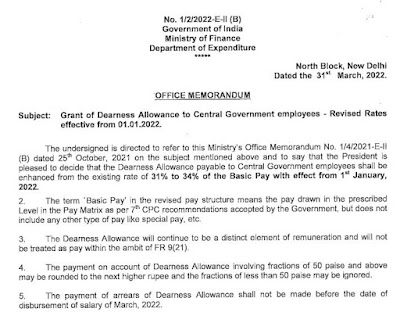
DA Jan 2022 - Grant of Dearness Allowance to Central Government employees - Revised Rates effective from 01.01.2022

 3% DA Hike - Revised Rates effective from 01.01.2022: DoE OM dated 31.03.2022 No. 1/2/2022-E-II (B) Government of India Ministry of Finance...