Tuesday, 3 February 2015

Dearness Relief payable for the period February, 2015 to July 2015

Dearness Relief payable for the period February, 2015 to July 2015 to (a) surviving pre 1.1.1986 retirees of banks (b) surviving spouses of pre 1.1.1986 retirees who are in receipt of Ex-gratia
Indian Banks’ Association
HR & INDUSTRIAL RELATIONS
No.CIR/HR&IR/D/G2/2014-15/1279
31st January 2015
Designated Officers of all Nationalised Banks and Associate Banks of State Bank of India
Dear Sirs,
Dearness Relief payable for the period February, 2015 to July 2015 to (a) surviving pre 1.1.1986 retirees of banks (b) surviving spouses of pre 1.1.1986 retirees who are in receipt of Ex-gratia
As per the directive contained in the Government of India, Ministry of Finance Department of Financial Services (Banking Division) letter F.No.11/2/2012-IR dated 17.12.13, the Dearness Relief payable to surviving pre 1.1.1986 retirees/surviving spouses of pre 1.1.86 retirees of banks for the period February to July 2015 will be as under :
Applicable CPI
Average

Amountof
Ex-gratia
per month
Rate ofAmount of dearness Relief   Dearness Relief
per month
Total Ex-gratia
amount
induding
Dearness Relief
per month
Z %            Z Z
5774 Pre 1.1.86
retirees
Surviving spouses of pre 1.1.86 retirees
350 866.31 3032 3382
175 866.31 1516 1691

yours faithfully,
sd/-
K S Chauhan
Senior vice President
Source: http://www.iba.org.in/Documents/Cir_12790001.pdf

Dearness Allowance for Workmen and Officer Employees in banks for the months of February, March & April 2015

Dearness Allowance for Workmen and Officer Employees in banks for the months of February, March & April 2015.
Indian Banks’ Association
HR & INDUSTRIAL RELATIONS
No.CIR/HR&IR/76/D/2014-15/1277
31st January, 2015
All Members of the Association
(Designated Officers)

Dear Sirs,
Dearness Allowance for Workmen and Officer Employees in banks for the months of February, March & April 2015. under IX BPS/Joint Note dt. 27.4.10

The confirmed All India Average Consumer Price Index Numbers for Industrial Workers (Base 1960=100) for the quarter ended December 2014 are as follows:-

Oct 2014 – 5774.95
Nov 2014 – 5774.95
Dec 2014 – 5774.95

The average CPI of the above is 5774.95. Consequently, dearness allowance to employees is payable for 734 slabs for the period February, March & April 2015 i.e., an increase of 2 slabs over the Current level.
In terms of clause 7 of the 9th Bipartite Settlement dated 27.04.2010 and clause 3 of the Joint Note dated 27.04.2010, the rate of dearness allowance payable to workmen and officer employees for the months of February, March & April 2015 shall be 110.10% of ‘pay’. While arriving at dearness allowance payable, decimals from third place may please be ignored.

We advise banks to pay the difference between the old and revised salary and allowances to officers on an ad hoc basis, pending amendments to Officers’ Service Regulations.

Yours faithfully,
Sd/-
K S Chauhan
Senior Vice President
Source: http://www.iba.org.in/Documents/Cir_12770001.pdf

TAMILNADU CONFEDERATION PROTEST DAY MEETING HELD ON 28.01.2015

TAMILNADU CONFEDERATION PROTEST DAY MEETING HELD ON 28.01.2015

A special meeting of TN Confederation was conducted at the meeting hall of Shastri Bhavan on 28.1.2015 by 01.00 PM.

Protest day was observed condemning the administration of Kalpakkam Atomic Power Plant for unleashing Trade Union victimisation against the office bearers for organising the two days nationwide strike during Feb.12,13.02.2014 announced by Confederation.

A resolution was passed unanimously for immediate withdrawal of disc. action taken against the office bearers of the kalpakkam Atomic Energy Employees’ Assn. and to reinstate the suspended office bearers This was sent to the authorities of the Kalpakkam Atomic Power Plant.

Further, 5th Memorial day was observed on the demise of com. Jayaseelan, the then General Secretary of COC, Shastri Bhavan.Com. J. Ramamurthy, President of the State Unit presided the meeting and delivered presidential address.

Com. S. Samraj, G.S., COC, Shastri Bhavan made reception address. Com. S. Sundaramurthy Treasurer of the State Unit made inagural address. Com. Duraipandian, General Secretary delivered memorial address.
Com. A. Soundararajan, President, State unit of the CITU has made special address on “Hire and Fire” and elaborated the mass retrenchment in Nokia, Hundai, IBM, TCS, deliberated against the privatisation policies of the Modi Sarkar. He made call to organise the working class against the anti labour, anti people policies of the Central Govt.

Com. Elangovan delivered vote of thanks. Hundreds of CG employees attended the meeting in full mass.

Source: Confederation

Dearness Allowance for Bank Employees – Circular issued by IBA

Dearness Allowance for Bank Employees – Circular issued by IBA

IBA issued circulars regarding increasing the Dearness allowance for bank employees from February to April 2015 and Dearness relief for bank pensioners from Feb to July 2015

Click here to download the IBA circular of DA for employees
Click here to download the IBA circular of DR for pensioners.
Click here to download the IBA circular of DR for pre 01.01.1986 retirees

Monday, 2 February 2015

Expected Dearness Allowance: Two More Instalments for the tenure of 6th Pay Commission

Expected Dearness Allowance: Two More Instalments for the tenure of 6th Pay Commission

Expected or Additional Dearness Allowance: Two More Instalments for the tenure of 6th Pay Commission i.e., July 2015 and Jan 2016.
After releasing the CPI(IW) for the month of December 2014, the second instalment of additional Dearness Allowance for the year of 2014 is confirmed to hike by 6%. This calculation effective from 1.1.2015 for the purpose of DA / DR to CG Employees and Pensioners upto June 2014. The total DA and DR will go up to 113%.
After the completion of 2014, two more instalments are balance for the year of 2015. These additional instalments are effective from 1.7.2015 and 1.1.2016. The index of ‘All India Consumer Price Index for Industrial Workers Base Year 2001=100′ upto December 2015 is essential to arrive the additional percentage of dearness allowance for the tenure of Jan to June 2014 and July to Dec 2014.
The 6th Pay Commission recommended the calculation method of additional DA for the period of 2006 to 2015, and from Jan 2016 is expected to begin with the recommendation of 7th Pay Commission.
A table is given for better understand the position of dearness allowance and remaining the additional DA…
Two More Instalments for the tenure of 6th Pay Commission

Source: www.cgstaffnews.in

Merger of DA is just a Distant Mirage

Merger of DA is just a Distant Mirage

Almost all the Federations adopted the resolution in their Meetings and submitted Memorandum to Central Government and 7th pay commission for merger of 50% DA with Basic Pay. The matter has been raised in Parliament several occasions, but until now the central government, whether it is NDA or UPA – not ready to accept this demand. The central Government always responded with a ready-made answer to this query as “since it has not been recommended by sixth CPC, there is no question of considering to merge the DA with pay”.

When the DA was reached 50%, the federations were not having that much hope that merger of 50% DA would be considered by the then Government. But when the DA was at the verge of reaching 100% Level, they started demanding like anything to consider Merger of DA as General Election for Parliament was due at the time. It seemed that the UPA Government was ready to accept this demand to woo the voters, since the Central and State Government Employees and their family members alone comprise considerable Vote bank. But the UPA government failed to fulfill the central government employee’s hope in its tenure.  The only good thing done to the central government servants by the previous government was constitution of 7th Pay Commission well in advance.

The approach of NDA government towards the central government employees clearly shows that the merger of DA with pay is not going to happen anyway. Because the way this demand has been handled by the Government and 7th Pay Commission shows that it will not be an achievable target for central government employees. The central government and 7th pay commission are not ready to accept or not even give in-principle nod for this Merger of DA proposal. So far the organizations and Unions met with the seventh pay commission, not at all gave any positive inputs to cg employees’ community about the 7th pay commission’s views on the proposal of merger of DA. At the end the demand of Merger of DA is now become an unrealistic expectation. So there is no point to expect that this government would consider this demand favorably.

Tags: 50% DA merger, 7th Pay Commission, merger of DA CENTRAL GOVERNMENT EMPLOYEES, DEARNESS ALLOWANCE,CENTRAL GOVERNMENT EMPLOYEES NEWS

Dearness Allowance from January 2015 will be 113%

Dearness Allowance from January 2015 will be 113%

The Expectation is over now, after the Labour Bureau released the AICPIN for the Month of December 2014 on 30th January 2015. From the Month of August 2014, the consumer price Index numbers for Industrial Workers remained same at 253. As we told in the previous post on “expected dearness allowance from January 2015” that if the AICPIN Points remain same for the next consecutive two months there will not be any change in our prediction. According to the formula prescribed for calculating DA for Central government employees, these 12 months AIPCIN points made the rate of Dearness Allowance to reach 113% level. This new rate will be paid to central government employees with effect from 1.1.2015. The Union Cabinet gave its approval for the previous installment of Dearness without any hype on 4th September 2014. So we can expect now this government will announce its decision over increasing rate dearness allowance in the first week of March 2015.

Expected DA from July 2015

So its all over now and here after our focus will be on expected DA from July 2015. The magic number 253, being static for last five months will play a vital role in the calculation of expected DA from July 2015. There is no scope for increase in AICPIN points for next four or five months. If this trend continues for next five months, we cannot expect more hike from this trend. The hike in the rate of Dearness allowance from July 2015 will be restricted with in the limit of 5% to 6%.

Tags: DA from 1st January 2015, Dearness allowance from July 2015, Expected DA from July 2015, CENTRAL GOVERNMENT EMPLOYEES, DEARNESS ALLOWANCE

Prevention of Sexual Harassment of Women at the Workplace – Amendments to CCS(Conduct)Rules 1964

Prevention of Sexual Harassment of Women at the Workplace – Amendments to CCS(Conduct)Rules 1964

G.I., Dep. of Per. & Trg., O.M.No. 11013/2/2014-Estt (A-III), dated 2.2.2015

Subject: Central Civil Services (Conduct) Rules 1964 — Guidelines regarding prevention of sexual harassment of women at the workplace— regarding

Following the promulgation of the Sexual Harassment of Women at Workplace (Prevention, Prohibition and Redressal) Act, 2013 [SHWW(PPR) Act] and notification of the Sexual Harassment of Women at Workplace (Prevention, Prohibition and Redressal) Rules, 2013 [SHWW(PPR) Rules] on 09.12.2013., the Government has recently, on 19.11.2014, notified the amendments to Central Civil Services (Conduct) Rules 1964 and Classification, Control and Appeal Rules, 1965. The amendments and other salient features of the Act/ Rules was brought to the notice of all concerned vide Office Memorandum of even no. dated 27.11.2014. The amendments to the Central Civil Services (Conduct) Rules 1964 and Classification, Control and Appeal Rules, 1965 and the Office Memorandum dated 01.12.2014 are available on the Department’s website.

2. The following guidelines, conveying the decision of the Committee of Secretaries on this subject, were issued vide this Department’s Office Memorandum No. 11013/3/2009-Estt.(A) dated 03.08.2009, “As regards provisions for protection of women, it was suggested that the complaints committee mechanism provided under Vishakha guidelines relating to sexual harassment should be strictly in accordance with the judgment and steps should be taken to ensure that the committee is effective and functional at all times. It would also be desirable for the Committees to meet once a quarter, even if there is no live case, and review preparedness to fulfil all requirements of the Vishakha judgment in the Department/Ministry/ organization concerned.”

3. As per the guidelines issued vide Office Memorandum dated 21.07.2009, it is also to be ensured that the Complaints Committee shall at all times be in existence and changes in its composition, whenever necessary, should be made promptly and adequately publicized. The composition of the Complaints Committee should also be posted on the websites of the concerned Ministries/Departments/Offices concerned.

4. Vide the Office Memorandum dated 01.12.2014, the attention of the Ministries/Departments was also invited to the reporting requirements mentioned in the SHWW(PPR) Act and SHWW(PPR) Rules.

5. All Ministries/ Departments are requested to please review the progress of implementation of the existing above mentioned guidelines issued in the aftermath of the Vishakha judgment.

6. Attention of all Ministries is invited to Section 22 of the Act relating to including information in Annual Report, and to request that information relating to number of cases filed, if any, and their disposal may be included in the Annual Report of the Ministry / Department.

7. All Ministries / Departments are also requested to furnish an annual return (as on 31 stMarch) in the enclosed proforma to this Department by 30th April every year.

Authority : www.persmin.gov.in (DoPT)

Procedure for conduct of supplementary DPC – Dopt issued orders with illustration

Procedure for conduct of supplementary DPC – Dopt issued orders with illustration

G.I., Dep. of Per. & Trg., O.M.No. 22011/2/2014- Estt.D, dated 30.1.2015

Subject:- Procedure for conduct of supplementary DPC

This Department instructions issued vide OM No. 22011/5/86-Estt (D) dated 10.4.89 [para 6.4.2 (i)] provide that vacancies occurring due to death, voluntary retirement, new creations etc. could not be foreseen at the time of placing facts and material before the DPC, therefore, another meeting of DPC (commonly referred to supplementary DPC) should be held for drawing up a panel for these vacancies.

2. References have been received with regard to the zone of consideration, the eligibility list for the supplementary DPC and whether officers who are included in the panel by the original DPC or in the extended panel but could not be promoted as these anticipated vacancies do not actually become available could be appointed against the additional vacancies later becoming available for the same vacancy year.

3. These issues have been examined in consultation with UPSC and following is decided:-
(i) The zone of consideration, in case of holding supplementary DPC, shall be fixed as per the provisions in this Department OM No. 22011/2/2002-Estt(D) dated 6.1.2006 keeping in view total number of vacancies arising in a particular vacancy year i.e. vacancies accounted in Original DPC + additional vacancies becoming available subsequently during the same year.

(ii) The eligibility list for supplementary DPC shall be prepared by removing the names of all such officers who have already been assessed by earlier DPC as fit, unfit or placed in the sealed cover by the original DPC before placing the same for consideration by the supplementary DPC.

(iii) The officers who have already been empanelled or placed in the extended panel but could not be promoted due to these vacancies not actually becoming available; need not be re-assessed by the supplementary DPC as the assessment matrix remains the same. They may be appointed against the additional vacancies of the same vacancy year as per recommendations of the earlier DPC. In such situation the number of vacancies for supplementary DPC shall be accordingly adjusted.
4. While calculating the regular vacancies for a DPC, it is incumbent upon administrative department to ensure that there is no arbitrariness in calculation of anticipated vacancies.

5. To provide clarity in implementation of these instructions some situation specific illustrations are enclosed as Annexure to this OM.

Illustration

Original DPC
No. of vacancies 5
Normal zone 5 x 2 + 4 = 14
Extended zone 5 x 5 = 25

Supplementary DPC
No. of vacancies – 2
Zone of consideration will be decided taking into account total number of vacancies in the vacancy year, i.e. 7 (Vacancies at the time of original DPC + unanticipated vacancies for the same year i.e. 5+2) in this case.
For 7 vacancies, normal zone is 7 x 2 + 4 = 18
Extended Zone 7 x 5 = 35

Situation 1- In the original DPC, first 5 officers are assessed as ‘Fit’ and no officer is assessed for extended panel or assessed as ‘Unfit’ and/or kept in ‘Sealed Cover’
Zone of consideration for Supplementary DPC will now be 13 (Normal Zone of consideration for total number of vacancies for that year — number of officers assessed by earlier DPC i.e 18-5).
As such, in the eligibility list of Supplementary DPC in the above illustration, 13 officers (9 left over officers from the original DPC and 4 additional officers) shall be included.

Situation 2 – In the original DPC, first 5 officers are assessed as ‘Fit’ and next 3 officers are assessed for extended panel and no officer is assessed as ‘Unfit’ and for kept in ‘Sealed Cover’
Zone of consideration for Supplementary DPC will now be 10 (Normal Zone of consideration for total number of vacancies for that year — number of officers assessed by earlier DPC i.e 18-8).
As such, in the eligibility list of Supplementary DPC in the above illustration, 10 officers (6 left over officers from the original DPC and 4 additional officers) shall be included.

Situation 3- In the original DPC, 5 officers are assessed as ‘Fit’, 2 officers are assessed for extended panel and 4 officers are assessed as Unfit’ and/or kept in ‘Sealed Cover’

Zone of consideration for Supplementary DPC will now be 7 (Normal Zone of consideration for total number of vacancies for that year — number of officers assessed by earlier DPC i.e 18-11)
As such, in the eligibility of Supplementary DPC in the above illustration, 7 officers (3 left over officer not assessed in the original DPC and 4 additional officers) shall be included in the normal zone.

Extended Zone in situation 1,2 & 3 above:
Extended zone in the Supplementary DPC, wherever resorted to, may be operated accordingly leaving out the SC/ST officers assessed by the original DPC.

Important- In the Supplementary DPC, (a) Zone of consideration (Normal as well as Extended) shall be decided taking into account total number of vacancies in the relevant vacancy year; and (b) all the officers already assessed in the original DPC are not to be included in the fresh zone of consideration in respect of the S-DPC.

Authority : www.persmin.gov.in (DoPT)

Most of the Employees of Defence, Finance and IT Ministries are not marked their attendance in BAS

Most of the Employees of Defence, Finance and IT Ministries are not marked their attendance in BAS

The Defence Ministry has topped the list of government organisations whose employees have defaulted in marking their attendance through Aadhaar-enabled biometric system.

Most of the employees of 27 departments and organisations affiliated to the Defence Ministry and nine each from Finance, and Information and Broadcasting Ministries have not been marking their attendance through the electronic system introduced by the NDA government.

In light of this, Department of Personnel and Training (DoPT) has, in an order, asked department heads to direct their employees to mark attendance on biometric systems.

A data on employees of 169 central government offices marking and not-marking their attendances has also been issued with the DoPT order.

The data, which has been prepared by the Department of Information and Technology, showed that none out of the 540 employees of DRDO was marking attendance.

The attendance number is zero for Engineer-in-Chief having 746 employees, Additional Directorate General Personnel Services with 150 strength and History Division with a staff strength of 20. All these departments function under the Ministry of Defence.

Of the total of 736 registered employees in DoPT, only 576 were marking their attendances, it said. A total of 2133, 761, 750 employees of Railways, Department of Revenue and Niti Ayog (though the list mentioned office name as Planning Commission) respectively were marking their attendance electronically.

None out of 419 employees registered with the Office of Registrar General and Census Commissioner under Home Ministry and OS Directorate (Army) with 70 registered personnel had marked their attendance through the system, as per the data.

There are 2830, 1080, and 971 registered employees respectively in these departments.

Also, none of the 195 registered employees of National Investigation Agency (NIA) were filing their attendance through the system, it said.

The Department of Electronics and Information Technology, the official record keeper for attendance of all the central government employees, recorded 78 per cent presence of employees on biometric system with 748 out of 958 using this technology.

Similarly, there were many employees in various departments who were defaulting in marking attendance

Read More at : http://economictimes.indiatimes.com/

Flash News

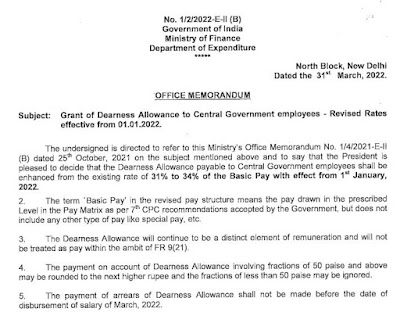
DA Jan 2022 - Grant of Dearness Allowance to Central Government employees - Revised Rates effective from 01.01.2022

 3% DA Hike - Revised Rates effective from 01.01.2022: DoE OM dated 31.03.2022 No. 1/2/2022-E-II (B) Government of India Ministry of Finance...