Friday, 30 May 2014

AICPIN FOR APRIL 2014 – EXPECTED DA JULY 2014 – 4th STEP COMPLETED

AICPIN FOR APRIL 2014 – EXPECTED DA JULY 2014 – 4th STEP COMPLETED

As per the press release of Labour Bureau, All India Consumer Price Index (Industrial workers Base Year 2001=100) for  the month of April, 2014 increased by three points from 239 to 242.

According to the hike of index for the month of April 14, the Expected DA from July 2014 is also increased by two percent from 3 to 5…

The below table is clearly indicate the movement of AICPIN with increasing additional Dearness allowance month wise…

AICPIN for the month of April 2014 begged at 242

Month/
Year
AICPIN (IW)
Base Year
2001=100
Increased/
Decreased
Points in
AICPIN
Total Points
Increased
Total of
12 Months
12 Months
Average
% Increase
over 115.763
Approximate
DA
Total DA % DA% Increase
Month wise
Jan-14 237 -2
2802 233.5 117.74 101.71 101 1
Feb-14 238 1
2817 234.75 118.99 102.79 102 2
Mar-14 239 1
2832 236 120.24 103.86 103 3
Apr-14 242 3 3 2848 237.33 121.57 105.02 105 5
 
Simple Calculator for Central Government Employees…

Each month, the Central Government announces the AICPIN points based on prices and inflation. It is based on these points that the Dearness Allowance is calculated. A new calculator has been created that calculates the Dearness Allowance based on the AICPIN point given by the user. When you type in your anticipated AICPIN point for the following month at the ENTER VALUE field, the calculator will show you the change in Dearness Allowance.
Source: 90pasisa.blogspot.in
[http://90paisa.blogspot.in/2014/05/aicpin-for-april-2014-expected-da-july.html]

Recommendation of Department Related Parliamentary Standing Committee on Compassionate Appointment-Regarding.

Recommendation of Department Related Parliamentary Standing Committee on Compassionate Appointment-Regarding.
Parliament Committee Matter
IMMEDIATE
No.41013/1/2013-Estt(D)
Government of India 
Ministry of Personnel, Public Grievances and Pensions 
(Department of Personnel and Training) 
 
OFFICE MEMORANDUM 
 
Subject:- Recommendation of Department Related Parliamentary Standing Committee on Compassionate Appointment – Regarding. 
 
The undersigned is directed to invite reference to the Department of Personnel and Training Office Memorandum of even number dated 25.03.2013 (copy enclosed) on the above mentioned subject wherein all the Ministries/Departments were requested to furnish an annual report in the enclosed proforma latest by 30th April of every year, indicating the status of implementation of Government instructions on compassionate appointment as on 31st March of that year. Initially separate reports for three years covering the period from 01.04.2010 to 31.03.2011, 01.04.2011 to 31.03.2012 and 01.04.2012 to 31.03.2013 should be sent. Thereafter, an annual report covering the period from 15th April of the preceding year to 31st March of the current years be sent.
 
2. The requisite information from the Ministries/Departments is still awaited. The Ministries/Departments are once again requested to furnish information urgently.
sd/-
(Mukta Goel)
Director(E-I)
 
Source: www.persmin.gov.in
[http://ccis.nic.in/WriteReadData/CircularPortal/D2/D02est/41013_1_2013-Estt-D-.pdf]

Dopt Orders on revision of format for OBC Caste Certificate

Dopt Orders on revision of format for OBC Caste Certificate

Revision of format for OBC Caste Certificate
 
No.36036/2/2013- Estt.(Res.)
Government of India
Ministry of Personnel, Public Grievances & Pensions
Department of Personnel & Training
North Block, New Delhi
Dated: 30th May. 2014
To,
The Chief Secretaries of all the State Governments/Union Territories
 
Subject: Revision of format for OBC Caste Certificate
 
Madam/Sir,
The Government of India had issued instructions on 8th September, 1993 vide DoPT OM. No. 36012/22/93-Estt.(SCT) providing for reservation to Other Backward Classes in the services and posts under the Government of India. The format of the Caste Certificate was prescribed vide Annexure A of the O.M. No. 36012/22/93-Estt.(SCT) dated 15th November 1993. In the said format, the then Ministry of Welfare’s Resolution No. 12011/68/93-BCC(C) dated 10th September 1993 was mentioned, which contained the list of castes and communities treated as OBC’s till that time. Since then, a large number of castes and communities have been added to the Central List of OBCs through various resolutions of the Ministry of Social Jusiice and Empowerment. The details of the resolutions subsequent to the Resolution dated 10th September 1993 do not find mention in the existing format. The said format also prescribes that the certificate issuing authority should certify that the candidate does not belong to the persons/sections (Creamy Layer) mentioned in Column 3 of the Schedule to the aforesaid OM. dated 8.9.1993.

2. Representations have been received in this Department wherein candidates belonging to OBC Communities have reportedly faced difficulty in getting the benefits of reservation. This is because of the fact that in the caste certificate issued by the concerned district authorities, although the name of the caste/community is mentioned in the certificate, the specific resolution by which the said caste/community has been included in the Central List of  OBCs is not indicated.
 
3. Keeping in view such problems faced by the candidates, this issue was examined in consultation with the National Commission for Backward Classes and it has been decided to revise the existing format of OBC Caste Certificate. A copy of the revised format is enclosed(Anuexure). All the certificate issuing authorities are requested to invariably mention the details of the Resolution (Number and Date) by which the castec/community of the candidate has been included in the Central List of OBCs and also to ensure that he/she does not belong to the persons/sections (Creamy Layer) mentioned in Column 3 of the Schedule to the aforesaid O.M. dated 8.9.1993 as amended from time to time.
 
4. I am to request that the revised format of the Certificate may please be brought to the notice of authorities under the State Governments/Union Territories who are empowered to issue the Caste Certificate.
 
Yours faithfully,
sd/-
(Sandeep Mukherjee)
Under Secretary to the Government of India
Annexure
 
FORM OF CERTIFICATE TO BE PRODUCED BY OTHER BACKWARD CLASSES 
APPLYING FOR APPOINTMENT TO POSTS UNDER THE GOVERNMENT OF INDIA
 
This is to certify that Shri/Smt./Kurnari_______________son/daughter of _______________________of village/town in District/Division __________________________in the State/Union Territory____________________belongs to the __________________community which is recognised as a backward class under the Government of India, Ministry of Social Justice and Empowerment’s Resolution No. _________________dated____________________*. Shri/Smt./Kumari ____ ______________ and/or his/her family ordinarily reside(s) in the ____________________________ District/Division of the__________________________ State/Union Territory. This is also to certify that he/she does not belong to the persons/sections (Creamy Layer) mentioned in Column 3 of the Schedule to the Government of India, Department of Personnel & Training O.M. No. 36012/22/93 – Estt.(SCT)dated 8.9.1993.**
 
District Magistrate
Deputy Commissioner etc.
Dated:
Seal
 
* – The authority issuing the certificate may have to mention the details of Resolution of
 Government of India, in which the caste of the candidate is mentioned as OBC.
** – As amended from time to time.
 
Note:- The term “Ordinarily” used here will have the same meaning as in Section 20 of the Representation of the People Act, 1950.
 
Source: www.persmin.gov.in
[http://ccis.nic.in/WriteReadData/CircularPortal/D2/D02adm/36036_2_2013-Estt-Res_30052014.pdf]

NFIR writes to 7th CPC to send Interim Report to the Government along with the aspect of merger of dearness allowance with basic pay…

NFIR writes to 7th CPC to send Interim Report to the Government along with the aspect of merger of dearness allowance with basic pay…
Preliminary inter-action meeting between 7th CPC & NFIR — reg.
NFIR
National Federation of Indian Railwaymen
3, Chelmsford Road, New Delhi-110 055
Affiliated to :
IndIan National Trade Union Congress (INTUC)
International Transport Workers’ Federation (ITF)
No.IV/NFIR/7th CPC/2013/Pt.Ii
Dated: 29-05-2014
The Chairman,
Seventh Central Pay Commission,
New Delhi
Respected Sir,
Sub: Preliminary inter-action meeting between 7th CPC & NFIR — reg.
Ref: Seventh CPC’s D.O. No.7CPC/22/Meeting dated 12th May, 2014.
We express our sincere gratitude to the 7th CPC for extending invitation to the NFIR to take part in the inter-action meeting. As this being the first meeting of preliminary inter-action nature. NFIR submits certain facts briefly for appreciation. The Federation would, however submit detailed memorandum separately on various issues as well as the proposed pay structure for Railwaymen/ Women and the need for upward revision of various allowances, incentive etc.
NATIONAL FEDERATION OF INDIAN RAILWAYMEN (N.F.I.R.)
NFIR is one of the major Federations in the railways functioning for the cause of rail workforce (serving & retired) and equally for the growth of Nation as well Railways since the last over six decades.
NFIR is one of the major constituents of the Joint Consultative Machinery (JCM). M. Raghavaiah, General Sccrctary/NFIR, is also the Leader of Staff Side/JCM.
INDIAN RAILWAYS
Indian Railways is a unique and complex transportation system under the control of Central Government, serving the needs of people since the last more than 160 years. Indian Railways handle over 19,000 regular trains (Freight & Passenger) per day besides about 3000 special trains a day during various seasons. Its route kilometerage is 65,187.
During the year 2012-13, Indian Railways moved more than 1010 Metric Tonnes of freight traffic and joined as fourth member of the select Billion Tonne Club of USA, China and Russia. The operating ratio has been around 90% barring the 3 years period between 2005-06 & 2008. The Indian Railways incur losses as a result of fulfilling the social service obligations. The approximate loss on this account is around Rupees Twenty Thousand Crores per annum.
RAILWAY EMPLOYEES’ ROLE:
The railway employees perform duties for ensuring uninterrupted flow of services. They Work at over 7000 railway stations. Most work places do not have access to facilities and basic amenities for their living. The employees are compelled to work under the open sky and inclement weather conditions. They face hazards associated with the job environment, remoteness. inhospitable terrain etc.,
Although, railway employees are part of Central Government Employees, their nature of work, duties and responsibilities are uncommon and not comparable with any other system/industry. The staff who maintain railway tracks, rolling stock, signal/telecom network, train operations, trains planning, punctuality, safety are skillful and devoted to the system but however, these factors have not been given due weighage by successive Pay Commissions. The running staff i.e. Loco Pilots, Asst. Loco Pilots, Guards. operating staff, station masters, controllers etc.. perform their jobs facing many odds. They are expected lo perform duties even beyond the prescribed duty hours.
We may incidentally cite para 2.3 of the report of the Chairman, High Level Safety Review Committee headed by Dr.Anil Kakodkar submitted to the Railway Ministry. According tlo the said report the number of railway employees killed in the course of performing duties has been higher as can be seen from the following figures (period 2007—08 to 2011)

Killed Injured
(a) Railwaymen 1,600 8,700
(b) Passenger/Public 1,019 2,110
(c) Unmanned Level Crossing 723 690
The nature of work, duties, responsibilities of railway staff justify grant of better pay structtire and other benefits treating the Railway Workforce as unique and not comparable with other Central Government employees. We shall explain the facts through our memorandum for consideration of Hon’ble 7th CPC.
NFIR‘s MEMORANDAM AND EVIDENCE:
As the NFIR is one of the major constituents of the JCM, our memorandum will be drafted and finalized after the submission of memorandum by JCM (Staff Side). In view of this, we request that we may be given time to submit our memorandum by 31st July, 20l4.
As the Hon’ble Pay Commission is aware that 1.3 million staff belonging to hundreds of caegories are working in the railways, we request that the Federation be given more slots in phases to facilitate us to explain the case of every important category cogently.
SATISFACTION LEVEL OF 6th CPC REPORT:
We may submit that the 6th  report, more particularly the concept of Grade Pay and Pay Band had generated many anomalies. This led to dis-satisfaction among different categories of railway employees. These anomalies are yet to be rectified by the Government. The proposals of Railway Ministry on 6th CPC issues are pending with Finance Ministry. MACPS aberrations have also been very large in number. Our efforts at the level of Railway Ministry as well Ministry of Personnel/MoF have not yielded positive result.
We hope that the Seventh Central Pay Commission would look into these issues in a realistic manner for mitigating the injustice caused to staff.
DEARNESS ALLOWANCE — IT’s MERGER WITH PAY:
Honhle Pay Commission may kindly appreciate that the Dearness Allowance (D.A.) has become 100% of pay w.e.f. 01/01/2014. This scenario was never anticipated by the 6th CPC. It may however be appreciated that in the past, the Government had merged DA with pay when it crossed 50% (In the year 2004). We are expecting 6% DA w.e.f. July 1, 2014, thus the DA% would be 106% of pay in July, 2014.
We therefore, request the Hon’ble Pay Commission to kindly consider this aspect for sending interim report to the Government recommending merger.
CONCLUDING:
NFIR assures its co-operation to the Pay Commission by way providing facts and material & equally hopes that this Pay Commission would render justice to the Railway employees.
Yours faithfully,
sd/-
(M.Raghavaiah)
General Secretary/NFIR
Forwarded to the Affiliated Unions of NFIR. lt was explained very effectively the uniqueness and uncommon working of the rail work force justifying different pay package. Speciai thrust was DA merger. The response has been positive.

Source: NFIR

NFIR writes to Finance Minister to merge 50% of Dearness allowance with basic pay – 28.05.2014

NFIR writes to Finance Minister to merge 50% of Dearness allowance with basic pay – 28.05.2014

On 28th May 2014, NFIR General Secretary writes to new Finance Minister Shri. Arun Jaitley to consider the huge anticipated demand of merging dearness allowance with basic pay for Central Government employees and Pensioners…
 
The letter is reproduced and given below for your ready reference… 
 
NFIR
National Federation of Indian Railwaymen
3, Chelmsford Road, New Delhi-110 055
Affiliated to :
IndIan National Trade Union Congress (INTUC)
International Transport Workers’ Federation (ITF)
No.1/5(A)/Pt.I
Dated: 28/05/2014
Sh. Arun Jaitley
Hon’ble Minister for Finance,
Government of India,
North Block
New Delhi
 
Dear Sir,
 
Sub: Merger of Dearness Allowance with Pay-reg.
 
While enclosing copy of Federation’s letter No. 1/5(A) dated 27/09/2013, NFIR desires to bring to your kind notice, the following facts for consideration.
 
2. In the Standing Committee meeting held under the chairmanship of the Secretary DoP&T, on 7th May 2014, the agenda item pertaining to merger of D.A. with pay was discussed by the JCM/Staff Side representatives. There has, however, been no positive response from the Official Side on the issue probably the VII CPC has started working on the terms of reference.
 
3. Now that the D.A. has become 100% of pay w.e.f. 01/01/2014 and another instalment of D.A. @ 6% of pay is likely to be granted by the Government w.e.f. 01/07/2014 as per the figures of Consumer Price Index, continuing D.A., without merger, is highly unjustified. In the past i.e. during the year 2004, the Government of India had merged 50% DA with pay for all purposes. Similar decision has, unfortunately, not been taken by the previous Government.
 
4. Seventh Central Pay Commission has already sent communications to JCM constituent organisations etc.. to submit Memorandums. At this juncture, it would be proper to convey to the Chairman, 7th CPC to consider the JCM (Staff Side) demand for merger of DA with pay with retrospective effect and send interim report to the Government for consideration.
 
NFIR, therefore, requests you to kindly consider our request and see that the Government makes reference to 7th CPC to consider DA merger with pay and to send its interim report to the Government for favourable consideration.
Thanking you.
Yours faithfully,
sd/-
(M.Raghavaiah)
General Secretary
Source: NFIR

Thursday, 29 May 2014

Feedback of AIRF’s Preliminary Meeting held with the 7th CPC - AIRF

Feedback of AIRF’s Preliminary Meeting held with the 7th CPC - AIRF
 
ALL INDIA RAILWAYMEN’S FEDERATION
(Estd, 1924)
4,State Entry Road,
New Delhi – 110055
INDIA
No.AIRF/405(VII CPC)
Dated: May 28, 2014
The Secretaries,
All Affiliated Unions,
Dear Coms.,
 
Sub: Feedback of AIRF’s Preliminary Meeting held with the VII CPC 
 
On the invitation of the Seventh Central Pay Commission for having Preliminary Interaction with All India Railwaymen’s Federation(AIRF), a delegation of the AIRF, comprising of Com. Shiva Gopal Mishra, General Secretary AIRF, Com. Rakhal Das Gupta, Working President AIRF, Com. Ch. Sankara Rao, Asstt. General Secretary AIRF and Com. J.R. Bhosale, Treasurer AIRF, met today, i.e. 28th May, 2014, the Seventh Central Pay Commission(Hon’ble Justice Shri Ashok Kumar Mathur, Chairman, Shri Vivek Rae, Member, Dr. Rathin Roy, Member and Ms Meena Agarwal, Secretary, Seventh Central Pay Commission) in Hotel Janpath(Camp Office of the VII CPC), New Delhi.
The following points were raised by the AIRF before the VII CPC:-  

(i) Extension and improvement in Railway Services 
(ii) Safety & Training 
(iii) Wages, Dearness Allowance and Other Allowances 
(iv) Living Wage 
(v) Interim Relief 
(vi) Merger of Dearness Allowance 
 
It was asserted by the AIRF that the Railwaymen are Industrial Workers and are governed by the Industrial Disputes Act, Factories Act and Hours of Employment Regulations etc.
 
It was stressed by the AIRF that, out of 7,000 railway stations, over 6,000 are road side stations where staff are bereft of all civic facilities like housing, electricity, drinking water, sanitation, medical facilities etc., and the education of their children suffers.
 
Indian Railways run 19,000 trains daily and additional train services are being introduced without developing
infrastructure and adding manpower, rather manpower is being reduced day-by-day. In spite of all impediments, there has been tremendous improvement in carrying goods traffic and passenger services.
 
AIRF further stressed that, the Railwaymen are working round-the-clock in all weathers and arduous conditions, even sacrificing their lives to keep the lifeline of the nation(Indian Railways) in operation. On the one hand it used to be said that we(the Railwaymen), are the second line of defence, on the other, when the issue of Wage Structure and Allowances comes, the Railwaymen always get raw-deal, saying, they are “Common Categories”. Quoting examples of the Running Staff, Technician, Technical Supervisor, Operating & Commercial Staff, AIRF asked, where we are common? The VII CPC agreed that they would definitely look into these aspects while deciding wages and allowances of the Railwaymen.
 
It was impressed upon to the Seventh Central Pay Commission that AIRF would lead broad categories/ departments’ representation to VII CPC during oral evidence.
 
It was also stressed that the Seventh Central Pay Commission should consider the matter of granting Interim Relief as well as merger of Dearness Allowance with the Pay.
 
The Members of the Pay Commission, mainly the Chairman himself, interacted with AIRF’s representatives. The Pay Commission gave patient hearing and assured that they could understand the complexity and gravity of the Railway Industry, devotion and dutifulness of the Railwaymen and would try to administer justice to the Railwaymen by way of their recommendations.
 
Thereafter, representatives of the Staff Side, National Council (JCM), lead by Com. Shiva Gopal Mishra, Secretary, Staff Side, National Council(JCM), along with Com. Rakhal Das Gupta, Com. Ch. Sankara Rao and Com. J.R. Bhosale, Members, Standing Committee, NC/JCM/AIRF, held discussions with the VII CPC.
 
The issues of Fixation of Wages, allowances and the matters of Anomalies of VI CPC, Scrapping of New Pension Scheme, Promotional Policy, General Grade Structure along with the demands of Interim Relief and Merger of Dearness Allowance with the Pay were raised by the Staff Side, NC/JCM. Apart from AIRF representatives, in the delegation, Coms. M. Raghavaiah, Guman Singh, S.N. Pathak, S.K. Vyas, Sri Kumar, K.K.N. Kutty and B.C. Sharma were also present on the occasion.
 
The Chairman, VII CPC, on persistent demand of the Staff Side, NC/JCM, suggested that the Staff Side can submit separate Memorandum on Interim Relief and Merger of Dearness Allowance, so that VII CPC can seek necessary advice from the Government, as to how to deal with these issues since there has been no specific reference in the matter from the Government to VII CPC on these subjects.
 
It was decided that detailed memorandum on behalf of Staff Side, National Council(JCM) should be submitted by 30th June 2014, and all the departments, like Railways and others should submit their memorandum by 15th July, 2014.
 
This is for your information and giving wide circulation amongst all sections of the Railwaymen.
Comradely yours,
sd/-
(Shiva Gopal Mishra)
Source: AIRF

AIRF – Preliminary submission to the 7th Pay Commission

AIRF – Preliminary submission to the 7th Pay Commission

Preliminary submission to the VII CPC 
 
ALL INDIA RAILWAYMEN’S FEDERATION
(Estd, 1924)
4,State Entry Road,
New Delhi – 110055
INDIA 
No.AIRF/405(VII CPC)
Dated: May 28, 2014
Justice Shri Ashok Kumar Mathur,
Chairman,
Seventh Central Pay Commission,
New Delhi
 
 
Dear Sir
 
Sub: Preliminary submission to the VII CPC 
 
I, on behalf of 13 lakh Railwaymen, welcome you and the Members of the VII CPC, would like to submit the following as a preliminary step towards our approach and expectations from the VII CPC.
 
All India Railwaymen’s Federation(AIRF) was established in the year 1924, and the leadership of this federation was heralded by the eminent personalities like Shri V.V. Giri, who was one of the founder members of the AIRF and was the General Secretary of the AIRF for long 10 years from 1927-37. Lok Nayak Jayaprakash Narayan was the President of this federation from 1947-57. Last President of the AIRF was Shri Umraomal Purohit, from 1980 to till his death in February 2014. He was also Secretary, Staff Side, National Council(JCM) since 1977.
 
All India Railwaymen’s Federation(AIRF) participated in the Independent struggle. It also saved Railway Industry from economic depression of 1930 and faced other challenging tasks at different times.
Railwaymen are the second line of defence, and during 1962 Chinese aggression, 1965 Pakistan War and 1999 Kargil War etc., Railwaymen stood firm in the duty post and carried out army and the necessary equipments to war front.
 
During natural calamities, like floods, earthquake etc., the Railwaymen transport necessary helps to the victims, and in far-flung areas in the country for conducting smooth elections. The Railwaymen run thousands of Special Trains, and during the 16th Lok Sabha elections, Indian Railways run 5,000 Special Trains in addition to split coaches for ferrying security personnel and election materials.
 
The Railways is a common man’s transport, cheaper than other modes of transport as also eco-friendly. The Indian Railways is the symbol of national integrity.
 
 
EXTENSION AND IMPROVEMENT IN RAILWAY SERVICES 
The Railways generate resources, internally also to a substantial quantity. The Railways is having 16 Railway Zones, 06 Production Units and Metro Rail, Kolkata(a new Railway Zone).
 
 
INDIAN RAILWAYS 
Comparative Statement of improvement in productivity of the Railwaymen is as under:-
 

2005-6 2012-13 Variation
Net Ton Kilometer (Million) 441762 641849 + 45.29
Passenger Kilometer (Million) 615634 1098103 + 78.37
Staff Strength (In Thousands) 1412.4 1287.3 (-) 8.86%


Traffic Unit for 1000 employees*, which is an indicator of improvement is as follows:-

2000-2001 2011-12
535 1408
 
*Traffic Unit represents Passenger Kilometer and NTKM
Indian Railways working is of belt system. It is not an individual’s performance, but collective efforts of all sections of the Railwaymen, which represents improvement in the performance.
 
 
SAFETY 
Safety gets paramount importance in the working of the Indian Railways. Unfortunately, new trains are being
introduced as per the demands, but without increasing line capacity, rolling stock and manpower. Rather manpower is decreasing violating the provision of the Hours of Employment. A committee in respect of Working Hours etc. of the Railwaymen was appointed by the Ministry of Railways, which had submitted its report to the Railway Board in August 2013, but unfortunately, no decision has yet been taken on the report of the said committee despite repeated representations. National average for training is 2% of the total expenditure, but the Railways spent only 0.50%.
 
Railwaymen are the Industrial Workers and govern under the Industrial Disputes Act and Hours of Employment & Regulations, framed under the Railway Act and Factory Act.
 
There are more than 7,000 railway stations, of them over 6,000 are road side stations. Large-number of stations are in the forest and terrorist infested areas. Staff working at the roadside stations are bereft of housing, potable water, sanitation, medical aid, and children education is a far cry.
 
Railwaymen work round the clock, and they have to remain vigilant all the 24 hours in 365 days. A committee was appointed on the Safety of the Railways under the chairmanship of Dr. Anil Kakodkar. Para 2.3 of the said report is cited below:-
 

Killed Injured
Railwaymen 1,600 8,700
Passenger/Public 1,019 2,118
(Unmanned Level Crossing) 723 690
 
 
WAGES, DEARNESS ALLOWANCE AND OTHER ALLOWANCES 
The wages of the Railwaymen are low in comparison to the workers of the PSUs. This has been constantly agitating the minds of the Railwaymen.
 
1st to 7th CPC appointed only after the series of agitations, submission of Charter of Demands or after the Strike Notice.
 
AIRF had to launch country-wide strike against anti-labour report of the 2nd CPC in the year 1960 and against the report of the 3rd CPC(20-day long 1974 strike).
 
LIVING WAGE was propagated by the 1st CPC as back as 1946-47. It has been embodied in the Article 43 of the Constitution of our country, wherein directive principles have been enshrined. Unfortunately, the same is yet to be achieved after 66 years of the Independence and 62 years of adoption of the Constitution.
The 4th CPC in para 7.32 of its report at page 85 had recommended periodical revision/review of wages through bilateral negotiations.
 
Railwaymen need separate consideration in respect of wages, allowance and other benefits. This matter was
agitated before the VI CPC also, and the VI CPC in para 7.36.100 of its report had observed as follows:-
“Various Railway Federations have demanded a special dispensation for Railway employees keeping in view the profitability of their organization. The demand is not without substance especially as employees have to be rewarded for efficient performance of the entire organization that has yielded continuous profits without resorting to any substantial increase in the passenger/freight fares in the recent years. A separate dispensation in terms of pay scales and allowances is not, however, possible, as long as the organization continues to be a Ministry in the Central Government because it will then need to be governed by the common pay scales and allowances for the entire Central Government. In such a scenario, the optimal solution would be corporatization of Indian Railways as a Public Sector Enterprise. This would allow the Railways flexibility in determining its own compensation package”.
 
The Staff Side, National Council(JCM) Standing Committee, had a discussion with the Government on Terms of Reference of the VII CPC on 24.10.2013 and requested to have another round of discussions in the matter, but unfortunately the government issued the said ToR unilaterally, which was protested by the Staff Side, NC/JCM. A meeting of the Standing Committee of NC/JCM was also held on 07.05.2014, wherein the issue of Interim Relief and merger of Dearness Allowance were again raised.
 
It may be mentioned here that, Interim Relief was recommended by the 3rd CPC, and the 4th CPC had recommended two Interim Relief. Before appointment of the V CPC, discussions were held on different dates in September 1993 with the Cabinet Secretary, when an Interim Relief of Rs.100 p.m. to Group `C’ and `D’ employees was sanctioned prior to appointment of V CPC and subsequently V CPC had recommended two Interim Relief. Interim Relief requires to bridge the gap of erosion in the real wage during interregnum period.
 
 
MERGER OF DEARNESS ALLOWANCE 
25% Dearness Allowance was merged in the Pay after series of negotiation with the Cabinet Secretary in September 1993.
The V CPC in its report had also recommended merger of Dearness Allowance when it crosses 50%, and the same was done.
It is necessary to point out here that the inflation trend prevailing during 01.01.1996 to 31.12.2005 and from 01.01.2006 to 01.01.2004 inflation was 74%, whereas from 01.01.2006 to 01.01.2011, it was 51%, and further raised to 100% on 01.01.2014.
 
Yours faithfully,
sd/-
(Shiva Gopal Mishra)
General Secretary
Source : AIRF

QUALIFYING SERVICE FOR PROMOTION

QUALIFYING SERVICE FOR PROMOTION

Eligibility for promotion : – It is necessary to fix suitable standards for promotion from one grade to another, including minimum length of service in the lower grade. As far as possible, the minimum length of service in the lower grade prescribed as a condition for promotion to the higher grade should not markedly be different from that prescribed by other Departments for promotion to similar grades involving the same nature of duties and responsibilities.
 
The qualifying service for promotion from one grade to another is necessary so that there is no premature promotion or undue jump in pay and also to ensure that the officer has sufficient opportunity to demonstrate his competence/potential for holding the higher post. The period of qualifying service varies from post to post depending upon the scale of pay and the experience, required for manning the higher post. Broadly, the following qualifying service for promotion from one grade to another may be followed:
 
Field of Promotion
 
From Grade Pay 
 (in Rs.)
To Grade Pay
 (in Rs.)
Qualifying Service 
(in years)
1800 1900 3 Years
1900 2000 3 Years
1900 2400 8 Years
2000 2400 5 Years
2400 2800 5 Years
2400 4200 10 Years
2800 4200 6 Years
4200 4600 5 Years
4200 4800 6 Years
4200 5400 8 Years
4200 6600 10 Years
4600 4800 2 Years
4600 5400 3 Years
4600 6600 7 Years
4800 5400 2 Years
4800 6600 6 Years
5400 6600 5 Years
6600 7600 5 Years
6600 8700 10 Years
7600 8700 5 Years
7600 8900 6 Years
8700 8900 2 Years
8700 10000 3 Years
8900 10000 2 Years
10000 HAG 3 Years
HAG HAG+Scale 1 Year
HAG Apex scale 2 Years
HAG+Scale Apex scale 1 Year

Source: 90paisa.blogspot.in
[http://90paisa.blogspot.in/2014/05/qualifying-service-for-promotion.html]

Enhancement of monetary ceiling for issue of sanction of medical claims – Confederation

Enhancement of monetary ceiling for issue of sanction of medical claims – Confederation
CONFEDERATION OF CENTRAL GOVT. EMPLOYEES & WORKERS 
1st Floor, North Avenue PO Building, New Delhi -110001 
Website: www.confederationhq.blogspot.com 
Email: confederationhq@gmaiI.com
Ref: CONFD/GENL/2014
Dated : 28-05-2014
To
The Secretary
Ministry of Finance
Department of Expenditure
North Block, New Delhi
 
Sir,
 
Sub: Enhancement of monetary ceiling for issue of sanction of medical claims.
 
At present the monetary ceiling for sanctioning medical claims is restricted to Rs.2 lakhs for Head of the Department. The Internal finance division is delegated for the sanction of medical claims above two lakhs to five lakhs. Now a days the medical  treatment has become too costly. The claims above two lakhs are increasing and accumulating at Internal finance division of the various Departments/Ministries.
 
Hence, it is requested to enhance the monetary limit for sanction of medical claims as per the prescribed list to five lakhs from the present two lakhs to the Head of the Department.
A line in reply is highly appreciated.
Yours faithfully,
sd/-
(M.Krishnan)
Secretary General
Source: http://confederationhq.blogspot.in/

LAST DATE FOR SUBMISSION OF MEMORANDUM TO 7TH CPC EXTENDED

LAST DATE FOR SUBMISSION OF MEMORANDUM TO 7TH CPC EXTENDED

As per the request of the JCM National Council Staff side, 7th Central Pay Commission has granted extension of time upto 15.07.2014 (15th July 2014) for submission of memorandum by individual organizations other than JCM staff side. The following is the revised time schedule (Last date).

1.  JCM National Council Staff side                :  30.06.2014
2.  All other Federations/Unions/Associations  :  15.07.2014

JCM National Council Staff side will be submitting a common memorandum before 30.06.2014 on the common demands of the Central Government Employees. The Copy of the JCM Staff side memorandum will be placed in the website.

All affiliated organizations of the Confederation are requested to prepare their sectional memorandum well in advance and be ready to submit it before 15.07.2014 to the 7th CPC. New Pay scales demanded by the JCM Staff side will be available in the common memorandum of the JCM Staff side.

Confederation National Secretariat meeting will be held on 31.05.2014 at ITEF Head Quarters (Rajouri Garden) at 2 PM as already notified to finalise the common memorandum. (Please note the time change from 11 AM to 2 PM). All National Secretariat members are requested to attend the meeting.
(M. Krishnan)
Secretary General
Confederation
Source: http://confederationhq.blogspot.in/

Flash News

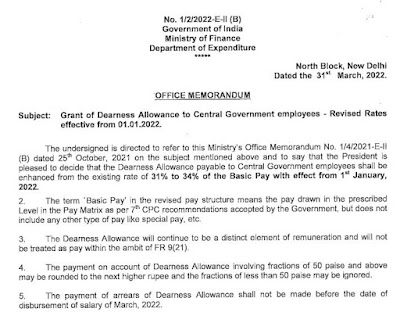
DA Jan 2022 - Grant of Dearness Allowance to Central Government employees - Revised Rates effective from 01.01.2022

 3% DA Hike - Revised Rates effective from 01.01.2022: DoE OM dated 31.03.2022 No. 1/2/2022-E-II (B) Government of India Ministry of Finance...