Friday, 6 April 2018

Current Pension rate of Contributory Provident Fund (CPF) Pensioners


Current Pension rate of Contributory Provident Fund (CPF) Pensioners

Ministry of Finance
Current Pension rate of Contributory Provident Fund (CPF) pensioners

The Central Government employees who are covered by CPF Rules (India) 1962 and who retired on or after 01.01.1986 are not entitled to any monthly pension/ex-gratia amount. However, the Government employees under CPF who retired between 18.11.1960 and 31.12.1985 are entitled to monthly ex-gratia amount of the following rates:

S.
No
Group of Service to which CPF retirees belonged at the time of retirementEnhanced amount of basic monthly ex-gratia
1Group A ServiceRs. 3,000/-
2Group B ServiceRs. 1,000/-
3Group C ServiceRs. 750/-
4Group D ServiceRs. 650/-
5Widows and dependent children of the deceased CPF beneficiaryRs. 645/-

Dearness ex-gratia equal to 50% of the amount of ex-gratia and Dearness Relief, as notified from time to time as per 5th Central Pay Commission series, on the sums of amount of ex-gratia and dearness ex- gratia is being paid to them. There is no proposal to increase the aforesaid rates.
This was stated by Shri Shiv Pratap Shukla, Minister of State for Finance in a written reply to a question in Lok Sabha today.

PIB

Representation of OBCs in the Central Government Services


Representation of OBCs in the Central Government Services

Press Information Bureau
Government of India
Ministry of Personnel, Public Grievances & Pensions
04-April-2018

Strength of Employees

As per information received from 77 Ministries/Departments including their attached/subordinate offices, the representation of SCs, STs and OBCs in the posts and services under the Central Government as on 01.01.2016 is 17.49%, 8.47% and 21.57% respectively.

Representation of OBCs in the Central Government services is less as compared to the percentage of reservation for them because reservation of OBC started in September, 1993.

As per available information, representation of OBCs as on 01.01.2012 was 16.55% which has now increased to 21.57% as on 01.01.2016. Therefore, there is an increasing trend in the representation of OBCs in the posts and services of Central Government.
Department of Personnel & Training has issued instructions to all Ministries/Departments to constitute an in-house Committee to identify backlog reserved vacancies, study of the root cause of backlog reserved vacancies, initiation of measures to remove such factors and to fill up such vacancies through Special Recruitment Drive.

This information was provided by the Union Minister of State (Independent Charge) Development of North-Eastern Region (DoNER), MoS PMO, Personnel, Public Grievances & Pensions, Atomic Energy and Space, Dr Jitendra Singh in written reply to a question in Lok Sabha today.

Schemes for welfare of Women and Children


Press Information Bureau
Government of India
Ministry of Women and Child Development

Schemes for welfare of Women and Children
05 APR 2018

Ministry of Women and Child Development (MWCD) implements several schemes supporting for the welfare of the women and children including SC/ST and minority of different age groups.

SwadharGreh Scheme
MWCD implements SwadharGreh Scheme which targets the women victims of unfortunate circumstances who are in need of institutional support for rehabilitation so that they could lead their life with dignity. The Scheme envisages providing shelter, food, clothing and health as well as economic and social security for the women victims of difficult circumstances which includes widows, destitute women and aged women. The total women benefitted under SwadharGreh scheme during 2016-17 is 16,530 and during 2017-18 is 17,291.

Ujjawala Scheme
Ujjawala Scheme is being implemented for Prevention of trafficking and for Rescue, Rehabilitation, Re-integration and Repatriation of victims of trafficking for commercial sexual exploitation. The number of beneficiaries under the scheme in the year 2017-18 and 2016-17 each is 6,175.

'Support to Training and Employment Programme for Women (STEP) Scheme'
The Ministry is administering 'Support to Training and Employment Programme for Women (STEP) Scheme' to provide skills that give employability to women and to provide competencies and skill that enable women to become self-employed/entrepreneurs. The Scheme is intended to benefit women who are in the age group of 16 years and above across the country.

National Nutrition Mission (NNM)
Government of India has approved for setting up of National Nutrition Mission (NNM) on 30.11.2017, which aims to achieve improvement in nutritional status of Children, pregnant women and lactating mothers and reduce anemia among children and women. It strives to reduce the level of stunting, under-nutrition, anemia and low birth weight babies. It will create synergy, ensure better monitoring, issue alerts for timely action, and encourage States/UTs to perform, guide and supervise the line Ministries and the States/ UTs to achieve the targeted goals.
Scheme for Adolescent Girls
The Government on 16.11.2017 approved continuation of the Scheme for Adolescent Girls for out of school adolescent girls of age 11-14 years for a period of one year i.e. up to 30.11.2018. The scheme aims at providing supplementary nutrition containing 600 calories, 18-20 grams of protein and micronutrients per beneficiary per day for 300 days in a year, motivating out of school girls to go back to formal schooling or skill training under non-nutrition component of the scheme. The cost norms for nutrition have also been revised from existing rates of Rs.5.00 per beneficiary per day to Rs.9.5 per beneficiary per day. Government has also approved phased expansion and universalisation of the Scheme for Adolescent Girls i.e. in additional 303 districts in 2017-18 and the remaining districts in 2018-19 with the simultaneous phasing out of Kishori Shakti Yojana. The scheme has been extended to all the districts of the country w.e.f. 01.04.2018.

Integrated Child Development Scheme (ICDS)
Further, under the Integrated Child Development Scheme (ICDS), 1,82,68,917 pregnant women and lactating mothers got benefit during the year 2016-17 and 1,63,10,379 during the year 2017-18 (as on 31.12.2017). Also, the number of Children (6 Months-6 years of age) including girl child who got benefit under ICDS Scheme during the year 2017-18 (as on 31.12.2017) is 6,81,38,809.

One Stop Centre (OSC)
One Stop Centre (OSC) scheme is being implemented by the Ministry to support women affected by violence w.e.f. 1st April, 2015, which aims to facilitate access to an integrated range of services including medical aid, police assistance, legal aid/case management, psychosocial counseling and temporary support services. At present, 170 OSCs are functional in various districts in 32 States. 97,961 cases have been registered as on 07.02.2018.

Universalisation of Women Helpline
The Ministry also implements the scheme of Universalisation of Women Helpline through States/UTs Government since 1st April, 2015 to provide 24-hour emergency and non-emergency response to women affected by violence. Women Helplines are functional in 28 States. As on date, a total of 12,14,763 complaints have been addressed from the Women Helplines.

This information was given by Union Minister for Women and Child Development, SmtManeka Sanjay Gandhi in reply to a question in Rajya Sabha today.

Source : PIB

New Income Tax Forms for AY 2018-19 - CBDT Notification


New Income Tax Forms for AY 2018-19 - CBDT Notification

Ministry of Finance
CBDT notifies Income Tax Return Forms for Assessment Year 2018-19

The Central Board of Direct Taxes(CBDT) has notified Income Tax Return Forms (ITR Forms) for the Assessment Year 2018-19. For Assessment Year 2017-18, a one page simplified ITR Form-1(Sahaj) was notified. This initiative benefited around 3 crore taxpayers, who have filed their return in this simplified Form. For Assessment Year 2018-19 also, a one page simplified ITR Form-1(Sahaj) has been notified. This ITR Form-1 (Sahaj) can be filed by an individual who is resident other than not ordinarily resident, having income upto Rs.50 lakh and who is receiving income from salary, one house property / other income (interest etc.). Further, the parts relating to salary and house property have been rationalised and furnishing of basic details of salary (as available in Form 16) and income from house property have been mandated.

ITR Form-2 has also been rationalised by providing that Individuals and HUFs having income under any head other than business or profession shall be eligible to file ITR Form-2. The Individuals and HUFs having income under the head business or profession shall file either ITR Form-3 or ITR Form-4 (in presumptive income cases).

In case of non-residents, the requirement of furnishing details of any one foreign Bank Account has been provided for the purpose of credit of refund. Further, the requirement of furnishing details of cash deposit made during a specified period as provided in ITR Form for the Assessment Year 2017-18 has been done away with from Assessment Year 2018-19.

There is no change in the manner of filing of ITR Forms as compared to last year. All these ITR Forms are to be filed electronically. However, where return is furnished in ITR Form-1 (Sahaj) or ITR-4 (Sugam), the following persons have an option to file return in paper form:-
(i) an Individual of the age of 80 years or more at any time during the previous year; or
(ii) an Individual or HUF whose income does not exceed five lakh rupees and who has not claimed any refund in the Return of Income.
The notified ITR Forms are available on the official website of the Department www.incometaxindia.gov.in.

Source: PIB

Thursday, 5 April 2018

DoPT: Recognition of Central Secretariat MTS Association


DoPT: Recognition of Central Secretariat MTS Association

No.17/1/2017-R&R and DC
Government of India
Ministry of Personnel, Public Grievances & Pensions
Department of Personnel & Training
3rd Floor, Lok Nayak Bhawan,
Khan Market, NewDelhi-110003
Office Memorandum

Subject: Recognition of Central Secretariat MTS Association - regarding.

The undersigned is directed to refer to OM of even number dated 29.06.2017, 06.09.2017 and CSMTSA's letter No. CS MTS/Recog/US/2018 dated 12/03/2018 on the subject mentioned above and to say that on the basis of information furnished by the DDOs of Ministries/ Department, it has been found that the Central Secretariat MTS Association has sufficient members for its recognition.

2. As such, it has been decided with the approval of Competent Authority to accord recognition to the Central Secretariat MTS Association under CCS (Recognition of Service Associations) Rules, 1993.

3. The recognition of the aforesaid Association will be valid upto 5 years or further directions issued in this regards, whichever is earlier.
(S.K.Mandl)
Under Secretary to the Government of India
Source: DoPT
Download Order

Economy in Use of Paper in Government Offices


Economy in Use of Paper in Government Offices

The e-Office is a Mission Mode Project (MMP) under the National e-Governance Programme of the Government of India. The e-Office product has been developed by National Informatics Centre (NIC), Ministry of Electronics & Information Technology (MeitY) for implementation in all central Ministries/Departments of the Government of India. e-Office suit comprises of various applications including routine daily works like Leave Management System, File Management System, Knowledge Management System, Tour Management System, Stationery Requests etc. to ensure economy in use of paper.

As on 21.03.2018, 78 central government Ministries/Departments are implementing e-Office.
This was stated by the Union Minister of State (Independent Charge) of the Ministry of Development of North Eastern Region (DoNER), MoS PMO, Personnel, Public Grievances & Pensions, Atomic Energy and Space, Dr. Jitendra Singh, in written reply to a question in the Rajya Sabha today.

Source: PIB.

Policy for Removal of Non-Performing Civil Servants


"Removal of Non-Performing Civil Servants Under Fundamental Rules (FR) 56(j), Rule 48 of Central Civil Services (CCS) (Pension) Rule, 1972"

Policy for Removal of Non-Performing Civil Servants

The provisions under Fundamental Rules (FR) 56(j), Rule 48 of Central Civil Services (CCS) (Pension) Rule, 1972 and Rule, 16(3) (Amended) of All India Services (Death-cum-Retirement Benefits) [AIS (DCRB)] Rules, 1958 have laid down the policy of periodic review and premature retirement of non- performing Government servants.

Up to January, 2018, a total of 21,195 Group 'A' and 47,039 Group 'B' officers have been reviewed, out of which provisions of FR 56(j) and relevant rules were invoked/recommended against 83 Group 'A' and 128 Group ‘B’ officers, including 15 officers of All India Services.

This was stated by the Union Minister of State (Independent Charge) of the Ministry of Development of North Eastern Region (DoNER), MoS PMO, Personnel, Public Grievances & Pensions, Atomic Energy and Space, Dr. Jitendra Singh, in written reply to a question in the Rajya Sabha today.

Source: PIB

Need to avoid the nomenclature "Dalit" for the members belonging to Scheduled Castes - Govt of India Order


Need to avoid the nomenclature "Dalit" for the members belonging to Scheduled Castes - Govt of India Order
No.12017/02/2018-SCD(R.L.Cell)
Government of India
Ministry of Social Justice and Empowerment
Department of Social Justice and Empowerment
Shastri Bhawan, New Delhi
New Delhi, dated: 15.03.2018
To,
The Chief Secretaries to all the State Governments/Union Territory Administrations.

Subject: Need to avoid the nomenclature "Dalit" for the members belonging to Scheduled Castes.

Sir,
I am directed to refer to the Ministry of Home Affairs (MHA) letter No. BC 12025/44/80-SC&BCD.I/IV, dated 10.02.1982, addressed to all the State Governments/Union Territory Administrations in which a request was made to issue instructions to the authorities empowered to issue the Scheduled Castes certificates, not to insert the word 'Harijin' in the Scheduled Caste certificates, but to mention only the caste to which the person belongs and which has been recognised as Scheduled Caste under the Presidential Orders. Subsequently, the Ministry of Welfare (now Social Justice and Empowerment), vide, letter No. 12025/14/90-SCD (R.L.Cell), dated 16.08.1990, again requested the State Governments/ UT Administrations that for all official transactions, matters, dealings, certificates etc., the Constitutional term, 'Scheduled Caste' in English and its appropriate translation in other national languages should alone be used for denoting the persons belonging to the Scheduled Castes. Thereafter, in compliance with recommendation of the Department Related Parliamentary Standing Committee the aforesaid instructions were again reiterated vide this Ministry's letter No.17020/64/2010-SCD (R.L.Cell) dated 22.11.2012.

2. The Hon'ble High Court of Madhya Pradesh, Gwalior Bench in its order dated 15.01.2018 passed in W.P. No.20420 of 2017 (PIL)-Dr.Mohanlal Mahor Vs.Union of India & Ors. has directed as under:-
"…..that the Central Government/ State Government and its functionaries would refrain from using the nomenclature ‘Dalit’ for the members belonging to Scheduled Castes and Scheduled Tribes as the same does not find mentioned in the Constitution of India or any statute."
3. All the State Governments/U.T. Administrations are requested that for all official transactions, matters, dealings, certificates etc., the Constitutional term, 'Scheduled Caste' in English, and its appropriate translation in other national languages should alone be used for denoting the persons belonging to the Scheduled Castes notified in the Presidential Orders issued under Article 341 of the Constitution of India.
Yours faithfully,
sd/-
(Arvind Kumar)
Director (SCD)

Source: http://www.icar.org.in

DAD Releases Handbook on Pay & allowances of JCOs & ORs


Ministry of Defence
DAD Releases Handbook on Pay & allowances of JCOs & ORs
Dated 04 APR 2018
The Defence Accounts Department is entrusted with the responsibility of maintaining the pay accounts of million plus Jawans and JCOs of Indian Army. The Pay Accounts Offices (PAOs) of this department are at the forefront of the concerted efforts that are being put in to ensure that these men get their correct dues within reasonable time frame.

An important requirement to meet the expectations of the end user and ensuring their contentment is that the JCOs/ORs understands their dues and their entitlement. If they further appreciate the processes involved in acceptance or denial of any dues, it would equip them with enough knowledge to have better awareness to contest entitlement inconsistencies, if any.

This handbook was conceptualized with the aim to provide more grasp on the rules of entitlement as well as to have complete transparency of procedures in the PAOs. This first edition contains all the procedures right from the inception stage of publishing and processing of the daily Part II orders, till the final processing and disbursement of entitlements.

The book also details the functional boundaries and constraints of PAOs. The chapters are so ordered that they lay down entitlement parameters in a user-friendly manner. Each of the chapter seeks to enlighten the JCOs/OR on the documentary and procedural requirements for processing an entitlement.

The audit and procedural requirements behind processing of Contingent Bill items, AFPP Fund claims, MACPs, transfer/deputation, leave/TD etc., are all detailed in distinct chapters of the handbook. The deductions from pay and allowances, bank account details, etc. are also elaborated in the book.

In a unique separate chapter interpretation of the Monthly Pay Slip has been elaborated. It details item-wise description of notifications provided in the Pay Slip, which, it is expected, would not only ameliorate grievances of Jawans at the inception stage but also give him confidence regarding legitimacy of the entitlements so granted. A chapter on general FAQs is also included for assistance and ready reference.

The book has sought to cover all the parameters of pay and allowances of JCOs/ORs, incorporating the 7th CPC entitlements as well, wherever available on the date of publication. This book in pdf format is also available on the website of PAO(OR) AMC & 11 GRRC as well as of PCDA(CC), Lucknow.

Standard Deduction Applicable for Pensioners - Clarification


Standard Deduction Applicable for Pensioners - Clarification

Ministry of Finance
Clarification regarding applicability of standard deduction to pension received from the former employer

The Central Board of Direct Taxes (CBDT) has clarified that the pension received by a taxpayer from his former employer is taxable under the head "Salaries". The Finance Act, 2018 has amended Section 16 of the Income-tax Act, 1961("the Act") to provide that a taxpayer having income chargeable under the head “Salaries” shall be allowed a deduction of Rs 40,000/- or the amount of salary, whichever is less, for computing his taxable income. Accordingly, any taxpayer who is in receipt of pension from his former employer shall be entitled to claim a deduction of Rs 40,000/- or the amount of pension, whichever is less, under Section 16 of the Act.

Earlier, the representations were received seeking clarification as to whether a taxpayer, who receives pension from his former employer, shall also be eligible to claim this deduction.

Source: PIB

Flash News

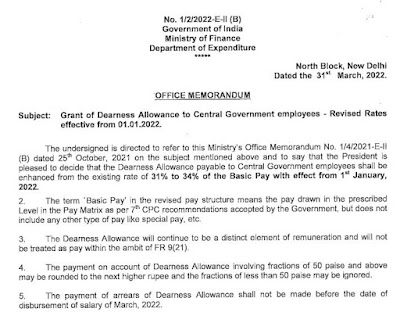
DA Jan 2022 - Grant of Dearness Allowance to Central Government employees - Revised Rates effective from 01.01.2022

 3% DA Hike - Revised Rates effective from 01.01.2022: DoE OM dated 31.03.2022 No. 1/2/2022-E-II (B) Government of India Ministry of Finance...