Friday, 7 April 2017

90 days paid leave for sexual harassment complainants at government


90 days paid leave for sexual harassment complainants at government

New Delhi: Paid leave of up to 90 days can be given to a woman government employee who has complained of sexual harassment at her workplace while the inquiry is pending, Union Minister Jitendra Singh today said.

In a written reply to the Rajya Sabha, he said leave up to a period of 90 days may be granted to an aggrieved female government servant during the pendency of inquiry under the Sexual Harassment of Women at Workplace (Prevention, Prohibition and Redressal) Act, 2013.

The leave granted shall not be debited against the leave account, said Singh, who is the Minister of State for Personnel, Public Grievances and Pensions.

PTI

Online Facility for Settlement of Claims in EPFO

Online Facility for Settlement of Claims in EPFO

Employees’ Provident Fund Organisation (EPFO) has taken various steps to provide various online services like for claims of provident fund, final settlement, withdrawals and pension fund withdrawal, etc. to its members in a quick and transparent manner. However, no specific date has been fixed. Receipt of transfer claims online has already been introduced by EPFO.

The claims other than transfer claims are received manually but processed on Computer Systems and the benefits credited to members by way of Core Banking Solution (CBS) and National Electronic Fund Transfer (NEFT) to their bank account.

Out of 120 field offices of EPFO, 110 field offices have already been connected with a central server.
This information was given by Shri Bandaru Dattatreya, the Minister of State (IC) for Labour and Employment, in written reply to a question in Rajya Sabha.

PIB

Thursday, 6 April 2017

New Email system for Government Employees soon


New Email system for Government Employees soon

GOVERNMENT OF INDIA
MINISTRY OF ELECTRONICS AND INFORMATION TECHNOLOGY
LOK SABHA
STARRED QUESTION NO: 451


ANSWERED ON: 05.04.2017

Use of Private e-mail by Government Employees


GOPALAKRISHNAN CHINNARAJ

Will the Minister of

ELECTRONICS AND INFORMATION TECHNOLOGY be pleased to state:-

Will the Minister of ELECTRONICS AND INFORMATION TECHNOLOGY be pleased to state:

(a) whether the Government is aware that the Government employees including PSU employees are still using private e-mail for official communication/work and if so, the reasons therefor;

(b) whether the Government is planning e-mail services at par with private e-mail services such as g-mail and Yahoo for officials work; and

(c) if so, the action taken to improve e-mail services provided by National Informatics Centre (NIC)?

ANSWER

(a) to (c): A Statement is laid on the Table of the House.

STATEMENT REFERRED IN REPLY TO LOK SABHA STARRED
QUESTION NO. *451 FOR 05.04.2017 REGARDING
USE OF PRIVATE E-MAIL BY GOVERNMENT EMPLOYEES


(a) to (c): The Government has notified the E-mail policy of Government of India vide Gazette Notification dated 18th February 2015. This policy inter alia mandates and provides for guidelines for use of Government email service, provided by NIC, for all official communications by Government officers.

The Government of India has also approved a project to strengthen the NIC email infrastructure. Once implemented, the new email system will provide for 50 lakhs email ids for Government users across the country. This new setup will be as per global standards.

National Informatics Centre (NIC) does not Track the usage of private emails by Government employees, including PSU employees.

Loksabha Q&A

Rajnath Singh orders all Directors General to ensure good food for paramilitary jawans

Rajnath Singh orders all Directors General to ensure good food for paramilitary jawans

Amidst complaints of poor quality food being served to jawans, Home Minister Rajnath Singh today directed all paramilitary forces to ensure that quality food is served to all personnel under their rolls.

At a high-level meeting, attended by Directors General of CRPF, BSF, CISF, SSB, ITBP etc., the Home Minister said that the food served to the jawans and others should be good and there should be no room for any complaint, according to official sources.

Singh said paramilitary personnel are deployed in hostile and difficult terrain and if bad food is served they would be demoralised.

The paramilitary personnel should always be served with quality food and the chiefs of the organisations must ensure that, he said.

The Home Minister is also learnt to have expressed his unhappiness over more than 160 CRPF jawans falling ill in Kerala due to food poisoning recently.

There have been several complaints in the past regarding poor quality food being served to paramilitary jawans, leading to the Home Ministry ordering an inquiry.
PTI

Wednesday, 5 April 2017

Employment on Compassionate Ground


Employment on Compassionate Ground

GOVERNMENT OF INDIA
MINISTRY OF RAILWAYS
LOK SABHA
UNSTARRED QUESTION NO: 5289

ANSWERED ON: 05.04.2017

Employment on Compassionate Ground
railways-Compassionate-Ground

SUNIL KUMAR SINGH

Will the Minister of RAILWAYS be pleased to state:-

(a) whether the Railways proposes to bring amendment in the provision in which employment on compassionate ground is given to any one dependent family member of the rail accident victim;

(b) if so, the details thereof and if not, the reasons therefor; and

(c) the total number of dependents to whom employment has been given during each of the last three years and the current year, zone-wise including Jharkhand?

ANSWER

MINISTER OF STATE IN THE MINISTRY OF RAILWAYS

(SHRI RAJEN GOHAIN)
(a) to (c) : A Statement is laid on the Table of the House.

STATEMENT REFERRED TO IN REPLY TO PARTS (a) TO (c) OF UNSTARRED QUESTION NO. 5289 BY SHRI SUNIL KUMAR SINGH TO BE ANSWERED IN LOK SABHA ON 05.04.2017 REGARDING EMPLOYMENT ON COMPASSIONATE GROUND

(a) & (b) Extant rules do not permit for providing employment to family members/legal heirs of those dying in train accidents or untoward incidents connected with the Railways. However, in the past, pursuant to announcement made by Hon’ble Minister of Railways, employment has been provided, in exception to rules and purely as a humanitarian gesture in certain cases. No change in the same is contemplated.

(c) Information is being collected and will be laid on the Table of the House.

Loksabha Q&A

Filling up of vacancy of Consultant(Vigiiance) in the Kendriya Bhandar


Filling up of vacancy of Consultant(Vigiiance) in the Kendriya Bhandar.

 F No. 21/1/2017-CS-1 (P)
Government of India
Ministry of Personnel, Public Grievances & Pensions
Department of Personnel & Training

2nd Floor, A Wing, Lok Nayak Bhgawan,
Khan Market, New Delhi
Dated 5th April, 2017
OFFICE MEMORANDUM

Subject: Filling up of vacancy of Consultant (Vigiiance) in the Kendriya Bhandar.

A copy of vacancy circular received from Kendriya Bhandar vide their Circular No. KB/1/Secy/Cons(Vigi)2017 dated 28th March, 2017 on the above mentioned along with its enclosures is circulated for information of all CSS officers.

2. Retired Officers at the level of Section Officer/Under Secretary/equivalent and served under government and having sufficient experience of handling vigilance cases are eligible for appointment.
(Chandra Shekhar)
Under Secretary to the Govt. of India
To
All Ministries/Departments (through website of DoP&T)

KENDRIYA BHANDAR
No. KB/1/Secy/Cons(Vig)12017
Pushpa Bhawan, Madangir Road,
New Delhi, the 28th March,2017
VACANCY CIRCULAR

Sub.: Filling up of the post of Consultant (Vigilance) - reg

Kendriya Bhandar, a Multi State Society registered under Multi State Cooperative Societies Act,2002 (MSCS Act,2002), with Government of India's share capital approx. 70% and functioning under Ministry of Personnel, PG & Pension, requires the service of a qualified and experienced Consultant having experience in the field of Vigilance matters.

2. Retired officers at the level of Section Officer/Under Secretary/equivalent and served under government and having sufficient experience of handling vigilance cases are eligible for appointment.

3. Details regarding qualification, experience and scope of work etc. for the post is at Annexure-I.

4. Eligible and interested persons may send their applications (as per annexure-II) along with their one passport size photograph latest by 15.4.2017
Annexure-I
Details of eligibility qualification/experience and scope of work etc. for the post of Consultant (Vigilance) in Kendriya Bhandar.

New Catering Policy -2017 in Railways


New Catering Policy -2017 in Railways

To improve the standard of food being provided to passengers in trains, new Catering Policy has been issued on 27th February 2017 wherein inter-alia IRCTC has been mandated to carry out the unbundling by creating a distinction primarily between food preparation and food distribution. In order to upgrade quality of food preparation, IRCTC is to set up new kitchens and upgrade existing ones. The salient features of the new Catering Policy 2017 are as under :-
(i) IRCTC to manage catering service on all mobile units. Pantry car contracts awarded by zonal railway to be reassigned to IRCTC.
(ii) Meals for all mobile units to be picked up from the nominated kitchens owned, operated and managed by IRCTC.
(iii) IRCTC not to outrightly outsource or issue licenses for provision of catering services to private licensees. IRCTC to retain the ownership and be fully accountable for all the issues pertaining to setting up and operation of the Base Kitchens and quality of food.
(iv) IRCTC to engage service providers from hospitality industry for service of food in trains.
(v) All four Base Kitchens under departmental operation of Zonal Railways (Nagpur, Chhatrapati Shivaji Terminus (CSTM) , Mumbai Central (BCT) and Balharshah) and all kitchen units i.e. Refreshment Rooms at A1 and A category stations, Jan Ahaar, Cell Kitchens are to be handed over to IRCTC on 'as is where is basis'. IRCTC to set up its own Kitchens at additional stations, if required.
(vi) Kitchen structures/land/space to be handed over by zonal Railways to IRCTC, for a period of 10 years extendable for another period of 5 years, on a token license fee.
(vii) IRCTC to be responsible for management of Food Plaza, Food Courts, Fast food units within the ambit of this policy.
(viii) The setting up/ development / refurbishment of new or existing Base Kitchens/Kitchen units to be undertaken by IRCTC. These kitchens are to be owned, operated and managed by IRCTC.
(ix) IRCTC to develop different types of kitchens keeping in view supply of food and usage assessed.
(x) IRCTC to develop the Business model for the kitchens so that they can expand and enhance the service. IRCTC to prepare a detailed concession agreement for setting up/development of the kitchens.
(xi) Zonal railway to manage static unit (catering stall /milk stalls/ trolleys etc.) except base kitchens and kitchen units to be handed over to IRCTC .
(xii) For the purpose of allotment, a Refreshment Room (at B and below category stations) or a stall or a trolley to be deemed as one unit. As such, a single unit is to be awarded through a single license.
(xiii) Provision of perpetual renewal has been done away with. Now it has been envisaged that tenure of all static units (except kitchen units and Food Plaza) shall be 5 years only. Tenure of Food Plaza shall be for a period of 9 years.
(xiv) Allotments of General Minor Units at all category stations to be done through open, competitive, two- packet tendering system from the eligible bidders by divisions.
(xv) For the first time, it has been envisaged that allotment of Special Minor units (reserved category) at all category stations will be done by divisions through open tendering system within the similar reserved category. The technical eligibility criteria has been simplified.
This Press Release is based on the information given by the Minister of State for Railways Shri Rajen Gohain in a written reply to a question in Lok Sabha on 05.04.2017 (Wednesday).

PIB

Married Women Employees can show their parents as her dependents for CGHS, LTC etc


Married Women Employees can show their parents as her dependents for CGHS, LTC etc

GOVERNMENT OF INDIA
MINISTRY OF PERSONNEL,PUBLIC GRIEVANCES AND PENSIONS
RAJYA SABHA
QUESTION NO 3280
ANSWERED ON 30.03.2017

Making service rules gender neutral

3280 Shri Narayan Lal Panchariya
Will the Minister of PERSONNEL,PUBLIC GRIEVANCES AND PENSIONS be pleased to state :-

(a) whether, a married woman employee can show her own parents as her dependents under the service rules applicable to Central Government employees;

(b) if so, under what conditions;

(c) if not, the rationale therefor;

(d) whether Government has taken any action to make the aforesaid service rules gender neutral both in letter and spirit; and

(e) if so, the details thereof and if not, the reasons therefor?

ANSWER

Minister of State in the Ministry of Personnel, Public Grievances and Pensions and Minister of State in the Prime Minister's Office. (DR. JITENDRA SINGH)

(a) to (e): The service rules of the Government employees have been framed keeping in view their contextual purpose and with a view to make them gender neutral.

As per Rule 50 of Central Civil Services (CCS)(Pension) Rules, 1972, father and mother of a Government employee (which includes a female Government employee) come within the definition of family. For the purpose of gratuity, there is no condition of dependency or inclusion in family.

In respect of General Provident Fund (GPF) Rule, female employees can nominate their parents for the benefits of GPF. There is no dependency criterion for nominating parents for the benefits of GPF.
Under Central Government Health Scheme (CGHS) Rules, married women employees have the option either to opt their dependent parents or dependent parents-in-law for CGHS facilities.

As per All India Services (AIS) {Medical Attendance (MA) Rules}, 'family' definition includes the name of parents wholly dependent upon the member of service and normally residing with such member.

As per CCS {Leave Travel Concession (LTC)} Rules, 'family' definition includes parents or step parents wholly dependent on the Government servant irrespective of whether they are residing with the Government servant or not.

As per CCS(Conduct Rules), "Members of family" in relation to a Government servant include the wife or husband, son or daughter, parents, brothers or sisters or any person related to any of them by blood or marriage, whether they are dependent on the Government servant or not.

As per AIS (Conduct) Rules, any person related, whether by blood or marriage, to such member or to his or her wife or husband, as the case may be, and wholly dependent on such member is treated as member of family.

Source : RAJYA SABHA

Factual position on proposed Amendments to RTI Rules

Factual position on proposed Amendments to RTI Rules
No change in fee structure or word limit in RTI queries
Government committed to full and easy implementation of RTI

A factually incorrect and misleading news report appeared in a section of the media that a new set of RTI Rules have been formulated which creates difficulties and hurdles in the right of the citizens to get information from the Government. It has been alleged that the size of the RTI has been restricted to 500 words and a provision of fees has been unfairly introduced in the Rules.

The facts are totally to the contrary. On 31st July, 2012, the Central Government notified the RTI Rules under Section 27 of the Right to Information Act, 2005. A copy of existing rules is available on the official website of DOPT. The Rules provided that an RTI application will ordinarily be not more than 500 words (subject to exception) with a nominal fee being charged from each applicant. These Rules were framed and notified in 2012.

However, legality of the CIC (Management) regulations of 2007 was challenged before the Delhi High Court and these were quashed. The matter has been pending before the Supreme Court. The Government therefore decided, in consultation with the CIC, that a comprehensive set of rules be notified by consolidating the key provisions of CIC (Management) Regulations and also the Rules of 2012. Same has been put up in public domain for comments.

The key provisions of the RTI Rules, 2012 have been identically incorporated verbatim. No change has been made in the RTI fee structure. The Government is committed to ensuring a full and easy implementation of the Right to Information.

The factual position on the proposed Rules is as follows:
  1. The existing RTI Rules 2012 notified on 31st July, 2012 specifically provide in section 3 that an application shall ordinarily not contain more than 500 words excluding annexure. It further provides that no application shall be rejected only on the grounds that it contains more than 500 words. There is no change proposed in these provisions in the new rules.
  2. The provision with respect to charging rates is identical to that contained in existing RTI Rules 2012 which provides for charging rates as per price fixed for a publication or Rs.2 per page of photocopy for extracts from the publication. There is a further provision in rule 5 that no fee under rule 3 and rule 4 shall be charged from any person who is below poverty line. This provision has been retained as such in the new proposed rules. Therefore, there is no change in fee and the existing rules have been proposed to be continued.
  3. There is no change in the postal charges for sending the information.
  4. The proposed rules do not limit the filing of either complaint or appeal "online" only. Both rule 8 and rule 13 dealing with filing of appeals and complaints especially provide for filing offline as well as online.
  5. The provision for withdrawal of appeal, which was earlier included in the Central Information Commission (Management) Regulations 2007 has been included in the new rules. Similarly, the provision for abatement of appeals/complaints on the death of the applicant/ complainant, which was earlier included in the Central Information Commission (Management) Regulations 2007, has also been included.
  6. With regards to the provision of officials being allowed to file documents to counter claims of false information, it is clarified that at present, as per the procedure of CIC, once appeal is taken cognizance of, the CPIOs are given a notice to furnish their submission before the appeal is decided. This was also part of the Central Information Commission (Management) Regulations 2007 which are now being incorporated in the rules. Therefore, the existing standard operating procedure has been proposed to be incorporated in the rules.
As can be seen from above, the allegation that there is a move to dilute the provisions of RTI is unfounded. The proposed amendments to the rules are in public domain for comments by April 15, 2017 and will be finalised keeping in view the public feedback received in the matter. The comments can be sent both online and in hard copy to the Department.

PIB

Government takes steps to generate Employment Opportunities


Government takes steps to generate Employment Opportunities

Government has taken various steps for generating employment in the country like encouraging private sector of economy, fast tracking various projects involving substantial investment and increasing public expenditure on schemes like Prime Minister’s Employment Generation Programme (PMEGP) run by Ministry of Micro, Small & Medium Enterprises, Mahatma Gandhi National Rural Employment Guarantee Scheme (MGNREGA), Pt. Deen Dayal Upadhyaya Grameen Kaushalya Yojana (DDU-GKY) run by Ministry of Rural Development and National Urban Livelihoods Mission (NULM) run by Ministry of Housing & Urban Poverty Alleviation.

In order to improve the employability of youth, around 20 Ministries run skill development schemes across 70 sectors. According to the data compiled by Ministry of Skill Development and Entrepreneurship, the number of persons skilled across various sectors during 2015-16 were 1.04 crore.

Government has implemented the National Career Service (NCS) Project comprises a digital portal which provides a nation-wide online platform for jobseekers and employers for job matching in a dynamic, efficient and responsive manner and has a repository of career content.

A new Scheme Pradhan Mantri Rojgar Protsahan Yojana (PMRPY) has been initiated by the Ministry of Labour and Employment in the year 2016-17 for incentivising industry for promoting employment generation with the allocation of Rs. 1000 crore. Under this scheme employers would be provided an incentive to enhance employment where the Government will pay the employer’s contribution of 8.33% EPS for new employees. In textiles (apparel and made-ups) sector, the Government will also pay the 3.67% EPF contribution of employers in addition to paying the 8.33% EPS contribution. Government announced a booster package of Rs. 6000 crores for the textile sector which is an employment intensive sector.

This information was given by Shri Bandaru Dattatreya, the Minister of State (IC) for Labour and Employment, in written reply to a question in Rajya Sabha today.

PIB

Flash News

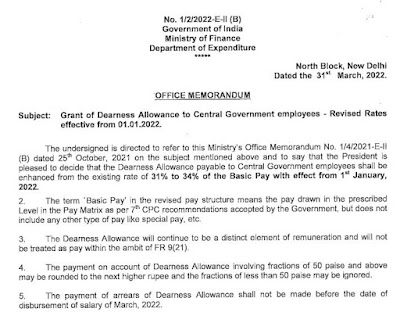
DA Jan 2022 - Grant of Dearness Allowance to Central Government employees - Revised Rates effective from 01.01.2022

 3% DA Hike - Revised Rates effective from 01.01.2022: DoE OM dated 31.03.2022 No. 1/2/2022-E-II (B) Government of India Ministry of Finance...