Monday, 13 February 2017

New Income Tax Rates And Deductions Applicable From April 1, 2017


New Income Tax Rates And Deductions Applicable From April 1, 2017

With some tinkering in the income tax rates for 2017-18, Finance Minister Arun Jaitley reduced the tax rate for income between Rs. 2.5 lakh and Rs. 5 lakh to 5 per cent in the Union Budget, while adding a surcharge of 10 per cent on tax for income between Rs. 50 lakh and Rs. 1 crore.

Although the basic income tax exemption limit remains the same at Rs. 2.5 lakh, there are many exemptions available in the Income Tax Act, which can substantially reduce your tax liability.

One needs to plan from the beginning of the next financial year to take maximum benefit of the income tax deductions available.

Here are the new income tax slabs for taxpayers:

General categorySenior citizensSuper senior citizens
(Up to 60 years of age)(60-80 years)(Above 80 years)
IncomeTaxIncomeTaxIncomeTax
Up to Rs. 2.5 lakhNilUp to Rs. 3 lakhNilUp to Rs. 5 lakhNil
Rs. 2,50,001-Rs. 5 lakh5%Rs. 3,00,001-Rs. 5 lakh5%Rs. 5,00,001-Rs. 10 lakh20%
Rs. 500,001-Rs. 10 lakh20%Rs. 5,00,001-Rs. 10 lakh20%Above Rs. 10 lakh30%
Above Rs. 10 lakh30%Above Rs. 10 lakh30%
# Surcharge of 10% for income between Rs. 50 lakh and Rs. 1 crore
# Surcharge of 15% for income above Rs. 1 crore
# Rebate of up to Rs. 2,500 for taxable salary up to Rs. 3.5 lakh
# Education and higher education cess of 3%
Here are the some of the deductions available for FY2017- 18: 

House Rent Allowance under Section 10 (13A) of the Income Tax Act

House Rent Allowance, commonly known as HRA, makes up a major chunk of a salaried individual’s total pay. HRA is partly exempted from tax. If you are staying in your own house or not paying any rent, your HRA will be completely taxable. However, those who stay with their parents can also claim HRA benefits by paying rent to their parents.

The amount which is allowed for exemption under HRA is calculated as minimum of:

1) Rent paid annually minus 10 per cent of basic salary plus dearness allowance
2) Actual HRA received
3) 40 per cent of basic and dearness allowance (50 per cent in case of metro cities)

Deductions under Section 80C
Section 80C of the Income Tax Act provides various provisions under which an individual can get deduction benefits up to Rs. 1.5 lakh. Employees’ Provident Fund (EPF), Public Provident Fund (PPF), Sukanya Samriddhi Account, National Savings Certificate and tax-saving fixed deposits are some of the investment options that offer benefits under Section 80C. The premium paid for life insurance plans, National Pension Scheme (NPS) and tax-saving mutual funds (ELSS) also qualify for deduction under Section 80C.
Further, one can claim tuition fees paid for up to two children, principal repayment on home loan, stamp duty and registration cost on the house bought as deduction under Section 80C.

Deductions under Section 80CCD(1B)
Introduced in Budget 2015-16, Section 80CCD (1B) provides deduction up to Rs. 50,000 for investment in NPS Tier 1 account. This deduction is over and above the deduction available in Section 80C. An individual in 30 per cent tax bracket can save up to Rs. 15,450 of tax by investing Rs. 50,000 in NPS.

Deduction of interest on housing loan (Section 24B)
Buying a house is among several other things an individual wants to do during his or her lifetime. The income tax rules also incentivise the same. Under Section 24B of the Income Tax Act, interest paid up to Rs. 2 lakh on housing loan and up to Rs. 30,000 on home improvement loan is allowable as deduction from your taxable income.

The government has however cut down tax benefits borrowers enjoyed on properties let out on rent. As per current tax laws, for properties rented out, a borrower could deduct the entire interest paid on home loan after adjusting for the rental income. On the other hand, borrowers of self-occupied properties get Rs. 2 lakh deduction on interest repayment on home loan.

However, according to the proposed change in Budget 2017, on rented properties, the borrower can only claim deduction of up to Rs. 2 lakh per year after adjusting for the rental income. And the amount above Rs. 2 lakh can be carried forward for eight assessment years.

Since the interest component of home loan repaid in initial years is higher, experts say that the borrower may not be able to fully adjust the interest paid as deduction even in subsequent years.

Deduction under Section 80EE
Under Section 80EE, an additional deduction of Rs. 50,000 is available over and above the limit of Section 24B on interest paid on home loans if the person is buying a house for the first time (the person must not own any other residential property on the date of sanction of loan). However, to avail the benefit of this section the value of the property must be below Rs. 50 lakh and the loan amount should not exceed Rs. 35 lakh. Further, the property must be bought after April 1, 2016.

Deduction under Section 80D

Premium paid for medical/health insurance for self, spouse, children and parents qualify for deduction under this Section. On can claim deduction of Rs. 25,000, if he is below 60 years of age, and Rs. 30,000 if he is above 60 years of age, towards medical insurance premium paid for self, spouse and children. Further, additional deduction of Rs. 25,000 is available if one has bought medical insurance for his parents. This deduction can go up to Rs. 30,000 if parents are above the age of 60 years.

Deduction under Section 80DD
If a tax payer has dependent parents, spouse, children or siblings who are differently-abled, then he can claim deductions up to Rs. 75,000 for expenses on their maintenance and medical treatment under this section. This deduction can increase to Rs. 1.25 lakh in case of severe disability.

Deduction under Section 80DDB
Under this section, one can claim deduction of Rs. 40,000 for treatment of certain diseases for self and dependents. The deduction can go up to Rs. 60,000 if the tax payer is above 60 years of age and if he is above 80 years of age, then the deduction amount is up to Rs. 80,000.

Deduction under Section 80E
According to the provisions of Section 80E, a taxpayer can claim deduction for interest paid on education loan for him, spouse or children. There is no upper limit on the amount of deduction. However, the loan must have been taken from a financial institutional or approved charitable institution and for full-time higher education.

Source: NDTV

INCOME TAX FAQ : What are allowances? Are all allowances taxable?


INCOME TAX FAQ : What are allowances? Are all allowances taxable?

​What is considered as salary income?
​​​ section 17​​ of the Income-tax Act defines the term 'salary'. However, not going into the technical definition, generally whatever is received by an employee from an employer in cash, kind or as a facility [perquisite] is considered as salary.

What are allowances? Are all allowances taxable?
Allowances are fixed periodic amounts, apart from salary, which are paid by an employer for the purpose of meeting some particular requirements of the employee. E.g., Tiffin allowance, transport allowance, uniform allowance, etc.
There are generally three types of allowances for the purpose of Income-tax Act ;taxable allowances, fully exempted allowances and partially exempted allowances.​

My employer reimburses to me all my expenses on grocery and children's education. Would these be considered as my income?
​Yes, these are in the nature of perquisites and should be valued as per the rules prescribed in this behalf.​​
During the year I had worked with three different employers and none of them deducted any tax from salary paid to me. If all these amounts are clubbed together, my income will exceed the basic exemption limit. Do I have to pay taxes on my own?

​Yes, you will have to pay self-assessment tax and file the return of income.​

Even if no taxes have been deducted from salary, is there any need for my employer to issue Form-16 to me?
​​Form-16 is a certificate of TDS. In your case it will not apply. However, your employer can issue a salary statement.​

Is pension income taxed as salary income?
​Yes. However, pension received from the United Nations Organisation is exempt.​​

Is Family pension taxed as salary income?
​No, it is taxable as income from other sources.​

​If I receive my pension through a bank who will issue Form-16 or pension statement to me- the bank or my former employer?
​​The bank.​

Are retirement benefits like PF and Gratuity taxable?
​​In the hands of a Government employee Gratuity and PF receipts on retirement are exempt from tax. In the hands of non-Government employee, gratuity is exempt subject to the limits prescribed in this regard and PF receipts are exempt from tax, if the same are received from a recognised PF after rendering continuous service of not less than 5 years.​

Are arrears of salary taxable?
​​​​Yes. However, the benefit of spread over of income to the years to which it relates to can be availed for lower incidence of tax. This is called as relief u/s 89​ of the Income-tax Act.​​

​Can my employer consider relief u/s 89 for the purposes of calculating the TDS from salary?
​​Yes, if you are a Government employee or an employee of a PSU or company or co-operative society or local authority or university or institution or association or body. In such a case you need to furnish Form No. 10E to your employer. ​​

​My income from let out house property is negative. Can I ask my employer to consider this loss against my salary income while computing the TDS on my salary?
​Yes, however, losses other than losses under the head 'Income from house property' cannot be set-off while determining the TDS from salary.​​

​Is leave encashment taxable as salary?
​​It is taxable if received while in service. Leave encashment received at the time of retirement is exempt in the hands of the Government employee. In the hands of non-Government employee leave encashment will be exempt subject to the limit prescribed in this behalf under the Income-tax Law.​

​Are receipts from life insurance policies on maturity along with bonus taxable?​

As per section 10(10D), any amount received under a life insurance policy, including bonus is exempt from tax. However, following receipts would be subject to tax:

Any sum received under sub-section (3) of section 80DD; or
Any sum received under Keyman insurance policy; or

Any sum received in respect of policies issued on or after April 1st, 2003, in respect of which the amount of premium paid on such policy in any financial year exceeds 20% (10% in respect of policy taken on or after 1st April, 2012) of the actual capital sum assured; or

Any sum received for insurance on life of specified person (issued on or after April 1st 2013) in respect of which the amount of premium exceeds 15% of the actual capital sum assured.
*Any person who is -
i) A person with disability or severe disability specified under section 80U​; or
ii) suffering from disease or ailment as specified in the rule made under section 80DDB.
Following points should be noted in this regard:
Exemption is available only in respect of amount received from life insurance policy.
Exemption under section 10(10D)​ is unconditionally available in respect of sum received for a policy which is issued on or before March 31, 2003.

Amount received on the death of the person will continue to be exempt without any condition.​

Authority: http://www.incometaxindia.gov.in/

Central government jobs about 2.83 lakh estimated by 2018


Central government jobs about 2.83 lakh estimated by 2018
As per the budget documents, the workforce of the central government establishments would be 35.67 lakh in 2018

New Delhi: Nearly 2.83 lakh central government jobs are estimated to be generated by next year. This projection has been made in the Union Budget for 2017-18 presented last week by finance minister Arun Jaitley.

As per the budget documents, the workforce of the central government establishments would be 35.67 lakh in 2018, about 2.83 lakh more than the actual head count of 32.84 lakh in 2016. The home ministry will add 6,076 more personnel to take its strength to 24,778 in 2018. About 1.06 lakh more workforce will be added in police departments to take the total head count to 11,13,689 by next year.
The strength of police departments under the central government is 10,07,366, as per the 2016 data. There will be an estimated increase of 2,109 persons in the external affairs ministry as against its actual strength of 9,294 in 2016, it said.

In newly created ministry of skill development and entrepreneurship, the government has estimated to add 2,027 jobs by 2018. Its actual strength in 2016 was 53 only. Minister of state for personnel, public grievances and pensions Jitendra Singh on Sunday said the additional workforce will help in providing more citizen-centric governance.

“The central government is trying to emphasise more on employability of our youths rather then employment. That is why the skill development ministry has been started. It will train more youths to become entrepreneur and be job-ready in changing scenario. “The projection of additional workforce will help in providing more citizen centric governance,” he said.

There would be an estimated 1,045 more staff in 2018 in the ministry of civil aviation from its actual strength of 1,141 in 2016. In the department of posts, there would be 20,442 more workforce from its strength of 4,48,840.

The ministry of environment, forest and climate change will add 2,165 more jobs in next year to take its strength to 5,094. An estimated 91 people will be part of the workforce in the minority affairs ministry in 2018, in addition to its actual strength of 169 in 2016.

The mines ministry will have 1,351 more jobs to take its strength to 9,481 and the department of space will have an estimated 17,894 personnel, 3,068 more than its strength of 14,826. The personnel ministry will have 2,367 more personnel in 2018 than its actual strength of 8,443 in 2016. Whereas, the ministry of water resources, river development and Ganga rejuvenation will have a workforce of 11,407 in 2018, 3,632 more than its actual strength of 7,775 in 2016.

PTI

Saturday, 11 February 2017

Grant of one time relaxation to the Central Government Employees who have availed LTC-80 and travelled by air by purchasing Ticket from other than authorized agents


Grant of one time relaxation to the Central Government Employees who have availed LTC-80 and travelled by air by purchasing Ticket from other than authorized agents

Shiva Gopal Mishra
Secretary
Ph: 23382286
National Council (Staff Side)
Joint Consultations Mechinery
For Central Government Employees
13-C, Ferozshah Road, New Delhi - 110001
E-mail :nc.jcm.np@gmail.com
No.NC-JCM-2017/
The Secretary,
Government of India,
Department of Personnel & Training,
North Block,
New Delhi
February 9, 2017

Sub: Grant of one time relaxation to the Central Government Employees who have availed LTC-80 and travelled by air by purchasing Ticket from other than authorized agents.

Ref:- Decision taken in the New Agenda No.III of the Standing Committee meeting of the National Council (JCM) held on 25.10.2016

Dear Sir,
In the Standing Committee meeting of the National Council (JCM) held under your chairmanship on 25.10.2016 the Staff Side informed that many non entitled Central government Employees had availed themselves the benefit of LTC-80 and purchased ticket from unauthorized agents, unaware of the rule position. Subsequently audit had returned the LTC final claims without sanctioning them and advised the administrative divisions of the Ministries concerned to recover the entire LTC advance from their salary. The staff Side also informed that Ministry of Defence, with the approval of Hon’ble Defence Minister had forwarded a proposal the DOPT seeking one time relaxation in such cases. The Secretary (P) informed in the meeting that the entire issue is under consideration of the DOPT.

To our shock and surprise the Ministry of Defence vide their ID Note dated 3.2.2017 has issue a letter to the lower formations (copy enclosed) stating that the DOPT has not agreed for granting bulk relaxation to thousands of Group B and Group C Defence Civilian Employees. Further DOPT has advised Ministry of Defence that the proposal for granting relaxation for booking of tickets through private travel agents may be scrutinized individually and has given certain guidelines which is practically difficult to adopt at this stage, since many such employees are due to retire from service shortly. It will be difficult for the administration to cross verify all those claims since the number of affected employees are more than 5000. In this situation we suggest the following for your kind consideration.

“In the case of those employees who have purchase air tickets from other than authorized agents and have actually travelled and submitted the tickets along with boarding pass, in such cases the administration may find out the actual LTC-80 fare from the concerned Airlines on that particular date when the concerned employee actually traveled and the claim may be restricted to the same and the balance amount if any calimed the same may be recovered from the concerned employee”.

The above proposal if accepted will reduce lot of administrative work and also will relieve the concerned employees from financial and mental hardship, thereby setting and outstanding issue once for all. In case of any further clarification required the Staff Side may please be invited for a discussion on the subject. Awaiting for your favorable response please.

Yours faithfully,
(Shiva Gopal Mishra)
Secretary
Source: Confederation

Bureaucracy delaying higher allowances implementation

Bureaucracy delaying higher allowances implementation

New Delhi: Complicated bureaucracy is delaying the implementation of the higher allowances under 7th Pay Commission recommendations, and it is now expected to start in three to four months, one leader of an employees union was quoted as saying.

The government has given higher basic pay with arrears, effective from January 1, 2016 in August 2016 to its employees on the recommendations of the 7th pay commission but referred hike in allowances other than dearness allowance to the ‘Committee on Allowances’ headed by the Finance Secretary Ashok Lavasa for examination in July, 2016 as the 7th pay commission had recommended for abolishing 51 allowances and subsuming 37 others out of 196 allowances.

The government has given the committee four months to submit the report but an extension was also given up to February 22, 2017 to submit its report on higher allowances. In October last year, Finance Secretary Ashok Lavasa had said the committee was ready with its report.

Usually, once the recommendations of the pay commission are approved, the increase in basic pay is followed by an increase in allowances.

The government earlier said that the cash crunch was the reason behind the delay in announcing higher allowances.

The announcement of assembly elections in five states has also given an excuse for the government as it cannot announce allowances hikes till the model code of conduct is in place up to March 8.

The higher House Rent Allowance (HRA) segment is of great benefit to central government employees in the allowances.This segment will more than double, with the increases ranging between 106% and 122% as recommended the 7th Pay Commission. So, the central government employees have a keen interest in higher House Rent Allowance (HRA).

The pay commission has recommended the rates HRA for these cities to 24%, 16% and 8% respectively of new pay matrix.

The Commission also recommended, that the rate of HRA will be revised to 27 percent, 18 percent and 9 percent respectively when DA crosses 50 percent, and further revised to 30 percent, 20 percent and 10 percent when DA crosses 100 percent.

The existing rates of HRA for Class X, Y and Z cities and towns are 30%, 20% and 10% of Basic pay (old pay in the pay band plus grade pay) are now paid to the central government employees according to the 6th Pay Commission recommendations until issuing of higher allowances notification.

The top bureaucrats living government bungalows and plush flats in the posh East Moti Bagh area in New Delhi. So, they don’t take House Rent Allowance (HRA).

‘The top bureaucrats houses have modular kitchens, hot and cold water supply like in hotels, solar lighting, a club with a swimming pool and tennis courts, jogging tracks, terrace gardens, a shopping complex, a primary school and banking facilities,’ an official at the urban development ministry said. They are also taking benefit of yoga and health centre.

The luxury apartments becoming popular among the bureaucrats. The secretaries of the central departments have been allotted a plot size of 8,250 sq ft, a plint area of 1,970 sq ft, eight bedrooms, four servant quarters, two garages, front and rear lawns. Hence, they are not interested to hike allowances and the higher allowances announcement dips in face of bureaucratic apathy.

However, we hope, the Finance Minister Arun Jaitley may announce the higher allowances, most probably after ending the model code of conduct on March 8, which will cover 48 lakh central government employees and 52 lakh pensioners.

Cashless treatment of ESIC Employees and cash compensation for loss of wages: Loksabha Q&A


Cashless treatment of ESIC Employees and cash compensation for loss of wages: Loksabha Q&A

GOVERNMENT OF INDIA
MINISTRY OF LABOUR AND EMPLOYMENT
LOK SABHA
cash-compensation-under-esic-scheme


UNSTARRED QUESTION NO: 875
ANSWERED ON: 21.11.2016
ESIC Employees
YOGI ADITYANATH
Y. S. AVINASH REDDY
KOTHA PRABHAKAR REDDY

Will the Minister of LABOUR AND EMPLOYMENT be pleased to state:-

(a) whether the Government has stopped/proposes to stop the cashless treatment of ESIC Employees;
(b)if so, the details thereof and the reasons therefor;
(c)the steps being taken by the government to alleviate problems of ESIC employees in this regard;
(d)whether the Health Insurance Scheme run by the Government provides guarantee of income which is necessary for livelihood and if so, the details thereof; and
(e)if not, whether the Government proposes to implement such schemes in future?

ANSWER

MINISTER OF STATE (IC) FOR LABOUR AND EMPLOYMENT (SHRI BANDARU DATTATREYA)

(a) & (c): No, Madam. The employees under ESI Scheme are eligible for cashless treatment in the ESI Hospitals and tie up hospitals. In case of emergency treatment outside the ESI network, the employees are reimbursed on CGHS rates or respective state rates.

(b): Not applicable in view of answer at (a) above.
(d): Yes, Madam. Under ESI Scheme, cash compensation for loss of wages is paid as under:
1. Sickness Leave - For 91 days @ 70% of wages
2. Temporary disablement - Till the spell of sickness lasts @ 90% of wages
3. Maternity leave - For 12 weeks (under revision to 26 weeks) @ 100% of wages
4. Unemployment allowance- @50% for first year and 25% for second year.
(e): Not applicable.

Source: Loksabha.nic.in

Pay element in the case of Loco Inspectors - 30% addition to 7th CPC pay matrix for refirement benefits


Pay element in the case of Loco Inspectors - 30% addition to 7th CPC pay matrix for refinement benefits
NFIR
National Federation of Indian Railwaymen
3, CHELMSFORD ROAD, NEW DELHI - 110 055

Affiliated to:
Indian National Trade Union Congress (INTUC)
International Transport Workers Federation (ITF)
No-IV/RSAC/Conf./Pt. VII
Dated: 08/02/2017
The Secretary (E),
Railway Board,
New Delhi

Dear Sir,
Sub: Pay element in the case of Loco Inspectors - 30% addition to 7th CPC pay matrix for retirement benefits - reg.

Ref: (i) NFIR's demand in the Board PNM meeting held on 22nd & 23rd December, 2016 for continuance of 55% & 30% pay element on 7th CPC pay matrix levels.

(ii)Railway Board' s letter No.E(P&A)II-2015/RS-25 dated 24/01/2017.

Pursuant to NFIR's references and discussions held in the Railway Board PNM meeting on 22nd and 23rd December, 2016, the Railway Board vide letter dated 24/01/2017 has issued instructions to the GMs of Zonal Railways to reckon add-on pay element of 55% on 7th CPC pay matrix levels for calculation of emoluments for the purpose of retirement benefits and 30% for other purposes to the running staff as per IREM provisions and extant instructions.

In the above context, NFIR brings to the notice of the Railway Board that in terms of the extant instructions (Railway Board's letter No.E(P&A)II/83/RS-10(IV) dated 25/11/1992) contained in para 5.5 of Board's letter dated 25/11/1992, the running staff deployed as Loco Inspectors are entitled for 30% addition to their basic pay for the purpose of pensionary benefits. Those Loco Inspectors retired/retiring w.e.f. January 2016 are required to be granted retirement benefits with 30% add on to their pay in the 7th CPC pay matrix level, but, however in the absence of Railway Board's instructions, some Zonal Railways are entertaining doubts and denying benefit of 30%o on revised pay matrix.

NFIR, therefore, requests the Railway Board to issue suitable clarification to the Zonal Railways to ensure 30% addition to the 7th CPC pay matrix of Loco Inspectors for payment of retiral benefits similar to running staff for whom 55% addition is allowed. A copy of the instruction issued may be endorsed to the Federation.

Yours faithfully,
(Dr M.Raghavaiah)
General Secretary
Source: NFIR

Amendment of Recruitment Rules for the post of Training Equipment Operator (TEO) in the pay level-5 of pay matrix in the ISTM


Amendment of Recruitment Rules for the post of Training Equipment Operator (TEO) in the pay level-5 of pay matrix in the ISTM

No.A-12034/14/2016-ISTM
Government of India
Ministry of Personnel, Public Grievances and Pension
Department of Personnel & Training
Training Division
Old JNU Campus, Block IV, 4th Floor,
New Mehrauli Road, New Delhi-110067
Dated: 8th February, 2017
OFFICE MEMORANDUM

Subject: Amendment of Recruitment Rules for the post of Training Equipment Operator (TEO) in the pay level-5 of pay matrix in the ISTM.

The undersigned is directed to upload the draft Recruitment Rules for the post of Training Equipment Operator in the Institute of Secretariat Training & Management, New Delhi and to request for comments, if any, from all the stakeholders on the draft RRs. The comments may kindly be sent on email ID:sanjay.mehta@nic.in and an.narayanan@nic.in latest by 09.03.2017.

Encl.: As above
sd/-
(Sanjay Mehta)
Under Secretary to the Government of India
Telephone: 011-2616 1871
sanjay.mehta@nic.in
Click to view the detailed OM
Authority: http://dopt.gov.in/

KV School Admission Schedule for the Session 2017-18


KV School Admission Schedule for the Session 2017-18

SCHEDULE FOR ADMISSION

The Admission Schedule for the Session 2017-18 will be as under:

S.noCONTENTSSCHEDULED DATES
1Advertisement for admission by Regional
office/Kendriya Vidyalaya
01/02/2017
2Online Registration for Class-I (Except for Special Provision) -  http//darpan.kvs.gov.in.a Online admission) 08-02-2017 (From 8.00 a.m)
3Last date of Registration for Class- I10.03.2017 (Till 4.00 p.m.)
4Declaration of selected list for Class I &
admission for Class-I.
20-03-2017 onwards
5Registration for Class-II onwards* (except Class XI). Wherever new Schools/Sections are opened registration may start from
08/02/2017
05-04-2017 from 8.00 AM
6Extended date for Second Notification admissions to be made under RTE Provisions (Class-I), if sufficient applications not received under RTE Provisions I17-04-2017
7Last date of registration for Class-II onwards* (except Class XI).18-04-2017 upto 4:00 PM
8In case sufficient number of registrations for SC/ST not received in Ist Phase, second notification may be issued.May to June 2017.
9Declaration of list of class II onwards25-04-2017
10Admission for class II onwards*26-04-2017 to 05-05-2017
11Registration for class XI*Within 20 days after declaration of Board results
12Display of list & admission for Class- XIWithin 30 days after declaration of Board results
13Last date of Admission for all Classes31-07-2017

Subject to availability of vacancies in a particular class

Note:
1. Admission under Special Provisions (Part B) (Single girl child, Grand son/grand daughters of KVS retired employees etc.) will be offline. In this regard please contact Principal of concerned Kendriya Vidyalaya.
2. List of children registered, list of eligible children, category-wise list of provisionally selected children, waiting list and subsequent lists to be compulsorily displayed on the web-site of the Kendriya Vidyalayas concerned, in addition to display on School’s Notice Board.
3. If any of the dates happens to be a public holiday the next working day shall be treated as opening/closing date.

Authority: http://kvsangathan.nic.in/

KV School Admission Guidelines for Academic Session 2017-18


KV School Admission Guidelines for Academic Session 2017-18

KENDRIYA VIDYALAYA SANGATHAN - GUIDELINES FOR ADMISSION IN KENDRIYA VIDYALAYAS

PART- A

GENERAL GUIDELINES
1. In supersession of all the guidelines governing admissions in Kendriya Vidyalayas that have been issued in the past, the following guidelines are issued to regulate admissions in the Kendriya Vidyalayas with effect from the academic session 2017-18. These guidelines are not applicable to Kendriya Vidyalayas located abroad.

2. DEFINITIONS
Unless the context suggests otherwise, the definition of the following terms used in these guidelines would be as below:-
(i) CENTRAL GOVERNMENT EMPLOYEES: An employee who draws his emoluments from the consolidated fund of India.

(ii) TRANSFERABLE:
An employee who has been transferred at least once in the preceding 7 years shall be deemed to be transferable.

(iii) TRANSFER:
An employee would be treated as transferred only if he/she has been transferred by the competent authority from one place/urban agglomeration to another place/urban agglomeration which is at a distance of at least 20 kms. and minimum period of stay at a place should be six months.

(iv) AUTONOMOUS BODIES / PUBLIC SECTOR UNDERTAKINGS:
Organizations which are fully financed by the government or where the government share is more than 51 per cent would be deemed to be autonomous bodies/ public sector undertakings.

(v) SINGLE GIRL CHILD:
Single Girl Child means the only child i.e. only girl child to the parents, with no other siblings.
Click to read the instructions…

Flash News

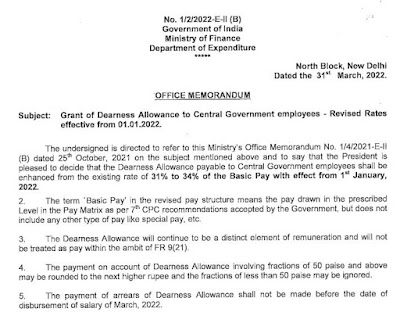
DA Jan 2022 - Grant of Dearness Allowance to Central Government employees - Revised Rates effective from 01.01.2022

 3% DA Hike - Revised Rates effective from 01.01.2022: DoE OM dated 31.03.2022 No. 1/2/2022-E-II (B) Government of India Ministry of Finance...