Tuesday, 15 November 2016

Cabinet approves Status-cum-Progress Report and constitution of Special Committee for Inter-Linking of Rivers in compliance of judgment of Supreme Court

Cabinet approves Status-cum-Progress Report and constitution of "Special Committee for Inter-Linking of Rivers" in compliance of judgment of Supreme Court

The Union Cabinet chaired by the Prime Minister Shri Narendra Modi has given its approval to the Status-cum-Progress Report and constitution of “Special Committee for Inter-Linking of Rivers” in compliance of Supreme Court judgment dated 27.2.2012 in the matter of Writ Petition (Civil) 512 of 2002: Networking of Rivers along with Writ Petition No. 668 of 2002.

Approval of the Union Cabinet will help in monitoring of the precious Inter-linking of River Projects to be carried out under National Perspective Plan 1980 of Government of India. The Status-cum-Progress Report of Special Committee for Inter-linking of Rivers will be submitted bi-annually for information of Cabinet, which will facilitate faster and appropriate decisions in the interest of the country as expeditiously as possible.

PIB

7th Pay Commission - Employees Provident Fund may be raised to Rs 25,000


7th Pay Commission - Employees Provident Fund may be raised to Rs 25,000

7th Pay Commission - Employees Provident Fund
 
Under the 7th Pay Commission minimum wage ceiling the Employees Provident Fund (EPF) is likely to raise to Rs 25,000 from the existing Rs 15,000.

The proposal drafted by Employees’ Provident Fund Organisation (EPFO) will be sent to the Union Government which is likely to be approved, the report suggests.

The decision has been taken by the members of Sub-committee of the Central Board of Trustees, EPFO - the highest decision-making body - on contract workers held on November 7.

According to reports, the EPFO has proposed a hike in the wage limit of all employees drawing basic salary Rs 25,000 would have to contribute to the provident fund. However, those government employees drawing above that limit will have the option to become a member of the provident fund and can have an option to select or reject if they want to.

The move taken by the EPFO comes in the wake of changes in the wage structure in accordance with the proposal of the 7th Pay Commission. Most of the trade union representatives at the CBT sub-committee meeting noting that the minimum wage of the Central government employees after implementation of the 7th Pay Commission report has been hiked to Rs 18,000, due to which the EPFO’s wage ceiling of Rs 15,000 needs to be altered.

The CBT pointed out that there could be a further increase in minimum wages from Rs 18,000 is likely with the trade unions demanding minimum wage to be increased at least Rs 21,000 to Rs 22,000.

In fact, the Employees’ Deposit Linked Insurance Scheme (EDLI) is directly linked to the minimum wage ceiling. At present, If an employee is earning up to Rs 15,000 he or she can avail of benefits under the Employees Deposit Linked Insurance Scheme (EDLI). The scheme provides life insurance of up to Rs 6 lakhs.

Source: FE

Grant of 90% medical advance for all treatments (IPD and OPD) under CGHS and CS(MA) Rules, 1944


No.S. 14025/18/2015-MS/EHSS
Government of India
Ministry of Health and Family Welfare
Department of Health & Family Welfare
Nirman Bhawan, New Delhi
Dated the 17th October, 2016
OFFICE MEMORANDUM

Subject: Grant of 90% medical advance for all treatments (IPD and OPD) under CGHS and CS(MA) Rules, 1944.

The undersigned is directed to refer to O.M.NO.S. 14025/7/94-MS dated 15.05.1996, and OM No.S.12025/1/96-CGHS(P) dated 1305.1997 provisioning, inter-alia, grant of advance upto 90% in case of major illness like by-pass surgery, Kidney transplant, major cancer treatment, etc.

2. During the meeting held on 25.03.2015, National Council (Staff Side) requested this Ministry to make provisions for grant of 90% advance of the estimated cost for all treatments for serving Central Government employees, irrespective of major or minor diseases.

3. The matter was examined in the Ministry. Considering that the basic purpose of grant of advance for treatment of any disease is to provide relief to a Government employee from facing hardship, it has been decided with the approval of the competent authority that serving CS(MA) and CGHS beneficiaries may be granted 90% medical advance of the approved CGHS package rates for all indoor treatments, irrespective of major or minor diseases, on receipt of a certificate from the treating physician of a Government/recognized hospital as per the guidelines given in the OM No.S.14025/7/94-MS dated 15.05.1996 and OM No.S-11016/1/92-CGHS(P) dated 29.10.1992 for CS(MA) and CGHS beneficiaries respectively.

4. For out-door treatment, it has also been decided that advance may be limited to 90% of the total estimated expenditure of the treatment, subject to the condition that the advance for OPD treatment may only be granted when the total estimate of expenditure for OPD treatment including tests/investigations is more than Rs.10,000/-.

5. The advance should be released within 10 days on receipt of the request for advance by the administrative Department/Ministry/office in order to avoid inconvenience to the employees.

6. The OM No.S.12025/1/96-CGHS(P) dated 13.05.1997 stands withdrawn from the date of issue of this O.M.
(Sunil Kumar Gupta)
Under Secretary to the Govt. of India
Source : Confederationhq

MEMORANDUM ON THE GRIEVANCES OF CASUAL LABOURERS WORKING IN THE DEPARTMENT OF POSTS

MEMORANDUM ON THE GRIEVANCES OF CASUAL LABOURERS WORKING IN THE DEPARTMENT OF POSTS
postal department Memorandum

NFPE
ALL INDIA POSTAL CASUAL, PART-TIME CONTINGENT
AND CONTRACT WORKERS FEDERATION
2151/1, New Patel Road, Shadipur, Dada Ghosh Bhavan, New Delhi-110 008.

To,
All Circle/Divisional/Branch Secretaries, NFPE
All CHQ office bearers of NFPE & affiliated Unions/Associations

Respected Sir,
This representation is submitted with the most fervent hope that your goodself will be kind enough to intervene on our behalf and favourable action will be taken to redress our grievances.

About 36000 employees, called as Casual labour, Part-time Casual labour, Part-time Contingent employee, daily rated mazdoors, substitutes etc. are working in the Department of Posts. Majority of us are part-time contingent employees. Govt. of India, Department of Posts had clarified that all the above mentioned categories, though called by different names, belong to the common category called casual labourers and they may be called as "full time casual labourer" and "Part-time casual labourers". Later on as per the Supreme Court verdict Temporary status of Group-D was conferred on full-time casual labourers subject to fulfilment of certain conditions. Thus as on date there are three categories of casual labourers working in the Postal Department. They are (a) Temporary status Casal Labourer (b) Full time Casual Labourer and (c) Part-time Casual Labourers. We, the undersigned, belong to the above three categories. The following are our genuine grievances.

1. REGULARISATION OF SERVICES AS REGULAR EMPLOYEES OF DEPARTMENT OF POSTS AND GRANT OF ALL  BENEFITS INCLUDING PENSION:

Eventhough, most of us are working as Casual Labourers for years together, Department of Posts has not worked out any scheme for our regularisation. The Temporary status Rules framed as per the Supreme Court orders is not in force now. Hence we are compelled to continue as Casual Labourers and there is no hope for regularisation. We request that action may be taken for working out a scheme for regularisation of all existing Temporary status, Full time and Part time Casual labourers as a one time measure.

2. REVISION OF WAGES WITH EFFECT FROM 01-01-2006 AND 01-01-2016 AND PAYMENT OF ARREARS OF WAGES:
(a) Eventhough the Postal Board has issued orders in January 2015 for payment of revised wages from 01-01-2006 at minimum of the 6th CPC rates, and also clarified all the queries raised by the lower units regarding eligibility of officials for fixation of revised wages from 01-01-2006, we are sorry to state that in many of the Postal Circles (states) and Divisions the orders are yet to be implemented. We have brought it to the notice of the Postal Directorate and concerned Chief Postmaster Generals, several times. But no improvement has taken place and we have been denied our legitimate right for revised wages and arrears from 01-01-2006. We pray your goodself to take immediate action for implementation of Postal Directorate orders in all Circles and Divisions and arrears may be paid at an early date.
(b) Now that, Government has already issued orders revising the pay and allowances of regular employees from 01-01-2016, consequent on implementation of 7th Central Pay Commission recommendations, our wages are also to be revised from 01-01-2016. After implementation of 6th CPC our wages was revised after 9 (nine) years in 2015. At least this time such a situation may be avoided and action may be taken to revise our wages from 01-01-2016, consequent on implementation of 7th CPC Report.
3. PAYMENT OF REVISED WAGES TO DAILY-RATED MAZDOORS:

Eventhough Department of Posts has issued orders on 17-06-2016 clarifying that those engaged on daily basis (Daily Rated Mazdoors) are also casual labourers, the lower authorities are denying wage revision and payment of arrears to Daily Rated Mazdoors on the plea that they are not casual labourers. We request you to issue strict directions to all authorities to grant revised wages and arrears to Daily Rated Mazdoors also at par with other casual labourers.

4. PREFERENCE TO CASUAL LABOURERS IN SELECTION AND APPOINTMENT TO THE VACANT POSTS OF GRAMIN DAK SEVAKS (GDS) OF POSTAL DEPARTMENT:

Department of Posts has issued clear orders to give first preference to Casual labourers while selecting candidates for filling up of vacant posts of Gramin Dak Sevaks. Orders were also issued to notify the Gramin Dak Sevak's vacant posts among casual labourers and willingness is to be obtained. If only eligible casual labourers are not available, then the posts are to be notified for open quota recruitment. Inspite of these unambiguous orders of the Directorate, the orders are not being implemented in Postal Circles. All GDS vacancies are being notified for open quota recruitment, without offering it first to casual labourers. We request you to issue strict instructions to all units to offer the GDS vacancies to casual labourers first as per Directorate orders.

Further the condition that only those working as casual labourer prior to 1993 be considered against GDS vacancies and insisting minimum qualification of matriculation may be relaxed in the case of existing casual labourers.

5. GRANT OF PAID WEEKLY OFF AND HOLIDAYS:

At present the authorities are not granting paid weekly off to casual labourers in most of the offices. Action may be taken for grant of paid weekly off and paid holidays to all full time and part-time casual labourers.

6. CONVERSION OF PART-TIME CASUAL LABOURERS AS GRAMIN DAK SEVAKS:

It is requested that all the Part time casual labourers may be absorbed as Gramin Dak Sevaks in the Department of Post as a one-time measure, by creating the required number of GDS posts on supernumerary basis as a one time measure.

7. ABSORPTION OF ALL TEMPORARY STATUS CASUAL LABOURERS AND FULL TIME CASUAL LABOURERS AS MULTI-TASKING STAFF (MTS):

It is requested that all Temporary status Casual Labourers and Full-time Casual labourers may be absorbed against Multi-Tasking Staff (MTS) posts in the Department of Posts by creating supernumerary posts, without disturbing the existing allotment of 75% MTS vacancies reserved for Gramin Dak Sevaks.

8. APPOINTMENT ORDERS TO BE ISSUED TO THOSE WORKING CONTINUOUSLY:

At present, the authorities are not issuing appointment orders to casual labourers and they are compelled to work without any record to prove their service. It is requested that appointment orders may be issued to those casual labourers who are working continuously.

Source: nfpe.blogspot.in

Monday, 14 November 2016

10% Discount in GoAir for Defence Personnel

10% Discount in GoAir for Defence Personnel

GoAir offers a 10% discount on base fares for serving and retired personnel of Defence, Paramilitary, Police and their departments.

Defence Promotion

GoAir offers a 10% discount on base fares for serving and retired personnel of Defence, Paramilitary, Police and their departments. This offer is available across our Network.

This is a gesture in recognizing the services that Indian Armed Forces personnel offer to our country. These special fares will help security forces plan their personal travel in advance and help them stay connected with their friends and families easily. The offer is available exclusively on www.GoAir.in, GoAir ticketing counters, GoAir call centre and all Travel Agent.

Under the offer, the defence, paramilitary and police personnel and their families will have to carry valid identification proof while travelling.

Rebooking or rescheduling of tickets can be done at the current existing fare.

Terms & Conditions
Travel Offer only valid for serving and retired personnel of Defence, Paramilitary and Police and their dependents.

Bookings can be made through www.GoAir.in, GoAir ticketing counters, GoAir Call Centre and all Travel Agents.

Kiosk check-in and web check-in is not available for bookings under this fare Agents can also make defense booking by calling up the call centre.

Tickets are subject to availability.

Defence personnel are required to carry their Defence ID proof. Their dependents need to carry Defence dependent ID proof.

Passengers unable to furnish their Defence ID proof at the time of check-in would be denied boarding and the PNR would be treated as No Show. If the passenger intends to rebook, he can, at the current fare.
This offer cannot be clubbed with any other offer or promotion.

Any other promotional fares other than standard fares are not applicable for this offer.
This offer does not apply for bulk/group bookings.

GoAir reserves the right to cancel/modify/change/alter the offer either partly or fully, at its sole discretion without assigning any reason, whatsoever, at any point prior to completion of the passenger’s journey.
In case of any dispute, the decision of GoAir management would be final and binding All disputes under this offer are subject to the jurisdiction of Mumbai only.

In addition to the above, Terms and Conditions and Citizen’s charter on www.GoAir.in would apply

* All disputes under this offer are subject to the jurisdiction of Mumbai only.

Source: www.goair.in

Revision in the procedure of cancellation and refund of value of Rs.10,000/- and above for the PRS counter tickets booked from 09.11.2016 to 11.11.2016

Revision in the procedure of cancellation and refund of value of Rs.10,000/- and above for the PRS counter tickets booked from 09.11.2016 to 11.11.2016

COMMERCIAL CIRCULAR No.561 of 2016

GOVERNMENT OF INDIA
MINISTRY OF RAILWAYS
RAILWAY BOARD
No. TC-II/2003/2016/refund
New Delhi, 10.1.2016
To Chief Commercial Managers
All zonal Railways
Managing Director/CRIS/Chankyapuri/New Delhi
Managing/Director/IRCTC/New Delhi

Sub: Revision in the procedure of cancellation and refund of value of Rs.10,000/- and above for the PRS counter tickets booked from 09.11.2016 to 11.11.2016.

Ministry of Railways desire that tie procedure for cancellation of tickets and refund of value of Rs.10,000/- and above for the PRS counter tickets booked from 09.11.2016 to 11.11.2016 shall be revised as under:-
(i) Cancellation of such tickets and refund of fare of value Rs.10,000/- and above shall NOT be allowed in cash or through green pay order or by any means involving cash across the counter. The payment shall be only through Cheque / ECS payment.
(ii) Such ticket may be refunded through filing of TDR only on surrendering of original ticket. TDR shall filed within the prescribed time limit for cancellation of ticket across the counter as per Refund Rule e.g. TDR shall be filed only upta half an hour before the scheduled departure of the train for RAC/WL tickets and for confirmed tickets upto 4 hours before the scheduled departure of the train, for which ticket has been issued etc.,
(iii) In such cases TDR and rerund of fare as per refund shall be allowed for waitlisted tickets also only through Cheque / ECS payment.
(iv) This shall be implemented with immediate effect.
This issues with concurrence of Finance (Commercial) and Accounts Directorates of Ministry of Railways.
CRIS may make necessary changes in the software.

Ensue action accordingly and confirm.
sd/-
(Vikram Singh)
Director Passenger Marketing
Railway Board
Authority: www.indianrailways.gov.in

Exemption of fee on National Highways extended

Exemption of fee on National Highways extended

In order to ensure smooth movement of traffic on national highways the government has decided to extend the suspension of fees on all toll plazas on National Highways across the country till the midnight of 18.11.16. Earlier the exemption had been allowed till the midnight of 11.11.16, and then extended till 14.11.16.

PIB

7th Pay Commission MACP Pay fixation - How to fix pay of central government employees on grant of MACP (Modified Assured Career Progression) on or after 1st January 2016?

7th Pay Commission MACP Pay fixation - How to fix pay of central government employees on grant of MACP (Modified Assured Career Progression) on or after 1st January 2016?

MACP Scheme which was introduced on implementation of 6th Pay Commission by revising Annual Career Progression Scheme (ACP) is continued to be effective after implementation of 7th Pay Commission with following changes.

Note for freshers
What is MACP?
This is a non-functional financial upgradation scheme meant for central government employees on completion of 10th, 20th and 30th Years of service when no promotion is granted during this period
1. The benchmark for considering the grant of MACP to Central Government Employees has been increased. Earlier the benchmark recorded in APAR (Annual Performance Appraisal Report) as "Good" will be the minimum eligibility. Now benchmark in APAR for grant of MACP after 7th Pay Commission has been revised to "Very Good".
Accordingly, MACP OM dated 19.04.2009 has been modified by OM O.M. No.F.No.35034/3/2015-Estt.(D), dated 28.09.2016 as follows
"17. For grant of financial upgradation under the MACPS, the prescribed benchmark would be 'Very Good' for all the posts."
2. MACP prior to 7th Pay Commission implementation involves placement in the next grade pay in the grade pay hierarchy and 3% increment in Basic Pay (pay in pay band and grade pay).
After implementation of 7th Pay Commission, financial upgradation under MACP is granted by providing one increment in the existing pay level and placing to equal or next higher pay in the next higher level of pay matrix.

MACP Pay fixation after 7th Pay Commission Implementation as per OM dated 28.09.2016 and Rule 13 of 7th Pay Commission (Revised) Pay Rules 2016:

Illustration 1 : MACP on 1st August 2016:(Applicable to employees granted MACP between 2nd July and 1st January )
1. 7th Pay commission Pay of an employee is fixed as Rs. 34900 in Level 5 (as against grade pay of Rs. 2800 in 6th CPC Pay) as on 1st January 2016.
2. As on 1st July 2016, he will be entitled to annual increment. Therefore, his pay will be fixed as Rs. 35,900/- at Level 5 Index 8.
3. He is entitled to MACP as on 1st August 2016.
4. In this case, financial upgradation under MACP is granted as follows.
Step 1: Existing Pay of Employee which is in Index 8 of Level 5 will be provided with MACP Increment and therefore his pay will be placed in Level 5 - Index 9, viz., in 37,000/-
Step 2. Since there is no pay in the next level (level 6) which is equal to Rs. 37,000/-, the next higher basic pay in Level 6 is Rs. 37,600/- which is at Index 3 of Level 6.
The relevant portion of Pay Matrix is given below.
Grade Pay240028004200
Entry Pay (EP)99101136013500
Level456
Index2.572.572.62
1255002920035400
2263003010036500
3271003100037600
4279003190038700
5287003290039900
6296003390041100
7305003490042300
8314003590043600
9323003700044900
10333003810046200
As per Rule 9 of 7th Pay commission Pay Rules 2016 the next date of annual increment in respect of this employee will be on 1st July 2017.

Illustration 2 : MACP on 1st March 2016:(Applicable to employees granted MACP between 2nd January and 1st July )

1. 7th Pay commission Pay of an employee is fixed as Rs. 55,200/- in Index 6 Level 8 (as against grade pay of Rs. 4800 in 6th CPC Pay) as on 1st January 2016.

2. He is entitled to MACP as on 1st March 2016.
3. As per O.M. No.F.No.35034/3/2015-Estt.(D), dated 28.09.2016, recommendations of 7th Pay Commission on MACP takes effect from 25th July 2016.
4. (i) Hence, an employee who is granted financial upgradation under MACP in the year 2016 between 2nd January to 1st July, can have his/her MACP pay fixed in 7th CPC Pay Matrix only if he/she exercise the option under FR22(I) a(1) for fixation of pay from 1st January 2017 viz., the next date of his/her annual increment.
Note: As per FR 22 (I) (a) (1), central government employees have the option, to have their pay fixed from the date of promotion / MACP or from the date of next increment.
Note: As per Rule 9 of 7th Pay Commission Revised Pay Rules 2016, An employee who is granted MACPS during the period between 2nd day of January, 2016 and 1st day of July, 2016, and who did not draw any increment on 1st day of July, 2016, the next increment shall accrue on 1st day of January, 2017
(ii) If an employee who is granted MACP in the year 2016 did not opt for moving his/her MACP pay fixation from the next date of increment i.e in January 2017, under FR 22 (I) (a) (1), he / she would end up with MACP Pay Fixation in pre-revised pay (6th CPC Pay) as on 1st March 2016 by exercising the option to defer the fixation 7th Pay Commission implemented pay until 1st March 2016 under Rule 5 of 7th Pay Commission Rules 2016.

(iii) Since, MACP in 7th Pay Commission Pay matrix takes effect from 25th July 2016, Employees who are granted financial upgradation under MACP from the year 2017, between 2nd January to 1st July, can have their pay fixed without exercising the option under FR22(I) a(1).

5. In this case, the most beneficial financial upgradation under MACP will be option chosen as detailed in 4 (i) above and the same is granted as follows.

Step 1: Grant of Annual increment of employee from 1st January 2017 will precede MACP fixation. Therefore, after annual increment his pay will be fixed at Rs. 56,900/- in the Index 7 Level 8.

Step 2: Then the employee will be provided with MACP Increment and therefore his pay will be placed at Rs. 58,600/ in Index 8 Level 8.

Step 3. Since there is no pay in the next level (level 9) which is equal to Rs. 58,600/-, the next higher basic pay in Index 5 Level 9 is Rs. 59,700/-. So, on MACP fixation the pay of employee will be fixed at Rs. 59,700/-.

The relevant portion of Pay Matrix is given below.

click here to reach the full 7th Pay commission Pay matrix

Grade Pay460048005400
Entry Pay (EP)171401815020280
Level789
Index2.622.622.62
1449004760053100
2462004900054700
3476005050056300
4490005200058000
5505005360059700
6520005520061500
7536005690063300
8552005860065200
9569006040067200
10586006220069200

As per Rule 9 of 7th Pay commission Pay Rules 2016, The next date of annual increment in respect of this employee will be on 1st January 2018.
Source: Gconnect

Income Tax 2016-17 (A.Year 2017-18) Rate, Exemptions, Deductions and Rebate for Salaried Employees under Section 10, Section 24, Section 89(1), Chapter VIA, and Section 87A

Income Tax 2016-17 (A.Year 2017-18) Rate, Exemptions, Deductions and Rebate for Salaried Employees under Section 10, Section 24, Section 89(1), Chapter VIA, and Section 87A

Income Tax Rate 2016-17

TAXABLE INCOME RANGERATE OF INCOME TAX
Up to RS.2,50,000NIL
Rs.2,50,001 to Rs.5,00,00010% of the amount by which the income exceeds Rs.2,50,000
Rs.5,00,001 to Rs.10,00,000Rs.25,000 plus 20% of the amount by which the income exceeds Rs.5,00,000
Above Rs.10,00,001Rs.1,25,000 plus 30% of the amount by which the income exceeds Rs.10,00,000
 Education Cess
3% on Total Income Tax Payble

Section 10 (13A) - Exemption in respect of HRA:

Under Sec. 10(13A), an employee who is in receipt of House Rent Allowance (HRA) can claim exemption, if he does not live in his own house, and pays rent in excess of 10% of his salary for his residential accommodation.
Exemption u/s 10(13A) is the least of the following
1. Actual amount of HRA received
2. 50% (for Chennai, Mumbai, Kolkata and Delhi) / 40% (for other places) of the Salary for the relevant period
3. Rent paid Less 10% of Salary for the relevant period.

Section 87A - Rebate of Income Tax for Taxable income up to Rs. 5 Lakh 

Finance Act 2016 provides for rebate of Income up to Rs. 5000/- in respect of Persons who have Taxable not exceeding Rs. 5 lakh.

Section 10(14) - Transport Allowance and Children Education Allowance (CEA)

Under Section 10(14), the Budget FY 2016-17 lets you claim Rs. 19,200 tax exemption as transport allowance and Rs. 2,400 tax exemption as Children Education Allowance (CEA) in a financial year.

Section 24(b) - Home Loan

If you have taken a Home Loan, then you can claim a tax deduction on the interest component of the loan under Section 24(b). For self-occupied properties, you can benefit from deductions of up to Rs. 2,00,000.

Section 89(1) - Income Tax relief in respect of Arrears of Salary pertaining to previous years

If arrears of salary has been received in Financial year 2016-17 related to previous years then Relief of Income Tax can be claimed u/s 89(1) by accounting income from arrears in respective years on notional basis.

Deductions allowed under Chapter VI A of Income Tax Act

Deduction Limit - Sec 80CCE. As per Section 80CCE, deduction can be claimed upto Rs. 1,50,000 for the payments / contributions made under Sections 80C, 80CCC and 80CCD

Section 80C - Subject to overall limit of Rs. 1,50,000 under Section 80CCE

For investments in specified schemes, saving instruments etc.
  1. Life insurance premium for policy:a) in case of individual, on life of assessee, assessee’s spouse and any child of assessee
    b) in case of HUF, on life of any member of the HUF
  2. Sum paid under a contract for a deferred annuity:a) in case of individual, on life of the individual, individual’s spouse and any child of the individual (however, contract should not contain an option to receive cash payment in lieu of annuity)
    b) in case of HUF, on life of any member of the HU
  3. Sum deducted from salary payable to Government servant for securing deferred annuity or making provision for his wife/children [qualifying amount limited to 20% of salary]
  4. Contributions by an individual made under Employees’ Provident Fund Scheme
  5. Contribution to Public Provident Fund Account in the name of:a) in case of individual, such individual or his spouse or any child of such individual
    b) in case of HUF, in the name of any member there of
  6. Contribution by an employee to a recognized provident fund
  7. Contribution by an employee to an approved superannuation fund
  8. Subscription to any notified security or notified deposit scheme of the Central Government.For this purpose, Sukanya Samriddhi Account Scheme has been notified vide Notification No. 9/2015, dated 21/1/2015. Any sum deposited during the year in Sukanya Samriddhi Account by an individual would be eligible for deduction. Amount can be deposited by an individual in the name of her girl child or any girl child for whom such an individual is the legal guardian.
  9. Subscription to notified savings certificates [National Savings Certificates (VIII Issue)]
  10. Contribution for participation in unit-linked Insurance Plan of UTI:a) in case of an individual, in the name of the individual, his spouse or any child of such individual
    b) in case of a HUF, in the name of any member thereof
  11. Contribution to notified unit-linked insurance plan of LIC Mutual Fund:a) in the case of an individual, in the name of the individual, his spouse or any child of such individual
    b) in the case of a HUF, in the name of any member thereof
  12. Subscription to notified deposit scheme or notified pension fund set up by National Housing Bank [Home Loan Account Scheme/National Housing Banks (Tax Saving) Term Deposit Scheme, 2008]
  13. Tuition fees (excluding development fees, donations, etc.) paid by an individual to any university, college, school or other educational institution situated in India, for full time education of any 2 of his/her children
  14. Certain payments for purchase/construction of residential house property
  15. Subscription to notified schemes of (a) public sector companies engaged in providing long-term finance for purchase/construction of houses in India for residential purposes/(b) authority constituted under any law for satisfying need for housing accommodation or for planning, development or improvement of cities, towns and villages, or for both
  16. Sum paid towards notified annuity plan of LIC or other insurer
  17. Subscription to any units of any notified [u/s 10(23D)] Mutual Fund or the UTI (Equity Linked Saving Scheme, 2005)
  18. Contribution by an individual to any pension fund set up by any mutual fund which is referred to in section 10(23D) or by the UTI (UTI Retirement Benefit Pension Fund)
  19. Subscription to equity shares or debentures forming part of any approved eligible issue of capital made by a public company or public financial institutions
  20. Subscription to any units of any approved mutual fund referred to in section 10(23D), provided amount of subscription to such units is subscribed only in ‘eligible issue of capital’ referred to above. 21. Term deposits for a fixed period of not less than 5 years with a scheduled bank, and which is in accordance with a scheme framed and notified.
  21. Subscription to notified bonds issued by the NABARD.
  22. Deposit in an account under the Senior Citizen Savings Scheme Rules, 2004 (subject to certain conditions)
  23. 5-year term deposit in an account under the Post Office Time Deposit Rules, 1981 (subject to certain conditions)

Section 80CCC - Subject to overall limit of Rs. 1,50,000 under Section 80CCE

Contribution to certain specified Pension Funds such as LIC or other authorised Insurance Companies

Section 80CCD(1) - Subject to overall limit of Rs. 1,50,000 under Section 80CCE

Deduction in respect of contributions to National Pension Scheme / System (NPS) notified by Central Government
Limit : 10% of salary in case of employees, 10% of gross total income in case of others

Section 80CCD(1B)

Deduction in respect of the deposit under a pension scheme notified by Central Government (NPS) up to Rs. 50,000/-

Section 80CCD(2)

Deduction in respect of employer contributions to NPS - National Pension Scheme / System - This deduction is available over and above the Rs. 1.5 lakh limit

Section 80 CCG

Amount invested in listed shares covered by Rajiv Gandhi Equity Equity Saving Scheme. Deduction of 50% of total investment subject to maximum of Rs. 25,000 is allowed for 3 consecutive assessment years, beginning with the assessment year relevant to the previous year in which the listed shares or list units of equity oriented funds are first acquired

Section 80D

Amount invested in Health Insurance
In case of Individual, amount paid: a) For self, spouse and dependent children: Up to Rs. 25,000 (Rs. 30,000 if specified person is a senior citizen or very senior citizen) b) For parents: additional deduction of Rs. 25,000 shall be allowed (Rs. 30,000 if parent is a senior citizen or very super senior citizen) In case of HUF, up to Rs. 25,000 (Rs. 30,000 if specified person is a senior citizen or very senior citizen).
The aggregate amount of deduction cannot exceed Rs. 60,000/- in case of an individual.

Section 80DD

Expenditure incurred for the medical treatment of a dependent (spouse, children, parents, brothers and sisters of the individual) up to Rs. 75,000 (Rs. 1,25,000 in case of severe disability)

Section 80DDB

Expenditure incurred for medical treatment of specified diseases for self, or wholly dependent spouse, children, parents, brothers and sisters up to Rs. 40,000 (Rs. 60,000 in case of senior citizen and Rs. 80,000 in case of very senior citizen)

Section 80E

Interest paid on Educational Loan with no limit

Section 80EE

Interest on loan for acquiring residential house property, sanctioned during the financial year 2016-17. The Housing Loan availed should be up to Rs. 35 lakh and should have been availed in the year 2016-17

Section 80G

Deduction in respect of donations to certain funds, charitable institutions, etc.

Section 80GG

Rent paid for residential accommodation from the income of Tax Payer / assessee who is not in receipt of HRA
Least of the following shall be exempt from tax: a) Rent paid in excess of 10% of total income*;
b) 25% of the Total Income; or
c) Rs. 5,000 per month.

Section 80 TTA

Interest on Savings Bank accounts subject to maximum of Rs. 10,000

Section 80U

Exemption of income tax for an income up Rs. 75,000 for persons with disability (Rs. 1,25,000 in case of persons with severe disability)
Source: Incometaxindia.gov.in

Sunday, 13 November 2016

Highlights: Finance Ministry reviewd the position regarding availability and distribution of all denomination of bank notes


Finance Ministry has reviewed the position regarding availability and distribution of all denomination of bank notes. Some of the highlights of the review and the decisions taken.


Government of India
Ministry of Finance
Department of Economic Affairs

 November 13, 2016


Press Release


Today  (13.11.2016) Finance Ministry has  reviewed  the  position  regarding  availability and
distribution of all denomination of bank notes. Some of the highlights of the review and the decisions taken are as follows:

1. In the first four days ( from November 10th to 13th , upto 5 pm ) about Rs 3.0 lacs crores of old Rs.500/- and Rs.1000/- bank notes have been deposited in the banking system and about Rs.50,000 crores has been dispensed to customers by either withdrawal from their accounts or withdrawal from ATM’s or by exchange at the counter. Within these four days, the banking system has handled about 18 crore transactions.

2. Coordination is being continuously done by Ministry of Finance with RBI, Banks and Post Offices to make all denomination notes available at all locations.

3. Instructions have been given to the Banks and Post Offices to ensure proper distribution of all denomination notes. Banks have also been especially advised to ensure the availability and distribution of small denomination notes.

4. Chief Secretaries of the States have been requested to identify the rural pockets, if any, where availability of cash has been a problem and provide all support to the Banks and Post Offices in order to ensure the last mile distribution of small denomination of notes is done through mobile banking vans and Banking Correspondents (BCs).

5. It has been reported that certain business houses viz. Hospitals , Caterers , Tent houses etc. are not accepting Cheques/Demand Drafts and online payment transfer from customers. It is advised that in such cases customer can make a complaint to the concerned District Magistrates/District Administration for action against such establishments.

6. Government of Assam has arranged a Mobile Banking Vans with support of Banks and State Government Staff at certain Hospitals for carrying out emergency banking transactions. All Banks have now been advised to arrange mobile banking vans to the extent possible at major hospitals to carry out emergency banking transaction for patients.

7. Banks have been advised to make arrangements for separate queues for Senior citizens and Divyang persons. Separate queues will also be arranged for exchange of cash to cash and transactions against Bank accounts.

8. Government of Arunachal Pradesh has made special arrangements like cash deposits /withdrawal and opening of new bank accounts in the remotely located areas with the help of Banks and State Government staff. State Governments have been requested to facilitate opening of new Bank accounts as a part of financial inclusion programme.

9. The issuance of the new series of Rs.500/- notes has already commenced.

10. Banks have been advised to increase the Business Correspondents limit of dispensing cash to Rs.2500/- for withdrawal from bank accounts.

11. Banks have been advised to increase the exchange limit over the counter from the existing Rs.4000/- to Rs.4500/-.

12. Banks have been advised to increase the Cash Withdrawal limit at ATMs from the existing Rs.2000/- to Rs.2500/- per day in the recalibrated ATMs, other ATMs will continue to dispense Rs.50/- and Rs.100/- notes until they are recalibrated.

13. The weekly limit of Rs.20,000/- for withdrawal from Bank accounts has been increased to Rs.24,000/-. The limit of Rs.10,000/- per day has been removed.

14. Banks have been advised to increase the issuance and use of mobile wallets and debit/credit cards as also to provide them to those customers and establishments not having access to these non-cash means of payment

15. The last date for submission of the annual life certificate for the Government Pensioners which is to be submitted in November every year has been extended up to January 15, 2017.


Press Release Ministry of Finance

Flash News

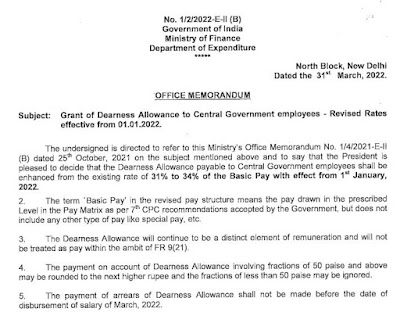
DA Jan 2022 - Grant of Dearness Allowance to Central Government employees - Revised Rates effective from 01.01.2022

 3% DA Hike - Revised Rates effective from 01.01.2022: DoE OM dated 31.03.2022 No. 1/2/2022-E-II (B) Government of India Ministry of Finance...