Tuesday, 21 June 2016

Highlights of PM Modi's address at International Yoga Day celebration in Chandigarh

Highlights of PM Modi's address at International Yoga Day celebration in Chandigarh


NEW DELHI: Prime Minister Narendra Modi launched the second International Yoga Day celebrations in Chandigarh on Tuesday. PM Modi addressed thousands of people gathered for asanas at Chandigarh's Capitol Complex. Over 30, 000 people, including 100 differently-abled children, participated in the event, which began at 6.30am. The theme of this year's event is to 'Connect the Youth'. Here are the highlights from the PM's address on Yoga Day:
  • Yoga talks about what you will get in this life. It is not a science of afterlife
  • This is a day linked with good health and now it has become a people's mass movement
  • The way mobile phone has become a part of life, you can make yoga a part of your life too
  • The UN is celebrating International Yoga Day all over the world. It was started last year on India's request. This day was picked as it is the longest day and the Earth is closest to the Sun
  • I really feel some people don't fully understand the power and benefits of Yoga
  • The world supported the idea of International Day of Yoga. All sections of society came together in this endeavour
  • This is a day linked with good health and now it has become a people's mass movement
  • Yoga is not about what one will get, it is about what one can give up
  • With zero budget, yoga provides health assurance. Yoga does not discriminate between rich and poor
  • Important to integrate yoga with our lives. Do not wait, make yoga a part of your life
  • Let's make yoga more popular globally. Let India produce good yoga teachers
  • Today more and more gynaecologists are recommending yoga for pregnant women
  • Yoga will connect you to yourself, which is vital in these times when everyone is so busy
  • Let's focus on one thing in the coming days, how to mitigate diabetes through yoga. Diabetes can surely be controlled through yoga

Today on the second International Yoga Day, on behalf of the Indian Govt, I am announcing 2 awards. Next year, on this day these awards will be given on behalf of India: (a) Best contribution to yoga internationally (b) Best contribution to yoga within India 

Source: TOI

NJCA MEETING ON 25th JUNE, 2016 AT NEW DELHI

NJCA MEETING ON 25th JUNE, 2016 AT NEW DELHI

NJCA
NATIONAL JOINT COUNCIL OF ACTION
No. NJCA/2016
Dated: June 20, 2016
To
All Constituents of the NJCA

Dear Comrades,

To review the situation and consider the developments and take appropriate decision, the National JCA will meet on 25th June 2016 at 11.30 hrs.in JCM Office, 13-c, Ferozshah Road, New Delhi.

You are requested to attend above cited meeting of the NJCA.

With Fraternal Greetings,
Comradely yours
sd/-
(Shiva Gopal Mishra)
Convener
 Source : http://confederationhq.blogspot.in/

Monday, 20 June 2016

Periodical review of performance of Government Servants as per provisions of FR 56(J) and Rule 48(1) of CCS (Pension) Rules 1972

Periodical review of performance of Government Servants as per provisions of FR 56(J) and Rule 48(1) of CCS (Pension) Rules 1972

CONTROLLER GENERAL OF DEFENCE ACCOUNTS
ULAN BATAR ROAD, PALAM DELHI CANTT-10
Date: 17-06-2016

Subject: Periodical review of performance of Government Servants as per provisions of FR 56(J) and Rule 48(1) of CCS (Pension) Rules 1972

A copy of MOD, D(lab) Branch ID No.26(1)/2015-d(Lab) dated 30.05.2016 on the above subject is enclosed herewith for compliance.

2. It is requested that compliance and action taken report may be sent to this office by 3rd of every month positively so that consolidated report may be submitted to Ministry in time.
Sd/-


IMPORTANT
MOST IMMEDIATE
GOVERNMENT OF INDIA
MINISTRY OF DEFENCE
D(LAB) BRANCH

Subject: Periodical review of performance of Government servants as per the provision of FR 56(J) and Rule 48(1) of CCS (Pension) Rules, 1972.

A consolidated instructions based on DoP&T’s guidelines on the above subject is enclosed herewith for circulation amongst the all cadre controlling authorities in MoD and Organisations/Lower formations of MoD for urgent action. It is requested that compliance and action taken report in this regard may be sent to this Ministry Positively by first of week of every month.

Enclos: as above
(Anil Kumar)
Deputy Secretary to the Govt. of India
Telefax: 23011681

CONSOLIDATED INSTRUCTIONS FOR
CARRYING OUT PERIODICAL REVIEW OF THE CASES OF GOVERNMENT SERVANTS AS REQUIRED UNDER FR 56(J)/FR56(I)/RULE 48(1)(6) OF CCS (PENSION) RULES, 1972.

Various instructions issued by the Government from time-to-time on the subject deal with compulsory retirement under the above mentioned provisions.

2. The Supreme court has observed in the state of Gujarart Vs.Umedbhai M.Patel, 2001(3)SCC 314,as follows:
(i) whenever the services of a public servant are no longer useful to the general administration, the officer can be compulsorily retired for the sake of public interest.
(ii) Ordinarily, the order of compulsory retirement is not to be treated as a punishment coming under Article 311 of the Constitution.
(iii) “For better administration, it is necessary to chop off dead wood, but the order of compulsory retirement can be passed after having due regard to the entire service record of the officer.”
(iv) Any adverse entries made in the confidential record shall be taken note of and be given due weightage in passing such order.
(v) Even un-communicated entries in the confidential record can also be taken into consideration.
(vi) The order of compulsory retirement shall not be passed as a short cut to avoid Departmental enquiry when such course is more desirable.
(vii) If the officer was given a promotion despite adverse entries made in the confidential record that is a fact in favour of the officer.
(viii) Compulsory retirement shall not be imposed as a punitive measure.

3. Accordingly, DOP&T has issued instructions vide their OM, dated 21.03.2014, 11.09.2015, 01.03.2016 for review & monitoring regularly such cases under FR 56(J) FR56(I)/RULE 48(1)(6) OF CCS (PENSION) RULES, 1972, by all the offices under the central government and sending the reports periodically.

4. The following procedures may be adopted for carrying out the Review:-
(i) Review of services of Government Servants at all levels (Group A,b (Gazetted/Non-Gazetted) & Group C including erstwhile Group D) on their attaining of age of 50/55 years or completion of 30 years of qualifying service whichever occurs earlier. Those who have already attained the age/qualifying service but have not been reviewed, should also be covered under this exercise except if they are retiring within one year on attaining the age of superannuation.

(ii) The respective Review Committee(s) should be constituted to adjudge the suitability of the Government Servant based on his/her past service and recommend for the retention or compulsory retirement.
(iii) the Internal Committees should also be constituted for each level to assist the Review Committees. The Internal Committees will screen/assess the entire service record of eligible government servants and place their findings before the respective screening committees to take a final view in the matter.
(iv) Secretaries of the Cadre Controlling Authorities/HODs will constitute Review Committees and Internal Committees consisting of TWO (02) Members at appropriate level. the approval of Defence Secretary for constitution of Review Committee/Internal committee, if required,may be processed through the Admn. Wing in MoD. Guidelines for constitution of Review committees are given at Annexure.
(Ref: DOPT’s O.M.No.25013/01/2013-Estt.A-1-IV, dated 11.09.15)

5. SCHEDULE FOR PERIODICAL REVIEW (TO BE INITIATED 6 MONTHS BEFORE DUE)
(i) the cases should be reviewed six months before he/she attains the age of 50/55 years, in cases covered by FR 56(J) and on completion of 30 years of qualifying service under FR 56(I)/Rule 48 of CCS (Pension) Rules, 1972 as per the following calendar:
Quarter in which review is to be made Cases of employees who will be attaining the age of 50/55 years or completing 30 years of service qualifying for pension

January to March July to September of the same year
April to June October to December of the same year
July to September January to March of the next year
October to December April to June of the next year


(ii) The Internal Committees will ensure that the service records of the employees being reviewed, along with a summary bringing out all relevant information, is submitted to the cadre authorities at least three months before the due date of review. However, no recommendation about retention or otherwise would be given by the Internal committee. Only views/comments/findings on each case may be given.

6. GENERAL GUIDELINES FOR REVIEW:-
(i) Doubtful Integrity: The officer would live by reputation built around him. If in any appropriate case, there may not be sufficient evidence to take punitive disciplinary action of removal from service. But his/her conduct and reputation is such that his/her continuance in service would be a menace to public service and injurious to public interest. Integrity of an employee, actions or decisions taken by the employee which do not appear to be above board, complaints received against him/her, or suspicious property transactions, for which there may not be sufficient evidence to initiate departmental proceedings, but such property transactions which give rise to suspicion about the bonafides of a government servant, may be taken into account. Acquiring large assets and getting money from subordinates can also be taken into consideration.
(ii) Government employees who are found to be ineffective will also be retired. The basic consideration in identifying such employee should be the fitness/competence of the employee to continue in the post which he/she is holding.
(iii) whenever the services of public servant are no longer useful to the general administration, the officer can be compulsorily retired for the sake of public interest.
(iv) For better administration, it is necessary to chop off dead wood, but the order of compulsory retirement can be passed after having due regard to the entire service record of the officer.
(v) Any adverse entries made in the confidential record or even uncommunicated remarks in the ACRs/APARs shall be taken note of and be given due weightage.
(vi) Even un-communicated entries in the confidential record can also be taken into consideration.
(vii) The order of compulsory retirement shall NOT be passed as a short cut to avoid Departmental enquiry when such course is more desirable.
(viii) If the officer was given a promotion despite adverse entries made in the confidential record that is a fact in favour of the officer.
(ix) In every review, the entire service records should be considered. the expression service record will take in all relevant records and hence the review should not be confined only to the consideration of the ACR/APAR dossier. the personal file of the officer may contain valuable material. similarly, the work and performance of the officer could also be assessed by looking into files dealt with by him or in any papers or reports prepared and submitted by him. Even uncommunicated remarks in the ACRS/APARS may be taken into consideration.
(X) Reports of conduct unbecoming of a Government servant that obstructs the efficiency in public services may also form basis for compulsory retirement. (for example: unauthorized proceeding on leave/failures in timely submission of IPR, criminal case/charges etc.)
(xi) while the entire service record of an officer should be considered at the time of review, no employee should ordinarily be retired on grounds of ineffectiveness if his/her service during the preceding 5 years or where he/she has been promoted to a higher post during that 5 year period, his/her service in the highest post, has been found satisfactory. It would be useful if all the data available about the officers are put together and a comprehensive brief is prepared by the Internal committee for consideration by the Review committee.
(xii) In the case of those officers who have been promoted during the last five years. the previous entries in the ACRs may be taken into account if the officer was promoted on the basis of seniority cum fitness, and not on the basis of merit.
(xiii) Ordinarily, no employee should be retired on grounds of ineffectiveness if he is retiring on superannuation within a period of one year from the date of consideration of the case. it is, however, clarified that in a case where there is a sudden and steep fall in the competence, efficiency or effectiveness of an officer, it would be open to review his case for premature retirement.
(xiv) compulsory retirement shall not be imposed as a punitive measure. Ordinarily, the order of compulsory retirement is not to be treated as a punishment coming under Article 311 of the constitution.
(xv) The supreme court had not only upheld the validity of FR 56(j) but also held that no show-cause notice need be issued to any government servant before a notice of retirement is issued.
(xvi) However, a Notice of three Months or three months pay & allowances in lieu thereof, for compulsory retirement, may be given.
(xvii) The appropriate authority defined in Note 1 below FR 56 should bonafide form an opinion that is in the public interest to retire the government servant in exercise of the powers conferred by that provision and this decision should not be an arbitrary decision or should not be based on collateral grounds.

Sunday, 19 June 2016

Non-settlement of genuine demands of the Central Government Employees

Non-settlement of genuine demands of the Central Government Employees

Ph.: 23382286
National Council (Staff Side)
Joint Consultative Machinery
for Central government Employees
13-C, Ferozshah Road, New Delhi — 110001
E Mail : nc.jcm.np@gmail.com
No.NC/JCM/2016
Dated: June 17, 2016
Respected Sir/Madam,

Sub: Non-settlement of genuine demands of the Central Government Employees

More than 32 lakh Central Government Employees working in various ministries of the Government of India, including Railways, Postal, Defence (Ordnance Factory and other Civilian Employees), Central Secretariat, Income Tax, Audit & Accounts and other employees of the government departments are aggrieved since long on non-settlement of their various demands.

The report of the VII CPC has further made them aggrieved because of the retrograde recommendations, including non-scientific calculation of Minimum Wage and Fitment Formula. The issue of National Pension Scheme(NPS) had been very heart burning for more than 1.1 million young Central Government Employees who have been deprived from the Defined Pension/Family Pension and we are agitating this issue with the Central Government since its inception.

Under the above compelled circumstances, the National Joint Council of Action has taken a decision to go on “Indefinite Strike” from 06:00 a.m. on 11th July, 2016.

The Central Government Employees of this country have always stood for the development and good governance of the country, but do feel de-motivated because of the inaction on their pending demands.
We do have written to Hon’ble Prime Minister of India vide letter No.NC/JCM/2016/CS/PM dated 14.06.2016 (copy enclosed for ready reference) with the request that the government should immediately come forward for negotiated settlement with the NC/JCM on the demands of the Central Government Employees to avoid unnecessary confrontation.

We earnestly hope that, you will kindly lay your hands and support us in our struggle as well as put pressure on the Government of India for resolution of our genuine demands at an earliest.
Yours faithfully,
(Shiva Gopal Mishra)
Secretary, Staff Side
National Council(JCM)
Mob: 9717647594

Source: ncjcmstaffside.com
Secy-Staff-Side-demands-central-government-employees

7th Pay Commission Latest News – Likely Minimum Pay 23,000 and fitment factor 2.7


7th Pay Commission Empowered Committee headed by Mr.Shri. Pradeep Kumar Sinha is in favour of increasing minimum pay and the fitment of factor – Zee News reports
7th-Pay-Commission-Latest-News


7th Pay Commission Latest News – Likely Minimum Pay 23,000 and fitment factor 2.7 – Zee News Reports on 7th CPC Empowered Committee’s proposal to Govt

All Central Government Employees would be rejoicing at the news that is published by Zee News if it turns to be a reality.

Empowered Committee that studies to suggest suitably on 7th Pay Commission recommendations is reported to have proposed a minimum basic pay of Rs. 23,000 in the place of Rs. 18,000 recommended by 7th Pay Commission.

As far as fitment factor is concerned by which the the basic pay of existing employees is to be revised, Zee News reports that fitment factor of around 2.7 has been proposed by Empowered Committee as against 2.57 recommended by 7th CPC.

Source: Zee News

The Empowered Committee of Secretaries under the chairmanship of Mr.P K Sinha, Cabinet Secretary convened a meeting on 14th June 2016 and discussed for increase in basic pay of Central Government Employees up to 30%.

As per Zee News report quoting Dainik Jagran, the Cabinet Secretary called on higher ups in Prime Minister Office on 15th June 2016 and discussed with them relating to report of Committee of Secretaries prepared so far with regard to 7th CPC related increase in pay and allowances of Central government employees.

It is also reported by Zee News that the secretaries panel which is reviewing the 7th pay commission’s recommendations submitted its report to the Finance Ministry. The Finance Ministry will prepare a note and present it before the Cabinet in the next 15 days.

While All Central Government Employees, Railway Employees Civilian Defence Employees have announced for All India Strike from 11th July 2016, it may have an impact on Govt in finalization of its decision on 7th Pay Commission recommendations as early as possible.

The central government employees and pensioners are likely to get their 6 months of arrears just ahead of the Dusshera festival in October.

As per media report, increased salary of July will be credited to the 47 lakh central government employees and 52 lakh pensioners’ accounts on August 1, 2016. But the arrears of last 6 months will be credited in one installment ahead of the Dusshera in October.

As per sources, the Empowered Committee of Secretaries headed by the Cabinet Secretary Pradeep Kumar Sinha has recommended a 30 percent increase in minimum and maximum basic pay structures along with doubling of existing rates of allowances and advances.

The 7th Pay Commission had suggested a maximum basic pay of Rs 2,50,000 and a minimum of Rs 18,000. A 30 percent increase would translate into maximum salary of Rs 3,25,000 and minimum at Rs 23,400, respectively.

Sources, further state that after getting final nod from the Empowered Committee of Secretaries, Finance Ministry will take only a few days to implement the higher pay package for central government employees.

Source: Times Group

Saturday, 18 June 2016

Finmin reject claims of inflation due to 7th Pay Commission award

Finmin reject claims of inflation due to 7th Pay Commission award

A salary hike is likely proposed by the Empowered Committee of Secretaries, which has been constituted to look into the recommendations of the 7th Pay Commission for cabinet nod, will not fuel inflation, says Finance Ministry top officials.

“The implementation of these recommendations will not affect inflation. The recommended pay scale has been hiked in line with the increasing size of the budget of government of India,” they told our reporter.
The 13-member body of Empowered Committee of Secretaries, headed by the Cabinet Secretary P K Sinha, who is processing the recommendations of the 7th Pay Commission decided to hand over soon its possible proposal to the the Finance Minister Arun Jaitley for cabinet nod. It is likely to propose a substantial pay hike which could be up to 30 per cent or even more, said officials.

the 7th Pay Commission had recommended a minimum monthly basic salary of Rs. 18,000 and maximum Rs. 2,50,000. A 30 percent increase would translate into minimum basic salary of Rs. 23,400 and maximum at Rs. 3,25,000, respectively.

However, The Empowered Committee is likely to purpose Rs 2,70,000 as highest basic pay and Rs 24,000 as the lowest, they also likely to recommend for doubling of existing rates of allowances and advances, the officials added.

The government in its annual budget has provisioned Rs 70,000 crore to meet the demand for implementation of 7th Pay Commission for central government employees which will take effect from January 1, 2016, while the allowances would be paid from the date of implementation.

“Central government employees could get the revised pay and allowances from their August salaries and arrears are to be paid ahead of festive season of Dussehra in one installment,” the officials confirmed.
The Economists fear that the 30 percent salary hike would fuel inflation as the pay commission recommendations will also have a bearing on the salaries of the state government staff.

So quite understandably, the government employees are happy as pay increase will enable them to increase their consumption and meet some of their unmet demand.

At the same time, there is a widespread fear that the pay commission recommendations are likely to increase inflation which will reduce the purchasing power of money.

RBI Governor Raghuram Rajan earlier said the 7th Pay Commission recommendations will not upset fiscal maths as additional expenditures will be offset by either surplus revenues or expenditure cuts.

Finance Minister Arun Jaitley earlier also said hat he was not worried about fiscal deficit on implementation of the pay commission’s recommendations. He said that the Pay commission award increase government expenses by Rs 1.02 lakh crore but that would not be a problem.

“The government has sufficient resources. Implementing the 7th Pay commission award will not affect inflation.” the official told our reporter.

The officials said that apart from hiking pay, the government is also likely to propose some administrative reforms, to be implemented in phases.

TST

7th CPC: Secretaries group submits final report to Fin Min; Cabinet approval in 15 days

7th CPC: Secretaries group submits final report to Fin Min; Cabinet approval in 15 days

New Delhi: It’s good news for central government employees eagerly waiting for the implementation of 7th Pay Commission.

The implementation of 7th Pay Commission appears to be a matter of a few days now. As per Dainik Jagran report, the Cabinet Secretary met the PMO officials on Wednesday and apprised them about the secretaries panel’s recommendations on the salary and allowances hike recommended for central government employees.

The secretaries panel reviewing the 7th pay commission’s recommendations have submitted its report to the Finance Ministry. The Finance Ministry will prepare a note and present it before the Cabinet in the next 15 days.

With the threat of strike by central government employees looming large, the Cabinet is expected to take a prompt decision on the recommendations resulting in notification.

The salary hikes recommended are expected to apply from July.

Read at: Zee News

7th Pay Commission – Non-settlement of demands – 11th July Indefinite Strike – NJCA writes to PM for intervention

7th Pay Commission – Non-settlement of demands – 11th July Indefinite Strike – NJCA writes to PM for intervention

Ph.: 23382286
National Council (Staff Side)
Joint Consultative Machinery
for Central Government Employees
13-C, Ferozshah Road, New Delhi – 110001
EMail: nc.jcm.np@gmail.com

NO.NC/JCM/2016/CS/PM
Dated: 14.06.2016
Hon’ble Prime Minister of India,
152, South Block,
Raisina Hill,
New Delhi-110011
Respected Sir,

Sub: Non-settlement of our demands – Decision to go on “Indefinite Strike” commencing from 11.07.2016 – Request for your intervention and support.

I write this on behalf of the apex level body of all the Central Government Employees Organizations who are participating in the Negotiating Forum; called the Joint Consultative Machinery. The JCM as a Negotiating Forum was conceived and implemented in 1966 after the prolonged discussions with the Staff Associations and the Federations in the Central Services in the wake of first industrial action in 1960. The idea of setting up the JCM was in realization of the absence of a platform to discuss, deliberate and settle the demands/issues/grievances/problems of the Civil Servants. Up to 1995-96 the JCM, which has a three level negotiating platform was functioning well, meetings were regular. However, after the promulgation of the new recognition Rules in 1993, the meetings at the Ministry level became few and far between and at the national level, the deterioration stepped in a little latter. The National Council, which was to meet thrice in a year did not meet even once in a year. The last meeting of the National Council was held on 15.05.2010 The organizations participating in the JCM were demanding the meeting to be held, but the pleas were ignored by the successive Cabinet Secretaries. The Charter of Demands (copy enclosed), in pursuance of which the strike is decided to be organized, has arisen due to long neglect of the grievances of the employees/workers.

When the 7th CPC was set up in February, 2014, no announcement for Interim Relief or DA Merger was made by the then government, which had all along been the practice whenever the government had set-up the Pay Commissions earlier. We fully co-operated with the Commission, submitted a memorandum detailing the issues and explained the reasoning behind each demand. The 7th CPC submitted report on 19.11.2015 to the government. In our communication dated 10.12.2015 (copy enclosed), we sought
improvement/amendment over the recommendations of the 7th CPC and explained our demands both in writing and orally before the Empowering Committee. Most of the meetings were monologues except perhaps the last one. What we have understood, is that, the Empowering Committee might not come forward to make any major changes. A fruitful meeting is supposed to be a dialogue where both parties at the negotiating table exchange their understanding, views and difficulties and reach a mutually acceptable position. In 1998, when the then Cabinet Secretary decided not to have such a dialogue with the Staff Side and unalterably issued the Government Notification on the 5th CPC recommendations, the then government did set up a committee of Group of Ministers. The GoM held discussions on all issues and averted the strike action. The 1998 situation establishes, without an iota of doubt, that, the Staff Side has always taken reasonable stand on all the issues and paved way for settlement.

The one and only recommendation made by the 7th CPC was to provide some relief to the past old pensioners. The Department of Pension & Pensioners’ Welfare has unfortunately recommended to the Cabinet Secretary that, even that recommendation must be rejected on the specious plea that the requisite relevant records might not be available.

These developments have caused anguish, anxiety and anger amongst the workers. It is now more than six months that the Commission submitted its report. If the government comes forward to hold a meaningful discussion with the leaders of the NJCA, a mutually acceptable settlement can be brought about and the impending strike, slated to commence from 11.07.2016, can ultimately be avoided.

We seek your co-operation, supports and intervention in the matter
Yours faithfully,
sd/-
(Shiva Gopal Mishra)
Secretary(Staff Side),
NC/JCM
Source : National Council (Staff Side)

Improve VII CPC recommendations. Revise Central Govt. employees wages immediately

Improve VII CPC recommendations. Revise Central Govt. employees wages immediately.

In the face of the unprecedented rise in the inflation of the Indian Economy during 2006-16, the Central Govt. employees demanded the Government to affect wage rise, for the emoluments fixed on the basis of the 6th CPC was incapable of meeting the both ends of an employee. Though under threat the then Government conceded the demand for setting up of the 7th CPC, they refused to grant any interim relief or DA merger, which alone would have mitigated the difficulties of the low paid employees.

When the NDA Government came to power, the NJCA & CCGGOO approached them also with a request that the difficulties of the low paid employees in Central Government must be appreciated and the demand for Interim Relief or DA merger be conceded. The NDA Government too did not respond to the plea made by the NJCA & CCGGOO.

The 7th CPC was to submit its report in August, 2016. However, at the intervention of the Government, the report was further delayed and it ultimately reached the Government only in November, 2015.
The report of the 7th Central pay commission was totally disappointing as it did not address any of the issues projected before them in a proper manner and most of the demands were rejected sans reasoning and logic. The increase they recommended was a paltry 14%, the lowest any Pay Commission had ever suggested.
Except setting up an Empowered Committee of Secretaries, the Government did not do anything so far on the report. It is now more than six months the report is with the Government. Normally the revised allowances which form part and parcel of the salary of the employees are granted with prospective effect i.e. from the date of the issue of the orders. The delay in taking decision on the 7th pay commission report will rob the employees of the increased allowances for ever.

The Staff side had been pursuing to have a meaningful negotiation and settlement of the issues. Except hearing the leaders of NJCA & CCGGOO, the empowered Committee did not go further. It acted as if it was powerless and the final decision will have to be taken by the Government. At the request of the Cabinet Secretary on 1st March, 2016 the strike action which was to commence in April, 2016 was deferred.
The determination of the Minimum wage on the basis of Dr. Aykhroyd formula enunciated in 1957 to which the Government of India was a party is the most significant issue. A right settlement thereon will have far reaching impact in the wage determination of the entire working class in the country. The confrontation is between the forces who wanted India to be the destination for cheap labour and others who fight against the exploitation.

The new Contributory Pension scheme introduced by the Government in 2004 has made one third of the Civil servants unsure of their entitlement at the evening of their life even though they were to contribute huge sums from their wages every month compulsorily. The PFRDA bill became an Act in the country as the members of Parliament both belonging to NDA and UPA voted in favour of the loot of the employees. Even the recommendation made by the Standing Committee of the Parliament to provide for a minimum guaranteed annuity pension was rejected when the Bill was passed. The other issue which must have a satisfactory settlement is about the contributory pension scheme.

The new pension scheme is a curse on the employees. As far as employees are concerned, they are worried that in future they may be deprived of their pension in total. They are also worried that there is no guarantee of either family pension or gratuity as per 7th pay commission recommendations. Scrap the PFRDA Act and NPS and grant Pension/family Pension to all CG employees under CCS (Pension) Rules, 1972 & Railways Pension Rules, 1993.

The one and only positive recommendation made by the 7th CPC was to provide some relief to the in the pension entitlement of the past pensioners. The Department of Pension & Pensioners’ Welfare has unfortunately recommended to the Cabinet Secretary that, even that recommendation must be rejected on the specious plea that the requisite relevant records might not be available.

The central government employees are very much annoyed and anxious with the 7th pay commission recommendations. As there had been no fruitful negotiations or discussions and having realized that the Government has no intention to settle the Charter of demands, the NJCA & CCGGOO have served strike notices. The indefinite strike will commence on 11th July, 2016, if no satisfactory settlement is brought about on the charter of demands. Prime Minister should intervene immediately for improvement of VII CPC recommendations and revision of Central Govt. employees wages.

Source-http://aidrdotoa.blogspot.in/

AIBOA Strike on 12th and 13th July 2016

AIBOA  Strike on 12th and 13th July 2016

ALL INDIA BANK EMPLOYEES’ ASSOCIATION
Singapor Plaza, 164, Linghi Chetty Street, Chennai-600 001
ALL INDIA BANK OFFICERS’ ASSOCIATION
A.K.Nayak Bhavan, 14, 2nd Line Beach, Chennai-600 001


CIRCULAR TO ALL UNITS
16th June, 2016
Dear Comrades,
AIBEA-AIBOA decide to plunge into immediate action to oppose attempts to denigrate Public Sector Banks and to protest against proposed merger and consolidation of Banks with a view to divert the people’s attention from the Himalayan bad loans in Banks .

12th July, 2016 – All India Strike in 5 Associate Banks
13th July, 2016 – All India Strike in ALL BANKS

All our units and members are aware of the increasing attacks being heaped on the public sector banks and the challenges faced by the PSBs.

In the name of banking sector reforms, the attempt is to privatise the Banks and hand them over to the private corporates to enable them to further loot the precious savings of the people.

The attempt is to consolidate the Banks to make them bigger with a view to globalize them instead of expanding the Banks and reach the common people within our country.

Already our Banks are bleeding due to alarming increase in bad loans, thanks to the deliberate default by the corporates and big business enterprises. Instead of taking tough measures to book the culprits and recover the loans, efforts are taken to hand over the banks to very same defaulters.

It is very clear that all their talks of banking reforms and proposals of merger and consolidation are only a ploy and game plan to divert the attention of the people from the massive bad loans in the Banks.

Our country needs strong public sector banks and not necessarily big banks or global-sized banks. Our country needs banking expansion and not consolidation of banks and shrinkage of banking services to people.

The focus should be the alarming increase in bad loans to the tune of about R. 13 lac crores. The efforts should be to recover the money by taking stringent measures and not hush it up through provisions, write-offs, CDRs and SDRs.

If the loans have been sanctioned wrongly, action should be taken on the concerned Executives. If the borrower has cheated the Banks, criminal action should be taken against the defaulter.

Providing for the bad loans, clean-up of Balance Sheet and making the Banks to incur the losses is not the solution to the problem. It is obvious, all these are only diversionary tactics to escape from the accountability for the huge bad loans.

Kingfisher Mallya is only the tip of the iceberg. There are many more sharks in the ocean of bad loans in the Banks. Why the list of defaulters is not being published by them? Why criminal action is not taken on the willful corporate defaulters? Why all velvet treatment to them? Why the attempt to convert the bad loans as equity investment in these defaulter companies? Is it the corporate governance and good governance policy of the Government ?

In IDBI Bank, 10 years ago, about Rs.9000 crores of bad loans were taken out of their books. Now another Rs. 19,000 crores is the bad loan. Instead taking action to recover these bad loans, the Government wants to privatise and sell the Bank to the very same private sector which is responsible for these huge loan default in IDBI Bank.

Hence AIBEA and AIBOA have decided to plunge into immediate action to oppose attempts to denigrate Public Sector Banks and protest against proposed merger and consolidation of Banks with a view to divert the people’s attention from the Himalayan bad loans in Banks.

Programmes

20th June Demonstrations in all centres all over the country
30th June Dharna in all State Capitals
12th July All India Strike in the 5 Associate Banks
13th July All India Strike in all the Banks

Comrades, while we are proud that we fought and achieved nationalisation of Banks, it is equally our duty to fight against the attacks on public sector banks. People’s money cannot be allowed to be looted like this. Public Sector Banks should be saved. They are nation building institutions. They must remain so.

It is time to move, time to fight. We exhort all our units and members to carry out the programme successfully and make the strikes a total success.

With greetings,
Yours comradely,
S. NAGARAJAN
GENERAL SECRETARY
AIBOA
C.H. VENKATACHALAM
GENERAL SECRETARY
AIBEA

Flash News

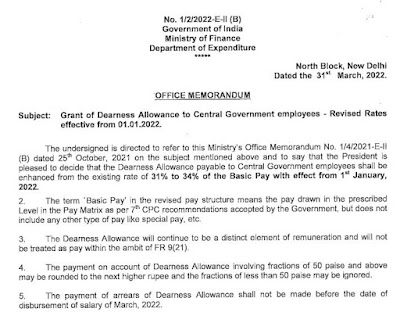
DA Jan 2022 - Grant of Dearness Allowance to Central Government employees - Revised Rates effective from 01.01.2022

 3% DA Hike - Revised Rates effective from 01.01.2022: DoE OM dated 31.03.2022 No. 1/2/2022-E-II (B) Government of India Ministry of Finance...