Sunday, 15 May 2016

Entitlement of various types of residential accommodations based on the revised Pay Scales recommended by 6th CPC

NFIR
National Federation of Indian Railwaymen

No. II/23/Part II
Dated: 13/05/2016

The Secretary (E),
Railway Board,
New Delhi

Dear Sir,
Sub: Entitlement of various types of residential accommodations based on the revised Pay Scales recommended by 6th CPC-reg.

Ref: (i) NFIR's PNM Item No. II/2014.
(ii) NFIR's letter No. II/23/Part II dated 08/04/2016.

During the course of discussions on item No. I l/2014 in the PNM meeting held with the Railway Board on 08th/09th October 2015, the Official Side stated that as per entitlement of Government accommodation applicable to Central Government employees as notified by the .Ministry of Urban Development the entitlement of employees having Grade Pay Rs. 1800/- is also a Type-I quarter. It was further stated that modification of the entitlement of employees in Grade Pay 1800/- from Type-I to Type-II is not in conformity with MOUD's Notification on the matter.

In order to examine the issue in detail and to respond further, Federation desires to have a copy of Notification issued by the Ministry of Urban Development.

NFIR, therefore, requests the Railway Board to provide copy of the notification of MOUD early.

Yours faithfully, 
(Dr. M. Raghavaiah)

Copy to the General Secretaries of affiliated Unions of NFIR.
Media Centre/NFIR.
File No. II/20l4 (PNM).

Original Circular

Empowered Committee for Running Allowance in the 7th CPC Pay Structure

Federation is for continuing the pay elements 30% and 55% of pay which are in vogue since the time of 4th CPC as far as running allowance is concerned without any dilution even when 7th CPC Pay Matrix levels are to be implemented.

 Empowered Committee for Running allowance in 7th Pay Commission Pay Structure

Railway Board has constituted Empowered Committee for Running Allowance in 7th Pay Commission Pay Structure – NFIR urges Railway Board to finalise Running Allowance related issues after due negotiations with Railway Federations soon

NFIR 
National Federation of Indian Railwaymen
No.IV/RSAC/Conf./Part VI
Dated: 11/05/2016

The Secretary (E),
Railway Board,
New Delhi

Dear Sir,

Sub: Empowered Committee for Running Allowance in the 7th CPC Pay Structure-reg.
Ref: Railway Board’s order No. ERB-U2016/23/1 dated 05/05/2016.

The Railway Board has since issued an order dated 05/05/2016 constituting Empowered Committee for Running Allowance in the 7th CPC Pay Structure. According to Board’s letter, ED/PC-I, Railway Board shall be the Convener of the Empowered Committee and five EDs of different directorates shall function as its members. In this connection, NFIR desires to convey that pursuant to bipartite agreement reached on the report of the Running Allowances Committee, 1980, the running allowance eligibility criteria, pay elements for various poses, ALK etc., were decided by the Railway Ministry in the year 1981.

With the implementation of 6th CPC pay structure (Pay Band & Grade Pay), a number of aberrations have however cropped up and all those issues were raised by NFIR in different fora. The issues were also discussed in the Fast Track Committee meetings, besides PNM and DC/JCM meetings, but unfortunately, there has been no finality till now. In the full Board meeting chaired by CRB on 7th February 2014 and in the Fast Track Committee meetings, it was decided that the running staff issues need to be dealt in the joint committee and accordingly joint committee was constituted.

Although the joint committee met twice, the issues remained unresolved. Now that the Railway Board has constituted Empowered Committee in the wake of 7th CPC report presently under consideration of the Government, the NFIR urges upon the Railway Board that the issues which are pending before the Joint Committee should be got finalized quickly. Thereafter there should be formal meetings with the Federations for discussing the new issues which may arise consequent upon the decision for implementation of VIIth CPC Pay Matrix levels. In this context, the Federation wants to remind the Railway Board that the pay elements 30% and 55% of pay which are in vogue since the time of 4th CPC should be continued without any dilution even when 7th CPC Pay Matrix levels are to be implemented. Federation hopes that the Railway Board would take note of earlier agreements reached with the Federations for ensuring that the same are not deviated.

Yours faithfully 
(Dr.M.Raghavaiah)
General Secretary
Download NFIR letter No.IV/RSAC/Conf./Part VI dated 11.05.2016 

7th Pay Commission – President NMC urged PM to Personally Intervene and Secure the Interests of the Salaried Class

President of the National Mazdoor Conference (NMC) Subash Shastri today expressed deep concern over the continued delay over non issuance of notification regarding the implementation of 7th Pay Commission recommendation till date.

7th Pay Commission – President NMC urged PM to Personally Intervene – Shastri urged Modi to liberally finance the States Governments as well so that the 7th Pay Commission recommendations are implemented simultaneously by the Centre as well as States.


President of the National Mazdoor Conference (NMC) Subash Shastri today expressed deep concern over the continued delay over non issuance of notification regarding the implementation of 7th Pay Commission recommendation till date.

In a memorandum sent to Prime Minister, Shastri has appealed him to immediately issue the said notification after review by empowered committee under expenditure secretary.

Shastri stressed upon removal of ambiguity as the issue is causing lot of hardships for salaried class and pensioners also.

“It is a cause of concern that delays in submitting its report by the committee is creating doubt in the minds of crores of employees both Centre/State Governments as the recommendations of 7th Pay Commission were to be implemented with effect from January 1, 2016, he added.

Shastri urged Modi to liberally finance the States Governments as well so that the 7th Pay Commission recommendations are implemented simultaneously by the Centre as well as States.

He urged PM to personally intervene and secure the interests of the salaried class. Shastri also appealed to raise Income Tax sealing to Rs 5 lac as the salaried class is finding it difficult to cope with increased inflation and rising costs.

Shastri reminded that NDA Government at Centre was voted to power by the urban voters of which the salaried class of Government sector formed the bulk force.

He stressed upon the need to issue notification regarding the amount of wages of daily rated workers at National level to be raised to Rs 10,000 per month as has already been principally agreed to by the Centre Government.

Source: Daily Excelsior

7th Pay Commission – 29% Central Government Employees to Retire in 10 years

“The Commission notes that losing experienced high-level personnel entails unquantifiable costs as new recruits will require training and on-the-job skills”.

7th Pay Commission – 29% Central Government Employees to Retire in 10 years – The textiles ministry has the highest proportion of employees (75%) in the 50-60 age group, followed by the coal (64%) and urban development (62%) ministries.

One of the chief problems in reforming India’s bureaucracy is that it is a powerful pressure group, which does not like to see a drop in its influence or a drop in its numbers. Now, a rare opportunity presents itself.

Of 3.3 million civilian central-government employees at the beginning of April 1, 2014, nearly one million (around 29%) are in the age group of 50-60 years, according to data released by the 7th Pay Commission recently.

“This is a ready pointer to the number of retirements that would take place in the next ten years,” said the report, running into nearly 900 pages. “The Commission notes that losing experienced high-level personnel entails unquantifiable costs as new recruits will require training and on-the-job skills. At the same time it presents ministries/departments the opportunity to align their personnel requirement in line with their current and future challenges.”

That observation is in line with a frequently mentioned need for administrative reform, which could include bringing in professionals from outside government, introducing performance-linked salaries and paying higher salaries to fewer employees.

“Successive governments have been guilty of turning a blind eye to administrative reform without which economic reform will not have its desired effect,” former cabinet secretary KM Chandrasekhar wrote in a column in The Economic Times. “The greatest obstacle to ease of doing business is administrative incapacity and, to this, governments traditionally pay no heed. It is time we brought administrative reform to the top of the governmental agenda and create systems that ensure efficiency and accountability.”

IndiaSpend’s analysis of the staffing of government departments and numbers of those facing retirement reveals the opportunities that exist in each.

The Pay Commission decides salaries and incentives for central-government employees. The Commission, which is constituted once in every 10 years, is also considered to be the base to decide salaries for state government employees.


“A central-government employee is defined as all persons in the civil services of the Central Government or holding civil posts under that government and paid salaries out of the Consolidated Fund of India. This, however, does not include such persons appointed to serve Parliament or the Union Judiciary,” the report said.

Here are some departments that have a heavy concentration of employees in the 50-60 age group:

Ministries With Experienced Personnel


Ministry Personnel (overall) Personnel (ages 50-60) Personnel aged 50-60 as % of all personnel
Textiles 3,095 2,328 75
Coal 305 196 64
Urban Development 30,665 18,962 62
Petroleum & Natural Gas 230 138 60
Science & Technology 6,680 3,787 57
Heavy Industry 246 138 56
New & Renewable Energy 187 97 52
AYUSH 164 84 51
Power 1,044 523 50


The textiles ministry has the highest proportion of employees (75%) in the 50-60 age group, followed by the coal (64%) and urban development (62%) ministries.

Among central-government employees, 22.23% are in the 20-30 age group, 22.28% in the 30-40 age group and 26.1% people in the 40-50 age group.

Age Profile of Central Government Employees
  •     50 to 60 years – 947,586
  •     40 to 50 years – 860,708
  •     30 to 40 years – 734,689
  •     20 to 30 years – 732,902
  •     Others – 21,537

While the sanctioned strength of central-government employees is more than four million, no more than 3.3 million positions are filled, indicating a vacancy of 744,000 positions or 18%.

Indian Railways – one of the world’s largest employers with more than 1.3 million – has the most vacant posts, 235,000 followed by the defence ministry (civil) at 187,000, finance ministry (over 80,000) and home ministry (over 69,000).

The government recruited 857,764 people between 2006 and 2014 – an annual recruitment of only 100,000 people every year.

During the years 2012 to 2017, India’s labour force is projected to increase by 44.6 million, which is an average annual increase of more than 8.9 million. “This suggests that the Central Government is at best a marginal source for employment generation,” said the Pay Commission report.

The recommendations of the 7th Pay Commission are likely to cost the exchequer more than Rs 1 lakh crore ($15 billion) in financial year 2016-17, an increase of 23% over existing salaries and allowances.

The 7th Pay Commission has recommended a minimum pay of Rs 18,000 per month — for peons, clerks and some police head constables — and an annual increment of 3%. It has also recommended doubling the ceiling on gratuity (lump sum paid based on years of service) to Rs 20 lakh from the current Rs 10 lakh, enhanced medical insurance and pension schemes.

Source: Business Standard

7th Pay Commission recommended that Family Planning Allowance should be abolished.

7th CPC has recommended for abolition of Family Planning Allowance since the level of awareness regarding appropriate family size has gone up among the government servants. 7th CPC is of the view that many benefits relates to children, viz., Children Education Allowance, Maternity Leave, LTC, etc., are available now.

7th Pay Commission famil planning Allowance Abolished


7th Pay Commission recommended that Family Planning Allowance should be abolished.


7th Pay Commission has proposed for abolishing Family Planning Allowance. Analysis and Recommendations of 7th Pay Commission on FPA is as follows:

Family Planning Allowance (FPA) is granted to Central Government employees as an encouragement to adhere to small family norms. The existing rates are as under:

Grade Pay Family Planning Allowance
1300-2400
210
2800
250
4200
400
4600
450
4800
500
5400
550
6600
650
7600
750
8700
800
8900
900
>10,000
1000

There are demands to make it equal to one increment. Representations have also been received requesting that the allowance should be double for those employees who adopt family planning norms after just one child.

Analysis and Recommendations

The Commission recognizes the fact that most of the benefits related to children, viz., Children Education Allowance, Maternity Leave, LTC, etc., are available for two children only. Moreover the level of awareness regarding appropriate family size has also gone up among the government servants. Hence, a separate allowance aimed towards population control is not required now. Accordingly, it is recommended that Family Planning Allowance should be abolished.

Saturday, 14 May 2016

Central Government Employees now get LTC advance ahead of 4 months of journey

Central Government Employees now get LTC advance ahead of 4 months of journey

LTC-CENTRAL-GOVERNMENT-EMPLOYEES-NEWS-ADVANCE

Relaxing norms, the government today allowed central government employees to take advance four months ahead of commencing journey under Leave Travel Concession (LTC) rules.

A government employee gets reimbursement of tickets for to and fro journey, in addition to 10 days leave encashment, when he avails LTC.

The existing rules allow an employee to draw advance for LTC journey for himself and his family members 65 days before the proposed date of the outward journey.

Since, the Ministry of Railways has decided to increase the advance reservation period for booking accommodation in trains from 60 to 120 days (excluding the date of journey) with effect from April 1 2015, the time-limit for drawable of LTC advance by the government servants may be increased from 65 days (i.e. two months and 5 days) to 125 days (i.e. four months and five days) in case of journey by train, the Office Memorandum F.No.31011/8/2015-Estt (A.IV) issued today by DoPT said.

The cases where the LTC journey is proposed to be undertaken by other modes of transport viz air, sea or road, the time-limit for drawing LTC advance shall remain 65 days only, it said.

In all the cases, where an advance is drawn for the purpose of availing LTC, it will be mandatory for the government servant to produce the outward journey tickets to the competent authority within ten days of drawable of advance in order to verify that he has actually utilised the amount to purchase the tickets, the order said.

There are about 50 lakh central government employees at present.

In another order, employees have been asked to compulsorily avail catering facilities provided by the Railways on Rajdhani and Shatabdi trains and the cost is included in the ticket.

The move comes after several references were received seeking clarification regarding the admissibility of catering charges charged by the Railways in respect of the rail journey performed by Rajdhani or Shatabdi on LTC.

The matter has been examined in consultation with Department of Expenditure, Ministry of Finance and it is clarified that if the government servant has to compulsorily avail the catering facility and the cost is included in the rail fare for Rajdhani, Shatabdi or Duronto trains, the fare charged shall be reimbursable in full as per the entitlement or eligibility of the government servant, the order added.

Inputs via PTI

Friday, 13 May 2016

Implement 7th Pay Commission recommendation: NMC

Implement 7th Pay Commission recommendation: NMC

Excelsior Correspondent

JAMMU, May 11: President of the National Mazdoor Conference (NMC) Subash Shastri today expressed deep concern over the continued delay over non issuance of notification regarding the implementation of 7th Pay Commission recommendation till date.
In a memorandum sent to Prime Minister, Shastri has appealed him to immediately issue the said notification after review by empowered committee under expenditure secretary.
Shastri stressed upon removal of ambiguity as the issue is causing lot of hardships for salaried class and pensioners also.
“It is a cause of concern that delays in submitting its report by the committee is creating doubt in the minds of crores of employees both Centre/State Governments as the recommendations of 7th Pay Commission were to be implemented with effect from January 1, 2016, he added.
Shastri urged Modi to liberally finance the States Governments as well so that the Pay Commission recommendations are implemented simultaneously by the Centre as well as States.
He urged PM to personally intervene and secure the interests of the salaried class. Shastri also appealed to raise Income Tax sealing to Rs 5 lac as the salaried class is finding it difficult to cope with increased inflation and rising costs.
Shastri reminded that NDA Government at Centre was voted to power by the urban voters of which the salaried class of G: overnment sector formed the bulk force.
He stressed upon the need to issue notification regarding the amount of wages of daily rated workers at National level to be raised to Rs 10,000 per month as has already been principally agreed to by the Centre Government.
Read at dailyexcelsior.com

Swachh Bharat Pakhwada (May 16-31, 2016) Action Plan for Pensioners Associations

Swachh Bharat Pakhwada (May 16-31, 2016) Action Plan for Pensioners’ Associations

No. 55/10/2016-P&PW (C)
Government of India
Ministry of Personnel, P.G. and Pensions
Department of Pension and Pensioners’ Welfare
3rd Floor, Lok Nayak Bhavan,
Khan Market, New Delhi
Dated the 9th May, 2015
The Secretary / President
All identified Pensioners’ Associations
(As per enclosed list)

Subject; Swachh Bharat Pakhwada (May 16-31, 2016) Action Plan for Pensioners’ Associations.

Sir,
As you are aware Government of India has launched Swachh Bharat Mission to achieve total sanitation and cleanliness by 2nd October, 2019. It has, therefore, been desired that each Ministry, based on the Ministry’s areas of responsibility, draw out and implement at least a fortnight long action plan every year to bring into focus, its contribution towards Swachh Bharat Mission and also to carry out substantive work related to Swachhta.

2. As a step towards this direction, this Department has prepared an action plan, to involve Pensioners’ Associations identified under Pensioners’ Portal in this mission, with special reference to ‘Swachh Bharat Pakhwada’ being observed during May 16-31, 2016. Under the proposed action plan, Pensioners’ Associations are expected to:-
(i) Organize a mass pledge by members of Pensioners’ Associations (copy enclosed)
(ii) Sensitize their members on cleanliness in their neighborhood.
3. In view of above you are requested to observe the Swachh Bharat Pakhwada during May 16¬31, 2016 by organizing the above activities by involving members of your Pensioners’ Associations.

4. You are also requested to take photographs of activities undertaken by you during the Pakhwada and send the same along with a report on the activities undertaken by your Association, immediately after duration of the Pakhwada, for uploading the same on Pensioners’ Portal website.
Your faithfully
sd/-
Deputy Secretary to the Govt. of India
Source: cis.nic.in

CGA OM on Rotation of Officials working in sensitive posts as per Central Vigilance Commission’s Circular

Controller General of Accounts OM referring to CVC instructions for transfering Officials who are working in sensitive posts s after every two / three years to avoid developing vested interests

CGA OM on Rotation of Officials working in sensitive posts as per Central Vigilance Commission’s Circular

CGA OM on Officials who are working in sensitive posts strictly rotated after every two/three years to avoid developing vested interests

No.C-11021/63/15/CGA/CVO/Office Guidelines/13

Government of India
Ministry of Finance
Department of Expenditure
Controller General of Accounts
(Vigilance Section)
Lok Nayak Bhawan
New Delhi the 6th April, 2016
OFFICE MEMORANDUM
Sub: Rotation of Officials working in sensitive posts – reg.

The undersigned is directed to invite a reference to this office OM No.C-11021/63/15/CGA/CVO/Office Guidelines/ 1419 dated 15.12.2015 vide which it was advised to ensure strict compliance of the Central Vigilance Commission’s Circular No. 03/09/13 issued under file No. 004/VGL/090/225553 dated 11.09.2015 dated 11.09.2015 and a list of officials rotated/transferred out of sensitive posts may be furnished to this office latest by 31.01.2016.

2. Compliance/Action taken report from your office yet to be received.

3. You are once again requested to ensure strict compliance to the Central Vigilance Commission’s guidelines and implement the same in letter and spirit immediately and submit a list of officials rotated/transferred out of sensitive posts at the earliest. A compliance report as well reasons for non-compliance by due date may be submitted to this office latest by 29.04.2016.

4. This issues with the approval of Controller General of Accounts.
(D.D.K.T. Dason)
Assistant Controller General of Accounts


No.C-11021/63/15/CGA/CVO/Office Guidelines/1419
GOVERNMENT OF INDIA
MINISTRY OF FINANCE
DEPARTMENT OF EXPENDITURE
CONTROLLER GENERAL OF ACCOUNTS
7th FLOOR.
LOK NAYAK BHAVAN
KHAN MARKET
NEW DELHI
15.12.2015
Office Memorandum

Sub: Rotation of Officials working in sensitive posts – Reg.
Attention is invited to Central vigilance Commission’s Circular No. 03/09/2013 issued under file No 004/VGL/ 090/ 225553 dated 11.09.2015 on the subject mentioned above. As per Commission’s instructions issued vide letter Nos 98/VGL/60/dated l5/4/l999. 02/11/2001 and 004/VGL/90 dated 1/5/2008 on the issue. it is prescribed that Ministries/Departments and CVOs are to identify the sensitive poets and staff working in these posts and also ensure that they are strictly rotated alter every two/three years to avoid developing vested interests.

It has also been observed in the Circular that such rotational transfers are not effected in many organisations due to which officials continue to remain in the same posts for long periods. Such overstay and continuous postings afford scope for indulging in corrupt activities. developing vested interests etc. which may not be in the interest of the organisation. The Commission had therefore emphasised for periodical rotation of officials holding sensitive posts/jobs.

In order to implement the guidelines of CVC’s circular; the following sections in the various Pay and Account Office: under the administrative control of Pr. CCAs/CCAs/CAs have been identified as sensitive:

l. Administration including Cash.
2. Pro Check.
3. Procurement/Paradise.
4. Sections dealing with banks.
5. Loans and Grants.
6. Any other section (as decided by respective Pr. CCAs/CCAs/CAs)

Further. the tenure of Sr. AOs/AOs/AAOs posted in these sections has been fixed as two years and the tenure for Sr. Accountants/Accounants has been fixed as three Years.

Rotation/transfers of all officers/officials who hove completed their tenures as per above cited guidelines they be considered. Also, while considering rotation/transfer of officials who have completed their tenures in the sensitive sections it may be ensured that they an posted to other sensitive sections only after a gap of minimum of two years. While considering rotation/transfer of officials posted in sensitive posts. officials working in non sensitive posts may also he considered for rotation/transfers after completion of six years on regular basis to improve overall efficiency of the organisation.

In cases. where AAOs are considered for promotion as AOs in the same office/Department due to administrative reasons. their services rendered in sensitive sections may be taken in to account while posting them as AOs.

All Pr. CCAs/CCAs/CAs are advised to amuse strict compliance of the Commission’s guidelines and implement me some in letter and spirit. A list of official rotated/transferred out of sensitive posts may be furnished to this office latest by 31/01/2016

This issues with the approval of Controller General of Accounts.
(Bhaskar Verma)
Dy. Controller General of Accounts (Vig)

Review of performance of public servants & Service Verification

Review of performance of public servants

In the public interest Govt can retire any Government servant by giving him notice of three months if their performance is poor.

Review of performance of public servants & Service Verification – Government has option to retire any Govt employee on attaining age of 50 if found poor performer.

Ministry of Personnel, Public Grievances and Pensions issued press release on review of performance of public servants.
Press Information Bureau
Government of India
Ministry of Personnel, Public Grievances & Pensions
28-April-2016 15:09 IST
Review of performance of public servants

The Ministry of Personnel, Public Grievances and Pensions is aware that review of performance of public servants occurs only after attaining age of 50 years or completion of 30 years of service. As per Fundamental Rule (FR) 56 (j):

“The Appropriate Authority shall, if it is in the opinion that it is in the public interest so to do, have the absolute right to retire any Government servant by giving him notice of not less than three months in writing or three months’ pay and allowances in lieu of such notice:

If he is in Group ‘A’ or Group ‘B’ service or post in a substantive, quasi-permanent or temporary capacity and had entered Government service before attaining the age of 35 years, after he has attained the age of 50 years.
(i) in any other case after he has attained the age of fifty-five years”.
(ii) In addition, as per Rule 48 of CCS(Pension) Rules, 1972, at any time after a Government servant has completed thirty years’ qualifying service, he may be required by the appointing authority to retire in the public interest, and in the case of such retirement the Government servant shall be entitled to a retiring pension provided that the appointing authority may also give a notice in writing to a Government servant at least three months before the date on which he is required to retire in the public interest or three months’ pay and allowances in lieu of such notice.
Further, as per Rule 16(3) (amended) of the All India Services (Death-cum-Retirement Benefits) Rules, 1958, the Central Government may, in consultation with the State Government concerned, require a Member of the Service to retire from Service in public interest, after giving such Member at least three month’s previous notice in writing or three month’s pay and allowances in lieu of such notice, – after the review when such Member completes 15 years of qualifying Service; or
(i) after the review when such Member completes 25 years of qualifying Service or attains the age of 50 years, as the case may be; or
(ii) if the review referred to in (i) or (ii) above has not been conducted, after the review at any other time as the Central Government deems fit in respect of such Member.
(iii) The above provisions have been reiterated from time to time and recently vide DoPT’s O.M. No. 25013/02/2005-AIS-II dated 28.06.2012 and 03.08.2015, and O.M. No. 25013/1/2013-Estt.A-IV dated 11.09.2015.
Disciplinary cases are conducted as per prescribed procedures. Normally, the details and monitoring of disciplinary cases is to be done by the respective cadre authorities. The Central Government has also from time to time been stressing on the need to complete disciplinary cases expeditiously and monitoring the same.
This was stated by the Minister of State (Independent Charge) for Development of North Eastern Region (DoNER), MoS PMO, Personnel, Public Grievances, Pensions, Atomic Energy and Space, Dr. Jitendra Singh in a written reply to a question by Shri Vivek Gupta in the Rajya Sabha today.

Press Release

Flash News

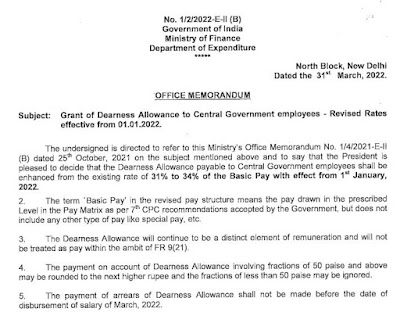
DA Jan 2022 - Grant of Dearness Allowance to Central Government employees - Revised Rates effective from 01.01.2022

 3% DA Hike - Revised Rates effective from 01.01.2022: DoE OM dated 31.03.2022 No. 1/2/2022-E-II (B) Government of India Ministry of Finance...