Showing posts with label revised pay scales. Show all posts

Friday, 6 July 2018

Board level and below Board level posts including non unionised supervisors in Central Public Sector Enterprises (CPSEs) - Revision of scales of pay w.e.f. 01.01.1017 - Payment of IDA at revised rates


Board level and below Board level posts including non unionised supervisors in Central Public Sector Enterprises (CPSEs) - Revision of scales of pay w.e.f. 01.01.1017 - Payment of IDA at revised rates
No W-02/0039/2017-DPE (WC)-GL-XIV/18
Government of India
Ministry of Heavy Industries & Public Enterprises
Department of Public Enterprises
Public Enterprises Bhawan

Block 14, CGO Complex,
Lodi Road, New Delhi-110003
Dated: 4th July, 2018
OFFICE MEMORANDUM

Subject:- Board level and below Board level posts including non unionised supervisors in Central Public Sector Enterprises (CPSEs) - Revision of scales of pay w.e.f. 01.01.1017 - Payment of IDA at revised rates- regarding.

The undersigned is directed to refer to the Para 7 and Annexure-III (B) of DPE’s OM dated 03.08,2017 wherein the rates of DA payable to the Board level and below Board level executives and non- unionized supervisors of CPSEs have been indicated. The next instalment for revision of rates of DA is due from 01.07.2018. Accordingly, the rate of DA (Dearness Allowance) payable to the executives and non-unionized supervisors of CPSEs is as follows:
(a) Date from which payable: 01.07.2018
(b) Average AICPI(2001=100) for the quarter Mar 2018- May 2018

March, 2018                      -  287
April, 2018                         - 288
May, 2018                           - 289
Average of the quarter      - 288

(c) Link Point: 277.33 (as on 01.01.2017)
(d) Increase over link point: 10.67 (288 minus 277.33)
(e) DA Rate w.e.f. 01.07.2018: 3.8% [(10.67 277.33) x 100]
2. The above rate of DA i.e. 3.8% would be applicable in the case of IDA employees who have been allowed revised pay scales (2017) as per DPE O.Ms. dated 03.08.2017, 04.08.2017 & 07.09.2017.

3. All administrative Ministries/ Departments of the Government of India are requested to bring the foregoings to the notice of the CPSEs under their administrative control for necessary action at their end.

S/d,
(Samsul Haque)
Under Secretary.

Tuesday, 28 February 2017

3rd pay panel for CPSEs suggests min Rs 30,000 for executives


3rd pay panel for CPSEs suggests min Rs 30,000 for executives

New Delhi: The third pay revision committee for central public sector enterprises has recommended minimum pay of Rs 30,000 per month for executives and a maximum of Rs 3.7 lakh for CMDs.

As per the recommendations, the minimum monthly salary of below Board level executives will increase from Rs 12,600 to Rs 30,000.

However, in case of CMDs, the maximum monthly salary for Schedule A CPSEs will go up from Rs 1.25 lakh to Rs 3.7 lakh.

In case of Schedule B, C and D CPSEs, the maximum monthly salary will be Rs 3.2 lakh, Rs 2.9 lakh and Rs 2.8 lakh, respectively.

The recommendations of the Justice Satish Chandra committee, which are to come into effect from January 1, 2017, will be placed before the Union Cabinet for approval.

Depending upon profits, the PSUs are categorised into different schedules, with highest being Schedule A. There are currently 64 Schedule A, 68 Schedule B, 45 Schedule C and 4 Schedule D CPSEs in the country.
The committee has recommended that the rate of House Rental Allowance (HRA) will be revised to 27 per cent, 18 per cent and 9 per cent when industrial dearness allowance (IDA) crosses 50 per cent, and further revised to 30 per cent, 20 per cent and 10 per cent when IDA crosses 100 per cent.

The panel recommended no change in the IDA pattern and the 100 per cent DA neutralisation shall continue to be applicable.

Revised IDA from January 1, 2017, shall be linked to All India Consumer Price Index (AICPI) (2001=100) series with the base of AICPI as on January 1, 2017 as per the quarterly average of AICPI of September, October and November 2016.

The committee has also suggested that the annual increment be retained at 3 per cent of Basic Pay.
It has further recommended that increment on promotion shall continue to be at par with the annual increment rate (3 per cent of Basic Pay).

The panel has recommended no change in the retirement age for CPSE employees.

Besides, it said that ESOP being a concept beneficial for both CPSEs and its employees, the Department of Public Enterprises (DPE) should elaborate the mechanism in consultation with concerned authorities to enable introduction of ESOP in listed CPSEs with empowerment to the Board or Administrative Ministry to approve the same.

It will be in lieu of part of performance related pay.

Profit making CPSEs, which can bear the cost of VRS with their own surplus resources, are allowed to implement VRS policy by allowing compensation/ex-gratia on the revised pay scales proposed to be effective from January 1, 2017.

The committee has also recommended a modified performance related pay but said that the overall profit distribution should be linked to 5 per cent of the annual profit accruing from core business activity.

PTI

Sunday, 15 May 2016

Entitlement of various types of residential accommodations based on the revised Pay Scales recommended by 6th CPC

NFIR
National Federation of Indian Railwaymen

No. II/23/Part II
Dated: 13/05/2016

The Secretary (E),
Railway Board,
New Delhi

Dear Sir,
Sub: Entitlement of various types of residential accommodations based on the revised Pay Scales recommended by 6th CPC-reg.

Ref: (i) NFIR's PNM Item No. II/2014.
(ii) NFIR's letter No. II/23/Part II dated 08/04/2016.

During the course of discussions on item No. I l/2014 in the PNM meeting held with the Railway Board on 08th/09th October 2015, the Official Side stated that as per entitlement of Government accommodation applicable to Central Government employees as notified by the .Ministry of Urban Development the entitlement of employees having Grade Pay Rs. 1800/- is also a Type-I quarter. It was further stated that modification of the entitlement of employees in Grade Pay 1800/- from Type-I to Type-II is not in conformity with MOUD's Notification on the matter.

In order to examine the issue in detail and to respond further, Federation desires to have a copy of Notification issued by the Ministry of Urban Development.

NFIR, therefore, requests the Railway Board to provide copy of the notification of MOUD early.

Yours faithfully, 
(Dr. M. Raghavaiah)

Copy to the General Secretaries of affiliated Unions of NFIR.
Media Centre/NFIR.
File No. II/20l4 (PNM).

Original Circular

Wednesday, 25 March 2015

Tamil Nadu Revised Scales of Pay Rules, 1989 – Selection Grade / special Grade scales of pay in the revised pay scales – Revised orders

Tamil Nadu Revised Scales of Pay Rules, 1989 – Selection Grade / special Grade scales of pay in the revised pay scales – Revised orders

TN Government Finance Department has issued an Abstract for Tamil Nadu Revised Scales of Pay Rules, 1989 for the Selection Grade/ Special Grade Scales also applicable to Secondary Grade Teacher and Headmaster Primary School.

ABSTRACT

Tamil  Nadu  Revised  Scales  of Pay Rules,  1989 — Selection  Grade/ Special Grade scales of pay in the revised pay scales –  Revised orders –  Issued.

FINANCE (CMPC)  DEPARTMENT

G.O.Ms.No.62                                                        Dated:09-03-2015.
Maasi-25,
Thiruvalluvar Aandu, 2046.
Read:
1.     G.O.Ms.No.210, P&AR(S) Department, dated: 11-03-1987.
2.     G.0.Ms.No.666,  Finance (PC) Department, dated: 27-6-1989.
3.     G.O.Ms.No.304, finance (PC) Department, dated: 28-3-1990.
4.     G.O.Ms.No.216, Finance (PC) Department, dated: 22-3-1993.

ORDER:

In the Government Order third read above, orders were issued re-introducing the Selection Grade/ Special Grade scales of pay and indicating the same in the annexure appended therein.     It has also been ordered therein that the Selection Grade/Special Grade scales of pay should be restricted to the level of first level and second level promotion posts scales of pay.

2)      Subsequently, the Tamil Nadu Administrative Tribunal in O.A.No.1625 of 1991 setting aside the entire para-4 of the Government Order third read above.   Consequently, necessary fresh orders were issued to protect certain special categories in the matter of award of Selection Grade/ Special Grade scales of pay like Office Assistants in all departments and Secondary Grade Teachers in School Education Department.

3) Consequent on the issue of the above Government Order, the following deviations have been brought to the notice of Government:–
a)  The spirit of the Government Order  is to award Selection Grade/ Special Grade to the Secondary   Grade   Teachers   by   counting   the   services   rendered prior  to  1-6-1988    on  identical  scales  of  pay.    But the  services  rendered beyond 1-6-1988    on lower scales of pay has also been taken into account which is against the general guidelines issued by Personnel and Administrative Reforms Department on award of Selection Grade/ Special Grade.
b)  In respect of awarding of Selection Grade/ Special Grade in High Schools I Higher Secondary Schools in the post of Secondary Grade Teacher, the services were counted and they were granted the scale of pay applicable to the promotion post of Primary School Headmaster, eventhough there is no scope for all the Secondary Grade Teachers to become Primary School Headmaster.
c)  The  Special Teachers and Physical Education Teachers who do not form part of a feeder category to the post of Primary School Headmaster have also been granted the scale of pay of Primary School Headmaster without considering the financial implications due to Judgement Orders and on wrong misconception of the orders issued in the Government Order third read above.

4)   Subsequent Pay Commissions   have   been   implemented  with   effect from  1-1-1996 and  1-1-2006    and  the  scales  of  pay  of  Secondary  Grade Teacher and Primary School Headmaster are fixed on two different pay scales are as follows:-


Pre-revised scale of
pay (01-01-1996)
Revised scale of pay
(01-01-2006)
Rs.
Rs.
Secondary Grade Teacher 4500-7000 5200-20200 +
Grade Pay of Rs.2800
Headmaster Primary School 5300-8300 9300-34800 +
Grade Pay of Rs.4300

As such, the services rendered in the post of Secondary Grade Teacher on a lower scale of pay cannot be counted for awarding Selection Grade/ Special Grade in the higher post of Primary School Headmaster on or after 01-01-1996.

5) Persons who are not entitled to get the benefit of higher Selection Grade/ Special Grade scales of pay applicable to  Primary School  Headmaster such as Secondary Grade Teachers in High Schools / Higher Secondary Schools as well as Special  Teachers / Physical Education Teachers filed writ petitions in the Hon’ble High  Court  seeking  legal  remedies.    In   all  such  cases  the  court  has  passed favourable orders.    It is observed that such orders were passed on the following grounds:–
(i)         Counter Affidavits were not filed properly resulting in ex-party orders passed by the Hon’ble High Court.

(ii)      Appeals were not filed in time.

(iii)     Consultation of Personnel  and Administrative Reforms Department, Finance
Department and Law Department for filing effective counter affidavits .

(iv)      Delays  in  filing   of  Writ  Appeals   or   Special   Leave  Petitions  resulted confirmation of the orders of the Hon’ble High Court.

(v)       Such court orders have been implemented and the undue benefits have been extended to the Secondary Grade Teachers as well as Special Teachers I Physical Education Teachers, consequent on filing of contempt petitions without examining the merits of individual cases which has caused a huge financial  commitment to the State Exchequer running to several crores of rupees.
6) As per the general orders in vogue, as ordered in  the Government Order first read above, the services rendered on identical and as well as higher scales of pay in the lower post can alone be taken into account for awarding Selection Grade/ Special Grade in the promotion post and no dispensation can be made in respect of any  Government  employee  including  Teachers  for  award  of  Selection  Grade/ Special Grade due to misinterpretation   of the orders  issued in the  Government Order fourth read above. Government have therefore decided to issue necessary amendment to the said Government Order to regulate the grant of Selection Grade/ Special  Grade  scales  of  pay  of  the  employees  including  Teachers  to  avoid re-opening of settled issues.

7) Accordingly,  the  following  amendment  is  issued to  para-3    (ii) of  the Government Order fourth read above:–
(1) In  respect of Secondary Grade Teachers in  High Schools I Higher Secondary Schools there is no promotion post for them.  Whereas, there is a promotion post for   the   Secondary   Grade   Teachers   in   Primary   Schools   viz.   Primary School Headmaster which envisages the restrictive proviso in para–4   of G.0.Ms.No.304,  Finance (PC) Department, dated: 28-3-1990.    As a measure of uniformity in the Selection Grade/ Special Grade  scales of pay of Secondary Grade Teachers  Government directed that the Secondary Grade Teachers in all schools be made eligible for the  Selection Grade/ Special Grade scales of pay as indicated in the Annexure-1 to the Government Order third read above.
(2) The Selection Grade/ Special Grade scales of pay indicated in the Annexure-1 to the G.O.Ms.No.304, Finance (Pay Cell) Department, dated: 28-3-1990    is applicable for the Fifth Tamil Nadu Pay   Commission period only i.e. from 1-6-1988    to 31-12-1995.     As such, the benefit of Selection Grade/ Special Grade scales of pay as contemplated   in para-3   (ii) of   G.O. Ms.No.216, Finance (Pay Cell) Department, dated: 22-3-1993    shall be made applicable  only to the cases of Secondary Grade Teachers and other employees who were awarded Selection Grade/ Special Grade between 1-6-1988    and 31-12-1995     and  the   same  cannot   be  extended   beyond  this   date   as subsequent    Pay Commission    revisions   were    implemented   with    effect from 1-1-1996 and  1-1-2006 respectively on par with the counterparts in Government of India.
(3) As the Secondary Grade Teachers in Primary schools is the feeder category for the post of Primary School Headmaster, they were allowed to count the services rendered  on  identical  scales  of  pay  prior  to  01-06-1988     in   the  post  of Secondary Grade Teachers for awarding Selection Grade/ Special Grade in the promotion post of Primary School Headmaster.  In the case of Special Teachers and Physical Education Teachers they have no chance for promotion as Primary School Headmaster and are not considered as a feeder category to the post of Primary School Headmaster with reference to Rule-2 of Tamil Nadu Elementary Education Subordinate Service Special Rules.   Hence, the Special Teachers I Physical Education Teachers are not entitled for Selection Grade/ Special Grade applicable to the post of Primary School Headmaster considering the services rendered in the post of Special Teachers/ Physical Education Teachers.
8) The  above  revised  order  shall  not  be  applicable   to  the  cases  where  orders have  already   been  issued  by  the  competent   authority   in  pursuance   to  the  court orders  and in cases where the court verdict  reached  finality.
(BY ORDER  OF THE GOVERNOR)
K.SHANMUGAM,
PRINCIPAL  SECRETARY TO GOVERNMENT.

Revision of Special Allowance and Cash Handling Allowance as a result of enhancement of Dearness Allowance w.e.f. 1.1.2014

Revision of Special Allowance and Cash Handling Allowance as a result of enhancement of Dearness Allowance w.e.f. 1.1.2014

No. 416/2008-Esft. (Pay II)
Government of India
Ministry of Personnel, Public Grievances & Pensions
Department of Personnel & Training
North Block, New Delhi
dated the 24th March, 2015
OFFICE MEMORANDUM

Subject: Revision of Special Allowance and Cash Handling Allowance as a result of enhancement of Dearness Allowance w.e.f. 1.1.2014

References are being received from various Ministries with regard to the amount of Special Allowance and Cash Handling Allowance admissible consequent upon enhancement of Dearness Allowance payable to Central Government employees @ 100% w.e.f. 1 st January, 2014 announced vide Ministry of Finance, Department of Expenditure O.M. No.1/1/2014-E-II (B) dated 27th March, 2014.

2. This Departments O.M. 4/6/2008-Est(Pay II) dated 1.10.2008 provides that the rates of Special Allowance and Cash Handling Allowance will be increased by 25% every time the Dearness Allowance payable on revised pay scales goes up by 50%.

3. All Ministries/Departments are therefore, again advised to take necessary action accordingly.
( A.K. Jain)
Deputy Secretary to the Government of India

Source: www.persmin.nic.in
[http://ccis.nic.in/WriteReadData/CircularPortal/D2/D02est/4_6_2008-Estt.Pay-II-24032015.pdf]

Tuesday, 24 March 2015

7th pay commission calculators give imaginary answers

7th pay commission calculators give imaginary answers

There is lot of calculators available in blogs and social media to calculate pay and allowance of 7th pay commission. People who saw these calculators wonder ‘did the 7th pay commission submit its Recommendation to the Government?’. OMG… When did the 7th pay commission submit its report to the central government? The Babus started enquire about these calculators from everybody who are in Federations and Associations. Even they don’t know how the pay scales would be recommended by 7th pay commission? How much percentage of increase the 7th pay commission would recommend in its report? But calculators do keep coming in day to day basis. Does it worth to calculate our basic pay through this so called 7th pay commission calculators?

Everybody should understand that to review and recommend the revised pay scales for 30 Lakhs Central Government employees is not a joke. It is just more than serious business.
The 7th pay commission comprises many Bureaucrats and many officials headed by renowned Supreme Court Judge, require more than 18 months’ time to interview hundreds of officials from Departments / Ministries and Representatives of Unions /Federations to get their views. The whole team of the 7th pay commission has to handle huge volumes of data to analyse the Service Condition and Socio Economic Conditions of the government servants before it start to recommend Pay and Allowance to entire community of the central government employees. The pay commission while recommending revision in pay and allowances has to take into account various factors like the economic conditions in the country, the resources of the Central Government and the global economic scenario as well as the impact upon the finances of the States, if the recommendations are adopted by them.

To recommend revised pay scales for 30Lakhs Central Government Employees is indeed an arduous Journey to perform. The 7th Pay commission, since its constitution, is doing commendable job. The Commission issued a Questionnaire and invited comments for their questionnaire invariably from government organizations, unions/ federations and from the Public also. Federations and Unions and Govt organization have been asked by the pay commission to submit the Memorandum to the commission.

The Seventh pay commission engaged with a variety of stakeholders, on issues which it has been mandated to cover, through series of Meetings from 16-6-2014. The Commission so far held 235 Meetings in 38 days from the Month of June 2014 to February 2015 with various Association/ Federations/Unions and Representatives of Ministries/ Departments. They have to go through all the inputs received from the above sources. All the Federations and Associations have been meeting with the 7th pay commission for the past eight months submitted their views and proposals to the commission. Since the federations, who knew their service conditions and department issues very well, have come across many pay commission, they would have discussed about their service condition and their departmental specific issues with 7th pay commission and discussed about their expectation over pay and allowances. So the only reliable source to tell anything about the Pay commission’s perspective is Pay commission officials or those who met with them. But none of them come forward to say anything about the views of 7th pay commission and never disclosed anything about the Pay Structure since they are not supposed to do so.

But so many 7th pay commission calculators keep coming in blogs. Did the Calculators do anything said above before it was made? Have these so called 7th pay commission calculators taken all the above factors in to the account before it was made? The Principles Applied for revising pay scales in each pay commission was entirely different. But, as for as sixth pay commission is concerned, the pay Structure itself was entirely different from previous Pay Structures of last 5 pay commissions. All the Unions, Associations and Federations have insisted 7th Pay Commission, through their memorandum, that the Running Pay Band and Grade Pay system to be dropped and Pre Revised Pay scale system to be adopted. So until now nobody knows what would be the principle to be adopted for revising pay scales for 7th pay commission? And what is the pay structure that 7th pay commission would recommend?

Read at: Gservants

Flash News

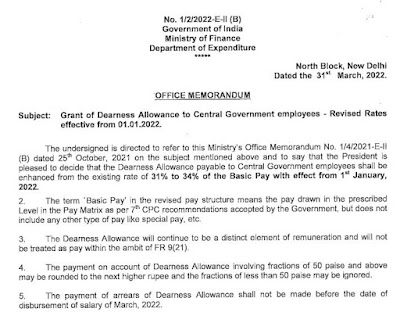
DA Jan 2022 - Grant of Dearness Allowance to Central Government employees - Revised Rates effective from 01.01.2022

 3% DA Hike - Revised Rates effective from 01.01.2022: DoE OM dated 31.03.2022 No. 1/2/2022-E-II (B) Government of India Ministry of Finance...