Tuesday, 26 April 2016

Posting of regular Under Secretary and posting on promotion to the grade of Under Secretary on ad-hoc basis – seeking options

IMMEDIATE
No.5/3/2015-CS.I(U)
Government of India
Ministry of Personnel, Public Grievances & Pension –
(Department of Personnel & Training)
*****
2nd Floor, LokNayakBhawan,
Khan Market, New Delhi-3
Dated the 26th April, 2016
OFFICE MEMORANDUM

Subject: Posting of regular Under Secretary and posting on promotion to the grade of Under Secretary on ad-hoc basis – seeking options – regarding.

The undersigned is directed to say that one Under Secretary who has returned from long leave is to be given posting. Further, it is also proposed to promote 8 Section Officers to the grade of Under Secretary from the approved panel.

2. The vacancies proposed to be filled up and the officers who are to be considered for posting are given in the Annexures to this OM. The vacancies include vacancies on account of existing vacancies and the retirement / deputation vacancies arising on 30.04.2016. Ministries/ Departments are requested to verify the vacancy position and in case of any discrepancy the same may be brought to the notice of this Department immediately.

3. The officers are requested to exercise option by 5.30 PM on 27.04.2016. The options may be submitted at the e-mail address given below as per enclosed proforma. Posting of officers will be decided in terms of Rotational Transfer Policy.

4. Web Based Cadre Management System: The officers concerned should also ensure that their data is complete in all respects in the web based cadre management system at cscms.nic.in If the data is not complete it should be first got updated through the nodal officer of the Ministry/ Department / CS.I Division before submitting the option . If the data is not complete in the web based system, the officer concerned will not be considered for promotional posting.

(Raju Saraswat)
Under Secretary to the Government of India
Tele: 24629412
Telefax: 24629414
Email: r.saraswat@nic.in
To: Officers concerned (through website of this Department)
ad-hoc-annexureI

ad-hoc-annexure
Source: Persmin

Policy Towards World War II Veterans Pensioners

Policy Towards World War II Veterans Pensioners

Ministry of Defence

The pension of World War-II pensioners was granted as per provisions of Pension Regulation for the Army in India (Part-I & Part-II) 1940, prevalent at that time. As per these Pension Regulations, there were provisions of Retiring pension, Ordinary pension, Special pension Family, Disability pension, Children Allowance and Gratuity, which were governed on the basis of different eligibility conditions like rank last held in different arms, qualifying service rendered, attributability / non attributability and aggravation etc. In addition, there was provision of ‘Jangi Inam’ for World War-I & II veteran pensioners which was payable for two lives and one life respectively. At present, the rate of monetary allowance on account of Jangi Inam is Rs.500/- per month.

The number of surviving World War-II pensioners and Family pensioners is dynamic and therefore, keeps on changing due to natural wastage. As regards actual number of World War-II pensioners, no separate data-base has been maintained to distinguish World War-II veteran pensioners vis-a-vis other pensioners.
This information was given by Minister of State for Defence Rao Inderjit Singh in a written reply to Shri Rajeev Chandrasekhar in Rajya Sabha today.

PIB

Steps Taken on Dhirendra Singh Committee Report

Steps Taken on Dhirendra Singh Committee Report

Ministry of Defence 

The Dhirendra Singh Committee submitted its Report to the Government in July, 2015. The Committee made 43 recommendations, out of which, 16 recommendations were regarding Make-in-India and 27 recommendations were regarding Defence Procurement Policy.

The Dhirendra Singh Committee recommendations have been examined by the Government and suitably factored into the Defence Procurement Procedure (DPP) 2016, which focuses on a boost to the Make-in-India initiative of the Government of India, by promoting indigenous design, development and manufacturing of defence equipment, platforms and systems.

This information was given by Defence Minister Shri Manohar Parrikar in a written reply to Shri Harivansh in Rajya Sabha today.

PIB

Over two lakh new central government jobs by 2017

Over two lakh new central government jobs by 2017

In a good news for people seeking government jobs, over two lakh posts are estimated to be created by the Central government in its various departments.

The Central government has projected in the budget estimates for 2016-17 an increase of about 2.18 lakh in the existing workforce of 33.05 lakh, as in 2015, by 2017.

The Home Ministry will add 5,635 new jobs to take its strength to 22,006 in 2017. Similarly, there will be 47,264 new posts in police departments to take its total to 10,75, 341 in 2017 from 10,28,077 (its strength in 2015), it said.

There will be increase of 10,894 in staff strength of the Defence Ministry to take the manpower count to 51,084 in 2017, according to the budget estimates presented by Finance Minister Arun Jaitley.
Minister of State for Personnel, Public Grievances and Pensions Jitendra Singh today said the projection has been made after due consideration and keeping in mind the futuristic vision of the government.

“The government, wherever required, takes into consideration creation of new posts. The budget estimates on the strength of Central government establishments will help provide good governance,” he told PTI.
The Civil Aviation Ministry will have 1,080 more posts to reach a total of 2,140 by 2017. The Ministry’s staff strength as in 2015 is 1,060, according to the budget estimates.

Similarly, the Department of Atomic Energy will add 6,353 new jobs to take the total of manpower to 38,025. There will be an estimated increase of 2,072 posts in 2017 in the External Affairs Ministry as against the actual strength of 8,913 in 2015, it said.

Mines Ministry will have 4399 new jobs by 2017. The staff strength of the ministry is 8,503, as in 2015. Similarly, the Personnel Ministry will see a jump of 1,796 new posts from 8,568 in 2015, as per the budget estimates.

The Cabinet Secretariat has already asked all ministries to mention “employment generation potential” in each scheme while seeking approval of the Union Cabinet and its Committees.

Similarly, all proposals seeking approval of appraisal bodies like Foreign Investment Promotion Board and Core Group on Disinvestment need to mandatorily mention employment generation potential, the Cabinet Secretariat has said.

PTI

Providing option of more Life Cycle Funds to the NPS subscribers

Annexure B -For Public and Stakeholders Comments 

Subject: Providing option of more Life Cycle Funds to the NPS subscribers
A. Launch of NPS and Current scenario

1. The National Pension System (NPS) was introduced in 2003 for all Central Government employees (except armed forces) who joined the service on or after 01.01.2004. The NPS marked a paradigm shift from the Defined Benefit Pension Scheme to Defined Contribution Scheme, thereby easing the escalating fiscal stress on the Government on account of rising pension liabilities. In 2009 different Schemes under the flagship of National Pension System regulated by PFRDA under the private sector and unorganised sector.

2. The National Pension System (NPS) has been arguably hailed as one of the best designed pension products domestically with its several unique features like full portability across jobs and geographical jurisdictions, choice of investment options to suit different risk appetites, option to choose from among several fund managers, no entry or exit loads, and perhaps the lowest fund management charges in the world. It is also regulated by a dedicated regulator.
3. The passage of the PFRDA Act in September 2013 followed by notification of the Act on 1st February 2014 marks an important milestone in the history of the Pension Sector reforms as the Act provides an overarching mandate to the PFRDA for promotion and development of old age security in India. In light of the paradigm shift in the pension landscape in the country, it is imperative to review the progress of NPS so far and realign the existing policy framework for Pension Funds within the mandate of the Act.

4. The NPS adopted a direct selling model to keep the costs low and to avoid the urge to mis-sell due to the embedded commissions. This distributor-free and agent-free model was designed to protect the individual and to maximise the pension wealth. It was adopted even at the risk of a slow start. The NPS architecture has been designed to create an enabling environment for the citizens to save for retirement.

5. Additionally, NPS also provides flexibility to subscribers where they can switch their pension funds among three options, i.e. equity, corporate bonds and government securities. They can also change their fund managers if they are not satisfied with the performance of Pension Funds.
B. Need of Revamping
• It is more than 12 years under NPS Govt. Sector and 6 (six) ) year since NPS was introduced in the market to cater to the retirement needs of Private Sector/Unorganised Sector subscribers.
• The NPS has made noticeable progress from the time of its inception, on boarding about 1 Crore subscribers with a total AUM exceeding 100000 crores by Dec 2015, with only 12% of the workforce covered by any kind of old age security in India, there is thus a huge untapped potential for NPS to expand. However, this would require multipronged approach with co¬operation of multiple stakeholders including Central Government, State Governments, Autonomous bodies, trade bodies, Regulators and many more.
• Besides the expansion in coverage, the provision of old age income security also entails working towards adequacy of income post working life, which can be done by optimizing returns through appropriate investment guidelines. While devising the investment guidelines, the interest of the subscriber is to be kept paramount, balancing the security aspect with adequacy of returns. While returns on investment under DC scheme cannot be guaranteed, it is important to frame guidelines, which enable the pension funds to deliver good real rate of returns to the subscriber for meaningful old age income security, which cannot be done with overload of fixed income securities. Hence, an enabling environment is required to be created for the Subscriber to maximize his/her returns depending upon his/her risk appetite.
• The fiscal stimulus being provided by the Government each year through its budget announcements are a major boost to the NPS , propelling the built up of a pensioned society.
• The experience gained since last more than decade this has been quite obvious that the NPS system has a well laid out architecture, it has been able to draw enough attention from the individual subscribers by very little marketing and publicity. It is also perceptible that investor awareness towards the various financial products has grown to the extant where subscribers can decide about the mix of asset class and Pension Fund and change the same as per its discretion.

PROVIDING OPTION OF MORE LIFE CYCLE FUNDS TO THE NPS
SUBSCRIBERS

1. The Expert Committee headed by Shri G. N. Bajpai was constituted in September 2014 to review investment guidelines for NPS in Private Sector with various terms of reference. One of the TORs was to reviewing the default scheme viz Life Cycle Fund.

2. The recommendations of EXPERT COMMITTEE TO REVIEW INVESTMENT GUIDELINES FOR NPS SCHEMES IN PRIVATE SECTOR handed over its report to PFRDA. The committee has given following deliberation on the said TOR as below:
“On the road to Prudent investor regime, the Regulator may, in the interim allow introduction of a few new schemes to test the risk appetite of the subscribers and build their confidence in asset classes perceived to be riskier viz Equity through the life Cycle fund approach. While the existing life cycle Fund shall continue to be the one with maximum investment in equity pegged at 50% (option LC50), more life cycle funds (at least two more to begin with) may be introduced keeping the core principle of “decreasing risk appetite with increasing age” intact with lower and higher ceilings in Equity to cater to both conservative subscriber and subscriber with a higher risk appetite.”
3. Further, one of the measure suggested by the said committee is to shift away from the fixed income fixated investment pattern and allowing more play to pension fund managers in equity, as a part of first phase to move to Prudential investor regime:-
“Allowing floating of life cycle funds with equity cap at 75%”.

4. Presently, NPS provides Life Cycle Fund option to the NPS subscriber with equity allocation up to 35 years is 50%. The agewise allocation of the Fund in these two Life Cycle Fund across the asset class `E’ , ‘C’ and `G’ is as under:-
Table:-1
nps-table1


38 years 44% 27% 29%
39 years 42% 26% 32%
40 years 40% 25% 35%
41 years 38% 24% 38%
42 years 36% 23% 41%
43 years 34% 22% 44%
44 years 32% 21% 47%
45 years 30% 20% 50%
46 years 28% 19% 53%
47 years 26% 18% 56%
48 years 24% 17% 59%
49 years 22% 16% 62%
50 years 20% 15% 65%
51 years 18% 14% 68%
52 years 16% 13% 71%
53 years 14% 12% 74%
54 years 12% 11% 77%
55 years 10% 10% 80%

1. In view of the para 2 & para 3 above, we have designed two more Life Cycle Fund may be called as “Aggressive Life Cycle Fund” with equity allocation of 75% at the age of 35 years and “Conservative Life Cycle Fund” with equity allocation of 25% at the age of 35 years. The proposed agewise allocation of the Fund in these two Life Cycle Fund across the asset class ‘E’ , ‘C’ and ‘G’ is as under:-

Table:-2
Aggressive Life Cycle Fund
Age Asset Class E Asset Class C Asset Class G
Up to 35 years 75% 10% 15%
36 years 71% 11% 18%
37 years 67% 12% 21%
38 years 63% 13% 24%
39 years 59% 14% 27%
40 years 55% 15% 30%
41 years 51% 16% 33%
42 years 47% 17% 36%
43 years 43% 18% 39%
44 years 39% 19% 42%
45 years 35% 20% 45%
46 years 32% 20% 48%
47 years 29% 20% 51%
48 years 26% 20% 54%
49 years 23% 20% 57%
50 years 20% 20% 60%
51 years 19% 18% 63%
52 years 18% 16% 66%
53 years 17% 14% 69%
54 years 16% 12% 72%
55 years 15% 10% 75%

Table:-3
Conservative Life Cycle Fund
Age Asset Class E Asset Class C Asset Class G
Up to 35 years 25% 45% 30%
36 years 24% 43% 33%
37 years 23% 41% 36%
38 years 22% 39% 39%
39 years 21% 37% 42%
40 years 20% 35% 45%
41 years 19% 33% 48%
42 years 18% 31% 51%
43 years 17% 29% 54%
44 years 16% 27% 57%
45 years 15% 25% 60%
46 years 14% 23% 63%
47 years 13% 21% 66%
48 years 12% 19% 69%
49 years 11% 17% 72%
50 years 10% 15% 75%
51 years 9% 13% 78%
52 years 8% 11% 81%
53 years 7% 9% 84%
54 years 6% 7% 87%
55 years 5% 5% 90%

• Further, the existing Default Life Cycle ( LC 50 ) can be made more dynamic , reviewing the ECG pattern as per the market conditions.
• Another Life Cycle fund with Alternative asset class with a cap of 5 % can also be introduced.

Note: Comments may be offered vide e-mail on sumeet.kapoor@pfrda.org.in or in hard copy to the below address-
To,
Ms. Sumeet Kaur Kapoor
Pension Fund Regulatory and Development Authority 1st Floor, Chatrapati Shivaji Bhawan
B-14/A, Qutub Institutional Area
New Delhi-110016

Prepare for strike we are sure the of getting better wage hike.

Prepare for strike we are sure the of getting better wage hike.
7th-CPC-Salary-Hik-Strike
Comrades,

The flash strike against the recent PF Rules, 2016 of the Central Government (i.e., Centre’s new rule on Provident Fund withdrawal) by large section of Garment Factory Workers and other Industrial Workers of Karnataka State on 18th and 19th April 2016 received immense response and there was a massive protest which resulted in road blocks for hours together, thereby the entire traffic of Bengaluru City was paralyzed. The traffic was also severely affected on Mysore, Tumkur and Hosur roads.

The COC Karnataka extended moral support and sympathy for this Labour Movement. The February 10th notification was under attack from trade unions from the beginning. The notification was published in the gazette on February 26 and created technical problems.

The violence in Bengaluru prompted the Labour Ministry, Govt. of India to cancel the February 10 notification which put restrictions on 100% withdrawal from the PF account.

Within few hours of protest in Bengaluru and other parts of Karnataka state , the Hon’ble Minsiter for Labour, Shri.Bandaru Dattatreya acted upon and withdrawn the notification issued on February 10th and informed that the old system will continue. This is a victory for the workers of the country.

This clearly shows that the Government of India does not want to antagonize the workers. If the Central Government employees also participate in trade union action against the retrograde recommendations of the VII CPC similar to the Garment Workers of Karnataka, we too can get similar results and hope for a better wage revision and a decent wage hike.

This Labour movement of the Garment Workers of Karnataka state is an eye-opener for all other working class in the entire country, Comrades if one state and one particular working class movement can bring changes to the policy of the Central Government, if the entire the entire country the Central Government employees agitate against the retrograde recommendations of the 7th CPC (where only 14 % wage hike was provided against the staff side demand of 80% wage hike and also reducing the number of allowances and reduction in HRA rates) then the Central Government shall provide the decent wage hike by settling the issue of wage hike with the staff side NJCA like the PF issue being settled.

Comrades it is high time to prepare for 11th July strike of Central Government employees under the banner of NJCA. We shall get good results and Central Government shall grant better wage hike than the 7th CPC recommendations. Better we prepare for 11th July strike better wage hike we get.
Comradely yours
(P.S.Prasad)
General Secretary
Source:http://karnatakacoc.blogspot.in/2016/04/prepare-for-strike-we-are-sure-of.html

Monday, 25 April 2016

Contact details of all CPCC Bank Branches – LIST OF CPPCs

Central Pension Accounting Office(CPAO) published a detailed list of CPCC Bank Branches and their address, email and phone numbers. We reproduced and given below for your information…

LIST OF CPPCs

Sl. 
No.
Name of the CPPCs CPPCs Address E-mail Address  Contact Numbers
1 SBI, Gujarat State Bank of India (CPPC)
th floor, Gandhinagar Zonal office
Opp. New Sachivalaya,Sector 10-B
Gandhinagar (Gujarat) – 382010
cmcppc.zoahm [@] sbi.co.in PH: 079-23245511-15
2 SBI, Karnataka State Bank of India (CPPC)
12/13, Lakshmayya Layout
Ganganagar (North)
Banglore (Karnataka) – 560024
cppc.bangalore [@] sbi.co.in PH: 080-25943661/62
3 SBI, M.P. State Bank of India (CPPC)
SBI Govindpura Branch Premises,
Govindpura, BHEL,
Bhopal (M.P.) – 462011
sbi.04467 [@] sbi.co.in PH: 0755-4206745/2600836
4 SBI, Odissa State Bank of India (CPPC)
161/162, CSD Building,
Bomikhal,Puri- Cuttack Road,
Bhubaneswar (Odissa) – 751006
cmcppc.zobhu [@] sbi.co.in PH: 0674-2572950/ 2572170
5 SBI, Haryana State Bank of India (CPPC)
Administrative Office Building,
nd floor, Plot No.-I/2, Sector- 5,
Panchkula (Haryana) – 134109
sbi.04469 [@] sbi.co.in PH: 0172-4569231/ 2570755
6 SBI, Chennai State Bank of India (CPPC)
112/4, KalimmanKoli Street,
Virugambakkam, Chennai -600092
cppc.zoche [@] sbi.co.in PH: 044-23772754/55
7 SBI, Delhi State Bank of India (CPPC)
SBI ChandniChowk Branch Premises,
nd floor, ChandniChowk,
Delhi – 110006
sbi.04475 [@] sbi.co.in PH: 011- 23888324,
23888301(AGM)
23888327, 23888309/302
8 SBI, Assam State Bank of India (CPPC)
th floor, Sethi Trust Building,
G.S. Road, Bhangagarh,
Guwahati (Assam) – 781005
cppc.zoguw [@] sbi.co.in PH: 0361-2463104
9 SBI, Andhra Pradesh State Bank of India (CPPC)
1/7/387, GNR Heights, 1 st floor,
Murshidabad Main Road,
Opp. Guru Nanak Care Hospital,
Hyderabad
(Andhra Pradesh) – 500020
sbi.04472 [@] sbi.co.in PH: 040-27670149
10 SBI, West Bengal State Bank of India (CPPC)
th Floor, Block-c, Samridhi Bhavan-1,
Strand Road,
Kolkata
(West Bengal) – 700006
sbi.04473 [@] sbi.co.in PH: 033-22570827
11 SBI, Uttar Pradesh State Bank of India (CPPC)
Sector – 1 Jankipuram,
Lucknow (U.P.) – 226021
cppc.04474 [@] sbi.co.in PH: 0522-6542211
12 SBI, Mumbai State Bank of India (CPPC)
th floor Premises No. T-651 & T-751, I.T.C.
Belapur, CBD Belapur Railway Station
Complex, Navi Mumbai– 400614
cppc.mumbai [@] sbi.co.in PH: 022-27574786/ 27565475
13 SBI, Bihar State Bank of India (CPPC)
th floor, Administrative Building,
Judges Court Road,
Patna (Bihar) – 800001
sbi.04476 [@] sbi.co.in PH: 0612-2677570/ 6451436
14 SBI, Kerala State Bank of India (CPPC)
GanpathyKovil Road, Vazhuthankadu,
Thiruvananthapuram (Kerala) – 695014
cppc.zotri [@] sbi.co.in PH: 0471-2326986/87
15 Allahabad Bank
Uttar Pradesh
Allahabad Bank
CPPC, 3 rd floor, Zonal Office,
New Building, Hazaratganj,
Lucknow (U.P.)- 226001
cppc [@] allahabadbank.in PH: 0522-2286489
16 Andhra Bank,
Andhra Pradesh
Andhra Bank (CPPC)
Head Office, Andhra Bank Building,
th floor, Koti, Sultan Bazar,
Hyderabad (Andhra Pradesh) – 500195
abcppc [@] andhrabank.co.in PH: 040-24757828 / 24757153
17 Bank of Baroda
New Delhi
CPPC, Bank of Baroda
13 th floor, Buliding
16 Parliament Street
New Delhi- 110001
cppc.ho [@] bankofbaroda.co.in
govtbusiness.ho [@] bankofbaroda.com
gb.delhi [@] bankofbaroda.com
Chief Mgr.(Baroda) -0265-2225899
18 BOI,
Maharashtra
Bank of India (CPPC)
Bank of India Building,
87-A, 1 st floor, Gandhibaug,
Nagpur (Maharashtra) – 440002
cppc.nagpur1 [@] bankofindia.co.in
ho.gbd [@] bankofindia.co.in
headoffice.gov [@] bankofindia.co.in
SK Ganju(GM) – 022-66684471
PH: 0712-2764341/ 2764091-95
19 Bank of Maharashtra,
Maharashtra
Bank of Maharashtra (CPPC)
1177, 2 nd Floor, BudhwarPeth,
Janmangal, Bajirao Road,
Pune (Maharashtra) – 411002
bom1407 [@] mahabank.co.in Ms. Kuber (Mgr)- 022-24467937/38
20 Canara Bank
Karnataka
Canara Bank (CPPC)
Chitrapur mutt complex,
15 th cross malleswaram
Bangalore,
(Karnataka) -560001
cppc [@] canarabank.com PH: 080-25596693
21 Central Bank of India,
Maharashtra
Central Bank Of India (CPPC)
nd floor, MMO Building
M.G. Road, Fort,
Mumbai (Maharashtra) – 400001
cmcppc [@] centralbank.co.in
cppc [@] centralbank.co.in
PH: 022-22703216/17
22 Corporation Bank
Karnataka
Corporation Bank (CPPC)
Pandeshwar, Mangladevi Temple Road,
Manglore (Karnataka) – 575001
hogovt [@] corpbank.co.in PH: 0824-2426532 / 2441425
23 Dena Bank
Maharashtra
Dena Bank (CPPC)
Mumbai Main Office,
17, Hornimon Circle,
Mumbai (Maharashtra) – 400023
gbd [@] denabank.co.in
ro.newdelhi [@] denabank.co.in
kapoorramakant [@] gmail.com
joshianandp [@] gmail.com
Mob.- 09594942594
24 IDBI Bank
Maharashtra
IDBI Bank (CPPC)
Government Business Operations,
Corporate Park, Unit No.-2, Behind Swastik
Chambers, SION-Trombay Road,
Chembur, Mumbai (Maharashtra) -400071
pradnya.mandhare [@] idbi.co.in
bp.patil [@] idbi.co.in
v_acharya [@] idbi.co.in
Ms. Pradnya (Mgr) – 022-66908489
PH: 022-66908405
25 Indian Bank Tamilnadu Indian Bank
Centralised Pension Processing Centre,
th Floor, No. 66, RajaJi Salai,
Chennai (Tamilnadu) – 600001
cppc [@] indianbank.co.in Phone : 044- 25231756/25231757
FAX : 044 – 2523 1751
Cell No : 9445030401 / 2
26 Indian Overseas Bank
Tamilnadu
Indian Overseas Bank
Central Pension Processing Centre,
Central Office,763, Anna Salai,
Chennai (Tamilnadu) – 600002
cppc [@] iobnet.co.in PH: 044-28889383/ 28519433
27 Oriental Bank of Commerce,
Haryana
Oriental Bank of Commerce (CPPC)
Corporate Office, Plot No.-5, Institutional
Area, Sector-32,
Gurgaon (Haryana)- 122001
cppc [@] obc.co.in
pnd [@] obc.co.in
PH: 0124-4126379 (AGM)
/4126527(DGM)
28 Punjab & Sind Bank,
New Delhi
Punjab & Sind Bank (CPPC)
H.O. P & D Department,
A-25, 1 st floor, Community Centre,
JwalaHeri, PaschimVihar,
New Delhi – 110063
cppc [@] psb.org.in PH: 011-25271585/ 25281210
29 PNB, New Delhi Punjab National Bank (CPPC)
st floor, Gurudwara Road, Karol Bagh,
New Delhi – 110055
cppcdel [@] pnb.co.in
hogbd [@] pnb.co.in
bo4421 [@] pnb.co.in
Chief Mgr. –
08527707999 / 09910900706
30 State Bank of Bikaner & Jaipur,
Rajasthan
State Bank of Bikaner & Jaipur
Centralised Pension Processing Centre,
nd floor, S.M.S. Highway,
Jaipur (Rajasthan) –302005
cppcjpr [@] sbbj.co.in
sbbj10016 [@] sbbj.co.in
PH: 0141-2227758/ 5172259
31 State Bank of Hyderabad,
A.P.
State Bank of Hyderabad (CPPC)
st floor, Methodist Complex, Opposite
Chermas, Abids,
Hyderabad (A.P.) – 500001
cppc-hyd [@] sbhyd.co.in PH: 040-23387414/ 23382881-882
32 State Bank of Mysore,
Karnataka
State Bank Of Mysore (CPPC) cppcmangalore [@] sbm.co.in PH: 0824-2496073/75
33 State Bank Of Patiala
Punjab
State Bank Of Patiala
Centralised Pension Processing Cell,
SCO 114, 1 ST Floor Urban Estate, Phase-II,
Patiala (Punjab)-147002
infocppc [@] sbp.co.in PH: 0175-2302817 /
2283322/2280272
34 State Bank Of Travancore,
Kerala
State Bank Of Travancore (CPPC),
Chembikalam Building 3 rd floor,
Vazhuthacaud,
Thiruvananthapuram
(Kerala) – 695014
cppc [@] sbt.co.in PH: 0471-2326525 /
35 Syndicate Bank,
Karnataka
Syndicate Bank (CPPC)
Central Accounts Department
nd Floor, SYNDICATE BANK H.O.-
Manipal, TQ- UDUPI,
(Karnataka) – 574104
syndcppc [@] syndicatebank.co.in PH: 0820-2575402 /
2571196/2574075
36 Union Bank Of India,
Maharashtra
Union Bank Of India (CPPC)
Government Banking Division, PBOD,
12 th floor, Union Bank Bhavan,
239, VidhanBhavanMarg, Nariman
Point,Mumbai (Maharashtra) –400021
nkramachandran [@] unionbankofindia.com
govtbusiness [@] unionbankofindia.com
puneetrai [@] unionbankofindia.com
bansal [@] unionbankofindia.com
PH: 022-
22896677/22896678/ 22020242-43
022-22896600/ 22838824
37 United Bank of India
West Bengal
United Bank Of India
CPPC, 4 th floor, Head Office,
11,HemantaBasuSarani,
Kolkata (West Bengal) -700001
homail [@] unitedbank.co.in
cmcppc [@] unitedbank.co.in
PH: 033-22622549/22621042
38 United Commercial Bank,
Maharashtra
United Commercial Bank (CPPC)
Somalwar Bhavan, 1 st floor,
Mount Road Extension, Sadar,
Nagpur (Maharashtra) – 442001
cppcna [@] ucobank.co.in
cppcna [@] gmail.com
PH: 0712-2559919/60
39 Vijaya Bank,
Karnataka
Vijaya Bank (CPPC)
Merchant Banking Division,
Head office, 41/2, M.G. Road, Trinity
Circle, Banglore (Karnataka) – 560001
mbd.pension [@] vijayabank.co.in
cmmbd [@] vijayabank.co.in
mbddgm [@] vijayabank.co.in
PH: 080-25584644
40 Axis Bank Ltd.
Maharashtra
Axis Bank Ltd. (CPPC)
Centralised Reconciliation & Settlement Cell
th floor, Gigaplex Building No. 1,
Plot No. I.T. 5, Airoli Knowledge Park, Airoli,
NaviMumbai (Maharashtra)- 400708.
cpu.pension [@] axisbank.com
gupta-vikas [@] axisbank.com
DebrajSaha (AVP) – 011-43506532
PH: 022-24253687
41 HDFC Bank Limited,
Haryana
HDFC Bank Limited(CPPC)
th floor, Vatika Atrium, Block-A,
Golf Course Road, Sector-53,
Gurgaon (Haryana)- 122002
suraj.tiwari [@] hdfcbank.co.in PH: 012-44664000/44664503
42 ICICI Bank Ltd.
Maharashtra
ICICI Bank Ltd. (CPPC)
ICICI Bank Tower, 6 th floor, Autumn
Estate, Chandivali, Andheri East,
Mumbai (Maharashtra) – 400072
pawan.mantri [@] icicibank.com
maya.shanbag [@] icicibank.com
vaibhav.sin [@] icicibank.com
Mr. nMantri: 022-61375108
Ms. Maya Shanbag: 022-26537358

Authority: http://cpao.nic.in/

Two Critical Point highlighted to Empowered Committee by Dorai on 7th CPC

Two Critical Point highlighted to Empowered Committee by Dorai on 7th CPC

7th-CPC-DORAI
In addition to the various genuine demands raised by the various Central Government Employees Federations/Associations with the Empowered Committee of Secretaries, I would like them to bring these 2 important crucial issues before the Empowered Committee of Secretaries for implementation:

1. RETENTION OF 3% INCREMENT IN VII CPC RECOMMENDATIONS IN CASE OF PROMOTION LEADS TO LOWER FINANCIAL BENEFITS BY FEW THOUSANDS THAN THE EXISTING BENEFITS UNDER 6TH CPC RECOMMENDATIONS:

The financial benefit would be much lower than what a government servant would be getting under VI CPC recommendation on promotion, because the existing benefit on promotion carry change in grade pay apart from 3% increase in Pay+Grade Pay. The following illustration shall show the huge difference:

Suppose an employee whose Pay is Rs.10400/- and the Grade pay is Rs. 2800/- totalling to Rs.13200(in the Pay band of 5200-20200), gets his next promotion to the Grade Pay of Rs.4200/- he will be entitled to the following hike in total remuneration under the existing VI CPC recommendation as a result of promotion:

Rs.13200 x 3% increment =Rs.400
Difference in Grade Pay from Rs.2800 to Rs.4200= Rs.1400
Total increase of increment in basic pay and Grade Pay= Rs.1800
D.A. at 125% as on 1/1/2016 on Rs.1800 = Rs.2250
HRA at 30%(assuming X city) on Rs.1800 =Rs.540
Total monetary benefit = Rs.4590/-

Whereas the net monetary benefit under VII CPC recommendation, as a result of promotion in the above case will be much lower than the above illustration as shown under:

Equivalent Basic Pay for Rs.13200 come to Rs.33900 as per pay matrix
Rs.33900 x 3% increment =Rs.1017(placed at Rs.35,400 as per pay matrix in the next level)
Total difference Rs.35400 – Rs33900 =1500
D.A. at 0% as on 1/1/2016 on Rs.1500= 0
HRA at 24%(assuming X city) on Rs.1500 =Rs.360

Total monetary benefit = Rs.1860/-only as against the existing Rs.4590/- leading to shortage of Rs. 2730/-
This is a big blunder committed by the VII Pay commission.

Therefore the increment on promotion should be atleast 5 to 6% to bring the benefit of increment on promotion to the existing level.

Whether increase of percentage for annual increment is considered or not, but increment of percentage for promotions definitely need to be implemented to bring the level of monetary benefit to the existing level.

2. NON RECOMMENDATION OF VII CPC REGARDING MERGER OF 50% OF D.A. WITH BASIC PAY WHEN D.A. CROSSES 50% IS A GREAT DISAPPOINTMENT:

The long standing demand of the central government employees for merger of 50% D.A with basic was not implemented by the government on the excuse that the VI CPC had not made such a proposal. Even the VII CPC is totally silent about this aspect. It appears no one has demanded the same before the VII CPC for consideration.

It is quite surprising that such a vital issue of non-recommendation of merger of D.A with basic pay when D.A crosses 50% is not being opposed by any central government associations or pointed out by the media. Had it been recommended by the VII CPC, the government shall definitely implement the same and the benefit of hike in salary as a result of merger of D.A with basic when it cross 50%, would be so vast that no government servant would crave for timely setting up of next VIII Central Pay commission.

M.DORAI 

Rates of Dearness Allowance applicable w.e.f. 1.1.2016 to employees of Central Government and Central Autonomous Bodies continuing to draw their pay in the pre-revised scale as per 5th Central Pay Commission

5th CPC Da order w.e.f 01.01.2016
dearness-allowance-5th-CPC

No. 1(3)/2008-E.II (B)
Government of India
Ministry of Finance
Department of Expenditure

North Block, New Delhi Dated the 22nd April, 2016.

OFFICE MEMORANDUM

Subject: Rates of Dearness Allowance applicable w.e.f. 1.1.2016 to employees of Central Government and Central Autonomous Bodies continuing to draw their pay in the pre-revised scale as per 5th Central Pay Commission.

The undersigned is directed to refer to this Department’s O.M. of even No, dated 1st October, 2015 revising the rates of Dearness Allowance in respect of employees of Central Government and Central Autonomous Bodies who continue to draw their pay and allowances in the pre-revised scales of pay as per 5th Central Pay Commission.

2.The rates of Dearness Allowance admissible to the above categories of employees of Central Government and Central Autonomous bodies shall be enhanced from the existing rate of 234% to 245% w.e.f. 1.1.2016. All other conditions as laid down in the O.M. of even number dated 3rd October, 2008 will continue to apply.

3.The contents of this Office Memorandum may also be brought to the notice of the organizations under the administrative control of the Ministries/Departments which have adopted the Central Government scales of pay.
(Nirmala Dev)
Deputy Secretary to the Government of India

Government likely to implement 7th Pay Commission award around September-October

Government likely to implement 7th Pay Commission award around September-October

New Delhi: The Central government employees will have to wait till September-October to get higher salaries under the 7th Pay Commission.

As per a Financial Express report, government is expecting that higher salaries released around the festival period starting with Durga Puja and Diwali will boost consumption, which will have a multiplier effect on the economy.

Though the employees will get arrears with retrospective effect from January 1, no retrospective arrears in allowances will be given. With the move, the exchequer would be able to save around Rs 11,000 crore.

The commission had estimated the additional outgo in FY17 due to its award at R73,650 crore.

Source: zeenews.india.com

Flash News

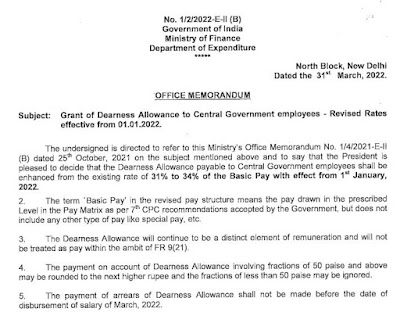
DA Jan 2022 - Grant of Dearness Allowance to Central Government employees - Revised Rates effective from 01.01.2022

 3% DA Hike - Revised Rates effective from 01.01.2022: DoE OM dated 31.03.2022 No. 1/2/2022-E-II (B) Government of India Ministry of Finance...