Showing posts with label NPS SCHEMES. Show all posts

Thursday, 22 March 2018

NFIR - Exemption of Railways from New Pension Scheme (NPS)


NFIR - Exemption of Railways from New Pension Scheme (NPS)
Dated : 19/03/2018
No. IV/NPS/PFRDA BILL/Part I
Shri Piyush Goyal,
Hon'ble Minister of Railways
Rail Bhavan,
New Delhi

Dear Shri Goyalji,
Sub: Exemption of Railways from New Pension Scheme (NPS) - reg.

Ref: (i) Hon'ble MR's D.o. No. 2012/F(E)III/1/4-Pt dated 29th March 2014 to Hon'ble Finance Minister, Government of India.
(ii) Hon'ble MR's D.O. No. 2012/F(E)III/I/4-Pt dated 20th Nov 2015 to the Hon'ble Finance Minister Shri Arun Jaitley.
(iii) NFIR's letter No. IV/NPS/PFRDA BILL/Part I dated l3th Feb, 2017,26th Oct, 2017 and 11/12/2017.
(iv) Railway Board's letter No. 2012/F(E)/III/1(1)/4-Pt dated 13/02/2018 to GS/NFIR.

Kind attention is invited to the correspondence cited under reference, latest being Railway Board's reply received vide letter dated 13/02/2018 wherein the Federation has been conveyed that the Hon'ble Minister of Finance and Corporate Affairs has communicated that the matter was re-considered in consultation with Pension Fund Regulatory and Development Authority (PFRDA) and the request for exempting Railway employees appointed on or after 01/01/2004 from the application of NPS does not seem to be a feasible proposition. While NFIR does not agree with the reply of Hon'ble Finance Minister, the Federation re-iterates the valid points placed below, urging upon the Railway Ministry to impress upon the Government, the need for exempting Railways from National Pension System (NPS).

The Ministry of Finance and the Pension Fund Regulatory and Development Authority (PFRDA) have failed to appreciate the facts that the nature of duties performed by the Railway employees is un-comparable, unique, complex, hazardous and akin to the duties being performed by the Armed Forces, in whose case the NPS has not been made applicable.

The Finance Ministry has also failed to appreciate that even during the British rule the Indian Railways was conceived and operated as an auxiliary wing of the Army by virtue of its complex nature of role and uniqueness of working of Railway employees which in turn requires a high degree of discipline, efficiency to run the services and carry passenger and freight traffic throughout the country including supplies to the borders of the nation.

The Finance Ministry has also failed to evaluate that it is the Indian Railways which works as supply line to the Armed Forces during crisis periods by transporting troops from one comer to the other including the nation's borders besides transporting Military hardware and other war material. In no way the performance of Railway employees can be underestimated than that of the Defence Forces Personnel.

Like Armed Forces, many of the Railway Personnel do stay away from their families for longer durations in the course of performing duties at remote places where minimum basic amenities like suitable accommodation, schooling, drinking water, health care facilities have been missing' Comparing the structure and importance of Railways with that of the Army, it would not be out of place to state that just as the 'Army requires a critical mass to fight battle/war, in similar way critical mass of trained employees is required to maintain Railway Tracks, Rolling Stock and ensure operation of services'. On an average over 700 Railway employees die per annum while performing their duties and nearly 3000 employees sustain injuries as reported by High Level Safety Review Committee (HLSRC) headed by Shri Anil Kakodkar. The sacrifices of Railway employees are unParallel.

Considering the strong merits in the demand of the Federation, Hon'ble MRs have written to the Minister of Finance to have a re-look into the case to be considered favourably to exempt Railways from the ambit of National Pension System (NPS).

Federation desires to mention that the Finance Ministry has erred and equally not considered the justified demand of the Railway employees projected by NFIR, perhaps applying different logic and ignoring the facts mentioned above. In this connection, NFIR reminds that the Federation leaders in the meeting held on 09th February, 2018 at Rail Bhavan, New Delhi had specifically requested the Hon'ble MR to kindly reach the Hon'ble Prime Minister for getting Railways exempted from the application of National pension System (NPS). It is a known fact that the NPS has generated lot of anger and anguish among the younger generation of Railway employees appointed on or after 01/01/2004 due to the inherent disadvantages of the NPS which does not guarantee even minimum pension i.e. half of the last pay drawn by the Railway employees.

NFIR, therefore, once again urges upon the Hon'ble MR to kindly take steps for reaching the Hon'ble Prime Minister for getting exemption of Railways from NPS at an early date'
With regards,
Yours Sincerely
S/d,
(Dr. M. Raghavaiah)
General Secretary
Source : NFIR

Tuesday, 26 April 2016

Providing option of more Life Cycle Funds to the NPS subscribers

Annexure B -For Public and Stakeholders Comments 

Subject: Providing option of more Life Cycle Funds to the NPS subscribers
A. Launch of NPS and Current scenario

1. The National Pension System (NPS) was introduced in 2003 for all Central Government employees (except armed forces) who joined the service on or after 01.01.2004. The NPS marked a paradigm shift from the Defined Benefit Pension Scheme to Defined Contribution Scheme, thereby easing the escalating fiscal stress on the Government on account of rising pension liabilities. In 2009 different Schemes under the flagship of National Pension System regulated by PFRDA under the private sector and unorganised sector.

2. The National Pension System (NPS) has been arguably hailed as one of the best designed pension products domestically with its several unique features like full portability across jobs and geographical jurisdictions, choice of investment options to suit different risk appetites, option to choose from among several fund managers, no entry or exit loads, and perhaps the lowest fund management charges in the world. It is also regulated by a dedicated regulator.
3. The passage of the PFRDA Act in September 2013 followed by notification of the Act on 1st February 2014 marks an important milestone in the history of the Pension Sector reforms as the Act provides an overarching mandate to the PFRDA for promotion and development of old age security in India. In light of the paradigm shift in the pension landscape in the country, it is imperative to review the progress of NPS so far and realign the existing policy framework for Pension Funds within the mandate of the Act.

4. The NPS adopted a direct selling model to keep the costs low and to avoid the urge to mis-sell due to the embedded commissions. This distributor-free and agent-free model was designed to protect the individual and to maximise the pension wealth. It was adopted even at the risk of a slow start. The NPS architecture has been designed to create an enabling environment for the citizens to save for retirement.

5. Additionally, NPS also provides flexibility to subscribers where they can switch their pension funds among three options, i.e. equity, corporate bonds and government securities. They can also change their fund managers if they are not satisfied with the performance of Pension Funds.
B. Need of Revamping
• It is more than 12 years under NPS Govt. Sector and 6 (six) ) year since NPS was introduced in the market to cater to the retirement needs of Private Sector/Unorganised Sector subscribers.
• The NPS has made noticeable progress from the time of its inception, on boarding about 1 Crore subscribers with a total AUM exceeding 100000 crores by Dec 2015, with only 12% of the workforce covered by any kind of old age security in India, there is thus a huge untapped potential for NPS to expand. However, this would require multipronged approach with co¬operation of multiple stakeholders including Central Government, State Governments, Autonomous bodies, trade bodies, Regulators and many more.
• Besides the expansion in coverage, the provision of old age income security also entails working towards adequacy of income post working life, which can be done by optimizing returns through appropriate investment guidelines. While devising the investment guidelines, the interest of the subscriber is to be kept paramount, balancing the security aspect with adequacy of returns. While returns on investment under DC scheme cannot be guaranteed, it is important to frame guidelines, which enable the pension funds to deliver good real rate of returns to the subscriber for meaningful old age income security, which cannot be done with overload of fixed income securities. Hence, an enabling environment is required to be created for the Subscriber to maximize his/her returns depending upon his/her risk appetite.
• The fiscal stimulus being provided by the Government each year through its budget announcements are a major boost to the NPS , propelling the built up of a pensioned society.
• The experience gained since last more than decade this has been quite obvious that the NPS system has a well laid out architecture, it has been able to draw enough attention from the individual subscribers by very little marketing and publicity. It is also perceptible that investor awareness towards the various financial products has grown to the extant where subscribers can decide about the mix of asset class and Pension Fund and change the same as per its discretion.

PROVIDING OPTION OF MORE LIFE CYCLE FUNDS TO THE NPS
SUBSCRIBERS

1. The Expert Committee headed by Shri G. N. Bajpai was constituted in September 2014 to review investment guidelines for NPS in Private Sector with various terms of reference. One of the TORs was to reviewing the default scheme viz Life Cycle Fund.

2. The recommendations of EXPERT COMMITTEE TO REVIEW INVESTMENT GUIDELINES FOR NPS SCHEMES IN PRIVATE SECTOR handed over its report to PFRDA. The committee has given following deliberation on the said TOR as below:
“On the road to Prudent investor regime, the Regulator may, in the interim allow introduction of a few new schemes to test the risk appetite of the subscribers and build their confidence in asset classes perceived to be riskier viz Equity through the life Cycle fund approach. While the existing life cycle Fund shall continue to be the one with maximum investment in equity pegged at 50% (option LC50), more life cycle funds (at least two more to begin with) may be introduced keeping the core principle of “decreasing risk appetite with increasing age” intact with lower and higher ceilings in Equity to cater to both conservative subscriber and subscriber with a higher risk appetite.”
3. Further, one of the measure suggested by the said committee is to shift away from the fixed income fixated investment pattern and allowing more play to pension fund managers in equity, as a part of first phase to move to Prudential investor regime:-
“Allowing floating of life cycle funds with equity cap at 75%”.

4. Presently, NPS provides Life Cycle Fund option to the NPS subscriber with equity allocation up to 35 years is 50%. The agewise allocation of the Fund in these two Life Cycle Fund across the asset class `E’ , ‘C’ and `G’ is as under:-
Table:-1
nps-table1


38 years 44% 27% 29%
39 years 42% 26% 32%
40 years 40% 25% 35%
41 years 38% 24% 38%
42 years 36% 23% 41%
43 years 34% 22% 44%
44 years 32% 21% 47%
45 years 30% 20% 50%
46 years 28% 19% 53%
47 years 26% 18% 56%
48 years 24% 17% 59%
49 years 22% 16% 62%
50 years 20% 15% 65%
51 years 18% 14% 68%
52 years 16% 13% 71%
53 years 14% 12% 74%
54 years 12% 11% 77%
55 years 10% 10% 80%

1. In view of the para 2 & para 3 above, we have designed two more Life Cycle Fund may be called as “Aggressive Life Cycle Fund” with equity allocation of 75% at the age of 35 years and “Conservative Life Cycle Fund” with equity allocation of 25% at the age of 35 years. The proposed agewise allocation of the Fund in these two Life Cycle Fund across the asset class ‘E’ , ‘C’ and ‘G’ is as under:-

Table:-2
Aggressive Life Cycle Fund
Age Asset Class E Asset Class C Asset Class G
Up to 35 years 75% 10% 15%
36 years 71% 11% 18%
37 years 67% 12% 21%
38 years 63% 13% 24%
39 years 59% 14% 27%
40 years 55% 15% 30%
41 years 51% 16% 33%
42 years 47% 17% 36%
43 years 43% 18% 39%
44 years 39% 19% 42%
45 years 35% 20% 45%
46 years 32% 20% 48%
47 years 29% 20% 51%
48 years 26% 20% 54%
49 years 23% 20% 57%
50 years 20% 20% 60%
51 years 19% 18% 63%
52 years 18% 16% 66%
53 years 17% 14% 69%
54 years 16% 12% 72%
55 years 15% 10% 75%

Table:-3
Conservative Life Cycle Fund
Age Asset Class E Asset Class C Asset Class G
Up to 35 years 25% 45% 30%
36 years 24% 43% 33%
37 years 23% 41% 36%
38 years 22% 39% 39%
39 years 21% 37% 42%
40 years 20% 35% 45%
41 years 19% 33% 48%
42 years 18% 31% 51%
43 years 17% 29% 54%
44 years 16% 27% 57%
45 years 15% 25% 60%
46 years 14% 23% 63%
47 years 13% 21% 66%
48 years 12% 19% 69%
49 years 11% 17% 72%
50 years 10% 15% 75%
51 years 9% 13% 78%
52 years 8% 11% 81%
53 years 7% 9% 84%
54 years 6% 7% 87%
55 years 5% 5% 90%

• Further, the existing Default Life Cycle ( LC 50 ) can be made more dynamic , reviewing the ECG pattern as per the market conditions.
• Another Life Cycle fund with Alternative asset class with a cap of 5 % can also be introduced.

Note: Comments may be offered vide e-mail on sumeet.kapoor@pfrda.org.in or in hard copy to the below address-
To,
Ms. Sumeet Kaur Kapoor
Pension Fund Regulatory and Development Authority 1st Floor, Chatrapati Shivaji Bhawan
B-14/A, Qutub Institutional Area
New Delhi-110016

Flash News

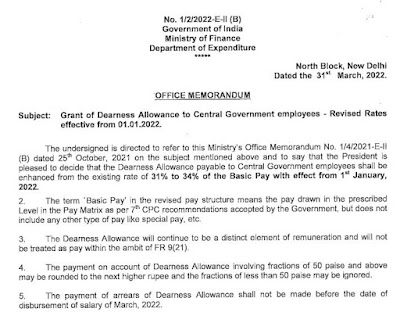
DA Jan 2022 - Grant of Dearness Allowance to Central Government employees - Revised Rates effective from 01.01.2022

 3% DA Hike - Revised Rates effective from 01.01.2022: DoE OM dated 31.03.2022 No. 1/2/2022-E-II (B) Government of India Ministry of Finance...