Sunday, 24 January 2016

EPFO may pay 9% interest on PF deposits for 2015-16

EPFO may pay 9% interest on PF deposits for 2015-16

Retirement fund body EPFO may provide 9 per cent interest on PF deposits for this fiscal, which is higher compared to 8.75 per cent provided in previous two fiscals to its over five crore subscribers.

The Employees Provident Fund Organisation’s (EPFO) finance panel has recommended raising the interest rate on statutory savings of over 5 crore subscribers from 8.75% to 8.95% during the current fiscal.

“The income projection of Rs 34,844.42 crore for the current fiscal is expected to be revised upward. Thus the body can provide 9 per cent rate of interest on PF deposits for 2015-16,” an EPFO trustee and Bharatiya Mazdoor Sangh Secretary P J Banasure told PTI.

The Employees Provident Fund Organisation’s (EPFO) Finance Audit and Investment committee (FAIC) recommended 8.95 per cent interest on PF deposits for the current fiscal in its meeting earlier this week.

Banasure, who is also a member of FAIC said:”If the EPFO provides 8.95 per cent interest rate on PF deposits for 2015-16, it will leave a surplus of Rs 91 crore as per income projections worked out in September last year. But the FAIC will meet again later this month to vet the latest income estimate which is likely to be revised upward.”

According to EPFO income projections worked out in September, providing 9 per cent interest on PF will result in a deficit of Rs 100 crore. “We are expecting that there will be a surplus of Rs 100 crore on providing 9 per cent rate of interest on PF deposits when EPFO will work out the latest estimates. FAIC can change its recommendation in the next meeting and suggest 9 per cent interest rate for 2015-16,” he said.

The proposal has to be endorsed by the Central Board of Trustees (CBT) before the Finance Ministry notifies it.

However, there has been indications from the Finance Ministry that it will slash interest rate on small savings like public provident fund in view of the rate cut by Reserve Bank of India.

The EPFO provides rate of interest from the earning on investments of formal sector workers’ funds without any assistance from the government.

Source: EOT

Age relaxation to the residents of the State of J&K in Railways

Age relaxation to the residents of the State of J&K in Railways


GOVERNMENT OF INDIA
MINISTRY OF RAILWAYS
(RAILWAY BOARD)


RBE No.1/2016


No.E(NG)-II/95/RR-1/26

New Delhi, dt.: 6/01/2016


The General Manager (P),
All Zonal Railways/Production Units, CORE/Allahabad,
MTP/Kolkata, Chennai, Mumbai,
CAO (R), DMW/Patiala, COFMOW/New Delhi,
Director General, RDSO/Lucknow, RSC/Vadodra,
Director, IRISE/Secundrabad, IRICEN/Pune, IRIEEN/Nasik & IRIM&EE/Jamalpur, Chairmen, RRBs/RRCs.


Sub: Age relaxation to the residents of the State of Jammu & Kashmir.

Kindly refer to this Ministry’s letter of even number dated 08.6.2012 (RBE No.70/2012) forwarding therewith a copy of the notification No. 15012/6/2011-Estt.(D) dated 30.12.2011 issued by Ministry of Personnel, Public Grievances & Pensions (Department of Personnel & Training) extending the currency of relaxation of age limit limit in favour of the residents of State of Jammu & Kashmir for appointment to Central Civil Services and posts, recruitment to which are made to UPSC/SSC or otherwise by the Central Government up to 31/12/2013.

Department of Personnel & Training have issued a further notifications No. 15012/1/2014-Estt(D) dated 30/9/2014 and 23/10/2015 and accordingly the relaxation of age limit in favour of the residents of the State of Jammu & Kashmir for appointment to Central Civil Services and posts, recruitment to which are made through UPSC or SSC or otherwise by the Central Government stands extended up to 31/12/2017.

Please acknowledge receipt.
(Neeril Kumar)
Director Estt.(N)-II
Railway Board.


Authority : www.indianrailways.gov.in

7th Pay Commission – Government to Factor in Payout of 7th CPC in Deficit Targets

7th Pay Commission – Government to Factor in Payout of 7th CPC in Deficit Targets

“The government will not be generous in the pay out this time as they already are facing pressures from various fronts like disinvestment and poor direct tax collections,” said Dharmakirti Joshi, currently the chief economist at CRISIL.

7th Pay Commission – Government to Factor in Payout of 7th CPC in Deficit Targets – It is expected that the government, while putting a final seal on the recommendations, will keep in mind the tight fiscal position of the country.
The payout of the seventh pay commission recommendations will make finance minister Arun Jaitley walk a tight rope when he announces the fiscal deficit targets for 2016-17.

Expected to incur an additional expenditure of Rs 1.02 lakh crore to pay higher salaries and pensions recommended by the commission, Rs 28,000 crore alone will go for salary hikes of railway employees. In total, the implementation will impact the fiscal deficit by 0.65% of the GDP.

Experts feel that deficit figures shared in the medium-term fiscal policy statement had stated that the fiscal deficit target for FY17 and FY18 is 3.5% and 3.0%, respectively will have a significant impact from the pay commission pay out, leaving the government with higher deficit numbers.

“Achieving these targets in view of the likely acceptance and implementation of the recommendations of the Seventh Central Pay Commission will be difficult. We expect that the fiscal deficit of FY17 to come in at 3.9% of GDP. This will push the attainment of the fiscal deficit target of 3% of GDP to FY19, a year later than envisaged in the fiscal policy statement. In the past also, pay revisions have pushed fiscal consolidation targets. Accordingly, the fiscal deficit targets are likely to be 3.9%, 3.5% and 3.0% in 2016-17, 2017-18 and 2018-19 respectively,” said Sunil Kumar Sinha, principal economist, India Ratings & Research.

However, the pay commission revisions are yet to be accepted by the high-powered panel headed by cabinet secretary PK Sinha. The recommendations have a bearing on the remuneration of 47 lakh central government employees and 52 lakh pensioners.

An empowered committee of secretaries was being decided to screen the recommendations with regard to all relevant factors of the Commission in an expeditious detailed and holistic fashion.
Though senior finance ministry officials feel that the pay-out which is likely to come only in the middle of 2016, might not be a big burden as the arrears would not be accounting to be much, unlike the past instances.

But, it is expected that the government, while putting a final seal on the recommendations, will keep in mind the tight fiscal position of the country.

“The government will not be generous in the pay out this time as they already are facing pressures from various fronts like disinvestment and poor direct tax collections,” said Dharmakirti Joshi, currently the chief economist at CRISIL.

Finance ministry till now has maintained a stand that it will be able to meet its target despite additional outgo on account of higher pay. But, finance minister Jaitley recently admitted that the impact of implementing the recommendations would last for two to three years.

The seventh pay commission had recommended an average 23.55% increase in salaries, allowances and pension, a move that will benefit 4.8 million staffers and 5.5 million pensioners. The hike will be effective from January 1, 2016.

A minimum pay of Rs 18,000 per month and a maximum of Rs 2.5 lakh has been recommended by the commission, headed by Justice (retired) AK Mathur, that presented its 900-page report to finance minister Arun Jaitley.

Source: Hindustan Times

Saturday, 23 January 2016

Service Discharge Benefit Scheme for Gramin Dak Sevaks

Service Discharge Benefit Scheme for Gramin Dak Sevaks

Department of Posts clarifies to All India Gramin Dak sevaks Union (AIGDSU) that Gram Dak Sevaks are eligible for New Service Discharge Benefit Scheme (SDBS) utilizing the platform of the “NPS-Lite” Scheme of the Pension Fund Regulatory and Development Authority (PFRDA)


New Service Discharge Benefit Scheme (SDBS) for the Gramin Dak Sevaks utilizing the platform of the “NPS-Lite” Scheme of the Pension Fund Regulatory and Development Authority (PFRDA).  Issue of PRAN Card will be discussed with PA.

Ministry Of Communication & Information Technology has issued a communication to All India Gramin Dak sevaks Union (AIGDSU) regarding Provisional Pension to GDS.
F.No.6-11/2009-PE-II(Pt.)/PAP

Government Of India
Ministry Of Communication & Information Technology
Department Of Posts
(Establishment Division/P.A.P.Section)
Dak Bhawan, Sansad Marg
New Delhi – 110 001
Dated:15th January, 2016
To
The General secretary,
All India Gramin Dak sevaks Union (AIGDSU)
Central Headquarters
First Floor, Post Office Building
Padamnagar, Delhi – 110 007

Sub: Implementation of a New Service Discharge Benefit Scheme (SDBS) for the Gramin Dak sevaks – reg.

Please refer your letter No.GDS/77/6/2015 dated 16.10.2015 on the subject cited above.

2. In this context, I am directed to inform you that as far as the provisional pension is concerned, SDBS is operated utilizing the platform of the “NPS-Lite” Scheme of the Pension Fund Regulatory and Development Authority (PFRDA). As per Gazette Notification of Pension Fund Regulatory and Development authority (Exits and withdrawals under the National Pension System) Regulations 2015, Copy enclosed there is no provision for provisional pension of any amount, as requested by the union, as far as the matter of non-issuance of PRAN Card and non-settlement of the case is concerned, the matter is being forwarded to PA wing for providing status in the matter.
(Major S.N.Dave)
Assistant Director General (Estt.)

Grant of 3rd MACP in GP 4600 for Record Supplier, Blue Printer in Ordnance Establishments

Grant of 3rd MACP in GP 4600 for Record Supplier, Blue Printer in Ordnance Establishments

BHARATIYA PRATIRAKSHA MAZDOOR SANGH
(AN ALL INDIA FEDERATION OF DEFENCE WORKERS)

REF: BPMS/OFB/ACP/64 (7/3/M)
Dated: 22.01.2016
To,
The Director (IR),
Ordnance Factory Board,
10 A, S K Bose Road,
Kolkata – 700001

Subject: Grant of ACP to Record Supplier, Blue Printer etc. in OFB between 01.01.2016 to 31.08.2008.

Respected Sir,
With due regards, your attention is invited to the points raised in the JCM meetings by the Staff Side Members of this federation on the subject matter.

You have already clarified that erstwhile ACP Scheme was applicable upto 31.08.2008 and the promotions / upgradations granted prior to 01.01.2006 in the merged grade pay had been ignored for grant of ACP in the promotional hierarchy upto 31.08.2008 and this clarification had already been implemented in favour of supervisory cadre (Chargeman & JWM) of Ord Fys.

On the above analogy, Blue Printer & Record Supplier being a feeder grade for Tracer (upto 20.04.2006) which is a feeder grade for Draughtsman / Chargeman may be granted the 02 financial upgradations under the ACP Scheme by ignoring his movement upto Blue Printer & Record Supplier.

MACP GP 1800


Further, your attention is invited to the order of CAT (Principal Bench) in OA No. 634/2013 (Smt Madhu Malti Tyagi & ors Versus Union of India & others) decided on  22.10.2013 wherein similar case had been dealt with and the relief was granted in favour of petitioners. Respondent No. 3 (General Manager, Ordnance Factory Muradnagar) had published the necessary Factory Order for pay fixation (copy enclosed) in this regard.

In such circumstances, you are requested to take necessary action so that similarly placed all the non-petitioner Record Supplier / Blue Printers may be granted 01st ACP in GP 2400/- and 02nd ACP in GP 4200/- on completion of 12 yrs & 24 yrs regular service between 01.01.2006 to 31.08.2008 & 03rd MACP in GP 4600/- on or after 01.09.2008 on completion of 30 yrs regular service.

Kindly resolve the issue without further delay.
Thanking you.
Sincerely yours
sd/-
(MUKESH SINGH)
Secretary/BPMS & Member, JCM-II Level Council (MOD)
Source: BPMS

Lakhs of Railway Employees participated today in 3 days Protest Programme


Lakhs of Railway Employees participated today in 3 days Protest Programme starting from 19.01.2016 to 21.01.2016

On the clarion call of the National Joint Council of Action(NJCA), three day (19th to 21st Jan, 2016) sit-in programme in all the state capital and industrial centers started today, wherein affiliates of All India Railwaymen’s Federation, National Federation of Indian Railwaymen, All India Defence Employees Federation, National Defence Workers Federation, National Federation of Postal Employees, Federation of National Postal Organisation, Confedration of Central Government Employees & Workers participated en mass.
FOR PUBLICATION

New Delhi: 19th January, 2016 – On the clarion call of the National Joint Council of Action(NJCA), three day (19th to 21st Jan, 2016) sit-in programme in all the state capital and industrial centers started today, wherein affiliates of All India Railwaymen’s Federation, National Federation of Indian Railwaymen, All India Defence Employees Federation, National Defence Workers Federation, National Federation of Postal Employees, Federation of National Postal Organisation, Confedration of Central Government Employees & Workers participated en mass.

At Jantar-Mantar, New Delhi, thousands of Central Government Employees, including the Railwaymen started peaceful sustained struggle, demanding redressal of long pending genuine demands of the Central Government employees, removal of retrograde recommendation of the 7th CPC, scrap Natioal Pension System(NPS) and restore Guaranteed Old Pension Scheme, payment of arrear of Productivity Linked Bonus, filling-up of vacancies, stop indiscriminate outsourcing, stop amendment in Labour Laws in favour of corporate, non-creation of new posts for new assets,

On this occasion, a mammoth peaceful rally of thousands of Central Government Employees, including the Railwaymen, was organized at Jantar-Mantar, New Delhi, which was addressed by Shri Shiva Gopal Mishra, Convener, NJCA and General Secretary, AIRF-NRMU, Shri S.K. Tyagi, President/NRMU, Shri B.C. Sharma, General Secretary URMU, Shri R.N. Parashar, General Secretary NFPE, Shri A.K. Kanojia, ITEF, Shri V. Bhattacharjee, Civil Accounts, Shri Giriraj Singh, President NFPE, Shri Devendra Kumar, FNPO, Shri R.K. Singh, General Secretary, Diploma Engineers’ Federation.

Giving stern warning to Government of India, all the speakers said, if their aforementioned demands are not resolved by the end of February 2016, all the Central Government Employees will be compelled to go on “Indefinite Strike” in the month of March 2016.

For General Secretary

Source: AIRF

Kerala 10th Pay Revision Report approved – Download Government Order

Kerala 10th Pay Revision Report approved – Download Government Order

Government of Kerala has issued a G.O.(P) No.7/2016/Fin. Dated 20/01/2016 for pay revision based on the 10 pay revision committee recommendations. The revised scales will come into force from 01/07/2014. The pay revision is for all Kerala State Government Employees and Teachers including part time staff.


Kerala Govt Order on the Recommendations of the 10th pay revision and allowances of State Government Employees and Teachers

Kerala Govt has issued a GO on the Recommendations of the 10th pay revision and allowances of State Government Employees and Teachers.

Kerala Government appointed the 10th Pay Revision Commission to suggest modifications, if found necessary, for the pay and allowances of all Government employees, including employees in part-time posts and casual sweepers.

Based on the 10th Pay Commission recommendations Kerala Government issued G.O.(P) No.7/2016/Fin. Dated 20/01/2016 for pay revision.  The revised scales will come into force from 01/07/2014. The revised scales of pay of different categories of posts in various Departments are shown in Annexures.

Download Government Order

Friday, 22 January 2016

Demands of Grant of Appropriate Pay Scales To Employees and Officers of Accounts and Audit

Demands of Grant of Appropriate Pay Scales To Employees and Officers of Accounts and Audit

NATIONAL CONVENTION ON THE DEMANDS OF GRANT OF APPROPRIATE PAY SCALES TO EMPLOYEES AND OFFICERS OF ACCOUNTS AND AUDIT
JOINT ACTION COMMITTEE OF ACCOUNTS & AUDIT EMPLOYEES & OFFICERS ORGANISATIONS

17/2 – C, P & T Quarters, Kali Bari Marg, New Delhi: – 110001
Email: v.aicaea@mail.com

NATIONAL CONVENTION ON THE DEMANDS OF GRANT OF APPROPRIATE PAY SCALES TO EMPLOYEES AND OFFICERS OF ACCOUNTS AND AUDIT
Dated 10th January 2016


DECLARATION

The representatives of All India Audit & Accounts Association, All India Civil Accounts Employees Association, All India Postal Accounts Employees Association, All India Audit and Accounts Officers Association, All India Association of Pay & Accounts Officers (Civil), All India Civil Accounts Employees Association, Category-II, All India Federation of Divisional Accounts Officers and Divisional Accountants Associations and All India P&T Accounts & Finance Officers Association met in the National Convention on 10th January 2016, Conference Hall, 4th Floor, Nirman Bhawan, CPWD, Koti, Hyderabad.
The Convention, in conformity with the observations given by the National Joint Council of Action of the Central Government Employees, totally rejects the anti-employee recommendations of the 7th CPC. The mutilation of Dr. Aykroyd formula in computation of minimum wages based on the 12-monthly average (ending on 1.7.2015) prices of essential commodities supplied by Labour Bureau at Shimla was a total jugglery on the part of 7thCPC. 

The convention considers that, reduction in the wages of women employee who avail CCL, forcing the employees to go on voluntary retirement on completion of 20 years of service in the name of ‘inefficiency’, earmarking ‘very good’ for MACP, withdrawal of all types of short term advances like festival/cycle/ LTC etc, refusal to recommend for scrapping of new Pension scheme, refusal to propose for dispensing with the outsourcing/casualisation/ contractorisation by regularizing the employees engaged through such methods for regular government functions are the most retrograde and the anti-employee recommendations of the 7CPC.
The Convention noted that on the issue of formation of Apex Level Grievance redressal mechanism to the Group B Gazetted Officers and Promotee Group A Officers, even after 67 years of independence, settlement has not taken place mainly because of intransigent and adamant stand of the Ministry of Finance, Government of India. The meeting noted that on all other demands also there is a dilly dallying attitude on the part of authorities resulting in non-settlement.

The Convention congratulates the Central Government employees for observing 27th November 2015 as BLACK DAY by wearing black badges and holding (lunch hour) demonstration at the work place and organizing lunch hour demonstration on 30th December 2015 responding to the call of NJCA, which was duly endorsed by the Confederation.

The Convention endorses the 26 Point Charter of Demands on issues related to the recommendations of the 7th CPC submitted to the Cabinet Secretary on 10th December 2015 by the Staff Side, National Council, JCM and on behalf of the NJCA and also by the CCGGOO to the Government to discuss and settle the demands immediately.

The Convention also endorses the decisions taken by NJCA on organizational actions including the decision of massive Dharna on 19th, 20th and 21st January 2016 and Indefinite Strike in the 1st Week of March 2016 with an appeal to the entirety of the Accounts and Audit Employees and Officers of the country to prepare and participate in all preparatory programmes and the Strike action under the guidance of the local Co-ordination Committees and JCAs.

The Convention takes the opportunity to congratulate all those employees and officers of Indian Audit and Accounts Department and other organised Accounts Cadre who responded the call of Apex JAC i.e. observance of demands day on 15th December 2015 and submission of the demands of the Accounts and Audit Employees and Officers in the form of Resolution to local Head of Offices for onward transmission to higher authorities.

The Convention totally agrees with the following proposals for pay structure for Audit & Accounts Cadres submitted by the apex level JAC to secretary, Department of Expenditure ON 11TH December 2015 seeking mitigation of the injustice done to the accounts and audit cadres by the 7th CPC.

1. Accounts/Audit Assistant: Re-designation of LDC as Accounts/Audit Assistants and grant of replacement scale of PB-1 Grade Pay Rs.2400 — i.e. level 4 pay scale of Table 5.Pay Matrix.

2. Accountant/ Auditor: Correction of error done in implementing 6CPC recommendations by the Government and Grant of replacement pay scale of PB 2 GP 4200 — i.e. level 6 pay scale of Table 5 in Pay Matrix.

3. Senior Accountant /Auditor (SA)/DA: Streamlining the contradictory views and recommendations of 7th CPC and grant of replacement pay scale of PB 2 GP 4600 — i.e. level 7 pay scale of Table 5.Pay Matrix to the Senior Accountant/ Auditor/Accounts Assistants (in Railways).

4. Assistant Accounts Officer/ Assistant Audit Officer/DAO II: Acceptance of Para No. 11.12.140 of the recommendations of 7th CPC and grant of replacement pay of GP 5400(PB-2) to AAOs on completion of four years’ service — i.e. Pay level 9, in the pay matrix.

5. Accounts/Audit/Senior Accounts/Audit Officer/DAO I/Sr. DAO: Grant of following pay scales to the Cadres indicated:
Audit/Accounts Officer/DAO Gr. I GP 6600 PB-3 — i.e.level-11 pay scale of Table 5.Pay Matrix
Sr. Audit/Accounts Officer/Sr. DAO (15%) GP 7600 PB 3 — i.e. level-12 pay scale of Table 5.Pay Matrix.

6. Qualification Pay Granting qualification Pay to all Organized Accounts and IA&AD uniformly in terms of the recommendations of 7 CPC in Para’s 8.9.43, 44 and 45 respectively.

7. Secretarial Staff : Pay scale of secretarial staff working in Account and Audit Organizations may be granted at par with Secretarial staff working in the Ministry.

8. Cadre review : Since no cadre review of Accounts and Audit departments had been done after 1987, the cadre review should immediately be initiated as per the recommendations of 7thCPC.

The Convention further resolves to:
· Reorganize and reactivate the local committees of the Joint Action Committee at every station within 10th February 2016.
· Organize following sustained agitational programmes.

1. Daylong Dharna at all stations by the local JACs on 11th February 2016
2. Signature campaign – all units/circles/ branches shall deposit the Signatures to their respective Central Headquarters with in 28th February 2016
3. Massive Dharna at Delhi

Source: http://confederationhq.blogspot.in/

Payment of Agency Commission on pension accounts – RBI Circular on 21.1.2016

Payment of Agency Commission on pension accounts – RBI Circular on 21.1.2016

Reserve Bank Of India
RBI/2015-16/294
DGBA.GAD.No.2278/31.12.2010/2015-16
January 21,2016
The Chairman & Managing Director/
The Chief Executive Officer
All Agency Banks

Dear Sir/Madam

Payment of Agency Commission on pension accounts

As you may be aware, agency banks are being compensated at Rs.65 per transaction for handling pension computation, payment and related services on behalf of Central and State Governments. As per the norms followed by the Government, a pensioner’s account should not have more than 14 credit transactions in a calendar year attributable to pension and related arrear payments, if any.

2. It has however come to our notice that certain banks are apportioning payment of arrears on account of Dearness Relief (DR) and/or delay in start of pension monthwise, thus, resulting in inflated agency commission claims. It is reiterated that number of commisionable transactions for payment of agency commission on account of pension in a year should not exceed 14. This includes one monthly credit for payment of net pension and a maximum of two per year for payment of arrears on account of increase in DR, if applicable.

3. It is also reiterated that cases involving payment of arrears on account of late start/restart of pension qualifies as a single transaction for claiming of agency commission. In other words, any payment of arrears on account of late start/restart of pension should be effected in a single credit transaction instead of separate monthly credits.

4. Some of the Central Government Departments and State Governments prefer to compute the pension figures on their own and pass them on to banks for payment. Such transactions may be included under non-pension payments, on which agency commission is payable on a turnover basis as per the existing norms (currently at 5.5 paise per Rs. 100/-).

Yours faithfully
(Manish Parashar)
Deputy General Manager

Anomalies in Pension of Pre-2006 HAG / S-30 Grade Pensioners of Organised Group ‘A’ Services – Recommendations of 7th CPC for Pensioners : D.K. Jain’s view

Anomalies in Pension of Pre-2006 HAG / S-30 Grade Pensioners of Organised Group ‘A’ Services – Recommendations of 7th CPC for Pensioners : D.K. Jain’s view

One of our regular and genuine viewer, Shri. D. K. Jain, ADG (Retd.) Military Engineer Services send an exclusive report of anomalies in Pension of Pre-2006 HAG Grade pensioners of Organised Group ‘A’ Services to us and given below for your reference…

Anomalies in Pension of Pre-2006 HAG / S-30 Grade Pensioners of Organised Group ‘A’ Services: 7th CPC Recommendations by D. K. Jain, ADG (Retd.) Military Engineer Services

1. 7th CPC has recommended pension formulation of past civilian employees retired prior to 01.01.2016, based on notional pay of the retiree which will be the minimum of the Level in the Pay Matrix corresponding to the Pay Band and Grade Pay at which he/she retired, duly raised by adding number of increments earned in that Level while in service, at the rate of three percent. The revised pension computed based on these parameters, i.e. minimum of the Level in Pay Matrix and number of increments earned in that Level will not be reasonable and will not impart due justice to pre-2006 HAG / S-30 grade pensioners of Organised Group ‘A’ Services. The pre-2006 pensioners of HAG / S-30 grade retired from Organised Group ‘A’ Services have been put to a great disadvantage compared to the pensioners of junior Levels and compared to post-2006 pensioners of the same Level who retired after getting non functional financial upgradation (NFFU) to the scale of HAG / S-30 grade in 2006 onwards, on implementation of 6th CPC recommendations. The issue needs to be examined in view of following submissions and remedial action taken so that the method of formulation of pension is not unreasonable and discriminatory to the above mentioned class of pensioners.

2. The revised pay scales for all Levels including Level 15 of 7th CPC Pay Matrix are based on implemented pay scale of 6th CPC. Anomaly in any of the implemented pay scales of 6th CPC therefore gets carried forward to the revised scale of that Level in 7th CPC Pay Matrix. Level 15 of the 7th CPC Pay Matrix corresponds to the scale of HAG and S-30 grades of 6th CPC and 5th CPC respectively. In connection with the anomalies in the implemented scale of HAG grade of 6th CPC, the following is relevant.

a. The pay scales of HAG / S-30 and HAG+ / S-31 have always been almost identical. The minimum of both the scales has always been same throughout right upto 5th CPC. The maximum of HAG+ / S-31 has, however, been slightly more than the maximum of HAG / S-30 scale. These scales from 3rd CPC to 5th CPC were as under:

HAG / S-30 HAG+ / S-31
3rd CPC 3000 Fixed 3000 – 3500
4th CPC 7300 – 7600 7300 – 8000
5th CPC 22400 – 24500 22400 – 26000

b. 6th CPC had recommended both these scales in the Pay Band PB 4 with Pay 39200 – 67000 and Grade Pay of 11000 for S-30 and 13000 for S-31. The difference in the recommended scales was 2000 only.

c. Both S-30 and S-31 scales were almost same in 6th CPC recommendations with slight difference of 2000, due to the following reasons:

i. S-30 and S-31 both grades were direct promotional grades from S-29, with the same experience of 3 years in S-29 grade.
ii. Promotion from both S-30 and S-31 to the next grade, i.e. S-32 was admissible directly. The experience required for promotion from either of these grades was same, which was 2 years.
iii. Wherever there was provision for promotion / upgradation from S-30 to S-31 scale, experience required in S-30 grade was nil.

d. During implementation stage of 6th CPC, S-30 and S-31 scales were taken out of PB 4 Pay Band and were placed in separate scales of 67000 – 79000 for S-30 and 75500 – 80000 for S-31 with no grade pay. At this stage, a substantial difference in starting pay of these scales, which was never there earlier, occurred. This had no justification keeping in view submissions at sub-paras (a) to (c) above and was unjust and discriminatory.

e. The pay scales of S-29 and S-30 grades from 4rd CPC to 6th CPC were as under:
SAG / S-29 HAG / S-30
4th CPC 5900 – 7300 7300 – 7600
5th CPC 18400 – 22400 22400 – 24500
6th CPC 37400 – 67000 plus 10000 Grade Pay 67000 – 79000

Upto 5th CPC, the officers of S-29 grade always got less/equal pay than S-30 grade. Consequently retirees from S-29 grade could never get higher pension than S-30 retirees. After implementation of 6th CPC w.e.f. 2006, the scale of S-29 extended upto 77000 (67000 pay in the band + 10000 grade pay) whereas the minimum of S-30 scale was 67000. After 2006, the retirees of S-29 scale, drawing pay above 67000 upto 77000, got pension above 33500 upto 38500, which was more than the admissible pension of 33500 of S-30 scale retirees at the rate of fifty percent of 67000, the minimum 6th CPC pay of the scale. The equation between the pension of S-29 and S-30 scale retirees thus got disturbed for the first time, when lower scale S-29 retirees got more pension than higher scale S-30 retirees, as the minimum pay of 6th CPC scale was less than the maximum of S-29 scale.

3. In view of submissions in para 2 above, the implemented 6th CPC pay scale for S-30 grade was anomalous with reference to both S-31 and S-29 scales. The justified and reasonable minimum pay of S-30 scale of 6th CPC should have been equal to the minimum of S-31 scale and not less than the maximum of S-29 scale which was 77000. Based on this justified minimum pre-revised pay of 77000, the revised pay scale of S-30 grade (Level 15 of Pay Matrix of 7th CPC) should have been 209500 (77000 x 2.72). Accordingly minimum revised pension for retirees of HAG / S-30 grade (Level 15 of Pay Matrix) at the rate of fifty percent of 209500 should be 104750.

4. After 2006, on implementation of 6th CPC scales, not only retirees from S-29 scale, even some of the retirees from S-26 and S-24 scales which were also in Pay Band PB4 and were two to three grades junior retired at pay exceeding 67000 and started drawing pension above 33500 which was more than the pension admissible to S-30 grade retirees. This being highly unreasonable, unjust and discriminative, the pre-2006 retirees from S-30 scale had to approach the courts for legal remedy. The issue came up for judicial scrutiny keeping in view the rules and legal position, reasonability, natural justice, constitutional provisions and various judgments of Apex Court on pension admissibility. CAT PB New Delhi in OA No. 937 / 2010 reviewed under RA No. 10 / 2015 between All India S-30 Pensioners Association and U.O.I. and High Court Patna in Civil Writ Case No. 10757 / 2010 between Shri MMP Sinha (a pre-2006 retiree from S-30 grade) and U.O.I., upheld that pre-2006 retirees of S-30 grade getting pension less than post-2006 retirees of lower grades is absolutely unreasonable, unjustified and against natural justice. The courts ordered that the pension of pre-2006 S-30 grade retirees should be stepped up to 38500 which the pensioners of lower grade were getting. As per courts’ verdict, based on pre-revised pension of 38500, the revised pension of S-30 retirees will be 98945 (38500 x 2.57). On implementation of 7th CPC scales in accordance with these judgments, the pension entitlement for S-30 grade (Level 15) pensioners has to be not less than what is admissible to post-2016 S-29 (level 14) retirees which is 109100 (fifty percent of 218200). Accordingly the justified revised pension of Level 15 / S-30 retirees should be 109100.

5. Before implementation of 6th CPC, promotions of the officers of Organised Group ‘A’ Service were much delayed as compared to those of IAS. 6th CPC commented that the huge time gap in promotion to various pay scales between Organised Group ‘A’ Services and IAS needed to be minimised and recommended that the officers of Organised Group ‘A’ Services should be given financial upgradation such that a particular batch of these services gets promotional scale of higher grade at various levels when any IAS officer of two year junior batch gets posted to the centre to those grades / levels. Based on these recommendations, from 2006 onwards, Non Functional Financial Upgradation (NFFU) was given to the officers of Group ‘A’ Services on non functional basis and the upgraded officers continued to work in the lower grade posts from which they were upgraded though given the promotional scale of the higher post. With NFFU, after 2006, the officers’ pay got upgraded to the next promotional scale much earlier than prior to 2006, when higher scale was available only on regular promotion to higher grade / post.

6. The same method of pension formulation based on increments earned in retirement scale of Level 15 (HAG / S-30) of the Pay Matrix recommended for both, i.e. pre-2006 regular promotees to the grade and to post-2006 promotees who were upgraded to the same scale under NFFU after 2006, is therefore unjust for pre-2006 regular promotees who have been put to a great disadvantage. Pre-2006 promotees to HAG / S-30 grade (Level 15 of Pay Matrix) were promoted to HAG / S-30 grade against the vacant posts in higher grade and the entire period spent in the scale was much less, the maximum being around three years. The increment earned by them ranged from nil to two and as per 7th CPC formulation, their notional pay will range from 182200 to 193300 and revised pension will range from 91100 to 96650. As far as post-2006 promotees to HAG / S-30 grade are concerned, they were granted NFFU from SAG / S-29 grade on non functional basis to the higher Level scale tenable by HAG / S-30 grade officers irrespective of availability of posts in that grade in the year in which two years junior IAS officers batch got promotion to that grade. The period spent in the scale by them was around six years during which they were either functioning in the post of SAG / S-29 (Level 14) or could have got regular promotion / higher post for part of the period. These officers earned at least five increments in the higher Level unless they retired earlier and the period when they were working in lower posts is also being counted towards the increments earned in Level 15. As per 7th CPC formulation, their notional pay will be at least 211300 in recommended scale at Level 15 of Pay Matrix and pension will be 105650 minimum against the entitlement of 91100 to 96650 for pre-2006 promotees in that Level.

7. All the pensioners promoted before 2006 or upgraded after 2006 to the same Level, i.e. Level 15 form the same class of past pensioners having joined the same service through the same recruitment procedure and having retired at the same Level. Entitlement of different pensions to these two group of officers who are of the same class is unreasonable. The group of post-2006 promotees were not holding higher post for the entire period for which increments are being considered in the formulation of pension. The method of 7th CPC pension formulation is therefore discriminatory to pre-2006 promotees to the scale. In the past, the Apex Court has struck down any such unreasonable, unjust and discriminatory pension entitlement of the past pensioners. With a view to provide justice to pre-2006 pensioners of HAG grade (Level 15), their minimum notional pay needs to be stepped up by maximum number of increments drawn by post 2006 officers, upgraded under NFFU to HAG / S-30 scale from the year 2006 onwards, for the period they functioned in the lower post of SAG / S-29 or upto one year of their regular promotion / placement in posts tenable by higher grade of HAG. The revised minimum pension should be according to this stepped up notional pay.

8. In view of foregoing, the reasonable and just minimum pension entitlement of the pensioners of Organised Group ‘A’ Services, who retired from Level 15 (HAG / S-30) works out to be as under on the basis as mentioned against each:

a. 104750. As per minimum pay of 209500 for Level 15 of Pay Matrix based on reasonable and just minimum pay of HAG / S-30 in 6th CPC scale (para 2 and 3 refer).

b. 98945 (38500 x 2.57). As per pension entitlement of the past pensioners retired before 2016 from lower level, i.e. Level 14 of Pay Matrix (SAG / S-29 grade), based on pension of 38500 being drawn by them prior to 2016 (para 4 refers).

c. 109100. As per pension entitlement of the pensioners of lower level, i.e. Level 14 of Pay Matrix (SAG / S-29 grade) retiring in 7th CPC regime, i.e. 2016 onwards (para 4 refers).
d. Pension entitlement as per (a) to (c) above needs to be further stepped up, based on increase in the minimum pay of 218200 (for pension entitlement of 109100) for Level 15, by maximum number of increments drawn by post 2006 officers, upgraded under NFFU to HAG / S-30 scale in the year 2006 onwards, for the period they functioned in the lower post of SAG / S-29 or upto one year of their regular promotion / placement in posts tenable by higher grade of HAG.

9. For justice to the pensioners retired from HAG / S-30 (Level 15 of 7th CPC Pay Matrix) grade, the minimum pension entitlement of the officers retired from Level 15 of 7th CPC Pay Matrix is required to be raised in accordance with 8 (a) to (c) above. The minimum pay of Level 15 in Pay Matrix is required to be revised to 218200 in place of 182200. Further, the revised minimum notional pay and minimum revised pension of the officers of Organised Group ‘A’ Services retired from Level 15 after promotion to HAG / S-30 grade prior to 2006 against the regular vacancies / post in the higher grade is required to be further stepped up in accordance with para 8 (d) above so that a class of pre-2006 and post-2006 within the class of pensioners of Level 15 is not created, otherwise officers retiring from Level 15 scale after NFFU to HAG / S-30 scale on implementation of 6th CPC recommendations from 2006 onwards will be eligible for higher pension as per the formulation recommended by 7th CPC due to more increments in Level 15 pay scale which include increments earned by them while continuing to be functioning in the posts of lower grade, i.e. SAG / S-29 grade.

“Anomaly in Pension Fixation as per Recommendations of 7th Pay Commission”

Flash News

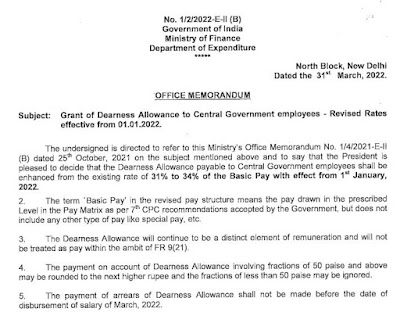
DA Jan 2022 - Grant of Dearness Allowance to Central Government employees - Revised Rates effective from 01.01.2022

 3% DA Hike - Revised Rates effective from 01.01.2022: DoE OM dated 31.03.2022 No. 1/2/2022-E-II (B) Government of India Ministry of Finance...