Friday, 22 January 2016

Payment of Agency Commission on pension accounts – RBI Circular on 21.1.2016

Payment of Agency Commission on pension accounts – RBI Circular on 21.1.2016

Reserve Bank Of India
RBI/2015-16/294
DGBA.GAD.No.2278/31.12.2010/2015-16
January 21,2016
The Chairman & Managing Director/
The Chief Executive Officer
All Agency Banks

Dear Sir/Madam

Payment of Agency Commission on pension accounts

As you may be aware, agency banks are being compensated at Rs.65 per transaction for handling pension computation, payment and related services on behalf of Central and State Governments. As per the norms followed by the Government, a pensioner’s account should not have more than 14 credit transactions in a calendar year attributable to pension and related arrear payments, if any.

2. It has however come to our notice that certain banks are apportioning payment of arrears on account of Dearness Relief (DR) and/or delay in start of pension monthwise, thus, resulting in inflated agency commission claims. It is reiterated that number of commisionable transactions for payment of agency commission on account of pension in a year should not exceed 14. This includes one monthly credit for payment of net pension and a maximum of two per year for payment of arrears on account of increase in DR, if applicable.

3. It is also reiterated that cases involving payment of arrears on account of late start/restart of pension qualifies as a single transaction for claiming of agency commission. In other words, any payment of arrears on account of late start/restart of pension should be effected in a single credit transaction instead of separate monthly credits.

4. Some of the Central Government Departments and State Governments prefer to compute the pension figures on their own and pass them on to banks for payment. Such transactions may be included under non-pension payments, on which agency commission is payable on a turnover basis as per the existing norms (currently at 5.5 paise per Rs. 100/-).

Yours faithfully
(Manish Parashar)
Deputy General Manager

Anomalies in Pension of Pre-2006 HAG / S-30 Grade Pensioners of Organised Group ‘A’ Services – Recommendations of 7th CPC for Pensioners : D.K. Jain’s view

Anomalies in Pension of Pre-2006 HAG / S-30 Grade Pensioners of Organised Group ‘A’ Services – Recommendations of 7th CPC for Pensioners : D.K. Jain’s view

One of our regular and genuine viewer, Shri. D. K. Jain, ADG (Retd.) Military Engineer Services send an exclusive report of anomalies in Pension of Pre-2006 HAG Grade pensioners of Organised Group ‘A’ Services to us and given below for your reference…

Anomalies in Pension of Pre-2006 HAG / S-30 Grade Pensioners of Organised Group ‘A’ Services: 7th CPC Recommendations by D. K. Jain, ADG (Retd.) Military Engineer Services

1. 7th CPC has recommended pension formulation of past civilian employees retired prior to 01.01.2016, based on notional pay of the retiree which will be the minimum of the Level in the Pay Matrix corresponding to the Pay Band and Grade Pay at which he/she retired, duly raised by adding number of increments earned in that Level while in service, at the rate of three percent. The revised pension computed based on these parameters, i.e. minimum of the Level in Pay Matrix and number of increments earned in that Level will not be reasonable and will not impart due justice to pre-2006 HAG / S-30 grade pensioners of Organised Group ‘A’ Services. The pre-2006 pensioners of HAG / S-30 grade retired from Organised Group ‘A’ Services have been put to a great disadvantage compared to the pensioners of junior Levels and compared to post-2006 pensioners of the same Level who retired after getting non functional financial upgradation (NFFU) to the scale of HAG / S-30 grade in 2006 onwards, on implementation of 6th CPC recommendations. The issue needs to be examined in view of following submissions and remedial action taken so that the method of formulation of pension is not unreasonable and discriminatory to the above mentioned class of pensioners.

2. The revised pay scales for all Levels including Level 15 of 7th CPC Pay Matrix are based on implemented pay scale of 6th CPC. Anomaly in any of the implemented pay scales of 6th CPC therefore gets carried forward to the revised scale of that Level in 7th CPC Pay Matrix. Level 15 of the 7th CPC Pay Matrix corresponds to the scale of HAG and S-30 grades of 6th CPC and 5th CPC respectively. In connection with the anomalies in the implemented scale of HAG grade of 6th CPC, the following is relevant.

a. The pay scales of HAG / S-30 and HAG+ / S-31 have always been almost identical. The minimum of both the scales has always been same throughout right upto 5th CPC. The maximum of HAG+ / S-31 has, however, been slightly more than the maximum of HAG / S-30 scale. These scales from 3rd CPC to 5th CPC were as under:

HAG / S-30 HAG+ / S-31
3rd CPC 3000 Fixed 3000 – 3500
4th CPC 7300 – 7600 7300 – 8000
5th CPC 22400 – 24500 22400 – 26000

b. 6th CPC had recommended both these scales in the Pay Band PB 4 with Pay 39200 – 67000 and Grade Pay of 11000 for S-30 and 13000 for S-31. The difference in the recommended scales was 2000 only.

c. Both S-30 and S-31 scales were almost same in 6th CPC recommendations with slight difference of 2000, due to the following reasons:

i. S-30 and S-31 both grades were direct promotional grades from S-29, with the same experience of 3 years in S-29 grade.
ii. Promotion from both S-30 and S-31 to the next grade, i.e. S-32 was admissible directly. The experience required for promotion from either of these grades was same, which was 2 years.
iii. Wherever there was provision for promotion / upgradation from S-30 to S-31 scale, experience required in S-30 grade was nil.

d. During implementation stage of 6th CPC, S-30 and S-31 scales were taken out of PB 4 Pay Band and were placed in separate scales of 67000 – 79000 for S-30 and 75500 – 80000 for S-31 with no grade pay. At this stage, a substantial difference in starting pay of these scales, which was never there earlier, occurred. This had no justification keeping in view submissions at sub-paras (a) to (c) above and was unjust and discriminatory.

e. The pay scales of S-29 and S-30 grades from 4rd CPC to 6th CPC were as under:
SAG / S-29 HAG / S-30
4th CPC 5900 – 7300 7300 – 7600
5th CPC 18400 – 22400 22400 – 24500
6th CPC 37400 – 67000 plus 10000 Grade Pay 67000 – 79000

Upto 5th CPC, the officers of S-29 grade always got less/equal pay than S-30 grade. Consequently retirees from S-29 grade could never get higher pension than S-30 retirees. After implementation of 6th CPC w.e.f. 2006, the scale of S-29 extended upto 77000 (67000 pay in the band + 10000 grade pay) whereas the minimum of S-30 scale was 67000. After 2006, the retirees of S-29 scale, drawing pay above 67000 upto 77000, got pension above 33500 upto 38500, which was more than the admissible pension of 33500 of S-30 scale retirees at the rate of fifty percent of 67000, the minimum 6th CPC pay of the scale. The equation between the pension of S-29 and S-30 scale retirees thus got disturbed for the first time, when lower scale S-29 retirees got more pension than higher scale S-30 retirees, as the minimum pay of 6th CPC scale was less than the maximum of S-29 scale.

3. In view of submissions in para 2 above, the implemented 6th CPC pay scale for S-30 grade was anomalous with reference to both S-31 and S-29 scales. The justified and reasonable minimum pay of S-30 scale of 6th CPC should have been equal to the minimum of S-31 scale and not less than the maximum of S-29 scale which was 77000. Based on this justified minimum pre-revised pay of 77000, the revised pay scale of S-30 grade (Level 15 of Pay Matrix of 7th CPC) should have been 209500 (77000 x 2.72). Accordingly minimum revised pension for retirees of HAG / S-30 grade (Level 15 of Pay Matrix) at the rate of fifty percent of 209500 should be 104750.

4. After 2006, on implementation of 6th CPC scales, not only retirees from S-29 scale, even some of the retirees from S-26 and S-24 scales which were also in Pay Band PB4 and were two to three grades junior retired at pay exceeding 67000 and started drawing pension above 33500 which was more than the pension admissible to S-30 grade retirees. This being highly unreasonable, unjust and discriminative, the pre-2006 retirees from S-30 scale had to approach the courts for legal remedy. The issue came up for judicial scrutiny keeping in view the rules and legal position, reasonability, natural justice, constitutional provisions and various judgments of Apex Court on pension admissibility. CAT PB New Delhi in OA No. 937 / 2010 reviewed under RA No. 10 / 2015 between All India S-30 Pensioners Association and U.O.I. and High Court Patna in Civil Writ Case No. 10757 / 2010 between Shri MMP Sinha (a pre-2006 retiree from S-30 grade) and U.O.I., upheld that pre-2006 retirees of S-30 grade getting pension less than post-2006 retirees of lower grades is absolutely unreasonable, unjustified and against natural justice. The courts ordered that the pension of pre-2006 S-30 grade retirees should be stepped up to 38500 which the pensioners of lower grade were getting. As per courts’ verdict, based on pre-revised pension of 38500, the revised pension of S-30 retirees will be 98945 (38500 x 2.57). On implementation of 7th CPC scales in accordance with these judgments, the pension entitlement for S-30 grade (Level 15) pensioners has to be not less than what is admissible to post-2016 S-29 (level 14) retirees which is 109100 (fifty percent of 218200). Accordingly the justified revised pension of Level 15 / S-30 retirees should be 109100.

5. Before implementation of 6th CPC, promotions of the officers of Organised Group ‘A’ Service were much delayed as compared to those of IAS. 6th CPC commented that the huge time gap in promotion to various pay scales between Organised Group ‘A’ Services and IAS needed to be minimised and recommended that the officers of Organised Group ‘A’ Services should be given financial upgradation such that a particular batch of these services gets promotional scale of higher grade at various levels when any IAS officer of two year junior batch gets posted to the centre to those grades / levels. Based on these recommendations, from 2006 onwards, Non Functional Financial Upgradation (NFFU) was given to the officers of Group ‘A’ Services on non functional basis and the upgraded officers continued to work in the lower grade posts from which they were upgraded though given the promotional scale of the higher post. With NFFU, after 2006, the officers’ pay got upgraded to the next promotional scale much earlier than prior to 2006, when higher scale was available only on regular promotion to higher grade / post.

6. The same method of pension formulation based on increments earned in retirement scale of Level 15 (HAG / S-30) of the Pay Matrix recommended for both, i.e. pre-2006 regular promotees to the grade and to post-2006 promotees who were upgraded to the same scale under NFFU after 2006, is therefore unjust for pre-2006 regular promotees who have been put to a great disadvantage. Pre-2006 promotees to HAG / S-30 grade (Level 15 of Pay Matrix) were promoted to HAG / S-30 grade against the vacant posts in higher grade and the entire period spent in the scale was much less, the maximum being around three years. The increment earned by them ranged from nil to two and as per 7th CPC formulation, their notional pay will range from 182200 to 193300 and revised pension will range from 91100 to 96650. As far as post-2006 promotees to HAG / S-30 grade are concerned, they were granted NFFU from SAG / S-29 grade on non functional basis to the higher Level scale tenable by HAG / S-30 grade officers irrespective of availability of posts in that grade in the year in which two years junior IAS officers batch got promotion to that grade. The period spent in the scale by them was around six years during which they were either functioning in the post of SAG / S-29 (Level 14) or could have got regular promotion / higher post for part of the period. These officers earned at least five increments in the higher Level unless they retired earlier and the period when they were working in lower posts is also being counted towards the increments earned in Level 15. As per 7th CPC formulation, their notional pay will be at least 211300 in recommended scale at Level 15 of Pay Matrix and pension will be 105650 minimum against the entitlement of 91100 to 96650 for pre-2006 promotees in that Level.

7. All the pensioners promoted before 2006 or upgraded after 2006 to the same Level, i.e. Level 15 form the same class of past pensioners having joined the same service through the same recruitment procedure and having retired at the same Level. Entitlement of different pensions to these two group of officers who are of the same class is unreasonable. The group of post-2006 promotees were not holding higher post for the entire period for which increments are being considered in the formulation of pension. The method of 7th CPC pension formulation is therefore discriminatory to pre-2006 promotees to the scale. In the past, the Apex Court has struck down any such unreasonable, unjust and discriminatory pension entitlement of the past pensioners. With a view to provide justice to pre-2006 pensioners of HAG grade (Level 15), their minimum notional pay needs to be stepped up by maximum number of increments drawn by post 2006 officers, upgraded under NFFU to HAG / S-30 scale from the year 2006 onwards, for the period they functioned in the lower post of SAG / S-29 or upto one year of their regular promotion / placement in posts tenable by higher grade of HAG. The revised minimum pension should be according to this stepped up notional pay.

8. In view of foregoing, the reasonable and just minimum pension entitlement of the pensioners of Organised Group ‘A’ Services, who retired from Level 15 (HAG / S-30) works out to be as under on the basis as mentioned against each:

a. 104750. As per minimum pay of 209500 for Level 15 of Pay Matrix based on reasonable and just minimum pay of HAG / S-30 in 6th CPC scale (para 2 and 3 refer).

b. 98945 (38500 x 2.57). As per pension entitlement of the past pensioners retired before 2016 from lower level, i.e. Level 14 of Pay Matrix (SAG / S-29 grade), based on pension of 38500 being drawn by them prior to 2016 (para 4 refers).

c. 109100. As per pension entitlement of the pensioners of lower level, i.e. Level 14 of Pay Matrix (SAG / S-29 grade) retiring in 7th CPC regime, i.e. 2016 onwards (para 4 refers).
d. Pension entitlement as per (a) to (c) above needs to be further stepped up, based on increase in the minimum pay of 218200 (for pension entitlement of 109100) for Level 15, by maximum number of increments drawn by post 2006 officers, upgraded under NFFU to HAG / S-30 scale in the year 2006 onwards, for the period they functioned in the lower post of SAG / S-29 or upto one year of their regular promotion / placement in posts tenable by higher grade of HAG.

9. For justice to the pensioners retired from HAG / S-30 (Level 15 of 7th CPC Pay Matrix) grade, the minimum pension entitlement of the officers retired from Level 15 of 7th CPC Pay Matrix is required to be raised in accordance with 8 (a) to (c) above. The minimum pay of Level 15 in Pay Matrix is required to be revised to 218200 in place of 182200. Further, the revised minimum notional pay and minimum revised pension of the officers of Organised Group ‘A’ Services retired from Level 15 after promotion to HAG / S-30 grade prior to 2006 against the regular vacancies / post in the higher grade is required to be further stepped up in accordance with para 8 (d) above so that a class of pre-2006 and post-2006 within the class of pensioners of Level 15 is not created, otherwise officers retiring from Level 15 scale after NFFU to HAG / S-30 scale on implementation of 6th CPC recommendations from 2006 onwards will be eligible for higher pension as per the formulation recommended by 7th CPC due to more increments in Level 15 pay scale which include increments earned by them while continuing to be functioning in the posts of lower grade, i.e. SAG / S-29 grade.

“Anomaly in Pension Fixation as per Recommendations of 7th Pay Commission”

Thursday, 21 January 2016

Admissibility of Travelling Allowance (TA) and other expenditure incurred while on training by the Government Servants on probation

Admissibility of Travelling Allowance (TA) and other expenditure incurred while on training by the Government Servants on probation

No.T-25014/1/2016-TRG(ISTM Section)
Government of India
Ministry Of Personnel, Public Grievances and Pensions
Department of Personnel and Training
(Training Division)
Old JNU Campus, Block IV,
New Mehrauli Road, New Delhi – 110 067
Dated: 21st January, 2016

OFFICE MEMORANDUM

Subject: Admissibility of Travelling Allowance (TA) and other expenditure incurred while on training by the Government Servants on probation.

Institute of Secretariat Training and Management (ISTM) is conducting Foundation Training Course of newly recruited Assistant Section Officers (DR) and Stenographers (DR). ISTM has received number of references from various Ministries and Departments, requesting for clarification, whether the expenditure incurred by trainee Assistants, now re-designated as Assistant Section Officers, for their boarding, lodging etc. while undergoing Foundation Training, under the aegis of ISTM can be reimbursed to them. Representations have also been received from Assistant Section Officers, through their administrative Ministries in this regard.

2. The matter has been examined in consultation with the IFD(MHA) with reference to the Supplementary Rules 164 and instructions issued by the Government from time to time under the aforesaid Rules, which govern claims of Travelling Allowances while on training by probationers. The rule position is clarified as under:-
(i) No Travelling Allowance may be allowed for the onward journey for joining the training institute;

(ii) No Travelling Allowance may be allowed to the probationers while they are taken for outstation for training activity;


(iii) Probationers have to pay boarding /lodging /transport charges, if any, from their pocket.


(iv) No daily allowance may be admissible.


(v) One side TA may be allowed to the participants while reporting for duty in the allocated Ministry/Department on completion of the Training Programme from an outstation Institute, which are located at Hyderabad, Kolkata, Chandigarh, Shimla and Jaipur, where such training is being conducted by ISTM at present, or any other State Training Institute, which may be identified later, outside NCR.
3. All Ministries/Departments of Government of India are, therefore, advised to decide the claims made by Assistant Section Offices in respect of reimbursement of expenditure by them for boarding/lodging and other transport charges during the period of their Foundation Training conducted by ISTM, in accordance with the provisions contained at para (2) of this O.M. In case, any reimbursement has already been made, the same may be recovered immediately.

4. This issues with the concurrence with the IFD(MHA), vide their Dy. No. 299/Fin.II/15, dated 31.12.2015.
sd/-
(O.P.Chawla)
Under Secretary to the Government of India
Authority : www.persmin.gov.in

Kerala Pay Revision Commission Recommendations approved by Cabinet on 20th January 2016

Kerala Pay Revision Commission Recommendations approved by Cabinet on 20th January 2016.

The Cabinet Committee has approved to revise the salaries of State Government Employees from 1.7.2014.

Yesterday Cabinet Ministry has approved almost all the recommendations made by the Pay Revision Commission 2014. The new revised scale will be calculated from July 2014 and the arrears for about 18 months will be given in four installments from April 2017.

The minimum and maximum pay scale would be between 16,500 and 1,20,000. Some changes has been made in the recommendations of Pay Revision Commission by the Government to reduce the additional burden.

And wait for a week to know the authentic information about the Government decision on the recommendations of Kerala Pay Revision Commission.

Click to view the official website of Kerala Govt Finance Department

7th CPC and Central Government finances – Karnataka COC

7th CPC and Central Government finances

Comrades,
There are various reports in the media about the impact of the 7th CPC recommendations on the common man and the government resources at large, the reports suggest that the Government may postpone the 7th CPC implementation also till its finances are set right.

These reports are totally wrong.

A) Let us examine the Revenue Secretary Shri Hasmukh Adhia statements which are also published in the news papers.
“So far, 1.8 crore refunds for assessment year 2015-16 have been processed, he said. In the past, refunds have been held up for years as the government sought to show healthier finances.”
“Data released by the government showed that over Rs 5 lakh crore was locked up in tax disputes at various levels, with some of the cases going back over 10 years. In value terms, over half the cases related to income tax with 30% of the cases involving corporation tax.”
B) The crude oil prices has come down from 140 $ to just 30$ a barrel in last year thus the Central Government finances have improved a lot.

Read more at : http://karnatakacoc.blogspot.in/

Facilitation Fee levied by authorized travel agents on Air Tickets

Facilitation Fee levied by authorized travel agents on Air Tickets

Principal Controller of Accounts (Ordnance Factories), Kolkata

Important Circular
Office of the PCA (Fys) Kolkata,
10A, S. K. Bose Road,
Kolkata -700001
Dated: 20/1/2016
NO.2078/AN-VIII/TA/LTC/BL
Sub: Facilitation Fee levied by authorized travel agents on air tickets book on Government account

A copy of Gol, MoF, DoE, OM no. 19024/1/2012-E-IV, dated 5/9/2014 on the above subject along with M/s Balmer Lawrie Co. Ltd. Letter dated 3/11/2015 is forwarded herewith for your information and guidance, please.

sd/
Nabarun Dhar
Jt. C of A.(Fys)
N0.19024/1/2012-E-lV
Government of India
Ministry of Finance
Departrnent of Expenditure
North Block, New Delhi.
Dated the 5th September, 2014.
OFFICE MEMORANDUM

Subject- Facilitation Fee levied by authorised travel agents on air tickets booked on Government account – Withdrawal regarding.

Attention is invited to this Department’s O.M of even number dated 10th October 2013 wherein the authorized travel agents namely M/s Balmer Lawrie & Company Limited (BLCL) M/s , Ashok Travels & Tours (ATT) and Indian Railways Catering and Tourism Corporation Ltd. (IRCTC) were allowed to levy ‘Facilitation Fee’ @ Rs.100/- per ticket for domestic sector and Rs.300/- per ticket for international sector for air travel. Wherein Government of lndia bears the cost of air passage.

2. The issue has been re-examined in consolation with the Ministry of Civil Aviation and Department of Legal Affairs in the light of provisions of the Air craft’s Rules,1937, as amended from time to time and it has been decided to Withdraw this Department’s O.M of even number dated 10th October 2013 with immediate effect. Consequently, no service charges (by whatever nomenclature), which are not included in the tariff charged by Air India / Airlines, are required to be paid to the authorized travel agents.

3. payment to the authorized travel agents for the Bills raised by them for air tickets produced/ purchased till date in respect of air travel already undertaken or due to be undertaken would be regulated as per O.M of even number dated 10.10.2013. it is reiterated that as far as possible air tickets on Government account may be obtained directly from Air India/ Airlines (booking counter/offices/website) and if obtaining tickets directly from Air India/ Airlines is not possible should the services of authorized travel agents be availed of.

4. All Ministries/Departments are advised to bring these instructions to the notice of all concerned from compliance.
Sd/-
(Subhash Chand)
Director
Balmer Lawrie
TOURS & TRAVEL
Date: November 03, 2015
To
Principal Controller of Accounts (FYS)
1OA, S K Bose Road
Kolkata – 700001

Kind attention: Mr. Nabarun Dhar, JT. Controller of Accounts (AN)

Dear Sir,
Kindly refer to your letter ref. no. 2078/ AN-VIII/TA-DA/BL dated 16/10/15, please note that in accordance with GOI, MoF, DoE OM no. 19024/1/2012-E.IV, dated 5/09/2014, we are not charging any Service Charge/Facilitation Fee/ Processing Fee etc. in our bill.

But SERVICETAX, EDU. Cess, & High Edu. Cess, are Govt. Statutary Taxes which are chargeable if you purchase any ticket from an agency and we are regularly depositing this Service Taxes to the service tax authority vide service tax registration no. AABCB0984EST047, which is already mentioned in our bill.

Hence you are kindly requested to make payment of service taxes accordingly.

Thanking you.
Yours faithfully,
For Balmer Lawrie & Co. Ltd.,
Sd/-
(S. Nath)
Sr. Branch Manager (Travel & Vacations)
Authority: http://pcafys.gov.in/

Click to view the order

Points to be taken into consideration while finalizing the 7th Pay Commission Report: Demands by MSA, SoI

Points to be taken into consideration while finalizing the 7th Pay Commission Report: Demands by MSA, SoI
SURVEY OF INDIA
MINISTERIAL STAFF ASSOCIATION (CHQs’)
Dehradun
Points to be taken into consideration while finalizing the 7th Pay Commission Report :-
The demand of the Staff Side to fix the minimum pay to that of Rs. 26,000/- has been completely rejected by the 7th CPC and has arbitrarily fixed the minimum pay as Rs. 18000/, The 7th CPC has mutilated the formula for fixing the minimum wage. The minimum wage recommended amounts to a meager increase of Rs. 2250 from the existing minimum pay of Rs. 7000 + 8750 (125 % DA as on 1.1.2016). From this minimum pay of Rs, 18000/-, as per the recommendation of the 7th CPC itself Rs. 1500/- will be recovered for CGEIGS and 10 % i. e Rs.1800/- will be recovered towards New Pension Scheme from the employees recruited after 1.1.2004 and 6% towards GPF contribution from the employees recruited prior to 1.1.2004 resulting in minus or a very meager  benefit for the low paid employees.
While the minimum wage is fixed as Rs. 18000/- the Secretary level officers are given a huge hike of Rs. 2,25,000 and the Cabinet Secretary’s salary is fixed as Rs. 2,50,000. The ratio between minimum pay and the maximum pay should be not more than 1: 8, the 7th CPC has kept the ratio as 1: 13.88.   The public at large is misled by the statement that a hike of Rs 23.5% is granted to Central Government employees where as the actual increase is only  3 to 4 % as per the calculation given below

Calculation of Pay and allowance for the month  of January 2016 as per  Sixth CPC is given below:-

Basic Pay Pay = PB Rs.5200 + GP Rs.1800 = Rs.7000/-
Assuming DA 125% as on 1.1.2016 = Rs. 8750/-
(Since he is staying in Quarter) HRA = Nil
T.A. = 600 + DA = Rs. 1350/-
Total Gross Amount =Rs. 17100/-
Deductions:
NPS 10% of basic Pay + DA =  Rs. 1575/-
CGEGIS = Rs.    30/-
Total Deductions = Rs.  1605/-
Net Pay (6th CPC) =Rs. 15495/-

Calculation of Pay and allowance for the month  of January 2016 as per  Seventh CPC is given below:-

Basic Pay Pay = Rs.18000/-
7th Pay Commission DA as  on 1.1.2016 = Nil
(Since he is staying in Quarter) HRA = Nil
T.A. = 600 + DA = Rs. 1350/-
Total Gross Amount =Rs. 19350/-
Deductions:
NPS 10% of basic Pay =  Rs. 1800/-
CGEGIS (as per 7th CPC recommendation) = Rs.   1500/-
Total Deductions = Rs.  3300/-

Net Pay (7th CPC) =Rs. 16050/-
The Benefit out of 7th Pay commission is (16050 – 15495) only Rs. 555/- which is 3.2 % of the gross pay of 6th CPC.
The minimum wages should be fixed at Rs. 23,100/- as per the calculation given below
Basic Pay Pay = PB Rs.5200 + GP Rs.1800 = Rs.7000/-   (Basic Pay)
100% D.A. which should be merged as per Vth CPC = Rs. 7000/-  (Dearness Pay)
25% DA on the above (total DA 125% - 100%) =Rs.  3500/-  (D.A.)
40% benefit (as given in VIth CPC) on Pay +DP =Rs. 5600/- (Fixation benefit)(*)
(*)(VIth CPC has given fixation benefit of  40% of the maximum of pre-revised scale)
Total Gross Amount =Rs. 23100/-
Hence the minimum benefit should be not less than 23,100/-

House Rent Allowance

The House Rent Allowance has been reduced from the existing 30% to 24%, 20% to 16% and 10% to 8%. More over the 7th CPC has recommended for abolition of various allowances like small family allowance, Cash Handling Allowance and advances like festival advance, Scooter Advance etc. Instead of removing the existing anomalies in the MACP Scheme, the 7th CPC has introduced examination for granting MACP. The 7th CPC has refused to make any recommendations against the New Pension Scheme. For the 2114 spell of 365 days child care leave for women employees the leave wages will be reduced to 80%.
We demand the Allowances like Family Planning Allowance, Cash Handling Allowance, Care Taker Allowance should not be abolished.   The Advances like Scooter Advance, Festival Advance, Flood Advance should not be abolished as these are  the meager amount the low paid employees are getting to celebrate festival and other genuine purposes.  CCL should be granted for 2 years without reducing it to 80% in the 2nd year.
Benefit on promotion before the 7th pay commission is more than the amount of promotion to be given after  implementation of the 7th Central Pay Commission :-
Suppose an UDC get promotion to Assistant before 1.1.2016.
His present Pay :11100 + 2400 Grade Pay
D.A. @ 125 %:16875
On promotion his pay will be : 11510 + 4200
New Pay as per  7th CPC=15710 X 2.57= 40374   Pay metrix : 41100/-
He will get the pay or Rs. 41,100/- in the revised scale  if he  get his promotion before 1.1.2016.
If the same person is getting promotion after 7th C.P.C.
Pay as on 1.1.2016  is    (11100+2400) X 2.57   =  34695   Pay metrix :  35,300/-
On promotion one increment in the same Level should be given   Rs. 36400/- .  As there is no pay near to that  his pay will be upgraded to 36,500/- minimum of the Pay matrix No. 6
His pay will be only Rs. 36,500/- if he get a promotion after 7th Pay Commission.
Hence the loss is    (41100-36500)   =   4600/-
It is one of the example in many cases the loss will be more than this.
Hence it is suggested that the rate of increment should be minimum 5% and on promotion 2 increment should be given otherwise there will be lot of difference in the pay of  employees who got promotion one day before the implementation of 7th Pay commission and those who got promotion after implementation of the 7th pay commission.

Rate of Increment shown in the Pay Matrix  is less than  3%

Please see the Pay Matrix given on page No. 89.
          Level 2,   Index 2,   the pay is shown as 20500,  after giving an increment of 3%  it should be 21,115/-  but the next index is only Rs. 21,100/- (level 2 index 3)    next pay also should be 21115 + 633 =21748 but the next index (level 2 index 4) is only 21700/-   in Level 6 index 14 also it should be 50500 + 1515 = 52015/- whereas it is given only 52000/-.  In many places even though the increment is shown as 3%,  it is rounded off to lesser amount causing  the employees at financial  loss.  In VIth pay, while calculating increment,  commission if the last digit  is 1 or above it used to  round  off to next 10.  So here also if the amount is 10 or above it should be rounded off to the next 100.  Kindly look into the matter.

Cadre Restructuring

As per 7th CPC para No. 1.26 (page No. 6), there is a  mention about Cadre Review.
" A serious grievance has been made by all services that Cadre Reviews have not taken place for years together, which has resulted in great anguish and frustration among the services.  Though it is essentially an administrative matter, it has a serious impact on the status and emoluments of employees.  On account of delay in Cadre Reviews, many Central Services lag behind and that gives rise to frustration and ultimately effects governance.  We have tried to cover this issue in the appropriate chapter in this report.  Therefore, the government should take a call and give them a proper representation in the government.
         6.2.10   (pare No. 106)   The services have contended that there is an urgent requirement for the Defence Forces to undertake periodic cadre reviews to remain current in their manpower structuring, and to enable the forces to adapt to the changing operational scenario at all times, without affecting the pyramidal structure in the services.  The commission recognizes the importance of Cadre Reviews in aligning a service to the ever changing organizational needs and to maintain congruence between functional needs and legitimate aspirations of its officers.
7.3.12 (page No. 170) The various service Associations highlighted that in very many cadres refiews have not been carried out for long.  Extant instructions are that a cadre review should be undertaken at least once in a period of five years.  The fact that these instructions have not been followed in many cases has bred resentment and frustration.
7.3.13.  The process of cadre restructuring and the reported delays affecting the genuine career aspirations of employees at all levels, was discussed with the Department of Personnel and Training (DoPT).  The department acknowledged that while the ideal periodicity is five years, in various cases, reviews are delayed due to many reasons.  Significant amongst these is non submission of proposals by the cadre controlling authorities.  As far as DOPTs concerned, the procedure as well as the templates (for proposal submission) is stated to have been well formulated and disseminated.  It was also informed that meetings of the Cadre Review Committee (CRC) are held regularly.
The maiden cadre review proposal in respect of Ministerial Staff, started in the year 2003 reached nowhere.  Whereas  cadre review of Group A Officers has been processed and implemented during the corresponding period. Thus cadre review procedure for group B & C staff should be implemented at the before the implementation of VIIth Pay Commission, so that our staff will be benefited.  It is therefore, urged upon the respective authority that Cadre Restructuring of Ministerial Staff in particular and Group ‘B’ & ‘C’ Staff in General should be considered before implementation of 7th CPC. Otherwise the same grievances and difficulties regarding continuation of operational scenario of Ministerial job will be existed after this CPC implementation.
The following points may kindly be taken into consideration while finalizing the VIIth Pay Commission proposal:
Sl. No.
Name of the Post
Remarks
01Estt. & Accounts
Officer
The Pay Scale of E & AO as per
4th CPC5th CPC6th CPCNow recommended
2375-75-
3200-100-3500
7450-225-
11500
9300-34800
GP 4600
9300-34800
GP 4800
The Pay Scale of Group 'B' Gazetted Post (Technical)
4th CPC5th CPC6th CPCNow recommended
2000-60-
2300-75-
3200
6500-200-
10500
9300-34800
GP 4200
Later on GP
Increased to
4600/-
9300-34800
GP 4800
There is a huge difference in the pay scales of E& AO as a specialized Gr ‘B’ Officer and other Group B Officers of Survey of India in 4th and 5th CPC.
The Duties of E & AO is much more than that of Group "B" Gazetted Officers (Technical) of Survey of India.
The duties of E & AO are:-
To function as DDO. To supervise both Establish & Accounts Section of the GDC. To Assist the Director in functioning as Administrative Head and Controlling Officer of the GDC/Directorate, etc. The Grade Pay of Section is Rs. 4800/- as per 6th Pay Commission. There are many Section Officers (Office Suptds.) are working under E & AO.
Hence the grade pay recommended by 6th CPC for E & AO is not correct. The Grade Pay of E & AO should be 5400/- considering the duties and responsibilities allotted to him/her.
As per VIIth Pay Commission report Para No. 7.1.4 (Page No. 140), the Grade Pay of Section Officer is a promotion post for Assistant (GP 4600). Initially on promotion, the SO is at GP 4800 and after four years is entitled to a non-functional upgrade to GP 5400 (PB-3), effectively two level higher.
As per VIIth pay commission report Para No. 11.27.19 (ii) page No. 684, the Superintendent of Income Tax are getting the Grade pay of Rs. 4600/-. There are many Office Superintendents working under an E & A.O. Hence it is suggested to consider to upgrade the Grade of Rs. 5400/- to E& AO.
02.Office SuperintendentThe duties of Office Superintendent in Survey of India is one and the same of Section Officers in other Departments. It includes supervising and checking the works of the Ministerial Section and to allot the work to the ministerial staff. Supervision of preparation of reports/returns, seniority lists/gradation list, budget estimates, audit reports, pension cases, work of cashier, internal auditing. Compilation/consolidation/monitoring and disbursement of Budget, Reconciliation, correspondence on audit paras, Data Entry and Respective Correspondence, work related to recruitment. To check the reply of legal cases/RTI caes and to ensure their timely submission. Training and guiding the junior ministerial staff, etc.
The Section Officers of other Departments are getting the Grade pay of Rs. 4800/-. Please refer the letter of 7th CPC regarding recruitment of staff, wherein the pay of Section Officers/equivalent is mentioned as Rs. 4800/-.
The name of Office Superintendent should be changed as Senior Section Officer in the proposed Restructuring proposal and the G.P should be determined accordingly.
03.AssistantsAs per the recommendation of 6th CPC the pay scale of Assistants was upgraded in the pre-revised scale of Rs. 6500-10500 as par with the Central Secretariat Assistants (Grade pay 4200 in the revised scale). In the meantime the grade pay of Central Secretariat Assistants has been raised from Rs. 4200/- to Rs. 4600/- but the same was not done in the case of Assistants of Survey of India. The Assistants were designated as Head Clerk before the creation of the GDCs and they were working as Section Officers in Units/field Parties.
Please refer the letter of 7th CPC regarding recruitment of staff, wherein the pay of Assistants are mentioned as Rs. 4600/- (copy enclosed).
As per VIIth Pay Commission Report page No. 145, the commission has strongly recommended parity in pay between the field staff and headquarter staff upto the rank of Assistants.
" The Commission accordingly strongly recommends parity in pay between the field staff and headquarter staff upto the rank of Assistants on two grounds—firstly the field staff are recruited through the same examination and they follow the same rigour as the Assistants of CSS and secondly there is no difference in the nature of functions discharged by both. Therefore to bring in parity as envisaged by the VI CPC, this Commission recommends bringing the level of Assistants of CSS as per with those in the field offices who are presently drawing GP of 4200. The pay of those Assistants/Stenographer who have in the past, been given higher Grade pay would be protected".
The Assistants of Central Secretariat already got the benefit of fixing their pay with Grade pay of 4600/- and they enjoyed this benefit from 1.1.2006 to 31.12.2015 and their pay will be fixed based on this pay. In order to maintain the parity the same benefit should be extended to the Assistants of Survey of India also.
The name of Assistants should be changes as Junior Section Officer in the proposed Restructuring proposal.
04.U.D.C.The qualification for the post of UDC is fixed as Graduation. Many posts whose educational qualification are graduation are granted with a Grade pay of 4200/- or 2800/-.
The name of UDC should be changed as Administrative Assistant Grade I in the proposed Restructuring proposal.
05.L.D.C.The minimum qualification for the post of LDC has been changed from X to XII but the pay scale of LDC has not changed. The Grade pay for all other posts whose minimum qualification is XII is starting from 2400. For example Hindi Typist, Data Entry Operator, etc. An LDC has to do typing/data entry operation in addition to Preparation of bills, diary and despatch, file management, assistance related to reports/returns/estimates etc. Hence the grade pay of LDC should be Rs. 2400/-.
The name of UDC should be changed as Administrative Assistant Grade II in the proposed Restructuring proposal.

LDC/UDC Issues :-

7th Pay Commission has turned down the genuine issue of LDC & UDC on the ground that the government has stopped direct recruitment for the clerical cadre and gradually phasing out the existing incumbents( Please see Para 11.22.100, Para 11.52.32, Para 11.52.32,. Para 7.7.37 & 11.35.28).  Issuing of such an order without the knowledge of Staff side may not be possible. Thus reason given for rejection of the demand is not convincing.
Besides Confederation/Staff Side JCM, several Departments had recommended upgradation of grade pay of LDC & UDC of Administrative Offices especially the LDC& UDCs of subordinate offices of Government of India.
But the fact is that Staff Selection Commission is frequently conducting recruitment for the post of LDC. Combined higher secondary examination for the selection of LDC also has been conducted recently. Moreover, no alternative recommendation to replace the LDC post is given in the report.  It is to be noted that the normal ratio of LDC and UDC in subordinate offices is 3:1 and thus LDCs have been allocated responsible sections and in many smaller offices LDC alone is handling the work of entire Administration.  The direction set in the recommendation of the Commission is to contractorise all the Administrative posts below the post of Assistants. This should be prevented at any cost and a respectable pay scale for LDC & UDC should be ensured. Without the active support of the Confederation/JCM this cannot be done.

LDC & DATA ENTRY OPERATOR

On the other hand rejecting Central Secretariat Clerical service demand of parity with DEO (Grade Pay 2400), the commission observes “Even though the entry requirements are similar, historically the pay scales of the two posts have been different. Besides, they comprise two distinct cadres with different set of roles and responsibilities. Hence, the demand for parity of pay of LDC with DEOs cannot be acceded to by the Commission.”(Para 11.35.38).
Historically these cadres may be different set of roles but the fact is that functions of LDC are more complex than that of DEO and same was brought before the commission by various Associations/Administrative Authorities. Earlier pay Commissions have fixed Pay Scale to DEO considering their work on computer. But today LDCs are selected on the basis of their expertise in computer operation also.
As you know, in subordinate offices DoPT manual is not followed for allocating work to LDCs there.  In order to bring the reality, some comments among the hundreds of comments posted in our web site/received through e-mail is given in annexure I, II & III. Please go through it.

  Parity of pay of Assistant/Stenographers with Central Secretariat.

Sixth Pay Commission has recommended parity for Assistant of subordinate offices with the Assistants of Central Secretariat and recommended Rs. 4200 grade pay for the genuine reason given in its report. But while implementing the report, grade pay of Assistant of Central Secretariat has been increased to Rs. 4600. All the Associations/Federations including this Association had demanded parity of pay of these cadres with Central Secretariat. JCM Staff Side through its memorandum had demanded parity with the Assistant/Stenographers of Central Secretariat. But in place of increasing the grade pay of Assistants/Stenographers of Subordinate offices, the Pay Commission has reduced the grade pay of Central Secretariat Assistant/Stenographers (Para 7.1.4(J). While implementing 7th Pay Commission Report, Government may not accept the degradation of the grade pay of the cadres of Central Secretariat. Thus necessary action to keep the Grade Pay (4600) of Assistant/stenographers of Subordinate offices including NSSO Offices at par with their counterpart at Central Secretariat is required.
The Assistants of Central Secretariat have  already got the benefit of fixing their pay with Grade pay of 4600/- and they enjoyed this benefit from 1.1.2006 to 31.12.2015 and their pay will be protected as per the recommendations of the 7th Pay Commission Report.  In order to obtain the parity between the Assistants of Central Secretariat and Field offices,  the  benefit of fixing their pay with a Grade pay of Rs. 4600/- from 1.1.2006 to 31.12.2015 should  be extended to the Assistants of Survey of India also.
Similarly, the Non Functional Selection Grade granted to the UDCs of Central Secretariat has also been withdrawn by the 7th CPC in its report (Para 7.1.4(J). Our demand is that the NFSG may be restored and the benefit of the same should be extended to the UDCs of subordinate offices also.

 Grant of MACP on Promotional Hierarchy:

The report of the Commission is confusing and contradictory. Please see Para 5.1.12, 5.1.44, 7.4.8, 74.13, 11.52.45 etc. The Pay Commission has drafted MACP recommendation to fool the employees and giving benefit to Government.  MACP should be granted on hierarchical scale, if both Levels are same it should be given in the immediately next level.

Transport Allowance

In A1 cities the employees crossed the limit of Pay Rs. 7440/ in pay band 5200-200200 was getting transport allowance Rs. 1600+DA. But 7th CPC has recommended only Rs. 1350 for these employees. The disparity is to be removed.

Abolition of interest free advance:

Pay Commission has recommended abolition of 12 advances including, Festival Advance, LTC Advances, Tour/Tr TA Advance Medical Advance etc. This will affect the touring staff and low paid employees. If this recommendation is accepted, no low paid employee can avail LTC.

Abolition/Reduction of Care Taking Allowance

As per recommendation contained in Para 8.3.23 of the 7th CPC report, the present care taking allowance has been abolished and in place Extra Work Allowance at  a  uniform rate of 2  percent  of Basic Pay per month. This will affect detrimentally to the caretaking work in various NSSO Offices especially in FOD Offices where permanent care takers are not appointed and the person assigned the duties of caretaking are doing heavy responsibilities.
On other hand, pay fixation on promotion from UDC to Assistant immediate next pay scale is found more beneficial than the hierarchical promotion. Fixation of a UDC drawing Rs. 10960+2400 promoted to Assistant is given below:
Fixation on Pay scale hierarchy i.e., Rs, 2800 GP
1/1/2016 10960+2400=13360 X 2.57 3433534300
Increment on 1.7.201635300
Increment on Promotion1059
Pay fixed at higher stage in 2800 Grade Pay37000

Fixation on Promotional hierarchy i.e. Rs 4200 GP
1/1/2016 10960+2400=13360 X 2.57 3433534300
Increment on 1.7.201635300
Increment on Promotion1059
Pay fixed at higher stage in 4200 Grade Pay36500

Similar deficiencies may be noticed in other cases also. For similar cases multiplication factor should be increased.  Two  increments should be granted  on promotion.
This may also be looked into.

Kindly consider the above facts while implementing the report of 7th Central Pay Commission.
We oppose Performance based Incentive System because it is not appropriate.   Marks acquired in APAR should not be linked with grant of Increment, promotion  & MACP.
D.A. should be merged with basic pay whenever it crosses  50%.
We oppose plan for Medical Insurance to Central Govt. employees.   CGHS facilities may be improved.
SECRETARY GENERAL,
MINISTERIAL STAFF ASSOCIATION
SURVEY OF INDIA

7th CPC recommends higher grade pay for JPA, SPA, Off-set Machine Operator, Machine Man and Electrical Supervisor

7th CPC recommends Junior Press Assistant (JPA) , Senior Press Assistant (SPA), Off-set Machine Operator, Machine Man and Electrical Supervisor, grade pay of 1800, 1900, 2400, 1900, and 4200 respectively

7th CPC recommends higher grade pay for JPA, SPA, Off-set Machine Operator, Machine Man and Electrical Supervisor

7th Pay Commission has recommended higher grade pay for JPA, SPA, Machine Man and Electrical Supervisor

Press Stream

    In IBM, the post of Junior Press Assistant (JPA) is placed in GP 1800, Senior Press Assistant (SPA) is in GP 1900 and Off-set Machine Operator is in GP 2400. Direct entry is at the level of JPA for which the qualification of Class X+ITI is required. In GSI, direct entry is at the level of Pressman, with GP 1900 and identical qualification requirements as that of JPA in IBM. JPAs of IBM have demanded parity with the Pressman post of GSI.

Analysis and Recommendations

    The posts of JPA and SPA should be merged in IBM. The merged cadre should be called Pressman cadre. It should be initially fixed in GP 1900 with  appropriate placement in the pay matrix. No discrepancy is noticed with regards to the post of Off-set Machine Operator. Hence, they should be granted normal fixation in the pay matrix.

Machine Man

    The post of Machine Man in IBM lies in GP 1800 with qualification requirement of Class X+ITI. This post has had horizontal parity with the post of Junior Press Assistant (JPA). Since we are recommending upgradation of JPA from GP 1800 to GP 1900, upgrading the post of Machine Man also to GP 1900 is warranted. Accordingly, the same is recommended.

Electrical Supervisor

The post of Electrical Supervisor in IBM lies in GP 2800 with qualification requirement of Diploma in Engineering. This post has had horizontal parity with the post of Junior Technical Assistant (JTA). Since we are recommending upgradation of JTA from GP 2800 to GP 4200, upgrading the post of Electrical Supervisor also to GP 4200 is warranted. Accordingly, the same is recommended.

Central government Employees unions to go on 3-day agitation; say, 7th pay commission matrix not final

Central Government Employees unions to go on 3-day agitation; say, 7th pay commission matrix not final

New Delhi: The Constituent Unions of National Council Joint Consultative Machinery of Central Government employees has called for a three-day agitation, from January 19 -21,  to draw the attention of central government to modifications it is seeking in the recommendations of  the 7th Central Pay Commission.

The unions called an agitation after the Cabinet gave its approval for constitution of an Empowered Committee to study the 7th Pay Commission report for implementation Process.

We don’t think that the pay matrix recommended by 7th CPC is final, we won’t accept the fitment factor recommended by the Commission, the union leaders voiced unanimously.

They said that the take-home pay is very much less when compared to previous pay commissions. If the Central Government accepts to increase the Minimum Pay, then that would be the criteria for arriving subsequent pay scales. Hence expecting changes in Pay Matrix is inevitable.

Read at: Zee News

7th CPC recommends that Heads of NDC, NDA and DSSC institutions should be upgraded to Apex Scale

7th Pay Commission recommends that heads of three institutions viz., National Defence College (NDC), New Delhi, National Defence Academy (NDA), Khadakwasla, Pune and Defence Services Staff College (DSSC), Wellington should be upgraded to Apex Scale

7th CPC recommends that Heads of NDC, NDA and DSSC institutions should be upgraded to Apex Scale

7th Pay Commission has recommended CGWB Technical Operator (Drilling) be given GP 1900 and be combined with the post of Compressor

National Academies

The Commission has received a number of demands from both the civilian and defence employees that the heads of National Academies should be upgraded to Apex Scale.

The Commission finds merit in upgrading only the heads of tri-services institutions of the defence forces. Accordingly, it is recommended that the heads of the following three tri- services institutions should be upgraded to Apex Scale:
a.   National Defence College (NDC), New Delhi

b.  National Defence Academy (NDA), Khadakwasla, Pune

c.   Defence Services Staff College (DSSC), Wellington

Only those  officers should  be posted  as  heads  of these establishments  who have minimum two years of service left before superannuation. No extension in service should be granted based on these recommendations.

Flash News

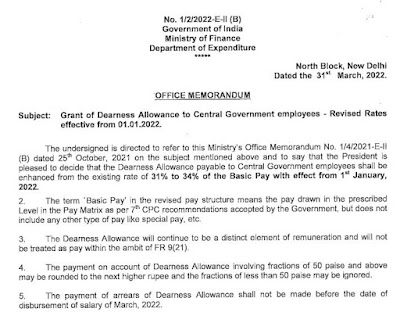
DA Jan 2022 - Grant of Dearness Allowance to Central Government employees - Revised Rates effective from 01.01.2022

 3% DA Hike - Revised Rates effective from 01.01.2022: DoE OM dated 31.03.2022 No. 1/2/2022-E-II (B) Government of India Ministry of Finance...