Monday, 23 November 2015

7th Pay Commission Report: General Provident Fund (GPF) for Central Government employees

7th Pay Commission Report: General Provident Fund (GPF) for Central Government employees

9.4.1 General Provident Fund (GPF) for Central Government employees was started w.e.f. 1 April, 1960. It covers those government employees who joined service before 01.01.2004 and are not governed by the Contributory Provident Fund Scheme. The scheme was introduced to foster the habit of saving amongst government employees and to provide them financial help in times of need. The Commission has not received any demands regarding modifications in this scheme.

Analysis and Recommendations

9.4.2 The Commission has analyzed the views of the previous Pay Commissions regarding GPF. The IV CPC and the V CPC did not favour making the scheme optional on the grounds that the fund provided relief to employees in times of need and that accretions to the fund also improved the government’s ways and means position. The VI CPC had, however, recommended that the “future investments in GPF should be allowed purely on voluntary basis with no minimum being prescribed.” Their rationale was that the resource position of Central Government is comfortable and the revenues are showing a steady growth, employees have the option of a variety of market instruments to choose from for investment purposes, and with the proposed increase in monthly subscription under the CGEGIS (70% of which is for saving purposes), the government employees will, in any case, be making a much higher saving.

9.4.3 The Commission notes that the recommendations of the VI CPC regarding CGEGIS and GPF were not accepted by the government; neither the CGEGIS rates were revised, nor GPF was made voluntary.

9.4.4 This Commission is of the view that, with the introduction of NPS w.e.f. 01.01.2004, the number of subscribers under the GPF scheme will decrease as time goes by. Moreover, the scheme has worked well over the past 65 years and has provided pecuniary relief to the subscribers in times of need. Accordingly the Commission does not find merit in any disturbance at this point of time. Hence, status quo is recommended.

7th Pay Commission Report: Person with Disabilities

7th Pay Commission Report: Person with Disabilities

 Introduction
9.6.1 As per the Persons with Disabilities (Equal Opportunities, Protection of Rights and Full Participation) Act, 1995, a “person with disability” means a person suffering from not less than 40 percent of any disability as certified by a medical authority. “Disability” as defined in Section 2(i) of the Act means– (i) blindness (ii) low vision (iii) leprosy cured (iv) hearing impairment (v) locomotor disability (vi) mental retardation (vii) mental illness.
9.6.2 As per the Census of India, 2011, there are nearly 26.8 million Persons with Disabilities (PWDs) in the country, which is nearly 2.21 percent of the total population.


PWDs in Central Government
9.6.3 The government provides three percent reservation in jobs for PWDs. Apart from this reservation at the entry stage, DoPT has issued instructions regarding identification of jobs, post-recruitment and pre-promotion training, providing aids/ assistive devices, accessibility and barrier free environment at work place, preference in government accommodation, grievance redressal, and preference in transfer/posting for PWDs. In a recent notification, a provision has been made for ten years’ (fifteen years in case of SC/ST and thirteen years in case of OBC candidates) relaxation in the upper age limit for direct recruitment to civil posts/services under the Central Government.

9.6.4 Moreover, there are certain special entitlements as given below:
i. Special Allowance for Child Care for Women with Disabilities at the rate of Rs.1,500 pm;

ii. Transport Allowance at double the normal rate, subject to a minimum of Rs.1,000 pm; iii. Constant Attendance Allowance for retired employees with 100 percent disablement at the rate of Rs.4,500 per month;

iv. Special Casual Leave for four days in a calendar year for specific requirements relating to disabilities;

v. Special Casual Leave for ten days in a calendar year for participation in Conferences/ Seminars/Trainings/Workshops related to disability and development.

9.6.5 In case the disability is work related, the following additional provisions are available:
a. Special Disability Leave;

b. Disability Pension;

c. Educational Concession to children of Defence personnel who are disabled in action.

9.6.6 For employees with differently abled children, Children Education Allowance and Hostel Subsidy is granted at double rate.


Demands

9.6.7 Associations of employees with disabilities made the following demands before the Commission:
i. Suitable enhancement in the existing provisions

ii. Provision of Common Room in offices with suitable recreational facilities

iii. Additional rebate in House Building Advance and Automobile Advance
iv. Establishment of Welfare Committees in the ministries
Analysis and Recommendations

9.6.8 The National Policy for Persons with Disabilities, 2006, enunciates the measures that need to be taken by the government to ensure equal opportunities, protection of rights and full participation in society for PWDs, in consonance with the principles enshrined in the Indian Constitution. India is also a signatory to the UN Convention on the Rights for Persons with Disabilities. Thus, provision of appropriate measures for employees with disabilities is the responsibility of the Union Government.

9.6.9 The Commission has made various recommendations regarding PWDs at different places in the report. They are consolidated here for ready reference:
i. In recognition of the singular responsibility faced by differently abled women in raising their children, the Special Allowance for Child Care for Women with Disabilities has been enhanced from the present rate of Rs.1,500 pm to Rs.3,000 pm

ii. Transport Allowance at double the normal rate has been retained, and the minimum amount has been increased from Rs.1,000 pm to Rs.2,250 pm

iii. Children Education Allowance and Hostel Subsidy have been kept at double rate for differently abled children

iv. Constant Attendance Allowance has been enhanced from Rs.4,500 pm to Rs.6,750 pm

v. Special Disability Leave has been subsumed in Work Related Illness and Injury Leave (WRIIL), with improved provisions

vi. Educational Concession, hitherto available only to the children of Defence personnel killed/missing/disabled in action, has been extended to similarly placed personnel of CAPFs, Indian Coast Guard, RPF and police forces of Union Territories mutatis mutandis

9.6.10 Besides the above recommendations, there are a few suggestions that can go a long way in improving the working environment for these employees:
i. In our interactions, it has been highlighted that easy access, particularly to toilets, remains an issue of concern. Hence, it is suggested that Guidelines and Space Standard for Barrier Free Built Environment for Disabled and Elderly Persons, issued by CPWD, Ministry of Urban Affairs and Employment, should invariably be followed while designing new government premises. Their application in the existing offices may also be explored.

ii. Every ministry should have a Welfare Committee, with due representation of differently abled employees, to address their concerns.
iii. The grievance redressal machinery should be strengthened and made more effective.

Meetings with 7th CPC and Cabinet Secretary – NC JCM Staff Side

Meetings with 7th CPC and Cabinet Secretary – NC JCM Staff Side

Meetings with the VII CPC and the Cabinet Secretary – resentment conveyed to Govt. of India
Shiva Gopal Mishra
 
Secretary
Ph.: 23382286
National Council (Staff Side)
Joint Consultative Machinery
Central Government Employees
13-C, Ferozshah Road, New Delhi – 110001
E Mail : nc.jcm.np@gmail.com
No.NC/JCM/2015
Dated: November 20, 2015
All Constituents of the
National Council(JCM)

Dear Comrades,
Sub: Meetings with the VII CPC and the Cabinet Secretary

Today I met the Chairman, VII CPC, Justice Shri Ashok Kumar Mathur, and expressed our anguish against retrograde recommendations of VII CPC, particularly reg. Minimum Wage, reduction in HRA and CCL, non-redressal of NPS, abolition of various allowances, examination of MACP benefit, etc. etc.

Tough he had given argument, but I told him about the anguish of all the constituents of the JCM(Staff Side), who feel that they have been betrayed by the VII CPC.

Comrades! I have also met the Cabinet Secretary, Shri P.K. Sinha, in the afternoon and handed him over a copy of the attached letter and requested him to convene meeting of the NC/JCM at an earliest as well as to intervene in the matters raised by the JCA in case of report of VII CPC at an earliest. The Cabinet Secretary has promised that he would try to fix the meeting at an earliest and also look into the points raised by the NC/JCM(Staff Side) for VII CPC.

With fraternal greetings!
Yours faithfully,
sd/-
(Shiva Gopal Mishra)
Secretary
Source : http://ncjcmstaffside.com/

7th CPC recommendations to reduce House Rent Allowance

7th CPC recommendations to reduce House Rent Allowance

The 7th Central Pay Commission has been recommended to reduce the percentage of House Rent Allowance for all categories of Central Government employees rationalized to 24 percent, 16 percent and 8 percent of the Basic Pay for Class X, Y and Z cities respectively.

The Commission also recommends that the rate of HRA will be revised to 27 percent, 18 percent and 9 percent when DA crosses 50 percent, and further revised to 30 percent, 20 percent and 10 percent when DA crosses 100 percent.


7th CPC HRA: HRA is the most important factor of allowance issuing to existing Central Government employees, it is given for compensate to live in rented house. The HRA rules are allowed for getting allowance even if he/she living in own house.

A major changes had been made in 6th CPC on HRA rules. The percentages were prescribed on basic pay according to the cities in India. The cities are classified as X, Y and Z and the rates of percentage respect of the cities are 30%, 20% and 10% on basic pay (Grade pay including).

Central Government employees are expecting changes in the rate of percentage according to cities.

NC JCM STAFF SIDE SUGGESTION ON HOUSE RENT ALLOWANCE

National Council JCM Staff Side given suggestion on House Rent Allowance for Central Government employees as under…

House Rent allowance. 


The present scheme of HRA is based on the recommendation of the 6th CPC, which is as follows:


We reproduce hereunder the recommendation made by the third Central Pay Commission in the matter of grant of house rent allowance. (Para 29 Part I. Vol. IV.Chapter 56), which would be the best if implemented even today. While we find it difficult to accept the kind of parity suggested above, we are aware of the acute problem caused by the lack of adequate government housing and by the inadequate government housing and by the inadequacy of the existing rates of house rent allowance and recommend as follows:-

Government should take houses on long lease and make residential accommodation available to its employees on payment of 10% of their pay.

(ii) Government should lay down appropriate house rent allowance rates in different cities and towns based not on population criteria, but on an actual assessment of the prevailing levels of rent in different cities and towns. Alternatively, certain notional rents for different types of accommodation meant for officers and personnel of specified pay groups should be laid down for particular cities after studying the actual conditions in that city. The difference between the actual rent paid and 10% of pay should be reimbursed subject to a maximum of the difference between the notional rent and 10% of the pay. The existing norms in regard to entitlement of accommodation, size of rooms etc. could, if necessary, be reduced depending on the housing situation and the norms usually adopted by different income groups in renting accommodation in the various cities. Such notional rents should, to start with, be applied to all stations falling under the description of classified cities for purposes of House Rent Allowance, Additions could also be made to the list later on by including other cities deserving similar treatment.

 (iii) Till the Government is able to make arrangements recommended in the preceding sub-paragraphs, the rates of HRA should be as follows:-
The above said recommendations is still to be acted upon by the Government and the transitory provisions suggested by them i.e. payment of allowances at a pre-determined rate on the basis of classification made of the cities depending upon the population continue to be employed. The non-implementation of the above recommendation of the third CPC , has without exception, gone to depress the wage of all sections of Central Government employees as they are perforce to spend more than what they receive as HRA for obtaining and retaining the accommodation.
The rates prescribed by the 6th CPC, though an improvement over its predecessor Commission, it has not improved the situation. The real estate value throughout the country has skyrocketed and owning an accommodation within the city/Municipal limit has become impossible for Government employees. There is not a single town/village where the real estate boom has remained unaffected. The phenomenal increase in the value of land has naturally impacted the rent, one is to pay on leasing house/flat. The house rent allowance does not bear even a small percentage of the rent. The 7th CPC may recommend to the Government to act upon the suggestion made by the 3rd CPC without any further delay. Pending action on the part of the Government, the Commission may suggest the following rates of House Rent allowance;


Sunday, 22 November 2015

7th CPC Pension Calculation : Fixation for Pre-2016 Pensioners

7th CPC Pension Calculation : Fixation for Pre-2016 Pensioners

The 7th Pay Commission has recommended the fixation of pension for civil employees including CAPF personnel, who have retired before 01.01.2016, given two formulations with illustrations for fixing of pension. One for the pensioners retired before 2016 and another one is for the pensioners retired before 2006.

And also recommended, the first formulation of fixing the pension may take a little time since the records of each pensioner will have to be checked to ascertain the number of increments earned in the retiring level. The first instance the revised pension may be calculated as in the second formulation and the same may be paid as an interim measure. In the event calculation as per the formulation of fixing the pension yields a higher amount the difference may be paid subsequently.

And one more important recommendation of option given to the pensioners for choosing whichever is beneficial to them.

Recommendations on fixing of Pension by 7th CPC : All the civilian personnel including CAPF who retired prior to 01.01.2016 (expected date of implementation of the Seventh CPC recommendations) shall first be fixed in the Pay Matrix being recommended by this Commission, on the basis of the Pay Band and Grade Pay at which they retired, at the minimum of the corresponding level in the matrix.

1.This amount shall be raised, to arrive at the notional pay of the retiree, by adding the number of increments he/she had earned in that level while in service, at the rate of three percent. Fifty percent of the total amount so arrived at shall be the revised pension.

2. The second calculation to be carried out is as follows. The pension, as had been fixed at the time of implementation of the VI CPC recommendations, shall be multiplied by 2.57 to arrive at an alternate value for the revised pension.

Illustration on fixation of pension : Case I : Pensioner ‘A’ retired at last pay drawn of Rs.79,000 on 30 May, 2015 under the VI CPC regime, having drawn three increments in the scale Rs.67,000 to 79,000 :

Fixation-of-pension-calculation-7th-CPC

Case II : Pensioner ‘B’ retired at last pay drawn of Rs.4,000 on 31 January, 1989 under the IV CPC regime, having drawn 9 increments in the pay scale of Rs.3000-100-3500-125-4500 :

7th-CPC-Fixation-of-pension-calculation 

Presenting the 7th CPC Report within the scheduled time and without much anomalies

Presenting the 7th CPC Report within the scheduled time and without much anomalies

One of our genuine reader Mr.M.Dorai says…

The Seventh Central Pay Commission have done an excellent job by presenting the VII CPC Report within the scheduled time and without much anomalies that were vastly found in VI CPC Report. Abolition of Pay Band and Grade Pay System deserve appreciation. Pay matrix have been worked out with brilliance which provide minimum entry scale as well as fitment table for existing employees according to the increments drawn unlike the 3 methods of fixation adopted by VI CPC among new recruits, promotees and existing employees which caused great disparity and anomaly in pay fixation.

The hike granted is also quite substantial which in fact is more than what VI CPC had granted. While the increase granted by VII CPC on pre-revised VI CPC basic pay actually ranges from 32% to 56% of the pre-revised Basic pay, the increase is projected as 15% wrongly by the media including the VII CPC in its comparison table which unnecessarily have been paving the way for resentment and unrest among the central government employees who would not have fully studied the report. While projecting the percentage of increase the VI CPC,had taken into account only the basic pay . Whereas the VII CPC had reckoned D.A. element to project the percentage of increase which gives a wrong picture of around 15% hike.

Therefore there should be no cause for resentment among the central government employees. They should rejoice over the benefits offered by the VII CPC. There is a overall increase of 25% to 40% in the gross emoluments which is more than what they received from the VI CPC. The retention of percentage of pension and percentage of commutation of pension and gratuity of 16.5 months and 300 days EL encashment on retirement shall steeply increase the take home retirement benefits by almost 60 to 70%.

In a nutshell the Chairman and Members of the VII CPC have done a commendable job and fulfilled their mission successfully ensuring justice to all levels of central government employees. Let us hope, the Government of India approve the recommendations without any changes and implement it .

Hats off to the Chairman and Members of the VII Central Pay Commission for presenting such an excellent report unseen in the history of pay commissions constituted so far.

Author: M.DORAI

7th CPC Report: Pay Structure for Defence Forces Personnel – Pay Matrix

7th CPC Report: Pay Structure for Defence Forces Personnel – Pay Matrix

The Defence Services in their Joint Services Memorandum have contended that the emoluments in the Defence Services should stand a fair comparison with what is available in the Civil Services, otherwise the Defence Services will be denied their legitimate share of the available talent pool.

5.2.2 The Commission has devised pay matrices for civil and defence forces personnel, after wide ranging feedback from multiple stakeholders. The common aspects of the two matrices and the unique elements in the defence pay matrix are outlined in the succeeding paragraphs.

Pay-Matrix-Defence-Forces-Personnel

Saturday, 21 November 2015

7th CPC Report: Military Service Pay (MSP) for Defence Forces Personnel

7th CPC Report: Military Service Pay (MSP) for Defence Forces Personnel

The defence forces personnel, in addition to their pay as per the Matrices above, will be entitled to payment of Military Service Pay for all ranks up to and inclusive of Brigadiers and their equivalents. The Commission recommends an MSP for the four categories of Defence forces personnel at Rs.15,500 for the Service Officers, Rs.10,800 for Nursing Officers, Rs.5,200 for JCO/ORs, and Rs.3,600 for Non Combatants (Enrolled) in the Air Force per month. MSP will continue to be reckoned as Basic Pay for purposes of Dearness Allowance, as also in the computation of pension. Military Service Pay will however not be counted for purposes of House Rent Allowance, Composite Transfer Grant and Annual Increment.

MSP-7th-CPC-Report
 
Authority: http://7cpc.india.gov.in/

Child Care Leave (CCL) for single male parent recommended by 7th Pay Commission report.

Child Care Leave (CCL) for single male parent recommended by 7th Pay Commission report.

New Delhi: The Seventh Pay Commission report has recommended Child Care Leave (CCL) for single male parent, which is currently given to only women employees.

CCL is granted to women employees for a maximum period of two years (730 days) during their entire service for taking care of their minor children (up to eighteen years of age).

The Pay Commission, headed by Justice A K Mathur, submitted its recommendations to Finance Minister Arun Jaitley yesterday.

“The Commission notes that in the event a male employee is single, the onus of rearing and nurturing the children falls squarely on his shoulders.

“Hence extension of CCL to single male parents is recommended,” the report said.

It also recommended CCL at 100 per cent of the salary for the first 365 days, and 80 per cent of the salary for the next 365 days.

CCL was first introduced by 6th Central Pay Commission.

The report also said there is a “palpable need” to bring in some inhibiting feature so as to ensure that only genuinely affected employees avail of this scheme.

“Towards this end, the Commission recommends that CCL should be granted at 100 per cent of the salary for the first 365 days, but at 80 per cent of the salary for the next 365 days,” the report said.
The report further said that the Commission recognises the additional responsibility on the shoulders of employees who are single mothers.

“Accordingly, it is recommended that for such employees, the conditionality of three spells in a calendar year should be relaxed to six spells in a calendar year,” the 900-page report said.

In making the recommendation, the Commission said it has also kept in mind the fact the concept of a paid (whether 100 per cent or 80 per cent) leave solely for child care for a period of two years, “is a liberal measure unmatched anywhere else”.

PTI

7th Pay Commission Basic Pay Calculation Method in brief with illustration

7th Pay Commission Basic Pay Calculation Method in brief with illustration

Know Easy steps to Calculate your 7th Pay Commission New Pay Scale

7th Pay commission simplified the calculation for arriving revised Pay through new 7th CPC Pay Metrix
We here illustrate the method through easy 6 Steps to calculate our 7th CPC New Pay and Allowances to know your self

Lat us Assume you are drawing Grade Pay Rs.4200 and Pay in the Band Pay Rs.12110

To calculate your Basic Pay and Allowance follow the steps given below.

Step-I
Calculate your sixth CPC basic Pay
( Grade Pay + Band Pay) = 4200+12110= 16310

Step-II
Multiply the above figure with 7th CPC Fitment Formula 2.57
16310 x 2.57 = 41916.70 . ( Paisa to be rounded off to the nearest Rupee)
The Ans is = Rs.41917

Step-III
Match this Answer with Matrix Table ( Given Below) Figures assigned in Grade Pay column Rs.4200

7th cpc pay


There is no matching figure we arrived above in this matrix, so the closest higher figure assigned in the Grade Pay column can be chosen ie is Rs. 42300

So , Rs 42300 is your New 7th CPC Basic Pay


Step-IV
Identify your HRA [ See : 7th Pay commission recommendation on HRA]
HRA has been revised as 24%, 16% and 8% for 30% , 20% and 10% respectively
So if you are in 30% HRA Bracket, your HRA in 7th CPC is 24% vis versa.
Let us assume now you are in 30% HRA bracket, your revised HRA is 24%
Find the 24% of the Basic Pay = 42300 x 24/100 = 10152
Your HRA is Rs.10152

Step-V
Identify your TPTA (Transport Allowance)
7th CPC Recommends Transport Allowance for three Category of Employees for Two Types of Places
If you are living in A1 and A classified cities (See the List of 19 cities classified as A1 and A cities) you will be entitled to get higher TPTA rates
7th cpc TPTA Transport Allowance
And since your Grade Pay is 4200 you fall in Second category
ie Grade Pay 2000 to 4800 – Rs 3600+DA
Your TPTA is Rs. 3600/- (DA is Nil as on 1.1.2016)


Step-VI

 (Sine DA will be Zero from 1.1.2016 So no need to calculate the DA to calculate 7th Pay and Allowances from 1.1.2016)
Add all the figures
New Basic Pay + HRA+TPTA = 42300+10152+3600 = 56052
Your revised 7th CPC Grass pay as on 1.1.2016 = Rs.56052

Source: www.gservants.com

Flash News

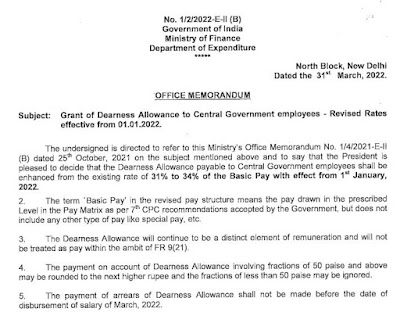
DA Jan 2022 - Grant of Dearness Allowance to Central Government employees - Revised Rates effective from 01.01.2022

 3% DA Hike - Revised Rates effective from 01.01.2022: DoE OM dated 31.03.2022 No. 1/2/2022-E-II (B) Government of India Ministry of Finance...