Saturday, 21 November 2015

MOST DISAPPOINTING AND RETROGRADE RECOMMENDATIONS: 7TH PAY COMMISSION REPORT: CONFEDERATION NEWS

MOST DISAPPOINTING AND RETROGRADE RECOMMENDATIONS: 7TH PAY COMMISSION REPORT: CONFEDERATION NEWS 

7TH PAY COMMISSION REPORT SUBMITTED TO GOVERNMENT OF INDIA ON 19.11.2015
WORST RECOMMENDATIONS EVER MADE BY ANY PREVIOUS PAY COMMISSION
ONLY 14.29% INCREASE IN PAY AFTER 10 YEARS

(EQUAL TO TWO DA INSTALLMENTS)!!!

50 LAKHS CENTRAL GOVERNMENT EMPLOYEES AND DEFENCE PERSONNEL CHEATED & DECEIVED


HOLD PROTEST DEMONSTRATIONS ALL OVER THE COUNTRY


NJCA LEADERS MEETING AT DELHI ON 20.11.2015 AT 11 AM, WILL DECIDE THE FUTURE COURSE OF ACTION
IMPORTANT RECOMMENDATIONS
  1. DATD OF EFFECT – 01.01.2016
JCM Staff Side demand – 01.01.2014 – Rejected
  1. MINIMUM PAY – 18000
JCM (SS) demand – 26000 – Rejected
Dr. Aykroyd Formula of 15th Indian Labour Conference for calculation of Minimum wage distorted by 7th CPC to deny the eligible minimum pay.
  1. FITMENT FORMULA – 2.57 TIMES
JCM (SS) demand – multiplication factor 3.7 (26000/7000)
  1. FIXATION ON PROMOTION – NO CHANGE – ONLY ONE INCREMENT IN THE OLD SCALE
JCM (SS) demand – Minimum two increments fixation.
  1. ANNUAL INCREMENT – 3% NO CHANGE
JCM (SS) demand – 5%
  1. MODIFIED ASSURED CAREER PROGRESSION – NO CHANGE – 10, 20, 30
Conditions made more stringent. Bench mark “Very Good” required instead of “good”. Examination for MACP proposed. Hierarchial promotion restored.
JCM (SS) demand: Five promotion – 8,7,6,5,4 (30 years)
  1. PAY BAND, GRADE PAY SYSTEM ABOLISHED
New Pension Structure called “Matrix based open ended pay structure” recommended. Total span of the scale 40 years.
JCM (SS) demand: Abolish pay band, Grade Pay system and open ended pay scales should be introduced.
  1. MAXIMUM PAY INCREASE – 14.29%
JCM (SS) demand – Minimum 40% increase for all employees.
  1. COMPARISON BETWEEN MINIMUM AND MAXIMUM PAY – 1:11.4 (18000 : 205400)
Demand of the JCM (SS) – 1:8
  1. NUMBER OF PAY SCALES – NOT REDUCED – NO DELAYERING
JCM(SS) demand – pay scales with grade pay 1900, 2000, 4600, 8700 and the pay scale 75500-80000 to be abolished.
  1. ALLOWANCES – NO IMPROVEMENT
Commission recommended abolition of 52 existing allowances such as Assisting Cashier Allowance, Cash Handling Allowance, Treasury Allowance, Handicapped Allowance, Risk Allowance, Savings Bank Allowance, Special compensatory (Hill Area) Allowance, Cycle Allowance, Family Planning Allowance etc.
  1. HRA REDUCED TO 24%, 16% AND 8% FOR X, Y AND Z CITIES
JCM (SS) demand – Existing HRA of 30% (for X class cities with population 50 lakhs and above), 20% (for Y class cities with population of 5 lakhs to 50 lakhs) and 10% (for Z class cities with less than 5 lakhs population) may be increased to 60%, 40% and 20%.
  1. DRIVERS – HIGHER PAY SCALE REJECTED
  1. DA FORMULA – NO CHANGE
  1. HBA – NO CHANGE – CEILING RAISED TO 25 LAKHS
  1. CASUAL LEAVE – NO INCREASE
  1. CHILD Care Leave
1st 365 days – Full pay (100%)
Next 365 days – 80% Pay only.
  1. MATERNITY LEAVE – NO CHANGE
  1. LEAVE ENCASHMENT AT THE TIME OF RETIREMENT – NO INCREASE MAXIMUM 300 DAYS ONLY
  1. MEDICAL
Medical Insurance Scheme for serving and retired employees recommended.
  1. TRANSPORT ALLOWANCE – NO HIKE –  ONLY 125% MERGER
Pay Level Higher Transport Allowance cities (A, AI) Other places
9 and above 7200 + DA 3600 + DA
3 to 8 3600 + DA 1800 + DA
1 and 2 1350 + DA 900 + DA
  1. LEAVE TRAVEL CONCESSION (LTC) – NO CHANGE
One time LTC to Foreign Country during the service rejected. Splitting of Home Town LTC for employees Posted in North East, Laddakh, Andaman & Nicobars and Lakshdweep allowed.
  1. ACCOUNTS STAFF BELONGING TO UNORGANIZED ACCOUNTS – PARITY WITH ORGANISED ACCOUNTS REJECTED.
  1. PERIODICAL REVIEW OF WAGES (NOT TEN YEARS) RECOMMENDED. NO PAY COMMISSION REQUIRED
  1. PERFORMANCE RELATED PAY SHOULD BE INTRODUCED IN GOVERNMENT SERVICES AND ALL BONUS PAYMENT SHOULD BE LINKED TO PRODUCTIVITY.
JCM (SS) demand – No Performance related Pay. Productivity Linked Bonus for all.
  1. COMPULSORY RETIREMENT AND EFFICIENCY BAR REINTRODUCED
Failure to get required bench mark for promotion within the first 20 years of service will result in stoppage of increment. Such employees who have out lived their ability, their services need not be continued and the continuance of such persons in the service should be discouraged.
  1. PROMOTEE AND DIRECT RECRUITS – ENTRY LEVEL PAY ANOMALY IS REMOVED
JCM (SS) demand – the differential entry pay between new recruits and promoted employees should be done away with.
  1. CADRE REVIEW TO BE COMPLETED IN A TIME BOUND MANNER.
Commission recommended to hasten the process of cadre review and reduced the time taken in inter-ministerial consultations.
  1. NEW PENSION SCHEME – WILL CONTINUE
  1. CEA & HOSTEL SUBSIDY
Rate
CEA per month             2250 – 25% increase when DA crosses 50%
Hostel subsidy              6750 – 25% increase when DA crosses 50%
  1. GROUP INSURANCE SCHEME
Level                    Monthly Contribution           Insurance Amount
1 to 5                   1500                                       15 Lakhs
6 to 9                   2500                                       25 lakhs
10 and above      5000                                       50 lakhs

PENSIONARY BENEFITS
  1. PENSIONERS – PARITY – LONG STANDING DEMAND OF THE PENSIONERS ACCEPTED
Commission recommends a revised Pension Formulation for Civil employees and Defence Personnel who have retired before 01.01.2016. (expected date of implementation of seventh CPC recommendations). This formulation will bring about complete parity of past pensioners with current retirees.
  1. PENSIONERS – MINIMUM PENSION RS. 9000/-
(50% of the minimum pay recommended by the 7th CPC)
  1. PENSIONERS – GRATUITY CEILING RAISED TO 20 LAKHS
  1. PENSIONERS – FIXED MEDICAL ALLOWANCE (FMA) – NO CHANGE (RS. 500/-)
  1. CGHS FACILITIES TO ALL POSTAL PENSIONERS RECOMMENDED
33 Postal dispensaries should be merged with CGHS
  1. GRAMIN DAK SEVAKS (GDS) OF THE POSTAL DEPARTMENT DEMAND FOR CIVIL SERVANTS STATUS REJECTED
Recommendation: – The committee carefully considered the demand for treating the Gramin Dak Sevaks as civil servants at par with other regular employees for all purposes, and noted the following:

(a)       GDS are Extra-Departmental Agents recruited by Department of Posts to serve in rural areas.

(b)       As per the Recruitment Rules the minimum educational qualification for recruitment to this post is class X.

(c)        GDS are required to be on duty only for 4 to 5 hours a day under the terms and conditions of their service.

(d)       The GDS are remunerated with Time Related continuity Allowance (TRCA) on the pattern of pay scales for regular Government employees plus DA on pro-rata basis.

(e)       A GDS must have other means of income independent of his remuneration as a GDS to sustain himself and his family.

Government of India has so far held that GDS is outside the Civil Service of the Union and shall not claim to be at par with the Central Government Employees. The Supreme Court Judgment also states that GDS are only holder of Civil posts but not civilian employees. The Commission endorses this view and therefore has no recommendation with regard to GDS.
(M. Krishnan)
Secretary General
Confederation

7th CPC Pay Fixation with examples

7th CPC Pay Fixation with examples

Pay Fixation in the New Pay Structure : The fitment of each employee in the new pay matrix is proposed to be done by multiplying his/her basic pay on the date of implementation by a factor of 2.57. 

The figure so arrived at is to be located in the new pay matrix, in the level that corresponds to the employee’s grade pay on the date of implementation, except in cases where the Commission has recommended a change in the existing grade pay. If the identical figure is not available in the given level, the next higher figure closest to it would be the new pay of the concerned employee. A couple of examples are detailed below to make the process amply clear.

The pay in the new pay matrix is to be fixed in the following manner:

Step 1: Identify Basic Pay (Pay in the pay band plus Grade Pay) drawn by an employee as on the date of implementation. This figure is ‘A’.

Step 2: Multiply ‘A’ with 2.57, round-off to the nearest rupee, and obtain result ‘B’.

Step 3: The figure so arrived at, i.e., ‘B’ or the next higher figure closest to it in the Level assigned to his/her grade pay, will be the new pay in the new pay matrix. In case the value of ‘B’ is less than the starting pay of the Level, then the pay will be equal to the starting pay of that level

Example I

i. For example an employee H is presently drawing Basic Pay of Rs.55,040 (Pay in the Pay Band Rs.46340 + Grade Pay Rs.8700 = Rs.55040). After multiplying Rs.55,040 with 2.57, a figure of Rs.1,41,452.80 is arrived at. This is rounded off to Rs.1,41,453.

ii. The level corresponding to GP 8700 is level 13, as may be seen from Table 4, which gives the full correspondence between existing Grade Pay and the new Levels being proposed.

iii. In the column for level 13, the figure closest to Rs.1,41,453 is Rs.1,41,600.

iv. Hence the pay of employee H will be fixed at Rs.1,41,600 in level 13 in the new pay matrix as shown below:

Pay Matrix


As part of its recommendations if Commission has recommended any upgradation or downgrade in the level of a particular post, the person would be placed in the level corresponding to the newly recommended grade pay.

Example II

i. Take the case of an employee T in GP 4200, drawing pay of Rs.20,000 in PB-2. The Basic Pay is Rs.24,200 (20,000+4200). If there was to be no change in T’s level the pay fixation would have been as explained in Example I above. After multiplying by 2.57, the amount fetched viz., Rs.62,194 would have been located in Level 6 and T’s pay would have been fixed in Level 6 at Rs.62,200.

Pay Matrix 7th CPC


ii. However, assuming that the Commission has recommended that the post occupied by T should be placed one level higher in GP 4600. T’s basic pay would then be Rs.24,600 (20000 + 4600). Multiplying this by 2.57 would fetch Rs.63,222.

iii. This value would have to be located in the matrix in Level 7 (the upgraded level of T).

iv. In the column for Level 7 Rs.63,222 lies between 62200 and 64100. Accordingly, the pay of T will be fixed in Level 7 at Rs.64,100.

7CPC PAY MATRIX

Authority: http://7cpc.india.gov.in/

Multiplication Factor / Fitment Formula recommended by 7th Pay Commission

Multiplication Factor / Fitment Formula recommended by 7th Pay Commission

7CPC_fitment-formula-7th-CPC


7th CPC recommended the Multiplication Factor proposed is 2.57

Fitment : The starting point for the first level of the matrix has been set at Rs. 18,000. This corresponds to the starting pay of Rs.7,000, which is the beginning of PB-1 viz., Rs.5,200 + GP 1800, which prevailed on 01.01.2006, the date of implementation of the VI CPC recommendations.

Hence the starting point now proposed is 2.57 times of what was prevailing on 01.01.2006. This fitment factor of 2.57 is being proposed to be applied uniformly for all employees. It includes a factor of 2.25 on account of DA neutralisation, assuming that the rate of Dearness Allowance would be 125 percent at the time of implementation of the new pay. Accordingly, the actual raise/fitment being recommended is 14.29 percent.

Source: 7thpaycommissionnews.in

Friday, 20 November 2015

7th Pay Commission Standard Pay Scale : Pay matrix with distinct Pay Levels

7th Pay Commission Standard Pay Scale : Pay matrix with distinct Pay Levels  

Seventh CPC is recommending a Pay matrix with distinct Pay Levels instead of Running Pay bands and Grade Pay.
 
7th-cpc-pay-structure
The new pay matrix for civilian employees

The new pay matrix for civilian employees

Authority: http://7cpc.india.gov.in/

7th CPC: Recommended Transport Allowance (TPTA)

7th CPC: Recommended Transport Allowance (TPTA)

Transport Allowance (TPTA) is granted to cover the expenditure involved in commuting between place of residence and place of duty. The existing rates are as under:


The following rates of Transport Allowance are recommended:


Regarding the optimal rate of Transport Allowance, the Commission notes that the allowance is already fully DA indexed. Therefore, since DA has already reached 119 percent and is likely to rise further before the implementation of our report, the following rates of Transport Allowance are recommended.

Authority: http://7cpc.india.gov.in/

7th CPC: Highlights of 7th Central Pay Commission Recommendations

7th CPC: Highlights of 7th Central Pay Commission Recommendations

7th Pay Commission Report


Recommended Date of implementation: 01.01.2016

Minimum Pay: Based on the Aykroyd formula, the minimum pay in government is recommended to be set at Rs.18,000 per month.

Maximum Pay: Rs.2,25,000 per month for Apex Scale and Rs.2,50,000 per month for Cabinet Secretary and others presently at the same pay level.

Financial Implications:The total financial impact in the FY 2016-17 is likely to be Rs.1,02,100 crore, over the expenditure as per the ‘Business As Usual’ scenario. Of this, the increase in pay would be Rs.39,100 crore, increase in allowances would be Rs. 29,300 crore and increase in pension would be Rs.33,700 crore.
Out of the total financial impact of Rs.1,02,100 crore, Rs.73,650 crore will be borne by the General Budget and Rs.28,450 crore by the Railway Budget.

In percentage terms the overall increase in pay & allowances and pensions over the ‘Business As Usual’ scenario will be 23.55 percent. Within this, the increase in pay will be 16 percent, increase in allowances will be 63 percent, and increase in pension would be 24 percent.

The total impact of the Commission’s recommendations are expected to entail an increase of 0.65 percentage points in the ratio of expenditure on (Pay+Allowances+ Pension) to GDP compared to 0.77 percent in case of VI CPC.

New Pay Structure: Considering the issues raised regarding the Grade Pay structure and with a view to bring in greater transparency, the present system of pay bands and grade pay has been dispensed with and a new pay matrix has been designed. Grade Pay has been subsumed in the pay matrix. The status of the employee, hitherto determined by grade pay, will now be determined by the level in the pay matrix.

Fitment: A fitment factor of 2.57 is being proposed to be applied uniformly for all employees.
Annual Increment: The rate of annual increment is being retained at 3 percent.

Modified Assured Career Progression (MACP):Performance benchmarks for MACP have been made more stringent from “Good” to “Very Good”.

The Commission has also proposed that annual increments not be granted in the case of those employees who are not able to meet the benchmark either for MACP or for a regular promotion in the first 20 years of their service.

No other changes in MACP recommended.

Military Service Pay (MSP): The Military Service Pay, which is a compensation for the various aspects of military service, will be admissible to the Defence forces personnel only. As before, Military Service Pay will be payable to all ranks up to and inclusive of Brigadiers and their equivalents. The current MSP per month and the revised rates recommended are as follows:

Military Service Pay


Short Service Commissioned Officers: Short Service Commissioned Officers will be allowed to exit the Armed Forces at any point in time between 7 and 10 years of service, with a terminal gratuity equivalent of 10.5 months of reckonable emoluments. They will further be entitled to a fully funded one year Executive Programme or a M.Tech. programme at a premier Institute.

Lateral Entry/Settlement: The Commission is recommending a revised formulation for lateral entry/resettlement of defence forces personnel which keeps in view the specific requirements of organization to which such personnel will be absorbed. For lateral entry into CAPFs an attractive severance package has been recommended.

Headquarters/Field Parity: Parity between field and headquarters staff recommended for similar functionaries e.g Assistants and Stenos.

Cadre Review: Systemic change in the process of Cadre Review for Group A officers recommended.
Allowances: The Commission has recommended abolishing 52 allowances altogether. Another 36 allowances have been abolished as separate identities, but subsumed either in an existing allowance or in newly proposed allowances. Allowances relating to Risk and Hardship will be governed by the proposed Risk and Hardship Matrix.

Risk and Hardship Allowance: Allowances relating to Risk and Hardship will be governed by the newly proposed nine-cell Risk and Hardship Matrix, with one extra cell at the top, viz., RH-Max to include Siachen Allowance.

The current Siachen Allowance per month and the revised rates recommended are as follows:

Risk and Hardship Allowance

This would be the ceiling for risk/hardship allowances and there would be no individual RHA with an amount higher than this allowance.

House Rent Allowance: Since the Basic Pay has been revised upwards, the Commission recommends that HRA be paid at the rate of 24 percent, 16 percent and 8 percent of the new Basic Pay for Class X, Y and Z cities respectively. The Commission also recommends that the rate of HRA will be revised to 27 percent, 18 percent and 9 percent respectively when DA crosses 50 percent, and further revised to 30 percent, 20 percent and 10 percent when DA crosses 100 percent.

In the case of PBORs of Defence, CAPFs and Indian Coast Guard compensation for housing is presently limited to the authorised married establishment hence many users are being deprived. The HRA coverage has now been expanded to cover all.

Any allowance not mentioned in the report shall cease to exist.

Emphasis has been placed on simplifying the process of claiming allowances.

Advances:All non-interest bearing Advances have been abolished.

Regarding interest-bearing Advances, only Personal Computer Advance and House Building Advance (HBA) have been retained. HBA ceiling has been increased to Rs.25 lakhs from the present Rs.7.5 lakhs.

Central Government Employees Group Insurance Scheme (CGEGIS): The Rates of contribution as also the insurance coverage under the CGEGIS have remained unchanged for long. They have now been enhanced suitably. The following rates of CGEGIS are recommended:

Central Government Employees Group Insurance Scheme


Medical Facilities:Introduction of a Health Insurance Scheme for Central Government employees and pensioners has been recommended.

Meanwhile, for the benefit of pensioners residing outside the CGHS areas, CGHS should empanel those hospitals which are already empanelled under CS (MA)/ECHS for catering to the medical requirement of these pensioners on a cashless basis.

All postal pensioners should be covered under CGHS. All postal dispensaries should be merged with CGHS.

Pension: The Commission recommends a revised pension formulation for civil employees including CAPF personnel as well as for Defence personnel, who have retired before 01.01.2016. This formulation will bring about parity between past pensioners and current retirees for the same length of service in the pay scale at the time of retirement.

The past pensioners shall first be fixed in the Pay Matrix being recommended by the Commission on the basis of Pay Band and Grade Pay at which they retired, at the minimum of the corresponding level in the pay matrix.

This amount shall be raised to arrive at the notional pay of retirees, by adding number of increments he/she had earned in that level while in service at the rate of 3 percent.

In the case of defence forces personnel this amount will include Military Service Pay as admissible.
Fifty percent of the total amount so arrived at shall be the new pension.

An alternative calculation will be carried out, which will be a multiple of 2.57 times of the current basic pension.

The pensioner will get the higher of the two.

Gratuity: Enhancement in the ceiling of gratuity from the existing Rs.10 lakh to Rs.20 lakh. The ceiling on gratuity may be raised by 25 percent whenever DA rises by 50 percent.

Disability Pension for Armed Forces: The Commission is recommending reverting to a slab based system for disability element, instead of existing percentile based disability pension regime.

Ex-gratia Lump sum Compensation to Next of Kin: The Commission is recommending the revision of rates of lump sum compensation for next of kin (NOK) in case of death arising in various circumstances relating to performance of duties, to be applied uniformly for the defence forces personnel and civilians including CAPF personnel.

Martyr Status for CAPF Personnel: The Commission is of the view that in case of death in the line of duty, the force personnel of CAPFs should be accorded martyr status, at par with the defence forces personnel.

New Pension System: The Commission received many grievances relating to NPS. It has recommended a number of steps to improve the functioning of NPS. It has also recommended establishment of a strong grievance redressal mechanism.

Regulatory Bodies: The Commission has recommended a consolidated pay package of Rs.4,50,000 and Rs.4,00,000 per month for Chairpersons and Members respectively of select Regulatory bodies. In case of retired government servants, their pension will not be deducted from their consolidated pay. The consolidated pay package will be raised by 25 percent as and when Dearness Allowance goes up by 50 percent. For Members of the remaining Regulatory bodies normal replacement pay has been recommended.

Performance Related Pay: The Commission has recommended introduction of the Performance Related Pay (PRP) for all categories of Central Government employees, based on quality Results Framework Documents, reformed Annual Performance Appraisal Reports and some other broad Guidelines. The Commission has also recommended that the PRP should subsume the existing Bonus schemes.
There are few recommendations of the Commission where there was no unanimity of view and these are as follows:

The Edge: An edge is presently accordeded to the Indian Administrative Service (IAS) and the Indian Foreign Service (IFS) at three promotion stages from Senior Time Scale (STS), to the Junior Administrative Grade (JAG) and the NFSG. is recommended by the Chairman, to be extended to the Indian Police Service (IPS) and Indian Forest Service (IFoS).

hri Vivek Rae, Member is of the view that financial edge is justified only for the IAS and IFS. Dr. Rathin Roy, Member is of the view that the financial edge accorded to the IAS and IFS should be removed.
Empanelment: The Chairman and Dr. Rathin Roy, Member, recommend that All India Service officers and Central Services Group A officers who have completed 17 years of service should be eligible for empanelment under the Central Staffing Scheme and there should not be “two year edge”, vis-à-vis the IAS. Shri Vivek Rae, Member, has not agreed with this view and has recommended review of the Central Staffing Scheme guidelines.

Non Functional Upgradation for Organised Group ‘A’ Services: The Chairman is of the view that NFU availed by all the organised Group `A’ Services should be allowed to continue and be extended to all officers in the CAPFs, Indian Coast Guard and the Defence forces. NFU should henceforth be based on the respective residency periods in the preceding substantive grade. Shri Vivek Rae, Member and Dr. Rathin Roy, Member, have favoured abolition of NFU at SAG and HAG level.

Superannuation: Chairman and Dr. Rathin Roy, Member, recommend the age of superannuation for all CAPF personnel should be 60 years uniformly. Shri Vivek Rae, Member, has not agreed with this recommendation and has endorsed the stand of the Ministry of Home Affairs.
The full report is available in the website, http://7cpc.india.gov.in.

PIB

Thursday, 19 November 2015

7th Pay Commission Report submitted – 23.55% increase in salary : Central Government Employees

7th Pay Commission Report submitted – 23.55% increase in salary : Central Government Employees

7th Pay Commission Report submitted – 23.55% increase in salary when taking increase in allowances also – Net Pay increase is 16%

7th pay commission report Highlights:
  • Minimum pay is 18,000/-
  • Grade Pay System abolished
  • Fitment formula will be 2.57. So using present basic pay, 7th CPC pay can be calculated by multiplying the same with 2.57 factor.
  • Increase in Military service Pay increased to 16,500
  • 3% annual increment
  • 52 allowances abolished
  • 16% increase in pay
  •  23.55% increase overall salary when taking in to increase in allowances also
  • 24% increase in Pension
7th-central-pay-commission-report-2015

In a bonanza for central government employees, the Seventh Pay Commission on Thursday submitted its final report to Finance Minister Arun Jaitley recommending a 22-23 percent jump in their salary and allowances.
The Pay Commission headed by Justice A K Mathur has suggested a 15 percent increase over the basic salary plus DA for the central government staff. An increase in allowances like HRA has also been recommended.

The total increase will be 23.55 percent of the gross salary (basic plus DA plus allowances). The pay commission has also  proposed a status quo on the retirement age of central government employees. Retirement age for central government employees is 60 years now.

The recommendations of the 7th Pay Commission are scheduled to take effect from January 1, 2016.
Besides Chairman, other members of the commission are Vivek Rae, a retired IAS officer of 1978 batch, and Rathin Roy, an economist. Meena Agarwal is secretary of the commission.

The central government constitutes the pay commission every 10 years to revise the pay scale of its employees and often these are adopted by states after some modifications.

The Commission was set up by the UPA government in February 2014 to revise remuneration of about 48 lakh central government employees and 55 lakh pensioners.

The Union Cabinet had extended the term of the panel in August by four months, till December. The 6th Pay Commission was implemented with effect from January 1, 2006.

Download 7th Pay Commission Report

Flash News: 7th Pay Commission has finally submitted its report to the Centre

Flash News: 7th Pay Commission has finally submitted its report to the Centre

The 7th Pay Commission submits its report to the Central Government.

The much-awaited 7th Pay Commission report was finally submitted to the Minister of Finance a short while ago.

The four-member 7th Pay Commission, under the chairmanship of Chairman A.K. Mathur, had worked hard for 21 months to prepare the report. The report was handed over to the Centre today. Salaries for Central Government employees and pensioners for the years 2016 to 2026 will be based on these recommendations.

Recommendations prescribed by the committee and their impact and explanations will be given in a series of articles that will appear in future.

Mixed Responses when Sixth pay commission report submitted to Finance Minister

Mixed Responses when Sixth pay commission report submitted to Finance Minister

There will be same response after the Report of 7th pay commission submitted to Finance Minister

Today the 7th pay commission going to submit its recommendations to Finance Minister Shri.Arun Jaitly.at 19.30 PM

Our waiting for knowing the 7th pay commission recommendation on pay and allowances will come to an end this evening. After that we will be hearing mixed responses from various quarters. If it gives satisfaction to one side and the same will be disappointment to other side.

When sixth pay commission submitted its report to the then Finance minister Mr.P.Chidambaram, many trade unions were not satisfied over the recommendation of sixth pay commission.

After presenting the report to Finance Minister P. Chidambaram, Mr. Justice Srikrishna said: “I have recommended something which is good for the nation … the average hike will be 40 per cent.”

The Hindu daily , dated 25-3-2008, has published various reports about the sixth pay commission recommendation. It described recommendation with a title “Bonanza for Central government staff”

♦ Commission recommends 40% hike in salary

NEW DELHI: In a major post-Holi bonanza, the Sixth Pay Commission on Monday recommended an average 40 per cent increase in the salary of over 40 lakh Central government employees and a doubling of most of their allowances that would impose a burden of Rs. 12,561 crore on the exchequer in 2008-09.

pay-commission-pay-scale
Resentment among CG employees Federation over recommendation of sixth pay commission also were reported in Hindu dated 25-3-2008

♦ The Centre of Indian Trade Unions has described the Pay Commission recommendations as “arbitrary, discriminatory and disappointing.”

♦ In a statement issued here on Monday, CITU president M. K. Pandhe said that against the demand of Rs. 10,000 as the minimum wage computed on the basis of the 15th Indian Labour Conference recommendations, the Commission has recommended only a paltry Rs. 5,740, while the maximum has been fixed at Rs. 90,000.

♦ The Confederation of Central Government Employees and Workers has described the Sixth Pay Commission’s recommendations as “totally unacceptable” and decided to stage a protest here on Wednesday to “fight for a decent wage settlement.”

♦ In a statement issued here on Tuesday, the Confederation drew attention to the recommendations that were made by them but rejected by the Commission, including fixing the minimum wage at Rs 10,000 a month. The minimum wage recommended in the report was even less than what was suggested in the previous Pay Commission, the statement said.

♦ South Central Railway Mazdoor Union secretary C. Ramakrishnama Charyulu on Monday said that the Sixth Pay Commission’s recommendations had disappointed all the Central Government employees. He said the pay hike recommended by the commission was nothing but pittance.

After submission of the 7th pay commission report we may hear same words but through others voice. Because the leaders might have been changed but voice will be the same . But as we said earlier the recommendation to be submitted today is not final verdict since it is subject to change. Because before 7th cpc report goes to cabinet approval it has to cross various hurdles.

Source: gservants

Mystery of 7th Pay Commission recommendations on Pay and Allowances will be revealed

Mystery of Seventh Pay Commission recommendations on Pay and Allowances will be revealed today

7th CPC Recommendation on Pay Structure, Annual Increment, HRA, DA, MACP, Promotion ,Pay Fixation Benefit will be known

All our doubts will be cleared and queries will be answered after submission of 7th pay commission report to Finance Minister today.

The VII Pay commission was appointed on 28th February 2014 to revise the pay and allowances of central government employees and the commission took twenty months time to complete its tedious but sensitive task. On 18th November 2015, the official website of Seventh pay commission informed that the commission is prepared to submits its report to Finance Minister on 19th November 2015 at 19:30 Hrs.
The news created buzz over internet and government staffs expectation went sky high because of many reasons.

The result of recommendations of 7th pay commission to be submitted to the government today will decide the financial future of the 35 Lakh Central government employees and 50Lakh pensioners. And of course it will impact 185 Lakh government employees of Central and state together, since the seventh pay commission recommendation will be followed by state government also.

All the central government employees very keen to know the 7th Pay Commission recommendation on the following important matters.

1.Amount of Increase in Basic Pay : There were many news and roumers circulated about the amount of Increase over Basic Pay. It is now expected 15 to 30 % increase will be there in the recommendations of Pay commission.

2. 7th CPC Pay Structure: Whether existing system [Pay Band and Grade Pay] continues or not ?.
Federations claimed that pay commission accepted to drop the Grade Pay and Pay band System and old Pay Scale system with open ended Pay scale would be recommended. This would be a critical decision as both the systems has its own advantages and dis advantages.

3.Annual Increment : How much it will be granted?
At least 5% of the Basic Pay has been expected as annual increment in 7th Pay commission. Some doubts are there that Performance based Increment and Promotion will be recommended by the Pay commission. But it is not feasible for implementing this proposal in Govt Sector.

4. MACP in 7th Pay commission : Federation demanded 5 MACP to be ensured in ones career. But it expected 4 MACP s will be granted. But the main plea of Central government Federation is MACP should be granted on Promotion hierarchy instead of Grade pay hierarchy.

5.Pay Fixation on Promotion : In the existing system it is reported that Pay fixation on promotion created anomaly and and it lead to Junior gets higher Pay than Senior Govt servants. There should be definite Pay Scale and Pay for respective promotion is expected with the benefit of 10% increment on pay fixation

6. House Rent Allowance
NCJCM Proposal demanded 60%,40% and 20% of HRA instead of 30%,20% and 10%. But it is not known how much the 7th pay commission decided to grant on HRA

7. Dearness Allowance
DA Calculation will be revised and it is expected the pay commission to recommend merger of dearness Allowance whenever DA reaches 50%

8. All other Allowances
All the other allowances including CCA, TA to be proportionate to the amount of increase in rate of Dearness Allowance.

All the above matters will be cleared by this evening and let us wait for 8 more hours to know the all the information. But whatever it is recommended in the 7th pay commission report is not final and it is subject to modification based on the impact and objections and responses both sides from central government and government servants, unions and Federations.

Source: gservants.com

Flash News

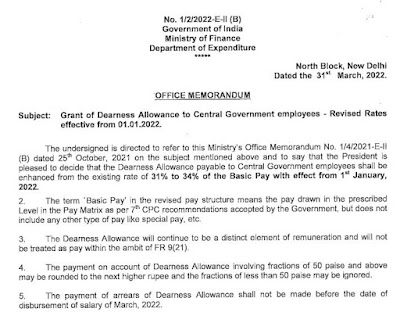
DA Jan 2022 - Grant of Dearness Allowance to Central Government employees - Revised Rates effective from 01.01.2022

 3% DA Hike - Revised Rates effective from 01.01.2022: DoE OM dated 31.03.2022 No. 1/2/2022-E-II (B) Government of India Ministry of Finance...