Friday, 18 September 2015

Why new Pay Commission report is important?

Why new Pay Commission report is important?

The Seventh Pay Commission report is awaited; it is that time of the decade when Government offices are buzz with expectation and excitement. Revision of salaries of the government employees in the country is a decennial affair. Governments, several of them, have continued with this practice despite the recommendations to the contrary, that is, to reduce the period and have a more frequent pay revision of the government employees. The 7th Pay Commission was appointed in 2014; normally the Commissions have been asked give their reports after due study of pay and allowances of government employees in 18 months. Last month, that is August, the Commission ought to have submitted it’s report.  Revision of pay scales is with effect from 1st. Jan 2016. If there is delay in implementation, which generally is the norm, it will be with retrospective effect without change in the due date.

Starting from the fourth pay commission, award of every commission has bought a virtual bonanza to the employees of the Government. Goa has one of the highest proportion of government employees to population. The all India average relatively is lower. There are 48 lakh Central Government employees and over one crore state and local government staff. Out of a total workforce of 47 Plus crore, almost 44 crore are in the unorganized sector. They are not covered by any Pay Commission; from time to time governments do fix the minimum wage rate which is neither uniform across the country nor is it followed strictly in letter and spirit. Viewed from this perspective, the pay panel’s exercise is not significant.

Yet, the Pay Commission recommendations are important from different perspectives. It has the potential to kick start the economy that has not seen growth revival for quite some time. Latest release of data regarding inflation in the economy indicates the decline of retail inflation for the second successive month. Actually, the WPI is in the red, which is a rare phenomenon.  By putting more money in the hands of the employees, government might succeed in creating more demand for goods and services. With federal states following in the footsteps of the centre, it is likely to sustain the enhanced demand for a longer time. At least with a time lag it is likely to have a rub off effect on pay and allowances in the organized private sector.

Pay and pension of central government employees amount to a full 1% of nation’s GDP. More pay will only further add to the burden of the exchequer. When the last pay commission’s recommendations were implemented, the fiscal deficit doubled to more than 6% in 2008-09.   According to the estimates submitted to the Parliament, government employees are likely to get a pay hike of around 16%. According to an estimate, this would be around 0.2 to 0.3% of GDP. Going by the recommendations of the previous commissions, the average gross increase would be much higher, may even top 40%. The fear of higher fiscal deficit may force the government to effect cuts in spending, with education and healthcare more likely to be the ‘soft’ targets.  This will hurt the poor and lower middle class sections of our society. The government is also likely to go slow on investment in infrastructure; even in normal times government’s expenditure on capital goods is not high. This will impact the recovery process in the economy and adversely impact the GDP growth rate.

Since the appointment of 7th Pay Commission was done well in advance, there is enough lead time for submission of report. Further, if the Government takes an early decision to implement the recommendations of pay revision, it will not have to shoulder the burden of arrears of pay. In all the previous pay commissions, payment of arrears was a huge financial burden; in the last pay commission revision, arrears of salary hikes for up to two years had to be paid by governments.

Apart from pay hike, there are other expectations from this pay panel. Keeping in view the rise in life expectancy and dearth of competent staff, the age of retirement may be tweaked in favour of the employees. Performance-linked pay is another area the commission may take a serious look at. Flexible working hours to facilitate women and persons with certain disabilities deserve consideration by the pay panel.  The recommendations, therefore, are significant and have far-reaching impact.

Source: http://www.navhindtimes.in

Government employees to get reviewed at 50, says DoPT

Government employees to get reviewed at 50, says DoPT

It is time for Indian bureaucrats to remember school. Or rather, that cold and terrible sweat before exam results.

The performance of those who have either completed 30 years in service or reach 50 years of age, whichever comes earlier, will be reviewed, according to a recent Department of Personnel and Training (DoPT) order. Those who get negative reviews will be given a three-month notice to retire.
The DoPT, headed by PM Narendra Modi, has decided to let go of non-performing officers and those with suspect integrity by giving them compulsory premature retirement.

Whenever the services of a public servant are no longer useful to the general administration, the officer can be compulsorily retired for the sake of public interest, said the DoPT circular. For better administration, it is necessary to chop off the dead wood.

The relationship of the NDA government with its employees has seen ups and downs. This is not the first time that the government has sighted rules to ensure transparency. Earlier, the government had amended the All India Service (conduct) Rules, 1968, to include a 19-point guideline for bureaucrats which mandates that they maintain 'political neutrality' and 'take decisions solely in public interest', among other clauses.

Detailed instructions have been issued for reviewing the quarterly performance of officers. The DoPT cited various Supreme Court observations for assessment of such cases. On integrity, the circular quoted the SC: "The officer would live by reputation built around him. In an appropriate case, there may not be sufficient evidence to take punitive disciplinary action of removal from service. But his conduct and reputation is such that his continuance would be a menace to public service and injurious to public interest."

Sighting FR 56(j), the rule pertaining to compulsory retirement, the order has asked every department to set up a two-member review committee which will screen officers and employees based on the internal feedback and yearly appraisal reports.

For Group A officers, secretaries of departments would head review committees. The Chief Vigilance Officer (CVO) of departments will mark cases where the record reflected adversely on the integrity of the gazetted officer. The CVOs are an extension of the Central Vigilance Commission (CVC ). The Government of India has about 45 laky employees.

Service record
For reviews, the entire service record will be considered, DoPT said. An officer could also be appraised on the basis of how she dealt with files or by delving into other documents and reports prepared and submitted by her. The instructions from Cabinet Secretary Pradeep Kumar Sinha also underlined the need for rotating officers working in sensitive and nonsensitive posts.

Our government has always believed in transparency. The PM has assured minimum government and maximum governance. This circular is a step in that direction, minister for department of personnel and training Jitendra Singh said. "It is a welcome step, this will help cleanse the system and ensure that those who have been misusing the system. It is necessary for the government to ensure periodic reviews," said BJP MP and former home secretary RK Singh.

"It is a welcome step by the government. Now the deserving and hard-working will get a chance to get ahead rather than those serving political masters. It will give us an incentive to perform and even go against politicians if the latter want to pressurise us to do something wrong," said a senior Haryana IAS officer posted in Rohtak, requesting anonymity.

But the review needs to be done regularly, say after every ten years. At 50 years, if some officer is let go for wrong conduct, it is hardly a punishment as he or she has had the best of time.

Source :http://m.businesstoday.com

Postal LGO Exam Results out to the cadre of PAs/SAs held on 23.11.2014

LGO Exam Results out to the cadre of PAs/SAs held on 23.11.2014

Results of LGO Examination 2014

Reckoning of GP 4600 as entry Grade Pay for Graduate Engineers (Drawing) for the purpose of MACPS

Reckoning of GP 4600 as entry Grade Pay for Graduate Engineers (Drawing) for the purpose of MACPS
National Federation of Indian Railwaymen
3, CHELMSFORD ROAD, NEW DELHI - 110 055
No. IV/MACPS/09/Part 9
Dated: 16/09/2015
The Secretary (E),
Railway Board,
New Delhi
Dear Sir,

Sub: Reckoning of GP 4600 (PB-2) as entry Grade Pay for Graduate Engineers (Drawing) for the purpose of MACPS-reg.

Ref: (i) NFIR’s PNM item no. 18/2011.

(ii Railway Board’s letter No. PC-V/2009/ACP/2 dated 20/06/2011 (RBE No. 93/2011)

(iii) Discussions held by NFIR with the MS/FC in the meeting held on 19/05/2015

The issue of placement of Graduate Engineers (Drawing) joined railways prior to 01/09/1998 came up for discussion in the separate meeting held between the Federations and the Board (MS/PC) on 19/05/2015. During the meeting following key points were emerged:-

In a Production Unit like ICF, there are 11 Graduate Engineers. These were recruited prior to 1998 in the pre-revised Scale of Pay of Rs. 5500-9000.

These Engineers were promoted to the pre-revised Scale of Pay of Rs. 6500-10,500 through normal promotion and a few through LDCE.

Since LDCE quota for promotion to pre-revised Scale of Rs. 6500-10,500 was very limited, only a couple of persons were accommodated and the remaining persons were promoted through normal promotion against promotion quota.

Federation also desires to highlight a peculiar case of Shri Karthikeyan. N of ICF. He was working as JE-II in the pre-revised Scale of Rs. 5000-8000 (required entry qualification is Diploma in Engineering only) during the period 1992 to 1996. Since he was holding Engineering Degree he was subsequently recruited against DR Quota in the V CPC Pay scale of Rs. 5500-9000 on 11/12/1996. However he was treated as holder of entry Grade Pay Rs. 4200/- only from the date of his appointment.

2. Although in the meeting held on 19/05/2015 with the Railway Board (MS & PC) the discussions were inconclusive, the Federation did mention that those Drawing cadre staff recruited with the entry qualification of B. Tech were allotted incorrectly the Pay Scale of 5500-9000 (6th CPC/GP 4200/) instead granting them the 5‘“ CPC Pay Scale of 6500-10,500 (6th CPC GP 4600/-). To remedy this anomalous situation, it was suggested that in the case those Engineering Graduates (Drawing), they be reckoned as holders of entry GP 4600/- - PB-2 for the limited purpose of MACP duly appropriately modifying the Board’s letter dated 20th June 2011 for covering all such cases.

As another meeting date has not yet been fixed, the issue continues to remain unresolved. It is also relevant to place on record that while some Engineering Graduates benefited on account of induction against LDCE quota, the similarly placed Engineering Graduates who got appointed against promotion quota vacancies of Rs. 6500-10,500 (5th CPC) have not been covered for the purpose of MACP on the pretext that they were not inducted in pay scale of Rs. 6500-10,500 against LDCE Quota. This anomalous situation needs to be rectified for ensuring equal treatment to all the Engineering Graduates of Drawing cadre whether reached pay scale of Rs. 6500-10500 through promotion or through LDCE quota.

NFIR, therefore, requests the Railway Board to reconsider their decision and see that all Engineering Graduates of Drawing cadre are granted MACP duly treating them as holders of entry Grade Pay of Rs. 4600/- (PB-2).
Yours faithfully,

(Dr. M. Raghavaih)
General Secretary


Source: NFIR

Strengthening of administration-Periodical review under FR 56(j) and Rule 48 of CCS (Pension) Rules, 1972

Strengthening of administration-Periodical review under FR 56(j) and Rule 48 of CCS (Pension) Rules, 1972
No.25013/01/2013-Estt.A-IV
Government of India
Ministry of Personnel, Public Grievances and Pensions
Department of Personnel and Training
Establishment A-IV Desk
North Block, New Delhi
Dated 11th September, 2015
OFFICE MEMORANDUM

Subject: Strengthening of administration-Periodical review under FR 560) and Rule 48 of CCS (Pension) Rules, 1972

The undersigned is directed to refer to this Department’s OM No. 25013/1/2013-Estt(A) dated 21/03/2014 on the periodical review under Fundamental Rule 56 or Rule 48 of CCS (Pension) Rules.

2. Various instructions issued on the subject deal with compulsory retirement under the above mentioned provisions. The Supreme Court has observed in State of Gujarat Vs. Umedbhai M. Patel. 2001 (3) SCC 3l4 as follows:

(i) Whenever the services of a public servant are no longer useful to the general administration, the officer can be compulsorily retired for the sake of public interest.

(ii) Ordinarily, the order of compulsory retirement is not to be treated as a punishment coming under Article 31 l of the Constitution.

(iii) “For better administration, it is necessary to chop off dead wood, but the order of compulsory retirement can be passed after having due regard to the entire service record of the officer.”
(iv) Any adverse entries made in the confidential record shall be taken note of and be given due weightage in passing such order.
(v) Even un-communicated entries in the confidential record can also be taken into consideration.
(vi) The order of compulsory retirement shall not be passed as a short cut to avoid Departmental enquiry when such course is more desirable.
(vii) if the officer was given a promotion despite adverse entries made in the confidential record, that is a fact in favour of the officer.
(viii) Compulsory retirement shall not be imposed as a punitive measure.

3. , In every review, the entire service records should be considered. The expression ‘service record’ will take in all relevant records and hence the review should not be confined to the consideration of the ACR / APAR dossier. The personal file of the officer may contain valuable material. Similarly, the work and performance of the officer could also be assessed by looking into files dealt with by him or in any papers or reports prepared and submitted by him. it would be useful if the Ministry/Department puts together all the data available about the officers and prepares a comprehensive brief for consideration by the Review Committee. Even uncommunicated remarks in the ACRs/APARS may be taken into consideration.

4. in the case of those officers who have been promoted during the last five years, the previous entries in the ACRs may be taken into account if the officer was promoted on the basis of seniority cum fitness, and not on the basis of merit.

5, As far as integrity is considered, the following observations of the Hon’ble Supreme Court may, while upholding compulsory retirement in a case, may be kept in view:
The officer would live by reputation built around him. in an appropriate case, there may not be sufficient evidence to take punitive disciplinary action of removal from service. But his conduct and reputation is such that his continuance in service would be a menace to public service and’injurious to public interest.
S. Ramachandra Raju vs. State of Orissa
[(l 994) 3 SCC 424]

Thus while considering integrity of an employee, actions or decisions taken by the employee which do not appear to be above board, complaints received against him, or suspicious property transactions, for which there may not be sufficient evidence to initiate departmental proceedings, may be taken into account. Judgement of the Apex Court in the case of Shri K. Kandaswamy, I.P.S. (TN:1966) in K. Kandaswamy vs Union Of India & Anr, l996 AIR 277, I995 SCC (6) l62 is relevant here. There were persistent reports of Shri Kandaswamy acquiring large assets and of his getting money from his subordinates. He also indulged in property transactions which gave rise to suspicion about his bonafides. The Hon’ble Supreme Court upheld his compulsory retirement under provisions of the relevant Rules.

6. Similarly, reports of conduct unbecoming of a Government servant may also form basis for compulsory retirement. As per the Hon’ble Supreme Court in State of UP. And Others vs Vijay Kumar ‘Jain, Appeal (civil) 2083 of 2002:

If conduct of a government employee becomes unbecoming to the public interest or obstructs the efficiency in public services, the government has an absolute right to compulsorily retire such an employee in public interest.

7. Many changes in the nomenclature and in the areas of responsibility of various departments/Ministries have taken place. In order to simplify and speed up the procedure of review, a need is felt to reconstitute the Review Committees. in partial modification of the OM 25013/15/86-Estt (A) dated 27/06/1986, it has been decided that the Secretaries of the Cadre Controlling Authorities will constitute Review Committees consisting of two Members at appropriate level. The Review Committees in the case of various levels of employees will be as under:

(A) in case of officers holding Group A posts:
(a) In r/o ACC appointees:
Review Committee may be headed by the Secretary of the concerned Ministry/Department as Cadre Controlling Authority.
(b) In r/o Non-ACC appointees:
(i) Where there are Boards viz CBDT, CBBC, Railway Board, Postal Board, Telecom Commission, etc. the Review Committee may be headed by the Chairman of such Board.
(ii) Where no such Boards/Commissions exist, the Review Committee may be headed ’by Secretary of the. Ministry/Department.
(B) in case of Group B (Gazetted) officers:
Additional Secretary/Joint Secretary level officer will head the Review Committee.
(C) In the case of Non-Gazetted employees:
(i) An officer of the level of Joint Secretary will head the Committee. However in case the Appointing Authority is lower in rank than a Joint Secretary, then an officer of the level of Director/Deputy Secretary will be the head.
(ii) in the case of Non-Gazetted employees in other than centralised cadres, Head of Department/Head of the Organisation shall decide the composition of the Review Committee.

8. CVO in the case of gazetted officers, or his representative in the case of non-gazetted officers, will be associated in case of record reflecting adversely on the integrity of any employee.

9. in addition to the above, the Secretary of the Ministry/Department is also empowered to constitute internal committees to assist the Review Committees in reviewing the cases. These Committees will ensure that the service record of the employees being reviewed, alongwith a summary bringing out all relevant information, is submitted to the Cadre Authorities at least three months before the due date of review.

10. The procedure as prescribed from time to time has been consolidated and enclosed as Appendix to the OM issued by this Department on 21/03/2014. As per these instructions the cases of Government servant covered by FR 56(j), FR 56(l), or Rule 48(1) (b) of CCS (Pension) Rules, 1972 should be reviewed six months before he/she attains the age of 50/55 years, in cases covered by FR 56(j) and on completion of 30 years of qualifying service under FR 56(l)/Rule 48 of CCS (Pension) Rules, 1972 as per the following calendar:

Sl No.Quarter in which review is to be made Cases of employees who will be attaining the age of 50/55 years or will be completing 30 years of service or 30 years of service qualifying for pension, as the case may be, in the quarter.
1.January to  MarchJuly to September of the same year
2.April to JuneOctober to December of the same year
3.July to SeptemberJanuary to March of the next year
4.October to DecemberApril to June of the next year 
11 All Ministries/Departments are requested to follow the above instructions and periodically review the cases of Government servants as required under FR 56(j)/FR56(l)/Rule 48(1)(b) of CCS (Pension) Rules, 1972.

12. instructions on composition of the Representation Committees will be communicated separately.
sd/-
(Mukesh Chaturvedi)
Director (Establishment)
Authority : www.persmin.nic.in

Government employees to get reviewed at 50, says DoPT

Government employees to get reviewed at 50, says DoPT

It is time for Indian bureaucrats to remember school. Or rather, that cold and terrible sweat before exam results.

The performance of those who have either completed 30 years in service or reach 50 years of age, whichever comes earlier, will be reviewed, according to a recent Department of Personnel and Training (DoPT) order. Those who get negative reviews will be given a three-month notice to retire.

The DoPT, headed by PM Narendra Modi, has decided to let go of non-performing officers and those with suspect integrity by giving them compulsory premature retirement.

Whenever the services of a public servant are no longer useful to the general administration, the officer can be compulsorily retired for the sake of public interest, said the DoPT circular. For better administration, it is necessary to chop off the dead wood.

The relationship of the NDA government with its employees has seen ups and downs. This is not the first time that the government has sighted rules to ensure transparency. Earlier, the government had amended the All India Service (conduct) Rules, 1968, to include a 19-point guideline for bureaucrats which mandates that they maintain 'political neutrality' and 'take decisions solely in public interest', among other clauses.

Detailed instructions have been issued for reviewing the quarterly performance of officers. The DoPT cited various Supreme Court observations for assessment of such cases. On integrity, the circular quoted the SC: "The officer would live by reputation built around him. In an appropriate case, there may not be sufficient evidence to take punitive disciplinary action of removal from service. But his conduct and reputation is such that his continuance would be a menace to public service and injurious to public interest."

Sighting FR 56(j), the rule pertaining to compulsory retirement, the order has asked every department to set up a two-member review committee which will screen officers and employees based on the internal feedback and yearly appraisal reports.

For Group A officers, secretaries of departments would head review committees. The Chief Vigilance Officer (CVO) of departments will mark cases where the record reflected adversely on the integrity of the gazetted officer. The CVOs are an extension of the Central Vigilance Commission (CVC ). The Government of India has about 45 laky employees.

Service record
For reviews, the entire service record will be considered, DoPT said. An officer could also be appraised on the basis of how she dealt with files or by delving into other documents and reports prepared and submitted by her. The instructions from Cabinet Secretary Pradeep Kumar Sinha also underlined the need for rotating officers working in sensitive and nonsensitive posts.

Our government has always believed in transparency. The PM has assured minimum government and maximum governance. This circular is a step in that direction, minister for department of personnel and training Jitendra Singh said. "It is a welcome step, this will help cleanse the system and ensure that those who have been misusing the system. It is necessary for the government to ensure periodic reviews," said BJP MP and former home secretary RK Singh.

"It is a welcome step by the government. Now the deserving and hard-working will get a chance to get ahead rather than those serving political masters. It will give us an incentive to perform and even go against politicians if the latter want to pressurise us to do something wrong," said a senior Haryana IAS officer posted in Rohtak, requesting anonymity.
But the review needs to be done regularly, say after every ten years. At 50 years, if some officer is let go for wrong conduct, it is hardly a punishment as he or she has had the best of time.

Source :http://m.businesstoday.com

Wednesday, 16 September 2015

Finance Minister Arun Jaitley to receive 6th Pay Commission report in December

Finance Minister Arun Jaitley to receive Sixth Pay Commission report in December


New Delhi : The Seventh Pay Commission headed by Justice Ashok Kumar Mathur is likely to submit its report to Union Finance Minister Arun Jaitley in December, presumably recommending a 40 per cent hike in salary for the central government employees.

Justice Mathur already told PTI on August 25, “The Commission may submit its report by the end of September.”

“We are likely to recommend something for the good of central government employees, after observation of inflation, the government’s financial position and salary structure of government employees in other countries. The Finance Minister will give the latest highlights,” a top official of the pay panel said, speaking on condition of anonymity.

He also said it has been mandated to recommend incentive schemes to reward excellence in productivity, performance and integrity, which it will do.

“Though previous Pay Commissions have talked about linking pay with productivity, the earlier governments have not accepted such recommendations. Since this government has shown strong political will, we hope they will accept our recommendations,” he added.

Over 5 million central government employees are expecting a bounty from the report which is likely to recommend major changes in salaries and terms of employment, including performance-linked pay and incentives.

“A joint secretary gets now Rs 128,000 as monthly salary with dearness allowance. I do not expect it to go up to more than Rs 160,000,” a joint secretary-level official of the Central Government said.

In his pre-budget speech in February, Jaitley said,“the Seventh Pay Commission impact may have to be absorbed in financial year 2016-17.”

The salary outgo of central government employees will increase in financial year 2016-17 at 15.79 per cent to Rs 1.16 lakh crore with the likely implementation of the Seventh Pay Commission award, said the statement tabled by Finance Minister Arun Jaitley in Parliament on August 12.

The Seventh Pay Commission, which was set up by the UPA government, was required to submit its report by August-end. The government constitutes the Pay Commission almost every 10 years to revise the pay scale of its employees and often these are adopted by states after some modifications.

The Commission has already completed discussions with various stakeholders, including organisations, federations, groups representing civil employees as well as Defence services and is in the process of finalising its recommendations.

The recommendations of the Seventh Pay Commission are scheduled to come into effect from January 1, 2016.

The Sixth Pay Commission was implemented with effect from January 1, 2006, the fifth from January 1, 1996 and the fourth from January 1, 1986.

Selection Process for engagement to all approved categories of GDC Posts - Review thereof

Selection Process for engagement to all approved categories of GDC Posts - Review thereof

No. 17-39/2012-GDS
Government of India
Ministry of Communications & IT
Department of Posts
Establishment Division
(GDS Section)

Dak Bhawan, Sansad Marg
New Delhi - 110001
Dated: 16 Sep 2015
All Heads of Postal Circles
Subject: Selection Process for engagement to all approved categories of GDS Posts Review thereof
Attention of all concerned is invited to this Directorate’s letter No. 17-39/7/2012-GDS dated 14th Jan 2015 vide which detailed selection process to the GDS Posts was introduced based on Aptitude Test to be conducted at Circle level through outsourced agency and selection to the GDS Posts was prescribed to be made based on marks secured in the Aptitude Test in respect of vacancies notified on or after 01.04.2015. Subsequent thereto, it was also laid down vide this Directorate’s letter No. 17-39/7/2012-GDS dated 28th May 2015 that in case vacancies notified on or before 31.03.2015 do not get filled up by 30.06.2015, the notification will be cancelled and vacancies be filled up under the new engagement process (Aptitude Test Method) effective from 01.04.2015.
2. In View of the pronouncement of the Hon’ble Prime Minister in his address to the Nation delivered on 15th Aug 2015 to make selection to the junior level posts based on marks appearing in the marks sheet without an element of interview through transparent online process, the selection process introduced vide this Directorate’s letter ibid has been reviewed by the authority competent to align the selection process/criteria with the pronouncement made by the Hon’ble Prime Minister taking note of the fact that GDS posts are lower level civil posts outside the regular civil service not falling under Group A, B & C posts by replacing the process introduced vide this Directorate’s letter No. 17-39/7/2012-GDS dated 14th Jan 2015, pending introduction of online process in due course, in the manner indicated below:-
(a) There will be no change in the eligibility criteria laid down in this Directorate’s letter No. 17-39/6/2012-GDS dated 14.01.2015 & strict observance of the same will be ensured by all recruiting authorities concerned while issuing notification.
(b) The recruiting authorities will be guided by the below mentioned method of engagement to all approved categories of GDS Posts:-
(i) In case a vacancy does not get filled up through other regular modes of engagement viz.; by combination of duties or by absorption of surplus GDS or by compassionate engagement or by transfer under limited transfer facility, vacancy will be notified first to casual labourers within the jurisdiction of the recruiting authority as per existing instructions contained in this Directorate’s letter No. 17-3 9/4/2012-GDS dated 14.01.2015 read with clarification issued under No. 17-15/2015-GDS dated 07.05.2015.
(ii) In case vacancy does not get filled up through process outlined at (i) above, the recruiting authority before taking decision to fill up the post by way of open notification is to examine the representation of the reserved communities and then decide to which community the vacancy is to be earmarked or the vacancy would go to other community based on order of shortfall subject to overall restriction of 50% in a calendar year strictly as per this Directorate letter no. 19-11/97-ED& TRG dated 27.11.1997. As regards, differently abled persons are concerned, instructions contained in this Directorate letter no. 21-8/92-ED&TRG dated 22.04.1994 shall have the application.
(iii) The vacancy will then be notified to Employment Exchange requesting nomination of suitable candidates [not less than 3] for the post within a period of 30 days from the date of sending requisition to the concerned authority having the prescribed qualification. Simultaneously [on the same day of notification of vacancy to Employment. Exchange], the vacancy will be given wide publicity by displaying a notice giving particulars of the engagement to be made, remuneration and other conditions attached to it at the concerned post office, the police station, the Panchayat office and any other public place considered suitable allowing the same time of 30 days for receipt of applications. A copy of the notification will also be circulated to all Post Offices within the Division duly entered in Account Bag for display on Notice Board. In case the last date falls on Sunday/Holidays, the cut of date will be reckoned as close of subsequent working day.
(iv) The candidates nominated by employment exchange (if any) will then be addressed by service registered post enclosing a copy of the application for the post with a covering letter containing instructions to fill-up the same and self attested documents to be enclosed for further submission to the recruiting authority concerned within 30 days mentioning the cutoff date up to which the application duly completed is to be received by recruiting authority by Registered / Speed Post. Here also, In case the last date falls on Sunday/Holidays, the cut of date will be reckoned as close of subsequent working day.
(v) The candidates nominated by the Employment Exchange as also those responding to the open advertisement will be considered.
(vi) The recruiting authorities concerned will arrange /maintain a register for keeping a proper record of the application received from the candidates applying against open notification as also in response to communication sent by them following their nomination from Employment Exchange on a day to day basis. However, the closed covers will not be opened till the day earmarked for selection.
(vii) The authority higher to recruiting authority will nominate a committee consisting of three members including the recruiting authority with two others not below the rank of Inspector Posts. Besides the said authority will decide the date on which such committee will meet for finalizing selection.
(viii) Selection will be made by the committee strictly based on marks secured only in Secondary School Examination pass certificate of 1oth standard conducted by any recognized Board of School Education in India and will be guided by the clarification issued under this Directorate’s letter No. 17-39/2012-GDS dated 08.01.2014. The committee will also prepare a select panel of 5 candidates for a post in accordance with directions contained in this Directorate’s letter No. 19-14/2010-GDS dated 25.06.2010 followed by letter dated 18.10.2013.
(ix) Result will be communicated to the candidate standing first in the list on the same day of selection through Registered post. Besides, a copy of the result will be displayed on the notice board of the recruiting authority on the day of finalization itself.
(x) Pre-engagement formalities will be got completed by the recruiting authority concerned in respect of the candidate standing at the top besides only verification of the documents in respect of other four remaining candidates finding place in the select panel.
3. Wherever notification has been issued adopting the new method of selection made effective from 01.04.2015, the same will be cancelled and the concerned recruiting authorities will be directed to initiate action to fill up the post taking recourse to the process outlined above. Besides this, where vacancies have been notified on or before 31.03.2015, action will be taken by the respective recruiting authorities by completing the process already undertaken.
4. The contents of this letter may be disseminated to all concerned for strict adherence.
(Surender Kumar)
Assistant Director General (GDS/PCC)
Source: http://www.indiapost.gov.in/dop/pdfbind.ashx?id=1606

Central Government wants its employees with doubtful integrity, efficiency sacked

Central Government wants its employees with doubtful integrity, efficiency sacked

New Delhi: To tone up the bureaucratic apparatus and weed out officials of doubtful integrity and efficiency, the government has asked all its departments to identify such central government employees and move proposals for their premature retirement.
Cabinet Secretary Pradeep Kumar Sinha
The move by the Department of Personnel and Training follows a meeting chaired by Cabinet Secretary Pradeep Kumar Sinha recently on mechanisms to be adopted to ensure probity among government servants.
The departments have been asked to invoke provisions of Fundamental Rule 56(J) to compulsorily retire such officials.

Under FR 56(J), the government has the “absolute right” to retire, if necessary in public interest, an
y Group A and B employee, who has joined service before the age of 35 and has crossed the age of 50.
Under the rules, a C Group government servant, who has crossed the age of 55 can be retired prematurely but action can be taken only if the official is suspected to be corrupt or ineffective.

Group A comprise officers of All India Services like IAS, IPS, Indian Forest Service, IRS, while Group B consists of gazetted & non-gazetted officers and Group C clerical and ministerial staff.

However, action can be taken only against such officers whose annual increment have stood frozen for a few years and have not got promotion in preceding five years.

The meeting emphasised rotation of officers on sensitive and non-sensitive posts and their review and screening under FR 56(J).

The DoPT has been asked to monitor implementation and obtain compliance from all ministries in this regard.
“As this activity is to be completed in a time bound manner, it is requested that priority attention may be paid to it and inputs sent to the internal vigilance section at the very earliest,” the notice, sent to all ministries, said.
The Cabinet Secretariat has been issuing such orders from time to time. In February 2012, the UPA government notified a rule making it compulsory for IAS, IPS and officers from other all-India services to retire in “public interest” if they fail to clear a review after 15 years of service.

PTI

ALLOWANCES – Dearness Allowance – Dearness Allowance to the State Government Employees from 1st of January, 2015 – Sanctioned – Orders – Issued.

ALLOWANCES – Dearness Allowance – Dearness Allowance to the State Government Employees from 1st of January, 2015 – Sanctioned – Orders – Issued.
 
GOVERNMENT OF TELANGANA
ABSTRACT
FINANCE (HRM.IV) DEPARTMENT
G.O.MS.No. 129
Dated: 09-09-2015.
Read the following: 1. G.O.Ms.No.35, Finance (HRM.IV) Department, dated: 01-10-2014. 2. G.O.Ms.No.26, Finance (HRM.IV) Department, dated: 18-03-2015.

O R D E R:

Government hereby order revision of the Dearness Allowance (DA) sanctioned in the Government Order 2nd read above to the employees of Government of Telangana from 8.908% of the basic pay to 12.052% of basic pay from 1st of January, 2015.
 
2. The Dearness Allowance sanctioned in the above para shall also be payable to:
i) The employees of Zilla Parishads, Mandal Parishads, Gram Panchayats, Municipalities, Municipal Corporations, Agricultural Market Committees and Zilla Grandhalaya Samasthas, Work Charged Establishment, who are drawing pay in a regular scale of pay in the Revised Pay Scales, 2015.

ii) Teaching and Non-Teaching Staff of Aided Institutions including Aided Polytechnics who are drawing pay in a regular scale of pay in the Revised Pay Scales, 2015.

iii) Teaching and Non-Teaching Staff of Universities including Professor K. Jayashankar Telangana State Agricultural University and Jawaharlal Nehru Technological University, Hyderabad who are drawing pay in a regular scale of pay in the Revised Pay Scales, 2015.
3. Government also hereby order revision of the Dearness Allowance rates in respect of State Government employees drawing the Revised U.G.C Pay Scales, 2006, from 107% to 113% of the basic pay with effect from 1st of January, 2015.

3.1. The above rate of Dearness Allowance is also applicable to:
(i) The Teaching and Non-Teaching staff of Government and Aided Affiliated Degree Colleges who are drawing pay in the Revised U.G.C Pay Scales, 2006.

(ii) The Teaching staff of the Universities including the Professor K. Jayashankar Telangana State Agricultural University and the Jawaharlal Nehru Technological University, Hyderabad and the Teaching staff of Govt. Polytechnics who are drawing pay in the Revised UGC/AICTE Pay Scales, 2006.
4. Government also hereby order revision of the Dearness Allowance rates in respect of State Government employees drawing the Revised U.G.C Pay Scales 1996, from 212% to 223% of the basic pay with effect from 1st of January, 2015, as DA equivalent to 50% Basic Pay was already merged through G.O.Ms.No.9, Higher Education (U.E.I) Department, dated: 8-2-2006 and G.O.(P)No.173, Finance (PC.I) Department, dated:23.07.2007.
4.1. The above Dearness Allowance rate is also applicable to:
(i) the Teaching and Non-Teaching staff of Government and Aided Affiliated Degree Colleges who are drawing pay in the Revised U.G.C Pay Scales, 1996.

(ii) the Teaching staff of the Universities including the Professor K. Jayashankar Telangana State Agricultural University and the Jawaharlal Nehru Technological University, Hyderabad and the Teaching staff of Govt. Polytechnics who are drawing pay in the Revised UGC/AICTE Pay Scales, 1996.
5. Government also hereby order revision of rate of the Dearness Allowance in respect of Judicial Officers whose pay scales were revised as per Shri E. Padmanabhan Committee Report vide G.O.Ms.No.73, Law (LA&J, SC-F) Department, dated: 01.05.2010 from 107% to 113% with effect from 1st of January, 2015.

6. Government also hereby order revision of rate of the Dearness Allowance in respect of Judicial Officers whose pay scales were revised as per First National Judicial Pay Commission Report vide G.O.Ms.No.60, Law (LA&J SC-F) Department, dated: 07.05.2003 from 212% to 223% of the basic pay with effect from 1st of January, 2015, as Dearness Allowance equivalent to 50% of basic pay was already merged as Dearness pay vide G.O.Ms.No.27, Law (LA&J SC-F) Department, dated: 13.03.2008.

7. Government hereby order revision of the Dearness Allowance rate sanctioned in the G.O.1st read above to the State Government employees in the Revised Pay Scales 2010 from 77.896% of the basic pay to 83.032% of the basic pay with effect from 1st of January, 2015 in the Revised Pay Scales of 2010.

7.1 The Dearness Allowance sanctioned in the above para shall also be payable to:
i) The employees of Zilla Parishads, Mandal Parishads, Gram Panchayats, Municipalities, Municipal Corporations, Agricultural Market Committees and Zilla Grandhalaya Samasthas, Work Charged Establishment, who are drawing pay in a regular scale of pay in the Revised Pay Scales, 2010 and to the full time contingent employees whose remuneration has been revised from Rs.3850/- to Rs.6700/- per month vide G.O.Ms.No.171, Finance (P.C.III) Department, dated 13.05.2010.

ii) Teaching and Non-Teaching Staff of Aided Institutions including Aided Polytechnics who are drawing pay in a regular scale of pay in the Revised Pay Scales, 2010.

iii) Teaching and Non-Teaching Staff of Universities including Professor K. Jayashankar Telangana State Agricultural University and Jawaharlal Nehru Technological University, Hyderabad who are drawing pay in a regular scale of pay in the Revised Pay Scales, 2010.
8. Government hereby order revision of the Dearness Allowance rate sanctioned in the G.O.1st read above to the State Government employees in the Revised Pay Scales 2005 from 191.226% of the basic pay to 201.588% of the basic pay with effect from 1st of January, 2015 in the Revised Pay Scales of 2005.

8.1. The Dearness Allowance sanctioned in the above para shall also be payable to:
i) The employees of Zilla Parishads, Mandal Parishads, Gram Panchayats, Municipalities, Municipal Corporations, Agricultural Market Committees and Zilla Grandhalaya Samasthas and Work Charged Establishment who are drawing pay in a regular scale of pay in the Revised Pay Scales, 2005.

ii) Teaching and Non-Teaching Staff of Aided Institutions including Aided Polytechnics who are drawing pay in a regular scale of pay in the Revised Pay Scales, 2005.

iii) Teaching and Non-Teaching Staff of Universities including the Professor K. Jayashankar Telangana State Agricultural University and the Jawaharlal Nehru Technological University, Hyderabad who are drawing pay in a regular scale of pay in the Revised Pay Scales, 2005.
9. Government hereby order the revision of Dearness Allowance rate sanctioned in the G.O. 1st read above to the State Government employees in the Revised Pay Scales, 1999 from 196.32% of the basic pay to 205.318% of the basic pay with effect from 1st of January, 2015 in the Revised Pay Scales of 1999.

9.1. The Dearness Allowance sanctioned in the above para shall also be payable to:
i) The employees of Zilla Parishads, Mandal Parishads, Gram Panchayats, Municipalities, Municipal Corporations, Agricultural Market Committees and Zilla Grandhalaya Samasthas and Work Charged Establishment who are drawing pay in a regular scale of pay in the Revised Pay Scales, 1999.

ii) Teaching and Non-Teaching Staff of Aided Institutions including Aided Polytechnics who are drawing pay in a regular scale of pay in the Revised Pay Scales, 1999.

iii) Teaching and Non-Teaching Staff of Universities including the Professor K. Jayashankar Telangana State Agricultural University and the Jawaharlal Nehru Technological University, Hyderabad who are drawing pay in a regular scale of pay in the Revised Pay Scales, 1999.
10. Government also hereby sanction an ad-hoc increase of Rs.100/- per month in cash to the Part-Time Assistants and Village Revenue Assistants from 1st of January, 2015.

11. The Dearness Allowance sanctioned in the paras 1-9 above shall be paid in cash with the salary of September, 2015, payable on 1st of October, 2015. The arrears on account of payment of Dearness Allowance for the period from 1st of January, 2015 to 30th of August, 2015 shall be credited to the General Provident Fund Account of the respective employees.
11.1. However, in the case of employees who are due to retire on or before 31st December, 2015, the arrears of Dearness Allowance shall be drawn and paid in cash as the employees due to retire on superannuation are exempted from making any subscription to the General Provident Fund during the last four months of service.

11.2. In respect of those who do not have General Provident Fund accounts, the arrears of Dearness Allowance for the period of 1st of January, 2015 to 30th of August, 2015 shall be credited to the Major Head “8009 – State Provident Funds – 01 Civil – M.H.101. General Provident Fund- S.H.(01) General Provident Fund (Regular)”, to be transferred to the General Provident Fund Account whenever opened. However, in the case of an employee who ceases to be in service prior to the opening of a General Provident Fund account, the arrears so impounded shall be drawn and paid with interest on the date on which such employee ceases to be in service.

11.3. In respect of the employees who were appointed to Government service on or after 01.09.2004 and are governed by the Contributory Pension Scheme (CPS), the arrears from 1st of January, 2015 to 30th of August, 2015, 10% of the DA arrears shall be credited to the PRAN accounts of the individuals along with the government share as per the existing orders and the remaining 90% of arrears shall be paid in cash.

11.4. In respect of Full Time Contingent Employees, who are not eligible for GPF Accounts, the arrears may be paid in cash.

11.5. In the event of death of any employee before the issue of these orders, the legal heir(s) shall be entitled to the arrears of Dearness allowance in cash.
12. The term ‘Pay’ for this purpose shall be as defined in F.R.9 (21) (a) (i).

13. The Drawing Officer shall prefer the bill on the Pay & Accounts Officer, Hyderabad, or the Pay & Accounts Officer/ the Assistant Pay & Accounts Officer of the Telangana Works Accounts Service or the Treasury Officer, as the case may be, for the amount of arrears for the period from 1st of January, 2015 to 30th of August, 2015 to be adjusted to the General Provident Fund Account in the case of an employee who has opened a General Provident Fund Account.

13.1. Bills for the adjustment of arrears of Dearness Allowance to the Compulsory Savings Account as per para 11.2, shall be presented at the same time as bills for crediting the arrears of Dearness Allowance to the General Provident Fund Account as per para 11.

14. The Drawing Officers shall ensure that the Bills are supported by proper schedules in duplicate indicating details of the employee, the General Provident Fund Account Number and the amount to be credited to the General Provident Fund Account, to the Pay & Accounts Officer/Treasury Officers/Assistant Pay & Accounts Officers or Pay & Accounts Officers of the Telangana Works Accounts Service, as the case may be. The Pay & Accounts Officer/Assistant Pay & Accounts Officer or Pay and Accounts Officer of the Telangana Works Accounts Service/District Treasury Officer/Sub-Treasury Officer shall follow the usual procedure of furnishing one copy of the schedules along with bills to the Accountant General based on which the Accountant General shall credit the amounts to the General Provident Fund Accounts of the individuals concerned. The second copy of the schedules shall be furnished to the Drawing Officers with Voucher Numbers.

15. All Drawing Officers are requested to ensure that the bills as per the above orders are drawn and the amounts credited to General Provident Fund Account by 15th October, 2015 at the latest. The Audit Officers (Pay & Accounts Officer, Deputy Directors of District Treasuries and Pay & Accounts Officer of Telangana Works Accounts Service, etc.) are requested not to admit the pay bills of the Office concerned for the month of October 2015 unless a certificate is enclosed to the bills to the effect that the arrears of difference in Dearness Allowance for the period from 1st of January, 2015 to 30th of August, 2015, are drawn and credited to the General Provident Fund Account before 24th of October, 2015.

16. In respect of employees working in Government Offices in the Twin Cities, the Pay and Accounts Officer shall consolidate and furnish information in the proforma annexed (Annexure-I) to this order to the Finance (HRM.IV) Department to reach on or before 10th of November, 2015.

17. All the Audit Officers (Sub-Treasury Officers) are requested to furnish the figures of the amount credited to the General Provident Fund Account and the amounts credited to Compulsory Savings Account in the prescribed proforma (Annexure-I) enclosed, to the District Treasury by the end of 20th of November, 2015.

18. The Deputy Directors of District Treasuries in turn shall consolidate the information and furnish the same in the same proforma to the Director of Treasuries and Accounts by 20th of November 2015, and who in turn, shall furnish the consolidated information to Government by 30th of November, 2015.

19. In respect of employees of Local Bodies, the Drawing Officers shall furnish the above information in the prescribed proforma as per Annexure-II to the Audit Officer of the District concerned before 20th of November, 2015 and who will, in turn furnish the consolidated information to the Director of State Audit by 30th of November, 2015. The Director of State Audit in turn shall furnish the consolidated information to the Secretary to Government, Finance (HRM.IV) Department by 10th of December, 2015.

20. In regard to the Project Staff, the Joint Director of Accounts of each Project shall furnish the information in the prescribed proforma as per Annexure-II to the Director of Works Accounts by 30th of October, 2015, and who, in turn, shall furnish the information to the Finance (HRM.IV) Department by 20th of November, 2015.

21. All the Drawing and Disbursing Officers and Audit Officers are requested to intimate to the employees working under their control as to how much amount of arrears of Dearness Allowance is credited to the General Provident Fund Account/Compulsory Savings Account as per the Proforma annexed (Annexure-II) to this order. They are further requested to adhere to the above instructions and any deviation or non-compliance of these instructions will be viewed seriously.

22. All Departments of Secretariat Heads of the Departments and are requested to issue suitable instructions to the Drawing and Disbursing Officers under their control and to see that these instructions are followed scrupulously. The Director of Treasuries and Accounts/ Director of State Audit/Pay & Accounts Officer/Director of Works Accounts, Telangana, Hyderabad, are requested to issue suitable instructions to their subordinate Audit Officers so that these instructions are carefully followed by them.

23. The expenditure on the Dearness Allowance to the employees of Agricultural Market Committees and Greater Hyderabad Municipal Corporation shall be met from their own funds in view of the orders issued in G.O.Ms.No.9, Finance (PC-I) Department, dated: 18.01.2010.

24. This G.O. is available on Internet and can be accessed at the addresses http://goir. telangana.gov.in and http://finance.telangana.gov.in .
(BY ORDER AND IN THE NAME OF THE GOVERNOR OF TELANGANA)
K. PRADEEP CHANDRA
SPECIAL CHIEF SECRETARY TO GOVERNMENT

Flash News

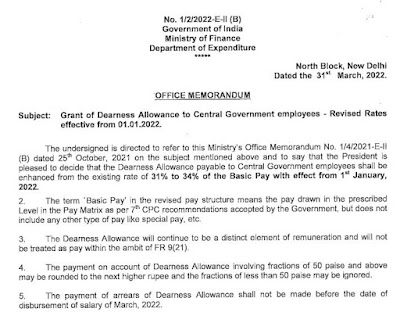
DA Jan 2022 - Grant of Dearness Allowance to Central Government employees - Revised Rates effective from 01.01.2022

 3% DA Hike - Revised Rates effective from 01.01.2022: DoE OM dated 31.03.2022 No. 1/2/2022-E-II (B) Government of India Ministry of Finance...