Monday, 7 September 2015

Spotlight of One Rank One Pension

Spotlight of One Rank One Pension

In simple terms, OROP implies that uniform pension be paid to the Armed Forces personnel retiring in the same rank with the same length of service, regardless of their date of retirement. Future enhancements in the rates of pension would be automatically passed on to the past pensioners. This implies bridging the gap between the rate of pension of current and past pensioners at periodic intervals.

Under this definition, it has been decided that the gap between rate of pension of current pensioners and past pensioners will be bridged every 5 years.

The benefit will be given with effect from 1st July, 2014. The present government assumed office on 26th May, 2014 and therefore, it has been decided to make the scheme effective from a date immediately after.
Arrears will be paid in four half-yearly instalments. All widows, including war widows, will be paid arrears in one instalment.

To begin with, OROP would be fixed on the basis of calendar year 2013.

Pension will be re-fixed for all pensioners retiring in the same rank and with the same length of service as the average of minimum and maximum pension in 2013. Those drawing pensions above the average will be protected.

Personnel who voluntarily retire will not be covered under the OROP scheme.

In future, the pension would be re-fixed every 5 years.

Sunday, 6 September 2015

One Rank One Pension- Projected OROP Table PBOR and Officers

One Rank One Pension- Projected OROP Table PBOR and Officers

Government Announces One Rank One Pension Scheme for Ex-Servicemen

Government Announces One Rank One Pension Scheme for Ex-Servicemen 

The Government has announced the One Rank One Pension scheme for the Ex-Servicemen. This was announced by the Defence Minister Shri Manohar Parrikar here today. The following is the statement of the Defence Minister:

“Government of India respects its Defence Forces and Ex-Servicemen for their valour, patriotism and sacrifices. The Government is proud of their devotion to duty and bravery. Our forces, besides vigilantly and gallantly defending the nation, have displayed exemplary standards of courage and bravery in natural calamities, law and order situations and other difficult circumstances.

The issue of “One Rank One Pension” (OROP) has been pending for nearly four decades. It is a matter of deep anguish that the various governments remained ambivalent on the issue of OROP. In February 2014, the then Government stated that OROP would be implemented in 2014-15, but did not specify what OROP would be, how it would be implemented or how much it would cost. An estimated Rs. 500 crore provided for OROP in the budget presented in February 2014 by the then government was not based on any thorough analysis. It is pertinent to mention that the then Minister of State for Defence in 2009 had, in reply to a question, informed Parliament that there are administrative, technical and financial difficulties in implementing OROP. It is for these reasons that the present government took some time to fulfil its promise.

Prime Minister Shri Narendra Modi has, on various occasions, reiterated the Government’s commitment to implement OROP for Ex-Servicemen under military pension. As stated above, the previous government has estimated that OROP would be implemented with a budget provision of a mere Rs. 500 crore. The reality, however, is that to implement OROP, the estimated cost to the exchequer would be Rs. 8,000 to 10,000 crore at present, and will increase further in future.

The Government held extensive consultations with experts and Ex-Servicemen. The main argument for OROP is that the Defence personnel retire early and thus are not able to get the benefits of serving till normal retirement age. Despite the huge fiscal burden, given its commitment to the welfare of Ex-Servicemen, the Government has taken a decision to implement the OROP.

In simple terms, OROP implies that uniform pension be paid to the Armed Forces personnel retiring in the same rank with the same length of service, regardless of their date of retirement. Future enhancements in the rates of pension would be automatically passed on to the past pensioners. This implies bridging the gap between the rate of pension of current and past pensioners at periodic intervals.

Under this definition, it has been decided that the gap between rate of pension of current pensioners and past pensioners will be bridged every 5 years.

Under the OROP Scheme:
The benefit will be given with effect from 1st July, 2014. The present government assumed office on 26th May, 2014 and therefore, it has been decided to make the scheme effective from a date immediately after.
Arrears will be paid in four half-yearly instalments. All widows, including war widows, will be paid arrears in one instalment.

To begin with, OROP would be fixed on the basis of calendar year 2013.

Pension will be re-fixed for all pensioners retiring in the same rank and with the same length of service as the average of minimum and maximum pension in 2013. Those drawing pensions above the average will be protected.

Personnel who voluntarily retire will not be covered under the OROP scheme.

In future, the pension would be re-fixed every 5 years.

It is estimated that the expenditure on arrears alone would be ten to twelve thousand crores of rupees. Apart from the fact that the previous government had provided for only Rs. 500 crore in the budget, it is noteworthy that the Koshiyari Committee had accepted the estimate of Rs. 235 crore as additional financial burden to implement OROP. The present government has accepted OROP in true spirit without being constrained by these inaccurate estimates.

OROP is a complex issue. A thorough examination of interests of retirees of different periods and different ranks is needed. The inter-service issues of the three Forces also require consideration. This is not an administrative matter alone. Therefore, it has also been decided that a One Member Judicial Committee would be constituted which will give its report in six months.

Prime Minister Shri Modi has fulfilled his commitment and approved OROP for Armed Forces personnel. Ministry of Defence will soon issue detailed Government Order.”


PIB

Saturday, 5 September 2015

One Rank One Pension : A new wave of expectation rises; Announcements expected in 48 hours

One Rank One Pension : A new wave of expectation rises; Announcements expected in 48 hours

“Although there is no official confirmation from the government, the ex-servicemen’s United Front are ready to accept the demand if it comes with a once-every-two-years pension revision, instead of five.”

Implementation of One Rank One Pension : After crossing multiple hurdles the One Rank One Pension scheme is stuck at one final block. The Government has clarified that it was impossible to revise the pension each year. It is ready for a revision once every five years. But, there are talks that the Government would relax its stand and agree to revise the pension once every two years.

“There is no confirmation from the Government side, but if they agree to revise the pension once every two years, we will accept the term” Major General (Retd) Satbir Singh, who is heading the protests, said.

Sources claim that a section of the ex-servicemen are not ready to accept the once-every-two-years revision. They want to call a general body meeting and discuss it.

Months, weeks, and days have gone. The announcement from the government is now expected in 48 hours. But, there is always the question of whether one should or shouldn’t trust these news.

Many wonder why the demand, that had remained pending for years, suddenly gained momentum and force now. Plenty of reasons are also being attributed to it. Here are the two most important ones –

1. The fact that Modi had voluntarily offered to implement the OROP if he is voted to power. OROP was also included in his election manifesto.

2. Defence pension has not been revised for more than seven years, since the recommendations of the 6th Pay Commission came into being. Thousands of army personnel who had retired before 2006 have not been given any pension revision until now. The Government’s refusal to heed to the countless talks, cases, and judgements of various courts has brought the crisis to this stage.

Trade unions eye Rs 15,000 per month minimum wage as national baseline

Trade unions eye Rs 15,000 per month minimum wage as national baseline
By Subodh Varma, TNN

One of the key issues on which the negotiations between the government and the 10 central trade unions that had called for a general strike on Wednesday broke down was that of minimum wages. A labour ministry document circulated amongst the trade unions days before the strike, argued that by current norms, prices and calorific needs, Rs.6330 per month is the monthly wage adequate for an unskilled worker with a wife and two small children.

The trade unions and various other federations that represent 15 crore workers had demanded Rs.15,000 per month minimum wage as a national level floor wage. Striking a generous posture, the government modestly increased its proposal to Rs.7098 per month.

What the government had proposed was less than half of what was demanded. This was one of the contributory factors to the breakdown of negotiations. Other demands of the workers included social security coverage, non-interference with existing labour laws, etc.

How did the government calculate their proposal? A look at the fine print shows a slew of gross under-estimations and the use of an archaic formula first spelled out way back in 1957. Some of the food items' prices are far from reality. For instance dal is costed at Rs.65 but only one of the various dals in the market - chana or gram dal - comes in this range. Arhar (tur) is Rs.135 per kg, urad is Rs.117.5, masur is Rs.95. All these current retail prices are from the consumer affairs ministry's price monitoring data spanning 81 cities and towns.

Mutton is priced at a bizarre Rs.80 per kg, although it doesn't really matter because only 50 g is allowed. This is convertible to 250 grams of vegetables which are priced at an imaginary Rs.16 per kg. In the real world mutton is selling at anywhere between Rs.300 to Rs.400 per kg. And rarely if any vegetable sells at Rs.16 per kg.


 But the real rub comes in the non-food items. Just Rs.390 is supposed to be spent on rent every month. And, fuel for cooking and utilities like electricity etc. are all supposed to be covered under a meagre Rs.780.

All education, medical expenses, marriages, care of elderly, recreation etc. is lumped together and costed at 25 percent of the food expenditure. This practice started after the Supreme Court in a landmark judgement in 1991 directed as much saying that if such a minimum wage cannot be guaranteed then the managements have no right to run their business. But even this works out to a mere Rs.980 per month.

Costs of education and healthcare have risen tremendously in the past several years and even one major episode of sickness in the family would be devastating. The government's wage calculation seems to be blissfully unaware of this.

Recent government data shows that real wages, that is, after adjusting for inflation are dipping while the share of wages to profits is also dipping in the organized sector. In the unorganized sector which employs over 90 percent of India's workforce, wages are abysmally low and conditions of work onerous. Small wonder then that the trade unions were unwilling to accept the government's proposals.


Source : The Economic Times

Central Government Employees may cheer for higher bonus this year

Central Government Employees may cheer for higher bonus this year

After long times Central Government Employees are going to get higher amount of bonus this year. Earlier, the ceiling for bonus was Rs. 3500 per month. From this year, the ceiling is going to be increased to as high as Rs. 10,000 per month. In a letter from Secretary, Ministry of Labour and Employment, Mr S. Agarwal conveyed this good news to Sri Vijesh Upadhyay, Genl. Secy., Bharatiya Mazdoor Sangha.

MINISTRY OF LABOUR & EMPLOYMENT
SHRAM SHAKTHI BHAVAN
NEW DELHI – 110001
SHANKAR AGGARWAL, I.A.S.
Secretary of Govt. of India
D.O.No.51040/4/2015-IR(PG)
28th August, 2015
Dear Shri Upadhyay,

Kindly refer to our discussion regarding the calculation ceiling for bonus. The Government is considering to revise calculation ceiling from the preset level of Rs.3,500 per month to Rs.7,000 per month or the minimum wages for the scheduled employment as fixed by the appropriate Government, whichever is higher. Minimum wages have not been fixed as yet, however, the minimum wages will be fixed at a level which is respectable.

2. Under these circumstances, on an average the calculation ceiling for the purposes of bonus would be Rs.10,000 per month.
Yours Sincerely,
(Shankar Aggarwal)
Shri Virijesh Upadhayay
General Secretary,
Bhartiya Mazadoor Sangh
27, Deendayal Upadhyay Mag.
Rouse Avenue, New Delhi-2


Friday, 4 September 2015

7th Pay Commission likely to see pay hikes by 40%

7th Pay Commission likely to see pay hikes by 40%

New Delhi: The Seventh Pay Commission’s report is likely be submitted to the Finance Minister Arun Jaitley shortly.

Sources said that there will be no internal relief. The average increase in basic fair pay for all government employees will be in the region of 40-45%.

This is a very rough average because for senior level officers, like the Cabinet Secretary or officials at the secretary level, the payback could increase by more than 50%.

The Pay Panel may recommend a new pay scale from January 1, 2016. The existing HRA would be retained for A1 cities; while there would be a 15-20% hike for other cities.

But interestingly when we spoke to government employees they were not really happy, essentially perhaps because effectively if you take the DA out, it is not really a hefty bonanza as many thought it would be.
Also, given the price rise and inflation issues, most people are saying it is really not that sufficient. Most of these recommendations will be implemented.

But the point is, if the Finance Minister Arun Jaitley has a problem with any of the observations or with the impact of the Pay Commission recommendations, he might even send this back to the Pay Commission for another round of iteration.

In that case, some amendments will be made that come back to the Finance Ministry and then it may go back to the Cabinet for approval. If that happens, it could delay the process by about 1-2 more months.
A central government employee will earn up to 40% more if the government accepts the Seventh Pay commission’s proposals, which will be submitted shortly.

This pay hike would affect the lives of over 48 lakh central government employees and 55 lakh pensioners and could trigger off similar pay hike across state governments as well.

An official of the Pay Commission, says recommendations will be made to improve productivity.
The Commission will be talked of market driven compensation at the top level, where there are expert persons required by the government. There should be open competition with the public. If they have a better candidate from outside, he should be appointed instead of simply promoting people by seniority, said the official.

TST 

Central Employees DA release not discussed in cabinet meeting

Central Employees DA release not discussed in cabinet meeting

New Delhi: The release of Dearness Allowance (DA) did not figure in the Union Cabinet on Wednesday, despite media saying earlier that it would raise the issue in the meeting.


The cabinet meeting, chaired by Prime Minister Narendra Modi, discussed only the controversial issue of land ordinance, which was allowed to lapse on August 31 at the Prime Minister Narendra Modi official residence, 7, Race Course Road (RCR) here.

“The Union Cabinet today gave its approval to an order issued by government on August 28 to extend the provisions of compensation, rehabilitation and resettlement available to farmers under the 2013 Land Acquisition Act to 13 other central laws as well,” a senior officer in the PMO said.
“The release of the Dearness Allowance (DA) was not discussed at all in the meeting,” the official told The Sen Times.

The government is likely to approve a hike in dearness allowance (DA) to 119 per cent from the existing 113 per cent, benefiting the around 30 lakh central government employees and 50 lakh pensioners including dependents.

“The average rate of retail inflation for industrial workers from July 1, 2014 to June 30, 2015 works out to be 6.77 per cent. Thus the Central government will hike dearness allowance for it employees by 6 per cent,” an official of Finance Ministry said.

He further said the Finance Ministry will put a Cabinet proposal later in this month for approval of 6 per cent dearness allowance hike from July 1 this year as the revised Consumer Price Index number for Industrial Workers for June was released by Labour Ministry on July 31.

With increase in DA, the pensioners will also gain as the benefit provided to them as dearness relief will be hiked to 119 per cent of pension.

The central government in April hiked dearness allowance by 6 percent to 113 percent of the central government employees and pensioners’ basic pay with effect from January.

The increase is in accordance with the accepted formula based on the recommendations of the 6th Central Pay Commission, an official statement had said.

The release further said the combined impact on the exchequer on account of both DA and DR would be of the order of Rs 6,762.24 crore per annum, and Rs 7,889.34 crore in the 2015-16 (for a period of 14 months from January 2015 to February 2016).
TST

One Rank One Pension: Government veterans close to a deal?

One Rank One Pension: Government veterans close to a deal?

New Delhi: The agitating ex-servicemen and the government appeared to have ironed out some major differences over the contentious issue of one rank one pension with the defence veterans saying tonight that they may accept revision of pension once in two years instead of one year as demanded by them.

Maj Gen (retd) Satbir Singh
War veteran Maj Gen (retd) Satbir Singh, who has been leading the protest in Jantar Mantar for the last 80 days, said they have got positive signals from the government for the last few days but stopped short of saying there was a breakthrough.

Singh said the issue was non-negotiable and both the elements of the OROPO concept cannot be interfered. An agreement can be reached once we know what is on the platter (offer by the government), he said, adding effective date of revision must be from April 1, 2014.

Independent MP Rajeev Chandrasekhar, who has been mediating on the issue, said it was time veterans must return home with honour and grace by reaching an early settlement.

He urged them to accept the revision of pension every three years.

Meanwhile, not in the best of health yet undeterred, Colonel (retd) Pushpendra Singh today resumed his fast-unto-death demanding prompt implementation of One Rank, One Pension scheme at Jantar Mantar here hours after he was discharged from an army hospital.

Singh, one of the ex-servicemen fasting in demand of the immediate implementation of the OROP scheme, was hospitalised Monday last ? the ninth day of his fast after his medical report showed increased ketone levels.

Singh was admitted to the ICU of Army Hospital Research and Referral, from where he was discharged today.

Hours later, he returned to the protest site to join his fellow ex-servicemen, whose agitation entered the 80th day today.

PTI

MoD Order 3.9.2015: Revision of Pension for Pre-2006 Pensioners w.e.f. 01.01.2006 instead of 24.09.2012 and Arrear of Pension/ Family Pension will be paid

Revision of Pension for Pre-2006 Pensioners w.e.f. 01.01.2006 instead of 24.09.2012 and Arrear of Pension/ Family Pension will be paid – MoD Order 3.9.2015

“Revised tables indicating minimum guaranteed pension / ordinary family pension for Indian Commissioned Officers which is annexed with GOI, MOD letter No.1(11) 2012-D(Pen/ Policy) dated 17.01.2013, shall be effective with effect from 01.01.2006 instead of 24.09.2012. Pension Disbursing Authorities are hereby authorized to step up the pension/ family pension of the affected pre-2006 pensioners/ family pensioners with effect from 01.01.2006 instead of 24.09.2012 and arrear of pension/ family pension will be paid”.

No 1(04)/2015(l)-D(Pen/Pol)
Government of India
Ministry of Defence
D(Pension/Policy)
New Delhi, Dated: 3rd September, 2015
To
The Chief of Army Staff
The Chief of Naval Staff
The Chief of Air Staff

Subject-Revision of pension of pre-2006 Commissioned Officer pensioners/ family pensioners.

The undersigned is directed to refer to this Ministry’s letter No, 17(4)/2008(1)/D(Pen/Pol) dated 11.11.2008 as amended, issued in implementation of government decision on the recommendations of the Sixth CPC for revision of pension/ family pension in respect of Pre-2006 Armed Forces pensioner/family pensioners. As per provisions contained in Para 5 therein, with effect from 01.01.2006 revised pension and revised ordinary family pension of all pre-2006 Armed Forces pensioners/ family pensions determined in terms of fitment formula laid down in Para 4.1 above said letter dated 11.11.2008, shall in no case be lower than fifty percent and thirty percent respectively, of the minimum of the pay band plus the Grade pay corresponding to the pre-revised scale from which the pensioner had retired/ discharged/ invalided out/died including Military Service Pay where applicable.

2. The above minimum guaranteed pension was revised,vide GOI. MOD letter No. 1(11)/ 2012/D(Pen/Pol) dated 17.01.2013 with effect from 24,09,2012, at the rate of minimum of fitment table for the Rank in the revised pay band as indicated under fitment table annexed with SAI 2/S/2008 and SA]. 4/S/2008 as amended, plus Grade pay corresponding to the pre-revised scale from which the pensioner had retired / discharged/ invalided out/died including Military Service Pay.

3. Now, after issue of GOI, Ministry of Personnel. PG & Pensioners, Department of Pension & Pension Welfare OM No. 38/37/08-P & PW (A) dated 30.07.2015, it has been decided that the pension/family pension of all pre.2006 pensioners/family pensioners may be revised in accordance with Para 2 with effect from 01.01.2006 instead of 24.09.2012.

4. In case the consolidated pension/family pension calculated as per Para 4.1 of this Ministry’s letter No. 17(4)/2008(1)/O(Pen/Pol) dated 11.11.2008 is higher than the pension/ family pension calculated in the manner indicated above, the same (higher consolidated pension/family pension) will continue to be treated as basic pension/ family pension.

5. Accordingly, revised tables indicating minimum guaranteed pension / ordinary family pension for Indian Commissioned Officers which is annexed with GOI, MOD letter No.1(11) 2012-D(Pen/ Policy) dated 17.01.2013, shall be effective with effect from 01.01.2006 instead of 24.09.2012. Pension Disbursing Authorities are hereby authorized to step up the pension/ family pension of the affected pre-2006 pensioners/ family pensioners with effect from 01.01.2006 instead of 24.09.2012 and arrear of pension/ family pension will be paid.

6. All other terms and conditions shall remain unchanged.

7. The provisions of this letter shall take effect from 01.01.2006 and arrears, if any, shall be allowed from 01.01.2006 to 23.09.2012.

8. This issues with concurrence of Finance Division of this Ministry vide their ID No. 22(5)/2015/Fin/Pen dated 25.08.2015 and Ministry of. Finance, Department of expenditure vide their ID No. 1(12)/EV/2015 dated 2.9.2015.

9. Hindi version will follow.
sd/-
R. K. Arora
Under Secretary to the Government of India
Authority: www.desw.gov.in

Flash News

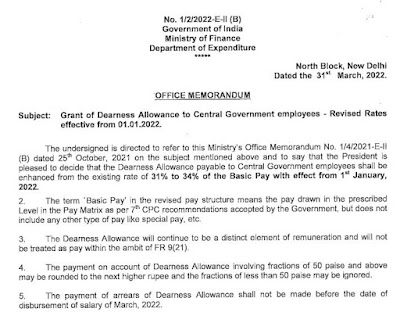
DA Jan 2022 - Grant of Dearness Allowance to Central Government employees - Revised Rates effective from 01.01.2022

 3% DA Hike - Revised Rates effective from 01.01.2022: DoE OM dated 31.03.2022 No. 1/2/2022-E-II (B) Government of India Ministry of Finance...