Thursday, 5 February 2015

Proposal to discontinue exemption of Rs. 1.5 lakh available for Savings under Section 80C

Proposal to discontinue exemption of Rs. 1.5 lakh available for Savings under Section 80C

It is learnt that Finance Ministry is considering to put up a proposal for discontinuing Exemption of Rs. 1.5 lakh presently available under Section 80C for Savings and Insurnace such as premium paid, investment in NSS, Mutual funds, Pension funds etc. Alternatively, the basic income tax exemption limit of Rs. 2.5 lakh would be raised to Rs. 4 lakh. Reasons behind such a bold move by Finance Ministry as per sources are:

1. Income Tax Department could not verify whether the Investments declared to be have been made to avail exemption under Section 80 C were actually made

2. To make Income Tax Law simple by raising basic Income Tax Exemption Limit and avoid complexities involved in providing Income Tax Exemption to promote savings.

As per Finance Ministry proposals, the current system allows individuals to avail of the Section 80C benefit without having made the required investments.

Most of the tax returns by individuals are processed by what is called a ‘summary assessment’, under which an adjustment in the reported income is made only in cases of arithmetic error or of a wrong claim that is apparent from the return filed. Officials do not ask questions or insist on proof of investment while processing returns. Only in cases of ‘scrutiny assessment’ and ‘assessment of income that has earlier escaped assessment’, which are done in very few cases, more information or evidence is sought to ensure that the reported income is correct.

Even in the case of salaried individuals, where the employer may insist on proof of investments, the tax authorities do not. Besides, if a salaried individual wrongly claims in his return that Section 80C investments have been made, the TDS by the employer and paid to the department is refunded by the tax authorities without asking any questions. In the case of self-employed, there is no check either by the employer or the taxman.

So the ministry feels that any individual who is actually interested in saving would anyway do it and there is really no need to incentivise the same through the tax policy.

Savings entitled to tax benefit under Section 80C include payments towards life insurance, deferred annuity, provident funds, National Savings Certificates, unit-linked investment plans of LIC Mutual Fund, pension funds set up by mutual funds, equity-linked savings plans, deposits with National Housing Bank and tuition free paid for education of children.

Source: Financial Express

Highlights of the 7th Central Pay Commission: Central Government Employees

Highlights of the 7th Central Pay Commission: Central Government Employees


1. Pay scales are calculated on the basis of pay drawn pay in pay band + GP + 100% DA by employee as on 01-01-2014.

2. 7th CPC report should be implemented w.e.f. 01-01-2014.

3. Scrap New Pension Scheme and cover all employees under Old Pension and Family Pension Scheme.

4. JCM has proposed minimum wage for MTS (Skilled) Rs.26,000 p.m.

5. Ratio of minimum and maximum wage should be 1:8.

6. General formula for determination of pay scale based on minimum living wage demanded for MTS is pay in PB+GP x 3.7

7. Annual rate of increment @ 5% of the pay.

8. Fixation of pay on promotion = 2 increments and difference of pay between present and promotional posts (minimum Rs.3000).

9. The pay structure demanded is as under:-
Existing Proposed (in Rs.)
PB-1 GP Rs.1800 – 26,000
PB-1 GP Rs.1900  – 33,000
PB-1 GP Rs.2000  – 33,000
PB-1 GP Rs. 2400 – 46,000
PB-1 GP Rs.2800 – 46,000
PB-2 GP Rs.4200  – 56,000
PB-2 GP Rs.4600 – 74,000
PB-2 GP Rs.4800 – 74,000
PB-2 GP Rs.5400  – 78,000
PB-3 GP 5400 – 88,000
PB-3 GP 6600 – 1,02,000
PB-3 GP 7600 – 1,20,000
PB-4 GP 8900 – 1,48,000
P4-4 GP 10000 – 1,62,000
HAG – 1,93,000
Apex Scale – 2,13,000
Cabinet Secretary – 2,40,000

10. Dearness Allowances on the basis of 12 monthly average of CPI, Payment on 1st Jan and 1st July every year.

11. Overtime Allowances on the basis of total Pay+DA+Full TA.

12 Liabilities of all Government dues of persons died in harness be waived.

13. Transfer Policy – Group `C and `D Staff should not be transferred. DoPT should issue clear cut guideline as per 5th CPC recommendation. Govt. should from a Transfer Policy in each department for transferring on mutual basis on promotion. Any order issued in violation of policy framed be cancelled by head of department on representation.

14. Transport Allowance –
X Class Cities Y Class Cities
Pay up to Rs.75,000 Rs.7500 + DA Rs.3750 + DA
Pay above Rs.75,000 Rs.6500 + DA Rs.3500 + DA

13. Deputation Allowance double the rates and should be paid 10% of the pay at same station and 20% of the pay at outside station.

14. Classification of the post should be executive and non-executive instead of present Group A, B, C.

15. Special Pay which was replaced with SPL/Allowance by 4th CPC be bring back to curtail pay scales.

16. Scrap downsizing, outsourcing and contracting of govt. jobs.

17. Regularize all casual labour and count their entire service after first two year, as a regular service for pension and all other benefits. They should not be thrown out by engaging contractors workers.

18. The present MACPs Scheme be replaced by giving five promotion after completion of 8, 15, 21, 26 and 30 year of service with benefits of stepping up of pay with junior.

19. PLB being bilateral agreement, it should be out of 7th CPC perview.

20. Housing facility:-
(a) To achieve 70% houses in Delhi and 40% in all other towns to take lease accommodation and allot to the govt. employees.
(b) Land and building acquired by it department may be used for constructing houses for govt. employees.

21. House Building Allowance :-
(a) Simplify the procedure of HBA
(b) Entitle to purchase second and used houses

22. Common Category – Equal Pay for similar nature of work be provided.

23. CP appointment – remove ceiling of 5% and give appointment within Three months.

24. Traveling Allowance:-
‘A1’ and ‘A’ Class Cities Other Cities
A. Executives Rs.5000+DA per day Rs.3500+DA per day
B. Non-Executives Rs.4000+DA per day Rs.2500+DA per day

25. Composite Transfer Grant :-
Executive Class 6000 kg by Goods Train/ Rate per km by road 8 Wheeler Wagon Rs.50+DA(Rs.1 per kg and single container per km)
Non-Executive Class 3000 kg – do – -do-

26. Children Education Allowance should be allowed up to Graduate, Post Graduate, and all Professional Courses. Allow any two children for Children Education Allowance.

27. Fixation of pay on promotion – two increments in feeder grade with minimum
benefit of Rs.3000.

28. House Rent Allowance
X Class Cities 60%
Other Classified Cities 40%
Unclassified Locations 20%

29. City Allowance
`X’ Class Cities `Y’ Class Cities
A. Pay up to Rs.50,000 10% 5%
B. Pay above Rs.50,000 6% minimum Rs 5000 3% minimum Rs.2500

30. Patient Care Allowance to all para-medical and staff working in hospitals.

31. All allowances to be increased by three times.

32. NE Region benefits – Payment of Special Duty Allowance @ 37.5 of pay.

33. Training:- Sufficient budget for in-service training.

34. Leave Entitlement
(i) Increase Casual Leave 08 to 12 days & 10 days to 15 days.
(ii) Declare May Day as National Holiday
(iii) In case of Hospital Leave, remove the ceiling of maximum 24 months leave and 120 days full payment and remaining half payment.
(iv) Allow accumulation of 400 days Earned Leave
(v) Allow encashment of 50% leave while in service at the credit after 20 years Qualifying Service.
(vi) National Holiday Allowance (NHA) – Minimum one day salary and eligibility criteria to be removed for all Non Executive Staff.
(vii) Permit encashment of Half Pay Leave.
(viii) Increase Maternity Leave to 240 days to female employees & increase 30 days Paternity Leave to male employees.

35. LTC – Leave Travel Concession
(a) Permission to travel by air within and outside the NE Region.
(b) To increase the periodicity once in a two year.
(c) One visit outside country in a lifetime

36. Income Tax:
(i) Allow 30% standard deduction to salaried employees.
(ii) Exempt all allowances.
(iii) Raise the ceiling limit as under:
(a) General – 2 Lakh to 5 Lakh
(b) Sr. Citizen – 2.5 Lakh to 7 Lakh
(c) Sr. Citizen above 80 years of age – 5 Lakh to 10 Lakh
(iv) No Income Tax on pension and family pension and Dearness Relief.

35. (a) Effective grievance handling machinery for all non-executive staff.
(b) Spot settlement
(c) Maintain schedule of three meetings in a year
(d) Department Council be revived at all levels
(e) Arbitration Award be implemented within six month, if not be discussed with Staff Side before rejection for finding out some modified form of agreement.

36. Appoint Arbitrator for shorting all pending anomalies of the 6th CPC.

37. Date of Increment – 1st January and 1st July every year. In case of employees retiring on 31st December and 30th June, they should be given one increment on last day of service, i.e. 31st December and 30th June, and their retirements benefits should be calculated by adding the same.

38. General Insurance: Active Insurance Scheme covering risk upto Rs. 7,50,000/- to Non Executive & Rs. 3,50,000/- to Skilled staff by monthly contribution of Rs. 750/- & Rs. 350/- respectively.

39. Point to point fixation of pay.

40. Extra benefits to Women employees (i) 30% reservation for women.
(ii) Posting of husband and wife at same station.
(iii) One month special rest for chronic disease
(iv) Conversion of Child Care Leave into Family Care Leave
(v) Flexi time

41. Gratuity:
Existing ceiling of 16 ½ months be removed and Gratuity be paid @ half month salary for every year of qualifying service.
Remove ceiling limit of Rs.10 Lakh for Gratuity.

42. Pension:
(i) Pension @ 67% of Last Pay Drawn (LPD) instead of 50% presently.
(ii) Pension after 10 years of qualifying service in case of resignation.
(iii) Increase pension age-based as under:
65 years – 70% of LPD
70 years – 75% of LPD
75 years – 80% of LPD
80 years – 85% of LPD
85 years – 90% of LPD
90 years – 100% of LPD
(iv) Parity of pension to retirees before 1.1.2006.
(v) Enhanced family pension should be same in case of death in harness and normal death.
(vi) After 10 years, family pension should be 50% of LPD.
(vii) Family pension to son upto the age of 28 years looking to the recruitment age.
(viii) Fixed Medical Allowance (FMA) @ Rs.2500/- per month.
(ix) Extend medical facilities to parents also.
(x) HRA to pensioners.
(xi) Improvement in ex-gratia pension to CPF/SRPF retirees up to 1/3rd of full pension.

Source: NC JCM Staff Side

Highlights of the 6th Central Pay Commission

Highlights of the 6th Central Pay Commission

The Union Cabinet today gave its approval for implementation of the recommendations of the Sixth Central Pay Commission. The revised pay scales will come into effect from 1/1/2006 and revised rates of allowances from 1/9/2008. The Cabinet has also decided that arrears will be paid in cash in two instalments – first instalment of 40% during the current year (2008-09) and the remaining 60% in the next financial year (2009-10).

2. The Cabinet has broadly accepted the recommendations of Sixth CPC with some modifications in the wake of representations received from various sections/Associations of Central Government employees. The new system of four Pay Bands with 20 Grade Pays recommended by the Commission has been accepted with some minor modifications.

3. The minimum Basic Pay for a Government servant has been increased to Rs.7000 from Rs.6660 recommended by the Sixth CPC. Consequently, the total emoluments of an employee at the lowest level will exceed Rs.10,000 p.m., including allowances.

4. The other highlights of the Cabinet decision covering all Government employees including the Defence Forces are:-
(i) Enhancement in the fitment in revised pay bands, which was recommended by the Sixth CPC to be based on multiplication factor of 1.74 to 1.86. This would result in increased emoluments for Government employees.
(ii) Increase in the rate of annual increment from 2.5% to 3%.
(iii) Removal of Campus restriction for grant of Transport Allowance.
(iv) Increase in Transport Allowance at the lowest level to Rs.600 (from Rs.400 in A-1/A class cities recommended by the Sixth CPC) and Rs.400 (from Rs.300 in other cities recommended by the Sixth CPC).
(v) At least three promotions have been assured for all Defence Forces’ personnel and civilian employees under the modified Assured Career Progression (ACP) Scheme. While the civilians would get it after 10, 20 and 30 years of service, the Defence Forces Jawans would get ACP in 8, 16 and 24 years.
5. For the Armed Forces personnel, the Commission, for the first time recommended a Military Service Pay (MSP). The Cabinet has increased the rate of MSP for PBORs to Rs.2000 from Rs.1000 recommended by the Commission. The Officers of the Defence Forces would get an MSP of Rs.6000 over and above their Pay.

6. The middle level officers of the Defence Forces namely Colonels and Brigadiers have been placed in the highest Pay Band of PB-4.

7. Senior Lt. Generals overlooked for promotion as Army Commanders due to lack of residual service would now get the grade of Army Commander (Secretary’s grade). In the case of existing Major Generals/Lt. Generals, MSP will be taken into account notionally for fixation of pay on 1/1/2006.

8. As replacement of the pay scale of Rs.24050-26000, a separate pay scale has been carved for DGPs, PCCFs, GM (Railways), members of the Boards of Income Tax, Customs & Central Excise, Postal and Ordnance Factories, among others, who were in this pre-revised scale. This would take them to the level of Rs.80000 in two years as against three years in the pre-revised scale.

9. Further, the IPS Pay Rules and the Indian Forest Service Pay Rules will be appropriately modified to provide in each State cadre one post of DGP and one post of PCCF at the apex level of Rs.80000 for heading their respective Forces.

10. Middle level Police and Civilian officers i.e. DIGs, Conservator of Forests, Scientists E & F, Superintending Engineers, Directors, Additional Commissioners of Income Tax and Central Excise and posts in equivalent grades have also been placed in PB-4.

11. Other salient decisions taken by the Cabinet are:-
(i) The lower limits of Disability Pension for Defence personnel to be doubled from Rs.1550 to Rs.3100. War Disability Pension to be granted at 60%;
(ii) The rates of Special Forces Allowance for Army and Air Force to be equated with navy’s Marine Commando Allowance;
(iii) For the officers of Central Para Military Forces, all the posts of Additional DIG upgraded to DIG level by the Pay Commission to continue to be manned by the cadre officers of CPMFs;
(iv) For the Railway employees who are in receipt of Running Allowance, this allowance will be taken into account while fixing their pay in revised pay bands;
(v) Government has continued the present position of granting Group A scale to Group B officers after 4 years of service and these officers would be placed in PB-3 instead of PB-2 recommended by the Sixth CPC. This would benefit Group B officers of the Railways, Accounts Services, CSS, CSSS and DANICS & DANIPS.
(vi) For Doctors, the Cabinet has approved promotions under the Dynamic ACP Scheme upto Senior Administrative Grade (Joint Secretary level) for Doctors with 20 years of service. Counting of Dearness Allowance (DA) on Non-Practicing Allowance (NPA) as on 01.01.2006 for fixing their pay in revised pay bands has also been approved;
(vii) For the scientists, continuation of the existing system of grant of Special Pay of Rs.2000 p.m. to Scientists G on promotion and doubling of the amount to Rs.4000 p.m. in Departments of Space and Atomic Energy and Defence Research & Development Organisation (DRDO) has been recommended.
12. The financial implications in 2008-09 on account of the implementation of the recommendations of the Sixth Central Pay Commission as modified by the Cabinet will be around Rs.15700 crore on the Central Budget and Rs.6400 crore on the Railway Budget.

Source : PTI

KEY REPORTS OF THE CENTRAL PAY COMMISSION:
Leave Travel Concession (LTC) Central Government employees should be allowed to travel to their home town along with their families on three occasions in a block of four years and to any place in India on the fourth occasion. This facility shall be available to the Government officers only for the first two blocks of four years applicable after joining the Government for the first time.

The blocks of 4 years shall apply with reference to the initial date of joining the Government even though the employee changes the job within Government subsequently. The existing blocks will remain the same but the entitlements of the new recruit will be different in the first eight years of service.

All other provisions concerning frequency of travel under LTC are to be retained. (Para No. 4.3.5) Travel entitlements, whether for the purpose of official tour/transfer or LTC, should be same but no daily allowance will be payable for travel on LTC.

Further, the facility shall be admissible only in respect of journeys performed in vehicles operated by the Government or any Corporation in the public sector run by the Central or State Government or a local body. (Para No. 4.3.6) Parents and/or step parents (stepmother and stepfather) who are wholly dependent on the Government employee shall be included in the definition of family for the purpose of LTC irrespective of whether they are residing with the Government employee or not. The definition of dependency is being linked to the minimum family pension for all purposes. Accordingly, all parents and/or step parents whose total income from all sources is less than the minimum family pension prescribed in Central Government and dearness relief thereon would be included in the definition of family for this purpose.

The extant conditions in respect of other relations included in the family including married /divorced /abandoned /separated /widowed daughters shall continue without any change. (Para No. 4.3.7) While encashment of Earned Leave upto 10 days along with LTC to the extent of total of 60 days may be continued, the leave encashed at the time of availing LTC should not be deducted from the maximum amount of Earned Leave encashable at the time of retirement. Consequently, the employees would be eligible to encash 300 days of Earned Leave at the time of their retirement, even though they may have encashed Earned Leave of upto 60 days during their career while availing LTC, whether to their home town or to any place in India.

Insofar as Railways is concerned, the employees shall be allowed to avail of this encashment at the time of availing of passes for a maximum of 60 days in the entire career subject to the condition that successive encashment cannot be made before a minimum period of two years has elapsed. (Para No. 4.3.8) Recommendations of Sixth CPC which will be examined separately List of Recommendations

1.Recommendation related to Bonus and Over Time Allowance.

2.Recommendation related to General Provident Fund for Central Government employees and Central Government Employees Group Insurance Scheme.

3.Recommendation related to lateral shift of Defence personnel to Central Para Military Forces.

4.Introduction of Health Insurance Scheme for Central Government employees and pensioners.

5.Upgradation of the posts of Additional Deputy Comptroller & Auditor General of India, Members, CBEC and Members, CBDT to the Apex Scale of Rs.80,000 (fixed).

6.Merger of all accounts services.

7.Corporatization of Indian Railways.

8.Abolition of Indian Telecom Service and Telecom Commission.

9.Outsourcing the process of commutation of pension to a PSU Bank/Institution.

10.Upgradation of the post of Director, Indira Gandhi National Forest Academy in Ministry of Environment & Forests to the higher pre-revised grade of Rs.26000 (fixed)

Source: 90paisa.blogspot.in

Wednesday, 4 February 2015

Implement 7th Pay Commission report with effect from January 1, 2014: BSNL Pensioners Welfare Association

Implement 7th Pay Commission report with effect from January 1, 2014: BSNL Pensioners Welfare Association

The All India BSNL Pensioners Welfare Association urged the Centre to implement the Seventh Pay Commission report with effect from January 1, 2014.

A resolution to this effect was adopted at the 10th annual general body meeting of the Salem West district branch of the association held here recently. M. Amirthalingam, former DGM, BSNL, and president of the association, presided.

Another resolution demanded creation of a permanent Statutory Wage Board for revising the pay and pension periodically. The meeting also demanded the Government to restore commutation of pension after 12 years as already recommended.

The other resolutions include increasing fixed medical allowance from Rs.500 to Rs. 2,000 a month, extending the admissibility of C.C.S (M.A) Rules, 1944 to the Central Government pensioners not covered under CGHS as already recommended, sanctioning funeral grant of Rs.10,000 on the death of pensioner/family pensioner to the family; provision of 50 per cent of concession in all public transport system and creation of CGHS Hospitals in all district headquarters.

The association also demanded merger of 50 per cent IDA / CDA with basic pension immediately and scraping the New Pension Scheme and cover all employees under Old Pension and Family Pension Scheme.
M. Mani, General Manager, BSNL Salem, spoke.

Review of progress of NPS (National Pension System) Implementation

Review of progress of NPS (National Pension System) Implementation

KENDRIYA VIDYALAYA SANGATHAN
18, Institutional Area, Shaheed feet Singh Marg,
New Delhi-110 016 (India)
Tel.:91-11-26855532,Fax : 91-11-26514179, 26565536
E-mail:addl.com.admn@ gmail.com ,
Website : www.kvsangathan.nic.in
 F.No.110126125/2012/KVS-NPS/PF/75-107
Dated:03.02.2015
To,
Deputy Commissioner/Director,
Kendriya Vidyalaya Sangathan,
All Regional Offices / ZIETs
Subject: Review of progress of NPS (National Pension System) implementation.
I am to inform that the Pension Fund Regulatory and Development Authority (PFRDA), New Delhi organised a review meeting on NPS (National Pension System) on 15th January 2015 from 10.30 A.M. to 12.30 P.M.. The following points were discussed in the above meeting:
(a) Subscriber coverage – It is intimated that all the employees who join in service on or after 01.01.2004 will come under New Pension System as per the policy of the Government. They also advised that as and when a candidate joins the service, the process for joining in NPS is to be completed immediately & efforts are to be made to enhance subscriber’s awareness by distributing brochures, updating S2 Form, issuing statement of transactions and redressing grievances in February 2015.
(b) Delay in uploading/remitting contributions – PFRDA took serious note for delays in uploading or remitting contributions. As per existing policy NPS contribution (Own and management share) is to be uploaded by 5th of  month vide Min. Of Fin. Deptt of Expenditure, New Delhi 0.M No following 1(7)(2003/TA/Part File/279) dt 02.09.2008. The delay in this matter will have serious consequences. Statutory penal provisions may also be enacted soon. So appropriate priority and extra attention is to be given.
(c) Confirmation of uploading legacy amount – The legacy amount is to be uploaded immediately and necessary confirmation to be obtained from the Pay & Accounts Office so that no legacy amount is left pending for uploading.
(d) Resolution of pending grievances under CGMS (Centralized Grievance Management System) – The grievances pending with PAO are to be resolved immediately. The delay in this matter will not be tolerated.

(e) Nomination details for subscribers — PFRDA advised that all the subscribers should provide the nomination details in the S2 form. Once the nomination details are provided by the subscribers, these details can be updated in the CRA system. This facility has been extended to subscriber also i.e. subscriber can himself revise nomination, address and mobile number.

(f) Refund of NPS contribution — PFRDA advised that employee’s contribution with management contribution along with interest up to the date of settlement may be returned to the official who has tendered resignation/expired while in service if their contribution is lying with office. And amount may be transferred to the concerned organization where the official is presently working in case of technical resignation. In this regard it is relevant to comply KVS(HQ) letter No.1101260125/2010/KVS/NRDCPS/Allot/PPAN/PF/1159-1232 dated 29.12.2010.

(g) Assessment of the performance of KVS in the field of NPS reveals that much more priority and attention is required by your Regional Office/ZIETs to achieve the ideal target of 100% uploading in time and zero grievances. In view of this it is advised to earmark one staff and one computer with Internet facility for the same at RO level and monitor the same personally and ensure regular compliance, positively, to avoid penal consequences.

(h) Please sensitize your office and all KVs under your control in this matter and a report be sent to the undersigned by 28.02.2015.
Yours sincerely
Sd/-
G.K. Srivastava, I.A.S
Addl. Commissioner (Admn. & Vig.)

Source: http://kvsangathan.nic.in/GeneralDocuments/ANN-03-02-15.PDf

7th Pay Commission urged to hold hearings of NC JCM Staff Side

7th Pay Commission urged to give hearings to NC JCM Staff Side because it is imperative to bring grass root workers level problems to the notice of 7th CPC.

Shiva Gopal Mishra,
Secretary
Ph: 23382286
National Council (Staff Side)
Joint Consultative Machinery for Central Government Employees
13-C, Ferozshah Road, New Delhi – 110001
E Mail: nc.jcm.np@gmail.com
No. NC-JCM-2015/7th CPC
2/2/2015
The Chairman
7th Central Pay Commission,
Chatrapati Shivaji Bhawan
1st Floor, B-14/A,
Qutab Institutional Area
New Delhi 110016
Post Box No. 4599,
Haus Khas P.O.

Respected Sir,

Sub: Holding of Hearings by 7th CPC with members of Standing Committee – National Council (JCM).

A lot of quarries are pouring in JCM Office from grass root workers ,as also from the Constituent Organization in respect of holding Hearings/Oral Evidence by 7th CPC . It may be appreciated that previous 6th CPC had held a detailed oral evidence with Members (Staff Side) of the Standing Committee of NC/JCM continuously for 3 days for better appreciation of the demands put-forth by the Staff Side.

It would, therefore, be highly appreciated if a time schedule is fixed, well in advance, so as to make necessary preparations in this regard.
Yours faithfully
sd/-
(S.G.Mishra)
Source: www.ncjcmstaffside.com

NC JCM staff side demands scheduled meetings of JCM for redressal of grievances of 40 Lakhs central government employees

NC JCM staff side demands scheduled meetings of Joint Consultative Machinery for redressal of grievances of 40 Lakhs central government employees.

Shiva Gopal Mishra,
Secretary
Ph: 23382286
National Council (Staff Side)
Joint Consultative Machinery for Central Government Employees
13-C, Ferozshah Road, New Delhi – 110001
No.NC-JCM/2014/DoP&T
Dated: February 2, 2015
Dr. Jitendra Singh,
Hon’ble Minister of State for Prime Minister Office,
Ministry of Personnel, Public Grievances & Pensions,
(Department of Personnel & Training),
(Government of lndia),
New Delhi

Respected Sir,

Sub: Joint Consultative Machinery (JCM) (Staff Side)

I would like to invite your kind attention towards my earlier letter dated June 30, 2014(photocopy enclosed for your kind perusal), wherein it was represented that the JCM(National level) is responsible for all the common issues of around 40 lakh Central Government Employees, particularly wages, allowances, leave etc. This machinery had become quite ineffective since last half decade. Since last four and half years, meeting of the National Councii(JCM) has not been held, resulting in stoppage of dialogue at the highest level. Decision taken by the Standing Committee on many agenda items has not been implemented, and in many of the government departments, Departmental Council has not been formed or non-existent. Even in these circumstances, you will appreciate that the role of the unions and the federations had been quite cooperative, but how long it will remain, we are not sure.

It is, therefore, requested that, to avoid any industrial unrest, JCM Machinery must be made effective and meetings of the same must be ensured with a yearly calendar. The said scheme should also be made participative to resolve and redress various problems of the Central Government Employees.

For the above, we would like to request you to kindly call a meeting of the Standing Committee of the NC/JCM under your chairmanship to strengthen the JCM Scheme.

With kind regards!
Sincerely yours,
sd/-
(Shiva Gopal Mishra)
Source: www.ncjcmstaffside.com

Xth BPS : UFBU not satisfied with IBA’s offer, to go on strike

Xth BPS : UFBU not satisfied with IBA’s offer, to go on strike

As scheduled the 10th BPS wage Negotiation Talk between Bank Unions (UFBU) and Indian banks Association held to day at Mumbai.

In the talks today(3rd Feb) IBA offered only 0.5% improvement(to take the wage hike to 13% from earlier offer of 12.5%) which is not satisfactory as per unions.

Bank Unions (UFBU ) decides to revive the Strike programme.

4 days Strike from 25th Feb and indefinite strike from 16th March.

Details are awaited
Update by Mr Mohan P

7th Pay Commission Pay – Impact of Flat CPI (IW) Aug 2014 to Dec 2014

7th Pay Commission Pay – Impact of Flat CPI (IW) Aug 2014 to Dec 2014
7CPC 
Needless to say, news and developments on 7th Pay Commission are foremost things that draw the attention of Central Government Employees and Pensioners nowadays.
As the commission’s regular time frame for submission of report is getting completed in less than 11 months, employees and pensioners hope for either implementation of Revised 7th Pay Commission Pay and Pension in time or grant of DA merged pay with interim relief from 1st January 2016.
Both of these exercises would require a percentage of Dearness Allowance to be merged with pay. So Quantum of DA as on 1st January 2016 gains much significance here.
As of now, Central Government and Railway employees and Defence personnel are in receipt of DA of 107% from July 2014. With all the indices from Jan 2014 to Dec 2014 have been officially released, DA with effect from January 2015 is confirmed to be 113%.
Check this article : 6% DA hike from January 2015

Though increase in DA of 6% from January 2015 appear normal at par with increase in DA previously, additional DA this time was possible only due to higher Consumer Price Indices from Jan 2014 to July 2014.
The index from August 2014 to December 2014 is totally flat and remained at 253 for 5 months thanks to economical factors such as lesser oil prices, good monsoon etc.
As, period from July 2014 to Dec 2014 form the 1st half of the chain of CPI needed to calculate DA from July 2015, this no inflation scenario would definitely impact quantum of DA from July 2015. For example, if CPI (IW) is flat at 253 for two more months (Jan 2015 and Feb 2015) and one or two point increase in the next 4 months (Mar, Apr, May and Jun 2015) would result in DA increase of only 5% from July 2015
DA from Jul 2015 [(252 + 253 + 253 + 253 + 253 +253 +253 + 253 + 254 + 255 + 255 + 255) -115.76]*100/115.76
= 118 % (DA increase of 5% from July 2015)

As far as DA from January 2016 is concerned, the cost of living indices from January 2015 to December 2015 will be the deciding factors. On account of various economical factors such as reduced interest rates etc., CPI (IW) may either be heading south or remain flat during this period, but it is too early to predict those factors now. Any way, it is sure that Consumer Price Index from January 2015 to December 2015 may not experience any steep upward movement. In that case, we can safely assume one point increase in CPI (IW) in alternative months from July 2015 to Dec 2015. This assumption provides increase in DA of only 2% from January 2016, which is worked out as follows
DA from January 2016 [(253 + 253 +254 +255 + 255 + 255 + 256 + 256 + 257 + 257 + 258 + 258) -115.76]*100/115.76
= 120 % (DA increase of 2% from July 2015

Source: gconnect

Auction for Sale of Government Stocks

Auction for Sale of Government Stocks

Ministry of Finance
03-February, 2015

The Government of India have announced the Sale (re-issue) of (i) “8.27 per cent Government Stock 2020” for a notified amount of Rs. 2,000 crore (nominal) through price based auction, (ii) “8.15 per cent Government Stock 2026” for a notified amount of Rs.5,000 crore (nominal) through price based auction, (iii) “8.24 per cent Government Stock 2033” for a notified amount of Rs. 3,000 crore (nominal) through price based auction, and (iv) “8.17 per cent Government Stock 2044” for a notified amount of Rs. 3,000 crore (nominal) through price based auction. The auctions will be conducted using multiple price method. The auctions will be conducted by the Reserve Bank of India(RBI), Mumbai Office, Fort, Mumbai on February 06, 2015 (Friday).

Up to 5% of the notified amount of the sale of the stocks will be allotted to eligible individuals and Institutions as per the Scheme for Non-Competitive Bidding Facility in the Auction of Government Securities.
Both competitive and non-competitive bids for the auction should be submitted in electronic format on the Reserve Bank of India Core Banking Solution (E-Kuber) system on February 06, 2015. The non-competitive bids should be submitted between 10.30 a.m. and 11.30 a.m. and the competitive bids should be submitted between 10.30 a.m. and 12.00 noon.

The result of the auctions will be announced on February 06, 2015 and payment by successful bidders will be on February 09, 2015 (Monday).

The Stocks will be eligible for “When Issued” trading in accordance with the guidelines on ‘When Issued transactions in Central Government Securities’ issued by the Reserve Bank of India (RBI) vide circular No. RBI/2006-07/178 dated November 16, 2006 as amended from time to time.

– PIB

Flash News

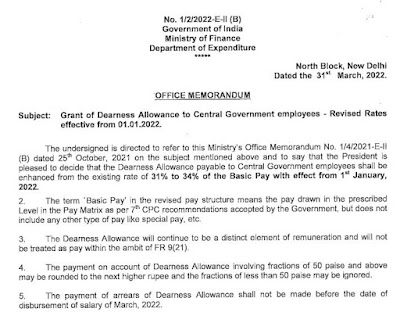
DA Jan 2022 - Grant of Dearness Allowance to Central Government employees - Revised Rates effective from 01.01.2022

 3% DA Hike - Revised Rates effective from 01.01.2022: DoE OM dated 31.03.2022 No. 1/2/2022-E-II (B) Government of India Ministry of Finance...