Wednesday, 12 November 2014

7th Pay Commission visit to Hyderabad from 18th to 20th November, 2014

7th Pay Commission visit to Hyderabad from 18th to 20th November, 2014
    Commission’s visit to Hyderabad
The Commission, headed by its Chairman, Justice Shri A. K. Mathur, proposes to visit Hyderabad from 18th to 20th November, 2014. The Commission would like to invite various entities/associations/federations representing any/all categories of employees covered by the terms of reference of the Commission to present their views.

Your request for a meeting with the Commission may be sent through e-mail to the Secretary, 7th Central Pay Commission at secy-7cpc@nic.in. The memorandum already submitted by the requesting entity may also be sent as an attachment with this e-mail.

The last date for receiving request for meeting is 17th Nov. 2014 (1700 hours).

Source: http://7cpc.india.gov.in/news06.html

Parity between Assistant, SO of Ordnance Factory and CSS/CSSS Pay Scale: Judgement by HC citing "Equal pay for Equal Work"

Parity between Assistant, SO of Ordnance Factory and CSS/CSSS Pay Scale: Landmark Judgement by HC citing "Equal pay for Equal Work".  Text of Hindustan Times News reproduced below:-
  New pay scale benefits for ordnance staff too: HC

UNIFORMITY Citing ‘equal pay for equal work’ principle, Delhi High Court tells Centre to grant pay parity to ordnance factory employees

Employees at Ordnance Factories (OF) – who have been contesting their omission from the benefits of the sixth pay commission for over seven years have finally more than one reason to rejoice.

Reining in the principle of ‘equal pay for equal work’ at public offices, the Delhi High Court has directed the Centre to grant pay parity to employees in the OF with that of identically ranked official in the Central Secretariat Service (CSS) and Central Secretariat Stenographer’s Service (CSSS).

The direction will be applied retrospectively from 2006 — when the sixth CPC was implemented. Not only this, the HC order will come in handy for the employees of the OF when the seventh central pay commission is implemented.

The HC order came in response to a petition filed by Ordnance Factory Employees Association challenging the decision of the finance ministry declining their request for the assistants working in the OF Board to be given same pay scale as was given to similarly placed officials in CSS, CSSS, Ar my Headquarters, UPSC and other services.

The starting point of discrimination against the employees of the OF Board came soon before the acceptance of recommendation of the sixth CPC when a pay upgradation of employees of CSS and CSSS was made in September 2006.

While the OFs and Armed Forces Head Quarters (AFHQs) — both non-secretariat organization — were excluded from the pay upgradation, the latter took the matter to the Central Administrative Tribunal (CAT) and got an order in its favour.

In the case of OF Board, the central government took the view that since it was a nonattached office working outside the Secretariat, there cannot be parity of pay scales. The OF Board was denied benefit of upgradation and the replacement scales given by the sixth CPC. The CAT, too, took a similar stand and denied any relief to the OF Board.

The matter finally reached the Delhi HC last year and after over a year of deliberation a bench of Justice S Ravindra Bhat and Justice Vipin Sanghi termed the discrimination meted out to the OF Board as “over-classification.”

The HC said the discrimination was illogical and artificial. It also took note that the cadre structure of CSS and CSSS is identical to that of the OF. In all the above organisations, the cadre of upper divisional clerks (UDCs) is filled by the feeder of the cadre of the lower divisional clerks (LDCs).

The cadre of assistants on the OF Board is filled by promotion from the feeder cadre of UDCs with at least five years of experience on regular basis.

“The OF Board was treated historically as equals to CSS/CSSS employees and enjoyed equal pay and all benefits flowing from equal pay,” the high court noted adding, “This was based on the previous four instances of determinations by successive pay commissions that they performed equal work.”

Source Image provided by http://aiamshq.blogspot.in/2014/11/blog-post.html

Source: http://lobis.nic.in/dhc/SRB/judgement/14-10-2014/SRB14102014CW46062013.pdf

Memorandum to the 7th Pay Commission by the Comptroller & Auditor General of India

Memorandum to the 7th Pay Commission by the Comptroller & Auditor General of India

Memorandum to the Seventh Pay Commission – Comptroller & Auditor General of India Group ‘B’ and ‘C’ cadres

Comptroller & Auditor General of India (CAG) submitted memorandum to 7th Pay Commission

The Comptroller & Auditor General of India (CAG) is a constitutional authority appointed by the President of India under Article 148 of the Constitution of India. The duties & powers of the CAG are prescribed in the Articles 149-151 of the Constitution of India. The Parliament under Article 149 of the Constitution has enacted the Comptroller & Auditor General’s (Duties, Power and Condition of Service) (CAG’s DPC Act) Act, 1971 replacing the earlier Government of India (Audit & Accounts) Order 1936.

Click to read memorandum

Central Civil Services (Classification, Control and Appeal) (Second Amendment) Rules, 2014

Central Civil Services (Classification, Control and Appeal) (Second Amendment) Rules, 2014

THE GAZETTE OF INDIA EXTRAORDINARY
[PART II—Sec 3(i)]
MINISTRY OF PERSONNEL, PUBLIC GRIEVANCES AND PENSIONS
(Department of Personnel and Training)

NOTIFICATION

New Delhi, the 31st October, 2014

G.S.R. 769(E).- In exercise of the powers conferred by the proviso co article 309 and clause (5) of article 148 of the Constitution, and after consultation with the Comptroller und Auditor General of India in relation to persons serving in the Indian Audit and Accounts Department, the President hereby makes the following rules further to amend the Central Civil Services (Classification, Control and Appel) rules 1965 namely—

1. (I) These rules may be called the Central Civil Services (Classification, Control and Appeal) (SecondAmendment) Rules, 2014.
(2) They shall come into force on the date of their publication in the Official Gazette.

2. In the Central Civil Services (Classification. Control and Appeal) Rules, 1965 (hereinafter referred to as the said rules)
(a) In rule I5, for sub-rules 2A, 3 and 4, the following sub-rules shall be substituted, namely: —

3) (a) In every case where it ta necessary to consult the Commission, the Disciplinary Authority shall forward or cause to be forwarded to the Commission for its advice:
(i) a copy of the report of the Inquiring Authority together with its own tentative reasons for disagreement, if any, with the findings of Inquiring Authority on any article of charge; and
(ii) comments of Disciplinary Authority on the representation of the Government servant on the Inquiry report and disagreement note, if any and all the cue records of the inquiry proceedings
(b) The Disciplinary Authority shah forward or cause to be forwarded a copy of the advice of the Commission received under clause (a) to the Government savant, who shall be required to submit, if he so desires, his written representation or submission to the Disciplinary Authority within fifteen days, on the advice of the Commission

(4) The Disciplinary Authority shall consider the representation under sub-rule (2) and/ or clause (b) of sub-rule (3), if any, submitted by the Government servant and record its findings before proceeding further in the matter as specified in sub-rules (5) and (6).

(5) If the Disciplinary Authority having regard to its findings on all or any of the articles of charge is of the opinion the any of the penalties specified in clauses (I) to (iv) of rule 11 should be imposed on the Government servant, it shall, notwithstanding anything contained in rule 16, make an order imposing such penalty.

(6) If the Disciplinary Authority having regard to its findings on ail or any of the articles of charge and on the basis of the evidence adduced during the inquiry Is of the opinion that any of the penalties specified in clauses (V) to (ix) of rule 11 should be imposed on the Government servant, it shall make an order imposing such penalty and it shall not be necessary to give the Government savant any opportunity of making representation on the penalty proponed to be imposed.”;
(b) In rule 16,—
(i) in sub-rule (I),-
(A) for the words, brackets and figure “sub-rule (3)”, the words, brackets and figure ‘sub-rule (5)” shall be substituted;
(B) for clauses (d) and (e), the following clauses shah be substituted; namely: —
“(d) Consulting the Commission where such consultation is necessary. The Disciplinary Authority shall forward or cause to be forwarded a copy of the advice of the Commission to the Government servant, who shall be required to submit, if he so desires, his written representation or submission on the advice of the Commission, to the Disciplinary Authority within fifteen days; and
(e) recording a finding on each imputation or misconduct or misbehavior.”
(ii) in sub-rule (2) for clauses (vi) and (vii), the following clauses shall be substituted,
“(vi) representation, if any, of the Government servant on the advice of the Commission:
(vii) the findings on each imputation of misconduct or misbehavior; and
(viii) the orders on the case together with the reasons therefor.;
(C) In rule 17, the words “and also a copy of the advice, if any, given by the Commission,” shall be deleted;

(d) In rule 19, in the second proviso, after the words “where such consultation ta necessary”, the words “and the Government servant has been given an opportunity of representing against the advice of the Commission.” shall be added;.

(e) In rule 27, in sub-rule (2), in the proviso, in clause (i) alter the words “where such consultation is necessary” the words “and the government servant has been given an opportunity of representing against the advice of the Commission,” shall be added:

(f) In rule 29, in sub-ruIe (1) in the first proviso, after the words “where such consultation is necessary”. the words“ and the Government servant has been given an opportunity of representing against the advice of the Commission shall be added:

(g) In rule 29-A, in the proviso, after the words “where such consultation is necessary”, the words “and the Government servant has been given an opportunity of representing against the advice of the Commission.” shall be added;

(h) In rule 32 shall be omitted.

[F. No. 11012/8/2011-Estt.(A)]
MAMTA KUNDRA, Jt. Secy.
Source: www.persmin.gov.in

Central Government employee opts for a surrogate child – What says CCS (Leave) Rules..?

Central Government Employee opts for a surrogate child – What says CCS (Leave) Rules..?

Can Central Govt Female Employees Opting for Surrogate Pregnancy Claim Maternity Leave?

Parenthood is a gift of god. Thanks to the development in medical sciences, childless couples can now opt for surrogate pregnancies. If women employees of Central Government organizations opt for surrogate pregnancies, can they claim maternity leave?

Women employees of Central Government establishments are given Maternity leave for a period of 180 days and male employees are given Paternity Leave for a period of 15 days if they choose to adopt babies. At present, there is no leave entitlements for parents of the surrogate child.

Let’s see what the Indian medical Research Council has to say about couples who choose to have babies through surrogate mothers.


Surrogacy: General Considerations

A child born through surrogacy must be adopted by the genetic (biological) parents unless they can establish through genetic (DNA) fingerprinting (of which the records will be maintained in the clinic) that the child is theirs.Guidelines for ART Clinics in India ICMR/NAMS

Surrogacy by assisted conception should normally be considered only for patients for whom it would be physically or medically impossible/undesirable to carry a baby to term.

Payments to surrogate mothers should cover all genuine expenses associated with the pregnancy. Documentary evidence of the financial arrangement for surrogacy must be available. The ART centre should not be involved in this monetary aspect.

Advertisements regarding surrogacy should not be made by the ART clinic. The responsibility of finding a surrogate mother, through advertisement or otherwise, should rest with the couple, or a semen bank.

A surrogate mother should not be over 45 years of age. Before accepting a woman as a possible surrogate for a particular couple’s child, the ART clinic must ensure (and put on record) that the woman satisfies all the testable criteria to go through a successful full-term pregnancy.

A relative, a known person, as well as a person unknown to the couple may act as a surrogate mother for the couple. In the case of a relative acting as a surrogate, the relative should belong to the same generation as the women desiring the surrogate.

A prospective surrogate mother must be tested for HIV and shown to be seronegative for this virus just before embryo transfer. She must also provide a written certificate that (a) she has not had a drug intravenously administered into her through a shared syringe, (b) she has not undergone blood transfusion; and (c) she and her husband (to the best of her/his knowledge) has had no extramarital relationship in the last six months.

(This is to ensure that the person would not come up with symptoms of HIV infection during the period of surrogacy.) The prospective surrogate mother must also declare that she will not use drugs intravenously, and not undergo blood transfusion excepting of blood obtained through a certified blood bank.

No woman may act as a surrogate more then thrice in her lifetime

Monday, 10 November 2014

CGHS EMPLOYEES ASSOCIATION MEETS 7TH PAY COMMISSION

CGHS EMPLOYEES ASSOCIATION MEETS 7TH PAY COMMISSION

All India CGHS Employees Association had a meeting with the 7th Pay Commission on 8th November 2014. During this meeting the delegation led by Shri Francis Ellis Secretary General raised the common issues of Administrative Staff viz. Upgradation of Grade pay of LDC to Rs 2800, Granting of MACP on Promotional Hierarchy etc.

All other Associations, inviting to meet the 7th Pay Commission are requested to please bring the Grade Pay issue of LDC/UDC and MACP issue before the Pay Commission in its own importance.

The photo of CGHS delegation with Pay Commission is placed below:

Source: http://aiamshq.blogspot.in/2014/11/cghs-employeesassociation-meets-7-th.html

All India Naval Technical Supervisory Staff Association meeting with 7th CPC and presentation i.r.o. technical Supervisory Cadre

All India Naval Technical Supervisory Staff Association meeting with 7th CPC and presentation i.r.o. technical Supervisory Cadre

The All India Naval Technical Supervisory Staff Association had an interaction with the complete team of 7th Central Pay Commission under Chairmanship of Justice Shri. Ashok Kumar Mathur at Naval Dockyard Mumbai on 08th Nov 2014. They handed over a memorandum to the 7th CPC and a presentation (scroll below) was organized in respect of the technical supervisory cadre.

Following office bearers were present during the detail interaction:

1. Shri. BB Mohanty   – President
2. Shri. AL Mhatre    – General Secretary
3. Shri. KM Nair      – Vice President
4. Shri. AS Raza      – Secretary
5. Shri. RK Pandey    – Treasurer
6. Shri. Navin Kumar  – Org. Secretary
7. Shri. T  Vargese   – Jt. Secretary
8. Shri. RG Pandey    – Jt. Secretary
9. Shri. Tarun Sarkar – Jt. Secretary
10.Shri. T Singh      – Jt. Secretary
11.Shri. JR Johnson   – Jt. Secretary
Regards,
Avinash Mhatre,
General Secretary
AINTSSA

Presentation to Seventh Central Pay Commission
By
All India Naval Technical Supervisory Staff Association
PAY  DETERMINATION
  • Reasonable ratio between maximum and minimum salary shall be 8: 1.
  • Proposed common and uniform multiple factor for revision of pay in respect of existing pay is 3.96 (as per % rise of NNP on constant prices).
  • Determination of minimum salary based on inflation (50% DA shall be treated as DP).
  • Rate of increment in each grade may please be granted @ 5% per annum.
  • Reduction of nos. of grade pays of Rs. 4800 & Rs. 5400/- in PB-2 need to merged and upgraded to GP Rs. 5400/- in PB-3 as doctrine of equal pay for equal work.
CONSISTENT ANAMOLY :  DISTURBANCE  OF VERTICLE RELATIVITY BETWEEN CHARGEMAN AND MASTER CRAFTSMAN 
Pay Commission Pay Scales Brief on improvements given in violation of vertical relativity & Pay Commission recommendations
Fourth CPC Sr. Chargeman Rs.1400-2300
Master Craftsman, Rs. 1400-2300
HSK-I, Rs. 1320-1560
Identical Pay scales of Sr. Chargeman, and MCM resulted in hierarchal confusion and attracted many court cases.
Fifth CPC Chargeman-II Rs. 5000-8000
Only three grades
Master Craftsman, Rs.4500-7000
HSK Rs. Rs.4000-6000
Skilled , Rs.3050-4590
Concept of four grades (Skilled, HSK Gr-II, HSK Gr-I and MCM) restored with MCM placed in the scale of Rs.5000-8000 equal to the Chargeman-II who supervises MCM.
2005 The post of MCM has been made as regular by Govt. Of India and accordingly benefit of pay fixation has been permitted, and stated that the work of Master Craftsman in grade Rs.5000-8000 will be supervised by Chargeman-II scale Rs.5000-8000.
Sixth CPC Chargeman Grade Pay Rs.4200, PB-2, Only three grades Skilled (GP Rs.1900), Highly Skilled (GP Rs.2400) and MCM (GP Rs.2800) were recommended in PB-1, maintaining the hierarchal order and the principle of higher post given the higher Grade Pay Para 3.8.27 of SCPC report. Concept of four grades (Skilled , HSK Gr-II, HSK Gr-I and MCM) restored with Sr. Technician placed in the GP of Rs.4200.

Sixth Pay Commission recommendation vide para 2.2.11 “Grade pay being progressively higher for successive higher posts, the employees on promotion will get monetary benefit on promotion in the form of the increased grade pay apart from the benefit of one additional increment” got violated.
MACP  Scheme
  • The scheme shall be unique effect between Defence service and civilian personnel, since there was a disparity earlier, service personnel are getting MACP scheme after 8, 16, 24 years whereas civilian are  getting  after  10, 20 & 30 years.
  • Proposed for five MACPs (after 6, 12, 18, 24 & 30 years).
  • Grant of MACP scheme on Promotional hierarchy.
  • Shift-over from one pay band (PB-2 to PB-3) to the next one on effect of MACPs.
  • Uniform MACP scheme for all central government departments including defence services.
INTRODUCTION OF  TIME  BOUND PROMOTIONS
Existing hierarchy of posts Existing Grade Pay Proposed hierarchy of posts after proposed cadre restructuring Proposed revised Grade Pay after proposed cadre restructuring Provision of time bound promotion instead of MACPS which shall compensate the losses due to MACPS
Chargeman Rs.4200 (PB-2) Junior Engineer 4800, PB-2 Entry grade For entry level post of JE (GP-4600)
Foreman Rs.4600 (PB-2) Assistant Engineer 5400, PB-3 1st Functional / non functional promotion to GP-5400 (PB-3) after completion of 6 years in GP-4800
Proposed Merger of
Technical Assistant and
Junior Technical Officer
Rs.4800 (PB-2)
And
Rs.5400 (PB-3)
Executive Engineer 6600, PB-3 2nd Functional / non functional promotion to GP-6600 (PB-3) after completion of 4 years in GP-5400
Technical Officer Rs. 6600 (PB-3) Superintendent Engineer 7600, PB-3 3rd Functional / non functional promotion to GP-7600 (PB-3) after completion of 4 years in GP-6600
Senior Technical Officer Rs. 7600 (PB-3) Chief Engineer 8700, PB-4 4th Functional / non functional promotion to GP-8700 (PB-4) after completion of 4 years in GP-7600, PB-3
Chief Technical Officer Rs. 8700 (PB-3) Principal Engineer 8900, PB-4 5th Functional / non functional promotion to GP-8900 (PB-4) after completion of 4 years in GP-8700 (PB-4)
CONDITIONS  OF  SERVICE
  • Hours  of  work  for  Non-Industrial Cadre = 40 hours.
  • Grant of Restricted Holidays to Technical Supervisors of Indian Navy.
  • Five days week for industrial establishments of Navy.
  • Leave facilities – Maximum accumulation of leaves.
  • Medical Facilities – Introduction of Assured healthcare  services to the technical supervisors working in Naval Units at remote and underdeveloped areas like Karwar, Azhimala etc.
More news on :  karnmk.blogspot.in

Saturday, 8 November 2014

Aadhaar Enabled Biometric Attendance System for Railway employees – Railway Board Orders

Aadhaar Enabled Biometric Attendance System enrolment process, all the Section Officers are responsible for enrollment of staff, including MTS and others working under them and the officers of the level of Under Secretary/Deputy Directors and above may enrol themselves on the website on their own.

Government of India
Ministry of Railways
(Railway Board)
Office Order No. 66 of 2014

Sub: Enrolment for Aadhaar Enabled Biometric Attendance System (AEBA)

Hon’ble MR has directed that all personnel of the Ministry of Railways, Rail Bhavan (including those located at Pragati Maidan) shall enroll on the Aadhaar Enabled Biometric Attendance System.

2. In this regard, the spadework for enrolment on the system has been completed by the C&IS directorate and the system is now ready to be used for user enrolment.

3. It is now required that all the personnel of Ministry of Railways working In the offices of Rail Bhawan and Pragati Maidan are to enroll themselves afresh directly on the website http://attendance.gov.in/regester/employee

4. For the said enrolment process, all the Section Officers are responsible for enrollment of staff, including MTS and others working under them and the officers of the level of Under Secretary/Deputy Directors and above may enrol themselves on the website on their own. After registration, all EDs shall forward a list of the personnel enrolled n their Directorate giving the information to C&IS through email as per annexure in a spreadsheet via email. Officers above the level of SAG may send their report directly through their PPS/Sr.PPS/PSO.

5. The detailed process for enrolment is enclosed which may be followed while enrolling. The said process of enrolment of all officers/staff under AEBAS should be completed latest by 18.10.2014 (Saturday).

6. For any clarification/ assistance, the following personnel of the Railway Board Computer Centre may be contacted:

1. Sh. Krishan Kant, Programmer, Cell No. 9717635888
2. Sh. Navneet Kr Saxera, Sr Programmer, Cell No. 9717 647095
3. Sh. Akhilesh Misra, Dir. Mech Engg (C&IS), Cell No. 9717640768

2014/O&M/9/3
Dated: 15.10.20 14
sd/-
(K.Krishnan)
Joint Secretary/Railway Board

Source: http://www.indianrailways.gov.in/railwayboard/uploads/directorate/secretary_branches/pdf/om/Aadhar_Card_161014.pdf

COPY OF CHARGE-SHEET CANNOT BE DENIED UNDER RTI ACT: CIC

COPY OF CHARGE-SHEET CANNOT BE DENIED UNDER RTI ACT: CIC

The CIC Prof M Sridhar Acharyulu held on 3rd November 2014 that ‘charge-sheet’ has to be disclosed after separating non-disclosable portions, if any, as per restrictions prescribed under RTI Act. Ms. Usha Kanth Asiwal sought to know from Director of Vigilance Delhi, details of complaint made to Anti Corruption Bureau on 25-04-2001 and inquiry leading to registration of case against 13 persons under Prevention of Corruption Act, which is now under prosecution in Tis Hazari Courts. She sought 22 point information, which broadly relate to contents of the Charge-sheet.

The PIO denied the information u/s 8(1)(h) of the RTI Act claiming disclosure would impede investigation or prosecution. The First Appellate Authority upheld the decision of the PIO. She approached the Commission in second Appeal. Though demand was not for copy of charge-sheet, the appellant agreed that a copy of charge-sheet would answer his application. Then issue before the Commission was whether charge sheet was public document, and if so could that be shared under RTI Act with any citizen.

CIC Prof Sridhar Acharyulu explained: ‘The charge sheet is a report held by the investigating officer, or public authority or court of law. As per the RTI Act, any information held by the public authority can be accessed by the citizen subject to the exceptions provided under Section 8. Because the charge-sheet contains the evidence which need to be adduced in the court of law, there is a possibility of opening up many details which could be personal or private or confidential. If the allegation requires to be proved by call data, the charge sheet refers to sheets of call data, which surely contain call details unrelated to allegation. That could be private information need to be protected. Hence each charge sheet has to be separately examined and only after separating unnecessary and unrelated details of evidence, and only required and permissible information out of chargesheet should be disclosed. Thus Charge-sheet can neither be prohibited enbloc from disclosure nor disclosed totally. Charge-sheet is a document held by concerned authority, which has to examine disclosable aspects vis-a-vis Section 8 and 9 of the RTI Act and then decide the case’.

As per the Criminal Procedure, the charge-sheet is the end product of investigation. With filing of charge-sheet, the investigation is closed and defense that investigation might get impeded does not stand at all. Whether revealing the information impedes apprehension or prosecution is the next question. The Respondent authority did not even raise this point and did nothing to explain the Commission about possibility of impeding apprehension/prosecution by disclosure. The Public Authority just mentioned the section number and did nothing else. The First Appellate Authority also did not apply the mind and chose not to give any reasons for upholding the denial by PIO. The exemption of larger public interest provided in Section 8(1) is not available to this clause (h). Thus it has to be decided on facts whether disclosure of charge-sheet will really obstruct investigation, apprehension or prosecution. The judgment of the Delhi High Court in W.P.(C) No.3114/2007 – Shri Bhagat Singh Vs. Chief Information Commissioner & Ors on this aspect is of relevance, since it deals with the applicability of the Section 8(1)(h) of the RTI Act 2005: S Ravinder Bhat J specifically notes, “As held in the preceding part of the judgment, without a disclosure as to how the investigation process would be hampered by sharing the materials collected till the notices were issued to the assessee, the respondents could not have rejected the request for granting information. …”

It can be inferred that there is no specific provision anywhere prohibiting the disclosure of charge-sheet and if there disclosure does not affect investigation or prosecution it can be permitted under RTI, unless there is a public interest against disclosure. The chargesheets containing charges under Prevention of Corruption Act, especially against public servants, need to be in public domain, in public interest.

Citing several decisions the CIC said: There is no specific provision under any law which state that charge-sheet is a public document, but there are several judgment of the Supreme court and High court which clarify that charge sheet is a public document. Queen-Empress v. Arumugan and Ors ( (1897) ILR 20 Mad 189) has held that any person has an interest in criminal proceeding has a justify to inspect under section 76 of the Indian Evidence Act. In N David Vijay Kumar v The Pallavan Gram Bank, Indian Bank in File No. CIC/SG/A/2012/000189 CIC Mr Shailesh Gandhi ordered disclosure of Charge sheet ruling out the contention of exemption under Section 8(1)(j).

On the perusal of the RTI application, the Commission found that the information sought by the applicant are the part and parcel of the information contain in the charge-sheet prepared after the completion of the investigation under section 173 of Cr. P. C. The purpose of the appellant will be served if the copy of the same would be provided to the appellant. The respondent authority also agreed to provide the copy of charge sheet.

Considering the provisions of Cr.P.C., Evidence Act, RTI Act, erudite judicial pronouncements, certain transparency practices in CVC, facts and circumstances of the case and contentions raised, the Commission holds that the charge sheet is a public document and it shall be disclosed subject to other restrictions provided under RTI Act. There cannot be a general hard and fast rule that every charge-sheet could be disclosed or should not be. Each RTI request for copy of Charge-sheet required to be examined and only permissible part should be given. The Commission, hence, directed the respondent to examine the content of charge-sheet and to provide appellant/… the copy of those portions of charge-sheet, which would answer the queries raised by appellant in his RTI application, within 3 weeks from the date of receipt of the order.

Source : http://confederationhq.blogspot.in/

Issue of Privilege Passes/PTOs covering Udhampur-Katra Section: Clarification by Railway Board

Issue of Privilege Passes/PTOs covering Udhampur-Katra Section: Clarification by Railway Board

GOVERNMENT OF INDIA
MINISTRY OF RAILWAYS
RAILWAY BOARD
I(W)2012/PS5-10/1
Dated.10-10-2014

The General Manager,
All Indian Railways &
Production Units

Sub: Issue of Privilege Passes/PTOs covering Udhampur-Katra Section.

Queries are being received from Railways/PU’s seeking Board approval for issue of Pass/PTOs on Udhampur-Katra Section.

In this connection, it is clarified that Railway Sections/Stations which have since been opened for passenger traffic, are part of Indian Railways. Hence, Pass/PTOs for such sections/stations may be issued. There is no need to seek Board’s approval in such cases. In future also, Passes/PTOs may be issued for such sections/stations, without making any reference to Board’s Office.

This disposes of RCF’s letter No.65-E/RCF/KXH/PASS/PTO/2014 dated 05.09.2014.

sd/-
Debasis Mazumdar)
Director Estt.(Welfare)
Railway Board
Source : AIRF
[http://www.airfindia.com/Orders%202014/katra%20udhampur%20pass.pdf]

Flash News

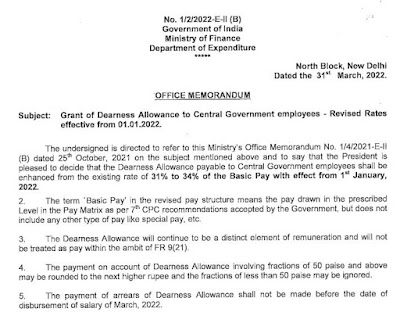
DA Jan 2022 - Grant of Dearness Allowance to Central Government employees - Revised Rates effective from 01.01.2022

 3% DA Hike - Revised Rates effective from 01.01.2022: DoE OM dated 31.03.2022 No. 1/2/2022-E-II (B) Government of India Ministry of Finance...