Tuesday, 4 February 2020

7th CPC Charge Allowance Notional pay fixation and revision of Pension of Pre-2016

7th CPC Charge Allowance Notional pay fixation and revision of Pension of Pre-2016

7th CPC

Charge Allowance may have been paid w.e.f. 01.01.2016 to 30.06.2017 at old rates which was admissible before 2016, the same may be reckoned for calculation of retirement benefits of employees who retired between the periods from 01.01.2016 to 30.06.2017
PC-VII No.148/2020
RBE No.14 /2020

GOVERNMENT OF INDIA (BHARAT SARKAR)
MINISTRY OF RAILWAYS (RAIL MANTRALAYA)
(RAILWAY BOARD)

No. D-43/15/2019-F(E)III

New Delhi, dated: 30.01.2020.

The General Managers / Principal Financial Advisors,
ll Zonal Railways / Production Units.

Sub : Reckoning of Charge Allowance for the purpose of revision of Pension of Pre-2016 retirees in terms of 7th CPC recommendations - reg.

Consequent upon the recommendations of 7th CPC, instructions were issued vide Board’s letters No.2016/F(E)III/1(1)/7 dated 10.08.2016 and 22.05.2017, regarding revision of pension / family pension of pre-2016 pensioners / family pensioners. A number of references have been received in this office for reckoning of Charge Allowance for the purpose of notional fixation of pay and accordingly revision of pension w.e.f. 01.01.2016.

2. The true nature of charge allowance was earlier considered by the Board and it was decided that the charge allowance, which is actually in the nature of pay restricted under FR-35. should be reckoned as 'Pay' as defined in Rule 1303(FR-9)(21) (a)(i) R-II/6th Edition and as such, it would count as pay for the purposes of pension. gratuity etc. as well as for leave encashment. Accordingly, instructions were issued vide letter No. F(E)III/94/PN1/26 dated 23.06.1995.

3. The issue has again been examined in Board keeping in view the earlier decision on charge allowance cited in para 2 above and it has been decided as follows:-
  • Since. Board had already decided to treat the charge allowance as pay restricted under FR-35 and to reckon it as emoluments for pensionary benefits vide letter dated 23.06.1995, the charge allowance may be taken into account for notional fixation of pay for the purpose of revision of pension / family pension of pre-2016 retirees w.e.f. 01.01.2016 in terms of first formulation as conveyed by Board’s letter No. 2016/F(E)III /1(1)/7 dated 22.05.2017.
  • Pay fixed in terms of Board’s letter No. PC-VII/2017/ 1/7/5/8 dated 08.08.2019 w.e f. 01.07.2017 may also be treated as emoluments in terms of Rule 49 of the Railway Services (Pension) Rules, 1993 for the purpose of fixation of pension.
  • Since, Charge Allowance may have been paid w.e.f. 01.01.2016 to 30.06.2017 at old rates which was admissible before 2016, the same may be reckoned for calculation of retirement benefits of employees who retired between the periods from 01.01.2016 to 30.06.2017.
4. Please acknowledge receipt.

(G. Priya Sudarsani)
Director, Finance (Estt.),
Railway Board.

Monday, 3 February 2020

Bank Employees Dearness Allowance from February 2020 - DA 2020

Bank Employees Dearness Allowance from February 2020 - DA 2020

According to the 10th Bipartite Settlement for the period from February, March and April 2020, 75.90 percent of the Dearness Allowance (DA) grants to Bank employees. In this regard the Indian Banks Association (IBA) released a circular and the same is reproduced and provided for your information below :

Indian Banks’ Association
HR & Industrial Relations
No.CIR/HR&IR/ 76/D/2019-20/ 8619

February 1, 2020

All Members of the Association (Designated Officers)

Dear Sirs,
Dearness Allowance for Workmen and Officer Employees in banks for the months of February, March & April 2020 under X BPS / Joint Note dated 25.5.2015.

The confirmed All India Average Consumer Price Index Numbers for Industrial Workers (Base 1960= 100) for the quarter ended December 2019 are as follows:-
  • October 2019 - 7418.42
  • November 2019 - 7486.90
  • December 2019 - 7532.55
The average CPI of the above is 7479.29 and accordingly the number of DA slabs are 759 (7479 - 4440 = 3039 / 4 = 759 Slabs) The last quarterly Payment of DA was at 717 Slabs. Hence there is an increase in DA slabs of 42 i.e 759 Slabs for payment of DA for the quarter February, March and April 2020.

AICPIN for December 2019 – Press Release

In terms of clause 7 of the 10th Bipartite Settlement dated 25.05.2015 and clause 3 of the Joint Note dated 25.05.2015, the rate of Dearness Allowance payable to workmen and officer employees for the months of February, March & April 2020 shall be 75.90% of pay. While arriving at dearness allowance payable, decimals from third place may please be ignored.

Yours Faithfully,
sd/-
S K Kakkar
Senior Advisor (HR&IR)

MoD – Defence Budget 2020 – 2021 – Defence Pension 2020

MoD – Defence Budget 2020 – 2021 – Defence Pension 2020


MoD – Defence Budget 2020 – 2021 – Defence Pension 2020


The Union budget for the 2020-21 financial year, presented to Parliament on February 01, 2020 by Finance Minister Smt Nirmala Sitharaman, envisaged a total outlay of Rs 30,42,230 crore. Rs 3,37,553 crore (excluding Defence Pension) has been allocated for Defence. A amount of Rs 1,33,825 crore was provided for Defence Pension in Budget Estimates 2020-21.

There is an increase in total Defence allocations (Rs 4,71,378 crore) of Rs 40,367.21 crore including Defence Pension over the 2019-20 fiscal year. Total defence budget accounts for 15.49 per cent of total central government spending for the 2020-21 fiscal year.

The allocation of Rs 4,71,378 crore reflects a 9.37 per cent increase over Budget Estimates (Rs 4,31,010,79 crore) for the 2019-20 financial year.

Of the Rs 3,37,553 crore allocated for the 2020-21 financial year, Rs 2,18,998 crore is for revenue (Net) expenditure and Rs 1,18,555 crore is for capital expenditure for Defence Services and Ministry of Defense organizations / departments. The total of Rs 1,18,555 crore allocated for capital spending includes expenditure related to modernisation.

Input from PIB

Budget 2020 – Personal Income Tax and tax simplification

Budget 2020 – Personal Income Tax and tax simplification

In order to provide significant relief to individual taxpayers and to simplify the Income-Tax law, the Finance Minister proposed to introduce a new and simpler personal income tax system in which income tax rates will be substantially reduced for individual taxpayers who forgo such deductions and exemptions.

The proposed tax-slab adjustments are listed in the table below:

Taxable Income Slab (Rs.)Existing tax ratesNew tax rates
0-2.5 LakhExemptExempt
2.5-5 Lakh5%5%
5-7.5 Lakh20%10%
7.5-10 Lakh20%15%
10-12.5 Lakh30%20%
12.5-15 Lakh30%25%
Above 15 Lakh30%30%


Surcharge and cess shall be continued to be levied at the existing rates.

In the new tax system, a taxpayer will gain substantial tax benefit, depending on the exemptions and deductions that he seeks. Thus its tax burden in the new regime will be reduced by Rs. 78,000. He would still be the gainer in the new regime, even though under the old regime he took deduction from Rs. 1.5 Lakh under various sections of Chapter VI-A of the Income Tax Act.

To individuals the new tax system will be free. An person currently benefiting from more deductions and exemptions under the Income Tax Act may choose to take advantage of them and continue to pay tax in the old regime.

The new rates for personal income tax would require foregone revenue of Rs. 40,000 crore per year. Measures were implemented to pre-fill the income tax return so that a person who opts for the new regime would not need an expert’s assistance to file their report and pay income tax.

The Finance Minister said that over the past several decades she has reviewed all exemptions and deductions that have been incorporated into the income tax legislation. The Income Tax Act currently provides more than one hundred exemptions and deductions of different character. In the new simplified regime, she said she has removed about 70 of them. She said that in the coming years, the remaining exemptions and deductions would also be reviewed and rationalized to further simplify the tax system and lower the tax rate.

Budget 2020 – Personal Income Tax and tax simplification

Saturday, 1 February 2020

4% DA hike to Central Government employees is confirmed as from 1 January 2020

4% DA hike to Central Government employees is confirmed as from 1 January 2020

4% DA hike to Central Government employees is confirmed as from 1 January 2020


The Consumer Price Index for Industrial Workers, according to a press release issued by the Labor Bureau, increased by 2 points and pegged at 330
 
Now there is an average of 12 months of AICPIN available for calculating the DA from January 2020.
As per the approved Dearness Allowance rate calculation formula, the DA will be increased by 4 per cent from January 1st, 2020.
For impact from 1.1.2020, the DA rate will increase from the current 17 per cent to 21 per cent. For this DA hike the Central Government must grant its approval. In the second week of March 2020, the Union cabinet must approve the plan to increase DA from 1 January 2020

Check the Expected DA 2020 for Central Government Employees

The Ministry of Finance will subsequently issue an order for payment DA to central government employees and DR to pensioners with effect from 1.1.2020

It appears that AICPIN does not have anything to do with the January 2020 rate DA. But it will provide momentum to the July 2020 Expected DA to reach a level that will affect DA indexed Allowances.

Check the Press Release

AICPIN for December 2019 - Press Release

AICPIN for December 2019 - Press Release
The All-India CPI-IW for December 2019 increased by 2 points and pegged at 330 (three hundred and thirty)
AICPIN for December 2019 - Press Release

No. 5/1/2019-CPI
GOVERNMENT OF INDIA
MINISTRY OF LABOUR & EMPLOYMENT
LABOUR BUREAU

"CLEREMONT", SHIMLA - 171004
DATED: 31st January, 2020

Press Release

Consumer Price Index for Industrial Workers (CPI-IW) - December 2019 

The AICPIN All-India CPI-IW for December 2019 increased by 2 points and pegged at 330 (three hundred and thirty). On 1-month percentage change, it increased by (+) 0.61 per cent between November and December 2019 when compared with the increase of (-) 0.33 per cent for the corresponding months of last year.

The maximum upward pressure to the change in current index came from Food group contributing (+) 1.87 percentage points to the total change. At item level, Onion, Jowar, Rice, Wheat & Wheat Atta, Arhar Dal, Moong Dal, Urd Dal, Mustard Oil, Egg (Hen), Fish Fresh, Goat Meat, Fresh Milk, Chillies Dry, Drum Stick, Potato, Cooking Gas, Electricity Charges, Fire Wood, Employees State Insurance (ESI) Contribution, Petrol, Flowers / Flower Garland etc. are responsible for the increase in index. However, this increase was checked by Chillies Green, Ginger, Banana, Brinjal, Cabbage, Carrot, Cauliflower, Green Coriander leaves, Guava, Lemon, Methi, Palak, Peas, Radish, Tomato, Toilet Soap, etc., putting downward pressure on the index.

Don't forget to read: Expected DA 2020 for Central Government Employees and Pensioners

Year-on-year inflation based on all-items stood at 9.63 per cent for December 2019 as compared to 8.61 per cent for the previous month and 5.24 per cent during the corresponding month of the previous year. Similarly, Food inflation stood at 12.22 per cent against 9.87 per cent of the previous month and (-) 0.96 per cent during the corresponding month of an year ago.

At centre level, Tiruchirapally observed the maximum increase of 12 points followed by Goa (11 points), Giridih and Belgaum (9 points each) and Ludhiana and Puducherry (8 points each). Among others, 7 points increase was observed in 4 centres, 6 points in 5 centres, 5 points in another 5 centres, 4 points in next another 5 centres, 3 points in 11 centres, 2 points in 12 centres and 1 point in 13 centres. On the contrary, Sholapur and Surat recorded a maximum decrease of 3 points each. Among others, 4 centres observed a fall in index by 2 points and 6 centres recorded a decline of 1 point. Rest of 5 centres indices remained stationary.

The indices of 34 centres are above All-India Index and 44 centres indices are below national average.

The next issue of CPI-IW for the month of January 2020 will be released on Friday 28th February, 2020. The same will also be available on the office website labourbureaunew.gov.in.

(AMRIT LAL JANGID)
DEPUTY DIRECTOR

Thursday, 30 January 2020

Court Order - Pension payments to employees who retired from the DOT from 1 October 2000 to 31 July 2001 - BSNL


Court Order - Pension payments to employees who retired from the DOT from 1 October 2000 to 31 July 2001 - BSNL


IN THE HIGH COURT OF DELHI AT NEW DELHI

Reserved on: 8th January, 2020
Decided on: 24th January, 2020

W.P.(C) 10019/2017 and CM APPL. 40921/2017 (stay)
UNION OF INDIA & ORS ……… Petitioners
Through: Ms. Mrinalini Sen with Ms. Kritika Gupta, Advocates.

versus

ALL INDIA BSNL PENSIONERS WELFARE
ASSOCIATION AND ORS ……… Respondents
Through: Mr. Ranvir Singh, Advocate for R1.
Mr. Naresh Kaushik with Ms. Vibhuti Tyagi and Mr.Tapasvi Raj, Advocates for R4, R9, R10 and R12.

CORAM: JUSTICE S. MURALIDHAR JUSTICE TALWANT SINGH

JUDGMENT

Dr. S. Muralidhar, J

1. The Department of Telecommunications (DOT), Government of India, (Petitioner No.1), the Bharat Sanchar Nigam Limited (BSNL) through its Chairman-cum-Managing Director (Petitioner No.2) and the Department of Pension & Pensioners Welfare ("DPPW"), Ministry of Personnel Public Grievances & Pensions (Petitioner No.3) have jointly filed this petition challenging an order dated 16th December, 2016 of the Central Administrative Tribunal, Principal Bench, New Delhi ("CAT") disposing of OA No. 2173/2014 filed by the Respondent No.1 and Respondents No. 4 to 14 thereby quashing an order dated 15th January, 2003 issued by the DOT in regard to payment of pension to employees who retired from the DOT between 1st October, 2000 and 31st July, 2001 and were subsequently absorbed in the BSNL. OA No. 2173/2014 was filed before the CAT by the All India BSNL Pensioners Welfare Association (hereafter Association) (Respondent No.1 herein) on behalf of 4230 affected pensioners in a representative capacity.

2. By the impugned order, the CAT has held that there was no justification for the DOT to deny the benefit to the Respondents 2 to 14 the benefit of formula adopted in Office Memorandum (OM) dated 18th October, 1999. The CAT has issued a direction to the Petitioners to re-fix the pension of the said Respondents; give them notional benefit of the IDA pay scale and thereafter grant all consequential benefits from the date of their respective dates of retirement in accordance with law.

3. It must be noted at the outset that on 23rd January, 2018 an interim order was passed that no coercive steps will be taken against the Petitioners for implementing the impugned order of the CAT.

4. The facts in brief are that on creation of the BSNL with effect from 1st October, 2000 all serving Group "A" officers were transferred to it on deputation basis. An OM dated 27th October, 1997 was issued by the DPPW on the issue of implementation of the recommendations of the 5th Central Pay Commission ("CPC") regarding revision of the provisions regulating pension/commutation of pension. This provided that pension shall continue to be calculated at 50% of average emoluments in all cases subject to a minimum of Rs.1275/- and maximum upto 50% of the highest pay in the Government.

5. The OM dated 27th October, 1997 further provided that those Government servants who opted for revised scales of pay and retired within ten months from coming into force of the revised scales of pay, basic pay for ten months preceding retirement shall be calculated as under:
  • For the period during which pay is drawn in the pre-revised scale
    Basic pay plus DA and Interim Relief I and II appropriate to the basic pay at the rates in force on 01.01.1996 drawn during the relevant period and
  • For the period during which pay is drawn in revised scale-Basic pay in the revised scale.
6. The above OM was further revised by an OM dated 17th December, 1998 specifying that pension shall not be less than 50% of the minimum pay in the revised pay scale.

7. Another OM dated 18th October, 1999 was issued by the DPPW modifying the earlier OM dated 27th October, 1997. This stated that the average emoluments for those retiring within ten months of coming over to the revised pay scales would be calculated thus:
“The average emoluments based on the basic pay of the preceding ten months of those Government Servants who had opted to come over to the revised scales of pay and had retired within a period of 10 months reckoned from January 1, 1996 shall be calculated as follows for the purpose of determining their pension entitlement.
(A) For the period during which pay was drawn in the pre- revised pay scales.

The total emoluments for the number of months for which pay was drawn in the pre-revised pay scales shall be calculated after taking into account the following:

i. Basic Pay (including increments if any drawn during the intervening period).
ii. Dearness allowance upto CPI 1510 i.e. @ 148%, III% and 96% of the basic pay as the case may be.
iii. The first and second installments of Interim Relief appropriate to the Basic pay drawn during the relevant period.
iv. Notional increase of the Basic Pay by applying the Fitment Benefit of 40 percent on the Basic pay in the pre-revised pay scale.

(B) For the period during which pay was drawn in the revised pay scales :
The aggregate of the Basic pay for the number of months for which pay was drawn in the revised pay scales.

The average emoluments of the preceding ten months will thereafter be calculated by adding (A) and (B) and dividing the result by 10. Pension admissible will consequently be 50% of the average emoluments so calculated.”

8. According to the Petitioners, the object behind this modification was to eliminate the anomaly in pension drawn by those retiring within ten months of coming over to the revised pay scale during the period from 1st January to 31st October, 1996 and those who retired after completion of ten months period with effect from 1st January,1996.

9. Prior to en masse transfer of DOT employees to the BSNL on deemed deputation basis with effect from 1st October 2000, several rounds of discussions were held with the unions. It was agreed to extend the retirement benefits in the BSNL in accordance with the CCS (Pension) Rules, 1972. This led to insertion of Rule 37A in the CCS (Pension) Rules which came to be published on 30th September, 2000. It provided for the conditions for payment of pension and absorption upon conversion of a Government Department into a Central Autonomous Body („CAB‟) or a Public Sector Undertaking (PSU).

10. The relevant portion of the newly inserted Rule 37A of the CCS (Pension) Rules read as under:
“(4) The permanent absorption of the Government servants as employees of the Public Sector Undertaking or Autonomous Body shall take effect from the date on which their options are accepted by the Government and on and from the date of such acceptance, such employees shall cease to be Government servants and they shall be deemed to have retired from Government service.
(7) The employees including quasi-permanent and temporary employees but excluding causal labourers, who opt for permanent absorption in the Public Sector Undertaking or Autonomous Body, shall on and from date of Absorption, be governed by the rules and regulations or bye-laws of the Public Sector Undertaking or Autonomous Body, as the case may be.
(8) A permanent Government servant who has been absorbed as an employee of a Public Sector Undertaking or Autonomous Body shall be eligible for pensionary benefits on the basis of combined service rendered by him in the Government and in the Public Sector Undertaking or Autonomous Body in accordance with the formula for calculation of pension/family pension under these rules as may be in force at the time of his retirement from the Public Sector Undertaking or Autonomous Body, as the case may be.
(9) The pension of an employee under sub-rule (8) shall be calculated on the basis of his last ten months average pay.
(10) In addition to pension or family pension, as the case may be the employees shall also be eligible to Dearness relief as per Industrial Dearness Allowance pattern.
(21) Nothing contained in sub-rule (12) to (20) shall apply in the case of conversion of the Departments of Telecom Services and Telecom Operations into Bharat Sanchar Nigam Limited in which case the pensioner benefits including family pension shall be paid by the government.
(22) For the purpose of payment of pensionary benefits including family pension referred to in sub-rule (21), the Government shall specify the arrangements and manner including the rate of pensionary contributions to be made by Bharat Sanchar Nigam Limited to the government and the manner in which financial liabilities on this account shall be met.”
11. In other words, Rule 37A provided that those Government servants permanently absorbed in PSU or the CAB would be entitled to pension in the same manner as Central Government employees.

Also check: MACP ON PROMOTIONAL HIERARCHY – MACP Supreme Court Order – Heard & Reserved – Order dated 23 Jan 2020

12. A further round of discussions was held with the unions by the management of BSNL on 2ndJanuary, 2001. It was agreed that options for absorption in the BSNL would be called in January, 2001. It was further mutually agreed that pending fitment in the IDA pay scales Group (C) & (D) optees will continue in the Central Government (CDA) pay scales. They were also to be paid an adhoc amount of Rs. 1,000/- per month with effect from1st October, 2000 which was to be adjusted from IDA emoluments, perks and benefits upon fitment in the IDA scale.

Facility of Life Certificate by banks from the doorstep of the pensioners


DoPPW - All Pension Disbursing Banks send SMS / Emails to all their pensioners every year on 24 October, 1 November, 15 November and 25 November, informing them to apply their annual Life Certificates by 30 November
Ministry of Personnel, Public Grievances & Pensions

Facility of Life Certificate by banks from the doorstep of the pensioners

30 JAN 2020

The Ministry of Personnel, Public Grievances & Pensions, Department of Pension and Pensioners’ Welfare (DoPPW), has taken a landmark step to make life easier for senior citizens to submit their Annual Life Certificate for continued pension. The Department vide its circular no. 12/4/2020-P&PW(C)- 6300, dated 17.01.2020 has issued directions to all the Pension Disbursing Banks to send SMSs/Emails to all their pensioners on 24th October, 1st November, 15th November and 25th November every year reminding them to submit their Annual Life Certificates by 30th November.
The Department for stricter monitoring in order to ensure that no pensioners are left out, directed all Pension Disbursing Banks to make an exception list as on 1st December every year of those pensioners who fail to submit their Life Certificate and issue another SMS/Email to them for submitting the Life Certificate. The bank in addition will also ask such pensioners through SMS/Email as to whether they are interested in submission of Life Certificate through a chargeable doorstep service, the charge not exceeding Rs.60/-.

The Central Pension Processing Cells (CPPC) of the Pension Disbursing Banks shall now be duty bound to submit a report to DoPPW in the month of January, February & March respectively, indicating the total number of pensioners who have not given their Life Certificate along with a breakup of the Certificates submitted physically and through Digital means.

Also check this : One notional increase for retired employees on 30 June after the completion of 1 year

The above is a landmark step from the side of the Central Government showing due care for pensioners. This step is in addition to the order issued recently dated 18.07.2019 vide which all pensioners age 80 years and above have been given an exclusive window to submit their Life Certificate w.e.f. 1st October every year instead of 1st November every year.

PIB

Wednesday, 29 January 2020

Unmarried permanently disabled and financially dependent sons to use CGHS facility

Unmarried permanently disabled and financially dependent sons to use CGHS facility


CGHS

No. 4-24/96-C&P/ CGHS (P)/ EHS
Government of India
Ministry of Health & Family Welfare
Department of Health & Family Welfare EHS Section

Nirman Bhawan, New Delhi
Dated: the 1st January 2020

OFFICE MEMORANDUM

Subject: Eligibility of Permanently Disabled Son of a CGHS Beneficiary to avail CGHS facility.

In terms of the Office Memorandum of even number dated 07.05.2018, unmarried permanently disabled and financially dependent sons of CGHS beneficiary suffering 40% or more of one or more disabilities as specified in the O.M. will continue to avail CGHS facility even after attaining the age of 25 years. However, the son above the age of 25 years, in cases where disability has occurred after attaining the age of 25 years, is at present not considered as dependent for availing medical facilities under CGHS as per extant policy.

Also check: CGHS - Medical benefits to dependent parents of Central Government Employees

2. The matter has been engaging the attention of this Ministry for quite some past. It has now been decided that such son(s) above 25 years, in cases where the disability has occurred after attaining the age of 25 years can be considered as dependent for availing medical facilities under CGHS, subject to fulfillment of all other conditions as mentioned in the O.M. dated 07.05.2018.

3. This issues with the approval of Competent Authority.

Also read: CGHS Package Rates for 15 Investigations under CGHS

(Rajeev Attri)
Under Secretary to the Govt. of India
Tel: 011-2306 1883

Cabinet approved the Medical Termination of Pregnancy Amendment Bill 2020

Cabinet approved the Medical Termination of Pregnancy Amendment Bill 2020

Cabinet approved the Medical Termination of Pregnancy Amendment Bill 2020

Chaired by Prime Minister Shri Narendra Modi, the Union Cabinet has approved the Medical Termination of Pregnancy (Amendment) Bill, 2020, to amend the Medical Termination of Pregnancy Act, 1971. The Bill will be introduced at the subsequent Parliamentary session.

Special features of the planned modifications
  • Proposing requirement for opinion of one provider for termination of pregnancy, up to 20 weeks of gestation and introducing the requirement of opinion of two providers for termination of pregnancy of 20-24 weeks of gestation.
  • Enhancing the upper gestation limit from 20 to 24 weeks for special categories of women which will be defined in the amendments to the MTP Rules and would include 'vulnerable women including survivors of rape, victims of incest and other vulnerable women (like differently-abled women, Minors) etc.
  • Upper gestation limit not to apply in cases of substantial foetal abnormalities diagnosed by Medical Board. The composition, functions and other details of Medical Board to be prescribed subsequently in Rules under the Act.
  • Name and other particulars of a woman whose pregnancy has been terminated shall not be revealed except to a person authorised in any law for the time being in force.
Also check: Amendment in the CCS (Leave) Rules, 1972 consequent upon the implementation of the recommendations of 7th CPC

The Medical Termination of Pregnancy (Amendment) Bill, 2020 is for expanding access of women to safe and legal abortion services on therapeutic, eugenic, humanitarianor social grounds. The proposed amendments includesubstitution of certainsub-sections, insertion of certain new clauses under some sections in the existing Medical Termination of Pregnancy Act, 1971, with a view to increase upper gestation limit for termination of pregnancy under certain conditions and to strengthen access to comprehensiveabortioncare, under strict conditions, without compromisingservice andquality of safe abortion.

It is a step towards safety and well-being of the women and many women will be benefitted by this. Recently several petitions were received by the Courts seeking permission for aborting pregnancies at a gestational age beyond the present permissible limit on grounds of foetal abnormalities or pregnancies due to sexual violence faced by women. The proposed increase in gestational age will ensure dignity, autonomy, confidentiality and justice for women who need to terminate pregnancy.
In orderto increase access of women to safe abortion services and taking into account the advances in medical technology, the Ministry of Health and Family Welfare proposed amendments after extensive consultation with various stake holders and several ministries.

PIB

Flash News

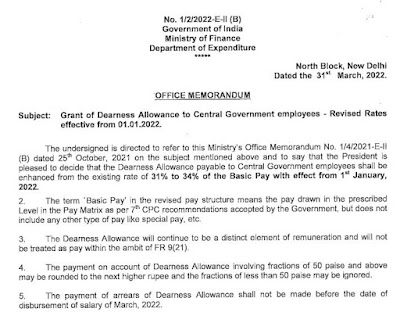
DA Jan 2022 - Grant of Dearness Allowance to Central Government employees - Revised Rates effective from 01.01.2022

 3% DA Hike - Revised Rates effective from 01.01.2022: DoE OM dated 31.03.2022 No. 1/2/2022-E-II (B) Government of India Ministry of Finance...