Thursday, 5 April 2018

DoPT: Recognition of Central Secretariat MTS Association


DoPT: Recognition of Central Secretariat MTS Association

No.17/1/2017-R&R and DC
Government of India
Ministry of Personnel, Public Grievances & Pensions
Department of Personnel & Training
3rd Floor, Lok Nayak Bhawan,
Khan Market, NewDelhi-110003
Office Memorandum

Subject: Recognition of Central Secretariat MTS Association - regarding.

The undersigned is directed to refer to OM of even number dated 29.06.2017, 06.09.2017 and CSMTSA's letter No. CS MTS/Recog/US/2018 dated 12/03/2018 on the subject mentioned above and to say that on the basis of information furnished by the DDOs of Ministries/ Department, it has been found that the Central Secretariat MTS Association has sufficient members for its recognition.

2. As such, it has been decided with the approval of Competent Authority to accord recognition to the Central Secretariat MTS Association under CCS (Recognition of Service Associations) Rules, 1993.

3. The recognition of the aforesaid Association will be valid upto 5 years or further directions issued in this regards, whichever is earlier.
(S.K.Mandl)
Under Secretary to the Government of India
Source: DoPT
Download Order

Economy in Use of Paper in Government Offices


Economy in Use of Paper in Government Offices

The e-Office is a Mission Mode Project (MMP) under the National e-Governance Programme of the Government of India. The e-Office product has been developed by National Informatics Centre (NIC), Ministry of Electronics & Information Technology (MeitY) for implementation in all central Ministries/Departments of the Government of India. e-Office suit comprises of various applications including routine daily works like Leave Management System, File Management System, Knowledge Management System, Tour Management System, Stationery Requests etc. to ensure economy in use of paper.

As on 21.03.2018, 78 central government Ministries/Departments are implementing e-Office.
This was stated by the Union Minister of State (Independent Charge) of the Ministry of Development of North Eastern Region (DoNER), MoS PMO, Personnel, Public Grievances & Pensions, Atomic Energy and Space, Dr. Jitendra Singh, in written reply to a question in the Rajya Sabha today.

Source: PIB.

Policy for Removal of Non-Performing Civil Servants


"Removal of Non-Performing Civil Servants Under Fundamental Rules (FR) 56(j), Rule 48 of Central Civil Services (CCS) (Pension) Rule, 1972"

Policy for Removal of Non-Performing Civil Servants

The provisions under Fundamental Rules (FR) 56(j), Rule 48 of Central Civil Services (CCS) (Pension) Rule, 1972 and Rule, 16(3) (Amended) of All India Services (Death-cum-Retirement Benefits) [AIS (DCRB)] Rules, 1958 have laid down the policy of periodic review and premature retirement of non- performing Government servants.

Up to January, 2018, a total of 21,195 Group 'A' and 47,039 Group 'B' officers have been reviewed, out of which provisions of FR 56(j) and relevant rules were invoked/recommended against 83 Group 'A' and 128 Group ‘B’ officers, including 15 officers of All India Services.

This was stated by the Union Minister of State (Independent Charge) of the Ministry of Development of North Eastern Region (DoNER), MoS PMO, Personnel, Public Grievances & Pensions, Atomic Energy and Space, Dr. Jitendra Singh, in written reply to a question in the Rajya Sabha today.

Source: PIB

Need to avoid the nomenclature "Dalit" for the members belonging to Scheduled Castes - Govt of India Order


Need to avoid the nomenclature "Dalit" for the members belonging to Scheduled Castes - Govt of India Order
No.12017/02/2018-SCD(R.L.Cell)
Government of India
Ministry of Social Justice and Empowerment
Department of Social Justice and Empowerment
Shastri Bhawan, New Delhi
New Delhi, dated: 15.03.2018
To,
The Chief Secretaries to all the State Governments/Union Territory Administrations.

Subject: Need to avoid the nomenclature "Dalit" for the members belonging to Scheduled Castes.

Sir,
I am directed to refer to the Ministry of Home Affairs (MHA) letter No. BC 12025/44/80-SC&BCD.I/IV, dated 10.02.1982, addressed to all the State Governments/Union Territory Administrations in which a request was made to issue instructions to the authorities empowered to issue the Scheduled Castes certificates, not to insert the word 'Harijin' in the Scheduled Caste certificates, but to mention only the caste to which the person belongs and which has been recognised as Scheduled Caste under the Presidential Orders. Subsequently, the Ministry of Welfare (now Social Justice and Empowerment), vide, letter No. 12025/14/90-SCD (R.L.Cell), dated 16.08.1990, again requested the State Governments/ UT Administrations that for all official transactions, matters, dealings, certificates etc., the Constitutional term, 'Scheduled Caste' in English and its appropriate translation in other national languages should alone be used for denoting the persons belonging to the Scheduled Castes. Thereafter, in compliance with recommendation of the Department Related Parliamentary Standing Committee the aforesaid instructions were again reiterated vide this Ministry's letter No.17020/64/2010-SCD (R.L.Cell) dated 22.11.2012.

2. The Hon'ble High Court of Madhya Pradesh, Gwalior Bench in its order dated 15.01.2018 passed in W.P. No.20420 of 2017 (PIL)-Dr.Mohanlal Mahor Vs.Union of India & Ors. has directed as under:-
"…..that the Central Government/ State Government and its functionaries would refrain from using the nomenclature ‘Dalit’ for the members belonging to Scheduled Castes and Scheduled Tribes as the same does not find mentioned in the Constitution of India or any statute."
3. All the State Governments/U.T. Administrations are requested that for all official transactions, matters, dealings, certificates etc., the Constitutional term, 'Scheduled Caste' in English, and its appropriate translation in other national languages should alone be used for denoting the persons belonging to the Scheduled Castes notified in the Presidential Orders issued under Article 341 of the Constitution of India.
Yours faithfully,
sd/-
(Arvind Kumar)
Director (SCD)

Source: http://www.icar.org.in

DAD Releases Handbook on Pay & allowances of JCOs & ORs


Ministry of Defence
DAD Releases Handbook on Pay & allowances of JCOs & ORs
Dated 04 APR 2018
The Defence Accounts Department is entrusted with the responsibility of maintaining the pay accounts of million plus Jawans and JCOs of Indian Army. The Pay Accounts Offices (PAOs) of this department are at the forefront of the concerted efforts that are being put in to ensure that these men get their correct dues within reasonable time frame.

An important requirement to meet the expectations of the end user and ensuring their contentment is that the JCOs/ORs understands their dues and their entitlement. If they further appreciate the processes involved in acceptance or denial of any dues, it would equip them with enough knowledge to have better awareness to contest entitlement inconsistencies, if any.

This handbook was conceptualized with the aim to provide more grasp on the rules of entitlement as well as to have complete transparency of procedures in the PAOs. This first edition contains all the procedures right from the inception stage of publishing and processing of the daily Part II orders, till the final processing and disbursement of entitlements.

The book also details the functional boundaries and constraints of PAOs. The chapters are so ordered that they lay down entitlement parameters in a user-friendly manner. Each of the chapter seeks to enlighten the JCOs/OR on the documentary and procedural requirements for processing an entitlement.

The audit and procedural requirements behind processing of Contingent Bill items, AFPP Fund claims, MACPs, transfer/deputation, leave/TD etc., are all detailed in distinct chapters of the handbook. The deductions from pay and allowances, bank account details, etc. are also elaborated in the book.

In a unique separate chapter interpretation of the Monthly Pay Slip has been elaborated. It details item-wise description of notifications provided in the Pay Slip, which, it is expected, would not only ameliorate grievances of Jawans at the inception stage but also give him confidence regarding legitimacy of the entitlements so granted. A chapter on general FAQs is also included for assistance and ready reference.

The book has sought to cover all the parameters of pay and allowances of JCOs/ORs, incorporating the 7th CPC entitlements as well, wherever available on the date of publication. This book in pdf format is also available on the website of PAO(OR) AMC & 11 GRRC as well as of PCDA(CC), Lucknow.

Standard Deduction Applicable for Pensioners - Clarification


Standard Deduction Applicable for Pensioners - Clarification

Ministry of Finance
Clarification regarding applicability of standard deduction to pension received from the former employer

The Central Board of Direct Taxes (CBDT) has clarified that the pension received by a taxpayer from his former employer is taxable under the head "Salaries". The Finance Act, 2018 has amended Section 16 of the Income-tax Act, 1961("the Act") to provide that a taxpayer having income chargeable under the head “Salaries” shall be allowed a deduction of Rs 40,000/- or the amount of salary, whichever is less, for computing his taxable income. Accordingly, any taxpayer who is in receipt of pension from his former employer shall be entitled to claim a deduction of Rs 40,000/- or the amount of pension, whichever is less, under Section 16 of the Act.

Earlier, the representations were received seeking clarification as to whether a taxpayer, who receives pension from his former employer, shall also be eligible to claim this deduction.

Source: PIB

Wednesday, 4 April 2018

Reimbursement in respect of Newspapers purchased/supplied to officers at their residence - Guidelines regarding


Reimbursement in respect of Newspapers purchased/supplied to officers at their residence - Guidelines regarding

No. 25(12)/E.Coord-2018
Government of India
Ministry Of Finance
Department of Expenditure
(E. Coord. Branch)

North Block, New Delhi
Dated 3rd April 201B
OFFICE MEMORANDUM
Subject: Reimbursement in respect of Newspapers purchased/supplied to officers at their residence-guidelines regarding.

Department of Expenditure, Ministry of Finance, vide order no.1 (24)/E.IIA/96 dated 13th September, 1996, had issued guidelines on the subject cited above It has been felt that these guidelines are dated and need to be updated. It has therefore, been decided that in place of the existing practice of getting monthly reimbursement of newspaper on production of newspaper bills, reimbursement for newspaper may be made at the rates mentioned below based on the certification given by the entitled officer:
S. No Level of Officers Reimbursement to be made per
month (In Rs. )
1.Secretary / Secretary
equivalent
As per actuals
2.Additional Secretary/ Additional Secretary equivalentRs.1100
3.Joint Secretary / Joint Secretary equivalentRs.850
4.Director / Deputy Secretary / Under Secretary Section Officer or
equivalent
Rs.500
  1. A certificate as per the Annexure, to the effect that expenditure has been incurred on newspaper shall be provided by the officers on half yearly basis to the office for reimbursement.
  2. This issues in supersession to all earlier guidelines Of Department of Expenditure on the subject. The orders will be effective with immediate effect.
  3. The orders will be effective with immediate effect.
sd/-
(H.Atheli)
Director
Click to view Certificate
Source: www.doe.gov.in

Equal Pay for Equal Work: Equal Pay for Daily Wagers/Contract Labourers and Regular Employees


Equal Pay for Equal Work: Equal Pay for Daily Wagers/Contract Labourers and Regular Employees

GOVERNMENT OF INDIA
MINISTRY OF LABOUR AND EMPLOYMENT
RAJYA SABHA
STARRED QUESTION NO. 346
TO BE ANSWERED ON 28.03.2018

EQUAL PAY FOR DAILY WAGERS/CONTRACT LABOURERS AND REGULAR EMPLOYEES

346. DR. SATYANARAYAN JATIYA:
Will the Minister of LABOUR AND EMPLOYMENT be pleased to
state:
(a)the policy of "equal pay for equal work" and the effective measures taken for the implementation of the same; and
(b)in reference to (a) above the measures taken to ensure equal payment to daily wagers and contract labourers employed in institutes, establishments and companies of Government and
private sector as is being given to regular employees employed there?

ANSWER
MINISTER OF STATE(IC) FOR LABOUR AND EMPLOYMENT
(SHRI SANTOSH KUMAR GANGWAR)
(a) & (b): The principal of "equal pay for equal work" was examined and laid down by the Hon‟ble Supreme Court in the civil appeal number 213 of 2013. The issue before the Hon‟ble Supreme Court was as under:

"whether temporarily engaged employees (daily-wage employees, ad- appointees, employees appointed on casual basis, contractual employees and the like), are entitled to minimum of the regular pay-scale, alongwith dearness allowance (as revised from time to time) on account of their performing the same duties, which are discharged by those engaged on regular basis, against sanctioned posts"

The Hon‟ble Supreme Court held that:

"There can be no doubt, that the principle of "equal pay for equal work" would be applicable to all the concerned temporary employees, so as to vest in them the right to claim wages, at par with the minimum of the pay-scale of regularly engaged Government employees, holding the same post"

The above judgement of the Hon'ble Supreme Court dated 26th October, 2016 covers various sets of temporarily engaged employees, viz. daily-wage employees, adappointees, employees appointed on casual basis, contractual employees etc. It is mandatory for the employer/principal employer to comply with the provisions of labour laws and apply the ratio laid down by the Hon'ble Supreme Court regarding "equal pay for equal work" while paying wages to its workers/labourers.

In so far as the contract labour is concerned, the Contract Labour (Regulation & Abolition) Central Rules, 1971 provides for wage parity as stipulated in rule 25(2)(v)(a) which is reproduced below:

"in cases where the workmen employed by the contractor perform the same or similar kind of work as the workmen directly employed by the principal employer of the establishment, the wage rates, holidays, hours of work and other conditions of service of the workmen of the contractor shall be the same as applicable to the workmen directly employed by the principal employer of the establishment on the same or similar kind of work"

Source: www.rajyasabga.nic.in

Payment of Minimum Wages to Contract/Casual Employees

Ministry of Labour & Employment

Payment of Minimum Wages to Contract/Casual Employees

04 APR 2018
The basic rate of minimum wages for the scheduled employments in the Central sphere was last revised and notified on 19.01.2017. A component of minimum rates of wage, Variable Dearness Allowance (V.D.A.), was last revised on 01.10.2017.Rates fixed for the scheduled employments in the Central sphere are applicable to establishments under the authority of Central Government, railway administration, mines, oil-fields, major port or any corporation established by a Central Government. These rates are equally applicable to contract and casual labourers/worker. The implementation of the Act is done by the Centre as well as the States in respect of their respective jurisdiction. In the Central Sphere, the enforcement is secured through the Inspecting Officers of the Chief Labour Commissioner (Central) commonly designated as Central Industrial Relations Machinery (CIRM) across the Country for workers falling under the Scheduled Employment in the Central Sphere including CPSUs and Railways establishments through regular inspections. In case of non-compliance, penal provisions against the defaulting employers are invoked.This Ministry is in constant endeavor towards implementing the revised rates of minimum wages. As far as employees in Railway are concerned guidelines were issued in December, 2017 to Ministry of Railways/Railway Board. Ministry of Railways has also issued instructions to its Zonal Offices across the country for strict compliance of minimum wages in December, 2017.The data of inspections, amount of claims, action taken against defaulting employer under the Minimum Wage Act, 1948 in the Central Sphere for the last three years is at Annexure 'A'.

Annexure 'A'

Claims cases under Minimum Wages Act, 1948
Year Claims Amount
B/F Filed Decided Awarded Recovered Paid to Workers
2015-16 3672 743 1796 66654417 44128036 34879425
2016-17 2610 1198 1138 96684922 49485990 48540964
2017-18(upto Dec.,2017) 2617 1050 819 95757253 20697840 24866702


Minimum Wages Act, 1948
Sl.No. Particulars 2015-16 2016-17 2017 -18(upto Dec,2017)
1. No. of Inspections Conducted 9803 9151 7380
2. No. of Irregularities Detected 75938 61689 62304
3. No. of Irregularities Rectified 46467 53255 28884
4. No. of Prosecutions Launched 1549 2321 1130
5. No. of Convictions 1476 1951 1721
This information was given by Shri Santosh Kumar Gangwar, Union Minister of State (I/C) for Labour and Employment in written reply to a question in Rajya Sabha today.

PIB

Dress Code prescribed for Income Tax Employees

Dress Code prescribed for Income Tax Employees

OFFICE OF THE PRINCIPAL CHIEF COMMISSIONER OF INCOME TAX, DELHI
C.R.BUILDING, L.P.ESTATE, NEW DELHI-110002
Phone No.011-23379596/23379245; FAX 011-23378668

F.No.PrCCIT/Admin/2017-18/02
Dated: 02.03.2018
Office Order

Reg: Dress Code prescribed for Income Tax Employees

The Income Tax Department strives to maintain a workplace environment that is well functioning and maintain high standard of conduct and decorum. As part of that effort, the Department requires employees to maintain a neat, clean and formal appearance that is appropriate for the workplace setting.

It if often seen that a large number of employees, especially the younger members of the department come dress casually for the office, which is unexpected of them.

All the Officers/Officials/ staff members should be attired in appropriate, formal, clean, modest and decent clothes. Casual and party attire should be strictly avoided during appearance in office. Any staff member who does not meet the attire, will be subject to corrective action and may be asked to leave the premises to change clothing.
This issues with the prior approval of the competent authority.
(Divya Vashishta)
Deputy Commissioner of Income Tax, (Hqrs.) (Admn.)
New Delhi.
Source: Confederation
dress-code-for-income-tax-employees

Flash News

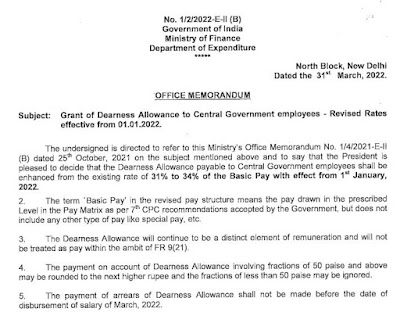
DA Jan 2022 - Grant of Dearness Allowance to Central Government employees - Revised Rates effective from 01.01.2022

 3% DA Hike - Revised Rates effective from 01.01.2022: DoE OM dated 31.03.2022 No. 1/2/2022-E-II (B) Government of India Ministry of Finance...