Monday, 5 March 2018

Modernisation of Ordnance Factories


Ministry of Defence
Modernisation of Ordnance Factories
05 MAR 2018

To keep pace with contemporary manufacturing technologies, Ordnance Factory Board (OFB) has undertaken modernisation of Ordnance Factories including the six factories located in the State of Tamil Nadu. In addition to modernisation of Plant & Machinery, capacity augmentation programme is also under way in three factories namely Heavy Vehicles Factory, Avadi, Engine Factory Avadi and Heavy Alloy Penetrator Project, Trichy.

Details of factory-wise expenditure incurred in the year 2016-17 on modernisation of the six Ordnance Factories located in the State of Tamil Nadu are as follows:

FactoryInvestment on Plant & Machinery and Civil Works on capacity creation & augmentationExpenditure on Renewal & Replacement of Plant & Machinery
(i) Heavy Vehicles Factory,  Avadi554.0024.59
(ii) Engine Factory  Avadi234.005.30
(iii) Heavy Alloy Penetrator Project, Trichy35.1912.19
(iv) Ordnance Factory, Trichy- 6.65
(v) Ordnance Clothing Factory, Avadi- 1.22
(vi) Cordite Factory  Aruvankadu-2.93

This information was given by RakshaRajyaMantriDr. Subhash Bhamre in a written reply to ShrimatiSasikalaPushpain Rajya Sabha today.

PIB

7th CPC: Payment of overtime Allowance (OTA) in the revised pay to the employees of Defence Industrial Establishments governed by the Factories Act, 1948


Payment of overtime Allowance (OTA) in the revised pay to the employees of Defence Industrial Establishments governed by the Factories Act, 1948

overtime-Allowance-OTA


Overtime Pay in 7th CPC for Defence Industrial Establishments governed by the Factories Act, 1948 - MoD Order

Government of India
Ministry of defence
(Department of Defence)
D(Civ-II)
B-Wing, Sena Bhavan,

New Delhi, the 26 February, 2018
OFFICE MEMORANDUM

Subject: Payment of overtime Allowance (OTA) in the revised pay to the employees of Defence Industrial Establishments governed by the Factories Act, 1948.

Consequent upon revision of pay structure as per VII CPC recommendations, the matter regarding payment of OTA, as per revised pay, to the employees of the Defence Industrial Establishments under the Factories Act, 1948 has been considered in consultation with the Ministry of Labour & Employment, Ministry of Finance and Ministry of Law & Justice.

2. It has been decided that the Overtime Allowance shall be paid to the employees of the Defence Industrial Establishment governed by the Factories Act, 1948 on the basis of revised wages with effect from the date the wages have been revised i.e. 1.1.2016. The OTA on the basis of revised wages is subject to the conditions stipulated in this Ministry's OM No. 14(1)/97/D(Civ-11) dated 1st July 1998.

3. It is further added/clarified that those categories of "workers" who come within the scope of Section 64 of the Factories Act and whose basic pay exceed the wage limit, as specified in sub-section (6) of Section (1) of the Payment of Wages Act, 1936, are entitled for payment of OTA in terms of MoD OM No. 14(2)/76/D(Civ-II) dated 25.06.1983 on the basis of wage limit notionally determined. Accordingly, OTA will be paid to them on the basis of wage limit notionally determined on the basis of old pay scales until the new wage limit is defined by the Ministry of Labour & Employment based on the consumer expenditure survey published by NSSO. Thereafter, the OTA will be paid to them on the basis of new wage limit notionally determined, if the basic pay exceeds the new wage limit.

The other conditions as laid down in this Ministry's letter No. 14(1)/97/D(Civ-II) dated 1st July. 1998 shall remain unchanged

4. This issues with the concurrence of MoD(Finance/AG/PB) vide their Dy No. 1 04/AG/PB dated 15.02.2018 and after consultation with Ministry of Labour & Employment vide their ID No. Z- 16025/09/2017-ISH-II dated 13.11.2017

(Dalpat Singh)
Under Secretary to the Govt. of India
Tel. 23014675

Recruitment of Pilots in Armed Forces : Central Government Jobs


Ministry of Defence
Recruitment of Pilots in Armed Forces : Central Government Jobs
05 MAR 2018
There are four modes of entry for becoming a pilot in the Indian Air Force (IAF) [NDA, CDSE, AFCAT and NCC special entry]. A written test is conducted for NDA/CDSE (by UPSC) and AFCAT (by IAF) entries followed by SSB testing. NCC special entry candidates with valid 'C' certificate (Air Wing) are directly called for SSB testing. The recommended candidates undergo medical tests. The final merit list is prepared based on the candidate's performance and medical fitness. On successful completion of flying training at Flying Training Establishments (FTEs) of the IAF, the cadet is commissioned as a pilot in the IAF.

Pilots are inducted in the Indian Navy as Permanent Commission (PC) or Short Service Commission (SSC).
  • Permanent Commission (PC) : Volunteers from serving Executive branch officers (upto 25 years of age) are selected for pilot training biannually.
  • Short Service Commission (SSC) : Short Service Commissioned officers are inducted biannually through Direct Entry Scheme.
All pilots in Army Aviation are commissioned officers. Options to join Army Aviation are as under:-
  • Volunteers who opt for Army Aviation during pre- commissioning training at IMA and OTA.
  • Volunteer Officers from any Arm of Indian Army on completion of one and half years of service.
Volunteer Officers are required to undergo the following tests:-
  • Pilot Aptitude and Battery Test (PABT)
  • Aviation medical examination
Officers clearing the PABT and medical examination undergo the Basic and Advance flying training, on completion of which they become pilots in the Indian Army.
As on 1st February, 2018, sanctioned strength and strength of pilots in Indian Air Force (IAF) is as follows:
Sanctioned StrengthStrength
42313855
There is a marginal shortage in strength of pilots in IAF against the authorized establishment.
Indian Navy:
Government Sanction735
Borne Strength644
Vacant Posts91
Indian Army:
The total number of pilots in Army Aviation as on date are:
Sanctioned794
Held602
Vacant192
A study on Restructuring of Army Pilot Cadre was conducted and salient decisions that have been implemented are:
  • There has been an increase in Direct Commissioned Officers (DCO) both from IMA and OTA.
  • For the DCO, the lower service limit of two years of attachment period with fallback arm after commissioning has also been reduced to one and half years.
IAF ensures that the aircrew are fully utilized in a cockpit vacancy for the maximum duration which is well beyond the period required for amortization of the cost of training. It is also ensured that only limited numbers are given release such that the combat potential of IAF is not compromised at any stage
  • Setting up of an Air Force Selection Board (AFSB) at Gandhinagar in 2013.
  • The selection process into the IAF has been simplified with the introduction of the Air Force Common Admission Test (AFCAT) for non-UPSC entries. Under this format, a candidate may apply for selection in any branch for which they meet the QRs, through a single application in a selection cycle.
  • Proactive steps have been taken by the IAF to reduce the shortage of pilots, which include participation in career fairs/exhibitions, advertisements in print and electronic media, motivational lectures in schools, colleges, visuals/signage at strategic locations etc.
This information was given by Raksha Rajya Mantri Dr. Subhash Bhamre in a written reply to Shri Harshvardhan Singh Dungarpurin Rajya Sabha today.

PIB

CGEWHO Rules


CGEWHO Rules

CENTRAL GOVERNMENT EMPLOYEES WELFARE HOUSING ORGANISATION Rules
CENTRAL GOVERNMENT EMPLOYEES WELFARE HOUSING ORGANISATION

PREAMBLE

  1. The Central Government Employees Welfare Housing Organisation is a 'Society' established to promote, control and coordinate the development of housing schemes at selected places, all over India, on no profit-no loss basis as a welfare measure. The Society is a registered body under the Societies Registration Act of 1860.
  2. Its aim is to provide welfare housing service of quality to the Central Government employees.
  3. The rules have been drawn up to give the Central Government employees, serving and retired, a perception of the task and an understanding of the Organisation's commitment to them and their own obligations in this matter. Such a brochure cannot be all comprehensive. Applicants may, therefore, contact the organisation's Head Office in New Delhi for clarifications.

DEFINITIONS

  1. General Body' means the list of Members given under Para 6 of the Memorandum of Association.
  2. 'Governing Council' means the list of members given under Para 5 of the Memorandum of Association.
  3. 'CGEWHO' means the Central Government Employees Welfare Housing Organisation.
  4. 'Scheme' means the self-financed housing project announced by the CGEWHO.
  5. 'Dwelling Unit' means a single storey/ duplex type/ flat type of housing unit constructed in independent group housing or multistoreyed construction or marked plots.
  6. 'Beneficiary' means an eligible applicant whose booking for a dwelling unit has been confirmed by the CGEWHO.
  7. For the purpose of CGEWHO, a Central Government employee is an inpidual who is appointed by or on behalf of the President of India and whose pension both charged and voted, is debitable to the Consolidated Funds of India, including the All India Services officials. However, employees of "States" and "Union Territory Administrations" are not included. Further, such Central Govt. employees as are eligible under similar organisations like AWHO, AFNHB, IRWO are also not included,

ELIGIBILITY:

PRIORITY - I
  1. Central Government Employees: Serving or retired Central Govt employees who are covered by the above definition will be eligible.
  2. Spouses of the deceased employees: Spouses of the deceased Central Government employees or deceased retired employees would be eligible, if the deceased employees would have qualified by criteria 3 (i) above.
  3. Employees of the CGEWHO, with a minimum of one year of service, will be eligible.
PRIORITY - II
Serving Employees of Central PSUs, State Govts., Union Territory Administration, Autonomous Bodies, Corporation, Nationalised Banks etc. Serving Uniformed employees of the Ministry of Defence and serving employees of Ministry of Railways.

PRIORITY - III
General Public, including retired/ spouses of deceased employees of Priority-II.

SPECIAL ELIGIBILITY CRITERIA

  1. Where both husband and wife are eligible, only one of them can apply.
  2. Employees, serving or retired, owning residential property, in his/her, or in the name of his/her spouse in the city/town, where the CGEWHO is planning a Scheme, will not be eligible for that Scheme. For this purpose, urban agglomerates contiguous to the city of the scheme (e.g. Delhi, NOIDA, Greater NOIDA, Gurgaon, Faridabad) will be considered as one city / town / location
  3. Employees will be entitled to only one dwelling unit under CGEWHO Schemes anywhere in the country.
  4. An employee who has been dismissed from the service, would cease to be a beneficiary of the Scheme and will not be eligible to apply.
  5. Eligibility and other conditions attached to the allotment of land by the Municipal and Local Development Authorities, as applicable to such Scheme, would prevail.
  6. The terms and conditions, as imposed by the Land Alloting Agency/Plans Approving Authority, in respect of cost, FAR, Bye-laws, eligibility etc, shall prevail and be binding on the beneficiary of the CGEWHO.

HOUSING CONCEPT

Subject to availability of land, dwelling units and garages in single units, multiple units, row housing, multi-storeyed building, group-housing or marked plots may be planned, subject to the approval of the local civic authorities. These plans will be announced as Scheme, as applicable.

TYPE OF HOUSES

The CGEWHO may build houses or flats of the following types: One bed-room units - Type A/L Two bed-rooms units - Type B/M Three bed-rooms units - Type C/N and Four bedroom units in Type D. These may be built with or without scooter/car garages/stilts. The design, the layout and the built-up area in each type may vary from place to place. More types may be added with consequent change in Rule 7.

OPTION TO APPLY FOR TYPE OF UNIT

The applicant may apply for any one of the above types of units linked with the Group to which he/she belongs, as under:
Type of dwelling unit / flatGroup of ServiceGrade PayPay Band
A or L (A type in highrise) D, C, B & ARs. 1300 and above1S onwards
B or M (B type in highrise) C, B & ARs. 1800 and abovePB-1 onwards
C or N (C type in highrise) B & ARs. 4200 and abovePB-2 onwards
DARs. 5400 and abovePB-3 onwards
Notes:
  1. Change of dwelling unit from one type to another type, provided otherwise eligible as per this para, can be entertained subject to payment of additional Application Fee and Earnest Money, as applicable, and availability of vacancies in that particular type of dwelling unit. However, change to a lower type of category will not entitle the applicant for refund of differential Application Fee but will entitle him for refund/appropriate adjustment of the differential Earnest Money paid.
  2. Change from one scheme to another scheme is not permitted. For doing so, an applicant should first withdraw /undertake to withdraw his allotment from the existing scheme and apply afresh in the new scheme, if he so desires (subject to payment of cancellation charges, as per rules).
  3. Request for change of DU from one type to another, within the same scheme, or change from one scheme to another, after physical possession of the originally allotted DU has been taken, are liable to be rejected. Further, in case the change as mentioned at subparas (i) & (ii) above have been agreed to and implemented, it will be construed that the applicant had joined the revised type of DU/ scheme from the very inception and all the payments received/ yet to be received will be treated, accordingly. CGEWHO's decision in this regard shall be final and the beneficiary will not have any claim whatsoever.
  4. In case an existing beneficiary of the CGEWHO under any other scheme, wishes to apply for the present Meerut (Phase I) Housing Scheme, he may do so by paying the Application Fee only and clearly stating in the 'Affidavit' the facts regarding his earlier registeration with the CGEWHO. In the event of confirmed allotment under Meerut (Phase I) Housing Scheme, the concerned beneficiary will have to surrender either of the two registerations. In case of surrender of original allotment, withdrawal charges shall be deducted, if applicable, as per the rules and remaining amounts transferred under the Meerut (Phase I) Housing Scheme. Failure to state the facts in the application may invite cancellation of both the applications/ allotments.

PLANS AND SPECIFICATIONS

Plans and specifications will be drawn up for each type of dwelling unit to meet the basic needs of the group and conforming to the bye-laws of the civic authorities. Different specifications may be considered for each type of dwelling unit.

TECHNICAL BROCHURE

After approval of the plans by the local statutory authorities, the plans of dwelling units and layout and the major specifications will be published in a Technical Brochure and circulated to all the beneficiaries. These, however, are subject to change prior to or during execution, at the discretion of the CGEWHO. CGEWHO undertakes construction of the housing projects as per approved plans and beneficiaries shall have no right to claim any changes or challenge the methods or procedures adopted during the construction.

STATIONS

Major building efforts of the CGEWHO will be concentrated in areas where there is concentration of Central Government employees. Other places may be added depending on availability of land and the likely demand.

MASTER PLAN

A Master Plan of projects drawn up for a period of 5 years at a time will be promulgated for the benefit of all Central Government employees. Revised Schedule will be announced as and when the Master Plan is rolled through CGEWHO's newsletter.

HOW TO APPLY

  1. The CGEWHO will announce the Scheme, giving location, station, types, covered areas and approximate cost of each unit for inviting applications.
  2. An employee who is eligible to become a beneficiary, may purchase the CGEWHO Rules/ Scheme Brochure along with Application Form from the nominated office/Head Office, on payment of Rs. 100/- in cash or through a bank draft drawn in favour of 'CEO, CGEWHO' payable at New Delhi.
  3. On receipt of the Application Form and the 'CGEWHO Rules', the applicant should fill the Form and return the same to the CGEWHO by the specified time, alongwith :
    1. Bank draft for refundable Earnest Money, as under :
      Type of DU / FlatNon-Refundable Application feesRefundable Earnest Money Deposit (EMD)Total Amt. ( in Rs.)
      A
      500
      50,000
      50,500
      B
      500
      50,000
      50,500
      C
      1,000
      1,00,000
      1,01,000
      D
      1,000
      1,00,000
      1,01,000
      Note: Rs. 100/- to be added towards cost of 'CGEWHO Rules Brochure' with above amount, in case, applicant is using downloaded application form.
    2. Affidavit as per the format prescribed in the CGEWHO Rules Book.
    3. Pay slip or copy of PPO duly attested. No interest will be payable on Earnest Money deposited alongwith the application for the first three months calculated from the day following the closing date of scheme, including extension, if any. Thereafter, beyond three months a simple interest @ 5% per annum will be payable to unsuccessful allottess till the date of refund. On allotment, the Earnest Money paid (alongwith the application) shall be deemed to be a part of the instalment(s) and the beneficiary will be treated as if he had made part payment of the first instalment.

REGISTRATION OF APPLICATIONS

On scrutiny of the Application Form, the applicants will be registered for a dwelling unit in the Scheme.

RESERVATION FOR SC/ST APPLICANTS

15% & 7.5% of the DUs of all the types in all the housing schemes of CGEWHO will be reserved for SC & ST applicants respectively, with a stipulation that there will be a minimum of one DU of each type in the reserved category and fractions, if any, will be rounded off to the nearest full number. The procedure adopted in such allotments shall be as under;
  1. In case of more number of applicants belonging to SC/ST categories, after first conducting the draw for the reserved categories alone, unsuccessful applicants shall be considered in the draw for general category of applicants. Those who will succeed in the general draw will get a confirmed allotment, and the remaining applicants, if any, shall be placed on the general waiting list as well as the one created especially for the reserved category of applicants. However, in case of less number of applications than the number of DUs reserved, the balance DUs (after giving confirmed allotment to the applicants belonging to the reserved category) shall automatically stand de- reserved, and will be considered in the general draw.
  2. The applicants desirous of being considered in the 'Reserved' category, will be required to submit an attested photocopy of the 'Caste' Certificate from the appropriate authority.
  3. These 'Reservations' will be applicable to 'Priority I' applicants only.

CONFIRMATION OF BOOKING

If the registered applicants for a given project exceed the number of dwelling units, computerised draw will be held at the Head Office separately for each type. Successful applicants will be given 'confirmation of booking' by an Allotment letter.

COST OF DWELLING UNITS

The cost of dwelling units, with or without garages, for each Scheme will be worked out by the CGEWHO and intimated at the time of announcing the Scheme. The cost will, interalia, include interest on investment in land purchased for a scheme, common amenities, cost of reserve funds, charges towards registration of land etc. The costs will be reviewed at different stages of construction and will be subject to escalation, on account of market prices, labour wages, Cooperative Society/Apartments Owners' Association's charges,essential alterations, additions etc. All revisions of cost will be charged to the beneficiaries and they will be liable to pay the same.

PAYMENT SCHEDULES

Beneficiaries will be required to pay instalments on the self- financing basis. The payments will be on call. Please also see para 7 of Part 'A' of this Brochure.

LATE PAYMENTS

Beneficiaries who join a Scheme, or are promoted from the waiting list, after the initial enrollment or are late in paying their instalments, will be charged interest from the respective dates of instalments towards equalisation charges. The rate of interest on these payments will be 15% per annum. This rate of interest is subject to change. The CGEWHO reserves its right to terminate the registration and cancel the allotment without giving any further notice, in case of default in making the scheduled payment beyond 120 days from the last date of payment.
NOTE: Once an allotment has been cancelled, for any reason whatsoever, it can not be revived under any circumstances. However, in extreme cases, the Competent Authority may agree to re-activate the allotment provided the request is accompanied by requisite outstanding payments.

CHANGES IN PAYMENT SCHEDULES

The CGEWHO will make every effort to indicate the prices of the dwelling units as accurately as possible but the costs may vary. Adjustments in payments and schedules may become necessary, commensurate with the progress of construction. Beneficiaries will be intimated of the changes as they occur.

MODE OF PAYMENT

All payments will be made by Demand Draft / Pay Order only on any Scheduled Bank payable at New Delhi, drawn in favour of the CGEWHO A/c 0267101018816 Canara Bank duly endorsed 'payee A/c only'. Payments in cash or cheque will not be accepted.

PAYMENT OF INTEREST

  1. No interest will be payable by the CGEWHO to the beneficiaries on any instalment paid after the confirmation of booking. Beneficiaries, to whom confirmed allotment has been made, shall also not be entitled to any interest on installments paid, in the event of cancellation/ withdrawal.
  2. No interest will be payable by the CGEWHO on the Application Fee, which is non-refundable.

REBATE

If a beneficiary pays the total cost of dwelling unit within 45 days of the confirmation of booking, a rebate of 2.5% will be given. However, this or any other rebate is not applicable for making any advance payment of the tentative cost of the dwelling unit. Further, this rebate is available to the applicants receiving allotment, on announcement of the scheme. Applicants joining the scheme, during its operation, subject to availability and offering to make early payments will not be entitled to this rebate.
LOAN ARRANGEMENTS
  1. Beneficiaries who are still in Central Government employment may be entitled to House Building Advance as admissible to Central Government employees in accordance with the rules of the Government of India.
  2. The CGEWHO will liaise with Nationalised Banks, Housing Development Financial Corporation and other financial institutions and endeavour to secure financial assistance by way of loans. Subject to agreement of the institutions, loans on second mortgage may be possible. However, the receipt of loan cannot be guaranteed. The quantum of these loans will, interalia, depend on the repaying capacity of the beneficiary.

ALLOTMENT OF SPECIFIC UNIT

The allotment of block, floor, specific dwelling unit will be made by a computerised draw of lots at the Head Office towards the end of the project and the results be intimated to each beneficiary. Allotments of a specific flat/ floor, as a result of the draw, shall be final and no requests for change shall be entertained.

RESERVATIONS

  1. Reservation will be made upto 3% of ground/lowest floor flats in each scheme for handicapped personnel in the CGEWHO's Housing Schemes.
  2. Personnel with the following disabilities will be eligible for such reservations:
    1. Orthopaedically handicapped - severe (75% and above)
    2. Visually handicapped - severe (75% and above)
    3. Mental illness - severe (75% and above)
  3. Availability of the above facility is restricted only to the allottee, his/her spouse and children only.
  4. Percentage of disability would be certified by the Head of Deptt. of a Government Hospital.

WITHDRAWAL FROM A SCHEME:

If a beneficiary wishes to withdraw from a scheme, he should submit a written request to the CGEWHO, alongwith the following documents.
    1. Letter of allotment in original (if issued)
    2. Original receipt(s) issued by this office against the payment(s) made by the beneficiary
    3. Pre-receipt as per proforma placed at Annexure II.
Allottees withdrawing from a Scheme will not be refunded their application fee, nor will they be entitled to any interest payment, No interest is paid to confirmed allottees. Allottees withdrawing after the date of commencement of construction, will be required to pay withdrawal charges @ 15% of the first instalment. Allottees withdrawing after allotment of specific floor/flats will be required to pay withdrawal charges @ 20% of the first instalment. Such refund will be made within 45 days of the receipt of the request for withdrawal alongwith all required documents.

CANCELLATION CHARGES

In addition to the Application Fee, 15% /20% of the first instalment will be levied as cancellation charges in case cancellation or withdrawal is sought after the commencement of construction/allotment of specific unit. These charges will also be levied on beneficiaries whose booking has been cancelled by the CGEWHO for want of timely payment or any other reason whatsoever.

POSSESSION

The beneficiary will be given a notice of two months to take the allotted unit, provided he/she has completed all formalities, paid all the dues, executed all the Deeds and obtained a Clearance Certificate from the CGEWHO.

DELAY IN TAKING OVER

The allotment of an inpidual who fails to take possession of the dwelling unit for three months after expiry of the notice period (inspite of making payment of following overhead charges per month or part thereof), shall be liable to be cancelled by the CEO, CGEWHO. Under special circumstances, such an allottee may approach the Chief Executive Officer, CGEWHO for an extension of this period which may be granted by the CEO as a special case for another maximum period of three months only.
Rs. 500 p.m. for Type A/L
Rs. 1500 p.m. for Type B/M
Rs. 2000 p.m. for Type C/N
Rs. 3000 p.m. for Type D
In the event of a beneficiary failing to take physical possession of the flat within 12 months of issue of the final call up letter, inspite of having paid the maintenance charges as above, the possession shall be given from the CGEWHO's Head Office only, and not from the site office, on 'as is-where is' basis. Further, in such a case any request for repairs, defect rectification etc will not be entertained. The beneficiary, who takes possession late will, however, be obliged to pay to the concerned Apartment Owners Association/ Society, the monthly up-keep & maintenance charges, as levied by it w.e.f. the date made applicable by the AOA or the date of allotment, whichever is earlier.

HANDING OVER

The dwelling units will be offered on 'as-is-where-is' basis after the Contractor and Architect have certified their completion. However, defects and deficiencies observed by the beneficiaries at the time of handing over/taking over, may be recorded in the documents. These will be examined and rectified, wherever applicable, in the defect liability period.

MUTUAL EXCHANGE OF DWELLING UNITS

Mutual exchange of type of DUs, during the currency of the scheme, or specific floor/ flat, after the draw has been conducted, may be permitted within the same scheme, or schemes managed by the same AOA/ Society subject to the two beneficiaries giving an undertaking to effect all the future payments, as called, and not to seek withdrawal from the scheme. However, in extreme situations, the Chief Executive Officer, may agree to accept withdrawal from the scheme, subject to payment of double the normal 'withdrawal charges' i.e. 30% / 40% of the 1st instalment (para 25 of the CGEWHO Rule refers).

COOPERATIVE SOCIETY/APARTMENT OWNERSHIP ASSOCIATION

Beneficiaries of each Scheme would form a Cooperative Society/Apartment Ownership Association under local laws governing such bodies. Every beneficiary will pay the Membership Fee for the Society/Association. In addition, a sum equal to 1.5% of the final cost of the dwelling unit will be charged from each beneficiary and credited to the account of his Society/Association, for its running expenses. The Society/Association, will administer the colony, look after its maintenance, attend to common property and provide guidelines for civic standards. The Society/Association will be governed by its byelaws.

PROCEDURE & OBLIGATIONS

  1. Coinciding with or after issue of the final call up notice, the CGEWHO will hold a General Body meeting of all the beneficiaries to elect the office-bearers of the proposed Apartment Owners' Association.
  2. Such elected adhoc Committee, of the proposed Apartment Owners Association, will aim at formally constituting the Association, including framing of its by-laws under the local laws governing such bodies, and register the same with the appropriate competent authorities.
  3. On completing the formalities regarding registration of the Association, the ad-hoc Committee would be required to convene a General Body meeting of all the beneficiaries to elect and constitute a regular Executive Committee.
  4. The duly elected adhoc Committee will take over all the common areas/services/facilities of the project within 6 months of its constitution - a period during which CGEWHO will maintain the residential complex and debit the actual maintenance expenses so incurred to the Apartment Owners' Association account.
  5. In case the adhoc/regular Committee fails to take over the common services/facilities/areas within a further period of 4 months, the CGEWHO shall be at liberty to wind up its operations at site, including demobilising its man power, leaving the complex in 'as is-where is' condition, at the discretion of the Chief Executive Officer, CGEWHO. However, during these 4 months period, though the CGEWHO shall maintain the complex at the cost of Apartment Owners' Association, it will charge an additional amount of Rs. 150/- per beneficiary per month for the services so provided which will be over and above the actual cost of maintenance and debit the same to the Apartment Owners' Association account, before handing over the balance of amount to it. (f) While some amounts will be transferred to the ad-hoc Committee by the CGEWHO, for meeting day to day expenses, bulk of the AOA charges collected will be transferred to the regular Executive Committee only, on a formal request by the President/Secretary, but after taking over all the common areas/services/facilities of the project. However, no interest would be paid by the CGEWHO to the AOA, on the amounts collected from the beneficiaries towards AOA charges.

ADDITIONS & ALTERATIONS

An undertaking covering the following aspects will be given by all the beneficiaries:
  1. Abide by the laws, bye-laws, rules and regulations of the Central or State Governments, the Civic bodies, the CGEWHO and the Cooperative Society/Apartment Ownership Association.
  2. Shall not sub-pide, extend, amalgamate, or carry out structural design or layout changes to the dwelling unit and garages without the prior permission in writing of the Civic Authority.
  3. The dwelling units and garages/stilts would be used for the sole purpose of living and car/scooter parking. Any commercial exploitation of these would be deemed to be a violation of terms and conditions.
  4. Facilities like stair-cases, passages, terraces, parks, lifts etc and common spaces and services, will be utilised by the beneficiary, alongwith other beneficiaries of the Scheme and no one will have exclusive right to their usage, nor make any alterations thereto.

OWNERSHIP

At the time of execution of Transfer Deed in favour of a beneficiary, he/she will have the option to register the dwelling unit in his/her own name, or jointly register it with one or two relations out of the undermentioned:
  1. Wife/Husband
  2. Son/sons, daughter/ daughters, including legally adopted children
  3. Parents (in case of unmarried @ widows without children)
  4. Brother/Sister (in case of unmarried @ widows without children)

SUCCESSION

In the event of the death of the beneficiary before the dwelling unit is taken over, his/her spouse or dependent children, whoever has been shown as the nominee in the Application, will be eligible to continue in the Scheme and to avail of the benefits under the Scheme. In case of unmarried members, these privileges will be extended to the dependent parents only. However, such changes in CGEWHO's records shall be made subject to the nominee fullfilling certain criteria and submitting requisite set of documents.

TRANSFER

The beneficiaries will not be permitted to dispose off the dwelling unit by way of Sale/Transfer/Assignment/ Long Lease/ by execution of Power of Attorney, under any circumstances, before transfer of the legal title of the dwelling unit by the CGEWHO in favour of the beneficiary. Any such transfer shall result in cancellation of allotment of the dwelling unit, in which case the allottee will pay penalty, as prescribed under the heading 'Cancellation Charges.' After transfer of the legal title of the dwellng unit in favour of the beneficiary, he/she may dispose off his/her dwelling unit, with prior permission of the concerned 'Kendriya Vihar Apartment Owners Association/ Society'. as per its byelaws.

LIABILITY OF THE CGEWHO

  1. In extreme situations beyond the control of CGEWHO, CGEWHO may be obliged to abandon a Scheme. In such a case, its liability would be to refund the deposits in full, with interest, in accordance with the Rules, less handling charges of 1% and Application Fee.
  2. The CGEWHO is only providing a service. It can in no way be held responsible for any claims of damages which may arise due to any reason whatsoever, including any commission or ommission, by the CGEWHO or its employees.

AMENDMENTS TO THE RULES OF THE ORGANISATION

The General Body is empowered to amend, alter or delete any of the Rules, as well as the Memorandum of Association.

ACCEPTANCE OF APPLICATION

The Chief Executive Officer, CGEWHO has the right of final acceptance of an application, its registration, booking and allotment of the dwelling unit and garages/stilts.

ARBITRATION

  1. All matters of disputes relating to CGEWHO Rules, which are likely to affect the rights of the beneficiaries, vis-a-vis, the CGEWHO, may be referred to the President of the Governing Council. The President shall appoint Arbitrator to adjudicate in the matter, whose decision shall be final and binding on the beneficiary and the CGEWHO. Request for arbitration of a dispute will be entertained only if it is made within two months of the cause of the action and prior to taking possession of the house. Possession will not be given till the arbitration proceedings are complete.
  2. Appointment of an Arbitrator will not be objected to on the ground that he/she is a person subordinate to the President, is a member of the Governing Council or the Executive Committee, is associated with the functioning of the CGEWHO, or is a beneficiary of a Scheme.
  3. President of the Governing Council shall have the privilege and authority to appoint a new successor to the Arbitrator after his demitting the office of Arbitrator on account of the transfer, resignation, retirement, death or any such eventuality, whereby the adjudicating Arbitrator is incapacitated to adjudicate the dispute between the parties.
  4. All suits and legal proceedings of any kind against CGEWHO shall be instituted only in the appropriate courts in Delhi, notwithstanding the location of the property, which may be subject matter of the dispute. All the arbitration proceedings/hearings shall be held in Delhi only.

MISREPRESENTATION OR SUPPRESSION OF FACTS

If it is found, at any time that an applicant has given false information or suppressed certain material facts, or has transferred the rights of the dwelling unit in any manner whatsoever, his/ her application will be rejected, and the registration/booking of dwelling unit will be cancelled without making any reference to the applicant. He/ she will also be debarred from participating in future schemes. In such cases, allottees will pay penalty as prescribed under the heading "Cancellation Charges".

OTHER SALIENT FEATURES REGARDING LOANS FROM FINANCIAL INSTITUTIONS

  1. The period of loan varies from 5 to 20 years. Repayment will, generally not extend beyond retirement.
  2. Co-borrowers: Earning members of a family like wife, son, daughter, father and mother can join as co- borrowers for increasing the amount of loan.
  3. The admissibility of loan is dependent on the repaying capacity of the borrowers and the co-borrowers opted by the beneficiary.
  4. Loan is generally disbursed only after applicant has invested his own share in full.

Sunday, 4 March 2018

7th CPC latest news: Over 8.77 lakh Gujarat Government Employees and Pensioners to get arrears from March and Odisha govt too..


7th CPC latest news: Over 8.77 lakh Gujarat Government Employees and Pensioners to get arrears from March and Odisha govt too..

The Gujarat government on Friday, March 2, announced that all government employees and pensioners will receive arrears from the 7th Central Pay Commission this month onward.

The payment will be made in three monthly installments - alternate months - said Gujarat Deputy Chief Minister and Finance Minister Nitin Patel in the assembly. This will benefit about 4.65 lakh Gujarat government employees and over 4.12 lakh pensioners, setting the exchequer back by about Rs Rs 3,279 crore.

"As the seventh pay commission was implemented with retrospective effect, employees and pensioners are eligible for arrears. The arrears will be paid from March onward and in three installments every alternate months. Employees will get arrears for seven months and pensioners for nine. These benefits will go to 4.65 lakh employees and 4.12 lakh pensioners of the Gujarat government," the Times of India quoted Patel as saying.

On Friday, the Odisha government also said that the recommendations of the 7th Central Pay Commission would be implemented in regards to employees and pensioners of public sector undertakings in the state.

Chief Minister Naveen Patnaik asked the department to revise salaries as per the recommendations of the seventh pay commission and this will come into effect from January 1, 2016, reported the Press Trust of India.

The state government had implemented the recommendations for government employees on August 29, 2017, but PSU employees were still waiting for the order.

The Central government had approved the recommendations of the Seventh Pay Commission in June 2016. The minimum pay was raised to Rs 18,000 a month from Rs 7,000. The employees had demanded a raise in minimum salary to Rs 26,000 and it was also said that the figures could be raised to Rs 21,000 per month. However, nothing was confirmed.

Source: IBT

Earmarking of reservation quota for women: NFIR


Earmarking of reservation quota for women

GOVERNMENT OF INDIA
MINISTRY OF RAILWAYS
(RAILWAY BOARD)
No.2007/TG - I/20/P Pt.II
New Delhi. Dated: 15.02.2018
The Principal Chief Commercial
Managers,
All Zonal Railways.

Managing Director,
CRIS, Chanakyapuri,
New Delhi.
(COMMERCIAL CIRCULAR NO 13 OF 2018)
Sub: Earmarking of reservation quota for women.

At present, following reserved accommodation is earmarked for use of female passengers:- .

(a) In Sleeper Class coach reservation quota of 6 berths in Mail/Express trains for ladies irrespective of age travelling alone or in a group of female passengers.

(b) In all trains having reserved sleeping accommodation, a combined quota of six lower berths per coach in Sleeper class and 3 lower berths per coach each in AC 3 tier and AC-2 tier classes for Senior Citizens, Female passengers of 45 years of age and above and pregnant women. In case of Rajdhani, Duronto and fully it Conditioned/Express trains, the number of berths to be earmarked under this quota in 3AC is 4 lower berths per coach as against 3 lower berths per coach in normal Mail/Express trains.

2. The issue regarding earmarking of ladies quota in 3 AC class of Garib  Rath Express trains has been examined and it has been decided to earmark a reservation quota of 6 berths in 3 AC class of these trains for exclusive use of female passengers irrespective of their a while travelling alone or in group of female passengers.

3. It has also been decided to modify the- logic of utilising accommodation earmarked under ladies quota as under:-
(i) Till preparation of first reservation charts, only female passengers travelling alone or in group of female passengers will be booked against this quota,

(ii) However, at the time of preparation of first reservation charts, the unutilised  quota earmarked for female passengers will b released to waiting, Its female passengers travelling alone or in group of female passengers followed by waiting list senior citizens.

If there are no such passengers and berths are left vacant, on board ticket checking staff shall be authorised to allot this accommodation to any other lady passenger/senior citizen on partially confirmed ticket, if any after making necessary entries in the reservation chart.

4. CRIS will make necessary modification in the software and advise date of effect to all Zonal Railways as well as this office.

5. Necessary instructions may be issued to all concerned accordingly.

( Shelly Srivastava)
Director Passenger Marketing
Railway Board.
Source: NFIR

Friday, 2 March 2018

INDWF: Minutes of National Anomaly Committee Meeting


INDWF: Minutes of National Anomaly Committee Meeting

F.No.11/2/2016-JCA-I(Pt.)
Government of India
Ministry of Personnel, Public Grievances & Pensions
Department of Personnel Training
North Block, New Delhi
Dated: 16 February, 2018
To
Shri Shiv Gopal Mishra
Secretary, Staff-Side
National Council (Staff Side)
Joint Consultative Machinery for, Central Government Employees
13-C, Ferozeshah Road, New Delhi- 110001

Subject: Minutes of the Meeting held on 11.01.2018 to discuss the admissibility of the agenda items received from the Staff Side, NC (JCM) for discussion in the National Anomaly Committee (NAC) for the 7th Central Pay Commission.

Sir,
Please find enclosed a copy of the Minutes of the meeting held under the Chairmanship of Joint Secretary (Establishment) on Thursday the 11th January, 2018 at 1500 hours in Room No. 190, conference Room, North Block, New Delhi with the representatives of Staff Side, NC(JCM) for information and necessary action.

2. As per discussion in the above meeting, Staff Side may please reconsider their views on Item No. 7. A copy of the recording during the meeting enclosed for per usual.
Yours faithfully,
S/d,
(D.K. Sengupta)

Deputy Secretary to the Government of India
Tel. 23040255

MINUTES OF THE MEETING HELD ON 11.01.2018 TO DISCUSS THE ADMISSIBILITY OF THE AGENDA ITEMS RECEIVED FROM THE STAFF SIDE FOR DISCUSSION IN THE NATIONAL ANOMALY COMMITTEE (NAC) FOR THE 7TH CENTRAL PAY COMMISSION

A meeting was held under the chairmanship of Shri G.D. Tripathi, Joint Secretary (Establishment), Department of Personnel & Training with the representatives of Staff Side of the National Anomaly Committee and senior officers from the other Ministries/Departments concerned at 3.00 p.m. on 11.01.2018 in Room No. 190, North Block, DoPT, New Delhi to consider the admissibility of the 18 items of anomaly forwarded by the Staff-Side of the National Council of JCM for settlement through discussion at the NAC constituted after the Seventh Central Pay Commission. The list of participants is at Annexure.

2. The Chairman welcomed the representatives of the Staff-Side of the National Anomaly Committee and asked Deputy Secretary (JCA) to briefly inform the participants the purpose for convening this meeting.

3. Deputy Secretary (JCA) informed that following the acceptance of the recommendations - to the extent they have been - of the 7th Central Pay Commission by the Government, the National Anomaly Committee has been constituted by DoPT. Subsequently, on receipt of a representation from the Staff Side, NC(JCM), the definition of what would constitute an anomaly has been revised and notified. Therefore, as per the revised scope of definition, anomaly will include the following cases;
a) Where the Official-Side and the Staff-Side are of the opinion that any recommendation is in contravention of the principle or the policy enunciated by the Seventh Central Pay Commission itself without the Commission assigning any reason;

b) Where the maximum of the Level in the Pay Matrix corresponding to the applicable Grade Pay in the Pay Band under the pre-revised structure as notified vide CCS(RP) Rules 2016, is less than the amount an employee is entitled to be fixed at, as per the formula for fixation of pay contained in the said Rules;

c) Where the Official side and the Staff Side are of the opinion that the vertical and horizontal relativities have been disturbed as a result of the 7th Central Pay Commission to give rise to anomalous situation.
4. Deputy Secretary (JCA) mentioned that a letter dated 16.08.2017 had been received from Secretary, Staff-Side proposing to discuss 15 items in the National Anomaly Committee (NAC). Subsequently, another letter dated 31.08.2017 was also received proposing 3 additional items. On examining these 18 items against the three (03) yardsticks as stated in para-3 above, it was felt that while some agenda items clearly fall within the definition of 'anomaly', there are a few which cannot be termed 'anomaly' as such, bordering more, as they are, on the side of 'demands'. There are a few more which apparently by virtue of affecting the interests of one Department should rather be taken up at the Departmental Anomaly Committee. On sharing the findings of this Preliminary examination with the Secretary, Staff-Side, a communication was received from him suggesting inter-alia, besides giving their own reasons for retaining the same agenda - except one item - for the NAC deliberations, that a meeting be convened to discuss and finalize the items so as to to avoid delay in convening the NAC meeting.

5. The Chairman then requested the leader of the Staff-Side and other members to put across their points of view on the issue.

6. The Leader, Staff-Side, thanked the Chairman for convening the meeting at the suggestion of Secretary, Staff-Side and initiated the discussion by emphasising that the next meeting of the National Council under the Chairmanship of Cabinet Secretary should be held urgently as more than 7 years have passed since the last such meeting was held. He referred to the background against which the JCM scheme has been institutionalized and stressed that the purpose of JCM is to avoid confrontation between the Government and its employees. He requested that the sentiments of the Staff-Side may be conveyed to the Cabinet Secretary so that the meeting of the National Council, JCM may be held without any further delay. He also suggested that the Cabinet Secretary should meet the Standing Committee of the National Council, JCM soon after the Republic Day celebrations so that the deliberations can be be held on all pending issues. The Leader, Staff-Side further stated that there are many issues arising out of the 7th Central Pay Commission's recommendations which are still to be settled to the satisfaction of the Staff-Side. He particularly mentioned about the recommendations relating to New Pension Scheme, Minimum Pay, Fitment Formula, etc.

7. Secretary, Staff-Side also expressed similar views about lack of interaction between the Official-Side and the Staff-Side. He mentioned that the institutions of JCM machinery has become defunct and stated that the meetings of the Standing Committee and the National Council, JCM should be called without any further delay. He also mentioned that the Group of Ministers had met the staff representatives and given some assurances for favourable consideration regarding the Minimum Pay and Fitment Formula. But even after 1-1/2 years, no decision has been conveyed by the Government. He regretted that inspite of the report submitted by NPS Committee, nothing fruitful has been done for bringing new pensioners under defined and guaranteed pension scheme. He stated that based on the assurance given by the group of Ministers, the Staff Side had deferred the call for strike but now it is getting very difficult for them to control the resentments of the staff. He stressed the need for frequent interactions so that each side can appreciate the other's views. He also mentioned that no decision has yet been conveyed on the 6th CPC related unresolved anomalies which, the Staff-Side feels, should be sent for arbitration as the Staff-Side has recorded its dissatisfaction on them.

(Action: D/o Pension & JCA Division, DoPT)
8. The Staff-Side members representing M/o Defence stated that they are on a hunger fast joining with the 4 lakhs Defence Civilian Employees to protest against the various decisions taken by Ministry of Defence against their interest. They lodged their protest aginst what they called 'arbitary' policy decisions made by the Government about outsourcing of jobs hitherto done in the ordince factories, converting Army Base Workshops to GOCO Model, closure of Station Workshops, Military Farms and Depots under Army Headquarters thereby rendering 31,000 Employees surplus including 9000 employees of Military Engineer Service, granting Uniform Allowance to the soldiers by stopping the practice of getting them stitched through almost 12000 Employees in 5 Ordnance Factories etc. This is against the assurance given by the Defence Ministry in the past to the Staff Side that the jobs being performed by ordnance factories would be outsourced. They also protested against the violation of the direction of Cabinet Secretary by the Ministry of Defence in that the Staff Side has not been consulted before deciding on outsourcing, closure, merger, declaring manpower surplus etc. They demanded that MoD may be directed to immediately hold discussions with the Staff Side and settle the issues in the interest of the Defence Industry and its employees
(Action: M/o Defence)
9. The Staff Side also raised the following issues:-
a) The demand of the Staff Side for extension of the date of option for switching over to 7th CPC Pay Scales from a date on which the employee got promotion/MACP is not yet settled. Necessary instructions may be issued in this regard.

(Action: Establishment Division, DoPT)
b) The Report of the NPS Committee even though submitted to the Government in August, 2017 the Staff Side is not yet given a copy of the same. The same may be given to the Staff Side and a meeting may also be held with the Staff Side by the Government before taking any decision on the recommendations of the NPS Committee.

(Action: D/o P & PW)
c) The Staff Side also pointed out what they felt arbitrariness of the decision of the Government to close down the various printing presses without even holding any discussion with the Staff Side. The employees have been asked to immediately get themselves, relived and join at faraway places. They added that assurances were given by the Cabinet Secretary at the National Council that the Government would discuss the problems faced by the staff and resolve the same in all cases when the Government decides to wind up any of its functions.
(Action: M/o Urban Development)
10. The Chairman stated that he has taken note of all the concerns expressed by the Leader, Staff-Side, Secretary Staff- Side and the other representatives of the Staff-Side. He stated that the work on finalizing the comments on the Agenda for the meeting with the National Council, JCM has been going on and another two weeks would be required to finalize the comments and thereafter the convenience of the Cabinet Secretary would be sought so that the meeting of the Standing Committee can be held in the month of February, 2018. He stated that the purpose of today's meeting was to familiarize with the issues as well as to arrive at a mutually agreed decisions as to which of them should be taken up for discussion and settlement at the NAC so that the first meeting can be convened at the earliest. He further emphasised that the items on which the Government, has held a view different from that of the 7th CPC would not be taken up for discussion at the NAC since the Government decisions on them are well-thought-out and conscious ones. However, where there is a disagreement between what has been recommended and what the 7th CPC should have recommended as part of its policy/principles would figure in NAC discussion.

11. It was seen that there are seven (7) proposed items which clearly fall within the definition of 'Anomaly'. At the conclusion of the discussions, the following was agreed to in respect of the remaining eleven (11) items:

Item No.DescriptionDecision
1Anomaly in computation of minimum wageIn view of the response of Secretary, Staff-Side, the JCA Division will re-examine.
23% Increment in all stagesIn view of the response of Secretary, Staff-Side, the JCA Divison will re-examine
6Remove Anomaly due to index rationalizationIn view of the response of Secretary, Staff-Side, the JCA Divison will re-examine
7Anomaly arising from the decision to reject option No.1 in pension fixationSent back to Staff-Side for reconsideration of its views
10Minimum PensionThe Staff-Side will take up this issue with the Department of Pension & Pensioners Welfare separately. This will not be treated as an anomaly.
11Date of effect of Allowances- HRA, TransportAllowance, CEA etcThil will be taken up separately as an item in the Standing Committee meeting
12.Implement the recommendation on Parity in Pay Scale between Sr. Auditors / Sr. Accountant of 1A & AD and organized Accounts with Assistant Section Officer of CSS.As this was already under examination in the Department of Personnel & Training it would not be taken up fordiscussion in NAC at this stage. If it remains undecided at the later stage,
it will be included for discussion in NAC.
13Parity in pay scales between Assistants/Stenographers in field/ subordinate offices and Assistant Section Offices and Stenographers in CSSThe Staff-Side, NC (JCM) will provide additional details
15Technical Supervisors of RailwaysThe Staff-Side, NC(JCM) will take up this issue at the Departmental Anomaly Committee of Ministry of Railways.
16.Anomaly in the assignment of replacement of Levels of pay in the Ministry of Defence, Railways, Mines etc in the case of Store Keepers.The Staff-Side, NC (JCM) will take up this issue at the Departmental Anomaly Committee of Ministry of Defence. JCA Division willwrite to Ministry of Defence in this regard.
18.Anomaly in the grant of DA instalment w.e.f.01.01.2016In view of the response of Secretary, Staff-Side, the JCA Division will re- examine.

12. The meeting concluded with a vote of thanks to the Chair.

LIST OF PARTICIPANTS IN THE PRE- NATIONAL

ANOMALY COMMITTEE OF THE NATIONAL COUNCIL (JCM) HELD ON 11/01/2018

S.No.Staff-SideOfficial-Side
1Shri Shiv Gopal MisraShri G.D. Tripathi
2.Shri M. Raghavaiah,Shri Amar Nath Singh
3Shri Rakhal Das GuptaShri Harjit Singh
4Shri J.R. BhosleMs. Sujasha Choudhury
5Shri Guman SinghMs. Nirmala Dev.
6Shri C.SrikumarShri Jaya Kumar.G.
7Shri K.K.N. KuttyShri A.K. Jain
8Shri Sankara RaoShri Charanjit Taneja
9Shri R. SrinivasanShri Rajeev Kumar Bahree
10Shri R.P. BhatnagarShri Ram Gopal

Source : INDWF

Kendriya Vidyalaya Schools in Chennai - Website link and Email address


Kendriya Vidyalaya Schools in Chennai - Website link and Email address

KV SCHOOLS

The details of KV Schools in Chennai are given below for your information…
There are 43 schools in and around Chennai.

 School name, website link and email address…
S.No. Name of KV Website address
1 ARAKKONAM No.1 www.kvarakkonamone.tn.nic.in
2 ARAKKONAM No.2 www.kvthakkolam.tn.nic.in
3 ARUVANKADU www.kvavk.tn.nic.in
4 AVADI AFS www.kvafsavadi.tn.nic.in
5 AVADI CRPF www.kvcrpfavadi.tn.nic.in
6 AVADI HVF www.kvhvfavadi.tn.nic.in
7 AVADI OCF www.kvocfavadi.tn.nic.in
8 ANNA NAGAR www.kvannanagar.tn.nic.in
9 DGQA www.kvdgqachennai.tn.nic.in
10 ASHOK NAGAR www.kvashoknagar.com
11 CLRI www.kvclrichennai.tn.nic.in
12 GILL NAGAR www.kvgillnagarchennai.tn.nic.in
13 IIT CAMPUS www.kviitchennai.tn.nic.in
14 ISLAND GROUNDS www.kvislandgrounds.tn.nic.in
15 MINAMBAKKAM www.kvminambakkam.tn.nic.in
16 COIMBATORE www.kvcoimbatore.tn.nic.in
17 DHARMAPURI www.kvdharmapuri.tn.nic.in
18 DINDUGAL www.kvgandhigram.tn.nic.in
19 KALPAKKAM No.1 www.kvkalpakkamone.tn.nic.in
20 KALPAKKAM No.2 www.kv2kalpakkam.tn.nic.in
21 KARAIKKAL* New KV
22 KARAIKUDI www.kvkaraikudi.tn.nic.in
23 MADURAI No.1 www.kv1madurai.tn.nic.in
24 MADURAI No.2 www.kv2madurai.tn.nic.in
25 MANDAPAM www.kvmandapam.tn.nic.in
26 NAGERCOIL www.kvnagercoil.tn.nic.in
27 NEYVELI Yet to be created
28 OOTACAMUND www.kvindunagar.tn.nic.in
29 PERAMBALUR* www.kvperambalur.tn.nic.in
30 PONDICHERRY No.1 www.kvno1jipmer.nic.in
31 PONDICHERRY No.2 www.kvpucpdy.nic.in
32 RAMESWARAM www.kvrameswaram.tn.nic.in
33 SIVAGANGA www.kvsivaganga.tn.nic.in
34 SULUR AFS www.kvsulur.org
35 TAMBARAM No.1 www.kv1tambaram.tn.nic.in
36 TAMBARAM No.2 www.kv2tambaram.tn.nic.in
37 THANJAVUR AFS www.kvthanjavur.tn.nic.in
38 THIRUVANNAMALAI www.kvtvmalai.tn.nic.in
39 TRICHY No.1 www.kvtrichyone.tn.nic.in
40 TRICHY No.2 www.kvtrichy2.tn.nic.in
41 VIJAYANARAYANAM www.kvvijayanarayanam.tn.nic.in
42 VIRUDHUNAGAR* www.kvvirudhunagar.tn.nic.in
43 WELLINGTON www.kvwellington.tn.nic.in

Source: https://90paisa.blogspot.in

AICPIN for the month of January 2018 - Expected DA July 2018


AICPIN for the month of January 2018 - Expected DA July 2018

No.5/1/2018-CPI
GOVERNMENT OF INDIA
MINISTRY OF LABOUR & EMPLOYMENT
LABOUR BUREAU
'CLEREMONT', SHIMLA-171004
DATED: 28th February, 2018
Press Release

Consumer Price Index for Industrial Workers (CPI-IW) - January, 2018

The All-India CPI-IW for January, 2018 increased by 2 points and pegged at 288 (two hundred and eighty eight). On 1-month percentage change, it increased by (+) 0.70 per cent between December, 2017 and January, 2018 when compared with the decrease of (-) 0.36 per cent for the corresponding months of last year.

The maximum upward pressure to the change in current index came from Housing group contributing (+) 3.99 percentage points to the total change. At item level, Goat Meat, Poultry (Chicken), Tea (Readymade), Pan Leaf, Doctor's Fee, Medicine (Allopathic), Cinema Charges, Bus Fare, Petrol, Flowers/Flower Garlands, etc. are responsible for the increase in index. However, this increase was checked by Rice, Wheat & Wheat Atta, Gram Dal, Eggs (Hen), Fish Fresh, Onion, Brinjal Cabbage, Carrot, Cauliflower, French Bean, Gourd, Palak, Peas, Potato, Radish, Tomato, Sugar, etc., putting downward pressure on the index.

The year-on-year inflation measured by monthly CPI-IW stood at 5.11 per cent for January, 2018 as compared to 4.00 per cent for the previous month and 1.86 per cent during the corresponding month of the previous year. Similarly, the Food inflation stood at 3.36 per cent against 4.32 per cent of the previous month and 0.34 per cent during the corresponding month of the previous year.

At centre level, Nasik reported the maximum increase of (16 points) followed by Nagpur (11 points), Pune, Lucknow and Goa (10 points each), Kodarma and Amritsar (9 points each), and Coonoor, Agra and Chandigarh (8 points each). Among others, 7 points increase was observed in 3 centres, 6 points in 1 centre, 5 points in 5 centres, 4 points in 1 centre, 3 points in 6 centres, 2 points in 7 centres and 1 point in 8 centres. On the contrary, Quilon recorded a maximum decrease of 6 points followed by Siliguri and Madurai (5 points each). Among others, 4 points decrease was observed in 3 centres, 3 points in 7 centres, 2 points in 8 centres and 1 point in 10 centres. Rest of the 6 centres' indices remained stationary.

The indices of 36 centres are above All-India Index and 40 centres' indices are below national average. The index of Varanasi and Jabalpur centres remained at par with All-India Index. The next issue of CPI-IW for the month of February, 2018 will be released on Wednesday, 28th March, 2018. The same will also be available on the office website www.labourbureaunew.gov.in.

(ANIL KUMAR NEGI)
DEPUTY DIRECTOR

Cabinet approves Amendments to Housing and Telephone Facilities Rules, Constituency Allowance Rules and Office Expense Allowance Rules for MPs


Cabinet approves Amendments to Housing and Telephone Facilities Rules, Constituency Allowance Rules and Office Expense Allowance Rules for MPs.
28 FEB 2018
The Union Cabinet chaired by Prime Minister Shri Narendra Modi has approved Amendment to (i) The Housing and Telephone Facilities (Members of Parliament) Rules, 1956 (ii) The Members of Parliament (Constituency Allowance) Rules, 1986, (iii) The Members of Parliament (Office Expense Allowance) Rules, 1988. The details are:

Increase in the monetary ceiling of furniture at residence of Members of Parliament from Rs. 75,000/- (Rs. 60,000/- for durable and Rs. 15,000/- for non­durable) to Rs. 1,00,000/- (Rs. 80,000/- for durable and Rs. 20,000/- for non­durable) w.e.f. 01.04.2018 which shall be increased after every five years commencing from 01.04.2023 on the basis of Cost Inflation Index provided under clause (v) of Explanation to section 48 of the Income-tax Act, 1961.

Broadband internet facility may be provided to Members of Parliament w.e.f. August 2006 against 10,000 surrendered call units per annum on land line connection. The facility of broadband internet to Members of Parliament is already in practice since August, 2006 and it will now be incorporated in ‘the Housing and Telephone Facilities (Members of Parliament) Rules, 1956 for its regularization through its amendment with retrospective effect by inserting a new rule.

Wi-fi zone with monthly tariff plan of Rs. 1700/- from 1.9.2015 to 31.12.2016 and Rs. 2200/- from 1.1.2017 onwards may be created in the Members residential areas for providing high speed internet connection (FTTH connection). This facility will be in addition to the existing broadband facility. For this purpose, three new sub-rules are to be inserted in ‘the Housing and Telephone Facilities (Members of Parliament) Rules, 1956.

Increase in the Constituency Allowance for Members of Parliament from Rs. 45,000/- per month to Rs. 70,000/- per month w.e.f. 1.4.2018 which shall be increased after every five years commencing from 01.04.2023 on the basis of Cost Inflation Index provided under clause (v) of Explanation to section 48 of the Income-tax Act, 1961.

Increase in the Office Expense Allowance for Members of Parliament from Rs. 45,000/- per month (Rs. 15,000/- for expenses on stationary items and postage plus Rs. 30,000/- for a computer literate person engaged by Member of Parliament for obtaining secretarial assistance) to Rs. 60,000/- per month (Rs. 20,000/- for expenses on stationary items and postage plus Rs. 40,000/- for a computer literate person engaged by Member of Parliament for obtaining secretarial assistance) w.e.f. 01.04.2018 which shall be increased after every five years commencing from 01.04.2023 on the basis of Cost Inflation Index provided under clause (v) of Explanation to section 48 of the Income -tax Act, 1961.

The decision of the Cabinet shall be conveyed to the Joint Committee on Salaries and Allowances of Members of Parliament for making amendments in the relevant rules which shall be get approved and confirmed by the Chairman of the Council of States and the Speaker of House of the People and will be published in the Official Gazette.

Additional financial implication on account of the decision taken by the Cabinet would be Rupees 39,22,72,800/- (Rupees Thirty nine crores, twenty two lakhs, seventy two thousand & eight hundred) approximately of recurring expenditure and Rupees 6,64,05,400/- (Rupees Six crores, sixty four lakhs five thousand & four hundred) approximately of non-recurring expenditure.

Background:
Article 106 of the Constitution provides that the Members of either House
of Parliament shall be entitled to receive such salaries and allowances as may from time to time be determined by Parliament by law. Consequently, the Salary, Allowances and Pension of Members of Parliament Act (MSA Act) was enacted in 1954 (Act 30 of 1954). Section 9 of the MSA Act provides for constitution of a Joint Committee of both Houses of Parliament for the purpose of making rules under the Act. The Joint Committee has the powers to make rules after consultation with the Central Government to provide for all or any of the matters enumerated in the said section.

PIB

Flash News

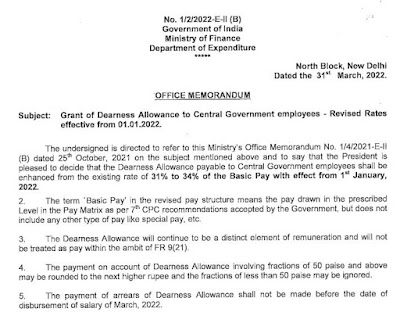
DA Jan 2022 - Grant of Dearness Allowance to Central Government employees - Revised Rates effective from 01.01.2022

 3% DA Hike - Revised Rates effective from 01.01.2022: DoE OM dated 31.03.2022 No. 1/2/2022-E-II (B) Government of India Ministry of Finance...