Thursday, 11 January 2018

Financial planning for the amounts received at retirement – Pre-Retirement Counseling

Financial planning for the amounts received at retirement – Pre-Retirement Counseling

Ministry of Personnel, Public Grievances & Pensions
MoS (Personnel) Dr. Jitendra Singh addresses Pre-Retirement Counselling Workshop “Sankalp’

Retiring employees should carry forward the Government’s flagship programmes – says Dr. Jitendra Singh

The Union Minister of State (Independent Charge) of the Ministry of Development of North Eastern Region (DoNER), MoS PMO, Personnel, Public Grievances & Pensions, Atomic Energy and Space, Dr Jitendra Singh has said that the services of superannuating and retired employees should be gainfully utilized to carry forward the flagship programmes of the Union Government led by the Prime Minister Shri Narendra Modi.

Addressing the Pre-Retirement Counseling (PRC) Workshop ‘Sankalp’ for the retiring employees of Ministries/Departments, organised by the Department of Pensions & Pensioners’ Welfare (DOP&PW) here today, Dr. Jitendra Singh said that the superannuating employees can be inducted into advisory bodies of their respective offices and also to dispose of grievances. Due to increasing life expectancy, an active life lies ahead of an employee at sixty years of age and the individual is at his prime capacity and energetic. Retirement should rather be viewed as the beginning of a new innings, he said. Such interactive workshops should come out with ideas on how best the services of retired employees can be utilized, he added.

Dr Jitendra Singh said for the first time this Government has cared for Pensioners as much as for the working employees. Minimum pension has been raised to Rs.1,000, Jeevan Pramaan biometrics introduced for submitting digital Life Certificate, more than 1,500 obsolete rules scrapped and the Anubhav platform introduced for the first time for retiring employees to share their experience.

In his address, Shri KV Eapen, Secretary, DOP&PW and Secretary, Department of Administrative Reforms & Public Grievances (DARPG), said the DOP&PW has so far registered more than 2,000 pensioners and conducted Pre-Retirement Counselling for more than 3,300 employees under the Sankalp project. The Department has registered 19 Pensioners’ Associations and 16 NGOs to involve Central Government Pensioners in social activities.

The PRC workshops target retiring personnel two to two-and-a-half years before the retirement date. Topics covered are (i) Formalities to be covered for timely payment of retirement dues (ii) Financial planning for the amounts received at retirement (iii) Preparation of Will (iv) CGHS facilities after retirement and (v) Post-retirement opportunities through Sankalp.

The “Sankalp’ programme has been initiated by the Department towards this end and a web portal of the same name has also been launched. Pensioners, Pensioner Associations and NGOs can register on the website http//www.pensionersportal.gov.in/sankalp.

There are approximately 40,000 fresh retirees every year from the Central Government Civil establishments alone. This number could be close to 1,00,000 including defense, railways, posts and telecom. In addition there is a pool of around 50 lakh existing pensioners.

FAQ on Payment of Pension to Government Pensioners (Updated 22.12.2017)

FAQ on Payment of Pension to Government Pensioners (Updated 22.12.2017)

FREQUENTLY ASKED QUESTIONS
Payment of Pension to Government Pensioners
(Updated as on December 22, 2017)

Scheme for Payment of Pension to Central Government Pensioners by Authorised Banks

Pension schemes/rules are formulated by the respective Central Government Ministries/Departments. A link to some of such schemes are available at www.rbi.org.in under Notifications> Master Circulars>Banker to Banks>Disbursement of Pension by Agency Banks. The Reserve Bank of India (the Reserve Bank) oversees disbursement of pension by its agency banks in respect of all Central Government Departments. In the process, it receives queries/complaints from pensioners in regard to fixation, calculation and payment of pension including revision of pension/Dearness Relief, transfer of pension account from one bank branch to another, etc. The Reserve Bank has analysed the queries/complaints, and put them in the form of answers to Frequently Asked Questions here. It is hoped that these will cover most of the queries/ doubts in the minds of pensioners.

1. Can the pensioner draw his/ her pension through a bank branch?

Yes. Even the Government employees earlier drawing their pension from a treasury or from a post office have the option to draw their pension from the authorized bank’s branches.

2. Who is the pension sanctioning authority?

The Ministry/ Department /Office where the Government servant last served is the pension sanctioning authority. The pension fixation is made by such authority for the first time and thereafter the refixation of pay, if any, is done by the pension paying bank based on the instructions from the concerned Central/ State Government authority.

3. Is it necessary for the pensioner to open a separate pension account for the purpose of crediting his/ her pension in authorized bank?

The pensioner is not required to open a separate pension account. The pension can be credited to his/her existing savings/ current account maintained with the branch selected by the pensioner.

4. Can a pensioner open a Joint Account with his/ her spouse?

Yes. All pensioners of the Central Government Pensioners can open Joint Account with their spouses.

5. Whether Joint Account of the pensioner with spouse can be operated either by ”Former or Survivor” or “Either or Survivor”.

Yes, the Joint Account of the pensioner with spouse can be operated either as ‘‘Former or Survivor” or “Either or Survivor”.

6. Whether a Joint Account can be continued for family pension after death of a pensioner?

Yes, the banks should not insist on opening of a new account in case of Central Government pensioner if the spouse in whose favour an authorization for family pension exists in the Pension Payment Order (PPO) is the survivor and the family pension should be credited to the existing account without opening a new account by the family pensioner for this purpose.

7. What is the minimum balance required to be maintained in the pension account maintained with the banks?

RBI has not stipulated any minimum balance to be maintained in pension accounts by the pensioners. Individual banks have framed their own rules in this regard.

8. Who sends the Pension Payment Orders (PPOs) to the authorized bank?

The concerned pension sanctioning authorities in the Ministries /Departments/ forward the PPOs to bank branches wherefrom the pensioner desires to draw his/her pension. However, on implementation of CPPCs, pension sanctioning authorities have started sending PPOs to the CPPCs of the bank instead of bank branch.

9. When is the pension credited to the pensioner’s account by the paying branch?

The disbursement of pension by the paying branch is spread over the last four working days of the month depending on the convenience of the pension paying branch except for the month of March when the pension is credited on or after the first working day of April.

10. Can a pensioner transfer his/ her pension account from one branch to another branch of the same bank or to the branch of another bank?

Pensioner can transfer his/ her pension account from one branch to another branch of the same bank and from one authorized bank to another authorized bank within the same centre or at a different centre;

11. Whether the paying branch has to maintain a detailed record of pension payments made by it in the prescribed form?

Yes. The pension paying branch/ CPPC is required to maintain a detailed record of pension payments made by it from time to time in the prescribed form duly authenticated by the authorized officer.

12. Can the pension paying bank recover the excess amount credited to the pensioner’s account?

Yes. The paying branch before commencement of pension obtains an undertaking from the pensioner in the prescribed form for this purpose and, therefore, can recover the excess payment made to the pensioner’s account due to delay in receipt of any material information or due to any bonafide error. The bank also has the right to recover the excess amount of pension credited to the deceased pensioner’s account from his/her legal heirs/nominees.

13. Is it compulsory for a pensioner to furnish a Life Certificate/Non-Employment Certificate or Employment Certificate to the bank in the month of November? If so, how can this requirement be complied with?

Yes. The pensioner is required to furnish a Life Certificate / Non – Employment Certificate or Employment Certificate to the bank in the prescribed format in the month of November every year to ensure continued receipt of pension without interruption. The pensioner can also present himself / herself at any branch of the pension paying bank for being identified for issue of life certificate. In case a pensioner is unable to obtain a Life Certificate on account of serious illness / incapacitation, bank official will visit his / her residence / hospital for the purpose of obtaining the life certificate.

There have been complaints that life certificates submitted over the counter of pension paying branches are misplaced causing delay in payment of monthly pensions. In order to alleviate the hardships faced by pensioners, agency banks were instructed to mandatorily issue duly signed acknowledgements. They were also requested to consider entering the receipt of life certificates in their CBS and issue a system generated acknowledgement which would serve the twin purpose of acknowledgement as well as real time updation of records.

A pensioner having Aadhar number can alternatively submit Jeevan Pramaan, a digital life certificate introduced by the Government of India. For obtaining this, he / she will have to enrol and biometrically authenticate himself / herself by downloading the application generating digital life certificate from the website jeevanpramaan.gov.in or other means described on the website. Once digital life certificates in the form of Jeevan Pramaan are fully implemented, pension paying branches will be able to obtain information about the digital life certificate of their pensioner customers by logging on to the website of Jeevan Pramaan and searching for the certificate or by downloading through their Core Banking Systems. Pensioners will also be able to forward to their bank branches by email/sms the relative link to their digital life certificate.

14. Who is responsible for deduction of Income Tax at source from pension payment?

The pension paying bank is responsible for deduction of Income Tax from pension amount in accordance with the rates prescribed by the Income Tax authorities from time to time. While deducting such tax from the pension amount, the paying bank will also allow deductions on account of relief to the pensioner available under the Income Tax Act. The paying branch, in April each year, will also issue to the pensioner a certificate of tax deduction as per the prescribed form. If the pensioner is not liable to pay Income Tax, he should furnish to the pension paying branch, a declaration to that effect in the prescribed form.

15. Can old, sick physically handicapped pensioner who is unable to sign, open pension account or withdraw his/ her pension from the pension account?

A pensioner, who is old, sick or lost both his/her hands and, therefore, cannot sign, can put any mark or thumb/ toe impression on the form for opening of pension account. While withdrawing the pension amount he/she can put thumb/toe impression on the cheque/withdrawal form and it should be identified by two independent witnesses known to the bank one of whom should be a bank official.

16. Can a pensioner withdraw pension from his/ her account when he/she is not able to sign or put thumb/toe impression or unable to be present in the bank?

In such cases, a pensioner can put any mark or impression on the cheque/ withdrawal form and may indicate to the bank as to who would withdraw pension amount from the bank on the basis of cheque/withdrawal form. Such a person should be identified by two independent witnesses. The person who is actually drawing the money from the bank should be asked to furnish his/her specimen signature to the bank.

17. When does the family pension commence?

The family pension commences after the death of the pensioner. The family pension is payable to the person indicated in the PPO on receipt of a death certificate and application from the nominee.

18. How the payment of Dearness Relief at revised rate is to be paid to the pensioners?

Whenever any additional relief on pension/family pension is sanctioned by the Government, the same is intimated to the agency banks for issuing suitable instructions to their pension paying branches for payment of relief at the revised rates to the pensioners without any delay. The orders issued by Government Departments are also hosted on their websites and banks have been advised to watch the latest instructions on the website and act accordingly without waiting for any further orders from RBI in this regard.

19. Can pensioners get pension slips?

Yes. As decided by the Central Government (Civil, Defence & Railways), pension paying banks have been advised to issue pension slips to the pensioners in prescribed form when the pension is paid for the first time and thereafter whenever there is a change in quantum of pension due to revision in basic pension or revision in Dearness Relief.

20. Which authority the pensioner should approach for redressal of his/ her grievances?

Branch/CPPC is the point of referral for the pensioner. Pensioners can approach the nodal officer(s) designated by the respective banks who would be holding regular meetings at different locations in their jurisdiction on lines of Pension Adalat. They can also contact the bank through toll free dedicated pension line of the respective bank to seek information related to their queries/complaints. In case of deficiency in service offered by the bank, pensioner can approach the concerned Consumer Education and Protection Cell at respective Regional Office of RBI and Banking Ombudsman under whose jurisdiction the bank branch, where the pensioner holds the account, falls.

21. Where can a pensioner get information about the changes in the pension/Dearness Relief or any pension related issue?

The pensioner can visit the Official Website of the concerned Government Department as also Reserve Bank of India Website (www.rbi.org.in) to get the information about pension related issues.

22. Whether a pensioner is entitled for any compensation from the agency banks for delayed credit of pension/ arrears of pension?

Yes. A Pensioner is entitled for compensation for delayed credit of pension/arrears thereof at the fixed rate of 8% per annum (since October 1, 2008) and the same would be credited to the pensioner’s account automatically by the bank on the same day when the bank affords delayed credit of such pension / arrears etc. without any claim from the pensioner.

These FAQs are issued by the Reserve Bank of India (The Reserve Bank) for information and general guidance purposes only which cannot be quoted in any legal proceeding and will have no legal purpose. It is not intended to be treated as legal advice or legal opinion. The Reserve Bank will not be held responsible for actions taken and/or decisions made on the basis of the same. For clarifications or interpretations, if any, readers are requested to be guided by the relevant circulars and notifications issued from time to time by the Reserve Bank and the Government.

Authority: www.rbi.org

Form No. 16 for Pensioners : Issue Certificate of Tax Deducted in Form 16 to the Pensioners

Form No. 16 for Pensioners : Issue Certificate of Tax Deducted in Form 16 to the Pensioners

Clarifications regarding use of Form No. 16 for pensioners where pensioners are drawing their pensions through banks – CBDT Circular No.761, dated 13.1.1998

1184. Clarifications regarding use of Form No. 16 for pensioners where pensioners are drawing their pensions through banks

1. The attention of the Board has been drawn to certain difficulties being faced by pensioners drawing their pensions through banks where the tax deduction at source certificate in the prescribed Form No. 16 is
some-time denied to them on the ground that no employee-employer relationship exists between the banks and the pensioner. At times, objections have also been raised by the banks on the premise that Form No. 16 relates to deductions from salaries and not from pensions. In other cases, the certificates have been denied on the ground that the bank was not aware of any other income which the pensioner may have had.

2. The matter has been considered by the Board. It is hereby clarified that :—

(a) as per section 17(1)(ii) of the Income-tax Act, 1961, the term ‘salary’ includes pension;

(b) once tax has been deducted under section 192 of the Income-tax Act, 1961, the tax-deductor is bound by section 203 to issue the certificate of tax deducted in Form 16. No employee-employer relationship is necessary for this purpose;

(c) the certificate in Form No. 16 cannot be denied on the ground that the tax deductor is unaware of the payees’ other income.

3. These clarifications may be brought to the notice of all concerned, especially the banks in your region.

Circular : No. 761, dated 13-1-1998

Abolishing of uploading of scanned copy of PAN Card at the time of registration of establishment

Abolishing of uploading of scanned copy of PAN Card at the time of registration of establishment

No.CAIU/011(2)2018/PAN Card
Date: 08.01.2018
To

All Additional Central P.F. Commissioner (Zones),
All Regional P.F. Commissioner In-charge of ROs.

Sub:- Abolishing of uploading of scanned copy of PAN Card at the time of registration of establishment - regarding.

Madam/Sir,

At the time of registration of an establishment, employer has to upload digitally signed copy of PAN card. There is a mandate of Ease of Doing business to eliminate the requirement of submitting scanned copy of PAN card at the time of registration.

2. In this regard, it is informed that the requirement of uploading the scanned copy of PAN card at the time of registration of establishment has been examined and online system has been put in place for verifying details of PAN directly from the Income Tax Department. Hence, it has been decided by the competent authority that there is no need to upload the scanned copy of PAN card at the time of registration of establishments. Information Services Division has already carried out necessary modifications in the software accordingly.

3. The field offices are, therefore, advised not to insist on the copy of PAN card at the time of registration of a new establishment.

Yours faithfully,
S/d,
(S.C. Goyal)
Addl. Central P.F. Commissioner-II (CAIU)

AIBEA & AIBOA : Joint Massive Signature Campaign

AIBEA & AIBOA : Joint Massive Signature Campaign

SAVE BANKING INDUSTRY - JOINT SIGNATURE CAMPAIGN - TARGET ONE CRORE
ALL INDIA BANK OFFICERS’ ASSOCIATION

Circular No.1/VII/2018
January 8, 2018
To:
ALL UNITS / STATE COMMITTEES

Comrades,

SAVE BANKING INDUSTRY
JOINT SIGNATURE CAMPAIGN
TARGET - ONE CRORE

The present Government at the centre with the focussed approach is targeting the "main nerve centre" of economic activity of our Nation [ie] our Industry, to carry out their plan of actions. Some of them are - broadly;

1. INFUSION OF CAPITAL TO BANKS: The Government conceded our demand but they are attached the conditions of reforms [ie] consolidation through mergers etc.

2. RECOVER THE BAD LOANS THROUGH STRINGENT MEASURES: In order to silence the strong voice of the people at large, an amendment to Banking Regulation Act - "Insolvency and Bankruptcy code" was brought in. 12 top accounts amounting more than Rs.2,52,000 crores is pending before National Company Law Tribunal[NCLT] for adjudication.

Through the NCLT total money will not come back to the Banks but accommodation of the big defaulters would certainly take place.

3. ACCOMMODATION OF THE BAD LOAND DEFAULTERS AND PENALISE THE COMMON MAN / DEPOSITORS: The earning to a financial Institution is mainly through lending operations. When the bad loans are increasing, earnings are declining.
To cover the future loss, the exercise of provisioning is taking place. Small depositors are to be paid increased rate of interest, to encourage the savings. But the present position is not favourable to small investors. In the name of non-maintaining the minimum balance in the accounts, depositors are penalised by levying charges and the income earned through this method is more than the real banking transactions.

4. BRANCH EXPANSION IS THE NEED OF HOUR NOT BRANCH CLOSURE: We have proved that the favourite issue of "financial inclusion" has been brilliantly implemented by Bankmen across the country thereby nearly 21 crores of accounts have been added with a total deposit of over Rs.70000 crores. We need branch expansion to cater the requirements of the common people of this country. At this point of time, Government is seriously pursuing the issue of mergers of Banks. 5 Associate Banks mergers with SBI had already led to closure of 1000 branches . Further 200 to 300 branches, SBI is planning to close down.

5. WITHDRAW FRDI BILL: Untimely introduction of the bill by the present Government has kick started the flight of Bank deposits to mutual fund. Leading Bank- SBI- has released an advertisement in social media instigating the small investors to invest in mutual funds instead of savings, through Bank accounts. The "bail in" clause has created sufficient fear and loss of confidence in Public Sector Banks.

Comrades, our Joint signature campaign has to be actively pursued and hit the target of getting the common people involved in the noble tasks of "Saving the Banking Industry" thereby "saving the Nation".

Plunge into vigorous campaign as the time at our disposal is too short and also precious.

Yours comradely,
sd/-
/S.NAGARAJAN/
GENERAL SECRETARY
Source: http://www.aiboa.org/

Wednesday, 10 January 2018

Regulation of Pay on imposition of a penalty under CCS (CCA) Rules, 1965 – Dopt

Regulation of Pay on imposition of a penalty under CCS (CCA) Rules, 1965 – Dopt

No.11012/15/2016-Estt.A-III
Government of India
Ministry of Personnel, Public Grievances and Pensions
Department of Personnel & Training
Establishment A-III Desk

North Block, New Delhi
Dated the January 10, 2018

OFFICE MEMORANDUM

Subject: Regulation of Pay on imposition of a penalty under CCS (CCA) Rules, 1965 – Comments regarding.

The Department intends to issue instructions on the above mentioned subject. Before the instructions in the Draft O.M. (Copy enclosed) are finalized, all stakeholders, Ministires/Departments are requested to offer their comments/views, if any, in this regard latest by 25th January, 2018 at the email address nitin.gupta@nic.in.

sd/-
(Nitin Gupta)
Under Secretary to the Government of India

Budget 2018 – Will income tax limit raise to Rs 3 or 5 lakh?

Budget 2018 – Will income tax limit raise to Rs 3 or 5 lakh?

“The tax slab is expected to be raised in favour of government employees”

According to information available, the annual budget, to be presented by Finance Minister Arun Jaitley on February 1, could have some sops for the middle-class families.

Post the Seventh Pay Commission, most government servants now find themselves within the tax slab. For a number of years now, government servants have been demanding that the tax-exemption slab be raised to Rs. 5 lakhs. The current exemption stands at Rs. 2.5 lakhs. There is a five percent tax on the income in the Rs. 2.5 lakhs to 5 lakhs bracket.

There are prevalent talks that the government could revise the slabs. This could come as a big boon for middle income groups, especially the salaried class who are suffering due to acute inflation. No changes were made in the tax slab last year, but the tax of 10 percent on the Rs. 2.5 lakhs to 5 lakhs slab was brought down to five percent.

The budget, to be presented next month, is expected to reduce the tax on the Rs. 5 lakhs to Rs. 10 lakhs slab to 10 percent (it currently stands at 20 percent). This could spell huge relief to the salaried class.

Similarly, the tax on the Rs. 10 lakhs to Rs. 20 lakhs slab could be reduced to 20 percent (currently stands at 30 percent). A tax of 30 percent is collected on the amount exceeding Rs. 20 lakhs. Tax rate on this slab is the lowest in India when compared to most other countries.

There is currently no exclusive tax slab for those earning between Rs. 10 lakhs and 20 lakhs, and those earning more than Rs. 10 lakhs automatically end up paying 30 percent in taxes.

The income tax department could raise the tax slab in order to provide relief to the salaried class that continues to suffer from the rise in prices of essential commodities due to inflation.

There are, however, some unconfirmed reports that claim that the tax slab is not likely to be raised to Rs. 5 lakhs.

Turnover of Canteen Store Department (CSD)

Turnover of Canteen Store Department (CSD)

Details of turnover made by the Army’s Canteen Store Department (CSD) canteen during the last three years

Turnover of CSD

Turnover of Canteen Stores Department (CSD) for the past 3 years is as under:

Year
Turnover in Crores
2014-15
Rs.13709.32
2015-16
Rs.15781.73
2016-17
Rs.17156.26

No restriction has been put on entitlement of the beneficiary. However, instructions have been issued to Unit Run Canteens (URCs) for local restrictions on bulk purchases to prevent pilferage.

Cabinet approves Cadre review of Group 'A' Executive Cadre of Central Industrial Security Force

Cabinet approves Cadre review of Group 'A' Executive Cadre of Central Industrial Security Force

The Union Cabinet chaired by Prime Minister Shri Narendra Modi has approved the Cadre review of Group 'A' Executive Cadre of Central Industrial Security Force (CISF).  It provides for creation of 25 posts of various ranks from Assistant Commandant to Additional Director General ranks to enhance the supervisory staff in Senior Duty posts of CISF.

The restructuring of the CISF Cadre will result in increase of Group 'A' posts from 1252 to 1277 with increase of 2 posts of Additional Director General, 7 posts of Inspector General, 8 posts of Deputy Inspector General and 8 posts of Commandant.

Impact:

After creation of these Group 'A' posts in CISF, the supervisory efficiency and capacity building of the Force would be enhanced. Timely creation of proposed posts in the Cadre Review of Group 'A' posts in the Force will enhance its supervisory as well as administrative capabilities.

Background:

The CISF came into existence through the CISF Act 1968 amended in 1983 declaring the Force as Armed Force of the Union. The original charter of CISF was to provide protection and security to the property of Public Sector Undertakings. The Act was further amended in 1989, 1999 and 2009 to enlarge the charter of duties and security cover to Private Sector Units and other duties that may be entrusted by the Central Government.

The CISF came into existence in 1969 with a sanctioned strength of only three Battalions. The CISF does not have a Battalion pattern like other CAPFs, except 12 Reserve Battalions and HQRs. Currently, the Force is providing security cover to 336 Industrial Undertaking (including 59 Airports) spread all over the country.  The Force, which had made a beginning with a sanctioned strength of 3192 in 1969, has grown to a strength of 1,49,088 as on 30.06.2017. The CISF has its Headquarters at Delhi. The Organization is headed by the DG which is an Ex-cadre post.

Cabinet approves amendments in FDI policy

FDI policy further liberalized in key sectors

Cabinet approves amendments in FDI policy


100% FDI under automatic route for Single Brand Retail Trading

    100% FDI under automatic route in Construction Development
    Foreign airlines allowed to invest up to 49% under approval route in Air India
    FIIs/FPIs allowed to invest in Power Exchanges through primary market
    Definition of ‘medical devices’ amended in the FDI Policy


The Union Cabinet chaired by the Prime Minister Shri Narendra Modi, has given its approval to a number of amendments in the FDI Policy. These are intended to liberalise and simplify the FDI policy so as to provide ease of doing business in the country. In turn, it will lead to larger FDI inflows contributing to growth of investment, income and employment.

Foreign Direct Investment (FDI) is a major driver of economic growth and a source of non-debt finance for the economic development of the country. Government has put in place an investor friendly policy on FDI, under which FDI up to 100%, is permitted on the automatic route in most sectors/ activities. In the recent past, the Government has brought FDI policy reforms in a number of sectors viz. Defence, Construction Development, Insurance, Pension, Other Financial Services, Asset reconstruction Companies, Broadcasting, Civil Aviation, Pharmaceuticals, Trading etc.

Measures undertaken by the Government have resulted in increased FDI inflows in to the country. During the year 2014-15, total FDI inflows received were US $ 45.15 billion as against US $ 36.05 billion in 2013-14. During 2015-16, country received total FDI of US $ 55.46 billion. In the financial year 2016-17, total FDI of US $ 60.08 billion has been received, which is an all-time high.

It has been felt that the country has potential to attract far more foreign investment which can be achieved by further liberalizing and simplifying the FDI regime. Accordingly, the Government has decided to introduce a number of amendments in the FDI Policy.

Details:

Government approval no longer required for FDI in Single Brand Retail Trading (SBRT)

    Extant FDI policy on SBRT allows 49% FDI under automatic route, and FDI beyond 49% and up to 100% through Government approval route. It has now been decided to permit 100% FDI under automatic route for SBRT.

    It has been decided to permit single brand retail trading entity to set off its incremental sourcing of goods from India for global operations during initial 5 years, beginning 1st April of the year of the opening of first store against the mandatory sourcing requirement of 30% of purchases from India. For this purpose, incremental sourcing will mean the increase in terms of value of such global sourcing from India for that single brand (in INR terms) in a particular financial year over the preceding financial year, by the non-resident entities undertaking single brand retail trading entity, either directly or through their group companies. After completion of this 5 year period, the SBRT entity shall be required to meet the 30% sourcing norms directly towards its India’s operation, on an annual basis.

    A non-resident entity or entities, whether owner of the brand or otherwise, is permitted to undertake ‘single brand’ product retail trading in the country for the specific brand, either directly by the brand owner or through a legally tenable agreement executed between the Indian entity undertaking single brand retail trading and the brand owner.

Civil Aviation

As per the extant policy, foreign airlines are allowed to invest under Government approval route in the capital of Indian companies operating scheduled and non-scheduled air transport services, up to the limit of 49% of their paid-up capital. However, this provision was presently not applicable to Air India, thereby implying that foreign airlines could not invest in Air India. It has now been decided to do away with this restriction and allow foreign airlines to invest up to 49% under approval route in Air India subject to the conditions that:

    Foreign investment(s) in Air India including that of foreign Airline(s) shall not exceed 49% either directly or indirectly

    Substantial ownership and effective control of Air India shall continue to be vested in Indian National.

Construction Development: Townships, Housing, Built-up Infrastructure and Real Estate Broking Services

It has been decided to clarify that real-estate broking service does not amount to real estate business and is therefore, eligible for 100% FDI under automatic route.

Power Exchanges

Extant policy provides for 49% FDI under automatic route in Power Exchanges registered under the Central Electricity Regulatory Commission (Power Market) Regulations, 2010. However, FII/FPI purchases were restricted to secondary market only. It has now been decided to do away with this provision, thereby allowing FIIs/FPIs to invest in Power Exchanges through primary market as well.

Other Approval Requirements under FDI Policy:

    As per the extant FDI policy, issue of equity shares against non-cash considerations like pre-incorporation expenses, import of machinery etc. is permitted under Government approval route. It has now been decided that issue of shares against non-cash considerations like pre-incorporation expenses, import of machinery etc. shall be permitted under automatic route in case of sectors under automatic route.

    Foreign investment into an Indian company, engaged only in the activity of investing in the capital of other Indian company/ies/ LLP and in the Core Investing Companies is presently allowed upto 100% with prior Government approval. It has now been decided to align FDI policy on these sectors with FDI policy provisions on Other Financial Services. Thus, if the above activities are regulated by any financial sector regulator, then foreign investment upto 100% under automatic route shall be allowed; and, if they are not regulated by any Financial Sector Regulator or where only part is regulated or where there is doubt regarding the regulatory oversight, foreign investment up to 100% will be allowed under Government approval route, subject to conditions including minimum capitalization requirement, as may be decided by the Government.

Competent Authority for examining FDI proposals from countries of concern

As per the existing procedures, FDI applications involving investments from Countries of Concern, requiring security clearance as per the extant FEMA 20, FDI Policy and security guidelines, amended from time to time, are to be processed by the Ministry of Home Affairs (MHA) for investments falling under automatic route sectors/activities, while cases pertaining to government approval route sectors/activities requiring security clearance are to be processed by the respective Administrative Ministries/Departments, as the case may be. It has now been decided that for investments in automatic route sectors, requiring approval only on the matter of investment being from country of concern, FDI applications would be processed by Department of Industrial Policy & Promotion (DIPP) for Government approval. Cases under the government approval route, also requiring security clearance with respect to countries of concern, will continue to be processed by concerned Administrative Department/Ministry.

Pharmaceuticals:

FDI policy on Pharmaceuticals sector inter-alia provides that definition of medical device as contained in the FDI Policy would be subject to amendment in the Drugs and Cosmetics Act. As the definition as contained in the policy is complete in itself, it has been decided to drop the reference to Drugs and Cosmetics Act from FDI policy. Further, it has also been decided to amend the definition of ‘medical devices’ as contained in the FDI Policy.

Prohibition of restrictive conditions regarding audit firms:

The extant FDI policy does not have any provisions in respect of specification of auditors that can be appointed by the Indian investee companies receiving foreign investments. It has been decided to provide in the FDI policy that wherever the foreign investor wishes to specify a particular auditor/audit firm having international network for the Indian investee company, then audit of such investee companies should be carried out as joint audit wherein one of the auditors should not be part of the same network.

Flash News

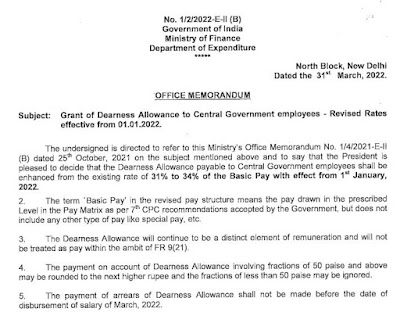
DA Jan 2022 - Grant of Dearness Allowance to Central Government employees - Revised Rates effective from 01.01.2022

 3% DA Hike - Revised Rates effective from 01.01.2022: DoE OM dated 31.03.2022 No. 1/2/2022-E-II (B) Government of India Ministry of Finance...