Wednesday, 25 October 2017

General Provident Fund (GPF) and other similar funds shall carry interest at the rate of 7.8% w.e.f. 1st October, 2017 to 31st December, 2017

GPF-INTEREST-RATE

General Provident Fund (GPF) and other similar funds shall carry interest at the rate of 7.8% w.e.f. 1st October, 2017 to 31st December, 2017.

The Government of India has announced that during the Financial Year 2017-18, accumulations at the credit of subscribers to the General Provident Fund (GPF) and other similar funds shall carry interest at the rate of 7.8% (Seven point eight per cent) with effect from 1st October, 2017 to 31st December, 2017. This rate will be in force w.e.f. 1st October, 2017.

The Notification to this effect has been issued and published in the Gazette of India on 23rd October, 2017.

PIB

DoT further simplifies the process for linking of Aadhaar with mobile number


DoT further simplifies the process for linking of Aadhaar with mobile number
- Introduces new OTP based option for consumer ease with two other convenient options
- Industry welcomes the move and pledges support to the government
In a bid to expedite compliance of telecom service providers with the Hon. Supreme Court's order dated 6th February regarding linking of Aadhaar card with mobile number and reverification process of mobile users, the Department of Telecommunications (DoT) issued a comprehensive instruction on Wednesday.

As per the new rules, the DoT has introduced three new methods to link the registered mobile number with Aadhaar i.e. OTP (One Time Password) based, App based and the IVRS facility. These new methods will help subscribers to get their mobile number linked to Aadhaar without visiting the stores of the telcos. For the ease of senior citizens and the people with disability and chronic illness, DoT has also recommended for the re-verification at subscribers' doorstep. According to the new guidelines, the telecom operators should provide an online mechanism for people to request such service and based on availability schedule the visit and complete the process.

Speaking on the development, Shri Manoj Sinha, Minister of State (Independent Charge), Ministry of Communications, said "The Aadhaar number system was designed to allow all residents of the country access to critical government services and important information that they may need from time to time. Mobile penetration is increasing rapidly in the country and the subscribers need to be provided with the ease of linking of the Aadhaar number with the mobile number. It is the government's endeavour to improve convenience and reduce time and energy spent by consumers to accessing government information and services that is their right to access."

Representative of COAI stated, "The latest clarifications from the DoT are aligned with what the industry, and the subscribers need at this time. While, it will take a little time to implement the directions, we are working closely with the government to improve and enhance the convenience of our consumers for undertaking Aadhaar based e-KYC linking of their mobile number. We are implementing all the necessary processes so as to be able to use the additional methods prescribed including OTP, App based and the IVRS facility. We expect it to get much faster and easier for individual mobile subscribers to comply with the e-KYC norms using their Aadhaar Registered Mobile Number (ARMN)."

In a circular in August, DoT had given instructions to the telecom service providers to provide iris or fingerprint based authentication of Aadhaar. The new regulations have specified that the telecom service providers must deploy iris readers for this purpose within a reasonable geographical area.
Further, in keeping with privacy rules, the DoT has mandated that telecom service providers' agent should not have access to the subscribers' e-KYC data and only the name and address of the subscribers should be visible. Subscribers can verify or re-verify their mobile numbers from anywhere in the country irrespective of which service area their mobile connection belongs to.

PIB

Brief of the meeting held today with the Cabinet Secretary (Government of India)

 BRIEF OF THE MEETING HELD TODAY WITH THE CABINET SECRETARY (GOVERNMENT OF INDIA)

Shiva Gopal Mishra
Secretary

National council (staff Side)
Joint Consulative Machinery for
Central Government Employees
13-C, Ferozshah Road, New Delhi-110001
E-Mail : nc.jcm.np@gmail.com


No.NC/JCM/2017

Dated: October 24, 2017
All Constituents of National Council(JCM)

Sub: Brief of the meeting held today with the Cabinet Secretary (Government of India)

Today I met the Cabinet Secretary(Government of India) and shown oru anguish for inordinate delay in finalzation of demands of the Central Government Employees, particularly National Pension System (NPS), Minimum Wage and Fitment Formula.

The Cabinet Secretary said that, he is aware of the problems of the Staff Side(JCM) raised by them from time to time and particularly to this issue and will definitely try to resolve them

Particularly on the issue of National Pension System(NPS) he said that the issue active consideration of the Government of India and we are trying to find out some solution to the problems arisen because of the NPS.

I also persuaded him to fix-up date of the meeting of the National Council(JCM), to which he said that, the agenda came, and some queries have been raised, which are still to be compiled by the DoP&T. He assured that, he will definitely fix-up the date of the meeting within a short period, and said that, before that, he will ask the Secretary(DoP&T) to hold meeting with the Staff Side.

I told to the Cabinet Secretary that, Central Government Employees are agitated because they feel that VII CPC has not done and justice with them and government is also ready to remove the issues pending before them.

This is for your information.

with Faternal Greetings!

Comradely yours,
sd/-
(Shiva Gopal Mishra)
Secretary(Staff Side)
Source: Confederation

House Rent Allowance (HRA) : Report of the Committee on Allowances

House Rent Allowance (HRA) : Report of the Committee on Allowances

House Rent Allowance (HRA) (Para 8.7.3-16)

Existing Provisions: HRA is paid @30, 20 and 10 percent for X class (50 Lakh & above), Y class (5 to 50 lakh) and Z class (below 5 lakh) cities respectively.

At present, in the case of those drawing either NPA or MSP or both, HRA is being paid as a percentage of BP+NPA or BP+MSP or BP+NPA+MSP respectively.

Recommendations of 7th CPC: It has been retained and rationalized. After applying a multiplication factor of 0.8, the rates have been revised downwards to 24 percent, 16 percent and 8 percent of the Basic Pay for X, Y and Z class cities, respectively.

The rate of HRA will be revised to 27 percent, 18 percent and 9 percent when DA crosses 50 percent, and further revised to 30 percent, 20 percent and 10 percent when DA crosses 100 percent. Add-ons like NPA, MSP, etc. should not be included while working out HRA.

Demands:
I. National Council (Staff Side), JCM: HRA may be retained @30%, 20% and 10% for X, Y and Z cities respectively as the Commission has taken unreliable statistics to determine HRA, which has been reduced by a multiplication factor of 0.8 to 24%, 16% and 8% for X, Y and Z cities respectively.

II. CAG, Civil Aviation, M/o Health & FW, M/o HRD - D/o of Higher Education, MEA, Coal, DAE, DRDO, Dep. Of Space, CVC: Retain the allowance at the existing rates.

III. M/o of Law & Justice- D/o Justice: Cities having population of more than 1 crore may be granted HRA @ 30%.

Analysis and Recommendations of the Committee: The Committee has the following observations on the recommendations of the 7th CPC on HRA:
(I) HRA rates have been revised downwards by applying the multiplication factor of 0.8 applied by the 7th CPC on all percentage- based allowances. This was done to neutralise the significant increase in the Basic Pay. All fixed allowances have only been given an inflation indexed increase by the 7th CPC. While the 7th CPC has not explicitly stated how the multiplication factor of 0.8 has been arrived at anywhere in the Report, it may be seen that factoring in the expected Dearness Allowance of 125% on 01.01. 2016 would have yielded a multiplication factor of 0.875 which may have been rounded off to 0.8.

(II) On the 7th CPC recommendation that the rate of HRA will be revised to 27%, 18% and 9% when DA crosses 50 percent and further revised to 30%, 20% & 10% when DA crosses 100%, the Committee is of the view that given the inflation rates since January 2016 and the RBI policy on inflation, the DA rates might not go beyond 50% in the next 10 years.

(III) While the rents for residential accommodation have not gone up significantly in the recent past and might also have fallen in some areas, the HRA at the rates recommended by the 7th CPC at the lower levels might not continue to be adequate as per the prevailing market rent.

In view of these observations, the Committee has deliberated upon the following three options which separately, or in combination, can be suggested by way of modifications to the 7th CPC recommendations:

Option (i): Having regard to submissions made before it stating that towards the later part of the ten year period, HRA compensation falls considerably short of requirement, the 7th CPC has recommended that the rate of HRA will be revised to 27 percent, 18 percent and 9 percent when DA crosses 50 percent, and further revised to 30 percent, 20 percent and 10 percent when DA crosses 100 percent. However, considering the present inflation rate, the rate of increase of the Dearness Allowance and future inflation projections, it appears unlikely that DA rates will reach 100 % in the ten year period. Taking this into consideration, the Committee considered that the timing of the upward revisions in HRA rates proposed by the 7th CPC may be advanced as under:

report-on-allowances-hra


This would have no immediate financial implication and the 1st revision, as per the current trend of increase in DA, is expected to occur in July, 2018. Accordingly, additional annual financial implication in July, 2018 will be approximately Rs.1850 crore. The additional financial implication in the second, third and fourth revision will also be
approximately Rs.1850 crore per annum.

Option (ii): Instead of advancing the full restoration of HRA rates, the Committee considered splitting the revisions proposed by 7th CPC as under:

7th-CPC-report-on-allowances-hra


The financial implication would be similar as in Option (i) except that the timing of the revision would undergo a change.

Option (iii): It has been pointed out that at the recommended rates, HRA at the minimum level might not be sufficient. The minimum HRA calculated at the entry level of Level 1for X, Y and Z category cities at the rates recommended by the 7th CPC will be Rs.4320, Rs.2880 and Rs.1440 respectively. The Committee considered recommending that the HRA at the rates recommended by the 7th CPC may be subject to a floor which may be fixed at Rs.5400, Rs.3600 and Rs.1800 per month, calculated at 30%, 20% and 10% of the minimum pay for X, Y and Z category cities respectively. This will benefit employees in Levels 1, 2 and 3.

The additional financial implication is estimated to be Rs. 385.00 crore and around 7.70 lakh employees shall be benefited. After a detailed consideration of the above options, the Committee recommended that either only option (iii) or option (iii) in combination with option 
(ii) be accepted. A final decision in this regard may be taken by E-CoS.

Authority: www.doe.gov.in

Click to view the Report

Transport Allowance (TPTA) : Report of the Committee on Allowances


Transport Allowance (TPTA) : Report of the Committee on Allowances

Transport Allowance (TPTA) (Para 8.15.53)

Existing Provisions: Granted to cover the expenditure involved in commuting between place of residence and place of duty. The existing rates are as under:


Officers drawing GP 10000 and higher, who are entitled to the use of official car, have the option to avail of the existing facility or to draw TPTA @ Rs.7000 + DA.

Differently abled employees are granted TPTA at double rates subject to a minimum of Rs.1000+DA.

Recommendations of 7th CPC: Transport Allowance is already fully DA indexed. Therefore, following rates of Transport Allowance are recommended:

Officers in Pay Level 14 and higher, who are entitled to the use of official car, will have the option to avail themselves of the existing facility or to draw the TPTA at the rate of Rs.15,750+DA pm.
Differently abled employees will continue to be paid at double rate, subject to a minimum of Rs.2,250 plus DA.

Demands:
I. National Council (Staff Side), JCM:

i. There should be only two levels for Transport Allowance, as under:
Level 9 and above
Rs.7500+DA (Higher TPTA Cities)
Rs.3750 + DA (Other Places
Below Level 9
Rs.3750+DA (Higher TPTA Cities)
Rs.1875 + DA (Other Places)

ii. Income Tax exemption, which was available for Transport Allowance, may be reintroduced.

II. Ministry of Health and Family Welfare: SAG Doctors should be paid Transport Allowance at the rates admissible to Joint Secretary in lieu of Staff Car.

Analysis and Recommendations of the Committee: The Committee notes that the Transport Allowance is fully indexed to Dearness Allowance and the rates have accordingly been revised by the 7th CPC. As the demands do not relate to any changes recommended by the 7th CPC, the recommendations of the 7th CPC on Transport Allowance may be accepted without any change.

When this allowance was introduced by 5th CPC, the entire amount was exempted from Income Tax. However, the Committee is not making any recommendations relating to raising of Income Tax ceiling on Transport Allowance as it is not within the purview of the Committee. The matter may be taken up separately with Department of Revenue.

Authority: www.doe.gov.in
Click to view the Report

Tuesday, 24 October 2017

7th CPC: Report of the Committee on Allowances


Report of the Committee on Allowances
April, 2017

Preface

Government of India, vide OM No.11-1/2016-IC dated 23rd July 2016 constituted a Committee under the Chairmanship of Finance Secretary & Secretary (Expenditure) and Secretaries of Home Affairs, Defence, Health & Family Welfare, Personnel & Training, Posts and Chariman, Railway Board as Members to examine the recommendations of the 7th CPC on Allowances.

The Committee acknowledges the assistance provided by Shri R.K.Chaturvedi Joint Secretary (IC) and his team, Shri P.K.Das, Additional Secretary (Expenditure) who headed the Group of Officers and the members of his group, the representatives of Departments / Ministries, Services and Staff Associations in finalizing the Report.

The Committee, after due deliberations, submits its report on 27th April, 2017.

sd/-
(Ashok Lavasa)
Chairman
sd/-
(Rajiv Mehrishi)
Member
sd/-
(G.Mohan Kumar)
Member
sd/-
(C K Mishra)
Member
sd/-
(B P Sharma)
Member
sd/-
(B V Sudhakar)
Member
sd/-
(A K Mittal)
Member
sd/-
(R K Chaturvedi)
Member Secretary

New Delhi
Date: 27th April 2017
Report of the Committee on 7th CPC Allowances

Authority: www.doe.gov.in
Click to view the Report

Revision of rates of Special Allowance payable to Parliament Assistants


Revision of rates of Special Allowance payable to Parliament Assistants

No. A-27023/02/2017-Estt (AL)
Government of India
Ministry of Personnel, PG & Pensions
Department of Personnel & Training
Block No. IV, Old INU Campus
New Delhi, Dated 2110.2017
OFFICE MEMORANDUM

Sub: Revision of rates of Special Allowance payable to Parliament Assistants.

The undersigned is directed to say that consequent upon the decision taken by the Government on the recommendations made by the 7th Central Pay Commission, the President is pleased to enhance the rates of Special Allowance payable to those wholly engaged in Parliament work during Parliament session by 50% from the existing levels of Rs. 1500/- and Rs. 1200/- payable to Assistants and UDCs respectively to the level of Rs. 2250/- and Rs. 1800/-.

2. The above limits would be automatically raised by 25% every time the Dearness Allowance on the revised pay structure goes up by 50%. No separate instructions on this count would be required.

3. The allowance will be admissible at full rates for every calendar month in which the Parliament is in Session for at least 15 days in that month. For month with shorter periods, the allowance will be admissible at half the rates prescribed for the full month.

4. The allowance will be admissible during the period of regular leave.

5. Normally, the allowance will be admissible to only .one Parliament Assistant in a Ministry. Where a Ministry considers it necessary to engage more than one Parliament Assistant on full time Parliamentary duty, the prior approval of this Department will be necessary. Such additional staff will also be entitled to the Special Allowance mentioned above according to the status he/she enjoys. Where this Ministry has agreed in the past to the engagement of more than one Parliament Assistant for Parliamentary work in any Ministry, this Ministry's approval need not be obtained afresh.

6. No Overtime Allowance shall be paid to Parliament Assistants for the calendar months in which the Parliament is in Session.

7. The Special allowance referred to above will be classified as "Other Allowances"

8. These orders shall take effect from 01.07.2017.
(Navneet Misra)
Under Secretary to the Government of India

All Ministries/Departments as per standard list.
Copy to:
NIC for uploading on the Website.

Source: DoPT

7th Pay Commission - Revision of rate of Training Allowance


7th Pay Commission - Revision of rate of Training Allowance

No. I3024/0 I/20 16-Trg. Ref.
Government of India
Ministry of Personnel, Public Grievances & Pensions
Department of Personnel and Training
[Training Division (ISTIUPA)]
Block-4, Old JNU Campus
New Mehrauli Road, New Delhi-67
Dated: October 24th 2017
OFFICE MEMORANDUM

Subject: Implementation of Government's decision on the recommendations of the Seventh Pay Commission - Revision of rate of Training Allowance.

Consequent upon the acceptance of the recommendations of the Seventh Central Pay Commission (CPC) by the Government conveyed vide Ministry of Finance, Department of Expenditure Resolution No. 11-112016-IC dated July 6, 2017, the President is pleased to decide that the Training Allowance In Training Academies and Institutes shall be regulated in the following manner:
(i) Training allowance
In the National/Central Training Academies and Institutes for Group 'A' officers24% of Basic Pay
In other Training Establishments12% of Basic Pay

(ii) Training Allowance will be admissible only to the employees who join the training establishments for a specified period oftime and are then likely to go back.

(iii) Training Allowance will not be admissible to those employees who are directly recruited by such training establishments for imparting training.
2. The revised rates of training allowance shall be admissible with effect from the 1st July, 2017.

3. In so far as the employees working in the Indian Audit and Accounts Department are concerned, these orders are issued with the concurrence of the Comptroller and Auditor General.

4. Hindi version will follow.
(Biswajit Banerjee)
Under Secretary to the Government of India
Source: DoPT

7th Central Pay Commission: Ceilings in respect of Office Expenditure on hospitality


7th Central Pay Commission: Ceilings in respect of Office Expenditure on hospitality

F.No. 13024/01/2016-Trg. Ref.
Ministry of Personnel, Public Grievances and Pensions
Department of Personnel and Training
Training Division
Block-4, Old JNU Campus
New Mehrauli Road, New Delhi-67
Dated: October 24 2017
OFFICE MEMORANDUM

Subject: Ceilings in respect of Office Expenditure on hospitality - reg

Consequent upon acceptance of the recommendations of the 7th Central Pay Commission (CPC) by the Government, Sumptuary allowance and Entertainment allowance have been abolished with effect from 30.06.2017. As per Resolution of the Government dated 06.07.2017, such expenditure on hospitality should be treated as office expenditure and the Ministry of Finance was to lay down the ceilings for various levels. Ministry of Finance, Department of Expenditure vide their OM No. 11-1I2016/E.Il B (ih CPC)Pt.III(C) dated 22nd September, 2017 has conveyed the ceiling of office expenditure on hospitality.

(Biswajit Banerjee)
Under Secretary to the Government of India
To
1. All Ministries/Departments of Government of lndia (as per DoPT's standard list and a request that this OM be given wide publicity).
2. All CTIs/ATls
3. Director, LBSNAA, Mussoorie.
4. Director, ISTM, Old JNU Campus, New Delhi.


No.11-1/2016/E.1I 8(7th CPC)/PUII(C)
GOVERNMENT OF INDIA
MINISTRY OF FINANCE
Department of Expenditure
(7th CPC matters)
North Block, New Delhi
Dated: 22.09.2017
OFFICE MEMORANDUM

Subject: Ceilings in respect of Office Expenditure on hospitality- regarding

Consequent upon acceptance of the recommendations of the 7th Central Pay Commission (CPC) by the Government, Sumptuary Allowance and Entertainment Allowance have been abolished with effect from 30.06.2017, As per Resolution of the Government dated 06.07.2017, such expenditure on hospitality should be treated as office expenditure and the Ministry of Financewas to lay down the ceilings for various levels. Accordingly, the hospitality related expenditure is now to be incurred as office expenditure.

The President is pleased to decide the ceilings of office expenditure on hospitality as under:

7thCPC-Ceilings-Office-Expenditure-hospitality


2. The expenditure on hospitality with ceilings mentioned above shall be booked as 'Office Expenditure'

3. The prescribed ceilings will be effective from the date of issue of this OM.
(Annie George Mathew)
Joint Secretary to the Govt. of India
Source: DoPT

Monday, 23 October 2017

GRAMIN DAK SEVAK ISSUE IN LOK SABHA - 22-03-2017


GRAMIN DAK SEVAK ISSUE IN LOK SABHA - 22-03-2017

GOVERNMENT OF INDIA
MINISTRY OF COMMUNICATIONS
DEPARTMENT OF POSTS
LOK SABHA
UNSTARRED QUESTION NO.3450
TO BE ANSWERED ON 22ND MARCH, 2017
GRAMEEN DAK SEVAKS
3450. SHRI RAHUL KASWAN:
SHRI RAMESH BIDHURI:
SHRI BALABHADRA MAJHI:
SHRI TAMRADHWAJ SAHU:

Will the Minister of COMMUNICATIONS be pleased to state:
(a) the total number of postal circles in the country and the number of GPOs, SPOs and EDBOs functioning under these circles alongwith number of these post offices located in rural and urban regions separately;
(b) the number of post offices manned by Grameen Dak Sevaks (GDSs) State/UT-wise alongwith the details about the monthly salary of the GDS;
(c) whether Grameen Dak Sevaks (GDSs) are eligible for pension like other Government employees and if not, the reasons therefor;
(d) whether Government is contemplating to constitute any Committee to look into the salary structure and other service matters of Grameen Dak Sevaks and if so, the details thereof;
(e) whether the said committee has submitted its said report and if so, the salient features of the said report; and
(f) the time by which it is likely to be implemented?

ANSWER

THE MINISTER OF STATE (IC) OF THE MINISTRY OF COMMUNICATIONS & MINISTER OF STATE IN THE MINISTRY OF RAILWAYS (SHRI MANOJ SINHA)
(a) Madam, the total number of Postal Circles in the country is 23. The total number of GPOs is 24, the total number of Sub Post Offices (SPOs) is 24753, the total number of Extra Departmental Branch Offices (EDBOs) is 129346. The details of these post offices rural and urban regions wise is enclosed at Annexure-I.

(b) The number of post offices which are manned by Gramin Dak Sewaks (GDS) is given in the Annexure-II. Details of the monthly wages admissible to various categories of Gramin Dak Sewaks are given in the Annexure-III.

(c) No, Madam. The legal status of the Gramin Dak Sevaks as held in 1977 by Apex Court is that they are holders of the civil posts outside the regular civil service. Being a distinct and separate category, CCS (Pension) Rules, 1972 are not applicable in the case of Gramin Dak Sevaks (GDS).

(d) Yes, Madam. To examine the system of Branch Post Offices, engagement conditions, existing structure of allowances and all other welfare issues pertaining to Gramin Dak Sevaks, a one-man Committee under the Chairmanship of Shri Kamlesh Chandra, Retired Member Postal Services Board was set up.

(e) Yes, Madam. The committee has submitted its report. The salient feature of the report is given in the Annexure-IV.

(f) The recommendations of the committee are being examined by the Department of Posts. No timeline is specified to implement the recommendations of the Committee.
Annexure-I : Distribution of Rural and Urban Post Offices as on 31.03.2016
Annexure-II : State wise list of number of post offices manned by Gramin Dak Sewaks
Annexure-III : Details of the monthly wages admissible to various categories of Gramin Dak Sevaks
Annexure-IV : Salient features of the GDS Report

Source: Confederation

Flash News

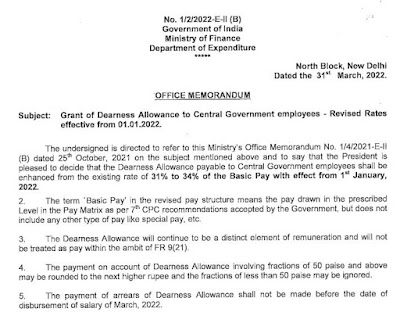
DA Jan 2022 - Grant of Dearness Allowance to Central Government employees - Revised Rates effective from 01.01.2022

 3% DA Hike - Revised Rates effective from 01.01.2022: DoE OM dated 31.03.2022 No. 1/2/2022-E-II (B) Government of India Ministry of Finance...