Monday, 11 September 2017

Payment on account of discontinued allowances - Daily officiating Allowance


Payment on account of discontinued allowances - Daily officiating Allowance.

discontinued-allowance-daily-officiating-allowance

GOVERNMENT OF INDIA
MINISTRY OF RAILWAYS
RAILWAY BOARD
No.E(P&A)I-2011/FE-4/1
The General Managers and principal Financial Advisers,
All Indian Railways & production Units.
PC-VII No.56
RBE No. 120/2017
New Delhi, dated 05.09.2017

Sub: Payment on account of discontinued allowances - Daily officiating Allowance.

Consequent upon the decision taken by the government on the recommendations of the seventh central Pay commission, the President is pleased to decide that disbursement of all existing allowances which have not been specifically recommended for continuation in terms of the Ministry of Finance's Resolution dated 6th July, 2017 shall be discontinued from 1st July, 2017. since, the Daily officiating Allowance has not been specifically recommended for continuation in the said Resolution dated 6th July, 2017, it ceases to exist with effect from 1st July 2017.

2.lt shall be the responsibility of the Heads of the Department to ensure that no bill relating to disbursement in respect of Daily officiating Allowance is drawn by the Head of office/Drawing & Disbursing officers under their purview/jurisdiction. Pay and Accounts officers shall ensure that no payment is effected if any such bill relating to the disbursement of the discontinued allowance is submitted to them. If any such bills are recieved, they should be returned to the DDO and intimation thereof shall also be given to the Head of the Department and the chief controller of Accounts.

3. This issues with the concurrence of the Finance Directorate of the Ministry of Railways.

4. Please acknowledge receipt.
(Anil Kumar)
Dy. Director/E{P&A}-I
Railway Board.
Source: NFIR DOWNLOAD PDF

Expected DA from January 2018 - DA would be 3% ?


Expected DA from January 2018 -  DA would be 3% ?

We have calculated the expected DA from January 2018 with different Scenarios, but most of the calculations comes around only 3 percent increase, lets us see the scenarios here

Scenario 1
In case the AICPIN value increase by 3 point for next FIVE months (example AUG 288, SEP 291, OCT 294, NOV 297, DEC 300,), then DA would be 3% (8.81-5 =3)

EXPECTED-DA-JAN-2018


Scenario 2
In case the AICPIN value increase by 3 point for next FIVE months (example AUG 289, SEP 293, OCT 297, NOV 301, DEC 305) then DA would be 4% (9.28-5 =4)

EXPECTED-da-jan-2018-AICPIN

Issue of restoration of -1S Pay Scale in 7th CPC & treatment of mutual transfer in Railways have been resolved: AIRF

Issue of restoration of -1S Pay Scale in 7th CPC &  treatment of mutual transfer in Railways have been resolved: AIRF

A.I.R.F.

All India Railwaymen's Federation
No. AIRF/24(C)
Dated : September 6, 2017
The General Secretaries,
All Affiliated Unions,

Dear Comrades!
    Sub: (i) Restoration of -1S pay scale
           (ii) Treatment of Mutual Transfer from one railway to other as "inter- division transfer"
           (iii) Brief of today's meeting with Cabinet Secretary

Two very important issues, being persuaded by AIRF at the Railway Board level, have been resolved, one is -1S grade, which had been abolished by the VII CPC, has been restored, and the other issue regarding mutual transfer from one railway to other will be treated as inter- division transfer and need not to take NOC from the Zonal Railway Headquarters. Divisions at their own level will issue NOC, lot of time consumed for this purpose will be saved.

Comrades! Today I met the Cabinet Secretary (Government of India) and raised the issue of "Very Good" benchmark along with other issues of National Pension System (NPS), Minimum Wage and Fitment Formula and non-holding of JCM Meetings.

The Cabinet Secretary's views were positive and he stated that he has already communicated to Chairman Railway Board and Secretary (DoP&T) that benchmark for MACPS cannot be more than the benchmark prevalent for promotion/ selection.

He also stated that the issue of National Pension System (NPS) is under active consideration of the Government of India and he will try to derive the best formula to resolve the problems arrived out of NPS.

With Fraternal Greetings
Comradely yours
Sd/-
(Shiva Gopal Mishra)
General Secretary

Source : AIRF

REVISION OF MINIMUM WAGE OF CENTRAL GOVERNMENT EMPLOYEES

central-government-employees-minimum-wage

QUANTIFICATION OF NEED-BASED MINIMUM WAGE AND NEED FOR REVISION OF MINIMUM WAGE OF CENTRAL GOVERNMENT EMPLOYEES

The concept of the Need-Based Minimum Wage has evolved in India after Independence and owes its origin to the Directive Principles of the Indian Constitution and the welfare policy of the Government. Its acceptance in principle connotes a public effort at an institutional determination of wage rates particularly in the industrial sector of the economy. Unfortunately the computation of the need based minimum wage has become a controversial subject in the country. While the concept of what the need based minimum wage should cover is fairly clear and generally accepted by both the employer and employee, its actual assessment into monetary terms has raised endless disputes not alone by the employer.

NEED-BASED MINIMUM WAGE FORMULA:

Minimum wages for the average family will have to be based on requirements of food, clothing, housing and so on. Additional components of expenditure to cover for children's education, medical treatment, recreation, festivals and ceremonies.

In a vast country such as ours, there are bound to be regional variations in these requirements owing to climatic conditions, food habits, etc. At the same time in order to ensure a degree of uniformity the Conference have adopted a certain norms. The food component carries the largest- proportion of the total cost of living in a working class family. The component’s significance is not only economic but human also. On food depends the health and efficiency of the worker, which is vital to the industrial production. After a protracted discussion the Conference adopted Dr. Aykroyd's second dietary prescription of the adequate diet level, the other one being the optimum diet level. An optimum diet according to him, is one which ensures the functioning of the various life processes at their very best; whereas an adequate diet maintains these processes but not at their peak levels. The optimum diet would include more of vitamins and less of proteins in its caloric content, while the adequate diet would include more of proteins and less of vitamins.
The Committee on Fair Wages laid down that the standard working class family should be reckoned as one consisting of three consumption units, supported by a single male earner and including his wife and two children below the of age 14 The 15th Session of Indian Labour Conference approved that the wage should cover four categories of needs considered essential for the worker's well being, viz. food, clothing, housing and miscellaneous. In calculating the minimum wage, the norms for the food category should be based on Dr. W.B. Aykroyd's formula for an adequate and balanced diet. It thus came about that a wage linked to the needs was suggested as a desirable minimum.

Subsequently, when attempting to implement the recommendations of the conference, almost all the wage fixing authorities including the committees appointed under the Minimum Wages Act, 1948 have invariably faced difficulty in determining: (i) the calorific norm which should form the basis of the diet content (ii) the exact composition of the diet (iii) the qualities of the various items of diet and (iv) availabilities of food commodities consumed by the worker and his pattern of consumption. In this regard the first assault was launched by the II Central Pay Commission (1959), pertaining to the calorific norm as laid down by the 15th Indian Labour Conference. The Indian Labour Conference worked out the three-unit formula, the minimum wage is worked out taking into consideration the calorific value requirements of 2,700 each, certain length of cloth requirement, housing rental value, education and medical expenses etc.

CONCEPT OF LIVING WAGES:

Concept of Living Wages It represents a standard of living which provides not merely for bare physical subsistence but for maintenance of health and decency, a measure of frugal comfort, including education of children, requirement of essential social needs and a measure of insurance against eh more important misfortunes including old age. This is the ideal wages and envisaged in Article 43 of Directive Principles in Part IV of the Constitution. I. L. O. Conventions also provide for living wages.

Living wages is the ideal wages and on the line as stipulated in Article 43 of our Constitution. Wage differentials are necessary part of wage structure if skill formation is to be motivated and productivity is to be achieved but at the same time it should be reasonable.

Hence it is relevant to quote the following observation made by the Kerala High Court in Association of Planters of Kerala v State of Kerala in this regard:  A failure to fix or revise minimum wages was not only a statutory violation but is a breach of fundamental right enshrined in Art. 23 of the Constitution. A duty is cast upon the State by provisions of the Act and Article 23 to fix and revise the minimum rates of wages.

7th CPC REPORT PARA NO 4 HAS ALSO DEALT THE ISSUE OF A NEED- BASED MINIMUM WAGE TAKING INTO THE CONCEPT OF THE FOLLOWING.

a) Normative family is taken to consist of a spouse and two children below the age of 14. With the husband assigned 1 unit, wife, 0.8 unit and two children, 0.6 units each, the minimum wage needs to address 3 consumption units;

b) The food requirement per consumption unit is shown in the Annexure to this chapter. The specifications were derived from the recommendations of Dr. Wallace Aykroyd, the noted nutritionist, which stated that an average Indian adult engaged in moderate activity should, on a daily basis, consume 2,700 calories comprising 65 grams of protein and around 45-60 grams of fat. Dr Aykroyd had further pointed out that animal proteins, such as milk, eggs, fish, liver and meat, are biologically more efficient than vegetable proteins and suggested that they should form at least one-fifth of the total protein intake

c) The clothing requirements should be based on per capita consumption of 18 yards per annum, which gives 72 yards per annum (5.5 meters per month) for the average worker’s family. The 15th ILC also specified the associated consumption of detergents

d) The prescribed provision of Report of the Seventh CPC 63Index 25 percent to cover education, recreation, ceremonies, festivals and medical expenses has been reduced to 15 percent.

THE THREE-UNIT BASED FORMULA ADOPTED BY THE PAY COMMISSIONS NEEDS A CHANGE TO SIX UNITS DUE TO FOLLOWING FACTORS :

The three-unit based formula to fix minimum wages presently counts only four members of a family ie husband, wife and two children. It has no provision to count dependent parents, if any, or even if there are more than two children.

The three-unit formula gives the husband a full unit, wife 0.8 unit, and 0.6 units for each of the two children.
Now the trade unions and the employees associations are of the opinion that the three-unit system are not sufficient to decide minimum wages because the children continue to stay with the family for longer periods. The two children and wife should be accorded one single unit instead of 0.6 units,” also, marriageable age of a child has also increased and they should also be given full units, the gender equality should also be observed instead of 0.8 units it should be full unit for the spouse.

Hence should be revised to the four unit formula gives the husband a full unit, wife full unit, and full units for each of the two children.

After the 2010 Supreme Court ruling that dependent parents are to be taken care of by children, two more units should be added and the formula be based on six-unit formulae than three.
"The CrPC section 125 and Maintenance of Parents and Senior Citizens Act make it mandatory for an earning member to maintain his parents, failing which he/she may have to face penal consequences. Today, the average life span of a person has increased to 68.3 years compared to that of 41 years in 1957. Hence two additional units have to be added,"

So there is a need to hike number of units from three to six to calculate minimum wages.

OTHER FACTORS AFFECTING OUR WAGES ARE AS FOLLOWS:

1) The 7th CPC has taken into consideration the 15% to cover education, recreation, ceremonies, festivals and medical expenses against 25% prescribed by the Supreme Court. Additional components of expenditure to cover for children’s education, medical treatment, recreation, festivals and ceremonies. This followed from the Supreme Court’s ruling in the Raptakos Brett Vs Workmencase of 1991 for determination of minimum wage of an industrial worker. The Supreme Court had prescribed this amount at 25 percent of the total minimum wage calculated from the first five components.

2) Secondly the prices of essential commodities for calculation of the minimum wage is always a debate , the price essential commodities by the using Consumer Price Index for Industrial Workers maintained by Labour Bureau, Shimla and the retail prices are showing different rates , the retail prices of essential commodities are at higher end including that of state Government run co-operative society’s compared to the retail prices maintained by Labour Bureau, Shimla by more than 15%, that is the prices maintained by Labour Bureau, Shimla are lower by more than 15% compared to market prices , the CG employees are deprived of proper minimum wage by an extent of 25% . If proper retail prices are taken into account the minimum wage shall be more than Rs 26,000/- as on 1st Jan 2016.

THE PAYMENT OF WAGES ACT, 1936:

The revision of payment of wages act, 1936 , the Government has raised the monetary limit of wages to Rs. 24000/- per month for the applicability of the Act by issuing the notification .This calculation of Rs 24,000/ is based on Dr. W.B. Aykroyd’s formula. This is done on the basis of figures of the Consumer Expenditure Survey published by the National Sample Survey Organization.

The payment of wages act, 1936 monetary limit of wages to Rs. 24000/- per month is for unskilled worker , if we add Rs 25% for skilled worker , it work out at Rs 30000/- for skilled worker which includes wages and allowances, at present the Central Government employees at the initial stage are paid Rs 23,000/- (Rs 18,000/ as minimum wage and Rs 5,000/ as allowances ), still there is gap of Rs 7,000/ , if the minimum wage of Central Government employees is re fixed at Rs 22,000/ then this gap shall be reduced.
The breakup of the Central Government employee's salary is as follows.

Non Metro City
Minimum wage Rs 18,000/-
HRA Rs 1800/-
Transport allowances Rs 900/-
Children education allowances Rs 2250/-
Total Salary : Rs 22950/-
The Central Government employees are deprived of the actual minimum wage of Rs 26,000/-. Hence there is a need of revision of minimum wage from Rs 18,000/ as Central Government is a model employer.
Via : COC Karnataka

Sunday, 10 September 2017

Is it possible to Increase the 7th CPC Minimum Pay and Improve the Fitment Factor?


Is it possible to Increase the 7th CPC Minimum Pay and Improve the Fitment Factor? 

7th-CPC-Minimum-Pay


7th CPC Minimum Pay - Don't give false hope and drag the issues till next Pay Commission


Is it really possible to Increase the Minimum Pay and Improve the Fitment Factor even 18 Months after the resolution for Implementation of 7th CPC Recommendation issued ?

What is that NCJCM Staff Side really wanted to convey to the Central Government Employees by posting such letters regarding Increasing of Minimum Pay and Improving of Fitment formula.

NCJCM Staff Side is the only hope and Final Destination for Central Government staffs to ask to settle their issues under negotiated settlement. But it seems that the Staff Side is not using this forum effectively to resolve the issues pertaining to the Central Government Employees.

The issues of HRA and Minimum pay are perfect examples of the failure of NCJCM Staff Side.

The central Government employees wouldn’t have faced such huge loss in payment of HRA if the same rate is implemented with effect from the date of Notification i.e 25.7.2016

When the Central Government was not even ready to reinstate the HRA at Sixth CPC rates, how come one expect that the Government will increase the Minimum Pay to Rs. 21000 or fitment factor from 2.57 to 3. Don’t give false hope and drag the issues till next Pay Commission.

Finmin to initiate Budget exercise next week


Finmin to initiate Budget exercise next week

Work on India’s first post-GST Union Budget 2018-19 will start next week with the finance ministry issuing timelines for different processes that will culminate with its presentation in February.

Finance Minister Arun Jaitley arrived at the parliament on Wednesday for Budget.

It may also be the current government's last full-fledged Budget as general elections are due in 2019.

Even though independent India’s biggest tax reform of GST was implemented from July 1, the Budget for 2017-18 (April- March), had followed the practice of tax revenue projections under the heads of customs duty, central excise and service tax alongside direct tax numbers.

With excise duty and service tax being subsumed in the Goods and Services Tax (GST), the classifications will undergo change, an official said.

While a new classification for revenues to be accrued from GST will be included in the Budget for next fiscal, for the current year two sets of accounting may be presented - one for actual accruals during April-June for excise, customs and service tax, and the other for July-March period for GST and customs duty.

The official said that since the GST rates are decided by a GST Council, headed by Union Finance Minister and comprising of representatives of all states, the Budget for 2018-19 will not have any tax proposals concerning excise and service tax levies.

Only proposals for changes in direct taxes - both personal income tax and corporate tax, besides customs duty - are likely to be presented in the Budget along with new schemes and programmes of the government.

This will be Finance Minister Arun Jaitley's 5th Budget in a row.

It would also be the last full Budget of the BJP-led NDA government before the 2019 General Elections. As per practice a vote-on-account or approval for essential government spending for a limited period is taken in the election year and a full-fledged budget presented by the new government.

While P Chidambaram had presented the previous UPA government's vote- on-account in February 2014, Jaitley had presented a full budget in July that year.

The official said the finance ministry will next week issue the Budget circular and start consultations with other ministries from October for Revised Estimates (RE) of expenditure for the current fiscal.

The Budget Circular contains the timelines for submission of information of budget requirements to the Ministry of Finance along with prescribed formats.

The ministries will have to provide the actual money spent in 2016-17 along with the budget estimates and Revised Estimates for current fiscal.

Along with this, they have to give the Budget they are expecting for 2018-19 as well, the official added.

Scrapping a colonial-era tradition of presenting the Budget at the end of February, Jaitley had for the first time presented the annual accounts on February 1, 2017.

With the preponement of Budget, ministries are now allocated their budgeted funds from the start of the financial year beginning April.

This gives government departments more leeway to spend as well as allow companies time to adapt to business and taxation plans.

Previously, when the Budget was presented at the end of February, the three-stage Parliament approval process used to get completed some time in mid-May, weeks ahead of onset of monsoon rains.

This meant government departments would start spending on projects only from August-end or September, after the monsoon season ended.

Besides advancing the presentation date, the Budget scrapped the Plan and non-Plan distinction and merged the Railway Budget with it, ending a nearly century-long practice.

PTI

Saturday, 9 September 2017

AIRF: Productivity Linked Bonus for the financial year 2016-17 to Railwaymen


AIRF: Productivity Linked Bonus for the financial year 2016-17 to Railwaymen


AIRF Productivity Linked Bonus


No.AIRF/387
Dated: September 7, 2017
The Chairman,
Railway Board,
New Delhi

Dear Sir,
Sub: Productivity Linked Bonus for the financial year 2016-17 to Railwaymen
Ref.: Meeting with the AM(Staff), Railway Board held on 04.08.2017
productivity-linked-bonus-2017-AIRF


Please refer to our discussion held in the chamber of AM(Staff), Railway Board, on the above subject matter on 4th August, 2017. All India Railwaymen's Federation(AIRF) has already explained in detail its viewpoint in respect of calculation formula for payment of PLB to Railwaymen.

You may recall that, PLB has been an outcome of the bilateral agreement between Ministry of Railways and Staff Side Federations, which was arrived at on 22.11.1979. The formula for calculation of PLB, that was formulated as a result of above-mentioned agreement, is sacrosanct, on the basis of which payment of PLB is being made to entitled railway employees every year till last financial year.

AIRF is totally against any deviation in the well settled formula devised to calculate PLB payable to railway employees under the said agreement.

It is, therefore, urged that, payment of PLB for financial year 2016-17 should be made on the basis of established formula as mentioned above and there should not be any effort to make any amendment in the same as also number of days, calculated last year for payment of PLB, should not be reduced, else this will lead to unwarranted impairment in industrial peace.

Source : AIRF

CPSE - Pay Revision of Board level and below Board level Executives and Non-Unionised Supervisors

CPSE - Pay Revision of Board level and below Board level Executives and Non-Unionised Supervisors

No.W-02/0028/2017-DPE (WC)-GL-XVI/ 17
Government of India
Ministry of Heavy Industries and Public Enterprises
Department of Public Enterprises
Public Enterprises Bhawan
Block No. 14, C. G. 0. Complex,
Lodhi Road, New Delhi-110003
Dated: 7th September, 2017
OFFICE MEMORANDUM

Subject : Pay Revision of Board level and below Board level Executives and Non-Unionised Supervisors of Central Public Sector Enterprises (CPSEs) w.e,f. 01,01.2017 - decision on Location based compensatory allowances and Non-Practicing Allowance (NPA)

The undersigned is directed to refer to para 10 of this department's O.M. of even. No. dated 3rd August, 2017 and sub-para. 3(b) of pars 1 of OM of even No. dated 4th August, 2017 regarding the issue of separate guidelines in respect of Location based Compensatory Allowance and Non-Practicing Allowance. After due consideration, the Government has decided on Location based Compensatory Allowance and Non- Practicing Allowance as follows:

Location based Compensatory Allowance:

(i) For serving in North-East States and Ladakh Region:
Assam, Meghalaya, Manipur, Nagaland, Tripura, Arunachal Pradesh, Mizoram and Sikkim10% of Basic Pay
Ladakh Region10% of Basic Pay

(ii) For serving in Island territories of Andaman and Nicobar (A&N) Islands and Lalishadweep
Areas around Capital Towns (Port Blair in A&N Islands, Kavaratti and Agatti in Lakshadwespi10% of Basic Pay
Difficult Areas (North and Middle Andaman, South Andaman excluding Port Blair, entire Lakshadweep except Kavaratti, Agatti and Minicoy10% of Basic Pay
More Difficult Areas (Little Andaman, Nicobar group of Islands, Narcondam  Islands, East Islands and Minicoy)10% of Basic Pay

(iii) Special allowance: For serving in the difficult and far flung areas:
Areas CoveredPercentage of Basic Pay
Part 'A' (Areas covered under Annexure-1 of D/o Expenditure O.M. No. 3/1/2017-EII(B) dated 19.7.2017)8% of Basic Pay
Part 'B' (Areas covered under Annexure-II of D/o Expenditure O.M. No. 3/1/2017-EII(B) dated 19.7,2017)6% of Basic Pay
Part 'C' (Areas covered under Annexure-III of D/o Expenditure 0.M. No. 3/1/201] 7- EII(3) dated 19.7,2017)4% of Basic Pay
Part 'D' (Areas covered under Annexure-IV of D/o Expenditure O.M. No, 3/1 /2017-EII(B) dated 19.7.2017)3% of Basic Pay

(iv) In the event of a place falling in more than one category, i.e. (i)(ii) and (iii) mentioned above, in that case only the higher rate of allowance will be admissible.

Non-practicing Allowance (NPA):
NPA upto 20% of Basic Pay would be paid to Medical Officers. NPA will not be considered as pay for the purpose of calculating other benefits.

2. The allowances specified in this O.M. will be outside the purview of Ceiling of 35% of Basic Pay wider 'Cafeteria Approach' and would be effective from the date of issue of presidential directive.
S/d,
(RajesKumar Chaudhry)
Joint Secretary to the Government of India

7th Pay Commission for Defence Pensioners calculation example for Major


7th Pay Commission for Defence Pensioners calculation example for Major.

S.
No
Description1st Case
1Date of Retirement26.05.1976
2RankMajor
3Qualifying Service30/06/01
4Scale of Pay (or Pay Band & G.P) at the time of Retirement OR Notional Pay scale as on 1.1.1986. for those retired before 1.1.19862300-100-3900-150-5100 Rank Pay - 1000
5Pay on retirement OR Notional pay as on 1.1.1986 for those retired before 1.1.19863400 (Basic Pay) + 600 (Rank Pay) 4000
6Pension as on 01.01.2016 before revision23815
7Family Pension as on 01.01.2015 before revision14289
8Family pension at enhanced rate as on 01.01.2016 before revision (if applicable) NA
9Revised pension by multiplying pre-revised pension by 2.5761205
10Revised family pension by multiplying pre-revised family pension by 2.5736723
11Revised family pension at enhanced rate by multiplying pre-revised enhanced family pension by 2.57NA
12Pay fixed on notional basis on 1.1.199611600 (Basic Pay) + 1200 (Rank Pay) 12800
13Pay fixed on notional basis on 1.1.200623810 (PIPB) + 6600 (Gr.Pay) + 6000 (MSP) Rs. 36410
14Pay fixed on notional basis on 1.1.201680400 (PIPM)+15500(MSP) 95900
15Revised pension w.e.f. 1.1.2016 as per first formulation47950
16Revised family pension w.e.f. 1.2016 as per first formulation28770
17Revised family pension at enhanced rate w.e.f. 1.1.2016 as oer first formulationNA
18Revised pension payable (Higher of S.No.9 and 1561205
19Revised family pension payable (Higher of S.No. 10 and 16)36723
20Revised family pension at enhanced rate payable (Higher of S.No. 11 and 17)NA
----------------- Basic Pay, Compensatory allowance, CPSE, Non Practicing Allowance, pay revision
CPSE - Pay Revision of Board level and below Board level Executives and Non-Unionised Supervisors

No.W-02/0028/2017-DPE (WC)-GL-XVI/ 17
Government of India
Ministry of Heavy Industries and Public Enterprises
Department of Public Enterprises
Public Enterprises Bhawan
Block No. 14, C. G. 0. Complex,
Lodhi Road, New Delhi-110003
Dated: 7th September, 2017
OFFICE MEMORANDUM

Subject : Pay Revision of Board level and below Board level Executives and Non-Unionised Supervisors of Central Public Sector Enterprises (CPSEs) w.e,f. 01,01.2017 - decision on Location based compensatory allowances and Non-Practicing Allowance (NPA)

The undersigned is directed to refer to para 10 of this department's O.M. of even. No. dated 3rd August, 2017 and sub-para. 3(b) of pars 1 of OM of even No. dated 4th August, 2017 regarding the issue of separate guidelines in respect of Location based Compensatory Allowance and Non-Practicing Allowance. After due consideration, the Government has decided on Location based Compensatory Allowance and Non- Practicing Allowance as follows:

Location based Compensatory Allowance:

(i) For serving in North-East States and Ladakh Region:
Assam, Meghalaya, Manipur, Nagaland, Tripura, Arunachal Pradesh, Mizoram and Sikkim10% of Basic Pay
Ladakh Region10% of Basic Pay

(ii) For serving in Island territories of Andaman and Nicobar (A&N) Islands and Lalishadweep
Areas around Capital Towns (Port Blair in A&N Islands, Kavaratti and Agatti in Lakshadwespi10% of Basic Pay
Difficult Areas (North and Middle Andaman, South Andaman excluding Port Blair, entire Lakshadweep except Kavaratti, Agatti and Minicoy10% of Basic Pay
More Difficult Areas (Little Andaman, Nicobar group of Islands, Narcondam  Islands, East Islands and Minicoy)10% of Basic Pay

(iii) Special allowance: For serving in the difficult and far flung areas:
Areas CoveredPercentage of Basic Pay
Part 'A' (Areas covered under Annexure-1 of D/o Expenditure O.M. No. 3/1/2017-EII(B) dated 19.7.2017)8% of Basic Pay
Part 'B' (Areas covered under Annexure-II of D/o Expenditure O.M. No. 3/1/2017-EII(B) dated 19.7,2017)6% of Basic Pay
Part 'C' (Areas covered underAnnexure-III of D/o Expenditure 0.M. No. 3/1/201] 7-EII(3) dated 19.7,2017)4% of Basic Pay
Part 'D' (Areas covered under Annexure-IV of D/o Expenditure O.M. No, 3/1 /2017-EII(B) dated 19.7.2017)3% of Basic Pay

(iv) In the event of a place falling in more than one category, i.e. (i)(ii) and (iii) mentioned above, in that case only the higher rate of allowance will be admissible.

Non-practicing Allowance (NPA):
NPA upto 20% of Basic Pay would be paid to Medical Officers. NPA will not be considered as pay for the purpose of calculating other benefits.

2. The allowances specified in this O.M. will be outside the purview of Ceiling of 35% of Basic Pay wider 'Cafeteria Approach' and would be effective from the date of issue of presidential directive.
S/d,
(RajesKumar Chaudhry)
Joint Secretary to the Government of India

Productivity Linked Bonus for the financial year 2016-17 to be paid in the current year 2017


Productivity Linked Bonus for the financial year 2016-17 to be paid in the current year 2017
NFIR Productivity Linked Bonus for the financial year 2016-17


Registration No. : RTU/Nnn/31/2012
NFIR Productivity Linked Bonus

No. I/10/Part IV
Dated 08/09/2017.
The Secretary (E),
Railway Board,
New Delhi

Dear Sir,
Sub: Productivity Linked Bonus for the financial year 2016-17 to be paid in the current year 2017
Ref: Railway Board's letter No. E(P&A)II-2017/PLB-3 dated 02/08/2017.

Kind attention of Railway Board is invited to the discussions held on 4th August, 2017 in the Chamber of Additional Member (Staff), wherein the Federation has explained the need to acord approval for payment if Productivity Linked Bonus equivalent to not less than 78 days wages as was done in the previous years.

NFIR again places the facts as below for immediate action for sanction:
  • The output given by Railway employees has been very much on high side particularly in the context of non-filling of over 2lakh vacancies and additional burden borne by the existing staff since the last two years.
  • Capital input should not be taken into consideration as the utilization of the said capital is not in the hands of workers.
  • During the previous six years, the PL Bonus was paid to the Railway employees equivalent to 78 days wages, therefore any reduction in number of days would cause serious resentment in view of the fact that Rail Workforce has been contributing for productivity inspite of difficult working conditions and heavy shortage of staff due to non-filling of vacancies and non-creation of new posts for new assets built.
  • In fact, the Railway Ministry should consider motivating the staff by granting more number of days wages than previous year at this juncture.
NFIR, therefore, requests the Railway Board to kindly take action for sanctioning the P.L. Bonus equivalent to not less than 78 days wages. It is also requested that payment may be arranged before commencement of Dussehra Pooja Holidays.

Federation may be kept apprised of the action taken in the matter.
Yours faithfully
(Dr. M. Raghavaiah)

General Secretary
Source: NFIR Download PDF

Flash News

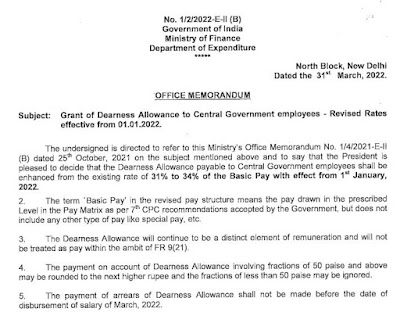
DA Jan 2022 - Grant of Dearness Allowance to Central Government employees - Revised Rates effective from 01.01.2022

 3% DA Hike - Revised Rates effective from 01.01.2022: DoE OM dated 31.03.2022 No. 1/2/2022-E-II (B) Government of India Ministry of Finance...