Wednesday, 26 July 2017

Government mulls induction of private sector talent in central government offices


Government mulls induction of private sector talent in central government offices

New Delhi: A proposal for induction of private sector talent in central government departments through lateral entry is under consideration, the Lok Sabha was informed today.

Minister of State for Personnel Jitendra Singh said the government was committed to appoint best talents subject to provision of rules.

“Niti Aayog in the three year action agenda for 2017-2020 has recommended for inducting specialists into the system through lateral entry in policy making areas on fixed term contract. This recommendation along with suggestions received from other quarters are under consideration,” he said in a written reply to the Lower House.

The PTI had recently reported that the government was mulling to open its doors for private sector specialists in its select departments.

PTI

New Post Offices will be opened in this fiscal-Manoj Sinha


New Post Offices will be opened in this fiscal-Manoj Sinha 

The Government has planned to open 81 Sub-Post Offices and 100 Branch Post Offices during the current financial year 2017-18 under the Scheme - "Rural Business & Access to Postal Network". Minister of Communications Shri Manoj Sinha said in a written reply to a question in the Lok Sabha today that the Department of Posts has also planned to open 66 Branch Post Offices by creation of new posts in 32 worst affected Left Wing Extremism (LWE) districts in the country under the aforesaid scheme in the current financial year.

Shri Sinha informed that out of 25,350 post offices in the States of the Country, 25,348 are computerised. He said that the Department of Posts takes action, from time to time, to induct technology and upgrade the system to cater to the growing market requirements and to increase revenue earnings. The Minister said that the increase or revision of rates of postal products and services is an ongoing exercise carried out from time to time and that there is no proposal to increase the rates of premium Business Development products at present.

Hiring of staff in Government service


Hiring of staff in Government service

The vacant posts in Government Ministries/Departments are required to be filled as per the Recruitment Rules for the post. Information related to recruitment of staff by Government of India is not centrally maintained.

Recruitment to various posts in Government of India is made through various recruitment agencies constituted for the purpose such as Union Public Service Commission, Staff Selection Commission etc. Recruitment agencies conduct examinations based on indents received from various Ministries/Departments/offices of Government of India. Ministries/Departments and the recruitment agencies have been sensitized to take all the required steps for filling up of the posts.

The Government is always committed to appoint best available talent subject to provisions of rules. NITI Aayog in the Three Year Action Agenda for 2017-2020 has recommended for inducting specialists into the system through lateral entry in policy making areas on fixed term contract. This recommendation alongwith suggestions received from other quarters are under consideration.

This was stated by the Minister of State for Personnel, Public Grievances and Pensions and Minister of State for Prime Minister's Office Dr. Jitendra Singh in a written reply to a question by Dr. K. Gopal and Shri Sisir Kumar Adhikari in the Lok Sabha today.

PIB

Violation of DoPT guidelines


Violation of DoPT guidelines 

Central Secretariat Manual of Office Procedure (CSMOP) lays down broad procedures for process management in the Central Secretariat. The CSMOP does not contain any provision for initiating disciplinary action against an official for non-compliance of procedure laid down in the CSMOP. It is for the concerned Central Secretariat office to take action against its officials, under the relevant Conduct Rules of service. Information relating to disciplinary action taken by Central Government offices against their officials for not following the procedure of CSMOP is not centrally maintained.

This was stated by the Minister of State for Personnel, Public Grievances and Pensions and Minister of State for Prime Minister's Office Dr. Jitendra Singh in a written reply to a question by Dr. Anupam Hazra in the Lok Sabha today.

Revision of Flat rate of Licence Fee for GPRA throughout country: Directorate of Estates OM dt 19.07.2017


Revision of Flat rate of Licence Fee for GPRA throughout country: Directorate of Estates OM dt 19.07.2017
No. 18011/2/2015-Pol.III
Government of India
Ministry of Urban Development
Directorate of Estates
Nirman Bhawan, New Delhi
Dated:19 July, 2017
OFFICE MEMORANDUM

Subject: Revision of flat rate of licence fee for General Pool Residential Accommodation (GPRA) throughout the country.

In terms of the provisions of the Rule 74 of the "Central Government General Pool Residential Accommodation Rules. 2017, the Government has decided to revise the flat rates of licence fee recoverable for the residential accommodation available in General Pool and also in Departmental Pools of Ministries/Departments of the Government of India throughout the Country (except in respect of substandard/unclassified accommodation of Ministry of Defence, accommodation for service personnel of the Ministry of Defence and accommodation under the control of Ministry of Railways), as shown in the Annexure.

2 The revised rates of licence fee would be effective from 1st July, 2017. All Ministries/Departments are requested to take action to recover the revised licence fee in accordance with these orders in respect of accommodation under their control all over the country.

3 This issues with the concurrence of Integrated Finance Wing of the Ministry of Urban Development vide Note dated 6/7/2017.
Sd/-
(Swarnal Banerjee)
Deputy Director of Estates (Policy)
Annexure
(To OM No. 18011/2/2015-Pol.III dated 19 July, 2017)
Revised flat rates of licence fee applicable for General Pool Residential Accommodation (GPRA) throughout the country w.e.f. 01-07- 2017

Sl. No.Type of AccommodationRangeExisting flat rates of Licence fee as per 2013 revisionLicence after merger of various areas in a type of   accommodation   as per % of accommodation- rounded to Rs. 10
1.IUpto 30115150
2.IUpto 30135
3.II26.5 to 40245310
4.II41 to 50310
5.III44 to 55370470
6.III56 to 65450
7.IV59 to 75500640
8.IV76 to 91.5625
9.IV (Special)59 to 75500680
10.Iv (Special)76 to 91.5625
11.V AUpto 1068751190
12.V ABeyond 1061065
13.V BBeyond 10610651270
14.VI AUpto 159.513051560
15VI BBeyond 159.515651870
16VII189.5 to 224.518352190
17VIII243 to35026303920
18VIII350.5  to 5223875

For Servant Quarters & Garages
Sl. No.ParticularsExisting Rates (p.m.)Revised Rates rounded to Rs. 10 (p.m.)
1Servant QuartersRs. 60/-70
2GaragesRs.35/- 40

For categories of Suite, living area and proposed flat rates of licence fee for Hostel Accommodation
Sl. No.Category ofSuiteLiving  Area (Sq. mtr.) Existing ratesRevised Rates rounded  to  Rs.10 (p.m.)
1Single Room(without Kitchen)21.5 to 30335/-400
Single Room (with Kitchen) 30.5 to 39.5475/-560
2Double Room47.5 to 6o650/-770

VACANCIES IN KENDRIYA VIDYALAYAS (KVs)


VACANCIES IN KENDRIYA VIDYALAYAS (KVs)
GOVERNMENT OF INDIA
MINISTRY OF HUMAN RESOURCE DEVELOPMENT
DEPARTMENT OF SCHOOL EDUCATION & LITERACY
LOK SABHA
UNSTARRED QUESTION NO. 1342
TO BE ANSWERED ON 24.07.2017
VACANCIES IN KENDRIYA VIDYALAYAS
1342. KUMARI SUSHMITA DEV:
Will the Minister of HUMAN RESOURCE DEVELOPMENT be pleased to state:
  1. (a)          the number of Kendriya Vidyalayas in North Eastern Region of the country, State/UT-wise; and
  2. (b)          the number of teaching and non teaching positions in these KVs along with the number of positions vacant?
  3. ANSWER
MINISTER OF STATE IN THE MINISTRY OF HUMAN RESOURCE DEVELOPMENT
(SHRI UPENDRA KUSHWAHA)

(a) & (b):     The number of Kendriya Vidyalayas (KVs) functioning in North Eastern Region of the country including the State of Sikkim, and the sanctioned strength/ vacancies position of teaching/ non-teaching staff in these schools is as under:-

S.No.
Name of State
No. of
KVs
Teaching & Non-teaching
(status as on 1.7.2017)
Sanctioned
Post
In- PositionVacant Posts
1Arunachal Pradesh16533252281
2Assam5625441600944
3Manipur8291161130
4Meghalaya7295189106
5Mizoram41206654
6Nagaland617571104
7Sikkim2715615
8Tripura9317189128
Total108434625841762
English Version
Hindi Version

EQUAL PAY FOR EQUAL WORK


EQUAL PAY FOR EQUAL WORK

GOVERNMENT OF INDIA
MINISTRY OF LABOUR AND EMPLOYMENT
LOK SABHA
UNSTARRED QUESTION NO. 1294
TO BE ANSWERED ON 24.07.2017

EQUAL PAY FOR EQUAL WORK

1294. SHRI KANWAR SINGH TANWAR:
SHRI HARI MANJHI:
SHRI INNOCENT:

Will the Minister of LABOUR AND EMPLOYMENT be pleased to state:

(a)whether the Hon'ble Supreme Court has given a ruling that the theory of equal pay for equal work should be implemented and if so, the details thereof;
(b)whether the Hon'ble Court has also reiterated that there should be no disparity in the salary of regular and casual workers in a welfare State if both are doing same nature of work and if so, the details thereof;
(c)whether the Government is aware that the contract workers are being deprived from equal pay for equal work by their employers and if so, the details thereof;
(d)whether the Government has set up/proposes to set up a suitable redressal mechanism in this regard and if so, the details thereof; and
(e)the other measures taken/proposed to be taken by the Government for the welfare and social security of workers including casual/contract workers in the country?

ANSWER
MINISTER OF STATE (IC) FOR LABOUR AND EMPLOYMENT 
(SHRI BANDARU DATTATREYA)

(a) & (b): In civil appeal number 213 of 2013 the issue for consideration ofthe Hon'ble Supreme Court was as under:

"whether temporarily engaged employees (daily-wage employees, ad- appointees, employees appointed on casual basis, contractual employees and the like), are entitled to minimum of the regular pay-scale, alongwith dearness allowance (as revised from time to time) on account of their performing the same duties, which are discharged by those engaged on regular basis, against sanctioned posts".

The Hon'ble Supreme Court held that:
"There can be no doubt, that the principle of ‘equal pay for equal work' would be applicable to all the concerned temporary employees, so as to vest in them the right to claim wages, at par with the minimum of the pay-scale of regularly engaged Government employees, holding the same post"

(c) & (d): In so far as the contract labour is concerned, the ContractLabour (Regulation & Abolition) Act, 1970 and the rules framed thereunder regulate the employment of contract labour. Rule 25(2)(v)(a) of the Contract Labour (Regulation & Abolition) Central Rules, 1971 provides for parity as mentioned below:
"in cases where the workmen employed by the contractor perform the same or similar kind of work as the workmen directly employed by the principal employer of the establishment, the wage rates, holidays, hours of work and other conditions of service of the workmen of the contractor shall be the same as applicable to the workmen directly employed by the principal employer of the establishment on the same or similar kind of work"

A well-established Central Industrial Relations Machinery (CIRM) is in place to enforce the Contract Labour (Regulation & Abolition) Act, 1970. The country-wide network of Dy. Chief Labour Commissioners (Central) and Regional Labour Commissioners (Central) under the control of Chief Labour Commissioner (Central) is mandated to settle the complaints/claims of the contract workers in terms of the provisions of the said Act and the Rules framed thereunder
(e): In order to provide social security benefits to the workers in theorganised sector, the Government has enacted the Employees' Provident Funds and Miscellaneous Provisions Act, 1952 and Employees' State Insurance Act, 1948.

For providing social security benefits to the workers in the unorganised sector, the Government has enacted the Unorganised Workers' Social Security Act, 2008 which stipulates formulation of suitable welfare schemes for unorganised workers on matters relating to:

(i) life and disability cover,
(ii) health and maternity benefits,
(iii) old age protection and
(iv) any other benefit as may be determined by the Central Government through the National Social Security Board. Various Schemes, formulated by the Government to provide social security cover to the unorganized workers as listed in Schedule I of the above Act.

Central Government has also launched the Atal Pension Yojana, Pradhan Mantri Jeevan Jyoti Bima Yojana and Pradhan Mantri Suraksha Bima Yojana for all citizens especially targeting unorganised workers to provide them comprehensive social security.

Source : Lok Sabha

Tuesday, 25 July 2017

Ex-gratia amount for CAPF personnel


Ex-gratia amount for CAPF personnel

The amount of ex-gratia lump sum compensation available to the families of Central Government Civilian employees, who die in the performance of their bona fide official duties under various circumstances, has been increased on the recommendations of the 7th Pay Commission w.e.f. 01/01/2016 vide DoP&PW OM No.38/37/2016-P&PW(A)(i) dated 04/08/2016, as under:

Circumstances
Earlier amount ( Rs.)
Revised amount (Rs.)
Death occurring due to accidents in course of performance of duties.10
lakh
25
lakh
Death in the course of performance of duties attributed to acts of violence by terrorists, anti social elements etc.10
lakh
25
lakh
Death occurring in border skirmishes and action against militants, terrorists, extremists, sea pirates.15
lakh
35
lakh
Death occurring while on duty in the specified high altitude, unaccessible border posts, etc. on account of natural disasters, extreme weather conditions.15
lakh
35
lakh
Death occurring during enemy action in war or such war like engagements, which are specifically notified by Ministry of Defence and death occurring during evacuation of Indian Nationals from a war-torn zone in foreign country.
-
45
lakh

The rate of ex-gratia lump sum compensation for 100 percent disability to CAPFs & Assam Rifles personnel, who are disabled in the performance of their bonafide official duty under various circumstances and are boarded out from service on account of disability attributable to aggravated in service, has been revised vide this Ministry OM No.27011/64/2010-R&W (Part) dated 07/06/2017 from Rs. 09 lakhs to Rs. 20 lakhs w.e.f 01/01/2016.

The 7th CPC has recommended a common regime of Risk and Hardship Allowance for Army and CAPFs which has been accepted by the Government.

This was stated by the Minister of State for Home Affairs, Shri Kiren Rijiju in a written reply to question by Shri Bahadur Singh Koli in the Lok Sabha today.

PIB

14th President of India Shri Ram Nath Kovind Profile


Profile: 14th President of India Shri Ram Nath Kovind

Ram-Nath-Kovind-14th-President-of-India
A lawyer, veteran political representative and long-time advocate of egalitarianism and integrity in Indian public life and society, Shri Ram Nath Kovind was born on October 1, 1945, in Paraunkh, near Kanpur, Uttar Pradesh. His parents were Shri Maiku Lal and Smt Kalawati.

Before assuming charge of the office of the 14th President of India on July 25, 2017, Shri Kovind served as the 36th Governor of the state of Bihar from August 16, 2015, to June 20, 2017.

Educational and Professional Background
Shri Kovind completed his school education in Kanpur and obtained the degrees of B.Com and L.L.B. from Kanpur University. In 1971, he enrolled as an Advocate with the Bar Council of Delhi.
Shri Kovind was Union Government Advocate in the Delhi High Court from 1977 to 1979 and Union Government Standing Counsel in the Supreme Court from 1980 to 1993. He became Advocate-on-Record of the Supreme Court of India in 1978. He practised at the Delhi High Court and Supreme Court for 16 years till 1993.

Parliamentary and Public Life
Shri Kovind was elected as a member of the Rajya Sabha from Uttar Pradesh in April 1994. He served for two consecutive terms of six years each till March 2006. Shri Kovind served on various Parliamentary Committees like Parliamentary Committee on Welfare of Scheduled Castes/Tribes; Parliamentary Committee on Home Affairs; Parliamentary Committee on Petroleum and Natural Gas; Parliamentary Committee on Social Justice and Empowerment; and Parliamentary Committee on Law and Justice. He was Chairman of the Rajya Sabha House Committee.

Shri Kovind also served as Member of the Board of Management of the Dr B.R Ambedkar University, Lucknow, and Member of the Board of Governors of the Indian Institute of Management, Kolkata. He was part of the Indian delegation at the United Nations and addressed the United Nations General Assembly in October 2002.

Positions Held
2015-17: Governor of Bihar
1994-2006: Member of the Rajya Sabha, representing the state of Uttar Pradesh
1971-75 and 1981: General Secretary, Akhil Bharatiya Koli Samaj
1977-79: Union Government Advocate at the Delhi High Court
1982-84: Union Government Junior Counsel in the Supreme Court

Personal Details
Shri Kovind married Smt Savita Kovind on May 30, 1974. They have a son, Shri Prashant Kumar, and a daughter, Miss Swati. An avid reader, the President has keen interest in reading books on politics and social change, law and history, and religion.
During his long public career, Shri Kovind has travelled widely across the country. He has also visited Thailand, Nepal, Pakistan, Singapore, Germany, Switzerland, France, the United Kingdom and the United States in his capacity as a Member of Parliament.

PIB

Pay Commission For Unorganised Sector


Pay Commission For Unorganised Sector

GOVERNMENT OF INDIA
MINISTRY OF LABOUR AND EMPLOYMENT
LOK SABHA
UNSTARRED QUESTION NO. 1352
TO BE ANSWERED ON 24.07.2017

PAY COMMISSION FOR UNORGANISED SECTOR
1352. SHRI MALLIKARJUN KHARGE:

Will the Minister of LABOUR AND EMPLOYMENT be pleased to state:

(a) whether the Government reviews the working conditions and pay scales of the workers working in unorganized sector by appointing commissions at regular intervals on the lines of employees of the Central Government;
(b) if so, the details thereof;
(c) if not, whether the Government has any such proposal in this regard at present; and
(d) if so, the details thereof along with the time by which final decision is likely to be taken in this regard?

ANSWER

MINISTER OF STATE (IC) FOR LABOUR AND EMPLOYMENT
(SHRI BANDARU DATTATREYA)

(a) to (d): The Minimum Wages Act, 1948, provides for fixation/periodic revision of minimum wages in employment to prevent exploitation of workers. Under the Act, the appropriate Government, both the Centre and the States, fixes/revises the minimum wages in scheduled employments falling in their respective jurisdiction. This Act provides for fixation of hours of work, payment of overtime wages besides providing penalties for offences under the Act and the Rules made thereunder.

Source : Lok Sabha
Hindi Version

Flash News

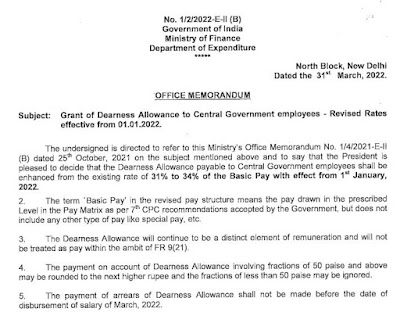
DA Jan 2022 - Grant of Dearness Allowance to Central Government employees - Revised Rates effective from 01.01.2022

 3% DA Hike - Revised Rates effective from 01.01.2022: DoE OM dated 31.03.2022 No. 1/2/2022-E-II (B) Government of India Ministry of Finance...