Showing posts with label Government staff. Show all posts

Wednesday, 26 July 2017

Hiring of staff in Government service


Hiring of staff in Government service

The vacant posts in Government Ministries/Departments are required to be filled as per the Recruitment Rules for the post. Information related to recruitment of staff by Government of India is not centrally maintained.

Recruitment to various posts in Government of India is made through various recruitment agencies constituted for the purpose such as Union Public Service Commission, Staff Selection Commission etc. Recruitment agencies conduct examinations based on indents received from various Ministries/Departments/offices of Government of India. Ministries/Departments and the recruitment agencies have been sensitized to take all the required steps for filling up of the posts.

The Government is always committed to appoint best available talent subject to provisions of rules. NITI Aayog in the Three Year Action Agenda for 2017-2020 has recommended for inducting specialists into the system through lateral entry in policy making areas on fixed term contract. This recommendation alongwith suggestions received from other quarters are under consideration.

This was stated by the Minister of State for Personnel, Public Grievances and Pensions and Minister of State for Prime Minister's Office Dr. Jitendra Singh in a written reply to a question by Dr. K. Gopal and Shri Sisir Kumar Adhikari in the Lok Sabha today.

PIB

Saturday, 24 September 2016

Payment of Allowances in Revised pay may satisfy the Government Staff

Payment of Allowances in Revised pay may satisfy the Government Staff


It is believed that Payment of Allowances in Revised pay may at least satisfy the Government Staff, despite the fact that the Pay Hike is not sufficient.7th CPC Allowances

Bapus are annoyed about the inordinate delay in announcing Allowances. Talks are doing rounds that the government is deliberately playing the delaying tactics to make the CG Staff to accept the decisions of Allowance Committee.

Central Staff upset with Pay Hike
Already the Central Government Staff are very much upset with Pay Hike recommended for next Ten Long years. They in fact are not happy about the Arrears paid to them. Though the Govt has defended that the Pay Revision arrears will not be as high as in previous Pay Commission, because Arrears for couple of years had been paid in previous Pay Commission. But this time Pay Revision took place within seven months from the due date. So obviously the Pay Revision Arrears will be lesser than previous Pay Commission.

Though a Committee was formed to review the Minimum Pay and Fitment Factor, it is believed that it was wrapped up already. But the federations are Optimistic. They expect somehow the Committee will help them to pacify the Govt Servants on this particular issue.

But nonpayment of Allowances in revised Pay will certainly axe the feel good factor in Central Government Offices. They are started losing patience over it and expect the government to announce it soon. Because the take home pay after pay revision is unbelievably very low comparing to the previous Pay commission. The Central government should not reduce the rate of Allowances and it should be implemented with effect from 1.1.2016

Friday, 6 May 2016

7th Pay Commission: Abolish overtime for Government staff, pay panel recommends

7th Pay Commission: Abolish overtime for Government staff, pay panel recommends
Overtime paid by Railways and Defence ministries constitutes 90% of total
The Seventh Pay Commission has recommended that overtime allowance, except for operational staff and industrial employees governed by statutory provisions, should be abolished, after data showed that the expenditure under the head for the Railways and Defence ministries more than doubled in seven years ending 2012-13.

A committee of secretaries headed by Cabinet Secretary P. K. Sinha is reviewing the Commission’s recommendations. Overall, the overtime paid by the Government increased from Rs.797 crore to Rs.1,629 crore in the period, prompting the Commission to observe that government offices need to increase productivity and efficiency; and recommend “stricter” control on the Centre’s expenditure under the head.

“Government employees, like every one else, should be paid for results, not to spend time in the office…but overtime is mandated by law in organisations like railways and in such cases payments must be realistic and not frozen in time and hence the recommendation to increase them by 50 per cent,” economist and Seventh Pay Commission Member Rathin Roy told The Hindu .

Overtime allowance paid in just the Ministry of Railways and to civilian employees in the Ministry of Defence, accounts for more than 90 per cent of all overtime paid by the Centre, the Commission found. While the Ministry of Defence has achieved some success in controlling payment of the allowance, the efforts of the Railways Ministry have not borne fruit as yet. As a percentage of pay, overtime allowance is declining in the Ministry of Defence but is on the rise in the Ministry of Railways. The allowance decreased to 6.54 per cent of pay in 2012-13 from nearly 8 per cent in 2006-07 in the Ministry of Defence. It increased to 2.58 per cent in the Ministry of Railways in 2012-13 from 2.09 per cent in 2006-07.

Rising faster


Overtime paid to employees in the Railways is rising faster than even their pay. The compounded annual growth rate of 17.2 per cent for overtime in the ministry exceeds that of pay which is 13.2 per cent. If the government decides to continue with the allowance for those categories of staff for which it is not a statutory requirement, then it should be increased by 50 per cent, the panel recommended.

In the Ministry of Railways, overtime paid to employees is rising faster than even their pay

Read at: The Hindu

Tuesday, 19 April 2016

Central government is set to recruit 2.2 lakh central government employees over a period of two years

Central government is set to recruit 2.2 lakh central government employees over a period of two years from March 1, 2015, despite the Centre’s announcements from time to time on a freeze in fresh recruitments.

The central government’s actual staff on March 1, 2015 was 33.05 lakh, which increased to 34.93 lakh in 2016 and is estimated to grow to 35.23 lakh by March 1, 2017, according to the budget estimates for 2016-17.

This includes the railways — which has not added a single worker to its strength of 13,26,437 in the last three years — but excludes the defence forces.

The biggest increase of 70,000 is projected in the revenue department which comprises income tax and customs, central excise and service tax, followed by central paramilitary forces, projected to rise by 47,000. The strength of the home ministry, excluding paramilitary forces, has increased by 6,000.

The cabinet secretariat, a fairly small department assisting the government, will add 301 employees, going up from 900 in 2015 to 1,201 by March 1, 2017. The I&B ministry added nearly 2,200 personnel in the last two years.

The personnel ministry, which manages government staff, added 1,800 jobs in the last two years, the urban development ministry 6,000, mines ministry 4,399 and department of space 1,000.

However, the financial allocation for salaries and allowances for the revenue department has not shown any major difference, for the reason that the department has not been able to recruit personnel due to slow progress in the cadre restructuring exercise.

Some departments have faced downsizing. Interestingly, there has been a cut in the department of rural development, the focus area of the government, where the strength has come down from 538 in 2015 to 472 in 2016-17.

A major reason for the spurt in hiring is that many departments faced acute staff crunch in Group B and C categories due to a moratorium on fresh recruitments for the past several years.

A lot of the new appointments have been in these categories. Vacancies have piled up over the years. More than six lakh posts are vacant in various central government ministries, according to the personnel ministry.

Friday, 2 October 2015

7th Pay Commission may also raise salary-levels of PSU employees

7th Pay Commission may also raise salary-levels of PSU employees

Early Retirement for Shoddy Job, Variable Pay to Shock Government Staff

Five to six per cent annual pay hike of Central Government employees is likely to be linked to tangible performance criterion. Under-performers are likely to be retired by 55 or 30 years of service, according to the Seventh Pay Commission report to be submitted soon.

The overall hike being recommended by former Justice A K Mathur-headed 7th Pay Commission is around 30 per cent. The Central Government employees are scheduled to get salary hikes on the basis of the recommendations by January 1, 2016. According to sources, the house rent allowance too would see an increase by 20 per cent. But the most significant recommendation is that 5 to 6 per cent of the annual increment would be performance-based. There is also likely to be a provision of retiring underperforming employees by the age of 55 or 30 years of service, whichever is more. “The Commission has spoken to all stake-holders and the recommendations are ready. We are expecting to submit the report any time soon,” sources said.

Set up by the erstwhile UPA government in February 2014, the Seventh Pay Commission was given a four-month extension by the NDA Government. Its term is till December 31. The commission may also raise salary-levels of PSU employees.

Read more at: Indian Express

Wednesday, 11 February 2015

43% salary increase for all categories of employees in Andhra Pradesh

Naidu matches KCR, hikes staff salary by 43%

Under pressure from his Telangana counterpart to match the salary hike for government staff, Andhra Pradesh chief minister N Chandrababu Naidu on Monday announced a 43% salary increase for all categories of employees. The Pay Revision Commission (PRC) had recommended a hike of 29%, but both AP and Telangana chose to peg the increase at 43%.

The hike will come into retrospective effect from June 2, 2014. The arrears will be credited in the general provident fund account of the staff and the revised salary paid from February onwards. More than six lakh employees and pensioners stand to benefit from the salary hike. “Though the state is going through a financial crisis, we have taken this decision keeping in mind the welfare of the employees. Now, I expect them to deliver the results in the form of better governance and better revenue collections,” Chandrababu Naidu told the media while announcing the salary hike.

The hike would cost the exchequer close to Rs 7,000 crore annually. At present, excluding the hike, the state generates annual revenue of Rs 47,000 crore but has a burden of Rs 53,000 crore in the form of salaries, pensions and interests on loans.

With this increase, the salaries of AP government employees have more than doubled in the last five years. The 63 per cent hike in dearness allowance effected during the last few months and the current 43 per cent hike will result in a 106 per cent hike in the salaries of all employees working in the state government. It would be near impossible for central government employees to get their salaries doubled even in 10 years whereas the AP and Telangana employees have achieved this rare feat in just five years.

Flash News

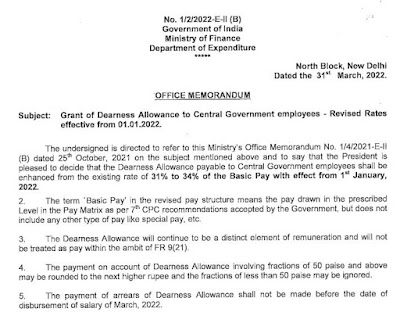
DA Jan 2022 - Grant of Dearness Allowance to Central Government employees - Revised Rates effective from 01.01.2022

 3% DA Hike - Revised Rates effective from 01.01.2022: DoE OM dated 31.03.2022 No. 1/2/2022-E-II (B) Government of India Ministry of Finance...